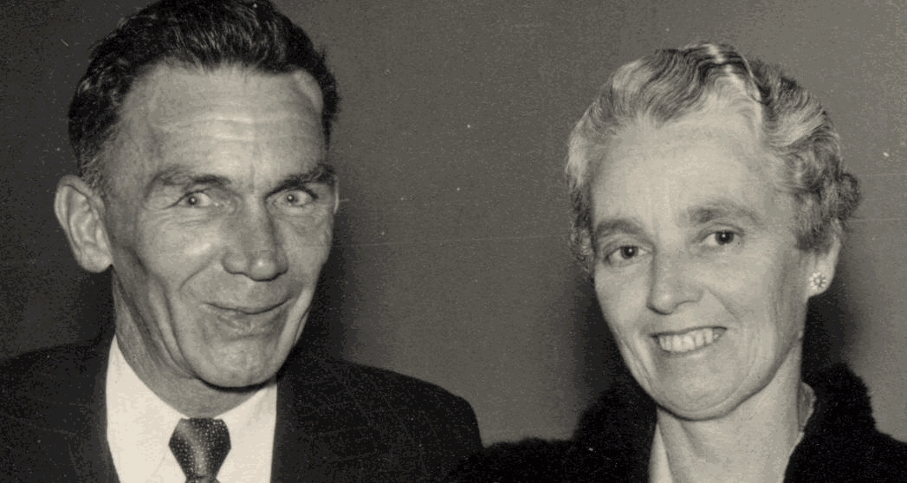
HARRISON, Arthur Louis “Lou” was Jack Harrison’s Uncle
30.3.1900 – 17.5.1967
Arthur Louis Harrison was born in Subiaco to Arthur Dight Harrison and Phoebe Alice Parsons.
From 1907 he corresponded with “The Sunshine League” run by The Daily News along with his brother William and sister Nellie living at the Harrison family home at 256 Perth Street, Subiaco.
Lou is first mentioned on 19 October, 1907 in letter from the Matron at the Home of Peace in Hamersley Road, Subiaco after the children from the Sunshine League made a visit.
In March 1908 Lous was a participant in a Sunshine League concert at the Home of Peace, Subiaco:
Conducted by UNCLE TOM.
My Dear Nieces and Nephews, – I must say at the outset that I was very pleased with the Sunshine Concert at the Home of Peace on Monday evening.
At its conclusion I passed around to each of the patients on the verandah, and they all said they had spent a most pleasant evening, and the beaming smile on their faces was evidence in support of their statement.
I was delighted also to meet so many of my happy and smiling nieces and nephews, and as for the program me, I cannot say more than that I was pleasantly surprised at its splendid quality. The older persons present enjoyed It as much as we did, for no one left till the close, although there was ample opportunity had they felt so disposed. For the benefit of those who were not able to attend – (I estimate that about 400 children were present) – I will give you the programme as it took place: –
Overture, Miss Ella R. Weickhardt; song, Miss Dorothy Kelly; recitation, Miss Diana Lazarus; character song, Master Sam Masai (accompanist Mrs. Brown); recitation, Miss Hilda Jones; pianoforte selection, Miss Cissie Troy; recitation, Miss Tessie Murphay; part song, Master Louis and Miss Nellie Harrison; character song, ‘Gretchen,’ the Misses Gracie M. White, N. Marie Burmaister, and Laura A. Porter; recitation, Miss Verona Rodriques; spectacular dialogue, the Misses Birdie Beckwith, Etta Hollis, Gwen Knox, Hattie Rlnger, Hilda Patterson, Gladys Taylor; and Mabel M. Wright; pianoforte selection, Miss Vera Cantor; song, Miss Margaret Parker; recitation, Miss Alice Rlckard; song, Miss Muriel Francis; part song, Misses Violet Frank, Eunice Thomas, Lizzie M’Narmara, Willa M’Donald, Rita Maddaford, and Vera Maddaford; recitation, Miss Janet Rlckard; pianoforte duet, the Misses Eileen O’Mahoney and Kathleen Dempsey; recitation, Miss Mavis M. Harris; song, Miss Katie Breadsell, recitation, Master Victor D. A. Courtney; chorus, Fremantle Girls. [1]
League Concert At The Home Of Peace Subiaco (1908). In 1908, the children from the Sunshine League performed a concert at the Home of Peace for the Dying and Incurable in Subiaco. Over 400 children attended. The concert was reported in the Daily News newspaper by Uncle Tom, a journalist and coordinator of the Sunshine League. The Sunshine League, the children, events and the adults who worked at the Daily News newspaper have been discussed in earlier posts on this blog. The Sunshine League was established by the Daily News newspaper in 1907 and was coordinated by Uncle Tom. Those children who joined the Sunshine League members were known as nieces and nephews were encouraged to spread kindness where ever they could to orphans, the sick and dying and old people in various institutions. They also helped raise money for the Perth Children’s Hospital and other causes in Perth. In the first year 1908 then annual report stated the Sunshine League held 28 concerts, 2 fancy dress balls, 16 bazaars, 2 afternoon teas and one play, a total of 49 events many of them organised and volunteered by children (and their families) raising hundreds of pounds. The children and their families also made substantial donations of money many of them from Subiaco (Daily News, 30 May, 1908).
On 18th July 1908 Nellie wrote to Uncle Tom about her sick brother Louie...
Uncle Tom. 256 Perth-street, Subiaco. Dear Uncle Tom, The doctor says Louie must go under an operation before long, and mother thinks it may be put off until the Children’s Hospital is open. Good-bye Uncle. – Your loving niece,
NELLIE HARRISON, aged 6.
Dear Nellie, – I am sorry Louie is not well, and that an operation is necessary. If I were your mother I would not put it off if the doctors say it is urgent. Will you give him my kind regards and accept same yourself – Uncle Tom.[2]
22 January 1910
256 Perth-street, Subiaco.
Dear Uncle Tom, — I am going to write you an essay on ‘How I spent my Holidays.’ The first week Willie and I went out fishing, and we caught a good many fish and crabs. I went to the little orphans’ picnic, and was glad to see them enjoy themselves. I went up to Statham’s Siding with Nellie, and came home last Friday. Now Nellie is ill with measles. Good-bye now, dear uncle.— I am, your loving little nephew, LOUIS HARRISON, aged 9.
Dear Louis,— I was sorry to hear of Nellie’s bad fortune in getting the measles. Tell her to avoid draughts and chills, and she will soon be all right again. Your handwriting is improving. If I were you I would write a page in an exercise-book every night, and you would soon be a very good penman.— Uncle Tom.[3]
12 March 1910
MY LETTER BAG
SUNSHINE-MAKING ACCOUNTS and
WELCOME CORRESPONDENCE
FIRST CLASS
256 Perth-street, Subiaco
Dear Auntie Nell, — I am very sorry we are losing “Uncle Tom,” and I am sending you 3d. each from myself and my two brothers. I am not able to write a long letter to-night, for I have the toothache. Good-bye, dear auntie, Your loving niece,
NELLIE HARRISON, aged 8¼
Dear Little Nellie, I thank you so much for your threepence sent in by Louis. It was very good of you all to club together and give the shilling. I do hope, the nasty old toothache is better. It is so painful, Isn’t it? Will you take part in our anniversary celebrations? I want as many as possible to assist. Good-bye, dear. Yours lovingly, Auntie Nell.[4]
12 March 1910
Friend of the Harrison family, Olive Dunn writes: Mrs. Harrison took me with Nellie and Louis to the farewell concert. Reply: Louis came in to see, me yesterday, but, poor little chap, he was suffering from toothache, and was just about to visit the dentist. I felt so sorry for him.
20 July 1910
MY LETTER BAG
256 Perth Street Subiaco
Dear Auntie Nell, it is a long time since I have written to you, but I always read the Children’s Page. I used to write to ‘Uncle Tom,’ and I got three prizes from him. One was for an essay on ‘The Spider,’ and the others were for two letters. I have coloured the Scout and I am enclosing it. I have three brothers; two older than myself and one younger, and I am ten years old and will be eleven next September. I am in the higher fifth at school. I will now close, as it is bed time. Hoping you are well. I remain your loving niece,
NELLIE HARRISON.
Dear Nellie, I do not remember you writing to me before, it was possibly to ‘Uncle Tom’ that you wrote, and I have been so busy that I have not been able to look your letter up. Now that you tell me about the essay on ‘The Spider’ I shall find it and read it. Can’t you get., your brother to join, the League? Do you think you and your brothers could help in a pretty opera if we decide to give it in aid of the Children’s Hospital? With love, dear,
From yours lovingly, Auntie Nell[5]
From 1912 aged 12 Lou was in the Scouts Troop 7 (Subiaco):
1912 SCOUT TROOP NOTES
Troop 7 (Subiaco).— Twenty boys under S.M. Bennett, spent an enjoyable holiday at Crawley. The SM. States that the camp was the best he has held in point of discipline and behaviour. Various competitions were held, the winners being: Throwing lifeline, G Walsh; long-distance swim, H Downey; long dive, E. Ritchie; making camp lamp, fork, tooth-brush, etc, L Harrison; camp fire competition between patrols, L. Harrisons tent. It is pleasing to note that several members of the Subiaco Fire Brigade are affording the troop great assistance at present.[6]
1914 SCOUT TROOP REPORT
No. 7 (Subiaco)
A few boys camped at Blackboy Hill from Saturday till Sunday last, when a most enjoyable and instructive time was spent. Sergt. Major Shepherd, of the Engineers (who worked by Sir Robert Baden-Powell in South Africa), took great interest in the boys, and was kind enough to give them a lecture on methods of defence, explaining to them the details regarding the entrenchments that have been constructed by the troops in camp, and the utility of -barbed-wire entanglements as a means of obstruction to an invading force. He also showed them how and where mines were laid, and explained the nature of the explosives. The boys proved to be excellent listeners, and the sergeant-major’s kindness was much appreciated. The
artillery lines were also visited, and Lieut. Leschen very kindly explained and demonstrated, the mechanism of the 18-pounder guns. The Scouts took full advantage of the opportunity to ask questions, to all of which Lieut. Leschen gave explicit replies, so that the boys absorbed a large amount of useful information. On Thursday last Scouts Sharp and Priestly were passed by Mr. Instructor Haigh for the ambulance badge. Leaders Medlin, Standley, and Harrison were re-examined and well proved their title to the badge.[7]
Lou attended Perth Technical School in 1915:
W.A. TECHNICAL SCHOOL RESULTS
30th December 1915
Freehand Drawing, Book Keeping, Business Methods – L. Harrison. [8]
On 21st January 1916, 16 year old Arthur Louis Harrison passed his medical examination to work with the W.A. Railways as an apprentice car and wagon builder in the locomotive department based in Midland. William Walter Kerr (42) was a carriage painter at the Midland workshops at this time. Prior to 1904 the WAGR workshops were located at Fremantle. In January 1904 the staff moved to the new Midland Junction Workshops. As most employees lived near Fremantle, the WAGR provided a morning and afternoon train which took employees from the western suburbs to Midland Junction. This train used old carriages and soon became known as ‘The Rattler’. Lou Harrison would have caught this train at Subiaco. Right up to the closure of the workshops in 1993 this train continued as a diesel railcar and was still known as ‘The Rattler’. He was appointed permanently on 1st February 1917.
12 January 1918
SCOUT No, 7 TROOP, SUBIACO.
‘Glencoe’ has much pleasure, to including in Scout Notes a portion of Scoutmaster A. E. Bennett’s report for the year 1917; the concluding portion: will appear in next Saturday’s issue: ‘The: annual report for 1917 is presented under very happy conditions. The troop after many ups and downs in its eight year’s history, now occupies the position of leading Troop in Western Australia. This is a source of great satisfaction to the members of the committee, who have at all times devoted themselves whole-heartedly to further the interests of the Troop.
Membership.— The number of Scouts at present on the roll total 35, made up of four Patrols. These are all active members, and attend regularly to their Scout work. In connection with membership, it is interesting to note’ that Leader A. L. Harrison, who has just resigned, after seven years’ service, introduced his younger brother to take his place; Leader Harrison’s elder brother was also a member of the Troop, and is now in Egypt with the 10th Light Horse Brigade. We hope this practice will obtain more generally in the future. In the Cubs’ section, we have- 25 members, who are in all respects a junior, troop, and are well managed toy their Juvenile leaders. The wisdom of having a Cub section will be apparent in the New Year, when seven Cubs come up to the Scouts.
Efficiency. — Taking the Troop as a whole, we are well grounded in Scout work. In some sections, such as bridge building, we have a large number who can show good results. Now that we have special facilities at our ranch at Waliston, we should be able to show an all-round improvement in bushcraft, and thereby approaching more nearly the ideal of the Chief Scout, who says that the Scout should ‘be a Backwoodsman, and not, as many still think, a kind of toy soldier.’ Another pleasing feature of the Troop’s work- is the ambulance section; we have 25 at the present time who hold the badge. Several were examined at the Christmas camp, so that practically all our members have qualified. We have to thank Mrs. Harrison for her consistent work in this section, extending over several years. Another section I hope to see develop next year, is gardening-. Our exhibit at the recent exhibition did not represent the amount of work put in; most of the vegetables were either too late or too early. I think this is a useful hobby to introduce to the boys, and hope we shall be able to assist them more in the future. The very important branches of Scout training – swimming and life-saving— seems to have been crowded out during the last few months by the call on the boys’ time and energies in the form of services at patriotic efforts, garden parties, etc. We hope to overtake this work in the coming months. With reference to a number of badges, such as laundryman, naturalist, cook, and others we want a higher standard, in order to make them of any real value.
Musical and Social. — Under the above heading, we can take a strong lead among Scout Troops. This, of course, is not to be wondered at when we know the amount of work that is performed by Mr. and Mrs. A. J. Foote and family. The Minstrel Troupe, formed during the winter months, proved highly successful, and, apart from the pleasure given, was the means of raising about £30, and of gaining many friends for the Troop. A first-class orchestra assisted the boys at their various appearances. It would seem we have an unlimited number of good musicians, who are always willing to help. In connection with future efforts in entertainment,
Mr. Fooet and I have agreed that the boys, must qualify in Scout work before being selected for entertaining. Turning to the social side of our work, we have’ to thank Professor Tattersall for his close interest in this connection. During the winter months he entertained to tea 30 boys, in parties of 15 who afterwards spent a very happy evening in music, song and story at his residence, and I feel sure these efforts will bear fruit in the future. Mr. Tattersall’s work in the study of biology has been invaluable.[9]
22 June 1918
SCOUT TROOP REPORTS
No. 7 (Subiaco)’.— The usual monthly church parade was held on Sunday last, when the Chaplain, the Rev. John Enrright, delivered a very interesting address on Daniel Webster, the great American, after which several new members were sworn in. At the conclusion of the service, Mr. W. Christie; president, handed to two ex-members; A. Harrison, 6 years’ service, and V. Smith, 3 years’ service, Scout certificate’s, remarking that neither of the recipients had a single unscoutlike action against his name, and that both had rendered the Troop very valuable assistance.[10]
A.I.F.
Aged 18, Arthur “Lou” Harrison tried to enlisted in the A.I.F. on 19th August 1918 but was rejected due to “recurrent discharge from both ears” confirmed by the Commissioner of Railways. He was an Apprentice Car and Wagon builder at the time and had both Phoebe and Arthur sign his enlistment form approving his application.
13 June 1919
SENIOR CADETS
W.A.FOOTBALL ASSOCIATION
Tomorrow’s fixtures:
SENIOR CADETS
Subiaco v. Cottesloe,
at Cottesloe Beach. — Subiaco will be represented by the following players:— Betteridge (c), Boddy, Binny, Crockett, Cowan, Exley, Green, Graham, Harrison, Judge, Monnock, Mills, McLachlan, Prior, Spencer, L. Sharples (v.c), Smith, Towers; emergencies, Elfverson, Kildahl, Barker, Spencer.
Players to be on the Subiaco station at 1.45 p.m. sharp.[11]
22 November 1919
BOY SCOUTS TROOP NOTES
No. 7, Subiaco
At the Troop’s annual meeting… At the recent first aid railwaymen’s annual competitions held in Perth, in the single-handed tests, Midland Junction Workshops, gold medals were awarded to A. L. Harrison and G. Pyett, both ex-members of No. 7. … Both these brother Scouts received their initial training in first aid and ambulance while members of No. 7, and it is very satisfactory to note that they have increased their knowledge, and are maintaining the reputation of the Troop, though no longer actively engaged in its ranks.[12]
On 30th November 1921 Lou Harrison was retrenched by the W.A. Railways after having worked there since apprenticed as a car builder from 1st February 1916. World War 1 was a very difficult time for the WAGR, with significant decline in rail traffic, shortage of men and lack of materials. This was made worse by a severe post-war recession. The new Commissioner of Railways, Colonel Pope, had no alternative but to defer spending and cutting costs to lower the annual WAGR deficit. This meant laying off staff as well.
It was shortly after his retrenchment that Lou Harrison went to Melbourne.
In July 1922 William Harrison visited the Eastern states. Brother Lou Harrison was living at 55 Osborne St, South Yarra, working as a carpenter. His Uncle Walter Charles Parsons was a lather living at 4 Caroline St, South Yarra at the time and William had corresponded with his daughter Edna during WWI.
Subiaco Skits
Murmurs from the Model Suburb
Will Harrison, of Perth-Street, is over East enjoying a well-earned recreation. Will will (no pun) be back in a month to ogle the girls and tickle the ivories.[13]
Phoebe’s brother Walter Parsons was Vice President of the Ascot Vale Catholic Young Men’s Society which coordinated social activities, a cricket and a football team.
1920
ASCOT VALE.—The weekly meeting of the Ascot Vale C.Y.M.S. was held on
Monday evening, May 3rd. Bro. W. Parson’s, vice-president, presided over a fair gathering of members…Mr, T Whelan reported defeat of football team by North Fitzroy by four points. Reports re ‘Boys’ Football Association and recent social were received. Members of football team were urged to attend training. Rev. Fr. Bakker kindly consented to give members a lecture on “Spiritualism” on Monday night, May 5th. He asked members to support the queen carnival; also school committee In reference to the local school fund. More cooperation was asked for from these members, and it was decided that football matters be
discussed at general meetings under the heading of general business, both committees to meet Sunday mornings to discuss same. Mr. W. Parsons, as an executive officer, spoke, re matters connected with society in general, and urged members to take active interest in coming sports, collecting, and to attend annual smoke night.
Lou Harrison played football in Melbourne, apparently playing with the Fitzroy Football Club.
Lou’s relatives in Melbourne 1922:
- Walter Charles Parsons – lather (4 Caroline St, South Yarra)
- Grandmother Mary Frances Harrison (nee Dight) was 85 (8 Brook St, Hawthorn) living with her daughters Frances and Minnie May.
- Cousin Bert Parsons who he had caught up with during the WWI (blacksmith living in Dandenong)
- Aunt Eliza Georgina Saunders (nee Harrison) – Brighton (husband Francis moved to Perth when she died)
After returning to Perth in 1922, William Harrison started buying land on which his father Arthur and brother Lou built houses, as they did on various blocks of land owned by the Harrisons in Kalaumda. By 1932 William had bought and sold some 25 properties, including lots in Cottesloe.
Lou returned to Perth in 1925 and lived with his family at 256 Perth Street Subiaco and later in Merriwa Street, Nedlands.
15 December 1923
YACHT Vera, 22ft., in splendid order, all gear complete.
L. Harrison, 256 Perth St, Subiaco. [14]
On February 13th 1926 Arthur “Lou” was married to Vera May Fryer and Charlie Harrison was best man:
HARRISON-FRYER
A pretty wedding was recently solemnised at St. Andrew’s Church. Subiaco, by the Rev. Greatorex, when Vera, only daughter of Mr. and Mrs. W. Fryer, of Jolimont, was married to Arthur Louis, second son of Mr. and Mrs. Arthur Harrison, of Nedlands. The bride, who entered the church on the arm of her father, looked charming in a frock French georgette over silk with briar embroidery, and pleating. Her veil was held in place by a coronet of orange blossom, whilst her train of ivory georgette, lined with shell pink and trimmed with ribbon and ideated flounces, was caught at the shoulders with sprays of orange blossom. The two trainbearers were little Miss Joan Murrie in dainty pink crepe de chine, with lace frills and. peaked cap of silver tissue, and Master Freddie Fryer (nephew of the bride) in a pink silk suit. The bride’s toilet was completed by a beautiful shower bouquet of white roses and fern. The bride was attended by two bridesmaids. Miss Vera Loggan and Miss Eileen Moffatt, the former wearing apricot georgette over silk : appliqued in pastel shades, and the latter wearing mauve brocaded georgette over silk. Both bridesmaids wore striking head dresses of Kilver tissue and carried bouquets of roses to harmonise with their frocks. The bridegroom was supported by his brother, Mr. Charlie Harrison as best man. and Mr. William Fryer (brother of the bride) as groomsman. After the ceremony a reception was held at Wembley Hall, Mrs. Fryer receiving the guests in a smart frock of Wedgwood blue morocain trimmed with coffee coloured lace and black hat with gold ospreys. Mrs. Harrison (mother of the bridegroom) was gracefully attired in black morocain enriched with crystal beads and hat en suite. After congratulations had been expressed to the bride and bridegroom a happy time was spent at the wedding breakfast. The usual toasts were honoured after which music and dancing was thoroughly enjoyed. Mr. and Mrs. Harrison left for their honeymoon at Busselton, the bride travelling in n. frock of cinnamon morocain richly embroidered and hat to match. Many beautiful presents, including cheques, were received.
In 1926, the freshly married Lou Harrison returned to building houses with his father, Arthur, and is mentioned applying successfully for a tender:
25 September 1926
REAL ESTATE MATTERS
A fine type of bungalow residence of eight rooms, for which Mr. L. A. Harrison’s tender of £3,698 has been accepted, is about to be built in Lawley-crescent, Mount Lawley, for Mr. R.S. Lynn. Designed by E. Summerhayes and Son, with a touch of Spanish style, suited to Western Australian conditions, it will take a prominent place among the best homes of Mount Lawley.[15]
[now demolished: Historical information
Date obtained from Sunday Times, p10 June 1927.The house was located at 52 Lawley Crescent, Mt Lawley. Lynne sold the house in 1935 (West Australian, 12 October 1935, p.6). The house was demolished at some point and a group of townhouses now stand on the site. https://collectionswa.net.au/items/66763185-3de3-40ac-acbf-ab5a146c9526]
Late 1920s Influence of Spanish Mission, popularised by Hollywood, as a building style. Popularity of Mediterranean styles reinforced by the winning design for the new University of WA’s Hackett Memorial Buildings (1929-1932), on the Crawley campus. Variations would appear during the 1930s for buildings such as the Captain Stirling Hotel on Stirling Highway, Nedlands, and domestic homes by architect Marshall Clifton. https://www.neilcowniearchitect.com.au/fieldnotes/nedlands
The building permit for 112 Derby Road, Shenton Park (originally referred to as #110) was issued in April 1927
According to historical archives compiled by the Heritage Council of WA Places Database, the building application notice read as follows:
- Date Issued: April 1927
- Authority: Subiaco Council
- Applicant/Builder: Arthur Louis Harrison (a local carpenter)
- Project Details: Construction of a 4-roomed brick residence
- Estimated Value: £400
On 15th June 1927, Lou Harrison and Vera had their first child
Valma June:
HARRISON (nee Vera Fryer)
On June 15, at Nurse Reid’s Private Hospital, Coolgardie-street, Subiaco, to Mr. and Mrs. A. L. Harrison, of 8 Bronte-street, Daglish daughter (Valma June). Both well.
In May 1928, Lou Harrison is noted as working at Wests Picture Palace was located at 440 Hay Street, Subiaco and was constructed in 1912.
7 April 1928
WEST’S THEATRE, SUBIACO
West’s Theatre, Subiaco, has during the past four months, been remodelled and modernised. This work has been carried out by Mr. L. A. Harrison, contractor, according to plans prepared by Mr. R. Rosenthal, A.R.I.A., architect. The building, it is said, now embodies every comfort, and convenience of modern theatre construction, including an attractive, decorative lighting system.
The reformed theatre will be officially opened by the Mayor of Subiaco (Mr. G. Roydhouse) tonight, and an attractive programme, prepared for the occasion, will include “The Jazz Girl” and “Young April” with a vaudeville act by “Athlone” and a number of supporting attractions. There will be a complete change of programme on Monday night. Seats may be booked by ‘phone (A1557).[16]
Whilst employed at the Electoral and Titles Office (the Treasury buildings and Titles Office buildings bounded by Barrack St, St Georges Terrace and Cathedral Avenue) William Harrison bought blocks of land in Inglewood and Subiaco (40 acres) for about 10 shillings a block/acre. His brother Lou and father Arthur built houses on these blocks to sell.
One of these houses, 112 Derby Road, Subiaco (now Shenton Park) became the home of Vera and Lou Harrison.
16 August 1928
Real Estate Matters
BIG SUBIACO FIGURES
£13,061 In Three Weeks
The Subiaco building surveyor (Mr. T. C. Taylor) reports exceptionally high figures for the past three weeks ended August 10. In all 27 permits were issued to a total value of £13,061. Of this number eleven are for brick houses, ranging in value from £692 to £1500. The latter is a seven-roomed house in Cooper-street for Mr. S. Moore. A five roomed brick dwelling in Derby-road is costing
Mr. A. Harrison £850, and another in Hampden-road for Mr. S. Moore is expected to cost £800. Mr. Moore is also erecting a brick house in Hardy-road at a cost of £780. ‘Two four-roomed houses in Bagot-road and Denis-street will cost £800 and £770 respectively. Dudley and Dwyer are erecting four weatherboard houses in Yilgarn-street at a cost of £2000, while one in. Herbert-street for Mr. A. Anderson will cost £500.[17]
29 September 1928
BRICKLAYER wanted, to lay cement bricks.
Harrison, Hardy-st, Hollywood. [18]
26 October 1929
SITUATIONS VACANT
PLASTERER’S Labourer wanted.
Apply Harrison’s job, Leura-St., off Park-road, Hollywood, Nedlands. [19]
On 26th November 1932 Lou and Vera Harrison had their second child, daughter Judith Helen.
24 August 1935
A NEDLANDS RESIDENCE
Inspection Today and Tomorrow of the Spanish-Californian type of design and consisting of a hall, lounge, dining room, two bedrooms, kitchen, pantry, bathroom, laundry, workshop and garage on the ground floor, and study, two bedrooms and sleep-out on the second floor, a gentleman’s residence, built by Messrs. A. Harrison and Son at 24 Highway, Nedlands, will be open for inspection from 2 o’clock until 6 o’clock today and tomorrow. Features of the interior are texture walls and plate rails, and wrought iron balustrading. The conveniences include gas heater, gas stove and gas copper and sewerage. From the sleepout a fine view of the river is obtained.[20]
25 April 1936
In Real Estate News, Arthur Harrison applied to make brick additions to 112 Derby Road, Subiaco (now Shenton Park) the home of his son Arthur “Lou” and Vera Harrison and their daughters Valma and Judith. [21]
Around 1936, Lou was conscripted to the Civil Construction Corps and sent to Rottnest to build Gun Emplacements. He helped construct the massive concrete bunkers for two 9.2-inch guns at Oliver Hill and two 6-inch guns at Bickley Battery, which were built to protect the Port of Fremantle.
Being “manpowered” meant your relative was an essential civilian worker redirected by the government under Manpower Regulations to perform vital wartime construction, rather than fighting overseas. Between 1936 and 1938, these workers transformed Rottnest (Wadjemup) into the heavily fortified “Fremantle Fortress”. Men drafted for this strenuous labour came from across Western Australia, living in strictly controlled military camps while enduring the secrecy and isolation of island life. Given his trade as a carpenter, the government’s Manpower Directorate would have viewed him as a highly valuable asset for defence infrastructure. His specific skills were critically needed for building the timber framework (formwork) used to pour massive concrete gun emplacements, erecting wooden sheds, and constructing military barracks.
- Oliver Hill (9.2-inch Guns): Work on these massive concrete structures commenced in March 1936 and was completed in December 1937. The guns themselves arrived on the island in 1937 and were officially mounted and proof-fired on November 21, 1938.
- Bickley Battery (6-inch Guns): The construction of these emplacements took place shortly after, spanning from September 1937 to April 1938. The infrastructure here was built by civilian contractors (Todd Brothers of Leederville) and became operational alongside Oliver Hill by the end of 1938.
As a carpenter, his primary role during these exact months would have been constructing the complex timber formwork (the temporary wooden molds) required to hold and shape the thousands of tons of concrete poured to create the deep underground plotting rooms, tunnels, and massive artillery rings you can still see on the island today.
Uncle Lou Harrison’s shacks at Kalamunda were much enjoyed holiday and picnic spots for all the Harrison families. Lou smoked a pipe and was a keen gardener.
Lou died in 1967 aged 67 whilst filling his car up with petrol in Subiaco – he had complained the day before of having indigestion and not feeling the best. He was described as a man with integrity and strength.
KARRAKATTA CEMETERY CREMATORIUM ROSE GARDENS
GARDEN 8; POSITION 26.
HARRISON (A.L.) On May 17 1967, suddenly, Arthur Louis of 112 Derby-road Subiaco, beloved husband of Vera, loved father of Walma (Mrs S.T. Smith) and Judith (Mrs J.G. Wager), father-in-law of Tom and John,
and loved pop of Kerry, Kim, Susan, Peter and Julie; aged 67 years.
Peacefully sleeping.
HARRISON (A.L.): In loving memory of my beloved husband, Lou.
Only the casket lied under the sod. For the jewel is in the hands of God.
HARRISON (Arthur Louis): A tribute to the memory of a great Dad. One of Nature’s gentlemen and a cheerful worker at rest. Val and Tom Smith.
HARRISON (Arthur Louis): Dearly loved grandfather of Kerry and Kim Smith. Cherished memories of a wonderful pop.
HARRISON (A.L.): In loving memory of a fine man. A wonderful father to Judith, firm friend and father-in-law to John and loving pop to Susan, Peter and Julie. We will all miss you, pop.
HARRISON (Arthur Louis):On May 17, loving brother and brother-in-law of Bill and Edna, fond uncle of Bill, Ramon, Jack and Jill. At rest.
HARRISON (Arthur Louis): On May 17, loved brother and brother-in-law of Charlie and Emmie of Harevy, loved uncle of Lindsay and Carol; deepest sympathy to Vera, Valma and Judith.
HARRISON (Lou): Suddenly, dear brother and brother-in-law of Nell and Ted McDavitt, uncle of Betty (Mrs Don Arcus), John, Ted and Ron. Treasured memories.
HARRISON (A.L.): Cherished memories of Lou, loved brother-in-law of Bill and Vida, fond uncle of Jeanette, Rob and Rase; sincerest sympathy to Vera, Valma and Judith.
HARRISON (A.L.): Suddenly on May 17, fond brother-in-law of Dot and Harry Fryer. Sadly missed.
HARRISON (A.L.): In memory of Uncle Lou; sympathy to Vera and family. Lila and Ron McDavitt.
HARRISON (A.L.): A tribute to a wonderful friend and companion; deepest sympathy to gran and family. Goodbye, pop. Julie, Keith, Barrie and Jeanette.
HARRISON (A.L.): A tribute in memory of a fine gentleman and good friend. Laurie and Elsie Wager.
HARRISON (A.L.): Sincere tribute to a dear friend; deepest sympathy to his loved ones. C.S. Smith and family.
HARRISON (A.L.): A very dear friend of Rita, Alan and family.
Vera Harrison died 18th December 1993 aged 88 after being a widow for 26 years.
[1] Daily News, 14 March 1908
[2] Daily News 18 July 1908
[3] Daily News Saturday 22 January 1910 page 10
[4] The Daily News Saturday 12 March 1910 page 11
[5] The Daily News Saturday 20 July 1910 page 2
[6] The Daily News Saturday 20th April 1912 page 11
[7] The Daily News Saturday 26 September 1914 page 8
[8] West Australian (Perth, WA : 1879 – 1954), Thursday 30 December 1915, page 9
[9] The Daily News Saturday 12 January 1918 page 8
[10] The Daily News Saturday 22 June 1918 page 7
[11] The Daily News Friday 13 June 1919 page 2
[12] The Daily News Saturday 22 November 1919 page 5
[13] Mirror Saturday 29 July 1922 page 3
[14] The West Australia Saturday 15 December 1923 page 19
[15] The West Australian Saturday 25 September 1926 page 8
[16] The West Australian Saturday 7 April 1928 page 7
[17] The Daily News Thursday 16 August 1928 page 2
[18] The West Australian Saturday 29 September 1928 page 23
[19] The West Australian Saturday 26 October 1929 page 26
[20] The West Australian Saturday 24 August 1935 page 4
[21] The West Australian Saturday 25 April 1936 page 6