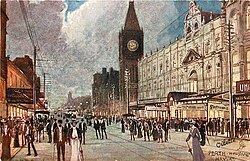
The Perth Town Hall, situated on the corner of Hay and Barrack streets in Perth, Western Australia, is the only town hall built by convicts in Australia. Upon completion it was the tallest structure in Perth.
Designed by Richard Roach Jewell and James Manning in the Victorian Free Gothic style, the hall was built by convicts and free men between 1867 and 1870. The exterior brickwork was laid in Flemish bond, and bricks were made from clay sourced from East Perth. Its decorations contain a number of convict motifs, including windows in the shape of the broad arrow, and decorations in the shape of a hangman’s rope.

The foundation stone for Perth Town Hall was laid on 24 May 1867 by Governor Hampton in a ceremony involving a lot of pomp and parade. However, there were torrential downpours. The ceremony went on anyway with an official procession from Government House and a mock battle performed by the Volunteer Regiments, Enrolled Forces of Pensioners, and the WA Country Regiment.
In the 1929 centenary of Western Australia one of the events in the city of Perth was the placing of a commemorative plaque in the northwest corner of the building by the Governor William Campion.
For many decades in the 20th century, shops were built into the sides of the ground floor, and the public lavatories accessible from Barrack Street were the only ones available for some distance. The shops included a pharmacy, bank, lunch bar and other shops. All these businesses and the attendant structures were removed prior to the renovation of the hall.
At the time of its centenary in 1970, the ground floor was still full of commercial businesses.
The Town Hall was restored in the late 1990s at the base in an award-winning restoration to repair the interior of the hall and the gothic arches at its base, which were “modernised” in the middle of the 20th century.
https://en.wikipedia.org/wiki/Perth_Town_Hall
Perth Town Hall is a longitudinal-shaped building built in Flemish bond brickwork with gabled roof and towers containing staircases in each of its four corners. The site of the Town Hall was known as Koorari and was an important meeting place for Whadjuk Nyoongar people. The Town Hall site was selected in 1867 and the hall was completed in 1870. The building is of aesthetic significance as a fine example of Victorian Free Gothic architecture. The building is a rare Australian example of a nineteenth century town hall, built by conflict labour, modelled on fourteenth century European market towns. The focus of civic and social activities since 1870, the place is a prominent Perth landmark. The building is closely associated with the State’s history of penal transportation.
https://collectionswa.net.au/items/a81c4577-8f8e-4a51-adf5-d36263285e9