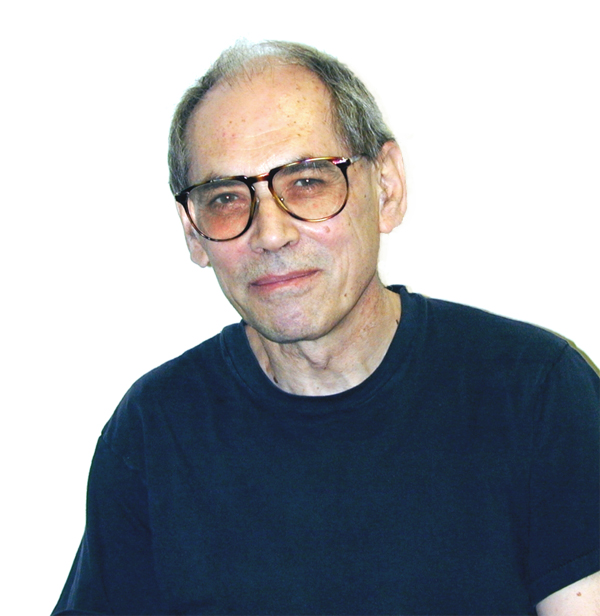
A prominent and versatile figure in contemporary music, Roger Smalley AM was born near Manchester, England in 1943. He studied piano with Antony Hopkins and composition with Peter Racine Fricker and John White at the Royal College of Music, London. He also took private composition lessons with Alexander Goehr and furthered his studies with Karlheinz Stockhausen on the Cologne Course for New Music.
Roger Smalley’s compositions have been performed and broadcast world-wide. He has been commissioned by many prestigious organisations and groups, including the BBC, ABC, West German Radio, Festival of Perth, London Sinfonietta, Australian Chamber Orchestra, Fires of London, Flederman, Nova Ensemble, Seymour Group and Australia Ensemble. His works feature on more than 20 commercially released CDs.
As a young composer, he was awarded the Royal Philharmonic Society Prize for his orchestral work Gloria Tibi Trinitas. His Piano Concerto, a BBC commission for European Music Year (1985), was the recommended work in the annual UNESCO Rostrum of Composers in 1987. This was the first time the Australian Broadcasting Corporation’s entry made it to the top of the list. In 2007, Smalley’s orchestral piece Birthday Tango (recently retitled Footwork) received the Australian Classical Music Award in the category ‘Best composition by an Australian composer’.
As a pianist, Roger Smalley was widely recognised for his performances of contemporary music. Early in his career, he was a prize-winner in the Gaudeamus competition for interpreters of contemporary music (1966), and received the Harriet Cohen award for contemporary music performance in 1968. In 1969, together with Tim Souster, he formed Intermodulation, an ensemble specialising in works involving improvisation and live electronics, which performed throughout England and Europe until 1976.
As a performer, Roger Smalley mastered a wide variety of solo and chamber music – he also appeared as a conductor. In 1989, he became the first Artistic Director and conductor of the West Australian Symphony Orchestra’s 20th Century Ensemble, continuing until 2000. His recordings as pianist and conductor have been released, among others, on the ABC Classics and Tall Poppies labels.
Smalley’s academic career was closely tied to his activities as a composer and performer. In 1968, he was appointed the first Artist-in-Residence at King’s College, Cambridge, where he subsequently held a three-year research fellowship. He came to Australia initially for a three-month composer residency at the University of Western Australia in 1974. He returned two years later to become a research fellow and subsequently Associate Professor of Music. In 1996, he was appointed a professiorial Research Fellow at the UWA. He was Emeritus Professor and Honorary Senior Research Fellow at The University of Western Australia and Honorary Research Associate at the Sydney Conservatorium of Music.
In 1991 he was the recipient of a Creative Development Award from the West Australian Department for the Arts, and was elected a Fellow of the Australian Academy of the Humanities. In 1994 he was awarded the Australia Council’s prestigious Don Banks Fellowship ‘in recognition of his distinguished contribution to Australian music’. He received the Australian Government Centenary Medal in 2001 and was proclaimed a Western Australian Living Treasure in 2004. In 2011, Smalley was appointed a Member of the Order of Australia (AM).
In 2015, Roger Smalley moved from Perth to Sydney where he lived until his death on 18 August 2015.
1977
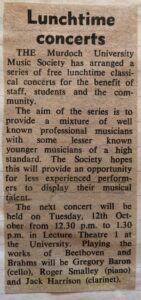
Lunchtime Concerts
Tuesday October 12th 1977
The Murdoch University Music Society has arranged a series of free lunchtime classical concerts for the benefit of the staff, students and the community. The aim of the series is to provide a mixture of well known professional musicians with some lesser known younger musicians of a high standard. The Society hopes this will provide an opportunity for less experienced performers to display their musical talent. The next concert will be held on Tuesday 12th October from 12.30pm to 1.30pm in Lecture Theatre 1 at the University. Playing the works of Beethoven and Brahms will be Gregory Baron (cello), Roger Smalley (piano) and Jack Harrison (clarinet).
1981
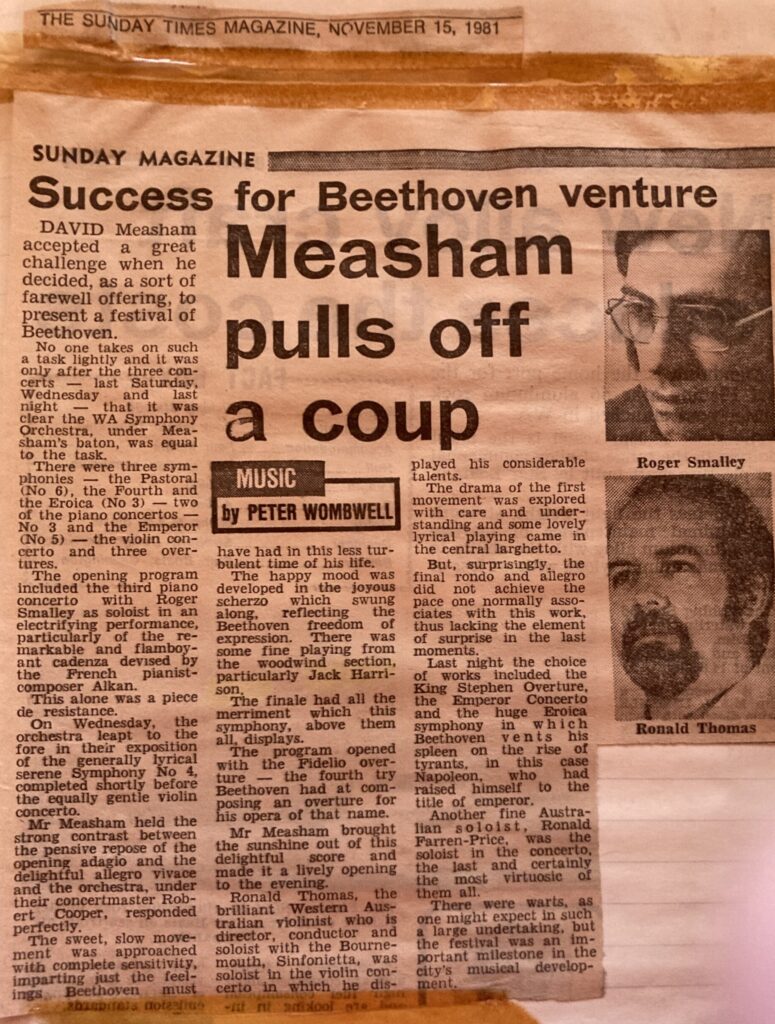
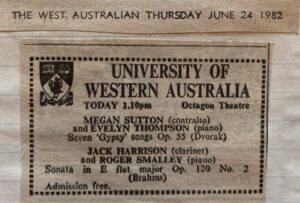
University of Western Australia
1.10pm Thursday June 24th 1982
Megan Sutton (contralto)
Roger Smalley (piano)
Jack Harrison (clarinet)
Sonata in E flat major Op. 120 No. 2 (Brahms)
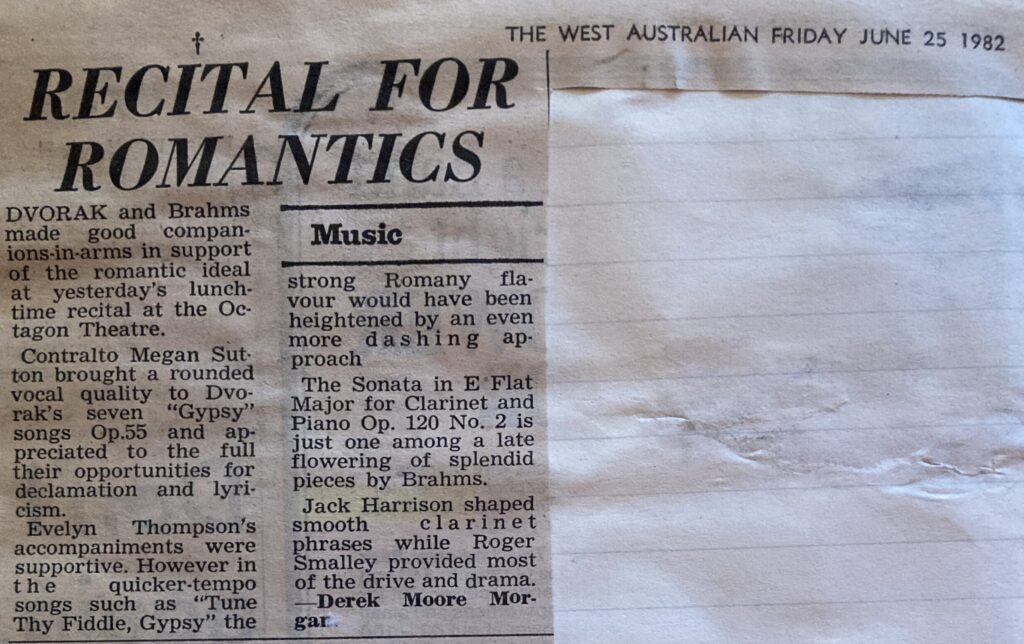
1983
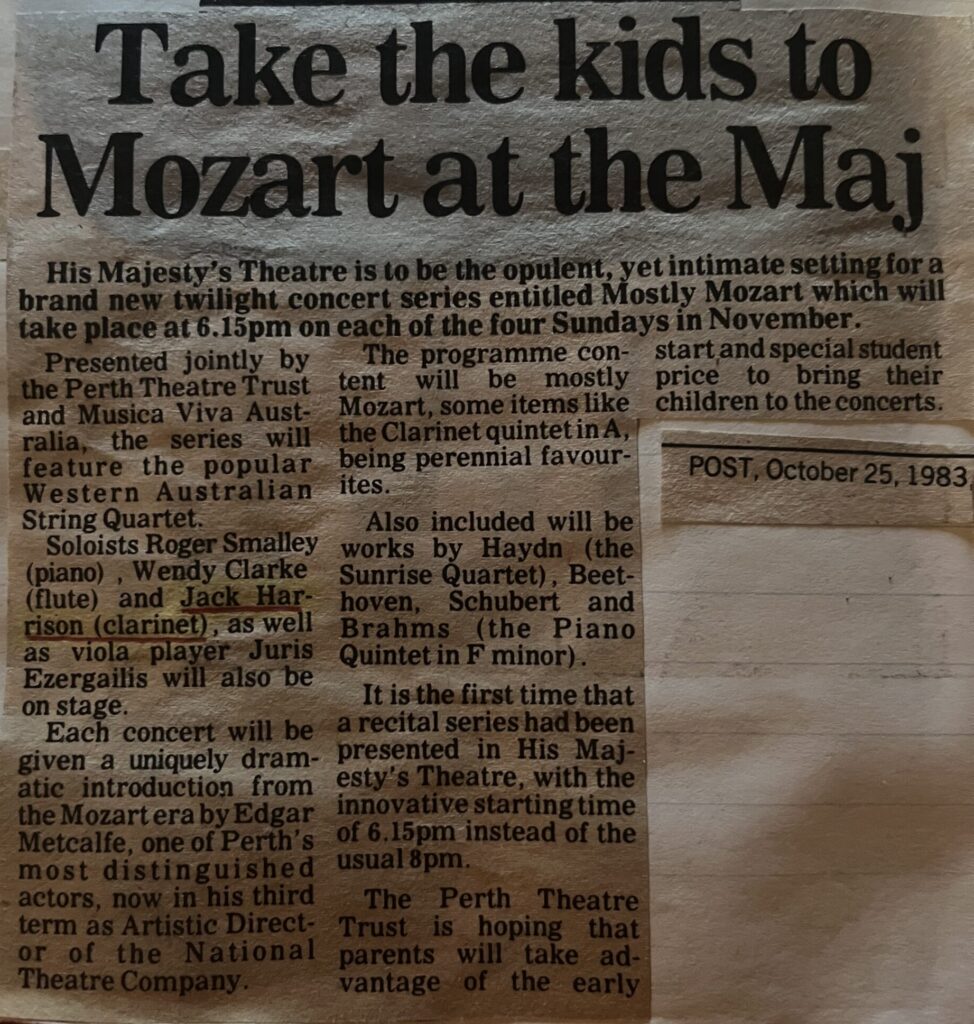
https://www.australianmusiccentre.com.au/artist/smalley-roger
https://en.wikipedia.org/wiki/Roger_Smalley
OBITUARIES
Roger Smalley obituary
Composer and pianist who went from Britain to Australia, where he was active in musical life for four decades
Wed 2 Sep 2015 01.55 AEST
The British-born composer Roger Smalley, who has died aged 72, was not only one of the most distinctive composers of the post-second world war generation; he was also active as a pianist, teacher and concert organiser. Following a composer residency at the University of Western Australia in Perth, he took up a permanent post there, and went on to be a significant force in Australian musical life for four decades.
Roger Smalley left Britain for Australia, and became a significant force in musical life there for four decades. Photograph: www.rogersmalley.com
His first published works – the Variations for Strings (1964), Piano Pieces I-V (1965) and String Sextet (1965) – pointed to his interest in new and experimental music. But they also showed an incipient interest in Renaissance music that came to the fore in a series of works based on keyboard pieces by the 16th-century organist and composer William Blitheman. Two works called Gloria Tibi Trinitas (one for orchestra, 1965, the other, which won a Royal Philharmonic Society prize, for soloists, chorus and orchestra, 1966) were followed by his Missa Brevis (1967) and two works called Missa Parodia (one for piano, the other for piano and ensemble, both 1967).
Smalley nonetheless retained an individual voice, and was critical of what he considered to be the over-prescriptive approach of Pierre Boulez. In 1965-66 he studied with Karlheinz Stockhausen in Cologne. The music that Smalley wrote for Intermodulation – the live-electronics ensemble he co-founded with Tim Souster, Peter Britton and Robin Thompson – reflects a degree of influence by Stockhausen, but is less mystical in character.
Accord (1975), for two pianos, first performed by the composer with Stephen Savage, was the work he regarded as his “real” Op 1. It is both brilliantly structured and powerfully communicative. A recording by the pianists Daniel Herscovitch and Erzsébet Marosszéky was released earlier this year on the Continuum label.
Like a number of other works, Accord was inspired by the view from a high point of Perth and its environs. Australia made a great impact on him during his visit there in 1974, and he returned to make it his home for the rest of his life, moving to Sydney in 2007. Works created in his adopted country included Didgeridoo (1974), for four-track tape, and, for orchestra, Diptych (Homage to Brian Blanchflower, 1991), based on some of the Perth-based dedicatee’s artworks, and Close to the Edge (1995), inspired by the miniatures of another Western Australian artist, Lesley Duxbury.
The Scherzo from Roger Smalley’s Piano Trio
However, Smalley never simply nurtured a confined territory of his own: he remained open to ideas in music of all periods, as in a series of works based wholly or partly on the mazurkas of Chopin, notably his Variations on a Theme of Chopin (1989), Piano Trio (1991) and Poles Apart, for a mixed quintet of wind and strings (1992). All three can be found on a recording on the NMC label, Poles Apart and Other Chamber Works (2004).
Of his larger-scale works, his Symphony was premiered at the BBC Proms in 1982, and he was the soloist in his Concerto for Piano and Orchestra when it was commissioned by the BBC for European Music Year 1985; the two were coupled on a CD for Vox Australis (1987). The Cello Concerto was first performed in Perth in 1997 by Raphael Wallfisch, to whom it was dedicated, and is included in a recording titled Kaleidoscopes, on ABC Classics (2003).
An excerpt from Roger Smalley’s Pulses, 1969, revised 1986
A native of Swinton, near Manchester, Roger was the son of Lionel Smalley, a secondary school headteacher, and his wife, Dorothy, the school secretary. Roger took to playing the piano as if performing at the Royal Albert Hall, so his father made a key for the existing piano lock to restrict his access to the instrument in the hope that the boy would do some homework. From Leigh grammar school, he won a scholarship to the Royal College of Music, London, to study the piano with Anthony Hopkins and composition with Peter Racine Fricker, John White – a CD of whose piano sonatas he recorded for NMC (1997) – and, privately, with Alexander Goehr.
I first met Smalley when he was at the RCM, and, impressed by his brilliance as a pianist, later invited him to give a recital at Kingston Polytechnic, south London, where I was music director. We were both on the committee of the Macnaghten Concerts, promoting contemporary music, and had great fun trying to bring up to date what was by then a rather conservative organisation, on one occasion attracting a large audience to the Queen Elizabeth Hall in London for a programme featuring both Intermodulation and rag music by Scott Joplin.
Roger Smalley playing Piano Sonata No 95 by his former teacher John White
In 1989, Smalley became the first artistic director and conductor of the West Australian Symphony Orchestra’s 20th Century Ensemble, which he continued to conduct until 2000. He received the Australian government centenary medal in 2001, was proclaimed a Western Australian Living Treasure in 2004, and, in 2011, was appointed a Member of the Order of Australia.
In 1967 he married Sarah Roe. The marriage ended in divorce, but they remained good friends. He is survived by his partner, Patricia Benjamin, the children from his marriage, Rachel and Davey, and three granddaughters.
Roger Smalley, composer and pianist, born 26 July 1943; died 18 August 2015
https://www.theguardian.com/music/2015/sep/01/roger-smalley
Roger Smalley Remembered 1943-2015
Date: September 1, 2015
Author: Rosalind Appleby
The music world has marked the passing of British/Australian composer Roger Smalley this month. Smalley died from Parkinson’s on 18th August 2015. He was well known in Western Australia because he was lecturer of composition at the University of Western Australia for three and a half decades and among other things founded the WASO 20th Century Ensemble. In 2004 he was proclaimed a State Living Treasure.
Vincent Plush in The Australian credited Smalley with putting Perth, the most isolated capital in the world, on the musical map.
WASO artistic planning manager Evan Kennea who studied composition under Roger Smalley agreed.
“Through his association with WASO, his brilliant music, his significant academic career, his exceptional performances and recordings as pianist and his inspirational support of young and emerging talent, Roger Smalley was a galvanising influence on the music world of Perth,” Kennea said.
Smalley’s funeral was on 26th August in Sydney, his home since 2007. Several eulogies were shared including one by WA French horn player Darryl Poulsen which has been reprinted below with permission. There was a request made that any floral tributes at the funeral be replaced instead with donations to the Australian Music Centre – a fitting tribute for a man whose life was all about music.
Roger Smalley Eulogy by Darryl Poulsen
Darryl Poulsen read this eulogy at Roger Smalley’s funeral celebration in Sydney on 26 August 2015.
My name is Darryl Poulsen. I am fortunate to have been a friend and colleague of Roger Smalley’s for more than three decades. I was his academic colleague at the University of Western Australia, and have performed with Roger many times over those years.
There are many people who have been a large part of Roger’s life, and I would like to acknowledge some of them here. Roger’s family: Rachael and Davey, daughter and son; their mother and Roger’s former wife Sarah; and Peter, his brother. They have all, from afar in the United Kingdom, been a very special part in Roger’s life. I had the good fortune of meeting a number of his UK family, either over there whilst on tour with Roger, or at special occasions here in Australia. I was struck on those occasions by the obvious love and affection between them, undiminished by the many thousands of kilometres separating them.
Roger lived for many years in Western Australia, and no doubt there are many colleagues and friends there, many of whom are not able to be here today.
Finally I would like to acknowledge Roger’s partner Pattie Benjamin and her children James, Sarah and Tim. They have all been a significant part of Roger’s life here in Australia. Pattie has provided unfailing support to Roger over many years. Support which has endured both the good times as well as the challenging times, such as his several recent bouts of ill-health. This enabled Roger to focus on his music, providing him with both a secure domestic base, as well as a keen interest and support, in all aspects of his musical career.
To all of Roger’s family and friends, I extend my deepest sympathies.
To talk about Roger the person, one has to talk about Roger the musician, for they really were one and the same. Composer, pianist, chamber musician, conductor, educator, and music critic: Roger was all of these, and his contributions to each were distinguished.
Extensive details of Roger’s background and achievements are readily available elsewhere, so I shall not use this occasion to recount them here. Suffice it to say, the list of musicians with whom he studied; prizes won, both as composer and performer; prestigious commissions; and significant honours and awards speaks for itself.
A self-effacing person by nature, the honours and awards are all the more appropriate recognition of the profound importance of Roger’s contribution to the arts.
Prior to coming to Australia, Roger was enjoying much artistic success in the UK and Europe. Fate of another kind, however, visited him, in the early 1970s. Professor Frank Callaway, then Head of Music at the University of Western Australia, contacted Roger during a visit to the UK seeking a meeting with him. Sir Frank, as he later became, was indefatigable when it came to enticing distinguished, talented international musicians to visit his Music Department in the most isolated capital city in the world, Perth.
The rest of that story is now history. Roger accepted Frank Callaway’s invitation for a three-month composer in residence position at UWA, arriving there in 1974. Three years later, he returned to Perth to take up an ongoing academic appointment at UWA. Naturally, his work as composer and performer was closely linked to his academic work. Roger spent three and a half decades at UWA, during which time he became a Professorial Fellow.
One can only begin to imagine the initial cultural readjustment Roger must have had to make when arriving in Perth from London. It seems however that, ultimately, this geographical and cultural displacement provided Roger a unique opportunity to seek new musical inspiration.
One such example was the stimulus he derived from his interest in visual arts, especially paintings and installations. His collaboration with artist Brian Blanchflower inspired the piece: Diptych: Homage to Brian Blanchflower, which, I am advised, Roger considered one of his finest. A similar collaboration with the printmaker Lesley Duxbury, also resulted in his piano quartet, both named and structured, after her artwork Crepuscule.
In Roger’s own words, he described the influence of visual art in an interview with William Yeoman:
‘….. up until the time I moved over here [Perth], I had never written anything at all with a visual stimulus. All of these pieces have been written here. So I think that being in a country where landscape and vastness and distance are all part and parcel of existence, obviously awoke a side of me which hadn’t been obvious before.’
Looking back now, one must acknowledge that Australian music is indeed the richer for the foresight of Frank Callaway all those years ago.
I would now like to offer some brief reflections on Roger. Two colleagues, Alan Bonds and Cathie Travers, recently shared their thoughts and recollections of Roger with me. Alan Bonds, violinist/violist, reminisced with me about Roger, when he first arrived in Perth, and when Alan himself was an undergraduate student in a number of Roger’s classes. The following are a few random recollections:
Although Roger’s interest, and indeed reputation, was firmly based in electronic music, we were all amazed that he would be interested in playing in regular chamber music sessions. Sight-reading substantial works, piano quartets and quintets, of Schubert, Schumann, Brahms etc., we were astonished that Roger would not only sight-read anything, but also play flawlessly. His intuitive grasp of music made for an enthralling experience for his musical partners.
Although coming with the extreme intellectual tendencies of the Cologne and Darmstadt Schools, he still enjoyed playing the beauty in the music of Schubert and Brahms. He was just a great musician who importantly, knew where he came from.
Studying and playing the music of the Second Viennese School with Roger was a formative influence. In particular, performing Schoenberg’s Pierrot Lunaire with Jane Manning and Roger was unforgettable, the performance was transformative.
Interestingly, like Stockhausen, Roger also discovered that humans make better music than machines. He wrote very challenging music. Roger was a modernist through and through, and he held his faith to the end.
His teaching was as rigorous as it was spontaneous and inspirational. He had a unique ability to see into the very heart of the music, and communicate it.
Cathie Travers offered the following insight into Roger’s influence at UWA:
Roger was not an especially good ‘piano’ teacher in the sense of helping to develop an advanced instrumental technique. But he was a great teacher about music. His sight-reading skills were fabulous. At the piano, Roger automatically started collecting and collating information on the elements of the score and the way the musical structure hung together [or failed to do so, as the case may be]… his hands responded to the flood of musical information pouring out of his brain, and his fast physical responses meant his read-throughs of complex scores were astoundingly accurate. He tended to drive a car in a similar manner: information in, and quick response reactions out; it could be a bit harrowing in the passenger seat of the car though.
I think it’s fair to say that his fascination with musical structure informed his every moment of existence as a musician, whether he was performing, educating, arranging or composing.
My own first recollection of Roger goes back to 1981. Returning to Australia from studying and working in Europe, I first met Roger when enrolling as a postgraduate student at UWA. I was extremely fortunate to have had Roger working with me performing in a number of recitals and chamber music concerts, as part of my postgraduate program.
No sooner had we commenced our musical projects, Roger decided to expand the horn literature by writing a new work for me. This was Echo IV. Written for horn and tape delay, it was the last in a series of works for solo instrument and tape delay. This was the pre-digital era, when electronics were still largely analogue.
Performing the work set considerable challenges. In particular, mastering the logistics of a tape delay system, comprising two reel-to-reel recorders stretched some distance across the auditorium, syncing the resultant time delay with an independent click-track, was fraught with unanticipated irregularities. So much so, that on the day of the premiere of Echo IV, it was decided to prerecord the two echos, which would then be played back with the live horn, and click track.
This too, however, proved challenging in performance. Synchronisation of the click-track and the recorded tracks parted company, leaving me with the invidious choice of deciding to play with either one or the other, rather than all together, as the composer intended!
Technological limitations of the day were never an impediment to Roger’s creativity. I remember Roger very distinctly saying that future advances in technology would one day make the playing of this piece, as well as other similar works, easier to realise. He was right of course. Some years later, with the benefit of the arrival of digital delay devices, we were able to perform Echo IV again, this time without click track, and more in the manner that the composer had conceived it.
Eventually, I joined Roger as an academic colleague at the University of Western Australia. During this extended period, more new works were commissioned and premiered.
A notable occasion with Roger was a tour we undertook of the United Kingdom, and Western Australia. Aptly called ‘Crossing Continents’, it was an innovative composition and performance exchange between British and Australian musicians. The concerts featured new works by British composers Dorothy Ker, George Nicholson and Adrian Moore, together with music by Roger, and James Ledger from the University of Western Australia.
Of particular note was the recognition Roger received in the UK. Interested musicians and public simply appeared from everywhere, seeking out Roger Smalley, even as we performed and gave workshops in some of the smaller places like in Surrey, for example. The reverence for Roger and his music was palpable.
Despite his long illness, I do not recall Roger ever complaining. Even in recent times, the world of music still occupied his being. The radio in his room at Lulworth, permanently tuned to ABC Classic FM, broadcast without interruption. I am sure that the presence of this music went some way to transport him from the terrible illness which had overtaken his body.
During a recent visit, I was able to talk with Roger about a composer whose music I had just heard performed in Vienna. The composer was the French Canadian, Claude Vivier. Interestingly, Roger’s body moved in recognition of the name as it was spoken. In a few precious but muted words, Roger was able to share with me his enthusiasm for Vivier’s music, and also relate the common ground they both had with Stockhausen. It was like a brief moment of musical conversation with the old Rog., I knew so well.
Two years ago, I had the good fortune of attending Roger’s 70th birthday celebration. At that event, I was asked to offer a few words about him. I chose to conclude my comments with a quote, which I would like to share once more. The musical idea expressed in the quote, in my opinion, deeply reflects the very essence of the Roger we know so well. The quote, from the journal, The Listener of 12 August 1971, is Roger in his own words, describing the compositional process of his work entitled Beat Music which premiered at the 1971 Proms concert with the ensemble Intermodulation:
‘I am continually trying to get away from the feeling that I am composing the music, and closer to the sensation that the music is composing itself. This sensation, which I experienced more strongly than ever before while writing Beat Music, is extremely difficult to verbalise, but I could describe it as the feeling that if you descend deeper and deeper into the materials of music until you reach the smallest and most insignificant-sounding object (say a C natural so low that it is no more than a click every second), you will merely have to disturb it slightly with the point of your pencil – push it around on the manuscript paper a little – and it will release the most phenomenal amount of energy.’
Farewell Roger.
We are sorry to report the death of RCM alumnus, Roger Smalley, on 18 August 2015. He was a hugely prominent and distinctive figure in contemporary music, both as a composer and a pianist.
Born in Swinton, near Manchester, in 1943, Roger Smalley started learning the piano at a young age. His father, a head teacher, would reportedly lock the piano in order that he should do some homework. He won a scholarship to study at the Royal College of Music in 1961, where he studied the piano with Antony Hopkins and composition with Peter Racine Fricker and John White.
Following an appointment as Artist in Residence at King’s College, Cambridge, in 1968 he then took a short composer residency at the University of Western Australia, later emigrating to Australia in the mid-1970s. He subsequently continued to enjoy a career as an academic at the same University, later moving to Sydney in 2007. In this time, he became a significant figure in Australian musical life, and his adopted country featured prominently in some of his works, notably Accord for two pianos (1975), inspired by the view from Perth and Didgeridoo (1974) for four track tape.
In 1989 he became the first artistic director and conductor of the West Australian Symphony Orchestra’s 20th Century Ensemble. He received the Australian government centenary medal in 2004 and was appointed a Member of the Order of Australia in 2011.
He was awarded the RPS prize for his orchestral work Gloria Tibi Trinitas. He received numerous prestigious commissions, made many recordings and his works were performed and broadcast worldwide. His own performance of his Piano Concerto was the recommended work in the UNESCO Composers’ Rostrum in 1987 – the first time the Australian Broadcasting Corporation’s entry made it to the top of the list.
https://www.rcm.ac.uk/about/news/all/rogersmalley.aspx