DIGHT
Dight = English, chiefly Yorks, habitation name so called from the old English dic = ditch, dyke.
Ever since the original John Dight II landed in Sydney around 1801 to the present day, four generations of Dights have played a distinguished role in the development of the wheat, sheep and wool industry in Australia.
JOHN DIGHT II was born on 24.3.1772 to John Dight (died 1790) and Martha Burrows who were married on the 2nd September 1761.
Told to take a sea journey due to his own ill health, John Dight II came to NSW as Surgeon of the ship Earl Cornwallis sailing for 206 days from London in November 1800 arriving in Sydney Cove on 12 June 1801. He brought with him his wife HANNAH HILTON (8.11.1781-27.5.1862) and infant daughter, Sarah (born March 1800). The ship was named after the Marquis of Cornwallis, the famous Governor-General and Commander-in-Chief of India. In the historic days of New South Wales, when there was a shortage of foodstuffs, supplies had to be obtained from India, hence the connection of Cornwallis with Australia. A portion of the Richmond district was subsequently called Cornwallis in memory of the old ship.
“On reaching Sydney he found that his medical services were at a discount, but his health was restored and he found the climate favourable, so he took a position in the Commissariat Department at Headquarters and remained there for four years. He then applied for a grant of land and stated farming near Richmond, on the Hawkesbury River, where he made his permanent home and brought up a large family, all of whom in after years bore a share in pioneering work. He was appointed coroner for the district in 1828 and held the position till his death in 1837.” The medical Journal of Australia, October 13th, 1934, p. 477
John Dight Snr was appointed personal surgeon to Governor King and he was also permitted the right to private practice at the fee of 2/6 per patient. Being free settlers they received a grant from Governor King at Mulgrave place – later Richmond – to be known as Durham Bowes. Along with neighbours Blackman and William Bowman, Dight received his Richmond grant in 1802; in September Edward Pugh moved in beyond his southern boundary. The Dight holding was larger than most, 155 acres, but partly subject to the river’s overflow. Hannah was praised for bringing her children up in the “Victorian principles” and described as ” a woman of personality and distinction, and insured for her family all the educational an social advantages at that time available.”
The Medical Journal of Australia, October 13th, 1934, p. 478
By 1806 he had 50 acres on lease to Devlin and Bell and had built a four room brick dwelling. The flooding of the Hawkesbury River at that time damaged the house. It was repaired but then totally destroyed by another flood in August 1806, when the entire Dight house was washed away with barely time to rescue Hannah and the children, trapped with Margaret Catchpole (a local midwife living with the Dight’s at the time) in the loft. Dight was appointed a special constable for flood duty and the misery and mopping up went on for weeks. He determined that the rebuilding of his own house would be on higher ground and to that end bought a nine-acre piece of land from Edward Luttrell.
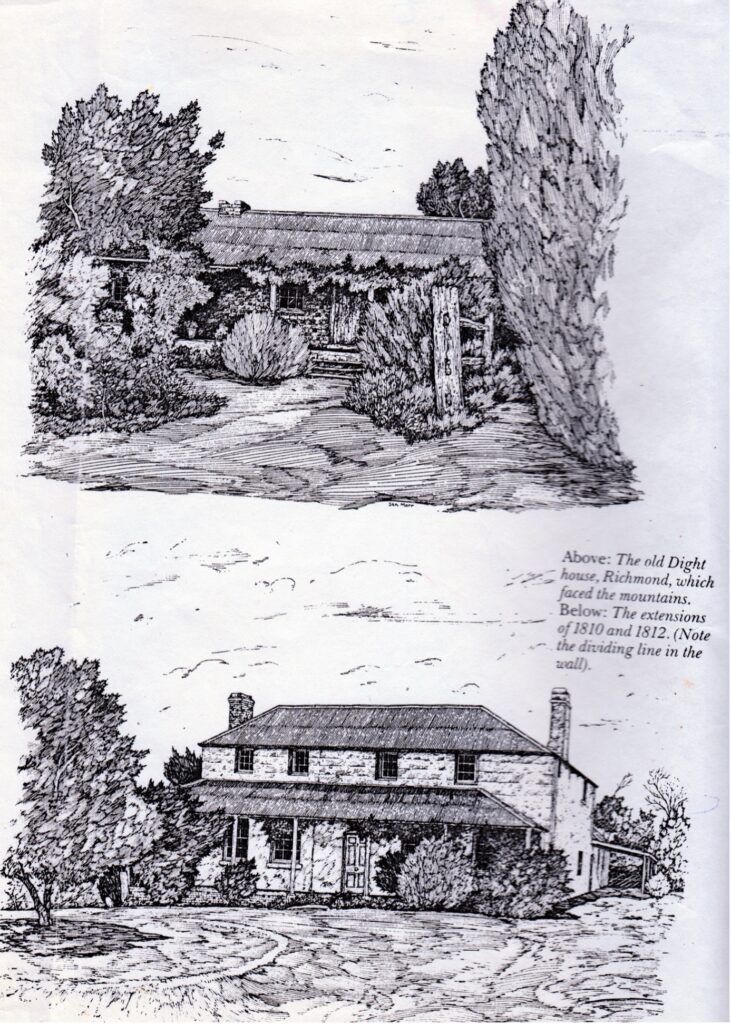
A two room brick dwelling existed on the site which was hardly big enough. Dight advertised in the Sydney Gazette June 1808 as “…to be let; a good brick dwelling house at Richmond…enquire of Mr Dight.” The Dights moved to Parramatta during which time John was superintendent of carpenters at the Commissariat. Added to in 1810, in 1812 Dight contracted with Lewis Jones to build a further addition of a second storey. This 1812 building contract is witnessed by Margaret Catchpole and is in the Mitchell Library.
“Margaret Catchpole, who had been transported in 1801 for a much romanticised horse-theft, worked as a nurse and midwife for a number of Hawkesbury families and at the time of the great flood in March 1806 was living with Mr and Mrs John Dight and their three young children: Dight had been a ship’s surgeon but did not practice in Australia, where too arrived in 1801 but in happier circumstances. Margaret Catchpole wrote back to her East Anglia Aunt and Uncle describing very vividly the events of the flood night at the Richmond farm where the Dights lived before Mountain View was even a twinkle in John Dight’s eye.
Thes places have binn so flodded that I thought once must all bin lorst…Being in the water up to my middell – as you well know I have a good spirit – I was trying to save what I could and I and Mrs Dight and her three children went upon the lorft for safety. We had nor binn there above one hour before the first chimney went dowen and the middle warl went. Then I expected the next chimney to go, and all the warles, and then to be crushed to dead, for the water was about five feet deep in the house…Mr Dight and his two minn was gone to knock down the pig sties and pig runs to drive the pigs away, so we were left alone. But great providence turned up. A boat to save us from a watery grave come and took us away. I was more frightened than all the way going over (from England to Sydney).”
Like so many folk in the region then, the Dights suffered much damage to their house and got a stern warning about building on ground which lay too low. There seems no doubt that it was now, after the flood of March 1806, that John Dight built the first part of Mountain View.
But these two rooms were insufficient and in 1812 Dight entered into an agreement with one Lewis Jones “to erect a dwelling house 25 long by 15’14”wide and 14’10” high about the foundations. The foundations were specified 2’ deep and two bricks thick.
R. Ian Jack Chapter 3 – Mountain View, Richmond
The old buildings of Mountain View on Dight’s Hill, Richmond, still testify to the solid workmanship of long ago. This old home, located in Inall’s Lane, Richmond, is still lived in and was classified by the National Trust in 1976, renovated and reopened in 1980. It is recognised as being of great historical interest as one of the few very early farmhouses still in existence.
Dight’s Farm Trust has existed since 1993.
John Dight II maintained his neutrality in the Rum Rebellion, apparently reserving his energies for local causes. In 1811 he was elected secretary of the Richmond school building committee and donated five guineas to its funds. His children were enrolled there. Dight’s name was always prominent on subscription lists, the Waterloo fund or the charitable funds that led up to the formation of the Benevolent Society; of which he was an inaugural Richmond committee member.
The thirteen children of John Dight II and Hannah:
Sarah (5.3.1800 – 17.2.1832)
Elizabeth (22.9.1802-19.3.1886, who married 8.11.1825 Hamilton Hume the explorer)
Mary (21.9.1804 – 26.12.1819)
Ann (21.8.1806 – 3.8.1889 who in 1847 married James Howe)
JOHN III (2.9.1808 – 23.4.1867 who in 27.8.1832 married ISABELLA MITCHELL)
George (20.10.1810 – 25.2.1841 who in 1841 married Elizabeth Ann Moore Howe)
Charles Hilton (13.1.1813 – 9.10.1852 who in 1845 married Emma Marie Smith)
Samuel Billingsley (12.3.1815 – 7.8.1888 married Sophia Howe, then Emma Howe)
Jane (15.2.1817 – 13.4.1899 who in 1842 married James Burleigh Sharp)
Susannah (15.2.1817 – 1896 who in 1844 married John Watson)
Arthur (6.6.1819 – 31.7.1895 who in 1861 married Janet McCracken)
Frances (10.9.1821 – 22.5.1893 who in 1842 married George Edward Mackay)
Sophia (25.11.1823 – 2.10.1899)
(The final seven children were subjects of a mass baptism at St Peters in July 1826)
In spite of periodically flooded farmlands, Dight had grown prosperous over the years and a provider of large quantities of grain and meat to the commissariat. John Snr was appointed coroner for the Hawkesbury District in 1828 and held that office until the time of his death in 1837. A few years prior to his death he received a Crown grant of a considerable area near Singleton – Stafford and Clifford.
The Dight family began to push pastoral tentacles into the Nepean and Hunter Valleys, reaching eventually the far Darling Downs. John and Charles Dight took up land near Albury and on the Yarra River, where the Dight Mills became famous. George and Samuel became owners of Stafford and Clifford. The youngest son, Arthur, purchased Clarendon from Charles Clarendon Cox in 1862 where he made his home and became a local MLA in 1869.
In 1870 George Dight II and John bought their uncle Samuel’s interest in the properties and took up their residences there, the former at Yetman and the latter at Boonall. They carried on the properties in partnership for several years but subsequently managed each property separately and Boonall has since been disposed of. On the death of Hannah on May 27th 1862, Yetman was left by will to her two sons Samuel and Arthur. In about 1915 Yetman homestead still belonged to the son of George Dight Snr and Elizabeth Howe, George William Dight Jnr who married Isabella Margaret Brodie.
John Dight II died aged 65 on 2.7.1837 aged 65 and is buried in family vault at St Peter’s Churchyard, Richmond. Hannah lived a further 25 years and died in 1862 at the age of 81. His will is in the N.S.W. archives.