Young Australia League
Founded in Perth in 1905 by John Joseph “Boss” Simons and Lionel Boas, the Young Australia League (YAL) is Western Australia’s oldest youth organization, originally established to foster Australian nationalism through football and travel.
The YAFL changed its name to ‘Young Australia League’ and its activities were diversified to include literature, debating, band music, sport and theatrical performances, as well as outdoor pursuits such as hiking and camping.
Setting its activities mainly for boys, the League promoted a philosophy of development of Australian nationalism with the aim of becoming the ‘largest boys club in the British Empire‘.
In 1909 the League had its first of many interstate tours, with overseas tours conducted in 1911, 1914, 1924 and 1929. These tours were instrumental in kick-starting the sport in the United States and in Canada prior to the war.
https://alchetron.com/Young-Australia-League
In the late 1920s, J.J. “Boss” Simons, founder of the Young Australia League (YAL), was inspired by the natural beauty of a valley in the Perth Hills. His dream was to create a weekend retreat where young people could experience the outdoors, develop friendships, and enjoy nature. That vision became Araluen.
As the Park developed, YAL members returning from overseas trips were encouraged to bring back plants, helping to shape the now iconic gardens. The landscape was carefully designed to complement the Canadian-style log cabins, granite features, and pergolas built throughout the property.
The Story of Araluen
Charlie Harrison played the bugle according to this reference of him touring interstate with the Y.A.L in December 1923 / January 1924 when he was 16:
(Jack Harrison) has taken part in many Y.A.L programmes and he is always a popular performer. His Uncle Charlie (Harrison) was a bugler on the “Boss” staff on an Interstate tour of 1924. That was long before Jack was born, but the family has kept in touch with the League ever since. The Boomerang August 1943
The role of “bugler” was an important one as is detailed in this article:
THE Y.A.L. BOYS
FROM WEST TO EAST.
LIFE ON GREAT WESTERN EXPRESS.
(From Our Representative.)
With such material as 340 boys approaching the end of their school years, and others just out of that period it might be thought that the present Y.A.L. interstate tour for education travel, which started on December 30th might rather develop into an affair which would give the boys the opportunity kick over the traces and sow a harvest of trouble for themselves. So far there
has been no sign of this. The outstanding feature to date is the remarkable order maintained by the leader (Mr. J. Simons) and the 10 officers under him, each of whom is in command of a company of about 30 boys, from whom four prefects are selected, making 40 in all nominated by the leader for their steadiness and strength of character, to help in the maintenance of discipline. There is practically no insubordination, and probably less need for punishment than exists in the ordinary school, no wild outbursts and bravado, nobody who tries to hang out of the window by the toes while the train is in motion, and no young rascal who tests himself as a prospective wire walker by balancing on the railing at the end of the carriage. The traditions of the Y.A.L. do not lead to this sort of thing, which has been tried in the past with painful results to the chief actors. The boys know from what has happened in the past that there is no bluffing when it comes to dealing with wrongdoers. The newcomers learn all from the boys who have been on previous tours. The spirit of the Y.A.L. soon infused into the latest recruits, a that is largely why everything is running so smoothly. There is no jumping on and off trains at will. A bugler gives the signal. He also controls lights out 9.30 p.m. and rising at 7 a.m., before which no talk is permitted. There is an interesting example of what happens when the morning rule was not enforced on the second day from Perth. The train was rumbling along at daybreak. The boys were all believed to be asleep as were most of the officers, who had only retired about two hours before through attending to those who had to be picked up along the route. When the train suddenly stopped there was heard An Amazing Chorus
of argumentative high-pitched boyish voices from one end of the train to the other. They were awake with the birds and were equally as vocal. One after the other the officers were roused by the noise. That afternoon on parade it was earnestly pointed out that something nasty waited those who might again participate in such an outburst of youthful spirits before 7 o’clock. The order was obeyed implicitly, but they made up for this suppression of their energies when the bugle sounded, and there was no more sleep that morning.
The boys arc not leading a dismal life by any means. There is plenty of fun day and night, each to his own liking; literature (humorous and heroic), games and tales, comic and popular songs and choruses, and instrumental music-band instruments, and many of a humble and disagreeable type.
Breakfast at Karalee on the morning of New Year’s Eve was remarkable for its simplicity, sufficiency and despatch. With stomachs yearning for food since the incident at daybreak, the boys formed up in companies outside their carriages and filed through the railway’s barracks where in about 15 minutes all had received a cup of tea, a pie and a large piece of cake, and sat down anywhere outside and were well filled. Thus handicapped, the brass (band of 40 players) proceeded to have their morning “blow” under the conductor, Mr. Val Smith, who
with 36 raw recruits to train, has made such progress that his band was able to march and play in Hay-street on the day before their departure for the Easten States, and have been greatly admired at stations across Australia.
The first part of the journey to Kalgoorlie was done in darkness, and consequently the boys were unable to see the beautiful country on the way to and beyond Northam, and the broad wheatlands stretching to eastwards. Many little crowds gathered at the various stations and wished them well, one of the most, enthusiastic being an old boy of the Y.A.L. now wearing a returned soldier’s badge, who bad travelled 23 miles to revive memories of a 12-year old tour in which he had participated.
The train dashed through old Coolgardie, once rich and famous for its alluvial gold deposits which thrilled the world, attracted thousands, and built a town whose (business centre was often as crowded as Hay Street, Perth. Its condition today pains those who knew it 20 years ago. Most of it has been dismantled. Only here and there stand a few weather-beaten structures in deserted streets. There were four or five people on the Station platform. Passing
the outskirts of the town, the young travellers get glimpses of some of the early alluvial diggings where hundreds of men made fortunes. Pot holes everywhere vividly visualised to them the feverishness of The Gold Hunt of bygone years when not a square foot of ground that gave promise of reward was not turned over. In the midst of these stood an old bearded prospector. The youngsters responded to his waving hand with a shrill chorus, in the middle
of which he dropped his arm, looked reflectively at the ground and walked away.
A few hundred yards further along four little children, bootless and hatless, ran from over the bill with upraised arms and roused a responsive yell from the train. They stood motioning their good-byes until lost to view, and eagerly awaiting the day when they may participate in an even bigger Y.A.L. tour.
Lunch was served at the Kalgoorlie Town Hall. The league had arranged to meet the situation in advance, and was assisted by a few friends in much the same way as at Karalee, so that feeding was speedily over, and, after a short march in Hannan Street, it was not long before the journey was resumed, with the addition of a party of 20 boys from the goldfields. The Mayor of Kalgoorlie called on Mr. Simons and his officers before they had left the Town Hall and wished them a successful tour.
The journey of 1,051 miles from Kalgoorlie to Port Augusta was accomplished under pleasant weather conditions.
What was lacking in scenery was made up by comfort on the Great Western express, the officials of which provided everything that the young tourists desired. All had sleeping accommodation, and the quality of the food was such that not a course was missed, and all plates were cleaned. In fact, it is expected that the 160Ib. of sausages, 2001b. of beef, and 2001b. of mutton, not to mention the vegetables and fruit, will have vanished with the serving of the last meal at Port Augusta. There were two dining cars; meals were served in relays of 40, and to meet the situation the railway staff had to be more than doubled.
The boys learned on the journey that an experiment was commenced a few months ago by Mr. P. J. Watson, of Mundrabilla station on the south, with the grazing of 2,000 sheep on the salt-bush and blue-bush land in the vicinity of Forrest, 651 miles east of Kalgoorlie, water being provided by the Commonwealth bores. The good news was also imparted that, as the result of recent rains, when there was hardly a week’s water in the dams, the supply will now occasion no anxiety for 12 months. The six million gallons dam at Tarcoola, it is stated, was filled to overflowing in an hour and a half. Prior to this the railway authorities had to cart water over the line for hundreds of miles from each end.
After passing the country east of Kalgoorlie timbered with salmon gums, kurrajongs, gimletwood and sandalwood, which cover the first 187 miles, there comes the fringe of the Nullarbor Plain lightly clothed with myall, mulga, and black oak for about 40 miles, the rest of the 400 miles being nothing but low saltbush and bluebush, through which the railway runs without a curve for 300 miles. Then there is the 50 miles belt of the Ooldea sandhills with its mallee gums, silky oak, black oak, native cork and myalls, the proximity of which is signalised by the Musgrave Range on the north-east. Red soil plains and undulating country characterise the track to the hilly country around Tarcoola. It is well grassed and timbered with black oak and myall and occasional eucalypts. The run down to Port Augusta from Tarcoola is mainly through the lake country, vast and shallow in the rainy reason, but mere sheets of salt in the summer. After a spin of about 50 miles through more plain country, relieved by flat-topped hills in the south-west, the terminus is reached at the head of Spencer’s Gulf. On a rainy morning with thunder and lightning, Port Augusta was reached about two and a half hours late owing to engine trouble occurring on the uphill run from Tarcoola, and the party was three hours behind by the time, the change was made to the narrow gauge line which winds its way for 120 miles through the hills to Terowie. The Cloud-capped Ranges,
lit by the morning sun, were a beautiful sight, and many owners of cameras were
busy snapping effects rarely seen in their own State. Notwithstanding that the night was well advanced, the boys were full of excitement with their near approach to Adelaide. Tea was speedily served on the platform at Riverton; the travellers rushed on again, the train still reducing the time lost since Tarcoola. Luggage was packed, and final touches were put on uniforms and band instruments ready for the appearance in the city. Steaming into the station, a few minutes before 10 p.m. on Wednesday, the youngsters finished off their lemonade, drinking 300 dozen bottles for the trip, and cheered and whistled with satisfaction at the conclusion of the long journey to the South Australian capital. A large number of people welcomed them. Lorries were waiting outside and baggage was taken to the Jubilee Oval, in North-terrace, whither the party marched with band playing and flags flying. Late tea was served, and before midnight, everyone was in bed in the grandstand receiving the benefits of open-air sleep. Western Mail Thursday January 10 1924 page 38
The Y.A.L. boys now touring the East arrived in Melbourne from Adelaide last Tuesday afternoon. They will spend a week in the Queen City. Sunday Times Sunday 13 January 1924 page 14
Y.A.L. TOUR:
Doings in Sydney
The Y.A.L boys have been out all day and to-night. They spent the morning at the Taronga Park Zoo to which they were carried across the harbour in a special ferry boat, and they cooled themselves in the afternoon at the Clifton Gardens baths. Tonight they were at the Rushcutters’ Bay Stadium enjoying a programme of boxing and vaudeville. The Lord Mayor of Sydney will tender a civic reception to the Y.A.L. party at noon tomorrow. The West Australian Thursday 17 January 1924 page 9
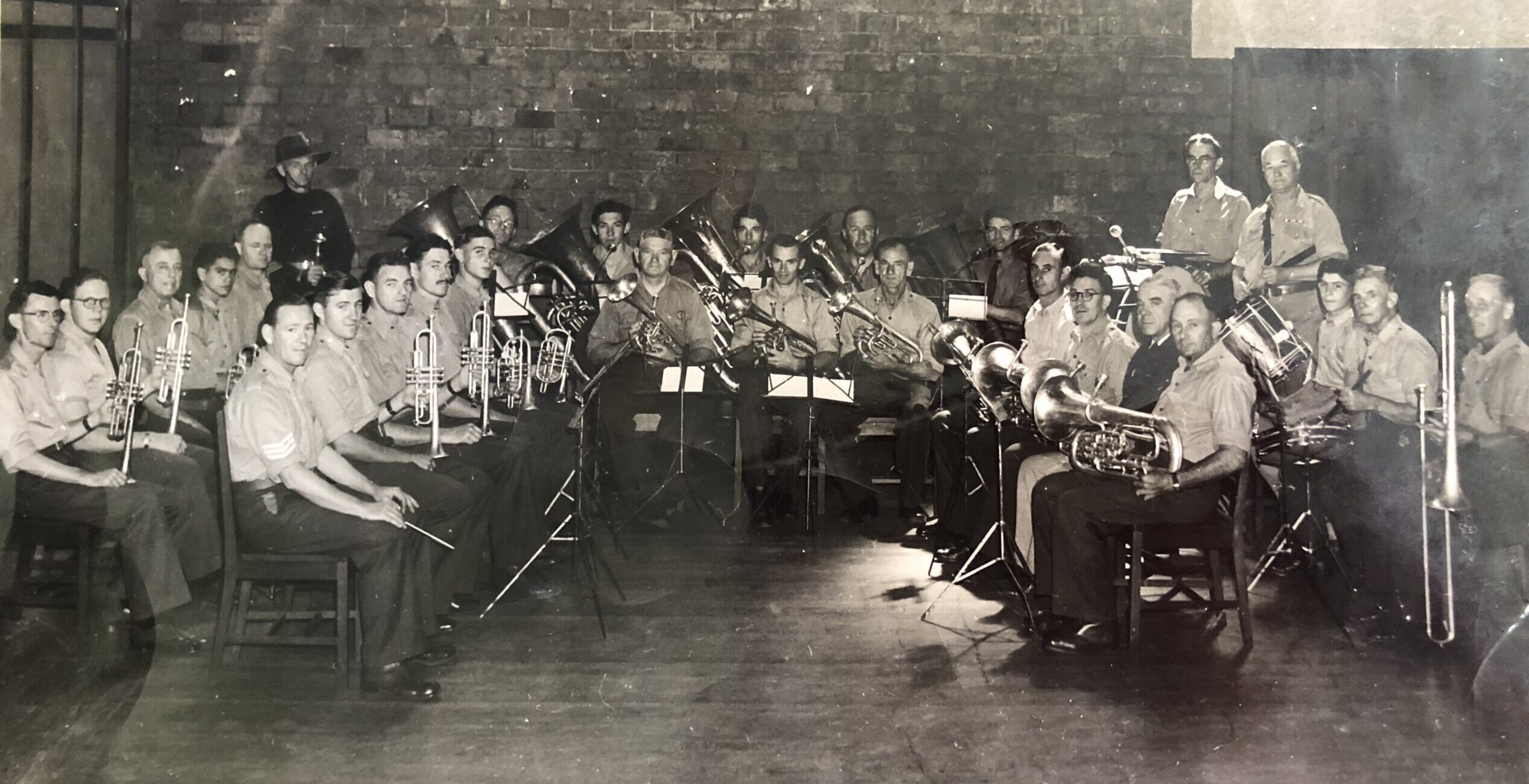
On completion of primary school, Ray Harrison was a drummer in the Y.A.L band.
BIOGRAPHY: John Joseph “Boss” Simons
https://adb.anu.edu.au/biography/simons-john-joseph-jack-8430