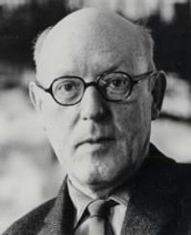
On 27th July 1968 Graham Wood and Stanislaw Kowarski (violins), John Dean (Viola), Brian Meddemmen (cello), John Mowson (bass), Patrick Brislan (Horn), Jack Harrison (clarinet) and Jill Harrison (bassoon) played the Australian premiere of Octet for Wind and Strings by Howard Ferguson. It was an A.B.C. Studio broadcast from the Basil Kirke Studio in Perth.
| 27.7.1968 | Howard Ferguson Octet Op. 4
for clarinet, bassoon, horn, string quartet and double-bass (1933) AUSTRALIAN PREMIERE |
Jack Harrison (clarinet)
Jill Mowson (bassoon) John Mowson (bass) Patrick Brislan (horn) |
ABC Broadcast
Basil Kirke Studio A.B.C. Adelaide Terrace, Perth, Western Australia |
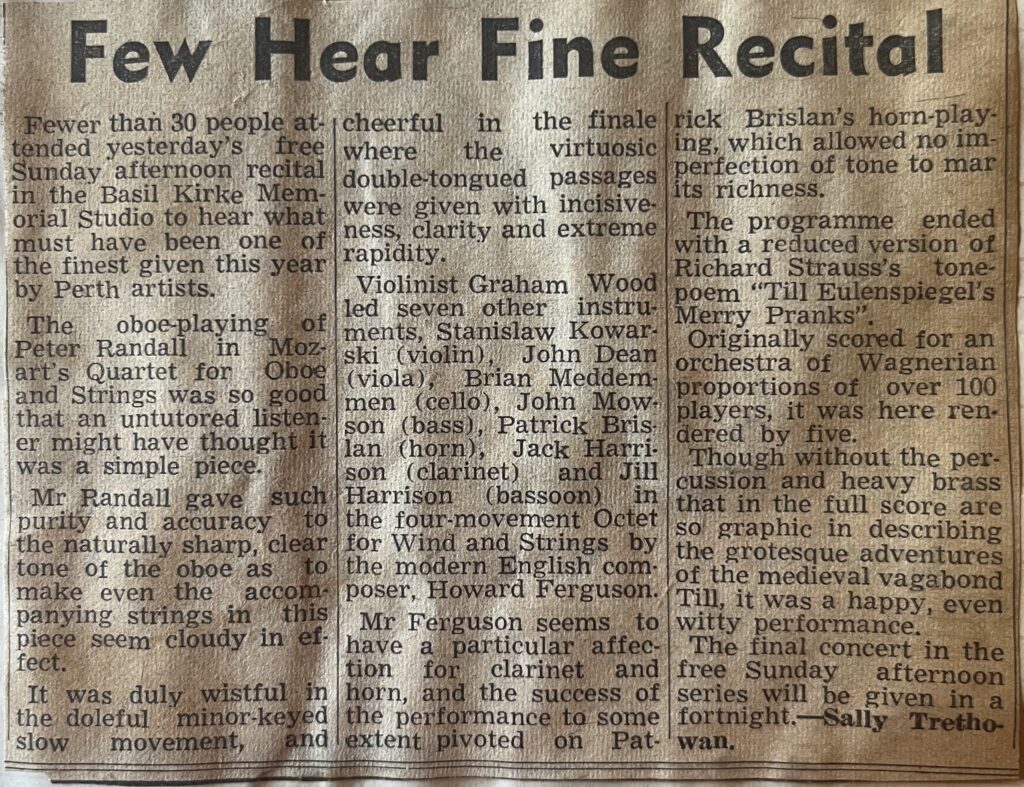
FEW HEAR FINE RECITAL
By Sally Trethowan
Sunday February 29 1968
Fewer than 30 people attended yesterday’s free Sunday afternoon recital in the Basil Kirke Memorial Studio to hear what must have been one of the finest given this year by Perth artists. The oboe playing of Peter Randall in Mozart’s Quartet for oboe and strings was so good that an unchartered listener might’ve thought it was a simple piece. Mr. Randall gave such purity and accuracy to the naturally sharp clear tone of the oboe as to make even the accompanying strings in this piece seem cloudy in effect. It was duly wistful in the doleful minor keyed slow movement and cheerful in the finale where the virtuosic double-tongued passages were given within incisiveness, clarity and extreme rapidity.
Violinist Graham Wood led seven other instrumentalists Stanislaw Kowarski (violin) John Dean (Viola) Brian Meddemmen (cello) John Mowson (bass) Patrick Brislan (Horn) Jack Harrison (clarinet) and Jill Harrison (bassoon) in the four movement Octet for Wind and Strings by the modern English composer Howard Ferguson. Mr. Ferguson seems to have a particular affection for clarinet and horn, and the success of the performance to some extent pivoted on Patrick Brislan’s horn playing which allowed no imperfection of tone to mar its richness. The program ended with a reduced version of Richard Strauss’s tone poem “Till Eulenspiegel’s Merry Pranks”. Originally scored for an orchestra of Wagnerian proportions of over 100 players, it was here rendered by five. Though without the percussion and heavy brass that in the full score are so graphic in describing the grotesque adventures of the mediaeval vagabond Till, it was a happy even witty performance. The final concert in the free Sunday afternoon series will be given in a fortnight.