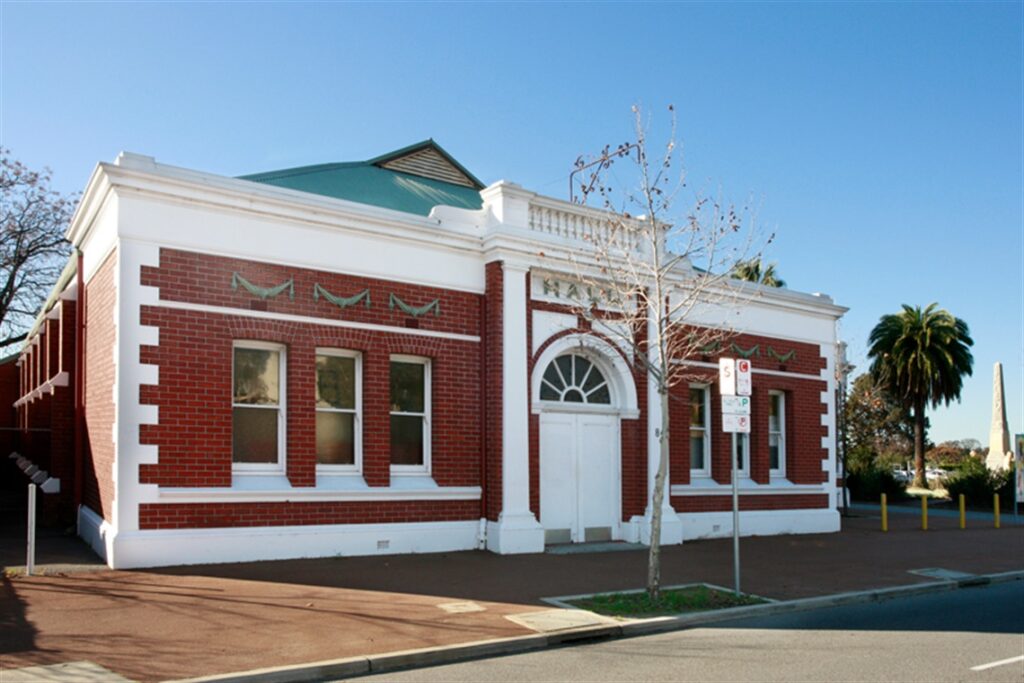
Leederville Town Hall is one of the surviving civic landmarks of Perth’s inner western suburbs. Standing at 82–84 Cambridge Street, West Leederville, the complex reflects the rapid growth of Leederville in the years before the First World War and the important role that halls played in the social, political, cultural and recreational life of Western Australian communities. The place has been in continuous community use since 1904 and is now entered on the State Register of Heritage Places.
The story of the Town Hall begins with the transformation of Leederville from a largely rural and semi-rural district into a rapidly developing suburb of Perth. The area was associated with early settlers William Leeder and John Monger, while market gardens, dairies and poultry farms supplied food to the growing Perth settlement. Development accelerated during the 1890s gold boom, when Perth’s population expanded and land was subdivided for housing.
Leederville became a Road District in 1895 and a municipality in 1896. As the population increased, the new municipality required civic buildings and, just as importantly, places where residents could meet, celebrate, dance, perform and conduct community business.
The first part of what is now the Leederville Town Hall complex was constructed in 1904. It was associated with the Excelsior Masonic Lodge and Sir Walter Scott Lodge, which provided funds for the building. The architect was Wallace Watkins, the builder was Alfred Wilks, and Albert Card was responsible for decoration.
The original complex consisted of a main hall and a smaller Lesser Hall or supper room. Together they cost approximately £1,200, a considerable community investment at the time.
The main hall could accommodate approximately 500 people, while the Lesser Hall could seat about 150. Particular attention was given to the floor, with contemporary descriptions emphasising the provision of what was intended to be “the very best floor for dancing”. The hall was also fitted with a Kitson lighting system, reflecting the desire to provide a modern and attractive venue for the rapidly expanding community.
From its earliest years, the complex was much more than a municipal building. It became a place for social gatherings, meetings, dances, entertainment and community activities.
Recreation and community life
The Town Hall was part of a broader recreational precinct. In 1905, plans were developed for a bowling green and croquet lawn. The bowling club held its first meeting in July that year, and the newly established greens and lawn were formally opened in November by Henry Daglish MLA and his wife, Edith Daglish. The bowling greens established at this time remain on their original site and are recognised as among the oldest continuously operating bowling greens in Western Australia.
The combination of hall, recreation grounds and later memorial precinct made this an important gathering place for generations of residents.
As Leederville continued to grow, the original building was no longer adequate for the municipality’s needs. A substantially larger hall was therefore constructed beside the existing Masonic Hall in 1914.
The new building was designed by A. E. Clarke, a prominent architect who had worked in Victoria before coming to Western Australia, and was built by the well-known local builder W. H. Roberts. The new hall was designed in the Federation Free Classical style, characterised by its restrained classical detailing, brick construction and formal civic appearance.
The new Town Hall was officially opened by the Governor on 19 September 1914.
It was an impressive building for the rapidly expanding suburb. The main hall measured approximately 72 feet by 45 feet and could accommodate around 600 people. It included a large public hall, entrance and anterooms, a projection room, dressing rooms and connections to the older building.
The 1904 Masonic Hall was incorporated into the new municipal complex. It was altered internally and used for municipal offices, including the Town Clerk’s office, Health Officer’s office, general office and a council chamber. Thus, the completed complex combined the functions of a civic administration centre with those of a large public entertainment and community venue.
There is an interesting irony in the history of the building. The new Town Hall was opened in September 1914, but the municipality that had built it was already approaching the end of its independent existence.
The City of Perth Act 1914 provided for the amalgamation of several inner suburban municipalities. Leederville subsequently ceased to exist as an independent municipality in July 1915 when it was incorporated into the City of Perth.
The Town Hall, however, survived the municipality that had created it. It continued to serve the local population as a community and recreational venue, becoming a physical reminder of the period when Leederville was an independent municipality.
The Town Hall and music
For much of the twentieth century, halls such as Leederville Town Hall were essential to musical life. Before the widespread availability of television, large purpose-built community halls provided spaces for concerts, dances, musical societies, theatrical productions, public lectures and community celebrations.
Leederville Town Hall’s large floor and stage made it particularly suitable for performances and dancing. Its continuing importance as a performance venue is reflected in the Town of Cambridge’s description of the building today, which notes its polished timber floors, historic character and suitability for stage performances.
For Western Australian music history, the significance of such a building extends beyond the famous concert halls and professional theatres. Community halls were where amateur musicians, dance bands, school groups, local orchestras, choirs and visiting performers could reach audiences within their own neighbourhoods.
The caretaker’s residence
The Town Hall complex also tells the story of the people who maintained these community facilities.
During the inter-war period and through the Second World War, the caretaker was Mr Haimes. A caretaker’s residence was constructed on the western side of the main hall in 1924, providing accommodation for him and his family.
The residence illustrates the way such civic buildings operated. The Town Hall was not simply a building opened for occasional events; it was a working community facility that required continual supervision and maintenance.
The First World War and the memorial precinct
The history of the Town Hall is also closely connected with Leederville’s experience of the First World War.
A war memorial was subsequently established beside the hall. The memorial was designed by Pietro Porcelli, one of Western Australia’s most significant early public sculptors. The memorial precinct, including its granite obelisk, marble lions and rose garden, forms part of the heritage significance of the overall site.
The relationship between the Town Hall and memorial is particularly significant. The hall represented community life—meetings, dances, concerts and celebrations—while the memorial provided a permanent place to remember members of that same community who served during wartime.
The 1954 floor
By the middle of the twentieth century, the Town Hall had experienced decades of intensive use. The original dancing floor had become badly worn through the many dances and other activities held there.
In 1954, the main hall floor was replaced with a wandoo timber floor removed from the University of Western Australia ballroom. The floor is therefore itself part of the building’s continuing story, connecting two important Western Australian cultural institutions.
A surviving community landmark
The Leederville Town Hall complex has survived numerous changes to Perth’s suburbs, local government structures and patterns of entertainment.
Today, the complex retains evidence of its different stages of development: the 1904 Masonic/Lesser Hall, the larger 1914 Town Hall, the 1924 caretaker’s residence, the bowling greens and the war memorial precinct. Together they form a remarkably complete record of the development of Leederville from a rapidly growing municipality into an established inner suburb.
Its heritage significance rests not simply in its architecture but in its social history. The Heritage Council describes the place as having social value to the immediate West Leederville community and the wider community because of its continuous use since 1904. It is also recognised as a civic landmark and as an important representation of Leederville’s rapid development in the years before the First World War.
The Town Hall was placed on the State Register of Heritage Places in 2003, and the Town of Cambridge’s heritage listing gives the complex a Category 1 municipal heritage classification, reflecting its exceptional significance to the locality.
https://inherit.dplh.wa.gov.au/public/inventory/details/33846a08-ca15-4814-85cf-ad36732bbe61
https://www.vincent.wa.gov.au/about-vincent/city/city-profile/history.aspx
https://www.cambridge.wa.gov.au/Discover/Hire-a-Venue-or-Facility/Leederville-Town-Hall