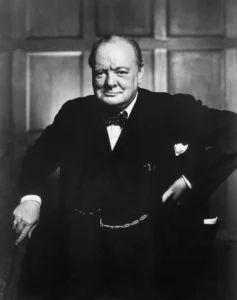
The Fellowship was created in 1965 as the living legacy of Sir Winston Churchill for the nation. It aims to honour his memory and spirit in a unique community of changemakers across the UK.
“There is nothing wrong in change, if it is in the right direction. To improve is to change, so to be perfect is to have changed often.” – Sir Winston Churchill
Honouring the spirit of Sir Winston
The idea for the Churchill Fellowship was developed in the last years of Sir Winston’s life and with his approval. It closely reflects his own concerns, with an emphasis on opportunities for individuals from all walks of life, international learning and discovery, and practical innovation in every area of society. These were elements which he strongly supported in his own life and in the formation of the Fellowship, and together they have created a remarkable resource for the nation.
In his own life, Sir Winston was not only a global public figure but also a lively and often self-taught enthusiast for a huge range of interests – from bricklaying to beekeeping, to painting and writing, for which he was awarded the Nobel Prize for Literature in 1953. He was, too, an early adopter of new technology, such as oil-fired engines for ships and radar for aeroplanes. And in politics, he was a very early champion of social policies including state pensions, unemployment insurance and public health care.
Today’s Fellowships continue this spirit of curiosity and change, of universal interest and public service. Above all, they echo his enduring belief in the potential of the individual, whatever their circumstance or adversity, to achieve great things.
https://www.churchillfellowship.org/about-us/our-story/
https://www.churchilltrust.com.au/
Jack Harrison received a Churchill Fellowship in 1971.
https://www.churchilltrust.com.au/fellow/jack-harrison-wa-1971/
Jack Harrison Churchill Fellowship Report
The Winston Churchill Memorial Trust
Final Report
Submitted by
Jack Louis Harrison
Churchill Fellow 1971
Perth, 10th November 1971
THE TRUSTEES
Dear Sirs,
It is with much pleasure that I present a report of my activities as a Churchill Fellow.
This was my itinerary: –
July 25th Paris
August 1st London
September 30th New York
October 6th Ann Arbor
October 8th Interlochen
October 14th Perth
This itinerary proved satisfactory, but I would like to make a general comment, that in planning from this distance, it is not always possible to know how productive or otherwise a particular visit will be. Had I known, for instance, about the Arts Academy in Interlochen, I would have included this in my planned itinerary. As it was, I was fortunate enough to fit in a brief visit which proved most productive. The best solution to this problem that I can suggest, is to allow rather more uncommitted periods in the itinerary.
My aims in applying for a Fellowship were:-
- To benefit from exposure to an international musical environment by attending concerts, rehearsals, recording sessions and chamber music.
- To observe the manufacture of clarinets and clarinet reeds at first hand.
- To undertake consultative lessons with leading clarinettists in England.
- To confer with leading teachers and visit music schools to ascertain the latest trends and methods in clarinet teaching, both class work and individual tuition.
- To evaluate the current clarinet repertoire by discussion with players and visits to publishing houses and libraries.
- To enlarge and improve my knowledge of the clarinet as a player and teacher, in all aspects.
SECTION A
To benefit from exposure to an international musical environment by attending concerts, rehearsals, recording sessions and chamber music.
I attended the following Symphony Concerts (unless indicated, all these concerts took place in the Royal Albert Hall as part of the 1971Sir Henry Promenade Concert Series – “The Proms”.)
11th June Scottish National Orchestra, Aberdeen,“Siegfried”[1]
13th June Harpsichordist Peter Williams, Bach Preludes and Fugues
20th June London Symphony Orchestra, Andre Previn
9th July Florence Teatro Comunale, Madame Butterfly
13th July Rome, Aida, Roman Ruins
20th July Ella Fitzgerald, Tom Flannigan, Ed Thigpen, Frank Delarosa
22nd July Paris Folies Bergere
3rd August BBC Symphony Orchestra, Pierre Boulez
5th August BBC Symphony Orchestra, Pierre Boulez
9th August Scottish National Orchestra, Alexander Gibson
11th August BBC Symphony Orchestra, Sir Adrian Boulte
13th August BBC Symphony Orchestra, Norman Del Mar
16th August BBC Symphony Orchestra, Colin Davis
21st August BBC Symphony Orchestra, Charles MacKerras
23rd August National Youth Orchestra, Pierre Boulez
1st September London Symphony Orchestra, Andre Previn –
Soloist, Gervase de Peyer. Usher Hall Edinburgh
3rd September BBC Symphony Orchestra, Daniel Barenboim
4th September BBC Welsh Symphony Orchestra, Wyn Morris
7th September BBC Symphony Orchestra, John Pritchard
9th September Leningrad Philharmonia Orchestra, Gennadi Rozhdestvensky
10th September Leningrad Philharmonia Orchestra, Gennadi Rozhdestvensky
13th September Leningrad Philharmonia Orchestra, Gennadi Rozhdestvensky
14th September BBC Symphony Orchestra, Malcolm Arnold
15th September BBC Symphony Orchestra, Jascha Horenstein
16th September London Symphony Orchestra, Colin Davis
6th October University Symphony Orchestra, Theo Alcantara, Ann Arbor, U.S.A
Of the concerts I attended, I felt that the Mahler Ninth Symphony on August 5th and the “Rite of Spring” on the 16th September were particularly outstanding performances.
Another memorable performance was of the Thea Musgrave Clarinet Concert with the soloist, Gervase de Peyer, accompanied by the London Symphony Orchestra. I made a special trip to Edinburgh to attend the rehearsals and performance of this. The work is in a modern idiom, but not so extreme as to become a purely academic exercise, and calls on the soloist to move about the orchestra and take up different positions to cue individual solos apart from the Conductor’s over-all control of the orchestra. At one stage near the end of this work, while the conductor is conducting a tranquil passage for the orchestra, the soloist turns to the percussion section and conducts them in a wild tempo, disregarding the rest of the orchestra. This work is a visual spectacle as well as a listening experience and would be suitable for inclusion in a Youth Concert or for an audience sympathetic to new experiments on the concert platform. Mr de Peyer’s flamboyant approach to the concerto performance added vitality to an exciting rhythmical work. I had the pleasure at this time of meeting the composer, Thea Musgrave, who arranged with her publisher, T.W. Chester, to photograph the solo clarinet part for my own personal study.[2]
REHEARSALS
2nd August B.B.C. Studios. B.B.C. Symphony Orchestra, Pierre Boulez
18th August All day rehearsal Croydon National Youth Orchestra, Pierre Boulez
20th August Morley College, London Philharmonic Orchestra, (woodwind and brass), Joseph Krips
29th August George Watson College, Edinburgh. London Symphony Orchestra, Andre Previn
30th August George Watson College, Edinburgh. London Symphony Orchestra, Andre Previn and Claudio Abbado
1st September Usher Hall, Edinburgh. London Symphony Orchestra, Andre Previn
2nd September Usher Hall, Edinburgh. London Symphony Orchestra, Claudio Abbado
3rd September B.B.C. Studios London, B.B.C. Ensemble, Pierre Boulez
12th September Croydon Amateur Orchestra, Hans Hubert-Schonzeler
13th September Festival Hall. Festival Ballet Orchestra.
1st October Metropolitan Opera Co., New York Orchestra and cast rehearsing “Fidelio”.
I found the rehearsal techniques of international conductors working under English conditions most educational, as they displayed many different ways of attaining an excellent concert.
COMMERCIAL RECORDING SESSIONS
11th August Walthamstow Town Hall. London Symphony Orchestra, L’Almedio. Orchestral Excerpts for an American Educational Library.
27th August All Hallows Church, New Philharmonia, Lorin Maazel. “Scheherezade” by Rimsky-Korsakov
28th August All Hallows Church, New Philharmonia, Lorin Maazel.
“Peter and the Wolf” and “Young Persons Guide to the Orchestra”.
14th September Walthamstow Town Hall. The Academy of St Martin-in-the-Fields, Neville Marriner – soloist Alan Civil, Mozart Horn Concerto.
15th September Walthamstow Town Hall. The Academy of St Martin-in-the-Fields, Neville Marriner – soloist Jack Brymer, Mozart Clarinet Concerto.
17th September Walthamstow Town Hall. The Academy of St Martin-in-the-Fields, Neville Marriner – soloist Jack Brymer, Mozart Clarinet Concerto.
I count as one of the highlights of my Fellowship being present at the recording of Mozart’s Clarinet Concerto by Jack Brymer with the Academy of St Martin-in-the-Fields, a small chamber orchestra. Incidentally, this was the third commercial recording of the Mozart Concerto to be made by this distinguished soloist.
CHAMBER MUSIC
22nd September Royal College of Music, Bernard Walton playing Brahms Quintet.
8th October Interlochen Arts Academy. Dusha Quartet playing “Contrasts” by Bela Bartok and “Quartet for the End of Time” by Messaien.
As, under Australian Conditions, the greater percentage of my playing is orchestral, I felt it wise to devote a large proportion of my limited concert-going time to orchestral rather than chamber music.
It should be noted, however, that I undertake as much chamber as I can and I consider that there will be a notable flow on into this field from my studies.
SECTION B
To observe the manufacture of clarinets and clarinet reeds at first hand.
The Leblanc Clarinet manufacturing concern is one of the largest in the world, with factories in France and America. Having met Leon Leblanc in Australia, I was shown over two of these factories by Leon and his nephew, Gerard.
The Leblancs devoted a considerable amount of time to me in discussions which ranged over the whole area of clarinet manufacture. The personal contact with “the boss” proved most valuable.
Another beneficial visit was to Hans Moennig in Philadelphia, U.S.A. I spend about four hours talking to him and observing the techniques employed by this very skilled craftsman. Mr Moennig, whose time is eagerly sought after by leading woodwind players in America, was kind enough to spare me a further two hours during which he worked on and improved the performance of my instruments by fine tuning a few notes and giving certain pads more clearance to give the instruments freer blowing qualities. I count my visit to Mr Moennig a great privilege.
A further most instructive session was that which I had with Gervase de Peyer in London on the subject of mouthpieces and how they may be adjusted to suit individual players by altering the proportion of the lay. This is a highly skilled and delicate operation which has not been attempted to any great extent or success in Australia. To have seen this work at first hand has given me the necessary know how and “courage” to continue this experimentation on my own.
While in France, I visited the Vandoran reed and mouthpiece factory and was able to inspect the complete processes involved. I must point out that this visit required the personal recommendation of Gerard Leblanc to Vandoran, because under normal circumstances visitors are not shown over this factory.
SECTION C
To undertake consultative lessons with leading clarinettists in England.
The Artists with whom I worked were:-
- Gervase de Peyer (Principal Clarinet with the London Symphony Orchestra)
- Jack Brymer (Principal Clarinet with the B.B.C. Symphony Orchestra)
- Bernard Walton (Principal Clarinet with the London Philharmonic Orchestra)
- Jack McCaw (Principal Clarinet with the New Philharmonia)
I had met previously in Australia both de Peyer and McCaw and this proved most helpful in getting away to a good start in London.
My reason for choosing London was based on my intense admiration for the tonal quality of the so called English School of clarinet playing. To ensure that I obtained the best value from my teachers, I arranged to work in specific areas without overlap. For example, with Gervase de Peyer I studied the “Rossini Variations” in depth.
Mr Jack Brymer introduced me to some new music for clarinet, soprano and piano, the most significant was “Sechslieder” by Spohr, at which we worked in depth. “Contrasts” by Bartok was another work that we studied in detail.
With Bernard Walton, I discussed basic posture and breath control and common faults in these matters and how best to go about eradicating such faults. My personal playing benefitted from these sessions in certain technical aspects.
Because I, myself, play French style instruments, I was interested to find that Jack McCaw was one of the few clarinettists in London playing similar instruments. These are built with a narrower bore than English clarinets, and I felt that his tonal quality was most English, more so that one would expect from a French instrument. We discussed his choice of these instruments and he claimed that he coild play with more surety of intonation than with the larger bore English instruments. However, to achieve his tonal quality, he uses a larger bore English mouthpiece, but this necessitates the retuning of some notes on his French instruments. I fell that Mr McCaw’s sound compares favourably with the clarinettists using English instruments, and this session showed me a direction in which to proceed in moulding my playing towards producing and English quality with French instruments.
SECTION D
To confer with leading teachers and visit music schools to ascertain the latest trends and methods in clarinet teaching, both class work and individual tuition.
I grasped every opportunity to discuss with the English players, also with Professor William Stubbins and Daniel di Cicca at the University of Michigan, U.S.A., current practice in teaching. The conclusion that I have drawn from these discussions is that teaching practice in Perth, both individual and class is definitely comparable in standard.
I was able to visit and inspect two of the foremost music schools in America, the Juilliard and the Curtis Institute.
Mr Geoffrey Michaels, formerly of Perth, who had been on the staff of Curtis as well as studying there, was able to show me over this famous school.
At the secondary level, the only school I was able to visit was the Arts Academy of Interlochen, Michigan, U.S.A., where again I had the pleasure of being shown over by an ex-Perth musician now teaching there. This was Mr. Brian Hanly, son of Vaughan Hanly, the Concertmaster of the West Australian Symphony Orchestra.
My over-riding impression of these schools was the lavish scale on which they are equipped, which obviously makes for easier teaching. This is something that could well afford to be borne in mind when planning a conservatorium in Perth.
SECTION E
To evaluate the current clarinet repertoire by discussion with players and visits to publishing houses and libraries.
I visited the following publishers and libraries:
In London:-
Oxford University Press
Chappells
British and Continental
Novello
Barenreiter
Boosey and Hawkes
Schotts
Musica Rara
J.W.Chester
Stainer and Bell
In America:-
The Curtis Institute Library
The Philadelphia Public Library
I have brought back with me a sizeable quantity of music from these and other sources including some photostat copies of hire material for study purposes only.
It is very difficult in Perth to keep up to date with published music and teaching material because of our isolation and I wonder if it might be possible for the Perth Central Music Library to institute a worldwide listing of new publications in a readily accessible format. This could be kept up to date from periodicals and catalogues, etc.
There is a further problem in the increasing number of works that are published as hire material only and it would be beneficial if the Central Library could obtain and hold photostat copies for evaluation but not performance. Publishers might well agree to this if approached by the State Library and/or Churchill Memorial Trust. There would need to be restrictions to satisfy publishers’ doubts, however, I feel it should be possible to arrive at some suitable arrangement.
SECTION F
To enlarge and improve my knowledge of the clarinet as a player and teacher, in all aspects.
There is no doubt whatsoever in my mind that I have achieved this purpose in great measure and that I have returned a much more knowledgeable clarinettist. I believe the personal confidence aquired from a realistic appreciation at first hand of international standards and styles and all that flows from such experience will prove one of very long term benefits of this study leave. I am looking forward to putting this into practise the beneficial results of my Fellowship. I have not gone into great detail on technical matters of teaching and playing in the body of this report because I believe these are personal in application. What suits me does not necessarily suit other players, however I am most willing to discuss these matters with any one interested and in fact, I have already had lengthy discussions with my colleagues since returning to the West Australian Symphony Orchestra.
Furthermore, this overseas visit has confirmed my belief that it would be of inestimable value to a practising musician to be able to undertake a sabbatical leave with financial security and I feel that every effort should be made to study the feasibility of introducing a scheme similar to that of University staff. Finance is of course the problem, but I do feel that a start should be made now on at least defining the problems involved.
Mr. di Cicci, who I met in Ann Arbor, was undertaking a year’s study on leave from his position as Professor of Clarinet at Indiana College in Pennsylvania. This is a common occurrence in America.
In conclusion, I would like to express my gratitude to the Winston Churchill Memorial Trust for awarding this Fellowship to me, without this assistance it would have been extremely difficult for me to have undertaken a comparable educational programme. I would also like to acknowledge the encouragement given me by my employers, the Australian Broadcasting Commission.
ADDENDA
- Recommendations for future Fellows studying overseas in similar fields
- Allow ample uncommitted time in itinerary
- Arrange to study with several teachers rather than one
- Prepare some repertoire works for study in depth before leaving
- Cultivate as many personal contacts as possible.
- Names and addresses of people helpful to me whilst abroad:-
Mr Leon Leblanc and Gerard Leblanc
70 Rue Des Rigoles
Paris, 70E
Mr Jack Brymer
Underwood
Ballards Farm Road
Croydon, Surrey.
Mr Gervase de Peyer
16 Langford Place
London. N.W.S
Mr Bernard Walton
6 Foxgrove
Soutgate
London, N14
Mr Jack McCaw
15 Leinster Avenue
East Sheen
London S.W. 14
Professor William Stubbins
3040 Exmoor Road
Ann Arbor, Michigan 48104
Mr Geoffrey Michaels
5358 Montgomery Avenue
Phuiladelphia
Pennsylvania, U.S.A
Mr Brian Hanly
Interlochen Arts Academy
Interlochen
Michegan 49643, U.S.A
The help received from these people is covered in my report.
The following were also of great assistance:-
Stephen Trier (Bass Clarinettist, London Philharmonic Orchestra) helpful with clarinet mouthpieces.
Colin Bradbury (Associate Principal Clarinet, B.B.C. Symphony Orchestra) visit to the National Youth Orchestra
Tony Jennings (Bass Clarinettist, B.B.C. Symphony Orchestra) visits to B.B.C. rehearsals.
Comments on travel arrangements with suggestions for improvements:-
- Airline schedules were flexible enough for my purpose
- Air travel, even on short hops, saves time
- Obtain open tickets where possible
- Accommodation should be booked in advance. I asked the airlines to do this for me which proved satisfactory.
- Luggage must be clearly marked as it sometimes goes astray.
Finance provided by the Trust proved satisfactory if one is not extravagant.
DIARY NOTES
Observations at Leblanc Factory at Courle
Logs stacked for a year, cut into lengths, left another year. Then to the assembly line – one man one lathe. Handed on – drilling of holes. Pivots hand assembled, tested at factory, then tuned by Leon with electric organ.
The smallest bore clarinet they have made is 1450. The L.L.1480. The new L71475, dynamics H 1500. The closer the lay the sharper, more open flatter. Leblanc MPs L1=1.00
L2=1.05
L3=1.10
L4=1.15
Vandoren
Mouthpieces 3 Diamonds cut the facing of the mouthpiece, circular rotating head with the three diamond rev. and cut from a pre set pattern the same facing, tolerance of error very little.
The making of reeds: dry can for 4 years, cut into lengths by bandsaw machine, flattened first, cut by machine at the same time trimming the sides, next step paring down to paper thin. The last step cutting the tip. At the factory is an automatic machine for grading the reeds into 5 different strengths. Bought 400; still don’t think they are graded very well.
Lesson 3rd August – Jack Brymer
Easy to approach. He feels my sound breaks up too soon. Gave me a doctored up mouthpiece (D Selmer) to try – definitely a smoother approach but I find that the more open chamber throws my clarinet a little out of tune, the A even more so. He uses the same fingering as me for the scales D and A, namely RH “B” also side Bb in some slower passages to get the better sounding note. Also referred to keeping the right hand down on throat nots as being like a resonator on a xylophone which without wouldn’t have much tone.
Deep breathing approach – think of an open tube from your diaphragm through the throat down the instrument and a foot past the bell.
I asked about wind or hiss when recording – he said sometimes skin pads can buzz a little or too close a microphone technique could cause some wind to be picked up.
Lesson 12th August – Gervase de Peyer
My set up restricted on the fortissimos. He talked about relaying one of my mouthpieces. Most of the lesson was devoted to the approach of clarinettists not making do with a reasonable reed would be striving for too fine a reed in the end would wreck the reed. Started on a little sales talk on 10-10s. Some American players play on Buffets doctored by a mechanic in Philadelphia.
Lesson 15th August – Gervase de Peyer
Found that I look down too much which closed my throat. Must keep my head up. Both trilling and tonguing is a reflex not a muscle condition. Practise a few tongues and trills with a reflex rather than muscle controls. Gervase uses more muscle vibrato than a diaphragm – feels I could use it more to effect. The closer lay gives more wind sound through the instrument than an open lay. Gervase said 50 thousand is the most he can control. After that it is too hard to pitch and hit the note in the middle. You should show a phrase to the audience like a soprano. On the lower notes, don’t forget to compensate with the throat to get the best sound. A handy top G is E first line with speaker (top B) up to G.
Lesson 16th August – Bernard Walton
The whole lesson was devoted to posture whilst playing. The chest and throat relaxed and open, the wind is governed by the diaphragm pushing slightly. Stand against a wall to feel the posture. For mouth position think of a cor anglaise bell. The chin should be well up even if it feels like a Benny Goodman. Try to get all notes with the slowest possible amount of air. Embouchere should only be a thin line of bottom lip, the top and side only being a seal. He likened the playing to starting the car – don’t put it in gear, push the clutch in then turn on the engine – have it running before starting. The chest and throat muscles remain relaxed without moving. The wrists should be in a semi circle from the elbows – if the wrists sink it restricts the finger action which should be from the joint nearest the hand. When trilling, think of the bottom nots (the not the trill is written on). When blowing the mouthpiece only, it should be a half a tone lower than at full pinch.
Observations after Bernard’s lesson:
I have to change my bottom lip to accommodate the top D harmonic from open G.
My shoulders ached after practice. With the new bite if I’m not careful the top Fs jump to the next harmonic. Query – should the throat compensate for octaves D to D above the stave?
Steve Trier
Riffault 42 is what Bernard is using on his old Smitt clarinet. Steve Trier had bored this mouthpiece to suit his Wurlizter clarinet. Riffault makes mouthpieces to different specifications and sells under names such as Mitchel Lowrie. Also makes for Vito American Leblanc.
Lesson 19th August – Bernard Walton
As you work up the scale, don’t think of tightening but the reverse, mentally think down. The sides of the reed govern the overtones, so too much pinching in the sides of the mouth will cut out certain overtones.
Both Bernard and Gervase use side and open Ds and C# in preference to changing the harmonics.
Liken all your actions while playing to talking, i.e. whispering or shouting. Never think of your sound as only projecting forward, think the sounds as both sides of you, and even behind.
Your tongue plays an important part in tone production, the more it’s out of the way the better. Think of the tongue as being more down the throat rather than in the mouth and as if you have to stretch your tongue to reach the reed.
Don’t feel as if you are hanging the clarinet on the thumb rest but more grabbing the wood.
A little jaw movement is necessary to pick out the high harmonics.
Don’t lock my shoulders back but push my chest and neck forward and make sure the diaphragm is stretched up.
Never have the sensation of blowing; think the wind is just spilling over, as little airspeed as possible.
Wed 18th August – National Youth Orchestra of Great Britain – Pierre Boulez
Colin Bradbury was kind enough to extend an invitation to me to spend a day at Croyden observing two rehearsals by the N.Y.O conducted by Pierre Boulez in preparation for a Prom Concert in the Albert Memorial Hall on the 23rd August. We arrived at approximately 9.45am and at 10am the first rehearsal commenced. The orchestra of some 150 youth ranging from 14 – 19 years of age treated the rehearsal very seriously and were given a strict set of rules to abide while at this residential Camp. As Boulez arrived they rose to their feet and sat at the Leader’s sign and throughout the rehearsal were very attentive and quiet. Boulez worked them as if they were professionals and not at any time did he talk down to them as perhaps a teacher at a conservatorium level might. The program consisted of:-
Stravinsky Symphony for Wind
Bartok Strings, Percussion and Celeste
Berg Seven Early Songs with soprano Heather Harper
Webern Six Short Pieces Op 6
Debussy La Mer
Lesson 31st August – Gervase de Peyer
Long note practice using a vibrato – think of the sound being further back in the throat. Some players work too hard to get volume – don’t force.
My fingering in slow moving passages (Opening Weber Concertino) too jerky, a more legato approach.
Gervase likened the lay of a mouthpiece to a spring board – the opening the more spring but is harder to pick reeds for.
With phrases try to work from one note to the next important note.
Lesson 4th September – Gervase de Peyer
Bb throat note 3rd and 4th fingers down (trills in Debussy) better quality note to establish the trills on.
New top Bb – same as F but thumb off.
Beginning of Debussy – rubato, hurry the last few notes in order to give time for a luftpauser (breath mark).
Gervase when relaying a mouthpiece goes to painstaking trouble to measure the lay at every point (see one of back pages) before cutting so as to know how much has been taken off and at what point. Also a little scraping inside the mouthpiece so as not to have too wide a rail. He also feels that a small bore instrument can’t take as open a lay as the larger bore.
Gervase was impressed with the way I could use a double tongue on the higher notes and should persevere.
Gervase also feels that the scales of D and A are better with the R.H. “B” but at times the other is necessary.
Lesson 6th September – Jack McCaw
Reed scraping:-
Too bright on high notes, fraction off both corners.
Too stuffy on lower notes, drill small hole about a third up the reed.
A little thick all over, shapen the edges but not right to the tip.
Jack says the lay doesn’t alter the tone much, it’s all in the chamber.
Useful top Ab if you have to slur to it: D fingering above the stave with F# C# key. Top A for slurring E above the stave and add F# – C# key. Try 3 in R.H.
Lesson 7th September – Gervase de Peyer
Compared lays on his and my doctored lay, decided the middle portion of the lay needed more spring, after touching up seemed better.
Gervase asked for a softer approach on the higher notes.
Too much wetting of the reed shortens the life – between blows just breathe into the mouthpiece – the moisture in the breath is sufficient to wet for blowing.
Gervase’s ligature screws are to one side.
Lesson 9th September – Gervase de Peyer
All the lesson was informal chat about different hard orchestral passages. Good fingering for Slow Movement Brahms (fingering charts).
Doesn’t use side Eb in Peter and the Wolf at the end of the cadenza.
Both agreed that the relayed mouthpiece was sounding quite good.
Suggested some new concertos and pieces:-
Arnold Cooke Concerto for Clarinet and Strings Novello
Poulenc Sonata for Clarinet and Piano Chester
Paul Lukas Alla Gitana LeDuc
Lesson 10th September – Jack Brymer
Talked repertoire:-
Templeton Pocket size Sonata Leeds
Wagner Adagio for Clarinet & Strings Luck Americana
Spohr Sechs Lieder (Cl, sop, piano) Barenreiter
Mozart Parto, parto (Cl, voice, p or orch) Schott
Charles Ives Largo (Cl, pno, violin) Southern
Krommer Concerto B & H
Krommer Double Concerto
When tonguing, he says the tongue pushes the mouthpiece away from the teeth grip, so compensate by pushing thumb upwards when tonguing.
He gave me two pieces to work on: Spohr and Krommer Concerto.
I suggested to him that maybe the rubber on top of his mouthpiece could give a bigger mouth cavity, he agreed, I must try.
Jack’s ligature is with screws to the top.
16th September – Jack Brymer
A lot of talking about ½ holes for intonation. When you ½ hole, blow a little harder to compensate. Low A add F# to flatten. Bb ½ hole the third finer.
Found out that Hans Moening of Philadelphia doctors the American Buffets to almost a 10 / 10.
When trilling with the right hand, hold with the left hand and relax the right. He trills with a rolling wrist action, not and up and down.
I shouldn’t take so long over my breath taking – he demonstrated by. Taking a few little breaths before a long phrase.
I put too much muscle behind my tonguing – he said more air and a lighter tongue.
Tried his instrument – he has a set up with quite a lot of back pressure, but the result is smoother. 10 / 10 more latitude for lipping in tune – also means a bit harder to centre the note.
17th September – Gervase de Peyer
Cutting papers for relaying:-
Emery polishing paper CL CI 71 M22 (heavy cutting)
John Oakley and Sons finishing paper CL C 4/0 81 M18
Gervase uses an old ligature shaped to hold the measuring guage on.
Repertoire suggestions:-
Busoni Concertino
Hoddynnott Concerto OUP Alan Frank in charge
Phillistate Sonata
Poulenc Sonata
Bartok Contrasts all in Bb
Stravinsky Three solos
Victor Babin Hillandale Chester
Tonguing – Gervase says the tongue should be as relaxed as possible and one shouldn’t be aware of the movement but more as a reflex.
As least possible movement also for fingering – in quick passages the fingers should not as far.
Trilling one should think of relaxed up muscles as well as contact muscles.
Lesson 21st September – Jack Brymer
Spent some time on the Shepherd after trill stop on the G before moving side C# can be flattened by 3rd LH (ring only).
Also look at Schubert Romanze OUP and Cooke (cl, voice & pno) OUP
He assures me that if were any clarinet better than the model he plays he would have to change although he has been playing 10 /10 bore for many years and would find it hard to adjust to a french bore. Although, he seems to think that a Buffet Moening would be close to a 10 / 10.
Bartok Contrasts – it doesn’t look good at a Chamber Music Recital to take on 2 clarinets so he plays it all on the Bb.
Use the side Bb as the main note unless the slurring is more important with the side Bb add 2nd & 3rd L.H.
Lesson 24th September – Jack Brymer
We worked on the Contrasts Bela Bartok. Marked the part, found a few misprints.
New top Bb as C except 1st L.H. up.
Jack talked about using the syllable “Or” which is a bigger cavity than “Oow”. You need greater wind support.
Talked about the intonation of the 10 / 10 being sharper than the French bore on the top register, at this stage would have quite a bit of trouble without the articulated G#.
In the Bartok use the Bb copy only – made some suggestions about the cadenza all marked.
Boosey and Hawkes Factory – 20th September
For relaying mouthpiece they use No.500 emery also for filling in holes a black block is used by bootmakers to finish black shoes.
While there, they filled in D and A hole on Jack Brymer’s clarinet to flatten. Added quite a bit. They seem to have lost all their skilled workmen so if I ever decide to buy 10 / 10 either write to Jack Brymer or be very careful.
Lesson 28th September – Jack Brymer
Sight reading – try to look at a group of 4 or 5 notes and click forward to the next group, never hesitating or looking back.
Good top F for certain passages Eb by the A key and add the top two sides.
Brymer would never consider recording the Nielson Concerto because of the superb Drucker recording, in other words, see what the odds are before thinking of any commercial recordings.
1st October – Herbert Blayman – New York
Showed me how he tests reeds after wetting – whether the tips fold over when touched.
He has his own crystal mouthpiece made by O’Brian.
His second player had designed an instrument for gauging the thickness of reeds called ana Exacto Reed.
5th October – Hans Moenig – Philadelphia
My Leblancs are a bigger bore than Buffet. He gave more vent to the lower big pads on both the Bb and A.
He says that an A should have a slightly narrower barrel to compensate for the high, sharp notes.
Hans reamed some wood out of the top joint of my A and it brought the throat notes down a little, also freed some high notes.
I’m still doubtful of the top F he suggested. Nail polish in the hole.
On the Bb he undercut the D (4th line) which brightened it up.
B & Ebs he also gave more vent.
The new Selmer model 10 is one of Moenig’s design through Julatte for Selmer.
Perhaps as Jack McCaw said, the barrels made quite a difference.
David Glazer
Very easy to approach. Uses a Buffet with his own mouthpiece with a silver tip and lay (very heavy). Only woodwind groups and chamber vocal and clari etc.
7th October – Bill Stubbins
Makes his own reeds but says that a good substitute is the German facing reed.
His ligature has a little raise of metal under the port reed side.
A lot of exercises for clarinet have been written by him and he says he will send me some free copies if I paid the postage – I agreed. I am not all that impressed with his S.K. mechanism. Rubber on top of the mouthpiece – Bill uses rubber bandage and puts it on with double sided sticky tape.
8th October – Daniel Di Cicca
Rubanks are used quite extensively in U.S.A. supplemented by tunes and band books.
He mentioned for a collection of different instruments the “Easy steps to Band Playing” published by Belwin.
Also said if I wrote I would receive a teachers’ manual of the above.
Mr Di Cicco teaches at Indiana Pennsylvania College.
Most Americans teach a half hole for C# and over 3rd harmonics in preference to right off.
[1] From travel diary – not included in Churchill Report, met Principal Clarinet Keith Pearson and his wife who was 2nd clarinet
[2] The Clarinet Concerto was written in 1968 in response to a commission from the Royal Philharmonic Society (in association with the Calouste Gulbenkian Foundation). It was first performed in February 1969 by the BBC Symphony Orchestra conducted by Colin Davis, with Gervase de Peyer as soloist at the Royal Festival Hall, London.