The Perth Town Hall, situated on the corner of Hay and Barrack streets in Perth, Western Australia, is the only town hall built by convicts in Australia. Upon completion it was the tallest structure in Perth.
Designed by Richard Roach Jewell and James Manning in the Victorian Free Gothic style, the hall was built by convicts and free men between 1867 and 1870. The exterior brickwork was laid in Flemish bond, and bricks were made from clay sourced from East Perth. Its decorations contain a number of convict motifs, including windows in the shape of the broad arrow, and decorations in the shape of a hangman’s rope.
The foundation stone for Perth Town Hall was laid on 24 May 1867 by Governor Hampton in a ceremony involving a lot of pomp and parade. However, there were torrential downpours. The ceremony went on anyway with an official procession from Government House and a mock battle performed by the Volunteer Regiments, Enrolled Forces of Pensioners, and the WA Country Regiment.
In the 1929 centenary of Western Australia one of the events in the city of Perth was the placing of a commemorative plaque in the northwest corner of the building by the Governor William Campion.
For many decades in the 20th century, shops were built into the sides of the ground floor, and the public lavatories accessible from Barrack Street were the only ones available for some distance. The shops included a pharmacy, bank, lunch bar and other shops. All these businesses and the attendant structures were removed prior to the renovation of the hall.
At the time of its centenary in 1970, the ground floor was still full of commercial businesses.
The Town Hall was restored in the late 1990s at the base in an award-winning restoration to repair the interior of the hall and the gothic arches at its base, which were “modernised” in the middle of the 20th century.
https://en.wikipedia.org/wiki/Perth_Town_Hall
Perth Town Hall is a longitudinal-shaped building built in Flemish bond brickwork with gabled roof and towers containing staircases in each of its four corners. The site of the Town Hall was known as Koorari and was an important meeting place for Whadjuk Nyoongar people. The Town Hall site was selected in 1867 and the hall was completed in 1870. The building is of aesthetic significance as a fine example of Victorian Free Gothic architecture. The building is a rare Australian example of a nineteenth century town hall, built by conflict labour, modelled on fourteenth century European market towns. The focus of civic and social activities since 1870, the place is a prominent Perth landmark. The building is closely associated with the State’s history of penal transportation.
https://collectionswa.net.au/items/a81c4577-8f8e-4a51-adf5-d36263285e9
1866
TOWN HALL FOR PERTH.
It is, we believe, the intention of the Governor to erect a Town Hall and Market Place in Barrack Square, Perth. The building will be of a substantial and pleasing character; the ground floor intended for market stalls, &c., with, we presume, capacious cellars underneath, and the upper floor a hall for business meetings, public entertainments, &c. The entire labour and materials will be provided at the cost of the Government; and when finished, the premises will be formally handed over to the City Council. Though this project emanates from the Governor himself, without, so far as we know, having even been suggested to him, it is one which can only be regarded by all as a forward step in our interests, as con-cern, at least, the improvement of the city, its progress and trading requirements. A Town Hall is one of the essentials of those municipal bodies who preside over the civic rights, titles, and privileges enjoyed elsewhere, and in the fact that it has not been sought for by the citizens, we can find no negation to a very high opinion of the benefits which one must confer on the city. The proposal is spirited, and its completion will practically install a somewhat more exalted conception of Perth as it will be, in pointing to another stage of advance-ment which must follow it. As for the Market Place it would be of immediate service to the city ; and while we hope that the building will be commenced with-out more delay than necessary, we think it is due even now to acknowledge the project as another instance that His Excellency has not only an eye to our real benefit, but the will to exercise his prerogative chiefly in that direction.
Inquirer and Commercial News (Perth, WA : 1855 – 1901), Wednesday 19 December 1866, page 2
1872
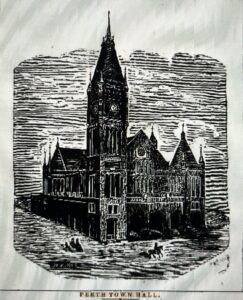 PERTH TOWN HALL.
THE design of this building is the joint production of J. Manning, Clerk of Works Convict Dept. and R. R. Jewell, the Colonial Clerk of Works ; the foundation was laid on the 24th May, 1867; by H. E. Govenor Hampton, and it was opened on the 1st June 1870 by H. E. Governor Weld. The general supervision of the work devolved upon Mr. Jewell, who was on the spot, while the joiners work and the entire construction of the roof was under the direction of Mr. Manning. The circular ribs were conveyed from Fremantle Prison upon a carriage constructed for the purpose by Mr. Manning. The roof is laminated, and while it is very light, it combines more than the necessary strength. The size of the room is 92 feet by 46 feet, and the height 28 feet to the corbel of the roof, and 28 feet from there to the ridge of roof. The superficial capa-city of the room is 4,232 feet, and will seat 1,000 persons independent of the gallery, The principal entrance is by the North East tower; there is also an entrance by the North West tower by a narrow well staircase.
The site of the Hall is well chosen, being situated in the centre of the business portion of the city. The basement of the hall is intended for a market, but has not yet been used for that purpose. Several of the bays have been converted by the City Council into offices. The acoustic properties of the Hall are very bad, owing to the open roof ; this might in a great measure, be re-medied by the construction of a sounding board over the platform, or by ceiling in the roof.
Several large public meetings have been held in the Hall, the most important being that held on the 17th inst., a report of which is given in another column. The largest gathering was at a monster tea meeting, given the day after the opening. The following statistics may prove of interest. The material employed in its construction com-prised, 1000 cubic yards of stone, a million and a quarter of bricks, 9,442 bushels of lime, 78,000 feet mahogany, 96,796 sawn and 39,760 split mahogony shingles. The height of the tower is 140 feet. The clock chimes the quarters and can be illuminated. An Annexe at the east end is fitted up as a temporary Legislative Council Chamber. The building suffered some trifling injury by the gale of the 10th ultimo, but has since been repaired.
Herald (Fremantle, WA : 1867 – 1886), Saturday 20 April 1872, page 1
1898
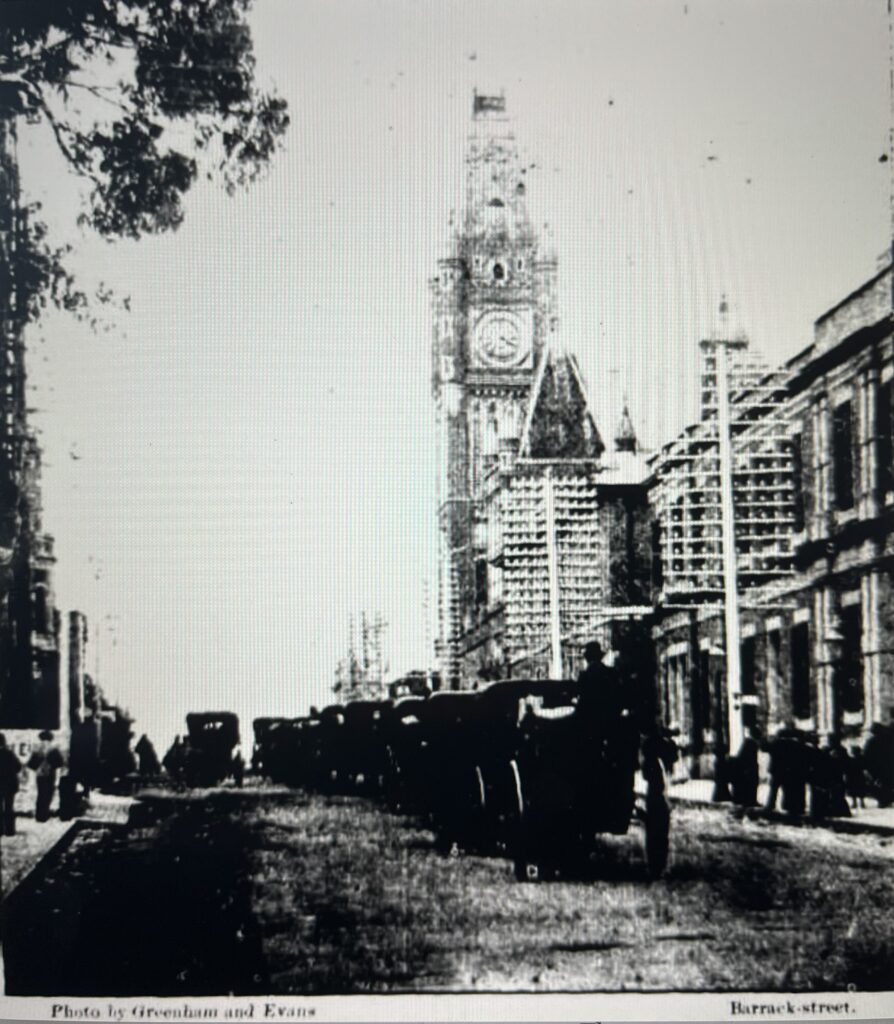 PERTH TOWN HALL SEEN FROM THE TERRACE.
BARRACK STREET VIEW.
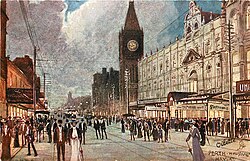
The Town Hall, while not of the im-posing size of the municipal buildings of the Eastern colonies, has a character of its own that makes it an integral part of Perth pictorially considered. Its weather-beaten brick, mellowed by years of sun and rain, has an air of age and solidity, while the clock tower is well proportioned and adds vastly to the appearance of Barrack-street and Hay-street, at the intersection of which it stands. There were negotiations for the transfer of the building to the Government, both the municipal and Government offices being cramped by being stationed in a block insufficient for the accommodation of both. While the municipal buildings and the Town Hall of the future may rear a larger and more imposing front on another city block, the present structure should be carefully preserved and enabled to live into that great age of which its firm and stable composition gives promise. It has been suggested that to it might be transferred the General Post Office. For this use its central position would admirably adapt it.
Western Mail (Perth, WA : 1885 – 1954), Friday 28 October 1898, page 23
1906
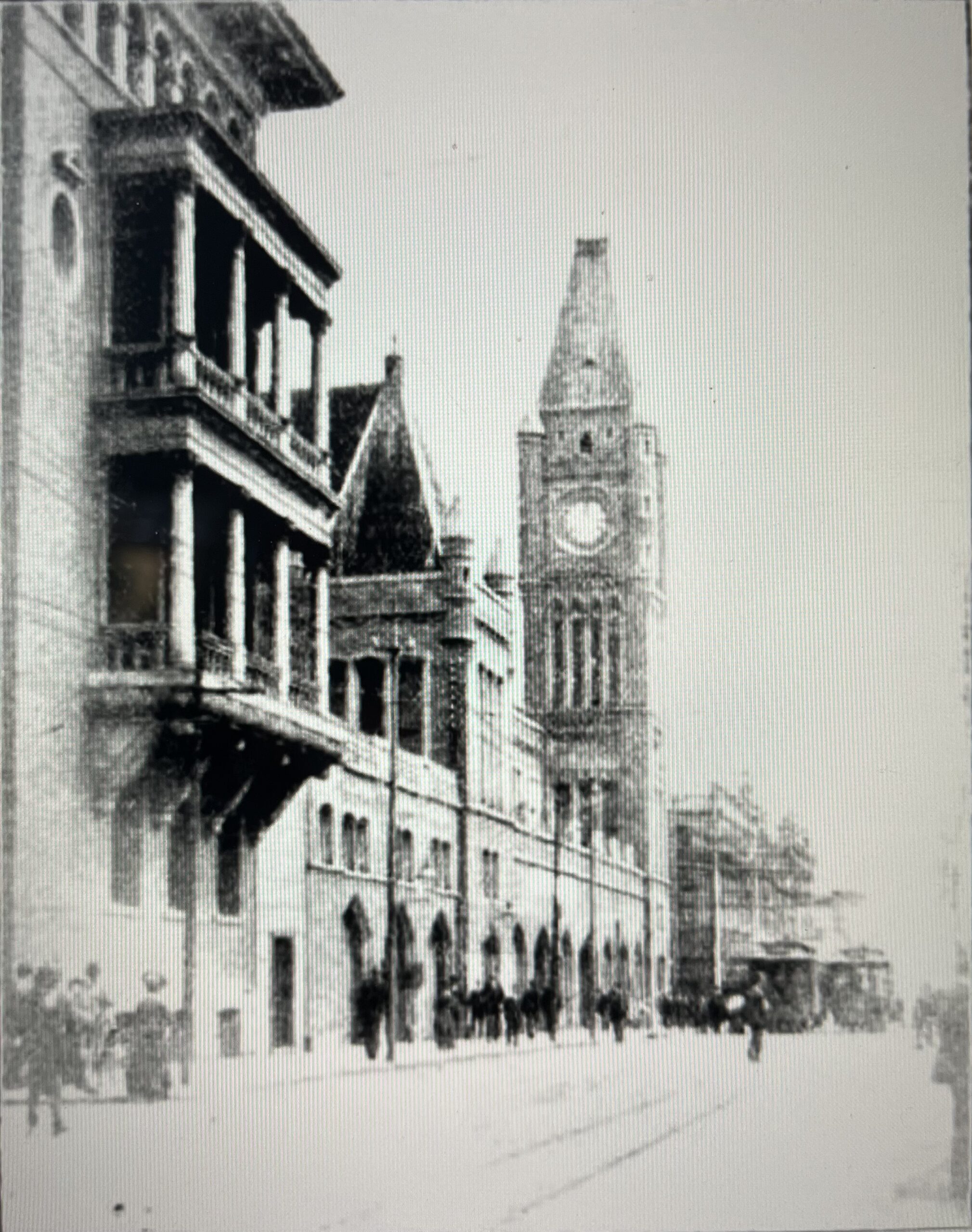
Western Mail (Perth, WA : 1885 – 1954), Saturday 29 December 1906, page 28
1922
 PERTH TOWN HALL. – ITS ROMANTIC CHARM. (By E.D.B.)
Modern though it be Perth is a city of romance. There is romance for those who would seek it in the rapid growth which has followed the gold discoveries of the early nineties. There was romance in the dreamy old town which for more than sixty years had slept peacefullg under the wooded slopes of Mount Eliza. There are few in Perth to-day who can recall the town of fifty years ago. So strong was the infusion of new blood during the early years of the gold rush, so many of the pioneers have passed away, that to most of us the capital of those bygone days belongs to a different age as it belongs to a different century. It is natural enough that little of the old town has survived. There would be little of it that could be tolerated to-day; and it is scarcely a matter for regret that the new city has almost obliterated the old. It should be, however, a mat-ter for great rejoicing that there are still left to us a few of the ancient land-marks deserving of a better fate than their fellows. Foremost amongst these is the Town Hall. A splendid specimen of late Gothic architecture, perfect in proportion, rich in historical association, dignified and distinctive it rises serene above this medley of modern shops and offices—the city of to-day. Perth could ill afford to lose it. Australia does not own its equal; and though familiarity has dull-ed the appreciation with which some citizens regard it visitors involuntarily acclaim its beauty and acknowledge its romantic charm. Built in the days when Perth was a scattered town of 5,000 inhabitants it could hardly be expected that the Town Hall would serve the needs of the modern city. It speaks volumes for the fore-sight of those to whom we owe it that it has fulfilled its function for so long. In those early days no vast expansion of the capital was to be looked for. Gold had been sought in the colony for several years but without success. The Eastern diggings had attracted from the col-ony a large proportion of its young man-hood, and the stagnation which had marked the settlement from its earliest days seemed to have fastened upon it as a permanent blight. Labour difficulties had arisen of such magnitude that the colonists were obliged to supplicate the Imperial Government for that which their Eastern neighbours would tolerate no longer—the transportation of convicts. And yet, with no bright hopes for the future, the erection of such a building was commenced. Are we of the present generation so far-sighted? Survivor of these desolate days can it be wondered that the Town Hall, with its historical appeal, should have won a place in the affections of the people? For the Town Hall has a very definite historical appeal. Conceived and erected while Western Australia was a Crown colony under the most primitive form of Government known to the Anglo-Saxon its opening synchronised with the dawn of a new era. On that occasion the Governor of the day announced that he had signed an ordinance to establish representative government in the colony and to accommodate the newly-created Legislative Council the erection of the present Government Savings Bank was immediately commenced. In 1890 after the granting of responsible government and for the following thirteen years the Legislative Assembly carried on its de-liberations in the Council Chamber, the council sitting in the building now occu-pied by the Agricultural Department. It is our duty to preserve these build-ings, the only Houses of Parliament known to the late Lord Forrest during his long administration of the State, the birthplace of the bold constructive mea-sures connected with his name. May they continue long to stand grey remin-ders of the pioneering days. Let no im-pious hand be raised against them. Though of comparatively recent con-struction, the Town Hall has features whose origin is shrouded in obscurity. Tradition and legend have already gath-ered round its prematurely hoary head. The most interesting of these relates to the broad arrows and the hangman’s rope perpetuated in the tower. It has been held that these were inserted by the working convicts as a reminder of, or a protest against, the fact that the building was erected by their labour. A material-istic age has ridiculed this belief, and it has been stated that they are accepted architectural devices. This may be true—it is certainly difficult to disprove— but inquiries amongst a number of Perth’s leading architects fail to reveal any known instance of the earlier use of the broad arrow. Sceptics, at length, are losing their assurance : doubters are coming to believe; and the opinion is gaining ground that the arrows, whether they were the grim jest of the con-victs or deliberately inserted by the de-signer, owe their origin, as Australia owes something of its colonisation, to the penal system of the mother country. Should any reader know of an instance where the device has been used in ear-lier work he will be able to deal with this persisting theory. But if it is accepted that the architect originated the device it must be conceded that he did so with a full knowledge of its associations. Another story, though not in such wide circulation, is that the tower, if not the whole building was designed as an act of friendship by Sir Charles Barry, well known as the architect of the Houses of Parliament in London. This would ap-pear to be pure surmise, with no weight of evidence to support it. In contempo-rary records Messrs. Jewell and Man-ning were the accredited architects, and their signatures appear on those plans of the building which are still in exist-ence. It must, however, be admitted that working plans of the tower are con-spicuously absent from the file, and this fact may have some bearing on the mat-ter. We can only be grateful for one solid fact in the vague mists of conjec-ture. Whatever doubts may be enter-tained as to the architect’s identity, his taste and ability are beyond all que-stion. Friday, May 24, 1867, Queen Victoria’s birthday, was an unprecedented event in the life of the small community. In those spacious days it was customary to celebrate the Queen’s birthday with mili-tary honours, but “on this particular occasion,” so runs the contemporary re-cord, “the day was made especially at-tractive to our colonists by the ceremony of laying the foundation stone of a Town Hall and Market Place. The city pre-sented the liveliest appearance, decked with flags and stirring with people.” This stirring throng represented a crowd of something like twelve hundred or fifteen hundred persons. It was ex-pected that the building would be com-pleted in about twelve months, but it was not, in fact, ready for occupation until about three years later. So slowly did the work proceed that in 1869 the “Morning Herald” remarked of the growing hall that it would cost the colony a very large sum of money; but it would no doubt at some distant date be found useful. That it has been found useful over 50 years of civic duty will attest. That it will continue to be useful in another sphere is the earnest hope of its many admirers. For though it may no longer cope with the city’s requirements as a Town Hall, position and association fit it admirably for an historical museum where all that belongs to the early days may be collected for safe keeping. The laying of the foundation stone was one of the last official duties performed by Governor Hampton. The opening fell to the lot of Governor Weld, and was performed on June 1, 1870, the forty-first anniversary of the foundation of the colony. At an official banquet connected with the ceremony Mr. Jewell delivered himself of the following figures relative to the new structure. The average number of men employed on the work during the three years was 15 me-chanics and 19 labourers daily. The building absorbed one million and a quarter bricks, and 1,000 cubic yards of stone. The roofing required 96,797 sawn and 39,760 split shingles. The founda-tions, as a whole, supported a weight of 3,900 tons, and the lowermost bricks of the tower (125 feet in height) carried a weight of almost one ton and three quarters each. This, briefly, is the story of the Town Hall. For over half a century it has adorned our city, setting a standard in good taste and classic design that has seldom been followed in Australia.
West Australian (Perth, WA : 1879 – 1954), Saturday 21 October 1922, page 10
1925
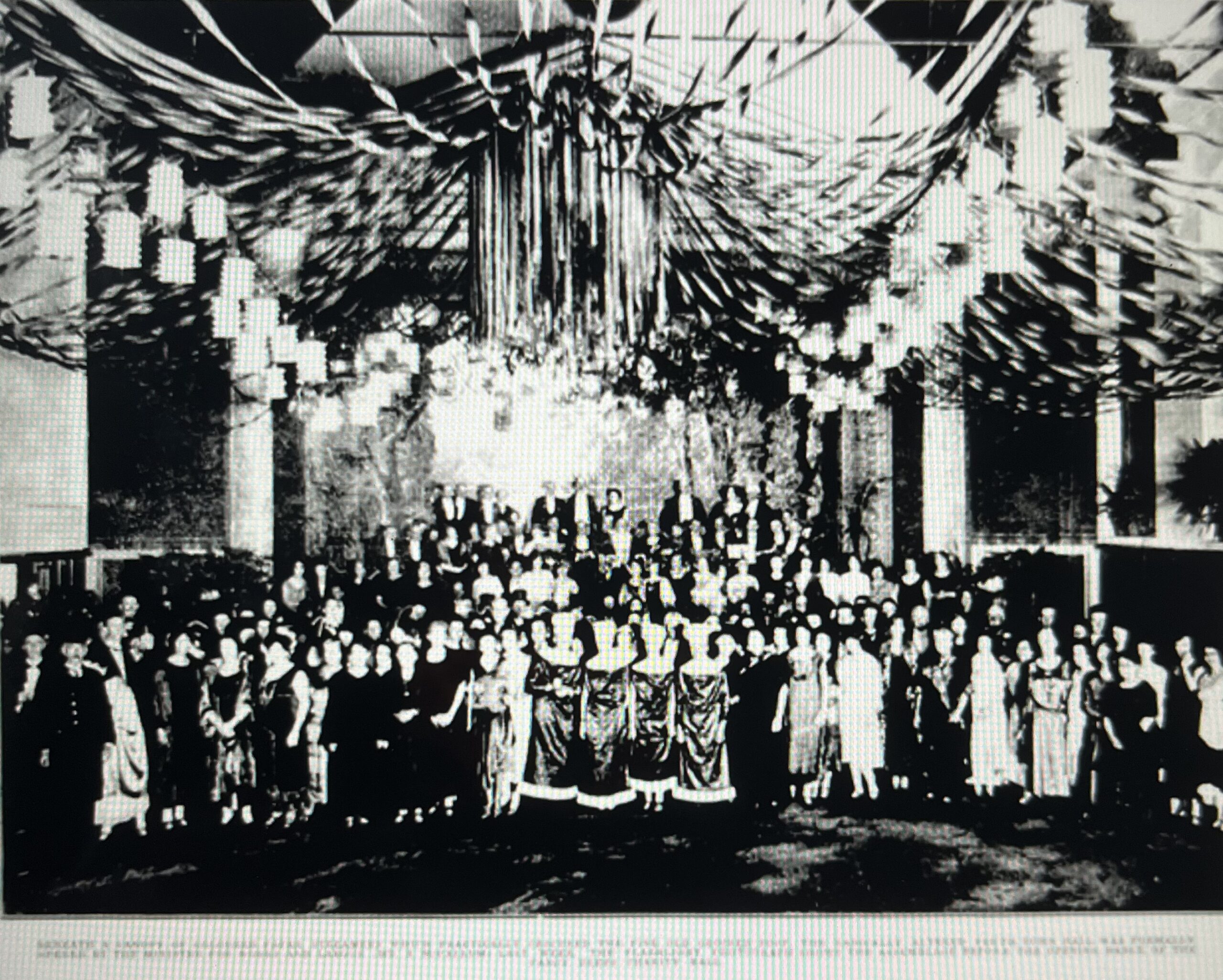 THE LAST ACT: PERTH TOWN HALL RE-OPENED.
Western Mail (Perth, WA : 1885 – 1954), Thursday 27 August 1925, page 3
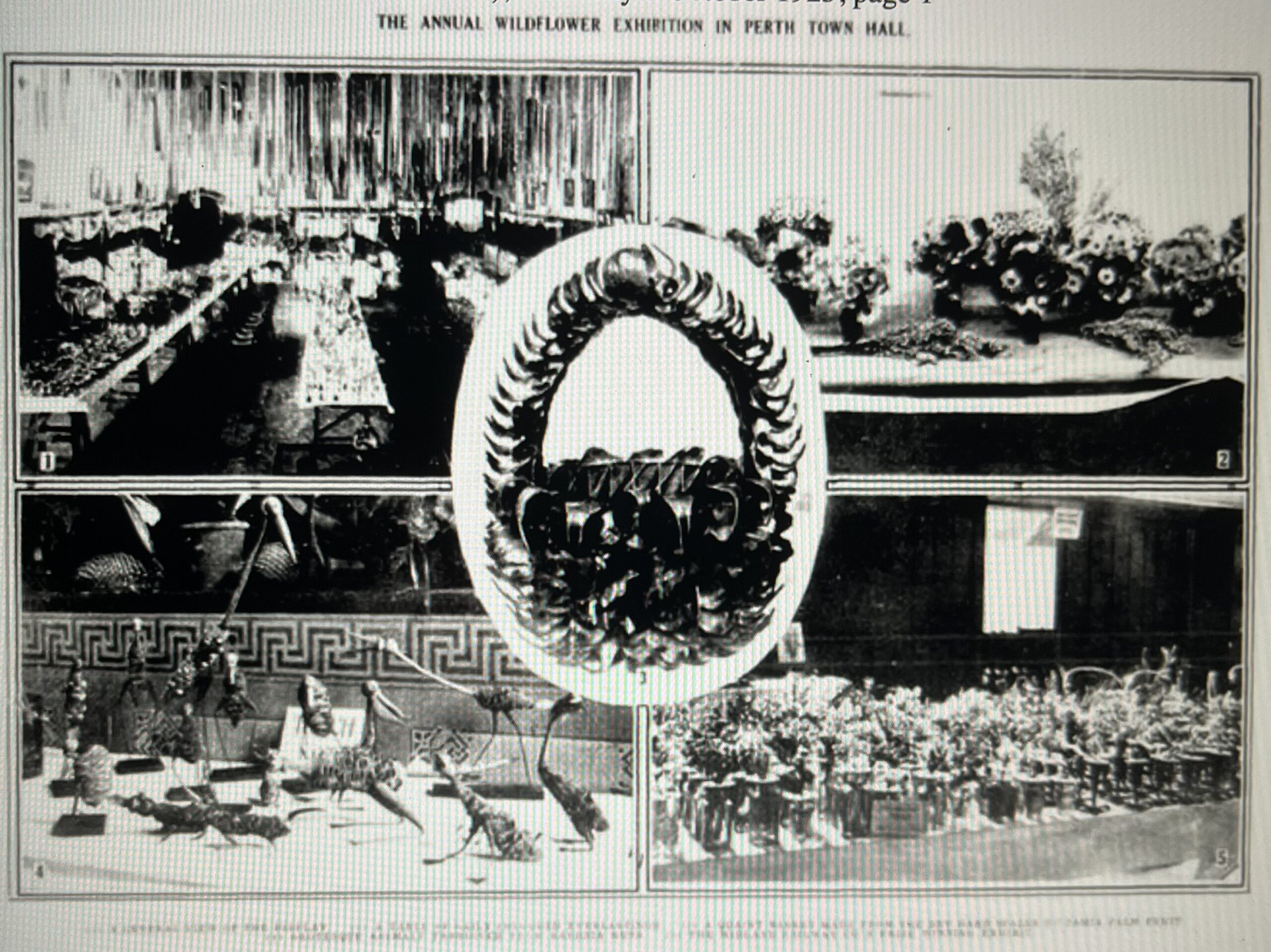
THE ANNUAL WILDFLOWER EXHIBITION IN PERTH TOWN HALL.
(1) GENERAL VIEW OF THE DISPLAY (2) A TABLE OF GAILY COLOURED EVERLASTINGS. (3) A QUAINT BASKET MADE FROM THE DRY HARD SCALES OF ZAMIA PALM FRUIT (4) GROTESQUE ANIMALS FASHIONED FROM BANKSIA NUTS (5) THE MIDLAND RAILWAY CO.’S PRIZE WINNING EXHIBIT
Western Mail (Perth, WA : 1885 – 1954), Thursday 8 October 1925, page 1
1927
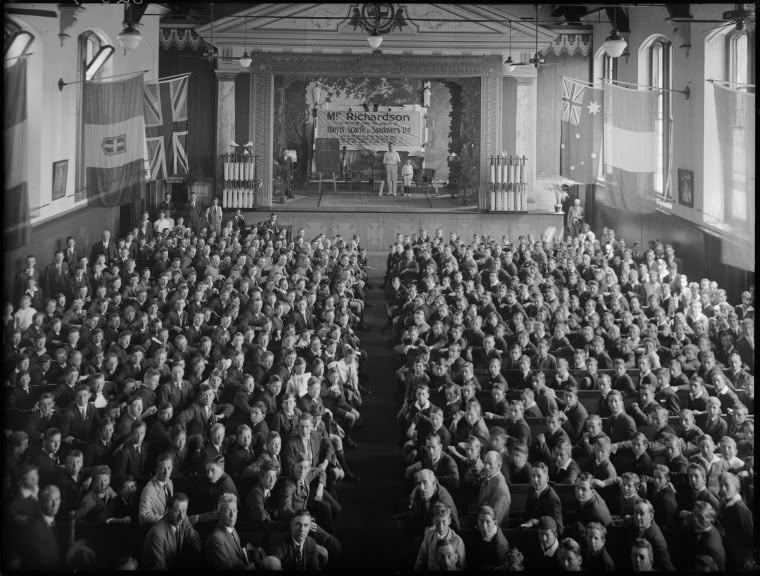
Cricket advice filled the Town Hall (22 October 1927)
Rows of young listeners fill Perth Town Hall for Arthur Richardson’s lecture on 22 October 1927. The subject was practical advice for young cricketers, and the packed room shows how much interest the game could draw beyond the boundary rope.
The camera faces the audience as much as the stage. Hats, jackets and carefully arranged rows turn a sporting talk into a vivid record of a community gathering, with the hall itself framing the occasion.
Photo credit and reuse: State Library of Western Australia
https://www.facebook.com/photo/?fbid=122124900225316546&set=a.122119686243316546
1929
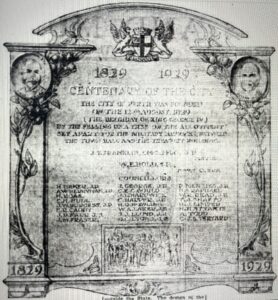 TABLET FOR PERTH TOWN HALL
1930
CONCERT TO-NIGHT
In Perth Town Hall
An orchestral concert will be given by the Perth Symphony Orchestra under the baton of Mr. H. T. Newton, at the Perth Town Hall this evening, commencing at 8.45. Gems such as the “Merchant of Venice Suite” and the “Egmont Overture” are features of the programme, while vocal items will also be contributed. A collection will be taken in aid of the unemployed musicians.
Sunday Times (Perth, WA : 1902 – 1955), Sunday 21 September 1930, page 2
1933
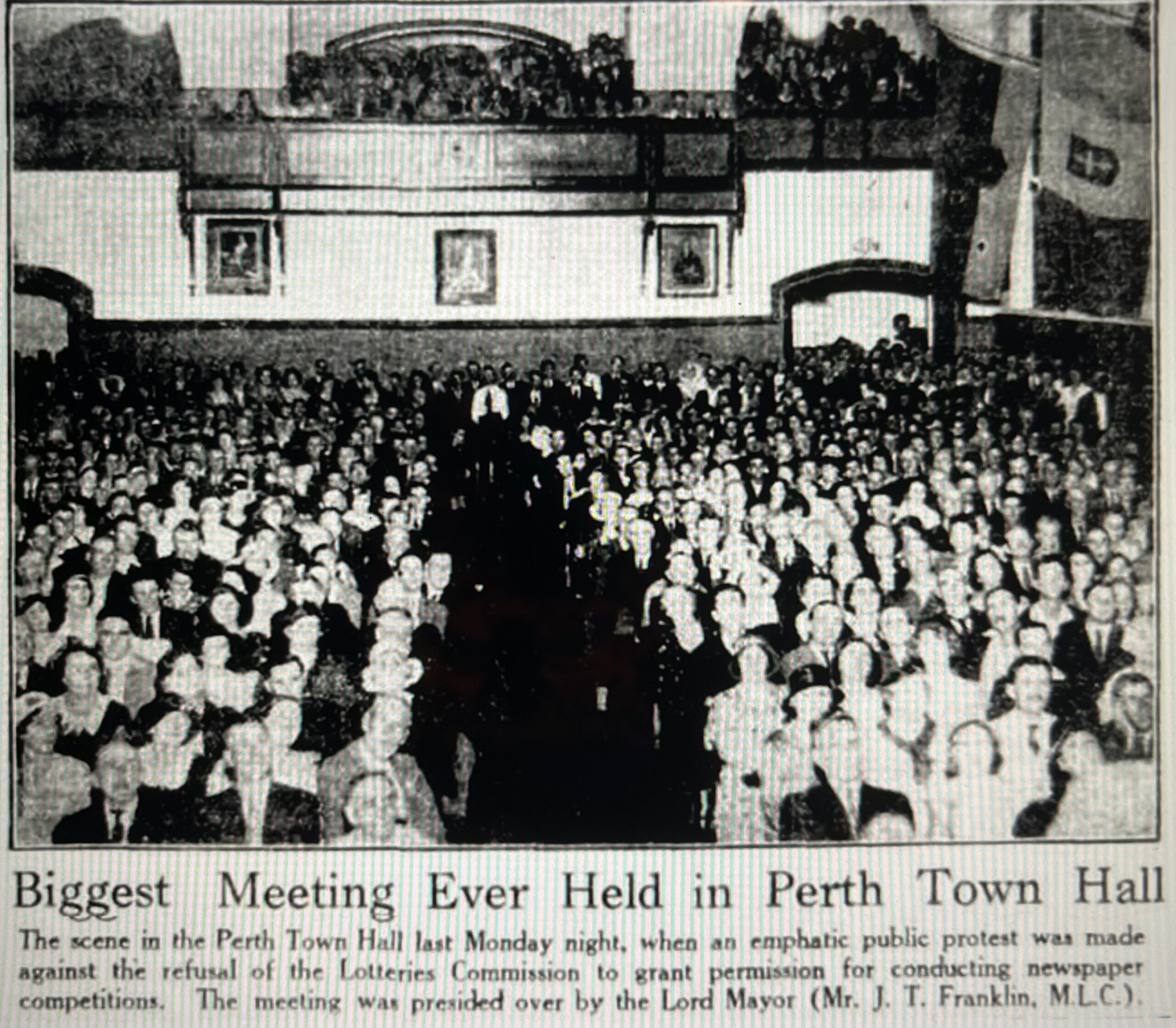 Biggest Meeting Ever Held in Perth Town Hall
The scene in the Perth Town Hall last Monday night, when an emphatic public protest was made against the refusal of the Lotteries Commission to grant permission for conducting newspaper competitions. The meeting was presided over by the Lord Mayor (Mr. J. T. Franklin, M.L.C.).
Sunday Times (Perth, WA : 1902 – 1955), Sunday 19 March 1933, page 3
MUSIC FESTIVAL
Opening at Perth Town Hall
The opening of the Ninth Musical Festival organised by the West Australian Music Teachers’ Association took place this afternoon in the Perth Town Hall. It will be continued tonight and tomorrow. Each year the council of this society voluntarily carries out the arrangements of a series of musical competitions. The entries, in spite of the stringency of the times, are especially good. The committee has been particularly fortunate this year in that it has been able to obtain the services of two adjudicators. Mr. William G. James, known throughout Australia as a composer and pianist, who visited Perth in the same capacity in 1928, has through the courtesy of the commission been enabled to visit Perth once again. Mr. Steuart Wilson, a noted English tenor and adjudicator, who is visiting Australia for the first time, will arrive in Fremantle tomorrow, and vocalists will have the opportunity of being criti-cised by a practical exponent of their art. The two judges will collaborate in the choral work. Tonight the festival will be officially opened by Mr. Basil Kirke. Mr. James will give his decisions in the following sections:— Percussion band, piano duet (under 13), Girl Guides’ choirs, violin solo (un-der 17), piano solo (under I8), violin prize-winners, and the duet for two pianos (open). Tomorrow morning 26 violinists under the age of 13 will face the adjudicator, whilst 42 pianists under 14 will compete for first and second place. In the after-noon 26 women and 15 men who have never won a prize will sing the songs set for these sections. Admission during the morning and af-ternoon session is: Adults 1s, children 6d, whilst for the evening programme, which commences at 7.30, the charge is 1s 6d, excepting the grand choral con-test, which takes place on Wednesday, June 28, when the tickets are 2s, book-ing free, at Nicholson’s.
Daily News (Perth, WA : 1882 – 1955), Monday 26 June 1933, page 7