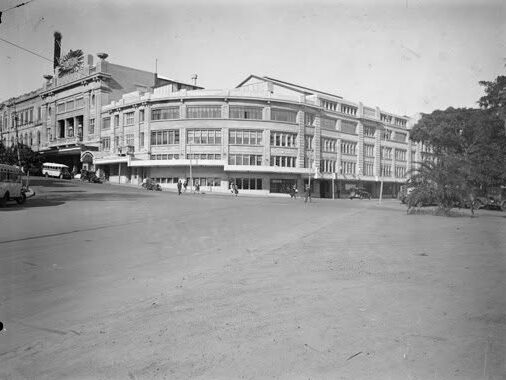
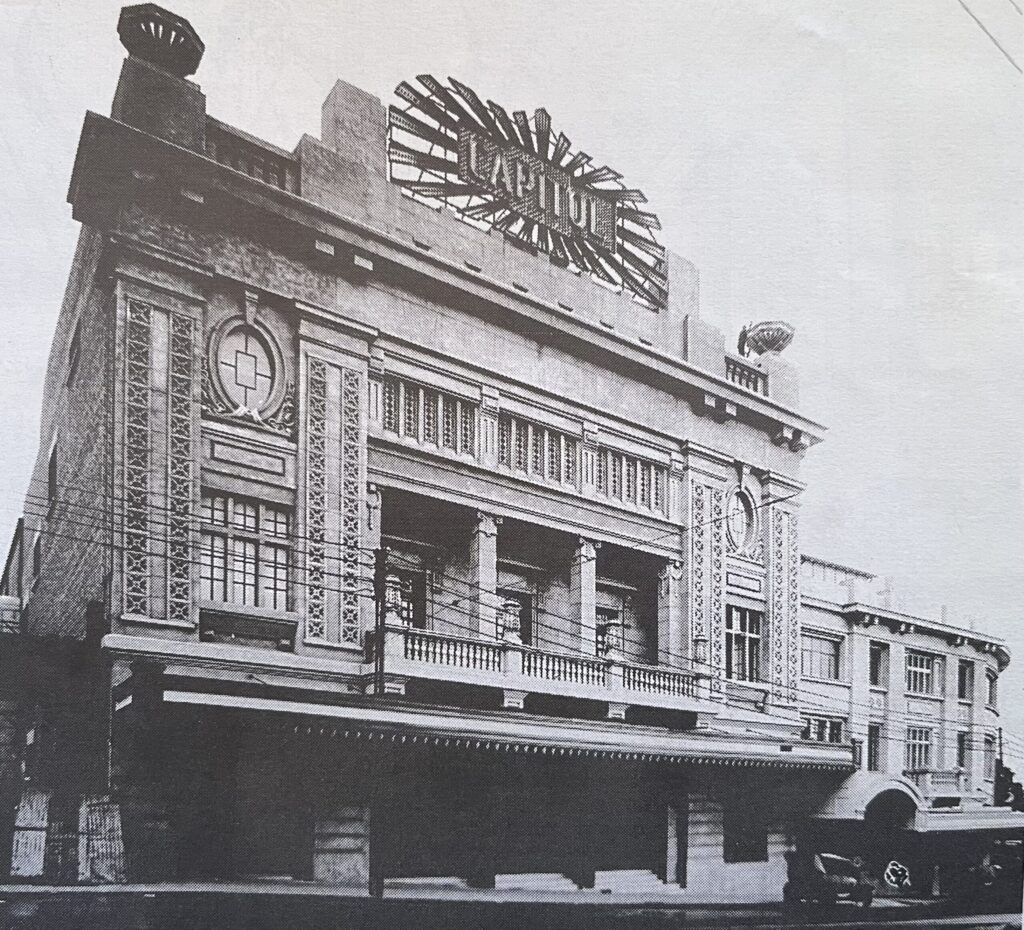
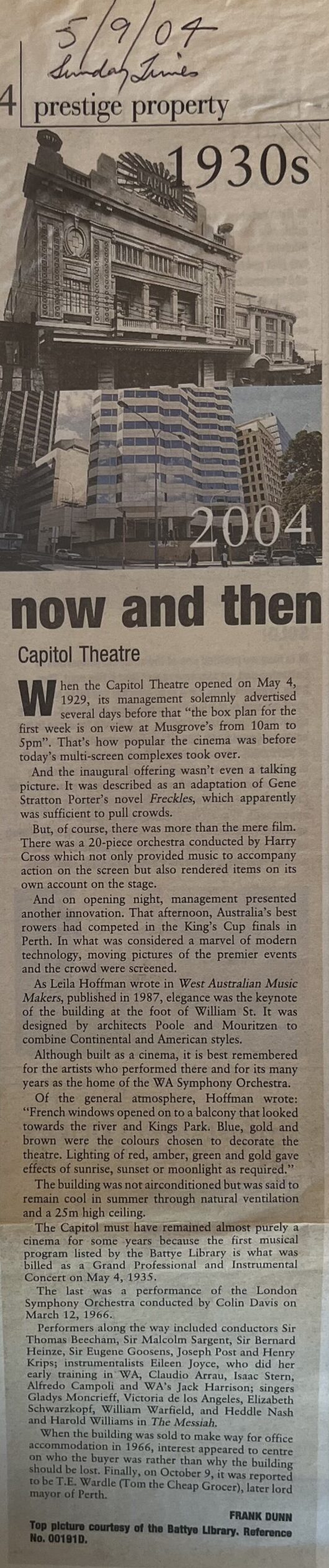
 The Capitol Theatre, located at 10 William Street, Perth, was designed by architects George Temple Poole and Christian Frederik Mouritzen and was officially opened on Saturday, 4 May 1929, by the Lord Mayor of Perth, James Thomas Franklin.
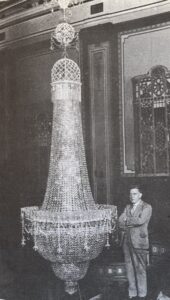
Located in lower William Street, the Capitol’s pride was the chandelier, comprising 62,000 crystals and weighing one and a half tons.
A bust of Rudolf Valentino stood in the foyer – often blood red from the lipstick kisses of his fans.
Like the Ambassadors Theatre, the capitol had weekly changes of variety shows to accompany its films. These variety shows ultimately fell victim to the Depression.
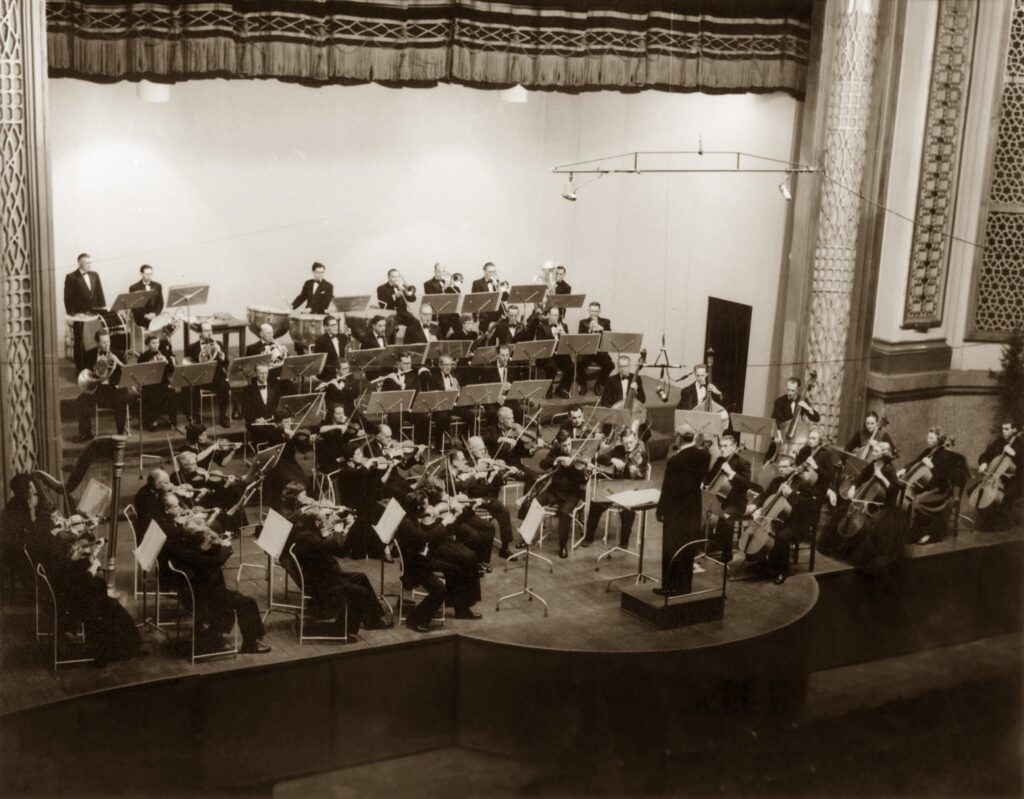
What do Noel Coward, Laurence Olivier, Dame Joan Sutherland and the Rolling Stones have in common? They all battled the bad acoustics at the Capitol, the vast 2200 seat picture palace created by architect George Temple-Poole at the end of his distinguished career. The West Australian Symphony Orchestra and A.B.C. Celebrity Artists also used the venue.
King, Ivan, Screen and Stars, (The West Australian Newspapers Limited), p.15-17
1927
PUSHING ON WITH PERTH’S OWN CAPITOL.
Comprehensive Building Plans :Temple Court’s Big Enterprise.
Some day, perhaps, Perth’s only pedestrian will be “the last of his tribe” — an interesting relic of a past age in a wheeled realm. It is a common picture to see congested city motor traffic, long parking lines and new garages.
Practical folk often wonder why owners, when they spin into Perth to “take in” a show at night, are content to leave their cars exposed to the elements. To meet the demand for an organised method of coping with the parking of cars is the aim of the company controlling the garages now being erected as part of the imposing Temple Court Buildings at the corner of William-st. and the Esplanade. The concern, on completion, will be something unique in the West, for the buildings will comprise A PALATIAL THEATRE, commodious garages and up-to-the minute cabaret-tearooms. Centrally situated and offering to the motorist seeking evening entertainment the opportunity of leaving his car at an accessible spot in the same buildings, they’ll have a strong appeal. Entrance to the garages will be made from the Esplanade to the first floor, and from William-street to the second floor. To obviate the chance of damage when manoeuvring the car to its desired location within, it will be transported to its appointed place by means of a trolley running on under-ground rails. On the third floor provision is being made for forty suites of offices, while on the fourth will be the cabaret-tea rooms. Naturally the last-mentioned should materially assist in swelling the business for the garages. A THIRTY YEARS’ LEASE has been given of the theatre, which has accommodation for 3,000 but in which seating is being arranged for 2,800. The designs for both stalls and circle seats show them to be roomy, comfortable, and natty in appearance. At least £21,500 is to be lavished on fhe furniture, fixtures and fittings.
An American-built organ will cost in the vicinity of £11,500, and with some of the best features of the Melbourne Capitol — such as indirect lighting and an orchesrra pit which can be raised or lowered at will — the local Capitol in the Temple Court Building should be a first-class theatre. In the summer it will gain the benefit of the cool river breezes, and the fresh air entering into the first-floor garage should assist in the ventilation of the theatre itself. According to Mr. A. W. Crooks, A.A.I.S.. secretary to Temple Court Buildings Limited, the contract signed provides for the COMPLETION OF THE THEATRE section by the end of the present year. Apart altogether from the anticipated profits from the garages, the company expects, on revenue from rents alone, to secure 13.6 per cent per annun on the total capital subscribed. It is a convincing testimonial to what they consider the soundness of the proposition that the company’s bank has consented to a loan of £60,000 for building purposes. The striking recommendation of Temple Court Buildings Ltd., it has been pointed out, is that it represents a centrally situated city freehold proposition. Values in Perth have jumped with Springheel Jack leaps in recent years, and in a growing city with a wonderful future in front of it, an attractive “bricks and mortar” security makes a strong appeal. Applications for shares, details of which appear elsewhere, are now being received and may be lodged at the companies offices, Warwick House, St. George’s-terrace, Perth. ‘The Mirror’ has had a peep at the building operations, and the progress being made promises well for the future.
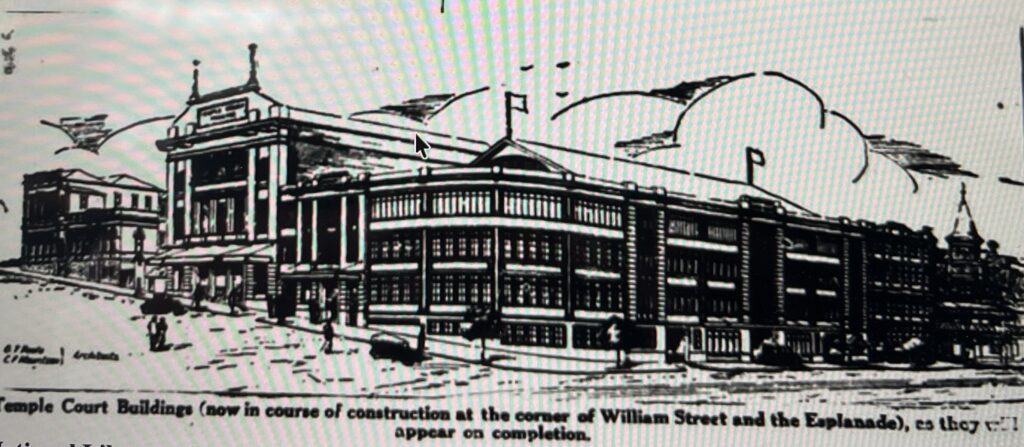 Temple Court Buildings (now in course of construction at the corner of William Street and the Esplanade), as they will appear en completion.
Mirror (Perth, WA : 1921 – 1956), Saturday 26 March 1927, page 8
1928
CAPITOL THEATRE
An Ambitious Scheme of Lighting
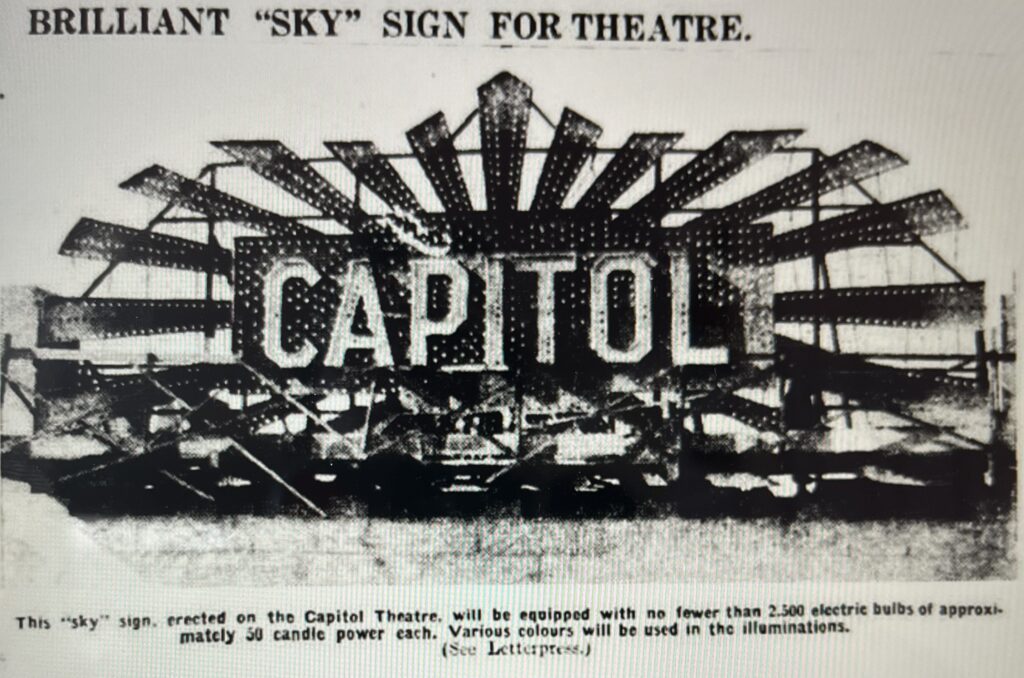
Something in the nature of a revelation in theatre illumination is promised at the Capitol, now in course of construction as part of Temple Court. When the doors are thrown open for the initial performance, the William-street frontage will be crowned by an electric sky sign as elaborate and magnificent as anything to be found in the bigger cities of the Eastern States. Not only for size, but also for its color scheme and ingenious flashing arrangements will the sign be remarkable. Measuring 40ft. by 20ft. high, it will contain 2500 natural colored lamps, emitting, over 125,000 c.p, In bold white lettering “Capitol” will blaze forth from a royal blue back-ground, while sparkling rays, blended from deep orange to pale gold, will constantly flow into space in representation of a flashing sun. The color combination will tone perfectly with the tinted columns on the front of the theatre, giving a most artistic effect, in that concealed lights will take the place of actual glaring lamps.
Indoors there will be additional examples of the electricians’ skill. In the main foyer will be a bronze statue of a beautiful woman in the attitude of drawing water from a fountain. The statue, mounted on a pedestal of marble, will stand on a massive marble bowl, in which goldfish will disport themselves, while, by means of lighting effects, the water constantly undergoes changes of color. A lounge alcove developed from the old English fireplace designs will be finished in lead-light, suffused in a soft glow of amber light.
The theatre will be capable of adaptation for any kind of performance, musical comedy, vaudeville, or high class concert. No longer will it be necessary for visiting companies to provide their own electrical effects, for there will be available complete facilities to command the multifarious scenes of sky, earth, and sea. To mention only a few, it will be possible to depict sun, moon, stars, Aurora Borealis, blizzard, burning forest, flowing water, storm cloud, lightning, rainbow, rains squalls, sand storm, pyrotechnic, and the numerous other effects necessary to lend color and realism to the varied shows. Over 1000 lights, ranging from 30 to 1600 c.p. each, will illuminate the stage. For the auditorium, roughly 175,700 c.p. will provide illumination in colors of blue, white, red, and amber. The only fixture visible to the audience will be a beautiful chandelier suspended from the centre of the dome, 16 1/2 ft. long, and 12ft. in diameter, containing 300 to-tally concealed and vari-colored lights reflected by thousands of prisms. An Australian-made dimmer that alone represents an outlay of £1600 will guarantee an entire absence of flickering, and give instead a light-dissolving effect.
Mr. Geo., Mitchell, whose electrical wonders at the Empire Theatre, in Sydney, the largest musical comedy theatre in Australia, created a sensation, and who was also connected with the electrical installation at St. James’ Theatre, Sydney, has received instructions to devise the best scheme that his long and world-wide experience can suggest, and we have his assurance, that when the Capitol is finished, theatregoers of Perth will havesomething to talk about. An auxiliary plant is to be installed as a safeguard against any failure of the town electric supply, and battery lights will illumine staircase landings and exits at all times.
Sunday Times (Perth, WA : 1902 – 1955), Sunday 15 January 1928, page 8
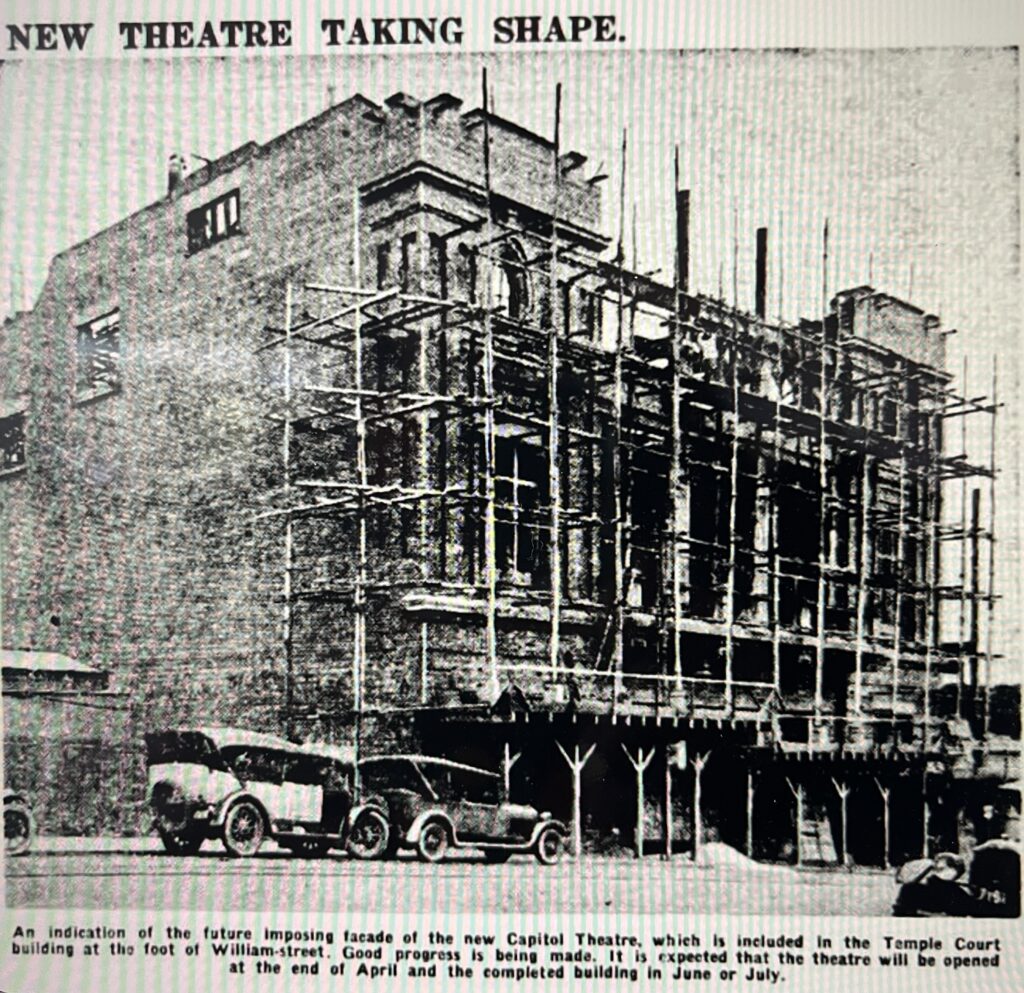
NEW THEATRE TAKING SHAPE.
An indication of the future imposing facade of the new Capitol Theatre, which is included in the Temple Court building at the foot of William-street. Good progress is being made. It is expected that the theatre will be opened at the end of April and the completed building in June or July.
 West Australian (Perth, WA : 1879 – 1954), Wednesday 25 January 1928, page 16
HARVEY FOR PERTH
CAPITOL’S NEW ORGANIST Leslie V. Harvey, organist At the Prince Edward Theatre, Sydney, will terminate his engagement with the Carroll management on February 18, and Eddie Horton will return to the console on February 20. The news will create some surprise in Sydney film circles, although Harvey’s intention to retire was known in America early in December. Many prominent Californian organists have applied to Dan Carroll by cable and letter for the berth, but the choice has fallen on Horton, who was the organist at the Prince Edward when the house was opened. HARVEY’S NEW CONTRACT is with Stanley N. Wright, at the Capitol Theatre. Perth, while by a coincidence Horton will finish his engagement at the Regent, Perth, to return to the Sydney house. Before taking up his new post Harvey will tour Australia on a vacation with his mother, who is expected in Sydney from U.S.A. this month. He will play the opening weeks of ‘The Scarlet Letter,’ which follows ‘What Price Glory’ into the Prince Edward, and Horton will pick up during the season in the same way that Albert Cazabori took over Will Prior’s baton while ‘Ben Hur’ was running.
Mirror (Perth, WA : 1921 – 1956), Saturday 28 January 1928, page 6
CAPITOL THEATRE
Decorative Scheme
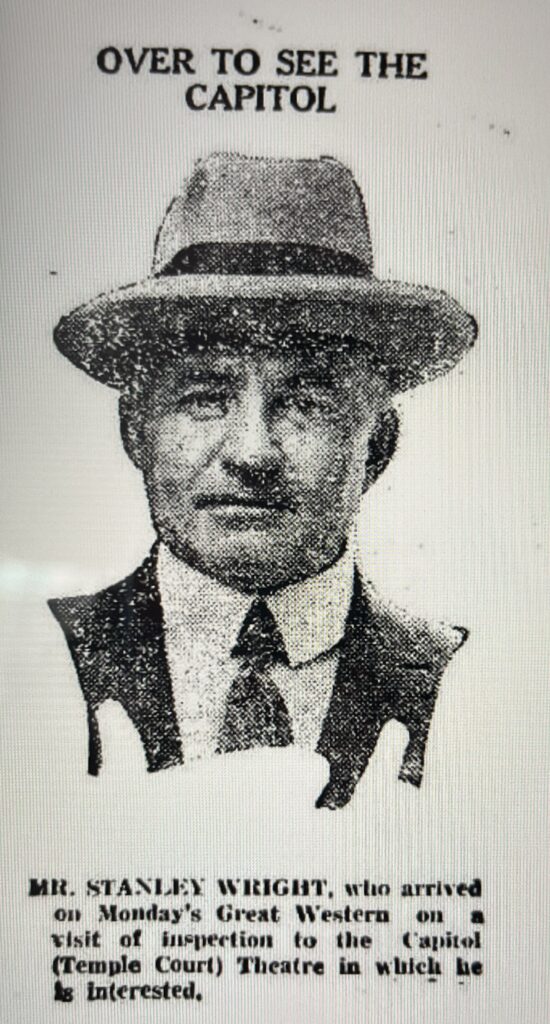
Mr. Stanley Wright, who is leasing the Capitol Theatre, arrived by the Transcontinental express this morning, and was met by Dr. Wright. Mr. Wright said he had been successful in securing the services of Mr. Leslie J. Harvey, late of San Francisco, and recently of the Prince Edward Theatre, Sydney, as organist of the three manual organ which is to be installed in the theatre by Messrs. Crowle and Co., of Sydney. The organ, which is the largest yet imported into Australia, is now in bond in this State, and it is expected a commencement with the installation will be made in about three weeks’ time. The interior decoration of the theatre will be along the lines of the Prince Edward Theatre, Sydney, the prevailing colors being blue, ivory, and gold. Silk panelling will also be extensively used, giving a sense of real dignity andf refinement to the place. An innovation to be introduced into the entertainments to be presented will be the appearance of stage bands, comprising both brass and wood-wind instruments. These combinations will play specially selected items, with appropriate settings. Nothing definite as to when the theatre will, be opened is available yet, Mr. Wright saying he preferred that adequate time should be taken to make a good job of the construction and decoration.
Daily News (Perth, WA : 1882 – 1955), Monday 30 April 1928, page 7
Call News-Pictorial (Perth, WA : 1927 – 1931), Friday 4 May 1928, page 12
BRILLIANT ‘SKY’ SIGN FOR THEATRE.
This ‘sky’ sign, erected on the Capitol Theatre, will be equipped with no fewer than. 2,500 electric bulbs of approximately 50 candle power each. Various colours will be used in illuminations.
West Australian (Perth, WA : 1879 – 1954), Thursday 28 June 1928, page 20
EARLY IN NEW YEAR
Capitol’s Opening
Possibly one of the most unique situations in Australia had to be faced by Stanley N. Wright for the new Capital Theatre, Perth. The theatre is part and parcel of the Temple Court £150,000 building proposition, £80,000 of which is being devoted to the theatre exclusive of furnishings, writes ‘Everyone’s.’ ? With Hoyts on one side controlling two theatres and the Union on the other with four houses, the first release film situation was acute and speculation has been rife for months as to how Wright would handle it. During the last 18 months he has made a study of Perth attendances, and has insisted that his board should not contemplate opening the Capitol until the Ambassadors had been launched and the general situation such that a perspective could be viewed of the whole field. ‘We will open,’ says Wright, ‘early in the New Year as the most modern theatre in Australia.’ The figures he compiled, estimating the attendances at the various houses, make interesting reading: — Ambassadors, handling 13 per cent, of Perth’s population, Prince of Wales 4 1/2 per cent.; Regent, 5 1/4 per cent.; Grand, 3 per cent.; Majestic, 2 3/4 per cent. The Ambassadors, Prince, Regent and Majestic are first release. Recently the Grand has been a combination. Perth’s population is 183,000. So that the untouched possibility of films after they have been screened in the various theatres equals a city with a population as under: — After Ambassadors, 159,000; after Prince, 175,000; after Regent, 173,000; after Grand. 177,000; after Majestic, 179.000. ; Mr. Wright states his policy will be the same as Herman Phillips’ at the Palais. St. Kilda; the pick of the city pictures, plus a featured operatic orchestra, playing on stage and accompanying in pit. The Ambassadors and Regent Orchestras consist of 16 players. It is announced that the Capitol will instal 30 and use them twice daily.
The house will seat 2600. It was the original intention to us? 15 players and a Wurlitzer organ. Since that policy was contemplated, however, two organs have been installed in Perth, and one of them, in addition to being played at both afternoon and evening de luxe sessions, is also the musical accompaniment for the intermediate sessions, starting early morning, and is used in addition at the evening intervals. ‘This is necessary,’ he says, ‘that I should have an outstanding musical novelty, and introducing a permanent orchestra of 30 pieces in place of an organ, I consider that I will have such an attraction. ‘ I do not think,’ he continued, ‘that talkies or sound pictures will abolish orchestras in Australia in the near future, if at all; and I am banking in the West on my band of 30. If sound pictures prove a success we will use them. ‘I have conversed with many people who have heard the talkies. Up to the present I nave not yet met anyone who is 100 per cent, solid on them. Most people guardedly say ‘They will come eventually.’ But in smaller cities like Perth there must be no argument about it. Unless they are the goods they will be found out in about ten minutes. ‘So far as the Capitol is concerned,’ said Mr. -Wright, ‘its big capacity and lesser film cost will enable me to present a strong programme. I have already contracted for selected pictures from Metro-Goldywn-Mayer, Fox, and. Universal. And the whole we will present at, as Sir Benjamin Fuller describes it in his St. James advertisements, ‘Common sense prices.’
Daily News (Perth, WA : 1882 – 1955), Friday 30 November 1928, page 10
PERTH’S LATEST THEATRE APPROACHES COMPLETION.
The Temple Court building, which embraces the Capitol Theatre, in William-street, will be opened shortly. The top picture shows the imposing exterior. The theatre entrance is on the left. The lower picture depicts the unfinished interior of the cabaret.
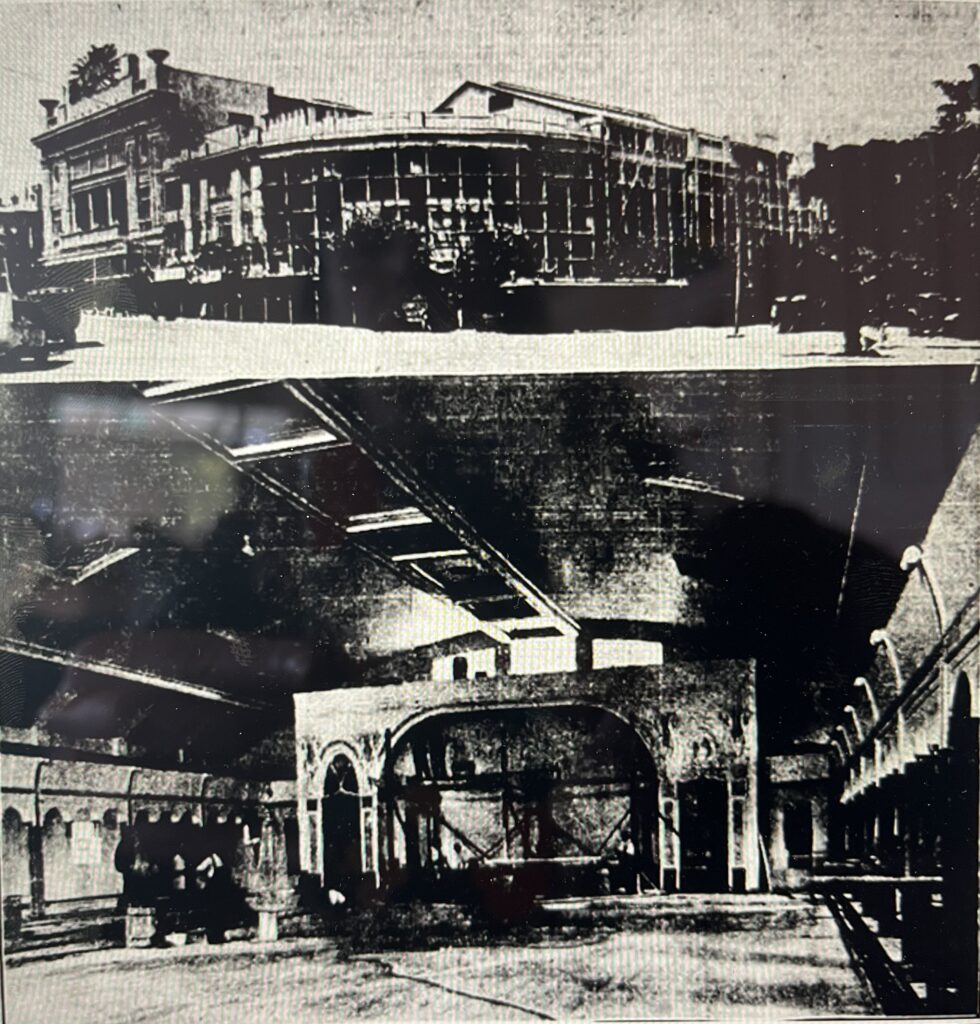
West Australian (Perth, WA : 1879 – 1954), Thursday 13 December 1928, page 22
The Capitol Theatre and Temple Court Buildings as seen from the top of the A.M.P building. Tenders are now being called by the Bank of New South Wales for the construction of a new building on the land adjoining the theatre.
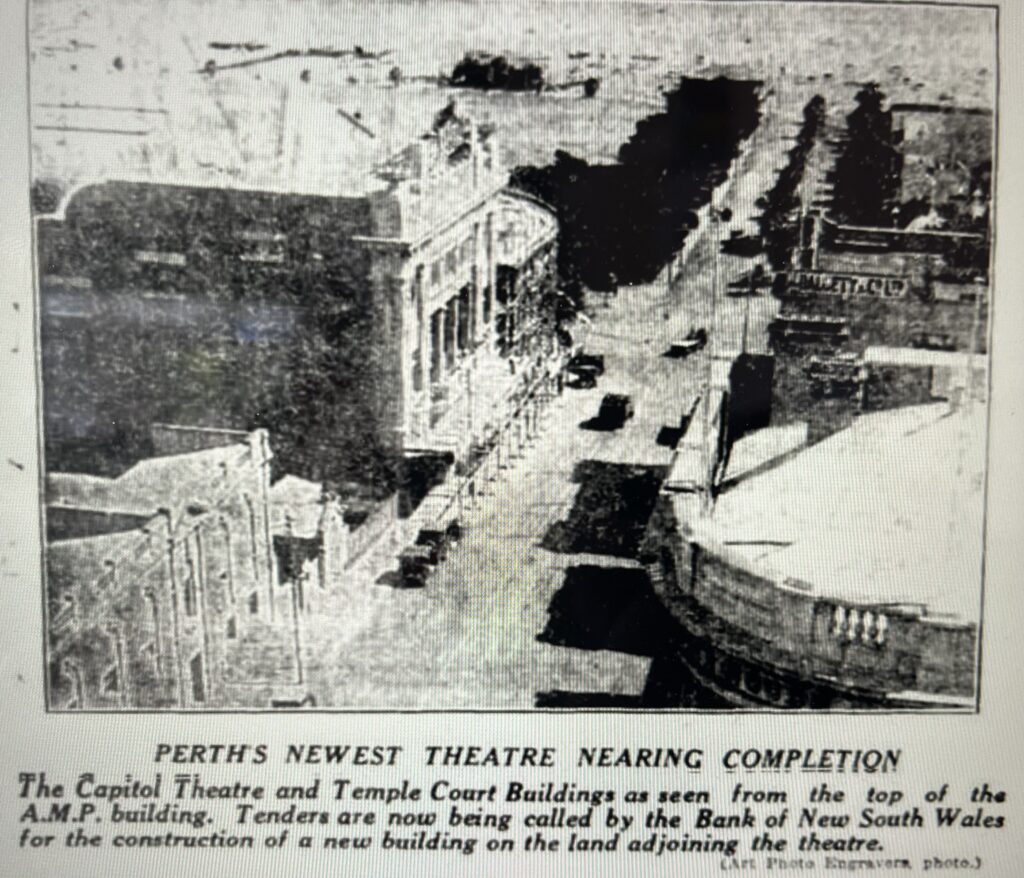
(Art Photo Engravers, photo.)
Sunday Times (Perth, WA : 1902 – 1955), Sunday 16 December 1928, page 1
1929
CAPITOL THEATRE
The box plan for the opening week of the Capitol Theatre will be opened at Musgrove’s, Limited, and at the Capitol Theatre on Monday morning next. The theatre presentations at 2.30 p.m. and 8 p.m. The Mayor of Perth (Mr. J. T. Franklin) will formally dedicate the theatre at the evening session. The pictorial programme will be headed by Gene Stratton Porter’s ‘Freckles,’ and the vaudeville section will include the ‘J. C. Williamson act. Syd Roy’s Lyricals.
Daily News (Perth, WA : 1882 – 1955), Saturday 27 April 1929, page 3
CAPITOL THEATRE.
ULTRA-MODERN STRUCTURE. Opening Next Saturday.
Like a mighty cyclops, the Capitol Theatre has reared its head in massive splendour among the giants of the city, and nightly its powerful eye flashes a message for miles: It now rests resplendent, an imposing spectacle, while an army of minions make busy about it, decking it gaily for its first public function on Saturday next. Dionysius has bestowed on Perth a bountiful birthday gift. No tawdry show is here. Luxuries have been lavished upon it, the art of the decorator has been exploited, and the utmost utility exacted, but all have been objected to a dominating note of tranquil ease. An impression of chaste solidity is conveyed to the observer from outside, and the interiors grand splendour confirms it. Space is abundant. The mezzanine becomes not a passageway, but a roomy ante-chamber, the lounge is a luxurious drawing-room apart, and in the auditorium the seating accommodation has suffered by an attempt to give adequate room for all. Acoustics, ventilation and conveniences— all are well-nigh perfect, and a close examination of the interior reveals master craftsmanship worked out to the merest detail of decoration. Its creators’ ambition was an ultra-modern ideal. The facade facing William-street, contains a wealth of unobtrusive ornament, contrived by Tindale and Miller’s Lime Co., admirably to supplement the architectural effect. An enormous illuminated sign is at the top, flanked at each corner by an octagonal ribbed urn executed in pressed cement. The urns carry coloured streamers, which will be distended up-wards by air currents from electric fans. Four perforated columns of pressed cement in a fancy design, illuminated by concealed lighting divide the space down to the verandah fascia. Over wide windows be-tween the outer spaces, are oval ventila-tions framed with glass, and bordered with banksia sprays executed in cement. The sprays further a decorative scheme carried out to incorporate a variety of West Australian wildflowers. Most of the central portion of the facade is occupied by a spacious balcony connect-ed with the lounge. It commands a fine view of King’s Park and the Swan River, and has room to accommodate a large number of people.
Interior Furnishings.
With the basic principle that the heaviness of colours tends to increase as they descend, a comprehensive scheme of colouring was carefully planned, to embrace the whole of the interior, including the entrance vestibule, the stairways, the mezzanine, the foyer, the auditorium, the stage and the ceiling. As a result, the patterns on the ceiling were executed in delicate tints of gold, blue and brown, and the intensity of the pigments was in-creased imperceptibly as they approached the lower levels, deepening ultimately into their strongest shades. The psychological effect is delightfully apparent as one em-barks from the front steps on an inspection of the theatre. In the entrance vestibule, an ornate ceiling in gold is supplemented by similar decorations on the upper walls, set off on the lower walls by attractive patterns in red tiles. From the ceiling hang five chandeliers, made from china in coloured patterns. The floor is covered with tiles of marble and Tarrezzo marble composition, worked in an attractive design. The Tarrezza material is a comparative novelty in Perth, although used extensively in the Eastern States. H. B. Brady and Co., who supplied the tiles, state that it is the best medium available for this type of work, the marble aggregate being washed and separated, and thus freed from all foreign matter.
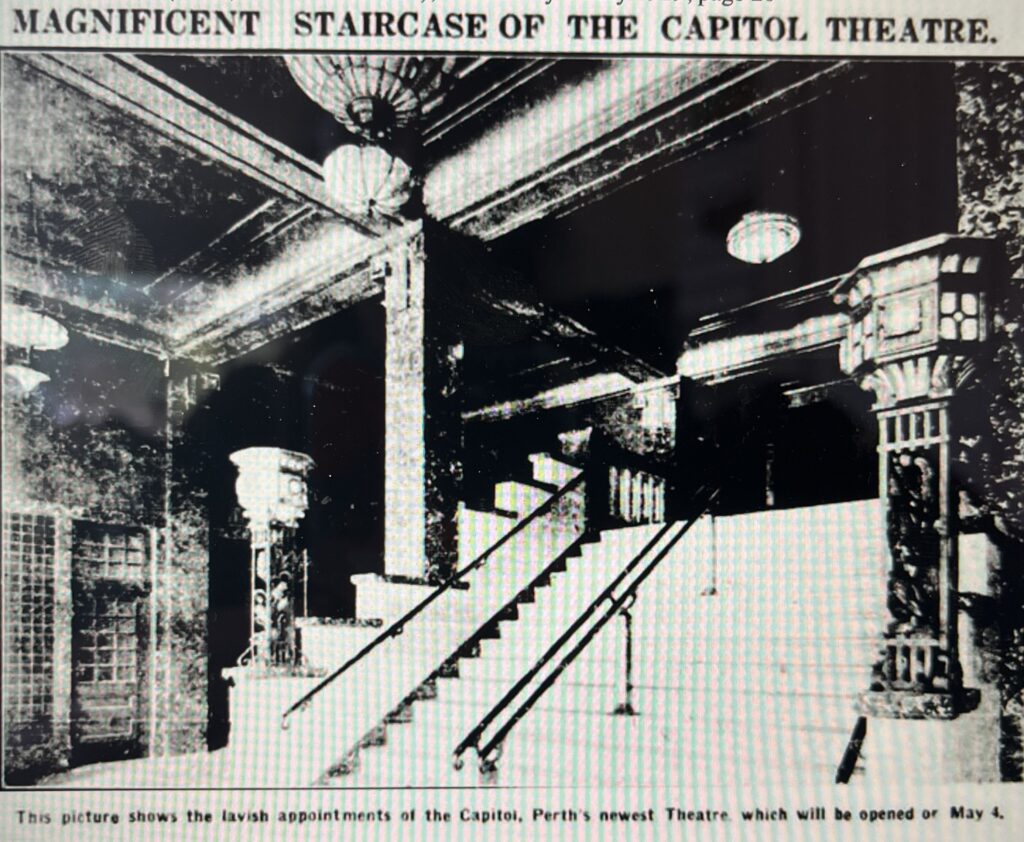
The ticket boxes are of novel design, Wunderlich, Ltd., having executed them in seasoned jarrah, surmounted by a bronze grille. Stairs leading upwards to the mezzanine are fashioned to a design in Tarrezza material. An elegant fountain stands on the staircase, fitted by the British General Electric Co., Ltd., with an electric motor which operates the cascade and the changing of colours. At the foot of the stairs, Tindale and Miller’s Lime Co. has worked banksia sprays in plaster, sprayed with bronze, and at the side of them are two electrically illuminated pedestal newels carrying designs of indigenous flora, specically manufactured to harmonise with their setting. The mezzanine is unusually large, and, by its spaciousness, it relegates to obscurity the five stairways opening from it. Three of them lead to the dress circle and the central one has on each side a ”cosy corner.” Inviting settees cover the three sides of the alcoves, and the walls are made of leadlights, one a replica of Perth in 1870, and the other of Perth in 1928. On the walls of the mezzanine are scenic paintings to represent autumn, fitted with frames of the darker shades of brown and blue. The rafters bear light and shade effects in gold and brown. Opposite the central stairway leading to the dress circle, a large opening gives access to the foyer.
Luxurious Lounge.
The foyer conveys a pleasurable impression of being an entity separate from the theatre. Only a portion of the mezzanine and one stairway beyond are visible, and the tasteful lounge furnishings complete the illusion. The prevailing colours are delicate tints, with gold and blue predominating. Intricate patterns are worked attractively on the ceiling, and continued down the walls, executed in paint and impressed lace. Illumination is provided by five cut glass chandeliers, supplemented by 12 lamp brackets on the walls, executed nicely in brass, with the globes in the form of stalactites. In one corner is an up-to-date soda fountain, and three French windows, luxuriously curtained, lead to the balcony. Entering the auditorium one is met by an atmosphere of immensity; but it is not a repelling vastness. An all-embracing scheme of comfortable furnishings and adroitly managed adjuncts has been work-ed out to cover the slightest object. The ceiling is beautifully panelled and decorated in delicate pigments. In the centre, a dome with a span of 40ft. rises 9ft. above the ceiling, and from it is suspended a huge hand-cut crystal chandelier, which was imported from Austria. It is 18ft. 6in. long and 7ft. wide, and weighs two tons. Besides interior lighting, it is illuminated, by four 2,000 candle power projection lamps in the ceiling, and is cap-able of lighting effectively the whole theatre. Coloured lights are operated from inside the cresting of the dome, and coloured cones from perforations at the top of the walls will be directed on the chandelier, producing an attractive effect of lighting the crystal in different colours. Two domes in the ceiling over the back of the dress circle have also been fitted with concealed lights. The walls of the auditorium further the decorative scheme of the ceiling. Along the tops of the walls, Tindale and Miller’s Lime Co. has designed panels of banksia sprays, with Grecian crests below, the mural decoration being executed in fibrous plaster to a design combining modern and old Grecian styles. Open grills, which were made in the walls, mainly for the purpose of ventilation, are executed in a delicate treatment apart from any orthodox style, greatly enhancing the general decorative effect. The perforations in the walls are continued, in the same ornate scheme, in the proscenium, which is comprised of an outer elliptical arch receding back to a smaller arch of the same shape. The two curves are connected by a dome, pierced by three large panels, through which an inlet of cool and purified air is effected by machine to further a comprehensive scheme of ventilation.
Comfortable Seating.
The impression of spaciousness one re-ceives on entering the stalls proves, by an inspection, to be no illusion. The rows of seats have been placed four inches further apart than is usual in a theatre, giving plenty of space to the spectator, and facilitating transit, and the seats are 20in. wide instead of the regulation width of 18in. They are a handsome type of theatre chair, coloured brown and blue in conformity with the general scheme, and provided with comfortable upholstery. Under every second seat is a wire rack to hold men’s hats. The seats are at a remarkably fine rake, and, instead of the front row being close to the screen, it has been removed 41ft. away, so that, with the screen set back from the stage, persons in the front seats will be ensured of a splendid visibility. An innovation in the theatre will be the seating of the orchestra in the auditorium. The management has followed the Parisien practice of doing away with an orchestral railing and placing the orchestra in an environment similar to that of the audience. Thus, instead of being segregated, the musicians are made part of the audience, and appear in the light of hosts playing to their guests. Prior to taking their seats to accompany the pictures, the musicians will appear in stage items on an advancing platform—another new feature. A sliding stage is placed over the permanent one, and when the screen lifts, the platform is propelled on rollers, by a machine, to the front of the stage. The theatre has a seating accommodation of 2,300, comprising 963 persons in the dress cirle, and 1,337 in the stalls. Every portion of the dress circle commands a fine view of the stage, and all the exit doors, the tiers extending upwards at an unusually large angle of inclination. Tired theatre-goers should find the seats a boon, combining as they do the elements of luxurious comfort and utility, with an adequate space for each. Roomy club chairs having a depth of 28in., and a loose cushion to each are provided in the front of the dress circle, and at the back are semi-club chairs.
The operating room, at the rear of the dress circle, is claimed to be the best in Australia, being 40ft. long by 10ft. deep, and having a subsidiary room of the same size immediately beneath it. The operating room contains all toilet conveniences, so that once the men begin work they have no need to leave the room until their shift is ended. The latest projectionary equipment was installed in a motor generator room by the British General Electric Co., Ltd. Two motor generator sets made by the General Electric Co., London, were provided to supply power for the high intensity arc lamp, the control of them being automatic.
Natural Ventilation.
 A feature of the theatre is its admirable ventilation, which is for the most part natural. It is stated that few places in Australia have a more lofty auditorium— it is 78ft. high—and the dress circle is at an unusual height above the stalls. Under the circle, two large openings executed in perforated cement work open into the mezzanine, and huge windows on each side of the theatre are mechanically operated to allow a a continuous stream of fresh air to enter. The domes and minor adjuncts assist to produce the welcome atmosphere of cool comfort which is at all times manifest.
There is an excellent system of sewerage and fire service throughout the building. The workmen of Peter and Moir have striven for 18 months to perfect it, and the exquisite finish of the plumbing work harmonises with the main decorative effect. More than 25,000ft. of pipes—all of Australian or British manufacture—were necessary to instal the water supplies. By the nature of the materials used, the building is practically fire-proof, but, in case of emergency, a large number of exit doors, easy of access, have been provided, and the theatre has been separated from the adjoining structures. The first fire curtain in Perth—a light iron screen—has been fitted in front of the stage, completely to separate the stage from the auditorium. The positions of the exit doors are painted on it for the benefit of the audience, and it will be lowered between acts. The theatre is equipped with 27 fire cocks, which can be fed with water from a main in William-street.
Genesis of Scheme.
The theatre forms part of a four-storey building containing also two garages, a cabaret, winter gardens, tearooms, and offices. The composite scheme was conceived in 1926 by Dr. A. J. Wright, who owned the property on which the structure stands. Promoted by Dr. Wright, a company called Temple Court Buildings, Ltd., was formed, and in July, 1926, plans were prepared by Messrs. Poole and Mouritzen, architects of Perth. The late Mr. C. F. Mouritzen who drew up the original plan, was an advocate of the Continental style, but Messrs. Carberry and Chard, of Sydney, who acted as advisory architects for the lessee, were biased in favour of the American type of theatre. Collaboration between the two firms produced a design embracing the beauty of both schools, with their solidity. Five tenders for the erection of the building were received, ranging from £101,433 (Mr. E. Allwood, of Perth) to £106,515, and in February, 1927, a contract for the construction was let to Mr. Allwood. Elder, Smith and Co., Ltd., acting on behalf of the Broken Hill Steel Proprietary Works, received the contract for the supply of con-structional steel. Although the buildings are four storeys high, the walls and foundations were made of a strength that would carry them to a greater height.
The theatre has a frontage of 83ft. 2in. to William-street, by a depth of 202ft., and the construction throughout is of reinforced concrete, steel framed. The stage is said to be the largest in a picture theatre in Perth. It is 79ft. wide and 35ft. deep, and is capable of accommodating any type of production. In the auditorium, a fine floor of jarrah was laid over the concrete foundation by Bunning Bros., Ltd., who also built the magnificent entrance doors and the other doors and their frames. The screen and the wooden fittings in the vestibule, and the staircases and the balustrading in the lounge and the dress circle were also carried out by the company’s workmen. Oregon timber was provided for the roof. Structural Steel Work. Mr. Hamilton, of Elder, Smith and Co., Ltd., who supervised the structural steel work for the company said that absolute adherence was made to the most modern practices of steel work design and lasting stability. The aim of the architects was to make the views of the stage from all angles free from obstructions, and they succeeded admirably. The steel structure of the theatre is unique. The main floor is supported by a massive steel grillage, which is made fire proof by a heavy concrete floor and a concrete covering around the steel beams and columns. Two huge girders supporting the dress circle are carried on steel stanchions, enclosed in concrete and built into the walls, so that the load on the dress circle is carried through a steel concrete covered shaft to the massive foundations. The length of the girders is 83ft., the depth of the principal girder being 7ft. 6in., and their combined weight 65 tons. They were built in posi-tion, and adequate provision was made for their proper stiffening. They are designed to carry a load considerably in excess of that possible by a crowding in the seating accommodation. The proscenium and the roof are sup-ported by specially designed steel work.
A special feature of the theatre is its insulation against extreme heat and cold by the use of Celotex insulating building boards. Celotex has been used with remarkable results for decorative effects, besides acoustic and insulating purposes. Over 33,000 square feet of it and more than 800 tons of structural steel work were used in the construction of the Temple Court buildings. Electric Installations. Infinite pains were taken to make the lighting of the theatre one of its most attractive features. The installations were under the control of Mr. G. Mitchell, who has had a wide experience of the various phases of theatrical work in America, the Continent, and the Eastern States. The lighting of the auditorium has been carried out primarily in red, blue, amber and green, all of the colours being operated by a Dimmer Bank machine, by which they can be merged imperceptibly to give the effects of sunrise, sunset, or moonlight, as desired. It took 74 miles of wire to complete the scheme, and 12,000 lamps were installed. A novelty was the institution of a control board for the stage manager, by which he is connected by bobbing lights with all the working parts of the theatre and the heads of the different departments. A switch on the board also controls the whole of the ventilation scheme, the huge turbine blower and exhaust motors which control it being started merely by the pressing of a button. In the rheostat room the British General Electric Co., Ltd., installed a large switch-board of a special design, equipped entirely with switch gear from the General Electric Co., Ltd., London. The company supplied the building with 38,000 feet of magnet conduit, 260 Gecoray reflectors for concealed lighting, and large quantities of G. E. C. Bakelite switches, lamp holders, and magnet conduit fittings.
The dress circle the stalls, and the lounge were fitted with 12 two-light heavy gilt brass brackets, spe-cially designed by the General Electric Co., Ltd., London. A new lighting feature was provided by Atkins (W.A.), Ltd., in the shape of dainty fixtures of hand-painted vellum, in a variety of charming designs and colours. The company exercised great ingenuity in planning the special lighting fixtures which appear in the theatre entrance, and similar fixtures were also installed in various posi-tions throughout the interior, together with lighting and heating contrivances. Among them are genuine X-ray reflectors for concealed lighting, a special type of bulkhead fittings, fancy electric light brackets, flush wall electric radiators, flame shades, and floodlights for colour work. Unbehaun and Johnston (W.A.), Ltd., supplied about 17,000 Phillips lamps and fittings, comprising all the lamps for the theatre and the signs outside, besides the colour effects, batteries for working the auxiliary lighting, and a portion of the switchboard controlling the main building. A standard telephonette system was installed, enabling communication to be made between any two parts of the building.
Illuminated Signs.
The large illuminated sign which surmounts the facade of the theatre presents an arresting spectacle. The sign is a replica of that over the Empire Theatre, Sydney, the word ”Capitol” being delineated in white lights, surrounded by a wave effect in blue, with the whole inside an amber and red frame constructed to represent the rays of the rising sun. Illumination is provided by 2,500 electric lamps, with a total of 125,000 candle power, the red and amber lights bursting into flame 64 times a minute. Eight hundred moving electric contacts are part of the mechanism, which is worked by a 1½ horse power motor. The sign, which costs 18/ per hour, is 45ft. long and 20ft. high, and requires 10,000 yards of electric wire. Unbehaun and Johnston (W.A.) Ltd., constructed it on the premises.
Another illuminated sign is being placed at the north-western corner of the theatre, to extend 46ft. above the roof level. The word “Capitol” is shown vertically, having on each side a “snake-chase,” and at the top and bottom are circular expansion effects, claimed to be the first in Australia. This sign, it is stated, will be visible from Mount Lawley.
The Entertainment.
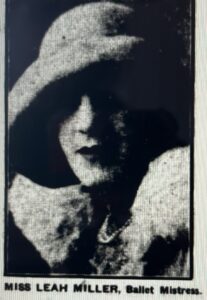 The principal film service to the theatre will come from Radio Pictures, a combine recently effected in America by the union of the Radio Corporation, the F.B.O. Film Producing Corporation. Victor Talking Music, and the Kieth-Orpheum Vaudeville Circuit. The amalgamated company in-vented a talking picture equipment called Photophone, which is claimed to be an ad-vance on the other “talkie” methods. The sound is reproduced on the film, so that a perfect synchronisation with the action is effected. The Photophone equipment will shortly be installed in the Capitol Theatre. The theatre has an orchestra of 20 in-struments, under the conductorship of Mr Harry Cross, and the stage presentation will be assisted by acts by Miss Leah Miller’s Sydney ballet of eight, “Pony Pav-lovas.”
Mr. Wright has arranged for a regular supply of vaudeville acts from the J. C. Williamson theatres in Sydney and Melbourne. The opening programme will be headed pictorially by an adaption of Gene Strat-ton Porter’s book, “Freckles.” The ballet will appear in a spectacular extravaganza called “Stepping into Society,” and a 17-minute act on the stage will be presented by Sid Roy’s Lyricals, a party of eight jazz instrumentalists, who will intersperse musical items with singing and dancing. Miss Beryl Evetts will be the featured dancer.
Acoustics of the Hall. The presentation of stage items and talking pictures in the theatre will be assisted by the admirable acoustics of the auditorium. The slightest sounds on the stage can be heard distinctly at the back of the dress circle, this being brought about by the solid symmetry of the building, aided to a large extent by its Celotex lining, which obviated a harsh, metallic surface, and stiffens the sound.
West Australian (Perth, WA : 1879 – 1954), Wednesday 1 May 1929, page 12
MAGNIFICENT STAIRCASE OF THE CAPITOL THEATRE.
This picture shows the lavish appointments of the Capitol, Perth’s, newest Theatre, which will be opened on May 4.
 West Australian (Perth, WA : 1879 – 1954), Wednesday 1 May 1929, page 20
TERRAZZO
Local Firm’s Work Beautifies Capitol Theatre
The local firm of H. B. Brady Co., of 235 Aberdeen-st., Perth, were entrusted with the Terrazzo work which is an outstanding feature of the Capitol Theatre. The manufacture of Terrazzo is one ot the most interesting processes of modern commercial art. Terrazzo, despite its glorious colours and texture, is nothing more or less than cement with a marble aggregate. Into wide, flat moulds, the cement, previously mixed with the colour desired, and with chips of single or multi-coloured marbles, is poured and allowed to set hard. Then the slabs are taken up and RUBBED WITH STONES till they are as flat and smooth as marble itself, and the marble, in all its natural beauty, shows in its setting, like marbles of fat in a ritz sausage. It is a prosaic simile, but it serves in measure, to describe Terrazzo. Nor is the material confined to slabs, baths and columns, and tiles, every form for which cement, or stone or marble, will serve may be served as well, or better, with Terrazzo. Brady and Company are believers in local Industry, and most of the cement used in their beautiful manufactures is local.
Call News-Pictorial (Perth, WA : 1927 – 1931), Friday 3 May 1929, page 20
CAPITOL THEATRE.
Opening Attraction.
By the Great Western express yesterday there arrived in Perth a party of eight entertainers, who will be one of the attractions during the first week’s programme of the Capitol Theatre, beginning with the opening to-night. They are known as Syd. Roy’s Lyricals, and are returning to London, via South Africa, after a successful season on the Tivoli circuit in the Eastern States. Asked to describe the form of entertainment given by his company, Mr. Roy said that it was a jazz band varied by acting, singing, dancing, comedy, three-part harmony and solo playing. He had with him Miss Beryl Evetts, champion Charleston dancer of England. “People are a little tired of jazz bands which are only jazz bands,” Mr. Roy explained, “so we are giving them something different, in which each performer shows what he can do. The plain jazz band is on the wane, even in England, and there is far more enthusiasm for jazz in England than there is in Australia. Ours is the oldest established band of its type in England; we have been together eight years without a change, and we are very proud of having been called the Prince of Wales’s favourrite band. None the less, we have enjoyed our Australian season, realising that Australian audiences are eminently fair. They have not the enthusiasm of English or South African audiences, but where applause is due they give it without stint. We were very popular in the East.” The Lyricals will leave for England, via South Africa, on May 20.
West Australian (Perth, WA : 1879 – 1954), Saturday 4 May 1929, page 20
THE INTERIOR BEAUTY OF THE CAPITOL THEATRE.
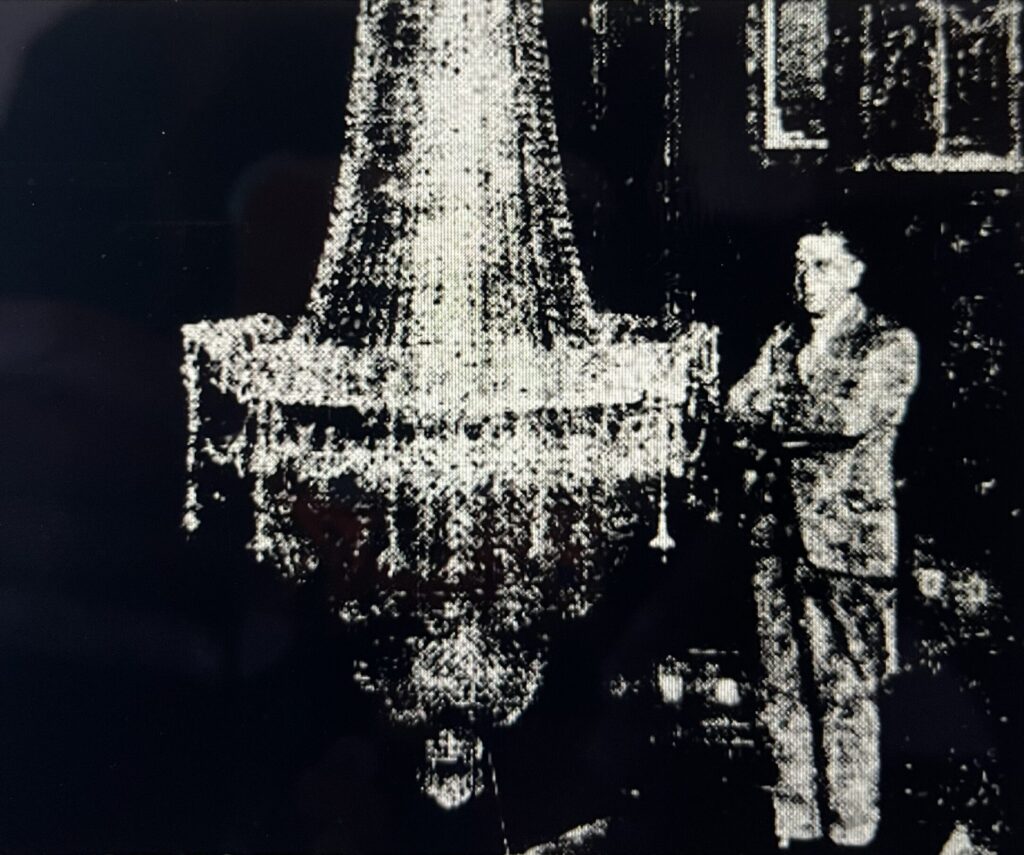 Right: The chandelier in the main dome of the theatre. It is 18ft. high and was imported from Austria. It is of cut glass crystal and forms the main illumination source of the auditorium.
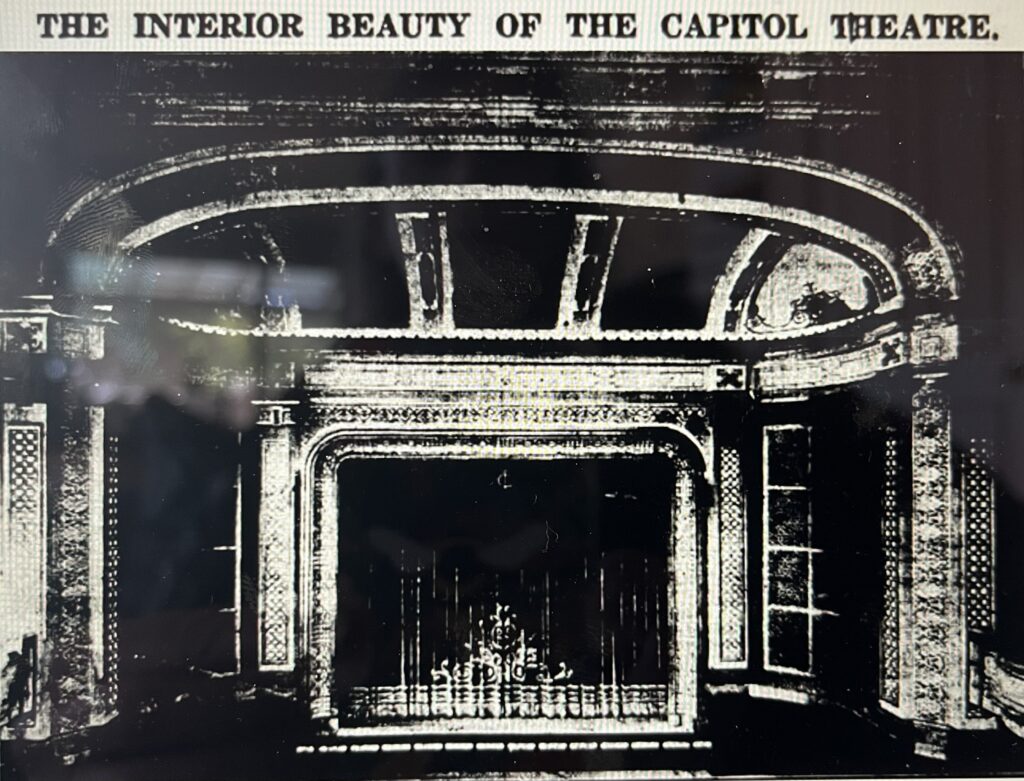 The Proscenium of the Capitol. The opening is 35ft. wide and 32ft. high. The curtain is of blue velvet lined with gold braiding and tassels. Blue and gold are the dominating tone colours of the decorative scheme of the theatre. Right: The chandelier in the main dome of the theatre. It is 18ft. high and was imported from Austria. It is of cut glass crystal and forms the main illumination source of the auditorium.
West Australian (Perth, WA : 1879 – 1954), Saturday 4 May 1929, page 7
CAPITOL THEATRE
Makes Bow to Perth Public
The result of two years or more of dreaming, planning, and working, were realised yesterday when Perth’s great theatre was thrown open for the inspection and pleasure of an expectant public. . Little remains to be added to the words of description and praise which have already been published about this splendid Western Australian enterprise. It is part of the Temple Court building scheme, an ambitious idea of which the theatre is the grand central portion. Carried out on modern lines of strength and dignity, the Capitol embraces those advanced forms of theatre design, decoration and comfort which are usually only found in the great world centres of population. That Western Australians have sufficient faith in the stability of their State and the willingness of the public to attend in great numbers is a tribute to their courage.
The fine opening programme referred to elsewhere sets a new standard in picture, theatre entertainment in this part of the world. Mr. Stanley Wright, the managing director of the Capitol, has gained his experience from the continent and America, and throughout Australasia, having managed some of Australia’s most successful theatres.
Refinement and decoration is apparent on all sides. The wonderful lighting-color painting, it may be called is restful to the eye and beautiful to behold. The comfort of the seating will soon be a matter for general public praise, the club chairs in the dress circle giving a degree of luxury not excelled in any theatre in this State, and probably not in other cities of Australia. Stage equipment and stage presentation is on an unusual scale, and the electric and scenic trappings of the Capitol stage are on similar lines.
With these advantages, and the personnel selected to present the Capitol programmes, the public will be distinct gainers. An operatic orchestra of 20 players, under the direction of Harry Cross, is one of the big attactions. The Capitol ballet is under the tuition of Miss Leah Miller, and is a combination of girls from Sydney whose work will be outstanding. Combined with the settings devised by J. J. Collins (presentation manager) the lighting effects of the great Capitol stage, and the musical accompaniment by the orchestra, the ballet will always be a popular feature.
Of pictures on the Capitol screen much could be said. The latest and one of the largest combinations in the picture producing world. Radio Pictures, will be seen from week to week, and should satisfy tile existing demands.
Programmes will be selected and presented with every care. A big attraction on Saturday next will be the well-known magician. Nikola, with an act of mystery and magic.
Capitol box plans are on view at the theatre and Musgroves.
Sunday Times (Perth, WA : 1902 – 1955), Sunday 5 May 1929, page 8
CAPITOL THEATRE.
OPENING BY MAYOR. Spectacular First Night.
Long before the doors of the new and luxurious Capitol Theatre were opened on Saturday night, crowds assembled in William-street to view the brilliant external lighting effects and hear the band playing on the the balcony. For nearly an hour before the commencement of the entertainment, patrons streamed in to explore the luxuriously furnished lobby and lounges and to inspect the interior decorations, and by 8 o’clock the immense auditorium was filled.
Before the rise of the curtain the managing director (Mr. S. N. Wright) introduced the Mayor of Perth (Mr. J. T. Franklin, M.L.C.) who declared the theatre open. Mr. Franklin recalled the fact that many years ago, Mr. Wright managed an open-air picture show at the foot of William-street, and he congratulated him upon his return to control such a fine theatre on the site of his previous unpretentious place of entertainment.
After the formal opening, the programme commenced with a spirited rendering of Suppe’s. “Light Cavalry” by the orchestra, a well-balanced combination, whose artistry at once won the warm approbation of the audience. The effect was enhanced by the staging of the band on a moving platform, which glided for-ward to meet the conductor and receded slowly during the playing of the closing bars. With the exception of the first portion of the topical gazette, the whole of the pictorial section of the programme was accompanied by incidental music by the full orchestra.
Attractive Ballet.
Another attraction that may be numbered among the permanent features of the theatre is the ballet whose popularity was loudly acclaimed from the moment of their spectacular entry. Gaily costumed, and displayed to the best advantage in novel setting and lighting, the “stepped into society”—to use the title of their act—in the most convincing fashion. Their original work was cleverly conceived, and executed to perfection. On the vaudeville side, Syd Roy’s Lyricals, with Beryl Evetts, were generously applauded. In solo dancing with other members of the company Miss Evetts proved herself a performer of versatility and dash. The Lyricals presented a bright act, comprising jazz music, song and dance. However, as the names of the contributors did not appear on the programme, it is impossible to comment on the individuals but special praise is due to the eccentric dancer whose work was on of the brightest spot in the entertainment.
In the principal picture, and adaptation of Gene Stratton Porter’s novel “Freckles,” John Fox, junior, carried the title role admirably, and was ably supported by Eulalie Jensen and Hobart Bosworth. The story is fairly familiar. Freckles, reared in an orphanage, finds himself handicapped in life’s battles by having only one hand. Eventually, his earnestness and pluck win him the friendship of a timber magnate, who appoints him the custodian of an area of valuable forest. Exciting battles with timber thieves follow, and he is finally waylaid by them and tied to a tree in such a position that he will be crushed by another tree, which the thieves are in the act of cut-ting down. In the meantime, however, Freckles has fallen in love with the magnate’s daughter, and it is she who discovers his plight and brings assistance. Just when the rescue seems complete the partly cut tree falls, and Freckles, in saving the girl, is, struck and pinned beneath its branches. Realising the hopelessness of his love for his employer’s daughter, he wishes to die, and the doctors can do nothing to help him; but the girl discovers that she reciprocates his love; the unwilling father relents, and Freckles and his fiancee are last seen enjoying the an-ticipation of living happily ever after.
Views of King’s Cup Race.
In the supporting picture, “The Night Bird,” Reginald Denny was seen at his best. Playing opposite him, Betsy Lee handled a difficult part with credit, but she was not assisted by the broken English jargon that was attributed to her as the pretty but ill-treated little Italian waif, the news of whose misfortunes was the principal factor in spurring the hero (Reginald Denny) to victory in the boxing ring, at a moment when his defeat seemed imminent owing to his haying lost trace of her. The picture provided an abundance of action and thrills, and was distinctly above the average. Despite the fact that the King’s Cup boat race did not start until late on Saturday afternoon, a film of the crowd and the finish was screened during the evening, and the New South Wales and West Australian crews were warmly applauded.
In the special souvenir programme, it was announced that the Capitol management intended installing the Photophone system of talkies, but that the silent films would continue to be shown as well. From the viewpoint of organisation, the arrangements on Saturday night were particularly good. Cars were run into the garage and parked by attendants, and patrons were able to walk upstairs to their seats without delay. After the performance, many held cabaret and supper parties at Temple Court, and were thus able to enjoy the whole night’s entertainment without leaving the roof under which they had parked their cars. The programme will be presented daily until Friday night.
West Australian (Perth, WA : 1879 – 1954), Monday 6 May 1929, page 16
1935
Perth Symphony Orchestra – Assisting Jubilee Appeal
The Perth Symphony Orchestra is playing a worthy part in W.A’s Jubilee Appeal for Youth and Motherhood. Not only has the orchestra’s own concert been cancelled in order that it should not conflict with tomorrow’s grand Jubilee entertainment at the Capitol Theatre, but it will assist in an active manner by contributing several items to this concert.
Mirror (Perth, WA : 1921 – 1956), Saturday 1 June 1935, page 20
1939
At the Capitol Theatre.
There was a large audience at the Perth Symphony Orchestra‘s concert on Saturday, with Dr. Malcolm Sargent conducting the orchestra, and Jeanne Gautier as solo artist. Mlle Gautier is not only a musical artist but is an artist as regards dress, and most pleasingly illustrates in her stage gowns the chic of the French woman. She was a charming study in a beautiful white frock-as simple as it was beautiful. The sunray pleated skirt was built on modified crinoline lines, just clearing the floor, and the backless and sleeveless corsage was intricately and almost invisibly held by a narrow band from the shoulders, round the neck. A scarlet sash swathing the waistline, much deeper on the right side than the left, and falling in long ends down the back supplied a fascinating note to her elegant toilette. At the conclusion of her solo she was presented with an immense basket of roses from the commission and other gifts.
The manager of the commission in Perth (Mr. Conrad Charlton) and Mrs. Charlton were present and brought with them a party among whom were Mr. Justice Dwyer and Mrs. Dwyer, Dr. and Mrs. D. D. Paton, Dr. and Mrs. Noel Cuthbert, Dr. and Mrs. Ralph Crisp, Mrs. Redvers Bate, and Miss A. M. Cummins.
West Australian (Perth, WA : 1879 – 1954), Monday 30 October 1939, page 4
1940
Orchestral Season
Harold Williams, whose recital at Government House Ballroom met with such tremendous success, will be the soloist at the first Celebrity Orchestral Concert in the 1940 series on Saturday April 20, at the Capitol Theatre. The A.B.C. (Perth) Symphony Orchestra, under the conductorship of Professor Georg Sehneevoight, will present a programme including Symphony No. 5 (Beethoven), Air de Ballet (Gluck), Karelia Suite (Sibelius), Shepherd Fennels Dance (Balfour), Caprice Espagnol (Rimsky-Korsakov). Mr. Williams will sing operatic excerpts from Mozart’s “Marriage of Figaro” and Wagner’s “Tannhauser.”
Sunday Times (Perth, WA : 1902 – 1955), Sunday 14 April 1940, page 8
1947
1949
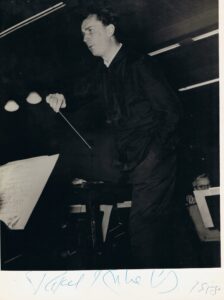
THE DYNAMIC KUBELIK
Eloquent Orchestral Achievements (By “Fidelio.”)
Smouldering Capulet-Montague hates flared in flame from end to end of the orchestra into a storm of whirling, clashing fury; the build-up was superb, the climax a fiery excitement; on and upward from this first peak Rafael Kubelik took us. in a glowing warmth of passionate, singing beauty, to the summit of it all, to Tschaikowsky’s soaring music of the lovers, the ecstatic, golden song of Romeo and Juliet. In a concert at the Capitol on Saturday nights in which Mr. Kubelik led the Perth Symphony Orchestra to quite exceptional achievements, this performance of the “Romeo and Juliet” overture was outstanding, a magnificently eloquent and glowing interpretation of one of the finest musical love-poems to come out of Russia. The tall Czech, whose conducting technique is vigorous but free of any oddities of behaviour, was rewarded with enthusiastic ovations such as Perth audiences are seldom moved to. A young man of obviously ardent temperament, he showed convincingly his ability to communicate the flaming intensity of its response in music of the romantic order.
UNFAMILIAR WORKS. He began by breaching Perth conventions. Does he not know that the only Mozart overtures we have room for are the “Figaro,” and occasionally the “Magic Flute?” He opened with the “Idomeneo,” a noble piece which has more than a hint of sombreness in it and which upsets all right-minded ideas by ending quietly. The rest of the programme, apart from the Tschaikowsky, consisted of Czech music. The late Mr. F. V. Mica (died 1744) showed us in his D Major symphony that, though even his name is unknown to Western reference books, he is well worth listening to. While using the general idiom of his period, he has none the less something individual to say. His opening Allegro was fresh and buoyant. In the Andante he is tripping, conventionally but gracefully a sedate measure in some courtly ballroom: in the compact closing “Fuga” he is again bouncingly nimble. The work made a very favourable impression. The modern Josef Suk strikes a deeper note in his fine and moving “Meditation On An Ancient Bohemian Choral,” for strings only. The string writing is beautiful, and Mr. Kubelik drew from this section of the orchestra a performance of great sensitiveness and distinction. Dvorak’s Symphony No. 4, in G Major, not unfamiliar here. was given a vital, colourful performance which maintained the standard of what had gone before. In these predominantly bucolic scenes Dvorak gives prominence to chirruping and singing flutes. The players concerned rose to the occasion admirably. The programme will be repeated tonight.
West Australian (Perth, WA : 1879 – 1954), Monday 27 June 1949, page 10
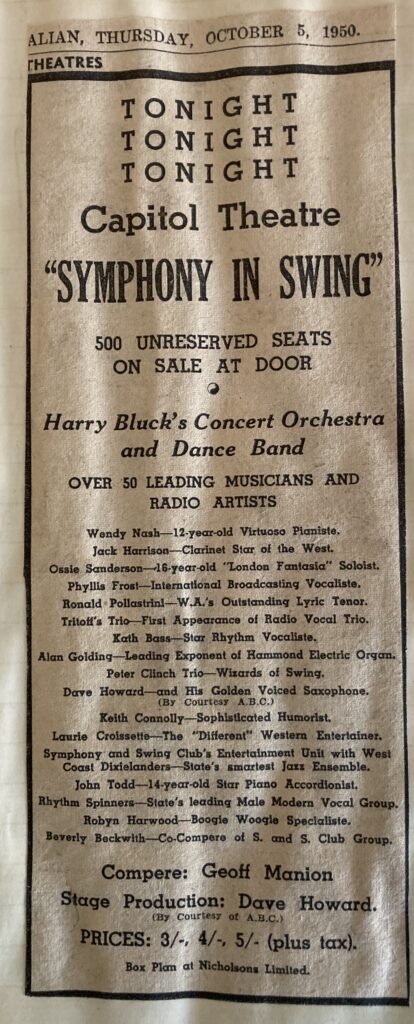
1950
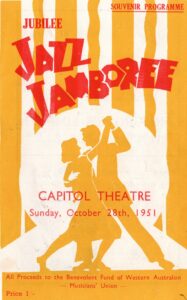
1951
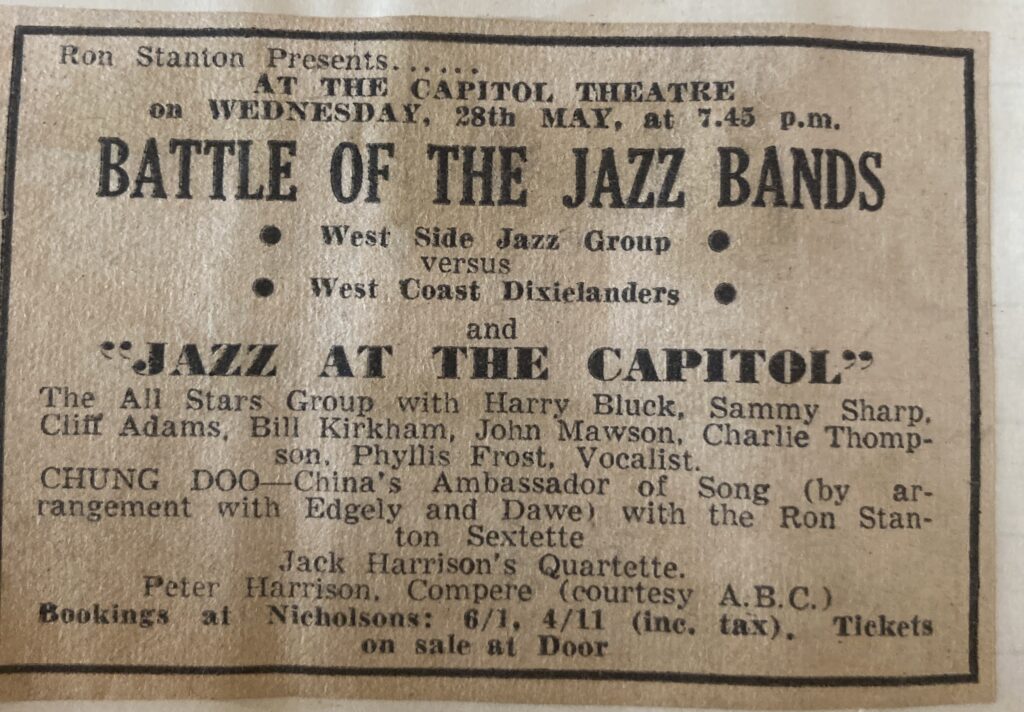
1952
1965
CAPITOL THEATRE
Capitol Theatre 1929 – 1968
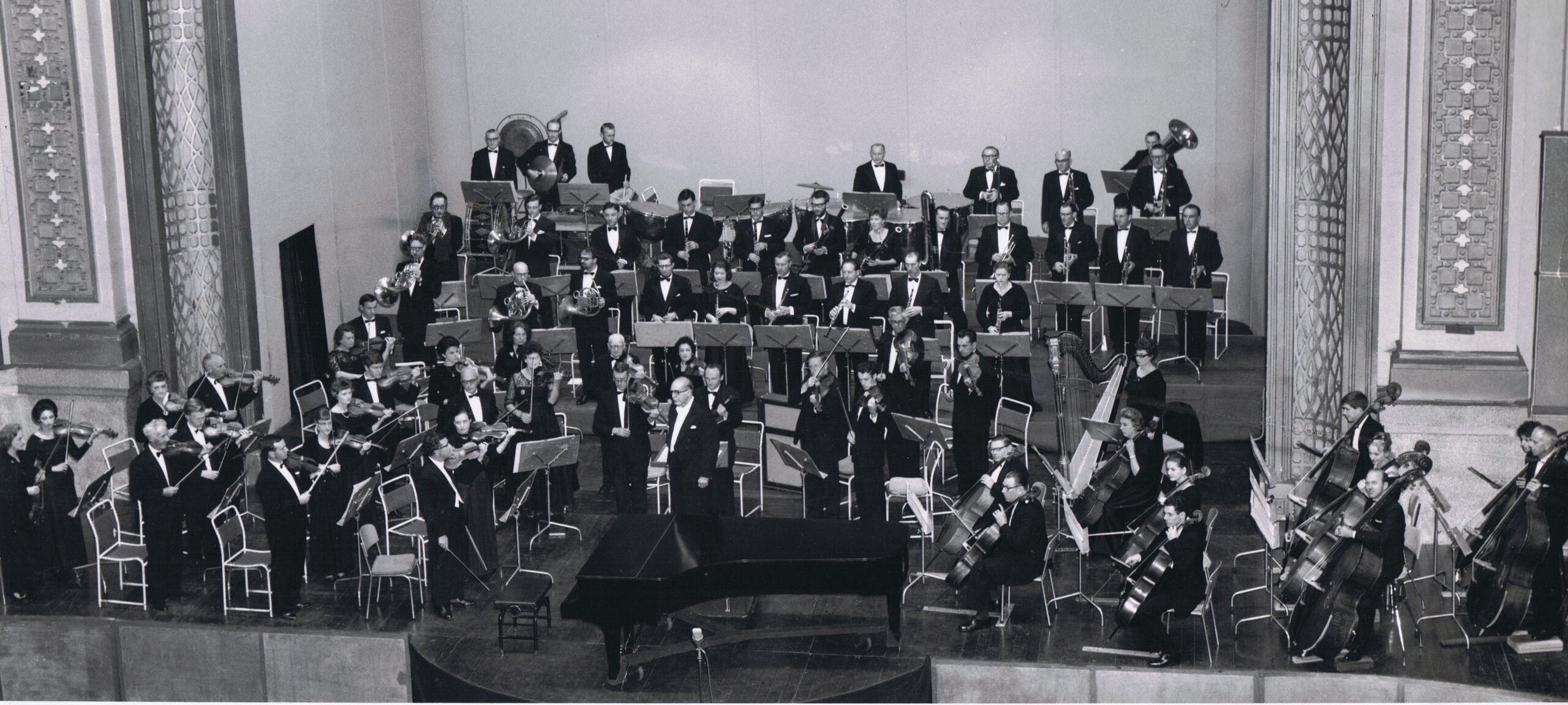
The Capitol Theatre, located at 10 William Street, Perth, was designed by architects George Temple Poole and Christian Frederik Mouritzen and was officially opened on Saturday, 4 May 1929, by the Lord Mayor of Perth, James Thomas Franklin. One of the Capitol Theatre’s stunning features was the Art Nouveau stencil work in the lounge foyer by designer, scene painter and decorator Philip Goatcher, nicknamed ‘Satin and Velvet’ Goatcher for the textile illusions he created. The Capitol Theatre also secured a marble bust of the late silent screen star Rudolph Valentino, by noted Italian sculptor Professor Giuseppe Bessi, which today forms part of the Museum of Performing Arts collection at His Majesty’s Theatre. The lavish crystal chandelier, that once adorned the Capitol’s auditorium, now hangs in Melbourne’s Princess Theatre.
In 1966, the need for a concert venue in Perth became critical when the Capitol Theatre was sold for the second time in six months to make way for a $1,000,000 six-storey office block. Located in a central position at the river end of William Street, the Capitol could seat 2,250 patrons and had featured such legendary performers as Noel Coward, Vivien Leigh, and Sir Laurence Olivier. The Capitol Theatre also played an important part in the West Australian Symphony Orchestra’s regular venue from 1953 until 1966. The ABC’s State manager, Graham Chisholm, feared that visiting celebrities might have to perform under canvas. Left with no permanent performance space, concerts were shifted to Winthrop Hall at the University of WA and WASO remained at the venue until the Perth Concert Hall was opened on Australia Day, 26 January 1973.