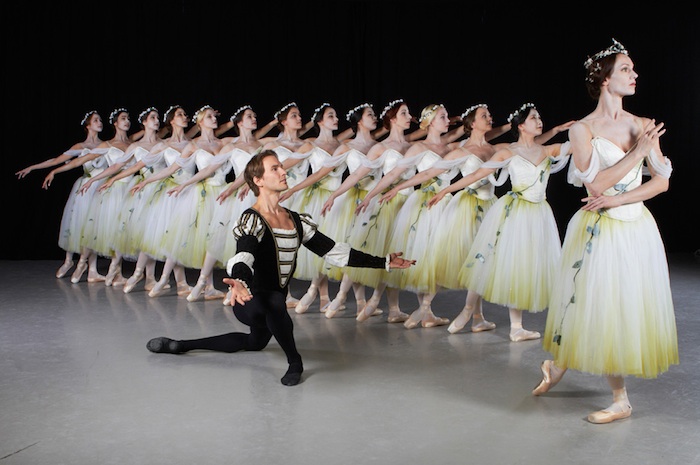
West Australian Ballet (WAB) is the state ballet company of Western Australia and is based at the Western Australian Ballet Centre in Maylands, an inner suburb of Perth. Founded in 1952 by Kira Bousloff (formerly of the Ballets Russes), it is the oldest ballet company in Australia.
WAB artistic directors have included Garth Welch (1979–83) and Ivan Cavallari (2007–12). 2024 saw the appointment of an interim artistic director, former Australian Ballet principal and artistic director, David McAllister. Choreographers who have produced dances for WAB include Krzysztof Pastor, David Nixon, Greg Horsman, Graeme Murphy, Stephen Baynes, Adrian Burnett, Gideon Obarzanek, Stephen Page and Natalie Weir, Jacqui Carroll, Chrissie Parrott and Garth Welch.
WAB performs with the West Australian Symphony Orchestra. At present the company consists of 34 full-time dancers and six ‘young artists’ (a full-time year-long development programme), structured since 2014 with principal dancers, soloists, demi-soloists and corps de ballet.[4][self-published source][failed verification] WAB performs three to four major seasons in Perth a year,[needs update] one at the Quarry Amphitheatre in City Beach, the others usually at His Majesty’s Theatre, Perth and Heath Ledger Theatre at the State Theatre Centre of Western Australia (although Burswood Theatre and Regal Theatre have also played hosts). They also tour throughout regional Western Australia, nationally and internationally, and provide choreographic workshops, an education program and other community activities.
Bousloff had travelled as a ballerina with the Ballets Russes to the east coast of Australia in 1938. She settled in Melbourne after her commitment to the Ballets Russes was complete, later moving to Perth with her second husband, composer James Penberthy. She fell in love with the city, declaring that the beautiful coastline reminded her of the French Riviera and later stated,
“when I came to the airport in little Perth at the end of the world, I put my feet on the ground, I looked around and I said loudly and strongly, ‘This is where I’m going to live, and this is where I’m going to die … this is my place’.”
She put together a corps de ballet and choreographed sequences for Perth Metropolitan Operatic Society’s production of The Gypsy Baron (conducted by Penberthy), and the following year held an open meeting of dancers and teachers to discuss establishing a major ballet company. Response was good, but there were no finances to support the venture until Eric Edgley, who ran His Majesty’s Theatre as a private commercial enterprise, put up £A 400 for the first production.
During the first 15 years of the company, Bousloff presided as artistic director, battling against financial constraints. Access to funds with inconsistent, and dancers sometimes performed without being paid. It was not until 1968–1970 when professional dancers, administrative staff and permanent headquarters were put into place. To begin with, rehearsals were held at Old Perth Boys School (now Perth Institute of Contemporary Arts) before moving to the West Australian Rowing Club, and then the first floor of the Grand Theatre (corner of Murray and Barracks Street) in 1955. In 1968, they transferred into King Street.
In the early days of WAB, Bousloff was assisted by her Russian friend Nadine Wulffius, who also was briefly president of WAB before Mr Edwards.
In 1986, Wulffius stated:
My first encounter with [… WAB] was very early in 1953 the year I arrived in Perth. Perth was at this time a very distant and sleepy town without the cultural life that we were used to in Europe. There was no permanent theatre. There was no permanent musical society or other such cultural and artistic organisations. When in November my relations told me that there was a Western Australian ballet company and they were to have a performance I was very surprised. I certainly had to go. It was on 15th November 1953. I went to His Majesty’s Theatre and there was the performance. It was called Graduation Ball and in it were some gypsy dancers and scenes. I was very surprised to find in Graduation Ball and some other selected small numbers great similarity to the kind of Ballet-style I was used to in Europe. The similarity of the choreography of this school to my own school was because the choreographer Mrs Bousloff had been taught by the same teacher as me, Olga Preobrasjenska. Mrs Bousloff was firstly taught by Olga after I had finished being taught by her. So the age difference between us was very large. [Wulffius was 16 years older than Bousloff.] I was pleased to learn this about Mrs Bousloff and wanted to get acquainted with her. After a while I did go and make her acquaintance and we became friends.
I did not give regular lessons at her studio, but I helped her with advice and with the corrections of her productions. By the way she was an excellent producer. And the first one I worked with her on was Cinderella and the music was by James Penberthy … It was not a very big company but it was big enough to put on small ballets….We worked slowly with performances but the company was not officially registered. It took us a few years until the company became registered, which was in 1957.[a] During this time the company didn’t have many performances because there was no government subsidy and all our dancers were working without a salary […].
— Nadine Wulffius
In 1969, Rex Reid took over as artistic director as the company became established as the state ballet company. In 1970, moving to North Fremantle Town Hall, where they remained until 1980, nine dancers received full-time contracts. In the same year the company also went on its first international tour to New Guinea. Luis Moreno succeeded Reid as artistic director in 1973, followed by Robin Haigin 1977, Garth Welch in 1979 and Barry Moreland in 1983. Moreland went on to remain in the position for 15 years.
Although the company continued to develop both its repertoire and technical and performance standards for the dancers, as well as enjoying many successes, the financial strains on the company also continued to grow. At times during the 1980s, there were doubts the company could continue.
Despite this, in 1986 an agreement between the Government of Western Australia and the Australian Broadcasting Corporation secured the orchestral services of the West Australian Symphony Orchestra for performances, a relationship that continues. In 1980 the company moved to the newly refurbished His Majesty’s Theatre which remained its performance, rehearsal and administrative home until 2012 when rehearsals and administration were moved to the West Australian Ballet Centre in Maylands. In 1981, Garth Welch’s world premiere of Peter Pan gave WAB its very first sell-out season.
In 1990 the company established a national and international touring program. Early tours included China, Japan and the Philippines, and since then has continued to tour in South-East Asia and within Australia. Moreland’s time as artistic director heralded the beginning of a series of high-profile collaborations including visual artist Charles Blackman and choreographer Chrissie Parrott.
Ted Brandsen took the helm as artistic director in 1998 and won the Australian Dance Award for choreography in 2000 for his Carmen which was later recorded and sold by ABC Television. Artistic director Judy Maelor-Thomas was appointed in 2001, followed by Simon Dow in 2003.
In 2007 Ivan Cavallari was appointed artistic director and efforts started to be made to increase the facilities and size of the company. By 2012, WAB had moved into the new West Australian Ballet Centre in Maylands and increased the company from 19 full-time dancers to 32, enabling it to perform the best of classical repertoire including Onegin in 2013. Other major productions included Marcia Haydée‘s Sleeping Beauty (marking WAB’s debut at the Burswood Theatre and having a cast of over 80), Gala (with guest principal artists from The Royal Ballet, Stuttgart Ballet and The Australian Ballet) and John Cranko‘s Taming of the Shrew.
In 2013, Cavallari left to return to Europe and Aurelien Scannella was appointed the new artistic director, his first year of programming beginning in 2014. Scannella expanded the company’s repertoire with new versions of Radio and Juliet (a play on Romeo and Juliet, set to Radiohead), Cinderella, Beauty and the Beast, and Great Gatsby.
In 2016 WAB premiered a re-staged version of the traditional production of Nutcracker, choreographed by principal dancer Jayne Smeulders, Sandy Delasalle, and Aurelien Scannella with design by Charles Cusick Smith and Phil Daniels.
In 2024, David McAllister joined WAB as guest artistic director.
https://en.wikipedia.org/wiki/West_Australian_Ballet
In 1952, West Australian Ballet was established by Madame Kira Bousloff – the first ballet company formed in Australia that is still in existence today.
Madame Bousloff, a Ballerina with the Ballets Russes, had travelled to the east coast of Australia in 1938. After completing her commitment with the Ballets Russes she travelled west to Perth on holiday and fell in love with the city, declaring that the beautiful coastline reminded her of the French Riviera.
Since its formation West Australian Ballet has developed an impressive reputation for superior classical and contemporary ballet and contemporary dance of the highest level. Its repertoire continues to develop steadily; classical ballet forming the foundation for the Company’s vocabulary, combined with a distinct contemporary outlook on the artform. West Australian Ballet stages full length classical ballets, narrative ballets and shorter works, and encompasses a variety of choreographic styles.
The Company is based in Perth and resides at the West Australian Ballet Centre in Maylands. It offers an extensive program of dance throughout the year, with three to four major seasons in Perth, regional touring throughout Western Australia, choreographic workshops, an extensive education program and other community activities.
West Australian Ballet also tours nationally and internationally; past international tours include China, Japan, Indonesia and the Philippines.
West Australian Ballet is the only dance company in the state that has an official partnership with its state symphony orchestra; the West Australian Symphony Orchestra.