At the end of 1944, the idea for a W.A. Youth Orchestra was floated by Mr Campbell Egan based on the success of the British model:
Choosing what is usually termed the “psychological moment” for launching his proposal, Mr O. G. Campbell Egan (Superintendent of Music in the Education Department) put forward a few days ago the idea of a youth orchestra for Perth. He had just recalled to our minds with a “song fest” the rights of the ordinary boy and girl (meaning those with no special gifts as well as the minority) to the joys of active music-making and the development of appreciation; and
Rotary had announced a plan for a youth centre which would include a hall for musical performances. Very timely, then, was the announcement of a scheme which links up with both these objectives in a thoroughly practical way-not an untried piece of idealism but a line of progress developed extensively and with fine results in both America and Britain. Since Mr Campbell Egan has himself expounded the purpose of his scheme and its value to the child and the community the present writer will venture here only to add a footnote or two. The youth orchestra is, as has been explained, the stage beyond the school orchestra, which, of course, is not available to the child after he leaves school. In London in 1926 the London Junior Orchestra was founded in order to ensure that the ever-increasing work done by Britain’s numerous school orchestras should not be wasted. It was restricted, at first, in so far as it catered only for “old boys and girls” from the public and secondary schools, but in 1929 it became an independent organisation. For years it gave concerts regularly in London. It grew so large that it had to be divided into two sections’ and by 1935 it became necessary to add a third section, the intention being that advanced, intermediary and elementary players should have their own orchestra. In 1939 the L.J.O. had the honour of being chosen to represent amateur orchestras in the London Music Festival of that year, when their president, Sir Henry Wood, conducted them. They have continued their activities during the war. It is not suggested that the L.J.O. provides in all respects the pattern on which a youth orchestra in Western Australia should be built, but it does set before us an interesting example. The London “Daily Herald” wrote a while ago words referring to the school orchestra movement which are just as, appropriate to its elder brother, the youth orchestra: “It inculcates an intelligent musicianship at an early age, it provides an excellent means of occupying leisure, and it is an extremely civilising influence, for music-making involves an acute balance between discipline and leadership and trims the wings of emotion with the shears of intellect.” [1]
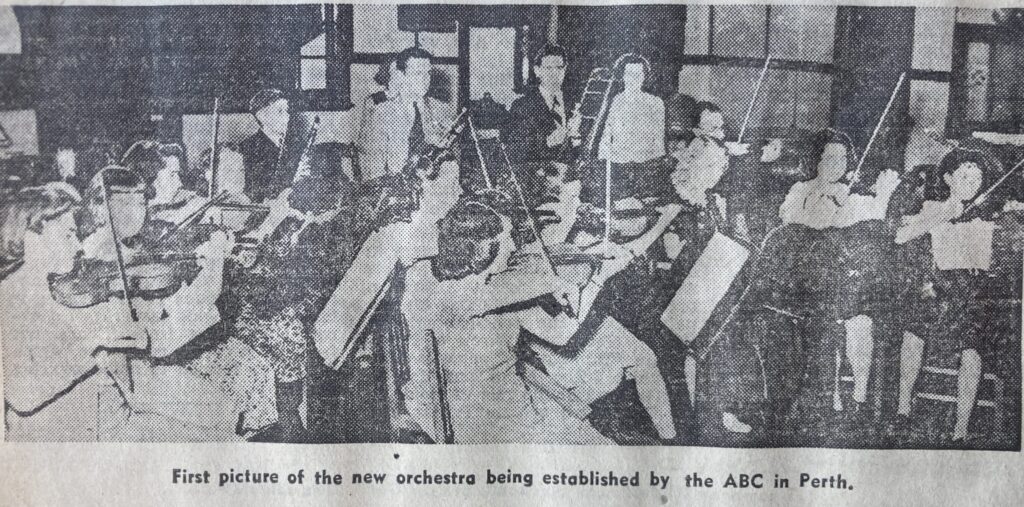
Jack Harrison was the youngest member of the newly formed ABC amateur Orchestra formed in 1945 by Mr E.J. Roberts.
Violinist, Norman Bourke was also in this orchestra, which rehearsed at Perth Girls’ School in James Street. Norman grew up in Wembley with musical siblings Marie, Bill and Walter who all played piano. Norman initially learnt violin from the nun Sister Mary Phillip at Victoria Park Convent on a borrowed instrument. About the time he started with the youth orchestra he was learning from Mr James, a friend of Vaughan Hanly who later joined the West Australian Symphony Orchestra. Norman left school after his Junior and started working aged 15 as a “Messenger” for the ABC which saw he and the Harrisons cross paths again several years later. Norman explained that and ABC “Messenger” was the bottom of the ABC food chain, required to pick up post and newspapers on a bicycle and deliver them back to Broadcast House. He initially got the job only for six weeks filling in behind someone who was sick, but then received an official telegram from the ABC offering him employment.
“Do it Yourself”
Amateur Orchestra is Opportunity (By “Althena”)
To a number of Perth’s amateur musicians, Mr E.J. Roberts and the ABC have offered a golden opportunity to “do it yourself” in unison by the formation of an amateur symphony orchestra. Mr Roberts selected only those whom he considered sufficiently conversant with their instruments to be able to give attention to the niceties of orchestral playing because, as he explained when I attended a recent rehearsal, his aim was to weld a miscellaneous collection of players into an orchestra, not to teach people how to play individual instruments. Although the majority of the players are of the teen age, ages range widely, from the diminutive Jack Harrison, the clarinettist, to elderly men and women who have joined forces with youth; linked by the ageless bonds of music.
The youngest member, Jack Harrison, comes from a musical family. He has been playing a clarinet for the past 18 months, but has played other instruments.[2]
Likes the Orchestra
Jackie Harrison, popular in the League Concert Party during the early stages of the war, has been among the regular listeners to the symphony orchestra concerts this season. Reason, he is gleaning all the knowledge he can about the clarinet. As a member of the juvenile A.B.C. Orchestra he has gained good experience and shows promise of becoming most proficient in the woodwind section. He is anxious to get back into the League band ranks if there is room for a clarinet.[3]
YOUTH ORCHESTRA
INAUGURAL CONCERT
High Standard Achieved
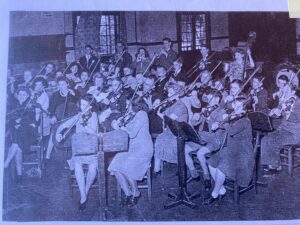
Winthrop Hall on Wednesday night was the scene of the inaugural concert of the newly formed All-youth Orchestra. What latent talent existed was revealed as the programme unfolded…Norman Burke and Leslie Jenkins in solo numbers…Jack Harrison’s contribution on the harmonica…[4]
[1] The West Australian Saturday 4 November 1944 page 4
[2] The Broadcaster Wednesday July 11 1945
[3] The Boomerang September 30 1945
[4] The West Australian Friday 19 October 1945 page 9
WAYO today:
The current WAYO was founded in 1974 to provide orchestral training and performance opportunities for young musicians aged 15 to 22.
- 1980s: Musical Director and conductor Peter Moore OAM (alongside figures like the late Richard Gill) co-founded the popular Babies Proms concert series, designed to introduce young children to orchestral instruments. Moore has served as an inspirational musical director for the organization since 1988.
- International Touring: Over decades of music-making, WAYO built a robust international touring profile, performing in major cultural hubs such as London, Prague, Berlin, Mannheim, Brussels, Paris, Singapore, and Hyogo.
- 2019: The orchestra made history by selling out the Perth Concert Hall for the first time in its 45-year run during its acclaimed Planets concert.
- 2024: WAYO celebrated its 50th anniversary with major sold-out commemorative concerts at the Perth Concert Hall featuring signature repertoire and guest conductors like Tze Law Chan.