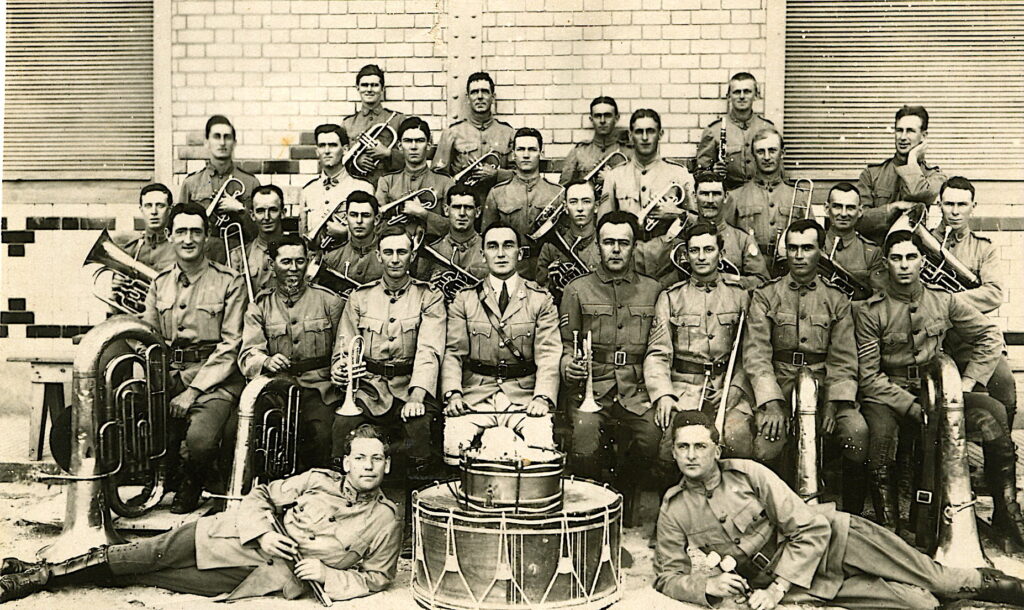
Hidden among the familiar stories of the battles, suffering and sacrifice of the Australian Light Horse lies an extraordinary story of 30 soldiers who could fight, ride—and make music. These were no part-time entertainers. The musicians of the Anzac Mounted Division were fully trained soldiers who were expected to put down their instruments, tie up their donkeys, sling rifles over their shoulders and fight alongside their brigades when called upon.
From 2 September 1917 in Palestine, these remarkably multi-disciplined ANZAC soldiers began to form what became the ANZAC Mounted Division Band. More than a century later, the story of this largely forgotten ensemble is being pieced together through a remarkable combination of a single band photograph and the wartime diaries of one of its members, the solitary Western Australian soldier and musician William Edward Harrison of Subiaco.
As is the case with Harrison’s diary, it details rather dull facts coupled with remarkable ones. Detailed daily army grind eventually whittles away to single sentences as conditions and the sheer challenge of staying alive become challenging. Life revolves around food, letters from home and not being killed by a mortar shell or disease. Teenage morals give way to necessity and Harrison lies, steals and boasts about survival feats that his parents would no doubt have punished him for back home in Subiaco.
Previously uncharacteristic behaviour is displayed by most band members as the war dictates their dreadful living conditions and their fragile mortality becomes evident. Brushing shoulders with highly esteemed officers and royalty is mentioned in the same sentence as how much alcohol was consumed after a performance. Passionate care of their equine partners is interspersed with violent assaults for a few oranges and what trumpet part was being performed that day.
Thirty ordinary blokes aged from 18 to 40 left Australia to fight for King and Country and were in the right place at the right time to throw together a functional band in Palestine. The joy of being able to play music together was clearly evident and the acknowledgment through financial assistance and permanent appointment to Chauvel’s headquarters placed this unlikely group at the front to provide much needed morale to send ANZAC soldiers to battle.
William Harrison’s diary details 140 performances over 20 months from their appointment until 28th May 1919. Details of disease, disciplinary action and tactical circumstances swell and reduce the band numbers, with Harrison’s choice on discharge from hospital to stay two extra few weeks preferring “to go back to the Unit” indicative of the bond that was formed.