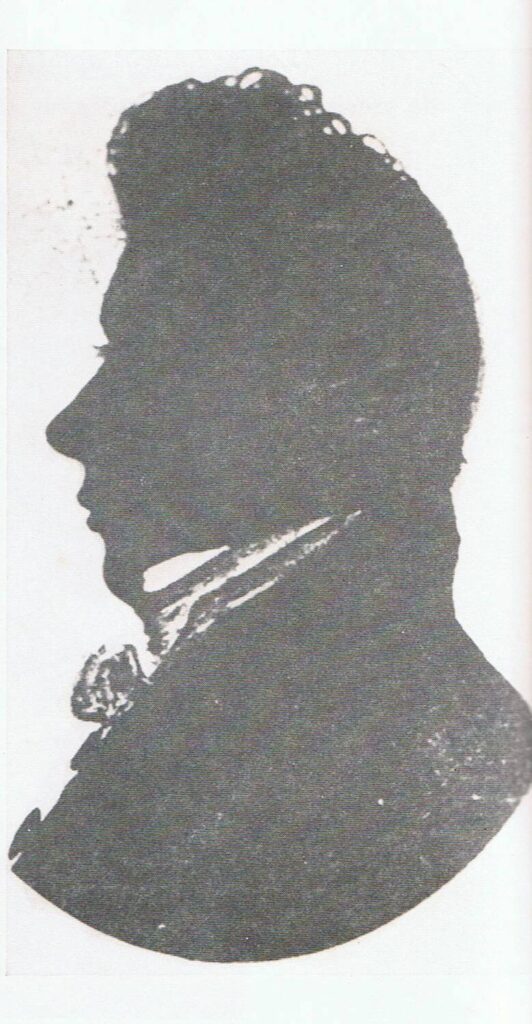
MITCHELL
Mitchell = English Scots and Irish: from the Middle English, Old French given name Michel, the regular vernacular form of Michael.
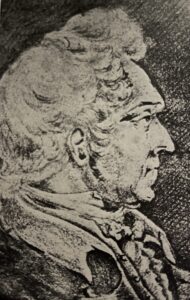
CAPTAIN WILLIAM MITCHELL was born in Kent, England on 1.5.1786, the son of Isabella Mitchell and Reverend Thomas Mitchell (left) born in Norwich, a former Chaplain to the Fleet in the Royal Navy at Portsmouth.
They lived in New King Street, Broadway, Deptford in 1814 and later at Broadstone Cottage near Poole, England. His grandfather, Thomas Mitchell, of the East India Company, designed Lord Nelson’s flagship, the Victory.
Martin, Desmond, A Tale of Twin Cities: Part 1 – The Founding Years, (Graphic Books, 1981). p.31.
Captain William Mitchell was a naval officer with the Kent Militia and arrived in Australia in 1810. A widower (“William’s first wife died in an asylum”), he left his son, William, in the care of his parents in Britain.
Carnegie, Margaret, Friday Mount: First Settlement at Holbrook and the South-Western Slopes of New South Wales, (Hawthorn Press, 1973). p.28
“Although Captain William Mitchell’s father was Chaplain to the Royal Navy, and his grandfather designed Lord Nelson’s flagship the Victory, the Captain seems to have been of weaker metal and to have preferred good times to self advancement and the Governor’s pleasure”.
Martin, Desmond, A Tale of Twin Cities: Part 1 – The Founding Years, (Graphic Books, 1981). p.23.
“…he was a Captain in the Army living on his pay, but with fair prospects in the future (his father being in good circumstances) but a bubble speculation into which he entered by the advice of friends and the glowing prospects held out by the promoters of the CoFu…ruined him beyond all hope of retrievement.”
Carnegie, Margaret, Friday Mount: First Settlement at Holbrook and the South-Western Slopes of New South Wales, (Hawthorn Press, 1973). p.28
He was given two hundred acres adjoining the Huon de Kerrileau property called Horatio Farm.
William Mitchell does not seem to have been held in the highest regard in all aspects of his behaviour as the Governor commented adversely to Undersecretary Peel “I am sorry to inform you that Mr Mitchell is a very dissipated Character and much addicted to low company”.
This is supported by two letters he kept from his father, a minister, who encouraged him to change his ways:
Two letters exist to William Mitchell from his father Thomas in London:
Addressed to Mr William Mitchell c/0 Rev. S. Marsden N.S.W.
Deptford 14th Aug. 1812.
My dear William,
It gave us very great pleasure to learn by your letter of 12th Nov last of your safe arrival in New South Wales in such good health and more particularly as we had received no account from you since you left Teneriffe. I trust we shall now hear from you by every opportunity. I have no doubt you must have felt very keenly hearing of your poor brother Thomas’ death in addition to which I have to mention that of his wife; poor Mary never had her health. She died about a month since, something of the Paralytic affection took her off. I attended her funeral. The dear boy Tom grows a sweet little engaging child, there is no doubt of him being well taken care of by his Grandmother and Uncle. I shall now give you some account of ourselves. Your dear Mother has been very much afflicted with Rheumaticism – gout for several months past, but I trust she is now feeling a little better. As for myself, I have abundant reason to be thankful, as my health never was better. Your dear boy, William, grows a very fine baby – very engaging: he often enquiries after you, he was very much affected on hearing from you. He requested his affectionate Duty to you. John and Richard are both in good health and going on very well. The latter has got into Greenwich Hospital as a clerk – likes his situation very much. With regard to news, I have nothing particular to relate; all our dear Relatives and Friends are well and much the same as when you left us. Isabella is married to a Mr Newington, a surgeon at Licehurst a very respectable man and the family most respectable. You will be concerned to hear of the death of that very worthy Mr Serle of the Transport Board. I do not wonder at the great regret you feel at leaving your Parents and Child, it is certainly a great happiness properly to know the value of dear Parents – it is like most other Belongings – we are not so sensible of it till we are separated from each other, but I trust in due time we may be permitted to see each other. There was no doubt a need for it and I agree with you that with our exertions and endeavours all will work together for good, and with your following the advice of your Parents you will have the same friend as your Parents to conduct you safely on. You give us a pleasing account of your farm (though in its infancy) and of its pleasant situation. I think the Governor allotted you a pretty good share, that of 220 acres which I have no doubt has all been done through the recommendations you took out with you. Of course you will see the policy of keeping in with him, and all who may have any direction in the affairs of the new settlements; in fact it is wise to make friends of all as we frequently find those we think little of, may be of use. I think it is a great offer the Governor having given you two men upon the stores for 18 months and 3 cows to be returned in two year’s time, either in kind or 26 pound per head. You no doubt feel an advantage in being on the Store; although it is but a bare existence, with your industry every day will get better, and a better proposition as you get on with the cultivation of your land which must be laborious work, but you will recollect it is all your own when done. And if you are but blessed with health and strength it is a great mercy, and I am sure with your exertion and management you will do as well as anyone there. You are very fortunate in meeting with so kind a friend in Mr Broughton [William Broughton was the store keeper], who married a relation of Mr Kennedy at Sefton. You will present my very best respects to him. It is rather remarkable you should be so situated as for your Farm to join that of his sons. I have no doubt you will cultivate that friendship that has begun between you. As for Mr Marsden, I think you will find him friendly towards you on account of the recommendations. I am well aware it requires the greatest circumspection therefore it is needless for me to say anything on the subject, as your own good sense will direct you to adopt such a mode of conversation as to put it out of anyone’s power to say anything to your prejudice.
I observe what you say about me submitting you a little money. I think you well know, I should at all times feel a great pleasure in doing that, or anything else in my power. You are but too sensible of the losses I have experienced and the heavy load I am labouring under in the struggle to repay the Debt I had contracted in being so long before I got unto a situation to provide for myself and Family. Not that I complain – I have great reason to be thankful for what God has done for me. However, under every circumstance I cannot refrain from doing a little, as I mean t write to Mr Broughton (by this conveyance) and request the favour of his advancing you Ten Pounds and that I would repay it to any person in London, or in any other way he may point out. You will receive this by the Brig Emu. You may expect to he from me again by the ship Fortune, which will sail in about a month, by which conveyance I shall send you some nails of different sorts and such other articles I shall think may be useful to you as well as some garden seeds. In your next, mention what kind of farming utensils you allude to my sending you as it is important I can form any idea of them. I suppose you have to use several article borrowed from the Store, particularly heavy sorts such as plough, farrow etc. In your next let me have a more full account of the Country and other particulars. I shall now conclude. Your dear Mother unites with me, also John and Richard in most affectionate love to you; and wishing you health, success and every blessing.
Believe me, my dear William,
Your every affectionate father,
Thomas Mitchell
P.S. 12.9.1812…was sent by Brig Emu since which I have nothing particular to communicate except that we are all in good health. You will, I hope, receive this by The Fortune by which convey I have sent you nails to the account enclosed which I thought will be useful to you. I assure you I have been hard put to it to send them to you, as you well know our circumstances. I have directed them to your address to the care of William Broughton Esquire, Commissary, Sydney. There is a case with nails, a bundle with the saws, and a small box 18 inch long with some garden seeds in a jar. The broad beans are loose also some Peas but you will easily discover the Prussian Blues from the others. I may now conclude. Your dear Mother unties in affectionate love to your self, John, Richard and your dear boy likewise sends his duty. He is in good health. And wishing you every happiness here and hereafter I ever remain
Your affectionate Father,
Thomas Mitchell.
P.S. My kind remembrances to Mr Broughton etc.
New King Street
Broadway, Deptford.
27th May 1814
My dear William,
I only received your very affectionate letter of 30th June last year, which conveyed the most pleasing account of your health and of your being so happily married, which I have heard confirmed by Rev. Mr Marsden, Mr Broughton, and by a letter Mr Lusen received from his son at the Cape who mentioned that Mrs Pringle had received a letter from the Governor’s Lady mentioning the particulars of the very respectable family you had married into, and every prospect of happiness success, which I trust will be fully experienced by you to the utmost. You have our Prayers and our dearest wishes for every happiness to attend you both. We most sincerely congratulate you on the occasion. Make our most affectionate love to your dear wife and say how happy we feel ourselves in such a connection. I have no doubt you will do everything to add to each other’s happiness, and the way to do that is the Path of Virtue arising from the Grace of God in the heart in causing you at all times to be looking up to Him as a Father who will fulfil every desire of the heart so far as is for your real good and His Glory Goal from His Sovereign hand are Blessings in Disguise, this we can speak from experience. Mr Marsden speaks very highly of you. I value very much his opinion of you. He says he will endeavour to promote your interests and give you every countenance, you cannot do better than to cultivate his friendship by doing everything to deserve his opinion of you. He appears to have your interests very much at heart and I have every reason to believe the Governor has the same good wishes for your welfare. It is a very pleasing consideration to have the countenance of the good and the great, the more so to be deserving of it. I trust you will be striving to cultivate a good understanding with the most respectable part of the community, not that I wish you to overlook the poor if their conducts are exemplary. I have not yet seen Major MacLean who I have no doubt will give me a good account of you and yours and confirm everything the others have said. I am very much obliged to Mr Broughton for his kindness to you in advancing 10 pounds to you. I shall return it in the manner he points out, which would have sent by this conveyance but your dear Mother is recovering from severe disposition (the old complaint) was so very ill as to be confined to her bed for near three weeks – but as soon as she is well enough she will go to town and procure the straw bonnet Mrs B. wishes to be sent and which will be forwarded at the first opportunity. I have written to Mrs B to that effect. I am extremely sorry to find by you that the cask with nails did not come to hand but I hope you have succeeded in recovering it as the articles were all put on board The Fortune at the same time, indeed I have receipt from one of the officers on board and a copy of which is as follows – Received Sept 21, 1812 on board The Fortune one cask, one bundle and one box directed to Mr Mitchell, New South Wales (signed) William Potter, Commanding Officer. Therefore if you have not got it they have been playing tricks in keeping it for their own advantage, they being very valuable articles that were carried in the cabin it is impossible a cask of 3 cwt. Or thereabouts could be overlooked except wilfully so I think they must be devoid of all feeling to retain such valuable articles to the very great disappointment of an industrious settler. You may rest assured I shall do everything in my power to make the Captain pay the utmost value, and if possible to the value they would fetch in the colony. At least I mean to apply to the Transport Board for the same on arrival of The Fortune in this Country and on my recovering the amount the same I shall appropriate it for your use, purchasing such articles as you may stand most to need them. When you write next, let me know what will be most acceptable in improving your estate.
And now my dear William I must inform you how we all go on. With regards to myself, my health has been wonderfully good and everything in my situation in Life nearly as when you left us. Your dear Mother’s health has been tolerably good except at times an attack of the old complaint with which she is presently laid up. Your brother John you will no doubt be surprised to hear is now at Cambridge studying for the Church of England and who if his life is spared I have no doubt will prove a zealous Preacher of the Gospel. Who knows but Providence may so far order it, as to send him into your Colony. If so it would make you very comfortable. Of himself I believe he would have no objections, but as he has an attachment to a very amiable young lady (a Miss Ashford of this place) perhaps that would be an obstacle therefore at any rate we must leave all these things to the well Disposer of all Events. Your brother Richard is settled as a clerk in Greenwich Hospital and is very steady. Your Aunt Hawkins is in but an indifferent state of health. Elizabeth, James and Thomas H are still in health, no changelings. Thomas has left us to board near Woolwich. Aunt Ellen and family are all well, John and his two sisters are married and doing very well. With regard to the Hammonds, your Aunt Hammond I am sorry to inform you is no more. Mr H. has left Portsmouth to live in Dover Place, Kent Road near Mr Kemps. All her family are well. Now my dear William as you well know how I am situated and the heavy expenses attending your brother John, being at Cambridge, I am prevented doing what I could otherwise do for you in sending out a plough and any other useful thing, but as soon as the expiration of his studies arrives which will be about a year, I trust I will be able to send you something. You have no doubt heard of the wonderful changes on the continent. Lord Wellington from what he has done in driving the French out of Spain and Portugal and entering France has so far stimulated the Allies that they have not only entered France but actually have dethroned Bonepart and banished him to the Isle of Elba in the Mediterranean where he has arrived.
Captain Mitchell retired from his regiment and was successful in winning the hand in marriage of the 15 year old ELIZABETH BROUGHTON HUON and they were married by the Rev Marsden on 16.3.1812 at St John’s Parramatta (witnesses Gabriel Louis Huon de Kerrilleau and Isabella Nelson) and remarried on June 19th 1812 (witnesses Catherine Davis and James Dempsey) by our first appointed Catholic clergyman, Fr. Therry, the day before which William became a Catholic as mixed marriages were not allowed. Their first two children Emma and Thomas were baptised on the same day. “Neither he or his wife remained in this faith, and Elizabeth is buried in the Church of England section of the Albury Cemetery.”
Martin, Desmond, A Tale of Twin Cities: Part 1 – The Founding Years, (Graphic Books, 1981). p.23
“In 1813, Captain Mitchell retired from his regiment and having received a grant of 200 acres from Governor Brisbane, took up residence with Elizabeth at Brisbane Meadows, near Goulburn. It was at Brisbane Meadows that the Mitchell children, destined to play such an important role in this district’s history, were born.
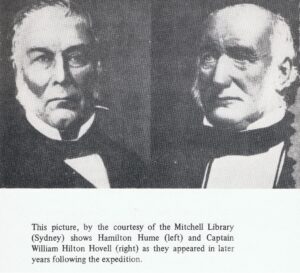 Only 11 years after Hume and Hovell’s memorable expedition, Charles Ebden journeyed south selecting runs both side of the newly discovered Murray, including Bonegilla and the present site of Albury, Mungabareena, meaning “favourable place for every tall talk”.
Martin, Desmond, A Tale of Twin Cities: Part 1 – The Founding Years, (Graphic Books, 1981). p.23
Captain Mitchell took up residence with Elizabeth at Corrondunna which they renamed Brisbane Meadows (named after Governor Brisbane) where their five sons and six daughters, including ISABELLA were born.
The eleven children of William Mitchell and Elizabeth:
Emma (born 8.9.1814, married Francis Rawdon Hume, brother of explorer Hamilton Hume)
Isabella (born 16.5.1816) married John Dight II
Thomas (25.6.1818 – 18.1.1879 married in 1850 to Charlotte Stuckey)
Mary Ursula (born 21.10.1820, married William Steele)
Edward (10.10.1822 – 22.4.1909, married Jessie Furlong)
Louisa (born 1.11.1824, who on 16.4.1846 married Elliot Heriot)
Eliza (born 22.7.1827, married David Bowen Jones)
Agnes (born 13.10.1829, married Ancrum Heriot)
Jean François Huon (born 16.10.1831 who in 1863 married Louisa Fenner, then Louisa Drury Evans)
James F. H. (29.5.1835 – 3.4.1914 who married his cousin Sarah Huon)
There was a fifth son, Frederick, who died young
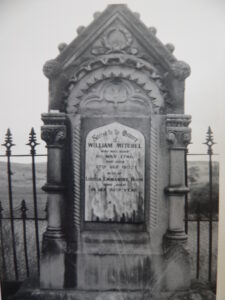
Captain William Mitchell died on 17.9.1837 at the age of fifty-one.
Obituary
William Mitchell – at his residence ‘Brisbane Meadows’ Argyle on the 19th ultimo, William Mitchell Esq in his 52nd year. Mr Mitchell (the son of a most respectable family of Kent) was an Emigrant of 27 years standing.
His bereaved widow and numerous sons and daughters will not alone lament the loss of the affectionate husband and tender parent. Many who knew him best must long regret the benevolent man, the conscientious master, the intellectual companion and the generous friend.
His remains were followed to their resting place in the Burial Ground at Inverary by a large assemblage of the chief landed proprietors, with their Dependents and other respectable inhabitants in the vicinities of Goulburn and Bungonia.
Sydney Monitor 18 Oct 1827
On Brisbane Meadow, is a headstone erected to the memory of its original owner, and which bears this inscription:
Sacred to the memory of
William Mitchell
Who was born 1st May 1786
And died 17th Sept 1837
And
Louisa Emmanuel Huon
Who died in her 70th year.”
Sydney Morning Herald Dec 1916 Captain J.H. Watson
In 1836, Ebden (who moved to Mt Macedon area, became Victorian Treasurer in the late 1850s) sold Mungabareena to Paul Huon, who presented it to his only sister, Elizabeth, daughter of the French Nobleman and now widowed on the death of her husband Captain William Mitchell in 1837. “However, she could not move immediately, and so sent nineteen year old Thomas to camp with Uncle Charles Huon (left) at Belvoir and run Mungabareena from there until he had prepared a home against her own arrival, which event took place in 1838 when she travelled down with the Rev. Docker’s party en route to establish Bontherambo in the Wangarrata area.” Elizabeth and her nine children travelled south by bullock wagon in company with the Faithfuls, who continued on to Wangarratta to become victims of the terrible “Faith Massacres.”
Martin, Desmond, A Tale of Twin Cities: Part 1 – The Founding Years, (Graphic Books, 1981). p.23
Elizabeth Mitchell built a homestead, first near today’s Waterworks and later at Hawkesview.
In 1836 Paul and Charles Huon squatted on the Wodonga run and John Dight took Bungowannah and an area to the west of Albury. In 1837, Charles explored land on the Murray River near its junction with the Tooma River, discovering Welaregang and hoped to establish a station there. “Unfortunely for him, his convivial nature and liquor-loosened tongue when at Tumut, prevented him from being the Upper Murray’s first settler. Roland Shelley’s lon ears were listening as Huon described and enthused about his new find to some of his friends, and when Huon susequently arrived at Welaregang he found Shelley was ahead of him and had claimed Welaregang for himself.”
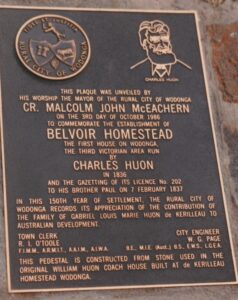
During Wodonga’s 150th year celebration, a plaque was unveiled commemorating Charles Huon’s homestead Belvoir, the first house in Wodonga.
“Thus did Gabriel Huon’s daughter come to be virtually the mother of Albury, while his second child, Paul, as owner and Charles, as administrator, fathered Wodonga”.
Martin, Desmond, A Tale of Twin Cities: Part 1 – The Founding Years, (Graphic Books, 1981). p.23
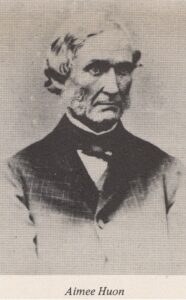 Aimé Huon arrived a little later with his brother-in-law Robert Brown. (Robert Brown was the first white man to settle on the site of Albury, although Hume and Hovell had discovered the area in 1824.)
When in 1838 Charles Huon bought Mungabareena Station from Charles Ebden for his sister soon after she was widowed, the land commenced from the north bank of the Murray at the mouth of Bungambrewatah Creek and extended nearly north westerly to “The Pinnacle” east of the township of Jindera to the northern end of Shelley’s or Hawkesview Range, south easterly by the top of that range past Shelley’s flat, Smith’s selection to the top of the hill, due north of Hawkesview House, east to the bank of the river which it followed to the point of commencement. Thus this first station formed on the Murray River included the site of Albury.
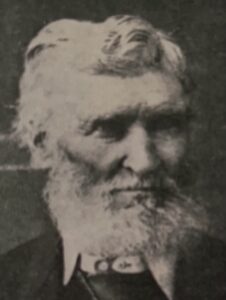
When Elizabeth and her young family arrived in 1838 the Crossing Place was a permanent camp for aboriginals described as both “numerous” and “treacherous”. Contrary to popular belief, they were well-built, standing up to 6ft tall, a proud, active race courageous by day, timid by night. The Australian Aboriginal was capable of great endurance and apparently regarded lightly any serious injury.
Typical was the story of the Aboriginal chief wanted for cattle spearing and found dead some weeks later in the fork of a gum tree. Gripped in one hand was a blood stained saw with which he had all but severed a leg badly injured during his earlier escape.”
When Elizabeth and her young family arrived in 1838, “night attacks were common along the Murray during which “buckeeny raids” were made on rival tribes for the purpose of collecting human kidney fat. When smeared generously on the victor’s body the kidney fat was thought to keep evil spirits at bay.” In 1864 there was such a raid on Hawkesview homestead by aboriginals and the body of a fourteen year old boy was found in nearby scrub and buried by the settlers the next morning.
Cliff Chamberlain, Border Morning Mail 1987
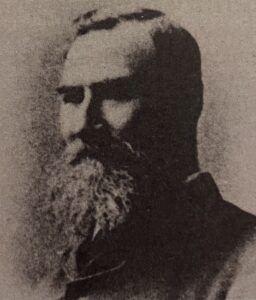
Such was the Albury of those Mitchell children encouraged by their mother to learn the customs and language of their aboriginal playmates. In due course as they swam, fished and canoed with their new found aboriginal friends, the Mitchells apparently became familiar and fluent in a number of aboriginal dialects. So much so that Jean F.H. Mitchell compiled a dictionary of the Woradgery tribe language.
“Most of the Mitchell boys later became official “protectors of the Aboriginals”. Because of the genuine friendship they were also privileged to attend many secret rituals seen by few other white settlers. These included the initiation of young tribesmen witnesses by John Mitchell from beneath the cloak of a tribal chief King George.
Earlier, King George at great personal risk, had warned Elizabeth of an impending raid by a hostile tribe bent on destroying Hawkesview homestead by fire. The attempt was aborted, and returning the favour, John Mitchell fought side by side with King George’s tribe, successfully defending it with his old muzzleloader against a buckeeny raid.’ Elizabeth Mitchell’s sons, Thomas and John, played a major role in the clearing and development of Hawkesview, Mungabareena, Thurgoona, Bringenbrong, Dora Dora and a string of other properties.
According to Stuart Hume, “the old hands changed runs as we change shirts; when one showed signs of wear, it was promptly discarded for another; many runs were bought and sold a dozen times.”
Charles Mitchell at one time owned Wodonga (41,000 acres), Baranduda (10,000 acre) and Bulgandrie (32,000). He founded the famous Coonong Station of 70,000 acres, later owned by Sir Samuel McCaughey, Conargo, a huge property and one of the Riverina’s best known, was also part-owned by Charles Mitchell. Another son, Aime, founded Gerogery Station (44,000 acres) and another adjoining Baranduda of 15,000. The Mitchell family owned Burrumbuttock (60,000), Mahonga (32,000) and Walbundrie (16,000).
[Although Mungabareena, at 4 pounds an acre in 1835, was worth almost 113000 pounds, it’s quite likely that Huon paid no annual rent. Today’s (1987) total unimproved value of Albury’s 25,700 acres is about $250 million on which rent, in the form of rates, is just under $18 million.]
Aime and Charles Mitchell, apparently pleased with stockman John Simmonds’ loyalty, gave him Piney Range, a 12,000 acre property on the Billabong. These two brothers, Aime and Charles, married sisters Mary and Eleanor Brown, Sisters of Robert Brown, Albury’s first storekeeper. Aime’s daughter, also an Elizabeth, was reputed to be the first white born child born on the Murray, in which she was destined to drown. Perhaps better know locally of Elizabeth’s sons was James, born near Campbelltown in 1835.
James took over the management of Table Top, bought by his mother Elizabeth in 1857, and transformed the primitive wilderness into one of Australia’s finest pastoral properties. Showing a remarkable combination of skills, experience and judgement, James Mitchell enthusiastically began ring-barking, fencing and tank-sinking when suddenly the rabbit menace struck.
According to Des Martin’s “Tale of Twin Cities”, James Mitchell borrowed 60,000 pounds for five years, during which time Table Top was completely freed of rabbits. In due course, Table Top wool frequently topped Australasian prices, its Devon cattle from English Royal Stud equalled the nation’s best and Mitchell’s racehorses and bloodstock had few peers.
Cliff Chamberlain, Border Morning Mail 1987 “Family History reads like a best-selling Novel”.
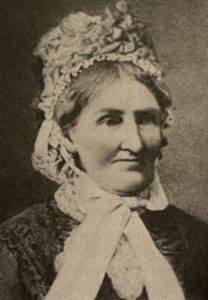
Elizabeth died on 5.11.1880 at Rockwood, Albury aged 83 and is buried in the Church of England area in the Albury Cemetery.
“The mind boggles at the courage of Elizabeth Mitchell, daughter of Gabriel Louis and Louisa Huon. Wed at teh age of 15 and widowed when she had ten children she actually took over Mungabareena Station which included the site of Albury. Elizabeth Mitchell could well be described as the mother of Albury and her tombstone in the Albury cemetery bears the appropriate inscription “Her children rise up and call her blessed.”
Macdonald, Jean, Albury Wodonga: The Chosen City, (Self published, 1980), p9
“Table Top’s Cremorne won the Sydney Birthday Cup, Doncaster Handicap and Caulfield Cup. James Mitchell’s generosity in many diverse fields included 4000 pounds to the Albury Hospital and 1000 pounds to the British Navy’s Dreadnought Appeal. In 1907 honouring the memory of his mother Mitchell donated its present bell to St Matthew’s Church.” Cliff Chamberlain, Border Morning Mail 1987
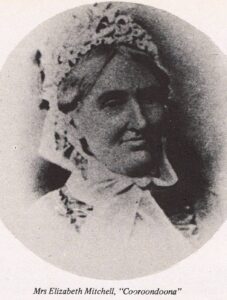
Left is a portrait of Elizabeth Mitchell, which hangs in the Elizabeth Ward of Albury Hospital.
The bell at St Matthew’s Church of England, Albury, was presented to James Mitchell in June 1907, inscribed to the memory of his mother, Elizabeth Mitchell.
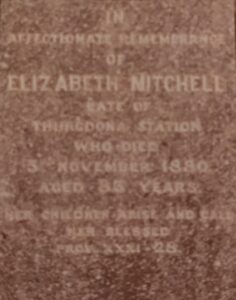
There is also a tree planted in her memory with a plaque on it in Albury Botanical Gardens.
When she was 16, Elizabeth’s daughter ISABELLA MITCHELL married JOHN DIGHT III on 27.8.1832.