HUON
Huon = of the Old French personal name Hugh
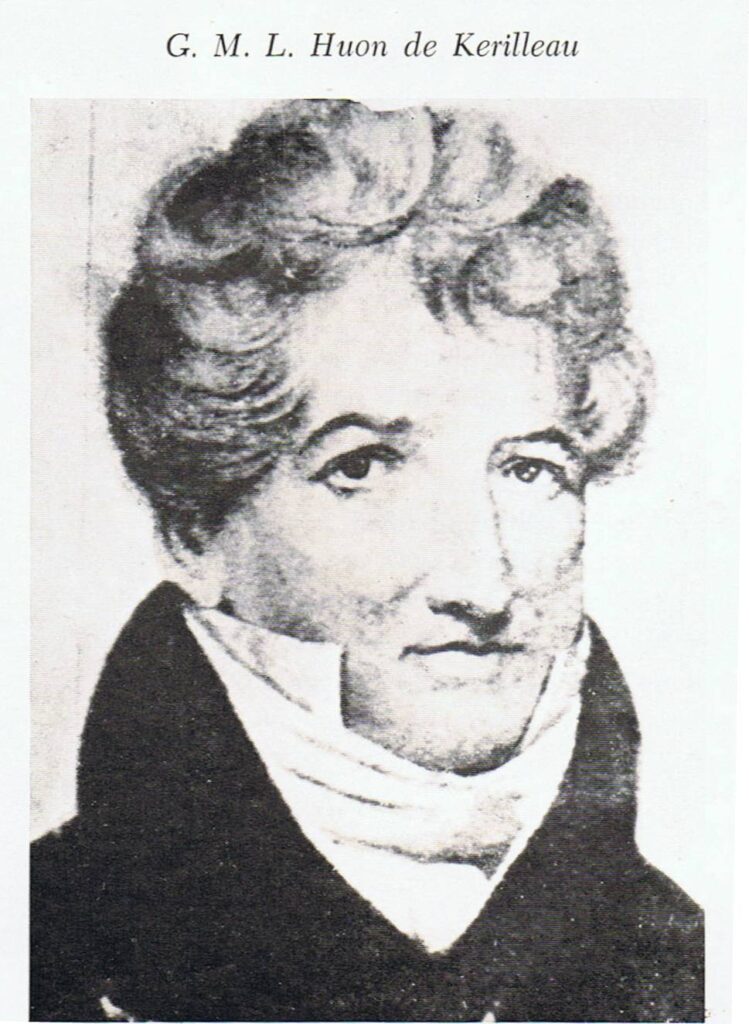
GABRIEL LOUIS MARIE HUON DE KERRILLEAU was born at St Pol de Lion, Brittany, France on the 17.4.1769, son of a French family, being the third and youngest son of Jean Francois Huon, Seigneur de Kerilis Lesquern and Plouvourn, Baron of Rennarch by his second wife.
The Huon family is old and aristocratic and can trace itself back to the recorded marriage of Henry Huon to Crortoise de Botquenal in 1440.
The Huon family also had a history linked to Breton’s seafarers and the tradition of serving in the French navy. The Huon name has been immortalized by explorer and naval commander Jean-Michel Huon de Kermadec (born in Brest in 1748), after whom Huonville, the Huon River, (Huon Pine was thus named as it grew near the river), and the Kermadec Islands (in the Pacific Ocean, north of New Zealand) were named. These namings occurred as a result of a trip from 1791-3, initially planned to investigate the disappearance of the ship La Perouse, missing since 1788. S. Odgers, Tasmania Guide, p. 148
The territorial name of de Kerrilleau comes from the estate of Gabriel’s mother, Anne de Kersalion, daughter of Jacques de Kersalion and Dame Marie Garielle Simon de Mouster.
“It is probable that Louis went to Wales, since he had Welsh ancestry and spoke the language. He had another connection with Great Britain; his uncle, the Bishop of St Pol de Leon, had been brought to England by smugglers, but whether Louis actually came with him is not known. A descendant wrote:
His uncle the Bishop of St Pol de Leon fled from his diocese when the Soldiery were within hearing of his palace and in an English smuggler’s open boat crossed the Channel in a desperate storm and landed on the coast of Cornwall, when at last his companions found an opportunity of dodging the customs officers of the King. The Bishop soon found himself lodged in London to be one of the supporters of the French Chapel in Little George Street. The Bishop subsequently became Chaplain to the Marquis of Buckingham, a connection which later to affect Louis’ life in New South Wales.
The Buckinghams were obviously friendly to the family. They were also very good to the Bourbons and had the King and all his family and “hangers-on” at Stowe after they had been kicked out. The Bishop might have been in this party and, being out of a job, was given that of Chaplain at Stowe”
Why Louis chose to go to Australia is not known. Some say his brother Aime went to America, where he subsequently founded the Huon brand of trotters.”
The facts are grim: “The eldest son, and Seignieur, Aimee, was arrested, his estates seized, and he himself imprisoned in France for six years. After that he was transported to the infamous penal settlement of Devil’s Island, off French Guiana, where he died. Strangely, since his whereabouts could not be proved, Gabriel’s lands were not sequestrated. But he lost them in the long run, and the death of Jean Francois (his son) at sea destroyed any possibility of him winning back any monies or possessions in France. Gabriel’s sister, Anne Marie Huon, whose married name was Rolland, dies there (in St Pol) in a hostel run by the nuns in the year 1839.”
Martin, Desmond, A Tale of Twin Cities: Part 1 – The Founding Years, (Graphic Books, 1981). p.16
“The French Revolution of 1789, the rising of the people against the tyranny of Royalty had broken out, to be the cause of a greater tyranny. The Bastille had been stormed and destroyed, and many of the loyal adherents of the crown fled from France to seek refuge in England. Among the refugees was Gabrielle Marie Huon de Kerrileau, a member of a family of the old French Nobility. From another branch of this family came Captain Huon de Kermadec, second in command of the expedition sent out by the National Assembly of France under Rear Admiral Bruni D’Entrecasteaux which in its search for the unfortunate La Perouse, anchored in Storm Bay, Tasmania on 21st April 1792.
When Louis Huon arrived in England he heard of the new land in the southern ocean that the British Government was colonising. It was the place his countrymen in the ships Boussole and Astrolab had called at, and then sailed away into seas from which they never returned. He was fired with a desire to visit that far off country, and learning that a second fleet was being fitted out to convey another large contingent of convicts to add to the population of the new settlement, he made up his mind to accompany it. The detachment of marines which had accompanied Governor Phillip to New South Wales was to be withdrawn, and was to be replaced by a corps of infantry raised for that particular service. Into that corps he enlisted, and under the name M. Louis he became a private in Captain Nicholas Nepean’s company of the N.S.W. corps, of which John MacArthur was Lieutenant. This company embarked on the ship Neptune, but through a variety of unfortunate circumstances, it was January 17th 1790 before they finally got clear of the English Channel, and after a voyage of five and a half months, arrived in Sydney June 23rd 1790 (was probably on the Surprize / Supply which arrived 23.6.1790 as the Neptune arrived 28.6.1790).
- Louis no doubt performed the duties of a soldier to the satisfaction of his officers, and being a gentleman, he would have assigned to him some office he would be qualified to fill. MacArthur befriended him and “Burke’s Colonial Gentry” is responsible for the statement: James MacArthur, of Camden Park, New South Wales, born at Parramatta 1789, educated by a French refugee (Huon de Kerrileau) until 1809”. By some it is said that he had a school in Parramatta. It is probable, therefore that he had as pupils Edward MacArthur, afterwards Lieutenant General Sir Edward MacArthur, who left Parramatta at the age of 18 to enter the army, John MacArthur Jnr, an English barrister who died in 1931, James MacArthur whose only daughter was mother of the MacArthur / Onslows, and Sir William MacArthur M.L.C, the four sons of John MacArthur, who, after he left the army, established the wool industry of Australia. Governor Bligh, writing to Mr Windham, Secretary of State for the Colonies, under date October 31 1807 says: “On the discharge of M. Huon de Kerrileau from the N.S.W. Corps, I gave directions for his receiving one hundred acres of land and the usual advantages”. Now, why should the Governor of the Colony, in a despatch to the Secretary of State especially mention a private soldier by name, and in doing so put the abbreviation for Monsieur before his name? Nor does he call him M. Louis, the name he enlisted under, but his own family name, and the branch of that old aristocratic family he belonged to, Huon de Kerrileau. (MacArthur built a cottage and schoolroom in Hassall Street, Parramatta for Huon). “The Town and Country Journal” circa 1915 by Captain J.H. Watson
“There is a little brick building at Parramatta which might well be preserved but it is not listed with those buildings considered worthy of preservation because of their historical value. It is the oldest school building still standing in Australia and was erected by John MacArthur as a school in which Huon de Kerrileau was to serve as tutor to his children. De Kerrileau was one of the French Nobility who fled to England during the reign of terror and later joined the New South Wales Corps. MacArthur managed to get his discharge from the Corps and built him a school and a house (in present Hassall Street) close to his own Elizabeth Farm House. Both the residence “Fairholm” and the school are still in a good state of preservation, while in the grounds still grow the oak trees that MacArthur planted to celebrate the news of Waterloo.” “The Town and Country Journal” May 1947
“He (Huon) married while at Parramatta, the Rev. Samuel Marsden tying the nuptial knot, his wife being Louisa Le Sage. The name suggests she was a French woman. Beyond that, as the first newspaper was not born, nothing has been handed down to us. It can be assumed that she, who was the mother of his family (and at this time their descendants occupy honourable positions all over the Commonwealth), was his equal in point of education and intellect, and worthy to be the wife of a Huon. On the map of the Parish of Narellan, in the County of Cumberland among the original grants, is one in the name of C.L.M.H. de Kerrillian. This should have been written G.M.L. Huon de Kerrileau, and it is not long ago that the attention of the Lands Dept. was called to this by one of the family. The adjoining grant stands in the name of William Mitchell. This gentleman, belonging to an old Kentish family, who held a captain’s commission in the county militia, came to N.SW. in the early years of last century. (Arrived 1812 in “Providence”). The fates ordained that the grant the Government was pleased to bestow on a settler of his class should be next to Huon’s. Louis Huon had three sons and one daughter, who, whilst very young, was married to her neighbour William Mitchell. In Governor Brisbane’s time, Huon and Mitchell moved into new country in the County of Argyle, near Bungona. Huon’s property was named “Corrundaroo” and Mitchell’s “Brisbane Meadow”. “The Town and Country Journal” circa 1915 by Captain J.H. Watson
“When the reign of terror in France was at its height, and the life of an aristocrat was not worth one hour’s purchase, Marie Louis Huon de Kerrileau and his wife left France as political fugitives, and took refuge in England, and his subsequent history was disclosed by a writer in the Melbourne Argus recently. For the purposes of concealment of his identity, Huon took the name Louis Michel. In that name he enlisted as a private in the Army, and some hears later joined the N.S.W. corps known as the 102nd Regiment, of which John MacArthur was the Captain. With this Regiment he embarked with the second fleet bound for Sydney in 1790, just two years after the first penal settlement has been formed. It is interesting to find these two men were associated, considering the great influence each of them exercised in different ways upon the pastoral industry of the country. Captain MacArthur was the founder of the great fine wooled flocks of Australia, and Huon’s descendants were instrumental in the formation of some of Australia’s most successful grazing properties.
It did not take such a shrewd man as Captain Macarthur long to discover that at least one of the men in the ranks of his regiment was out of place there. He quickly recognised that Private Louis Michel was qualified by breeding and education for better things than serving in the ranks of a penal settlement regiment, and the French refugee was given his discharge. In due course, Huon (who had assumed his real name again after arrival in the colony, but throughout his life kept his family status and title a secret) took up land in the Campbelltown district, and devoted himself to pastoral pursuits. Being intelligent, honourable in his dealings, and industrious, he succeeded in his business and brought up a large family. Later in life he handed his holding over to his sons, and took up new country on the South Coast. There he resided until 1829, when he disappeared in a mysterious manner. One day Huon started to walk from the Shoalhaven River district to Campbelltown to see his son and spend a day or two with him. It was not until a week later (there was no telegraphic system or mail in those days) that it was discovered that the old man had not reached his destination. Then search parties were organised and the densely timbered country was scoured daily for more than three weeks afterwards but without success. The only trace of Louis Huon found from that day to this was on a tree in one of the Shoalhaven gullies, not far from the coast. On this he had carved his initials with a pocketknife. In his adopted country, the French Royalist, whose fortunes had gone down with the fortunes of the Bourbons, had become a good bushman and successful pastoralist, appears to have lost his way and his life in the course of a journey lightly undertaken on foot. Of course he had to pass through rough, densely timbered wild country, and the probability, as it was considered at the time, was that he died in one of the caves in the vicinity of the coast.
The secret of this man’s identity was so well kept that it was not disclosed until nearly three quarters of a century after his death. There was at least one document in French in the family, which threw the fullest light on the subject, but it was only discovered by accident, adhering to the bottom of a pile of family papers, within the last few years. On being translated by the Sydney University, the document has since been authenticated, and the identity of the man who died a lonely and tragic death in the Shoalwater gullies and founder of the pioneer families of the Riverina, fully established as that of Huon.”
“The Town and Country Journal” 17th July, 1907
As time has progressed, Gabriel’s status has been romanticised, some people referring to him as a “Count”. ‘Born in 1769, Count Gabriel was said to have been the nephew of a Bishop of St Pol de Leon, who during the church’s suppression of 1791 escaped in a smuggler’s boat to England, where he eventually became “Chaplain to the Duke of Buckingham”.
Cliff Chamberlain, Border Morning Mail, 1987
“The oldest son inherits the designation “Seigneur de Kerilis Lesquern and Plouvern”, which is held today (1981) by Mr Hume huon of Melbourne, but Mr Stuart Hume of Garrorrigang, Goulburn, N.S.W., who has made a most extensive study of this branch of the family, and the Hon. Thomas W. Mitchell, C.M.G., of Towong Hill, Corryong, Victoria, a direct descendant of Gabriel through his only daughter Mrs Elizabeth Mitchell, both deny that there is any hereditary noble title, such as “Count de Kerrilleau” so frequently used in Australian references attached to the Huons.”
Martin, Desmond, A Tale of Twin Cities: Part 1 – The Founding Years, (Graphic Books, 1981). p.15
Approximately 130,000 people fled from the 1789 French Revolution, amongst them being Gabriel with his three brothers, supposedly smuggled out of France to England in 1790 by his mother, which has been disproved, both of his parents having died prior to his fleeing France. J. Jupp, The Australian People, p.472.
With the aid of his Uncle, Bishop of St Pol, Gabriel was furnished with letters of introduction from the Duke of Buckingham and enlisted in 1794 as a private soldier (in those days one had to buy a commission) in 102nd regiment of the New South Wales Corps. The New South Wales Corp encouraged its members to settle in New South Wales on completion of their service, with land grants promised as an extra inducement.
Carmody, Jean, Early days of the Upper Murray, (Shoestring Bookshop, 1981). p. 96
Fired with the desire to visit far off Australia, he enlisted under an assumed name – Louis Michel – and on 2 May 1794 sailed for Sydney with the Second Fleet in the Surprize as a private in Captain Nicholas Nepean’s company (in which John Macarthur was a Lieutenant). On board the ship after a voyage of five and a half months they arrived in Port Jackson on 25 October 1794.
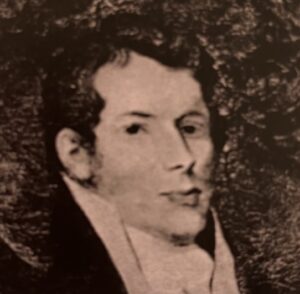
Gabriel, assuming his right name after presentation of his letters of recommendation from the Duke of Buckingham, is described as a gregarious and popular personality who made many friends. John Macarthur befriended him, persuading him to leave the army and appointing him private tutor to teach his children in the first school building in Australia specially built in Macarthur’s new home.
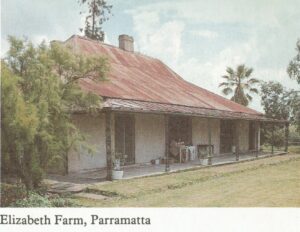
Burke’s Colonial Gentry is responsible for the statement regarding Macarthur’s son: “James Macarthur of Camden Park, New South Wales, born at Parramatta 1798, educated by a French refugee (Huon de Kerrilleau) until 1809.” Gabriel lived in a residence Macarthur built him until 1809 and in the surrounding grounds around Camden Park estate grow the oak trees that Macarthur planted to celebrate the news of Waterloo.
When Louis left Macarthur, according to the Macarthur papers, the latter referred to him “as a kind-hearted and accomplished gentleman of Brittany who, expatriated by the French Revolution, came to New South Wales as a soldier in the ranks.” It was also said that amongst the accomplishments of Macarthur’s children was a fluency in French that amazed their overseas friends when they went to England. According to Burke’s Colonial Gentry, in March 1815, Macarthur took his sons James and William to Paris where they were able to act as his interpreters.
On the 18th of December 1806 the Rt Hon William Windham (Lord Grenville, brother of the Marquis of Buckingham) gave orders that “G.L.M. Huon de Kerrilac, a French immigrant of distinguished family, should be discharged and that everything be done for his comfortable establishment.” On the 31st of October 1807, Bligh replied that “on the discharge of Huon de Kerrilac from the N.S.W. Corps, I gave directions for his receiving One Hundred Acres of Land and the usual advantages.” In the meantime, Macarthur and Bligh had become enemies and the land Bligh promised was not forthcoming.
Bligh was overthrown and on the 8th of August 1809 Lieutenant Governor Paterson granted 400 acres of Minto land near the present town of Narellan to Gabriel under the name of Kerrilian. Gabriel called this property Buckingham (renamed Gledswood in 1816 by the next owner James Chisholm, and today attracting some 120,000 tourists a year. Several convict-made buildings constructed of local sandstone remain on the property including the original residence, which later became the kitchen of the present homestead, a coach house and a one-room cottage.) This grant was confirmed by Governor Macquarie on 1.1.1810 and on that day he also received 100 acres at Bankstown, which he called Castle Cove. On the 25th August 1810 Gabriel got a further 30 acres at George River.
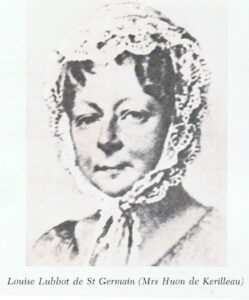
Gabriel met a young French girl Louisa Emmanuel Le Sage or Louisa Lubbot de St Germain or Gramaire after her arrival as a female convict (accompanied by 132 other female convicts, two of who died during the voyage) in the ship Indispensable on the 30th of April 1796.
According to her grandson, J.F.H. Mitchell, Elizabeth Mitchell recalled Louisa reminiscing (apparently Louisa was from was from the Noblesse) about an aunt, the Duchesse d’Angouleme, who was lady-in-waiting to the Queen of France. Elizabeth also remembered Louisa speaking of Versailles and St Cloud and sighing and weeping for the country she so loved which she knew she would never see again.
At the age of 22, she was convicted on the 17th of September 1794 of stealing a metal watch that did not work, a cloak, a petticoat, two shawls and a key valued at one penny which was probably in the coat of the pocket, the value of these items being 39 shillings (about $4). On the evidence given at her trial at the Middlesex Old Bailey, it looks quite likely that the jealous wife, Maria, of her employer, Mr James Brock of St George’s Hanover Square set Louisa up. Louisa claimed that Jas Brock (who was not present at court) gave her the watch and that she thought the clothes were cast offs that she was free to take. Louisa was given the light sentence of seven years transportation to Botany Bay but spent a year in Newgate Prison before boarding the next available assisted passage to Australia.
Louisa became governess to Macarthur’s daughters in the house where Gabriel was tutor to his sons.
The Melbourne Australian, 30th March 1935, p. 7.
She must have appeared to Louis Huon as an angel from heaven in the women-starved colony – a young, attractive woman who spoke French! Equally, the aristocratic, handsome and well-mannered Louis must have been a remarkable catch to Louisa, convicted lady’s maid. Obviously hoping to conceal her convict background and protect her reputation, apparently Louis Huon was to sustain the deception until the day he died that Louisa had become his wife in London and she had dutifully joined him in NSW.
The Weekend Australian, 27-28th February 1988, Magazine p. 5.
“ perhaps he (Louis) looked up the French girl on the ship’s manifest, found her worthy of interest, and arranged with Macarthur for that gentleman to have her assigned to him as a servant, for she became governess to Macarthur’s daughters in the house where Gabriel was tutor to his sons.”
Martin, Desmond, A Tale of Twin Cities: Part 1 – The Founding Years, (Graphic Books, 1981). p.22
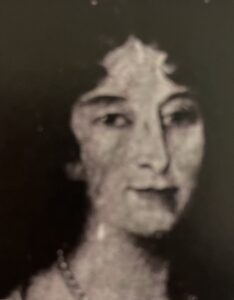
Mrs Elizabeth Macarthur (right) must have been kind to Louisa as she named her first child and only daughter after her. Elizabeth Broughton Huon was born on June 6th 1797 (William Broughton was the MacArthur’s storekeeper and evidently another friend of theirs) and baptised July 9th 1797. Two years later on 12th September 1799 they had a son, Paul. “…the Governor included them in his cleanup of local social life and, though they objected to a non-Catholic clergyman and service, had them married by Sam Marsden at Parramatta on 7th February 1801”.
Though it is obvious that Sydney society of the day accepted the Huons, as did the Macarthurs, before Sam Marsden tied his official knot the first two children were, at law, illegitimate”.
Martin, Desmond, A Tale of Twin Cities: Part 1 – The Founding Years, (Graphic Books, 1981)., p.22
“One can imaging the strains placed on Louis and their marriage by the fact that she could not be received and how humiliated she must have felt when her husband “was a regular visitor at Government House up to and during Sir Thomas Brisbane’s time” and she had to remain behind”.
Few emancipated convicts were received at Government House. The Australian, 6 Feb 1829
After the birth of their first two children, Gabriel and Louisa were finally married by permission of the Governor, at St John’s Church Parramatta on 7.2.1801 in Parramatta by Samuel Marsden, with witnesses Francois Durinault and Ann Hotness. As they were both Catholic, they were remarried in the Catholic faith by the Rev Fr Dixon (a priest transported for political crimes) on 19 June 1807. It was here that Louisa signed her name “Louise Lubbot de St Gramaire”.
The five children of Gabriel and Louisa :
ELIZABETH BROUGHTON (born 6.6.1797 in Parramatta, bap. Rev. Marsden on 9.7.1797 married William MITCHELL)
Paul (born 12.9.1799 – died November 1888)
Jean Francois (born 1802 – lost at sea on his way back to Australia)
Aimé (named after Gabriel’s brother) m. Mary Brown
Augustus (1806 – 12.9.1886 drowned in Fiji, m. Mary Brown)
Charles (born 1812, married Mary Brown’s sister).
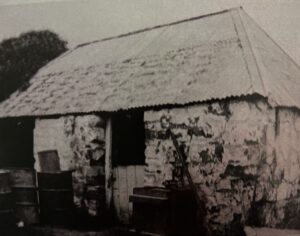
In January 1829, Gabriel started on foot from Bungonia, book in hand as apparently was his custom, through the steep Shoalhaven gorge to Campbelltown in order to visit a son. He was later seen and spoken to and twice put on the right road, but obviously got lost in the gullies o the Shoalhaven River. When it was found he was missing, the country turned out with his son-in-law, Captain William Mitchell, and made a thorough search for him.
D.Pike Australian Dictionary of Bibliography, p. 573
The only traces found were on a tree alongside the cattle track above the Shoalhaven Gorge at the Longpoint he cut an inscription saying “Going east” and his gold spectacles, broken, lying at the foot of the tree. He was never seen alive again nor has any trace of his body ever been found. This fulfilled a prophecy made before he left France, for apparently in 1777 Louis was stopped in the streets of Paris by a gypsy fortune teller who told him that he was doomed to be driven from his native country, to a distant foreign land, where his body would be lost and never found.
“No stone marks the spot where lie the bones of Royalist, Refugee, Pioneer Australian and head of an honoured family.
Louisa died in her seventieth year at the homestead “Carn”, Bungonia and is buried in Bungonia Cemetery.
Gabriel sent his son Jean Francois back to France in 1824 to try and claim two hundred acres “left to him in April 1786 by his Grandmother, the Countess of Lesquern. This would by 1823 have amounted to a considerable sum The trustees of that money were his cousin, Francois Malhurin de Lestrang, and the attorney, Louis Michelle de Flock. Obtaining the money was difficult and, after many letters to Brittany, Louis sent his eldest legitimate son, Jean Francois Huon, to France for education and to try and get the legacy.
He visited the French ship La Coquille sailing on 29 September 1824 to arrange a passage to France for Jean Francois. Captain Duperry provides an interesting comment on Gabriel Louis:
This jolly and gay old man appeared to be very much moved when he saw his country fellows and everyone of us hastened to pay him attentions which reminded him of the sacred soul of his fatherland…Living almost constantly in the lonely regions of New Holland, far from cities and isolated in the woods, Mr Huon had kept his natural gay and merry temper and relaxed from his labour in the arms of the Latin muses which he loved.
Gabriel Louis wrote on 29 September 1824 to his nephew in France:
I send you my second son, Jean Francois Huon, by La Coquille, Captain Du Perry, I declared it, considering his quality as a gentleman, that he neither knows to read or to write. The poor boy has been busy all the time which ought to have been devoted to education, to look after our cattle in the forests of Australia.
Notwithstanding all the encouragements we have received we have been obliged to work very hard. The larks did not fall roasted in our mouths…[I] would be glad to have word in writing from all the members of the family. Their remembrance will always be my trouble, and France my love forever.
I beg you, my dear nephew, to send me the correct amount of my property in Brittany, including expenses and taxes in order to enable me to benefit my sister, for it is but just I should help make her comfortable. I am more indebted to her than anyone else; but as I intend to send you a pupil, in a few years he must find in that country enough to live upon to finish the remainder of his studies…
Send me if you please my certificate of baptism, a copy of my nobility’s decree and a silver seal with my arms on it. The Universal Dictionary of P.C.V. Boisle, old lawyer, for we have not here a good French Dictionary.
Louis gave to his son copies of his marriage certificate and Jean Francois’ baptism to take with him to prove his identity. These documents probably gave a clue to Louisa’s identity, as it is unlikely that Louis would have deliberately misled a priest when there was no necessity to do so; nor would he have given his son inaccurate information on his mother to take to France; his known character is not in keeping with such actions. Father Therry obviously considered the marriage certificate to be accurate as he had kept it amongst his papers.”
Jean Francois took the following instructions from his father with him to France. They were returned with his effects when, after having successfully executed his father’s business, he was drowned.
Jean Francois “was apparently reasonably successful and doubtless a settlement in a lump sum was arranged. However disaster overtook him. Murder cannot be ruled out; one L’Estrang wrote either to Paul or Aime (addressing him as a cousin), advising that Jean had been “lost at sea” – and with him eleven thousand fancs. A few of the unfortunate man’s effects were saving, including his letters, but no money. One body was recovered but history does not say whether it was Jean Francois.
Letters from France concerning Jean Francois’ drowning contain many contradictions but a court case (No. 634) confirms most of the story. The case concerned the two hundred acres promised to G.L.M.H de Kerrilleau on 29 January 1822.”
“One account claims that the deeds or papers belonging to Louis were entrusted after his death to a French artist named “Chevalier”. He visited Australia in the suit of the Duke of Edin burgh. Chevalier is said to have promised to place Louis’ papers, ring etc before French authorities. However the descendents later found he had claimed to be himself the “lineal descendant”, stating that the articles were his. He was accepted as such and took possession of the Chateau, etc., until he died – it was too late then to take action to justify Louis’s rights.”
The wife of an early solicitor of Albury, Earl Toucher Fleming, commented to her daughter about Gabriel’s sons:
“how extraordinarily casual and happy-go-lucky they were.” She remembered them bringing a letter from the French Government to Grandmother for translation. It had arrived many months before, and they hadn’t bothered to do anything about it, so that though it was an invitation to return to France and claim their family estates before a certain date, they were not able to do so because, owing to their not bothering to get it translated when it arrived, the time limit had run out.
Doubtless William Huon, son of Paul, knew he could never inherit as his father had been illegitimate, so perhaps he ignored the invitation.
“HUON VICTORIA: The name of Charles and Paul Huon who were pioneer settlers.”
A.W.Reed, Place Names of Australia 1988, p.119
Around 1810, when Gabriel was firmly established at Buckingham near Narellan, a widower who had recently sold out of the British Army, arrived and was granted the 200 acre Horatio Farm next door.
This was CAPTAIN WILLIAM MITCHELL.