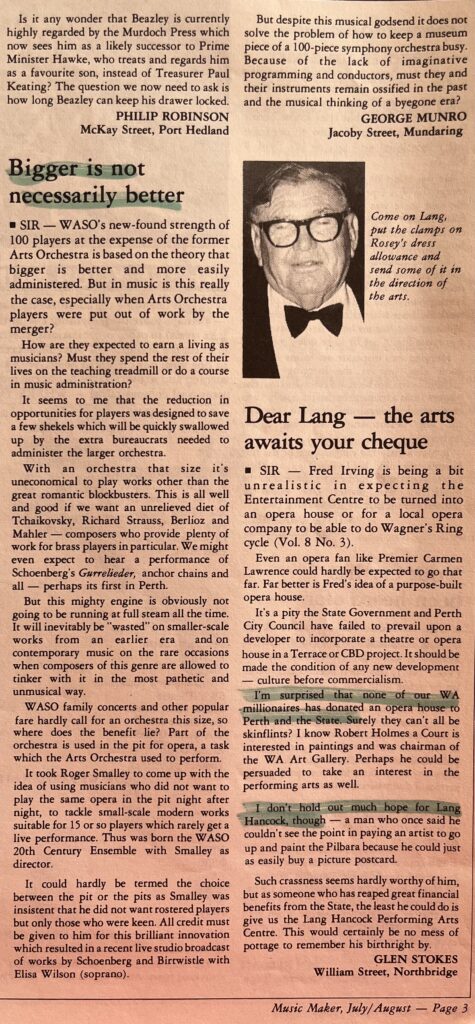
The West Australian Arts Orchestral Foundation and its Orchestra came into being in 1972 to train young local musicians and to provide orchestral support to local performing arts bodies, including the Western Australian Opera Company, The W.A. Ballet Company, The Gilbert and Sullivan Society and the Drama Company at the Playhouse.
The orchestra was auditioned as required and contracted on a season by season basis. Auditions were held by Vincent Warrener, Eric Royston Prince and later James Hopkinson.
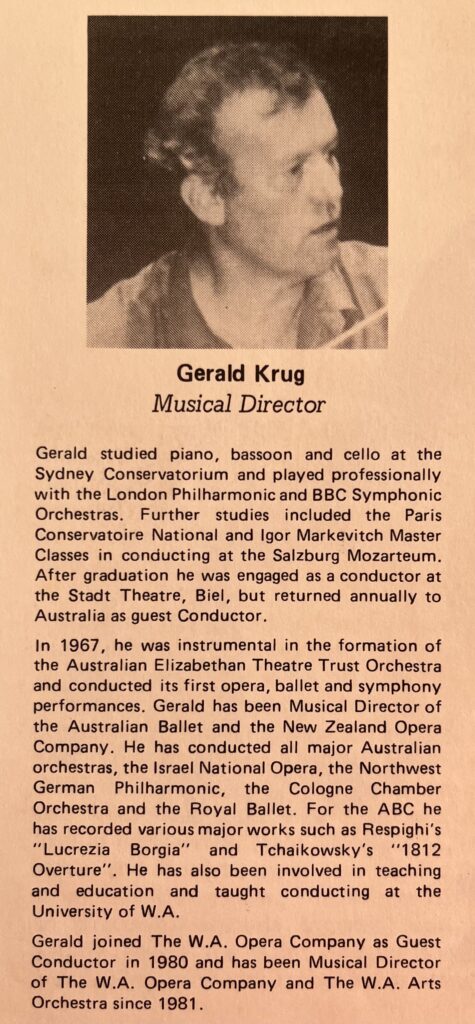
Conductors included Alan Abbott, Georg Tintner, Peter Bandy, Richard Gill, Brian Howard, Ian Westrip, Gary May and Gerald Krug.
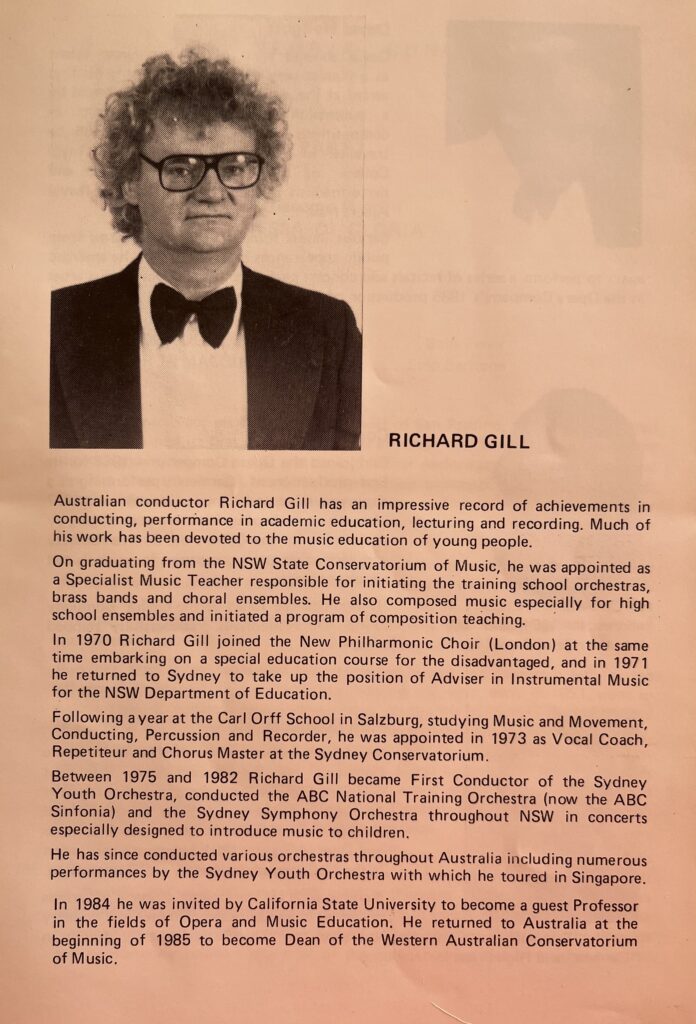
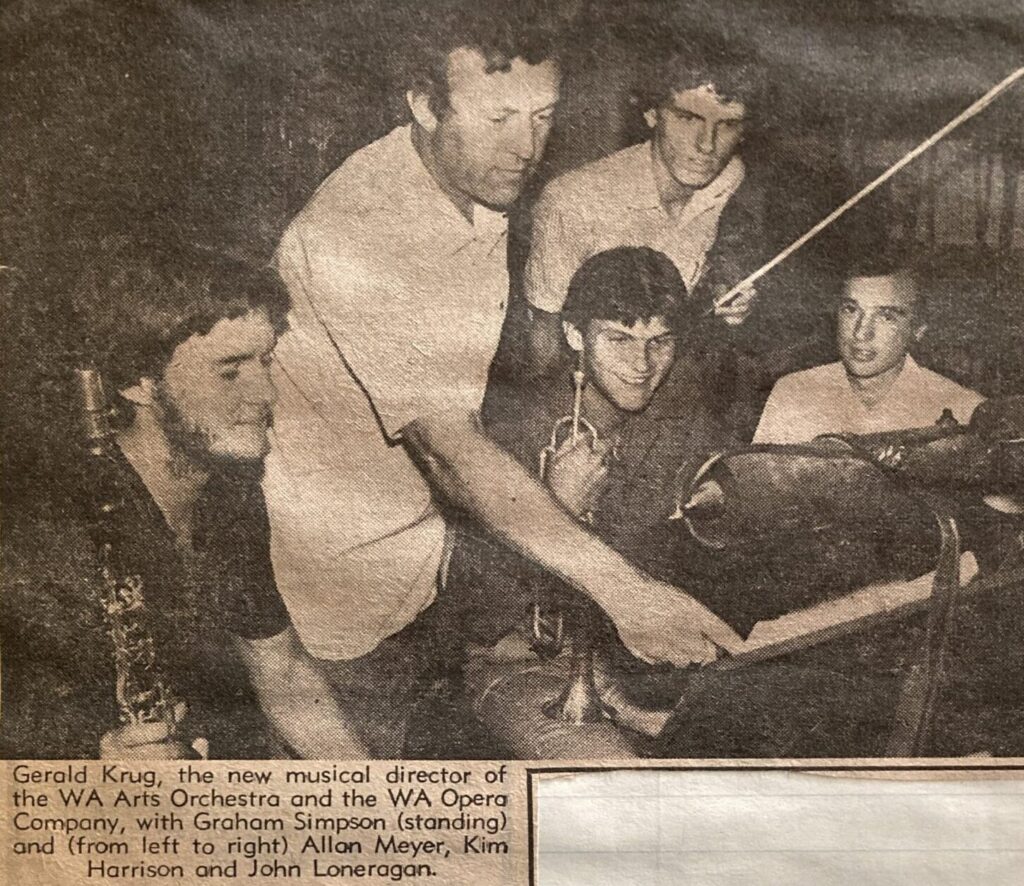
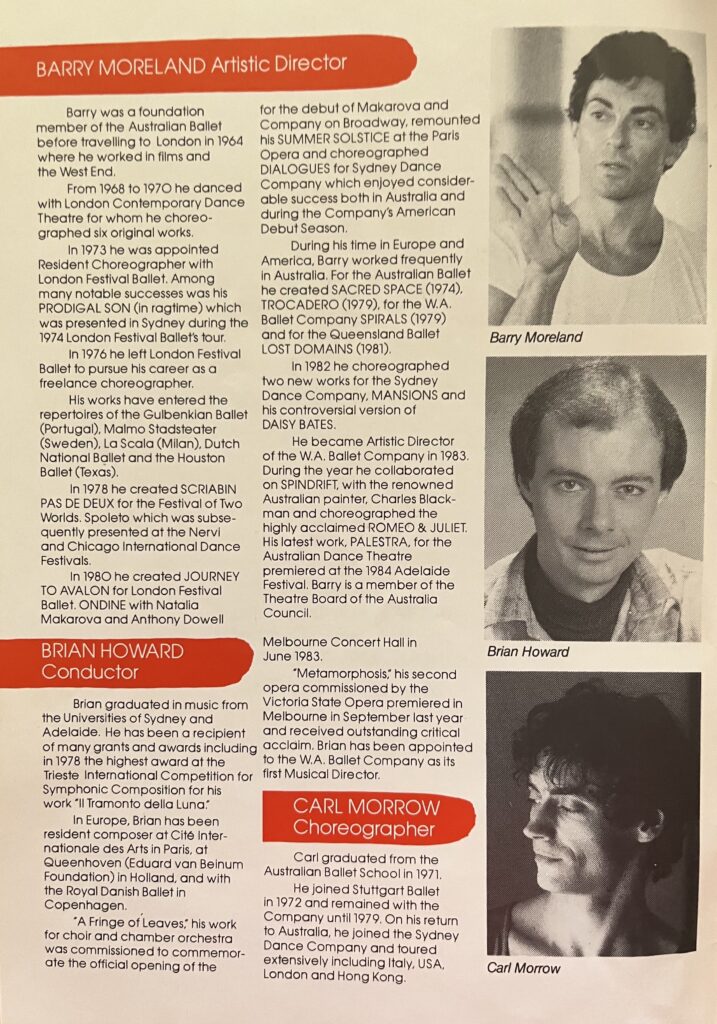 1984 saw the engagement for the first time of four full-time string players, thus taking the step towards a fully professional theatre orchestra. During 1984 these players performed under the banner of The W.A. Arts String Quartet, performing at the Perth Concert Hall, His Majesty’s Theatre and various private functions. In June 1984 the Quartet undertook a very successful North-West Tour in conjunction with singers from The Western Australian Opera Company. Joan Wright (bass) and Helen Pitcher/Tuckey (viola) auditioned successfully for these positions and departed from the WASO.
The orchestra then appointed three wind positions: bassoon, clarinet and flute filled by Peter Moore, Lorna Cook and Diane Riddell.
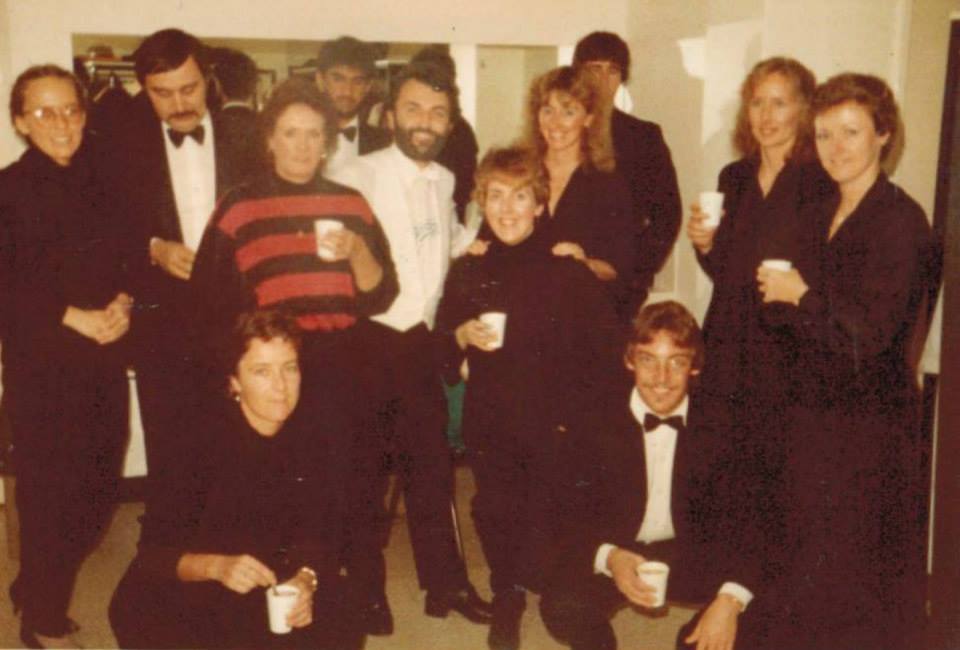
By 1985 the orchestra consisted of some 55 regular players, most of whom were booked on a contractual basis from season to season.
 The orchestra was funded by The W.A. Arts Council, I.L.D.A.C. and the Music Board of the Australia Council and The Perth City Council.
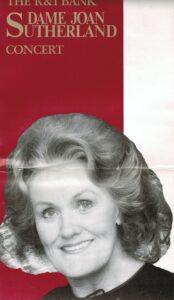
In 1986, the orchestra accompanied Dame Joan Sutherland.
In 1985, a committee chaired by Ken Tribe recommended all ABC Symphony Orchestras should divert to local ownership. Using the Tribe Report guidelines, the national scene was localised by a committee chaired by Robert Vickery. Federal funding was channelled through a body called Symphony Australia.
Significant changes resulted from these inquiries, including the recommendation that all W.A. Arts Orchestra funding be given to the WASO in order to create a bigger, permanent orchestra suitable for both concert performances and servicing the needs of the Ballet and Opera companies.
The W.A. Arts Orchestra was disbanded at the end of 1988 and its funding given to the WASO, effectively giving WASO the monopoly of all orchestral work in the State.
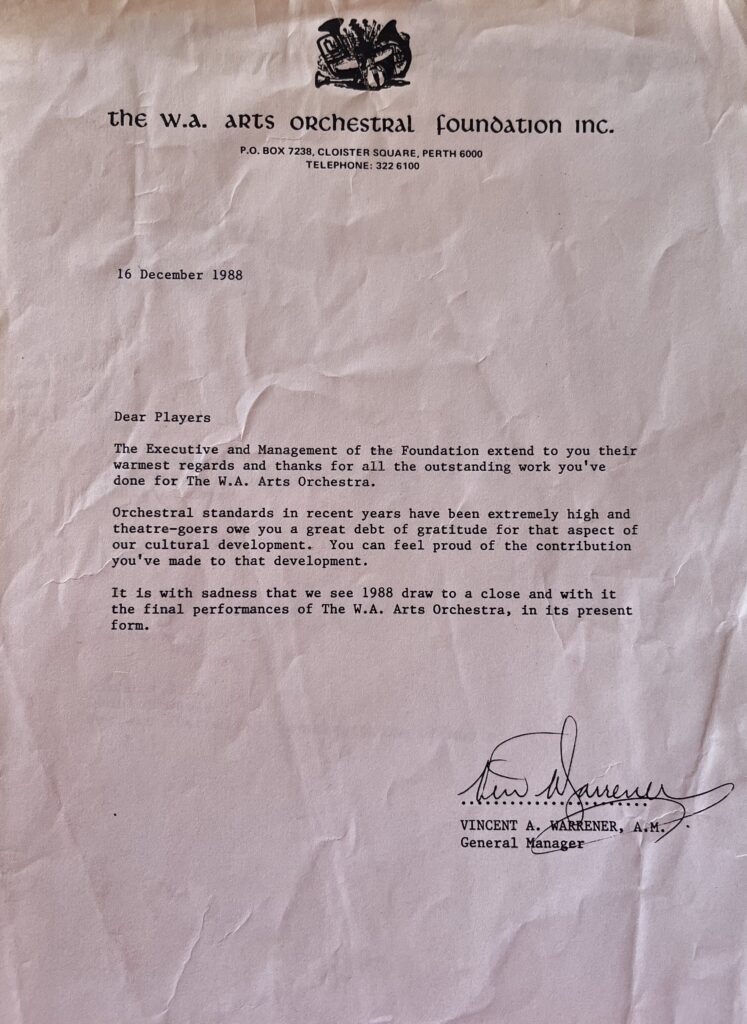
All the permanent W.A. Arts Orchestra players (except Diane Riddell on flute as it would have created 4 flute positions) were offered jobs with WASO, including their manager Miranda Lancaster-Allen.
In return for the additional funding, in 1989 WASO expanded its role to include playing for the local opera and ballet companies, initially committing twelve weeks of their annual roster to WA Opera and WA Ballet.
Although delighted to have this commitment by the government to expand the orchestra, the prospect of working as a pit orchestra didn’t appeal to some WASO players, especially those of the old school who remembered doing it 25 years prior. For the freelance players of Perth who relied on the W.A. Arts Orchestra for employment, it meant a change of career to teaching or a move away from Perth in order to find performance based orchestral work.