Norman Anzac Bourke (born on ANZAC Day) grew up in Wembley with musical siblings Marie, Bill and Walter who all played piano. Norman initially learnt violin from the nun Sister Mary Phillip at Victoria Park Convent on a borrowed instrument.
1939
MUSICAL FESTIVAL. Keen Choral Competition.
At last night’s session of the 14th West Australian Musical Festival, promoted by the W.A. Music Teachers’ Association, girls’ choirs and choirs from primary schools delighted a large audience in the Perth Town Hall. Public appreciation was shared by the festival adjudicator (Mr. Harold S. Elvins), who, at the close of the evening, said that he wished to congratulate Perth on having such a number of beautifully fresh young voices. The Victoria Square choir, which won ‘The Western Mail” shield for girls’ choirs, received high commendation from the adjudicator. “Their rendering was very delightfully clear in tone,” he said, “and the speed was nice and well sustained . . . it was a delightful performance. In ‘the Echo Song’ one could almost believe that the echo was outside the hall. The performance was technically faultless. The The songs which girls’ choirs were required to sing were Purcell’s “Nymphs and Shepherds” and “The Echo Song,” by Rowley. Eight school choirs competed, and such was the high standard that only ten marks separated the winning choir from the last on the list. The Victoria Square choir won with 92 marks and the Perth Girls’ School choir and Sacred Heart High School choir, with 88 and 87 marks respectively, were second and third. Six primary schools competed for the Levinson Centenary Shield for choirs of children under 13 years of age. This section was won by St. Joseph’s School with a performance which was. described by the adjudicator is “very delightful” The Kellerberrin State School choir and the East Victoria Park State School choir obtained the second and third places. During yesterday morning and afternoon several other sections. were decided. The’ pianoforte solo for children between 13 and 16 years of age provided an interesting contest. It was won by Mannix Gosper with 91 marks, with Stephanie James (90 marks) and’ Shirley Bowes Thompson (88 marks) closely following. The adjudicator said that the winner’s work was very good indeed and showed imagination and a sensitive touch. The festival will be continued today in the Assembly Hall. An important item of tonight’s programme will be the ladies’ solo championship, in which there are five finalists.
Other results of yesterday’s contests were as follows: Violin solo (under 14).-Helen Hookway (86 marks). Duet for two pianos-Stephanie James and Lois Harry (86 marks), 1; Terry Jeffers and Arthur Huck (84 marks), 2. Piano solo (over 13′ and under 16).Mannix Gosper (91 marks), 1; Stephanie James (90 marks), 2; Shirley Bowes Thompson (88. marks). 3. Piano quick study contest (under 15) Stephanie James (91 marks). Piano solo (over 15 and under 18).-John Hobley (88 marks); 1: Nancy Hemmant (87 marks), 2; Gwenyth Evans (85 marks). 3.. Piano solo (over 9 and under 12. final).Joy Edgar (91 marks). 1:. Margaret Carney (90 marks), 2; Walter Bourke (89 marks). 3. Piano solo (over 11 and under 13. final) Allison Linden (87 marks). 1: Walter Bourke (86 marks), 2; Mary Bernet and Valma Hoult (85 marks each). 3. Piano solo (over 12 and under 14. final) Barbara Webster (90 marks), I; Mlna Kooperman (89 marks). 2; Ted Bailey (88 marks), 3. Duet for two pianos (under 18):–Morna Graggs and Mannix Gosper
West Australian (Perth, WA : 1879 – 1954), Saturday 1 July 1939, page 15
1941
MUSIC. FESTIVAL – Concluding Sessions.
With a number of advanced contests, including the final of the ladies’ champion solo, the 16th West Australian Musical Festival ended on Saturday night at the Burt Memorial Hall. The day sessions had consisted mainly of finals of a number of junior sections which had been heard during the week. Tonight, in the same hall winners of prizes in many of the sections (over 60 contests were held during the week) will present a concert. The final of the ladies’ champion solo contest was one of the main events on Saturday night. Competitors had to sing an excerpt from oratorio or other sacred work. and an excerpt from opera or secular cantata, and the first prize of £1/1 carried also an engagement by the Australian Broadcasting Commission. “In an event like this,” the adjudicator (Mr. Claude Monteath) said after hearing five finalists, “we expect to find both voices and the ability to use them. In seeking a champion singer one thing to look for is consistency, and I think that in this connection the second appearance by the finalists has a definite value. One is entitled to consult one’s notes of the previous hearing to see if they agree. Of the winner I wrote a glowing report the other evening, and I find that I agree with it tonight. She reminded me of particularly beautiful playing on the A and E strings of a violin. I think you have a prize in this singer.” The section was won by Miss Margaret Jones, who sang “With Verdure Clad” (from “The Creation,” by Haydn, and “Care Selve,” from “Atalanta” (Handel). The vocal prize-winners’ section, for those who had won a first prize at any previous festival, was won by Miss Nancy Jacka. This contest carried a special gold medal donated by the trustees of Music Week, 1933, and a broadcasting engagement. The adjudicator said that the winner was the possessor of a very sweet,’ light soprano voice and that she excelled in a serene and pure style. In the open piano solo section (on which the adjudicator’s comments have already been published) Mannix Gosper was successful, gaining 94 points. The test piece was the Liszt arrangement of Schumann’s “Dedication.” Awards were as follows:
Violin solo (under 11). “Valse Mignonne” (Fontaine); Daphne Percival (88 points). 1: Norman Bourke (87). 2; Veronica Duignan (86 1/2).
West Australian (Perth, WA : 1879 – 1954), Monday 14 July 1941, page 4
1944
PRACTICAL MUSIC. EXAMINATION RESULTS. Complete Country Pass List. Results of the examinations in practical music conducted in country centres recently by the University and the Australian Music Examin ations Board have been made avail able as hereunder.
Violin Grade III: Norman Bourke, Perth
West Australian (Perth, WA : 1879 – 1954), Saturday 23 December 1944, page 9
1945
In about 1945 at the time he started with the youth orchestra, Norman was learning from Mr James, a friend of Vaughan Hanly who later joined the West Australian Symphony Orchestra.
Jack Harrison was the youngest member of the newly formed ABC amateur Orchestra formed in 1945 by Mr E.J. Roberts, as was Norman and they became close mates. The orchestra rehearsed at Perth Girls’ School in James Street.
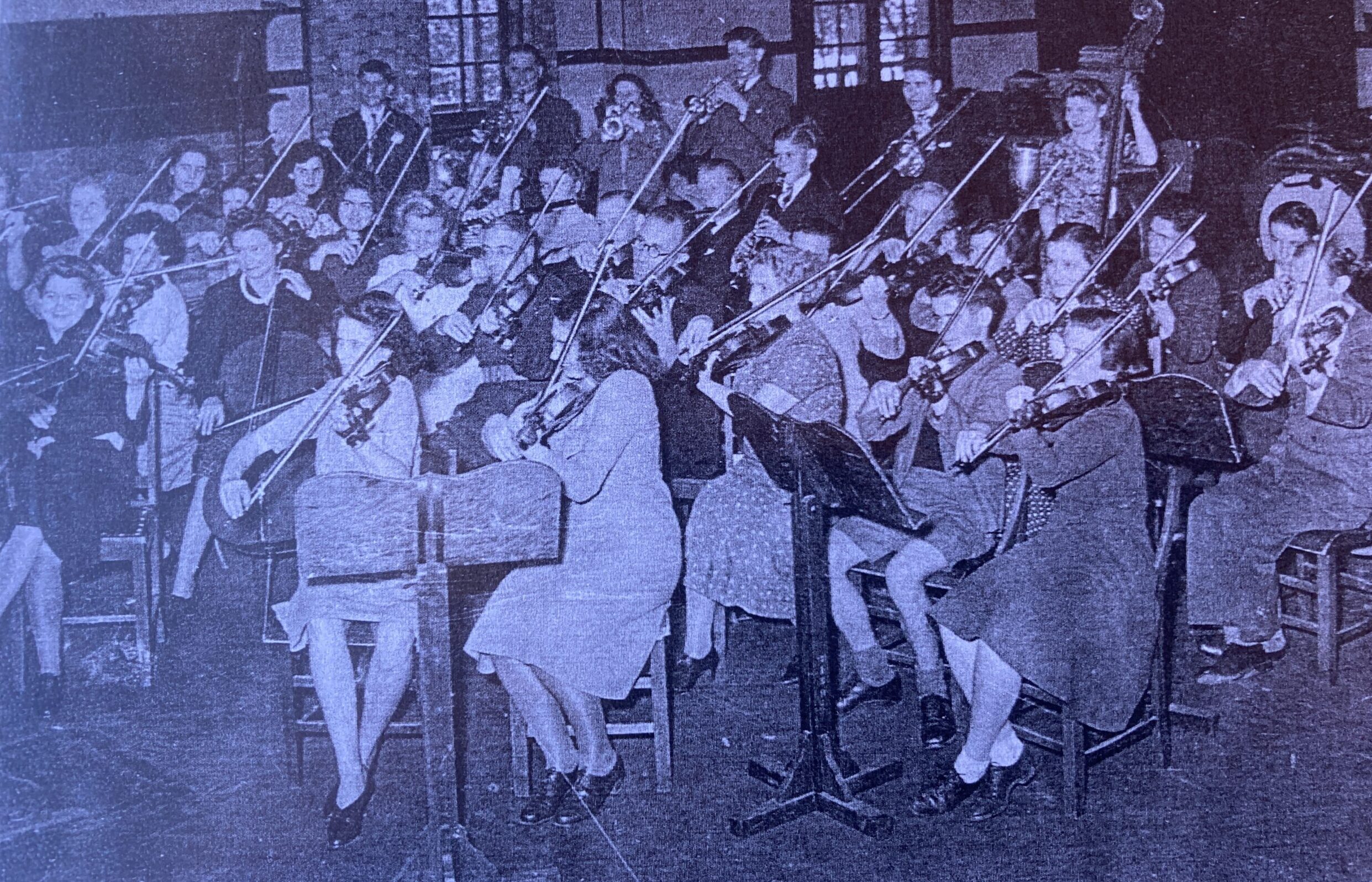
“Do it Yourself” – Amateur Orchestra is Opportunity (By “Althena”)
To a number of Perth’s amateur musicians, Mr E.J. Roberts and the ABC have offered a golden opportunity to “do it yourself” in unison by the formation of an amateur symphony orchestra. Mr Roberts selected only those whom he considered sufficiently conversant with their instruments to be able to give attention to the niceties of orchestral playing because, as he explained when I attended a recent rehearsal, his aim was to weld a miscellaneous collection of players into an orchestra, not to teach people how to play individual instruments. Although the majority of the players are of the teen age, ages range widely, from the diminutive Jack Harrison, the clarinettist, to elderly men and women who have joined forces with youth; linked by the ageless bonds of music.
The youngest member, Jack Harrison, comes from a musical family. He has been playing a clarinet for the past 18 months, but has played other instruments.
The Broadcaster Wednesday July 11 1945
YOUTH ORCHESTRA – INAUGURAL CONCERT – High Standard Achieved
Winthrop Hall on Wednesday night was the scene of the inaugural concert of the newly formed All-youth Orchestra. What latent talent existed was revealed as the programme unfolded…Norman Burke and Leslie Jenkins in solo numbers…Jack Harrison’s contribution on the harmonica…
The West Australian Friday 19 October 1945 page 9
1947
MUSIC FESTIVAL Adjudicator Praises Contestants
“I have enjoyed a splendid night and being one who did not pay to come in, wish I had,” said the visiting adjudicator (Mr. Herbert Davies) to the large audience towards the end of Saturday night’s session of the musical festival of the W.A. Music Teachers’ Association which is being conducted at the Burt Memorial Hall, Perth. Awarding the first prize for the mezzo soprano solo final to Alison Cairns, who secured 98 marks, Mr. Davies described that competitor’s singing as even better than on Friday. Ailsa Rae was placed second with 94, and Valerie Wynne third with 93 marks. The adjudicator paid a tribute to the accompanists for the final preliminary solo for those who had never won a first prize at a previous festival and said it had been a pleasure listening to the singers. The song was not easy and was a good test of the ability to summon up atmosphere. He considered that one of the competitors had a remarkably fine voice in the making. The prizes were awarded to Ailsa Rae (87 marks), Mary Buchan (86) and Iris Clifton (84). Only one competitor had been successful in “getting the brittle, crisp, sharp touch required, the adjudicator said, referring to the final piano solo under 18. The first prize was awarded to Margaret Carney (81 marks), and the second to Stephanie Tayler (75). The first prize only was awarded for the tenor solo. It went to Trevor Davey (73 marks). After the percussion bands competition at the afternoon session, contested by Nos. 1 and 2 bands from the Lesmurdie Ladies’ College, Mr. Davies expressed pleasure at the work done. He awarded first prize to the No. 2 band and an adjudicator’s prize to the other. Other results were: Final violin solo (under 17): Norman Bourke (91), 1; Daphne Percival (90), 2. Final piano solo (under 14): Thelma Barker (90), 1; Molly Moncrieff (88), 2; Janette Williams (87), 3. Violin sight reading (under – 16): Laurel Deverell (79), 1. The boys’ choir competition, held earlier in the festival, was won by the Aquinas College choir, the only other competitor being the Christ Church Grammar School choir. The choristers were complimented by the adjudicator. Among contests at tonight’s session, commencing at 7.30 o’clock, are those for the baritone solo, the final soprano solo, the final piano solo under 12, the final violin solo under 13, and for a concerted item for not less than five or more than eight singers.
West Australian (Perth, WA : 1879 – 1954), Monday 23 June 1947, page 10
MUSIC FESTIVAL – Further Competition Results
Further events in the music festival of the West Australian Music Teachers’ Association were decided in the Burt Memorial Hall yesterday and last night. Marjorie Osborne and Josie Metcalf, with 85 marks. were placed first and Josephine McKimmie and Eileen Negus, with 81 marks, second in the final of the piano duet (under 13). They played the “March of the Covenanters.” The set piece for the piano solo (under 13) was “Dance of the Dew Fairy.” Of 64 competitors only six were chosen for the final. The winner was Margaret Eddy, with 89 marks, and Josephine McKimmie. with 87 marks, was second. Six pairs faced the adjudicator in the sonata for violin and piano (under 17), a Mozart number. Norman Bourke and Veronica Carney, with 86 marks, were placed first and Jacqueline Bresland and Veronica O’Sullivan, with 82 marks, second. The adjudicator was Mr. Herbert Davis.
West Australian (Perth, WA : 1879 – 1954), Wednesday 25 June 1947, page 11
YOUTH ORCHESTRA – Excellent Playing By Juveniles (By “‘Tactus”)
The third concert of the Youth Orchestra, under the direction of Mr. O. G. Campbell Egan in the Winthrop Hail last night was a fine example of the work accomplished, and the promise for the future, in the musical branch of the cultural development of the younger generation. Numbering nearly 50 players, mostly in the string sections, but with a sprinkling of wood-wind, surprisingly good results were obtained. Not only to concerted numbers does that apply, but also to the members who stepped out and gave first-class entertainment with solos, a duet, a quintet, and vocal solos in which a voice of charming mezzo-soprano quality was revealed. There were many indications of capable and careful training in orchestral playing. The tone was rich, the bowing uniform and firm, a consistent observance was given in expression, phrasing, and accent, in addition to which the conductor secured a steady response to the effects he desired. The most notable success was the Ballet music from “Rosamunde” (Schubert). After prolonged applause, Mr. Egan remarked that he was gratified by the recognition by the audience the players’ achievement, for the work was actually for an adult orchestral rather than one composed of juveniles. The soloists were Violinists, Norman Bourke, Ray Nash, Colleen Harris, Don Gollangher and Lois Dear. Pianists, John Shure and Rosalind Du Rieu. Flautist, Jim Cartwrigbt. Oboist, Don Cartwright Saxophonist, Fay Sharp. Mezzo-soprano. Erica Warden. Quintet of strings, Colleen Harris Laurel Deverell, Roma Uren, Pat D’Arcy and Rene Harris. The Perth Boys’ High School Choir were deservedly well received in several unison and part songs conducted by Mr. C. L. Jenkins and accompanied by Miss Lois Harry. A ceremony which preceded the final number was the presentation on behalf of the orchestra by the leader, Don Gollangher of a baton each to Messrs. Egan and Jenkins in recognition of their work in the training.
West Australian (Perth, WA : 1879 – 1954), Thursday 16 October 1947, page 7
The Australian Broadcasting Commission said yesterday that in the Perth broadcast on December 16 in connection with the 1947 national radio eisteddfod, the A.B.C. judges’ prize and the listeners’ prize went to Master Norman Bourke of 6 Salvado-road, Wembley, who played the first and second movements of Handel’s ‘Sonata in E Major” in the Junior violin division of the music section. He was the first person in the series to win both prizes.
West Australian (Perth, WA : 1879 – 1954), Wednesday 24 December 1947, page 3
Norman left school after his Junior and started working aged 15 as a “Messenger” for the ABC which saw he and the Harrisons cross paths again several years later. Norman explained that and ABC “Messenger” was the bottom of the ABC food chain, required to pick up post and newspapers on a bicycle and deliver them back to Broadcast House. He initially got the job only for six weeks filling in behind someone who was sick, but then received an official telegram from the ABC offering him employment.
1948– brother – Walter
MUSIC AND ART OF SPEECH
Arising from the recent examinations in music and art of speech conducted under the scheme of the Australian Music Examinations Board, the following awards have been made for outstanding work: Music Scholarship of the University of W.A.: Walter George Bourke. This scholarship is valued at £100 per annum and is tenable for three years at an approved conservatorium or institution. Wendy Tyler was named proxime accesit. Medals for Pianoforte. Violin and Singing: Awarded to candidates of outstanding ability in Grades I or II. Pianoforte: Wendy Nash., honours in Grade L Violoncello: Wendy Tyler, honours in Grade I. Art of Speech Elocution Teachers’ Association Exhibition of £2/2/: Diane Hosking, honours in Grade V.
SPECIAL COMMENDATIONS. The following candidates, who obtained honours at the recent grade examinations, have been specially commended for their work: Pianoforte: Grade I, Wendy Nash, Julie Doust, Beryl Potter. Grade II. Ellane Siegrist, Carmel O’Meara. Pauline Callanan, Dawn Patman, Natalie Miolin. Grade III. Judith Watson, Lynette Jamieson, Desmond Kuhl, Pauline O’Connor, Robin Taylor. Grade IV, Allan Speer, Arthur Hennessey, Barbara Robinson Athol Higgins. Diane Nation, Alma Ridley. Grade V Michael Dean, Pauline Rowe, Joan O’Connell, Patricia Traynor, Beatrice Brooke, Marie Lanigan, Maureen Martin. Grade VI. Janet Cornwall, Margaret Stain, Norman Ryder, Barbara Kelly, Robyn Hatswell. Violin: Grade I. Bernice Cullity, Myrtle Tippett. Grade II. Patricia Rooney. Daniel Carney. Grade III,. John Eddington, Mary O’Neill. Grade IV. Glennis Paddon. Sheila Birch. Grade V, Jacqueline Anthony, Patricia Jones, Josephine McKimmie Ronald Barnett. Grade VI Angelina Ruggera, Vivienne Tole. John Ovens. Pauline Kenna. Violoncello: Grade I. Wendy Tyler. Grade 1,. Allan Bean. Grade IV. Ethna Edwards. Singing: Grade I, Laurensen Russell. Grade II. Betty Hamilton. Grade III, lulie Heath. Grade IV, Gwenyth Morris. Art of Speech: Grade I. Lynette Vincent, Caroline Darbyshire. Grade II. Brenda Bice, Phyllis Mather. Grade III Barbara Grebg. Sandra McNab. Grade IV. Judith Leveson Gower. Grade V, Diane Hosking, Mavis Warburton. Grade VI. Clare Massam. DIPLOMA HOLDERS. The following candidates obtained their diplomas in 1948: Licentiate: Pianoforte (perform er): Michael Maurice Barrington Martin, Pamela Kott, Verna Nelmes. Pianoforte (teacher): Irma Claire Hamilton. Associate: Pianoforte: Gwenneth Joan Ball, Yvonne Vallma Brand, Veronica Carney. Phyllis Eva Chick. Nola Margaret Connolly, Laurel May Devine, Margaret Gerard Goerke, Imelda Hayes. Shella Joy Hines. Kathleen Patricia McDonald. Joy Elizabeth Nicol, Ailsa Elsie O’Neill, Shirley Beatrice Owston, Jean Doris Payne, Edith Helen Priestner, Dorothy May Roscoe, Anne Elizabeth Thomas. Singing: Robert Barry Damon. Laurel June Drummond, Pamela Joy Flower. Brenda Howarth, Margaret Elizabeth Stewart. Art of Speech: Licentiate: Joyce Isabella Beurteaux Hall. Muriel Jessie Mackenzie. Associate: Joseph Claude Johnson.
West Australian (Perth, WA : 1879 – 1954), Wednesday 15 December 1948, page 28
1949
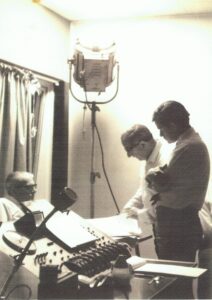
In 1949 Jack formed a recording group for the A.B.C. called Jack Harrison and His Music that was broadcast Australia wide. It was usually recorded on a Sunday with his father William Harrison producing many of the music arrangements and Norman Bourke was the A.B.C. sound producer.
1950
Norman Bourke explained that the main responsibility of the ABC at this time was to broadcast, which included not only from the studios in Broadcast House, but also to tour with artists to the country and broadcast live. There were seven studios in Broadcast House which housed the newsroom, 6WF (broadcasting lighter programs) and 6WN (classical and heavier programs). Studio 1 was the biggest and had the best sound in which “Music for Pleasure” was broadcasted on Wednesday evenings.
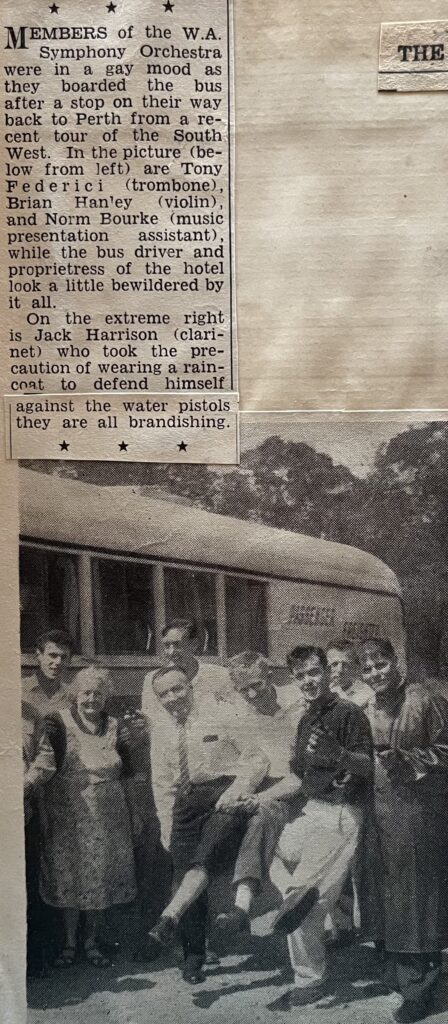
When required to tour, all the recording gear and instruments went on either the train if it was available, but mostly by bus. The Post Master General (P.M.G.) provided one technician to set up the broadcast equipment and the ABC provided a producer to broadcast the sound. Often the local town members would assist in the set up and usually provided enthusiastic hospitality and sumptuous food, even though sometimes the audiences were sparse.
COUNTRY MUSIC TOUR
Three well-known local artists will leave on Monday on a tour of country towns under the auspices of the Adult Education Board. They are Miss Stephanie James, pianist, Miss Pamela Flower, soprano, and Mr. Jack Harrison, clarinettist. The assistant-director of Adult Education (Mr. John Birman) said yesterday that towns to be visited would include Harvey, Balingup, Donnybrook, Busselton, Boyup Brook, Kojonup, Katanning and Pingelly. This would be the last of a series of concerts in country districts presented by the board during this year. Afternoon, performances for children would be given, in conformity with the board’s policy to arrange concerts for schoolchildren whenever possible, Mr. Birman said.
The West Australian Saturday 21 October 1950 page 8
1951
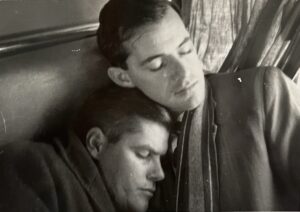
During a WASO country tour, Norman Bourke remembered attending a post performance country reception with Jack, only to discover that the WASO train had left without them. The Mayor of the town drove them like the clappers to the next train station, woke the station manager who came out pulling up his trousers, shouting “stop the next train”. The train was stopped and those musicians left behind gratefully boarded. The carriage they got into was the catering carriage and isolated from the rest of the train, so they cooked up a meal of eggs and sat the rest of the journey out.
1953
BOY VIOLINIST GETS HIGH PRAISE
“Yours is talent that you only get once in a generation and Perth has every reason to be proud of it,” said Mr. James A. Steele, the adjudicator for the Musical Festival, when awarding nine-year-old Geoffrey Michaels second place in the open violin solo section last night. Norman Bourke, who gained one point more than Michaels, was first. Miss Lynette Howieson won the ladies open championship solo with 90 points, Miss Margaret Jones being second with 89 points. Mr. Steele told the winner: “You have caught the mood of the song excellently and have given as good coloratura work as we would get from any professional singer. Of the final of the men’s champion solo, Mr. Steele said that the winner, Mr. Douglas Glendinning had a fine voice with great possibilities. Mr. Neil Garland was second. Other results were: Girls’ High School Choir: Coolgardie High School, 1; Perth Girls’ School Choir. 2. Final Soprano Solo: Miss Margery Walwyn, 1; Miss Alice Plant. 2. Final Baritone Solo: Mr. Gordon Freeman. 1; Mr. Vernon Wardrop. 2. Final Contralto Solo: Miss Irene Gilligan, 1; Miss Millicent Evans, 2. Final Open Piano Solo: Mr. Donald Thornton. 1; Miss Angela Travia and Miss Dawn Baldwin. 2.
West Australian (Perth, WA : 1879 – 1954), Saturday 11 July 1953, page 15
Norman continued to produce many of Jack’s radio programs.
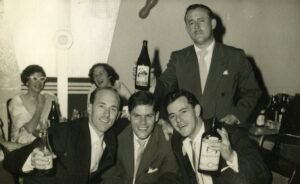
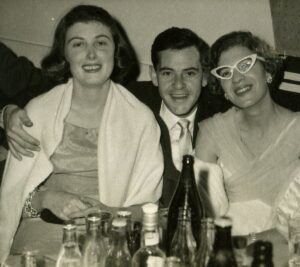
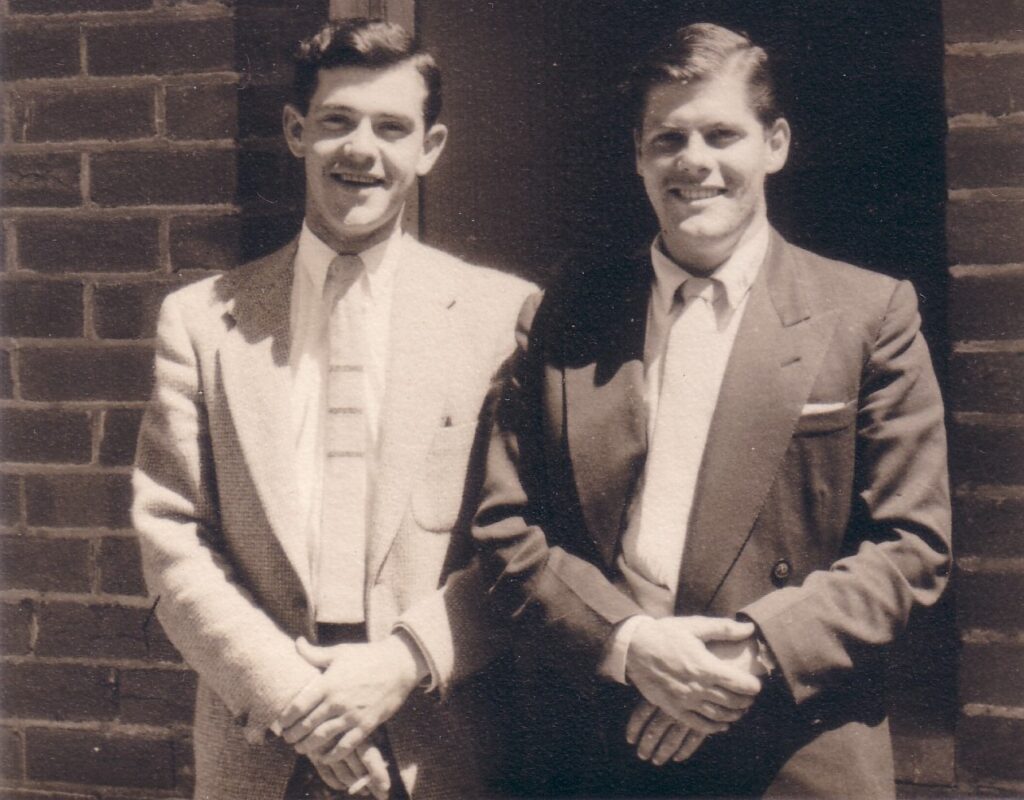
Norman was eventually promoted to Music Supervisor and moved to the Eastern States and the lads lost touch.
Later in life, after Jack was widowed, they enjoyed travelling together.