“For his outstanding contribution to music, his achievements as a musician, composer, conductor and teacher, for inspiring young musicians and for contributing to the professional standard of the West Australian Symphony Orchestra.”
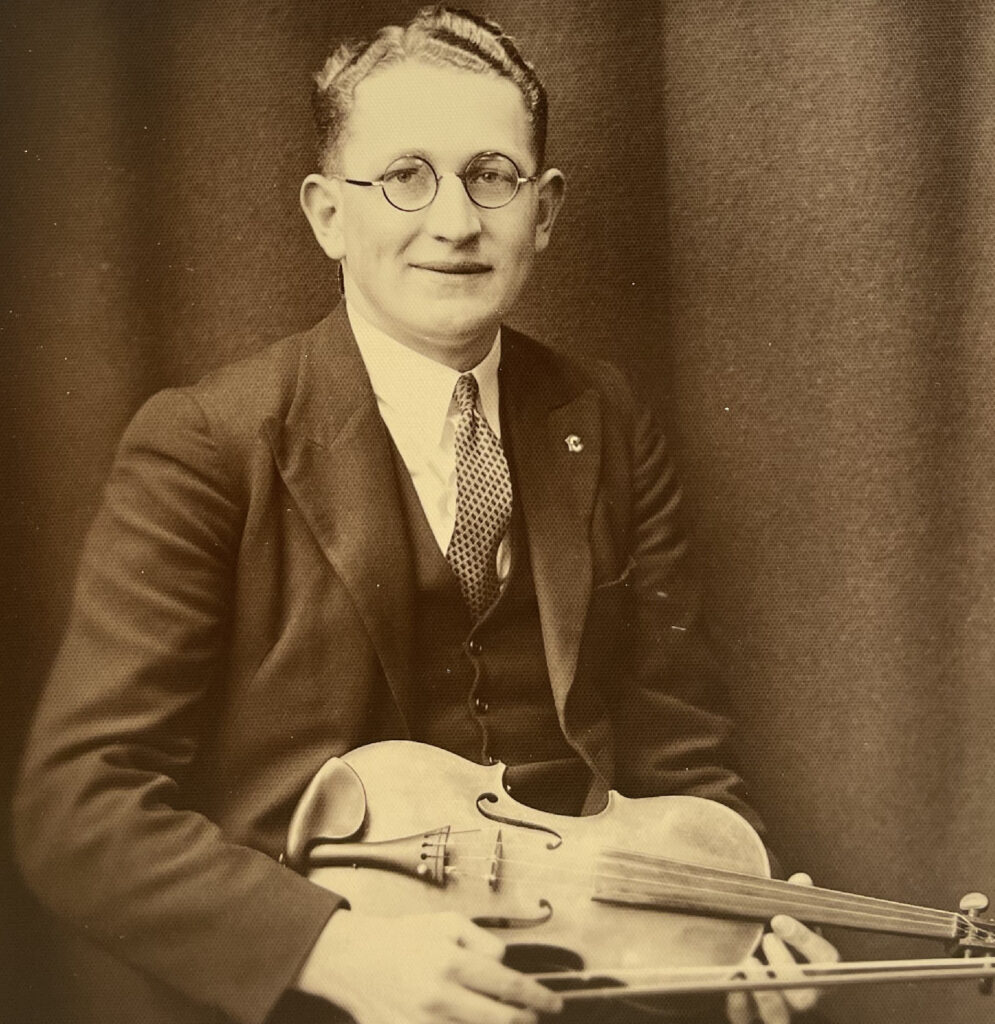
Vaughan Hanly was born in 1916 in Sydney. After initial violin tuition with Sister Mary Acquin at the Golden Grove Convent of Mercy, he won a scholarship enabling him to study with Florent Hoogstoel at the New South Wales Conservatorium of Music. In 1936 he graduated with both the Performer’s and Teacher’s Diplomas, winning the A.E. Smith Violin Prize. Two years later he made his debut performing the Wieniawski Concerto in D minor with the Sydney Symphony Orchestra. His out- standing performance led to other engagements, including a tour of Australia as solo violinist with Richard Tauber.
In 1939 he was appointed leader of the ABC’s Perth Orchestra, making his debut as soloist with the orchestra in Mozart’s Concerto in D K218, conducted by Sir Malcolm Sargent. As Madame Alice Carrard recalls, “The ABC was having only 25 people in the orchestra and they were all half amateurs. When Vaughan Hanly arrived then it was something out of the world.”
Between 1942 and 1945 Vaughan served in the Army Education Service in the area of music and drama. After the war he became very active as a teacher and as an examiner for the Australian Music Examinations Board. In 1947 he became Deputy Conductor of the ABC’s Perth Orchestra. He also appeared as soloist in the Tchaikovsky Concerto for Violin conducted by the visiting conductor Walter Suskind.
Vaughan Hanly spent 1948 in England studying conducting with Sir John Barbirolli and violin with the renowned teacher, Max Rostal. During his year abroad Vaughan was invited to join the first violin section of the London Symphony Orchestra affording him the opportunity of playing under many internationally famous conductors. He recalls with great joy playing in a performance of A London Symphony conducted by the composer Ralph Vaughan Williams.
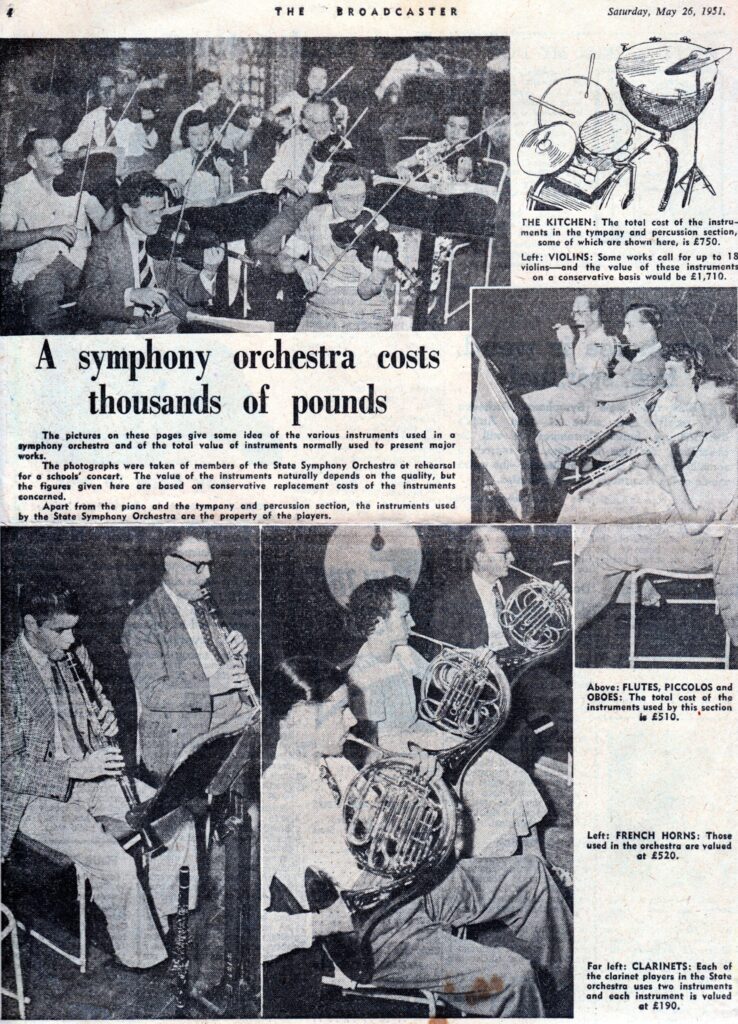
1951 Broadcaster article: cost of a symphony orchestra
Returning to the Perth Orchestra in 1949 Vaughan was very active as a soloist. He visited Adelaide to play the Sibelius Concerto for Violin and followed this with the first performance in Perth of the Delius Violin Concerto. On the same program was Rimsky-Korsakov’s Scheherazade which made it a very busy occasion for Vaughan. This varied and demanding schedule became typical and was maintained through to his retirement in 1976.
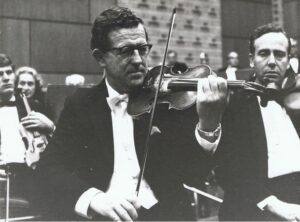
Vaughan Hanly, WASO Concertmaster 1967
Throughout the formative years of the West Australian Symphony Orchestra (WASO) as Concertmaster and Deputy Conductor, Vaughan Hanly, through his dedication and persistence, did much to raise the professional standard of the Orchestra, contributing to the fine reputation it has today.
In addition to his work as Concertmaster and frequent solo appearances Vaughan also conducted studio broadcasts and concerts.
For the 1956 Festival of Perth he was invited to conduct an all Mozart program to mark the bi-centenary of Mozart’s birth. His capacity to interpret works of a larger and more complex nature was demonstrated in 1961 when the resident conductor became too ill to continue after the first rehearsal for a subscription concert. The program consisted of Le Corsair Overture by Berlioz, The Pines of Rome by Respighi and Elgar’s Symphony No 1 in Ab major.
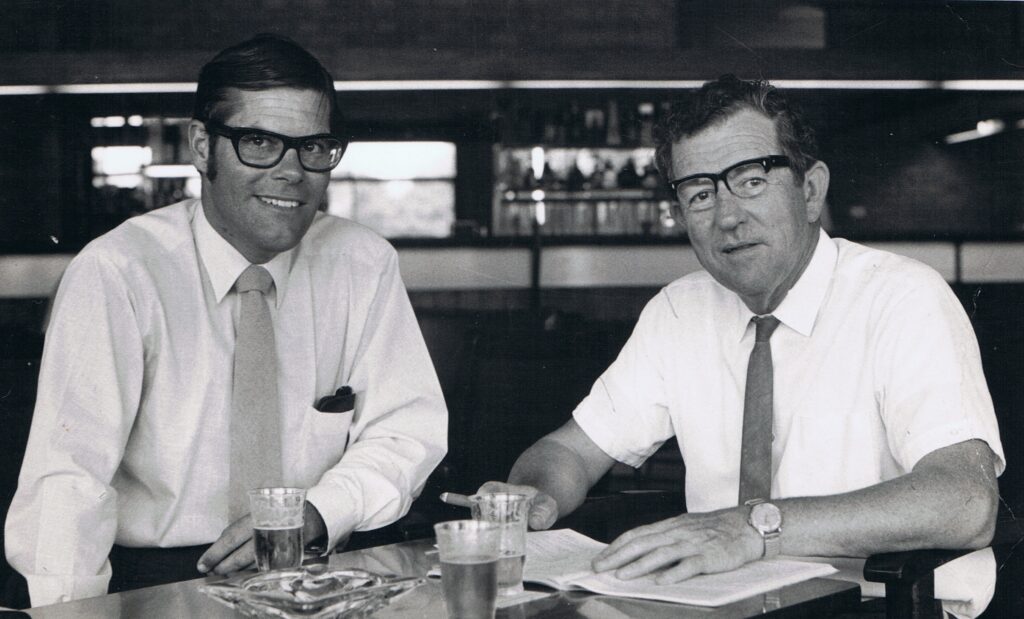
Vaughan Hanly and David Measham
The soloist, Larry Adler, was playing the first Australian performance of a concerto written for him by French composer Serge Lancen. Stepping in at such short notice and successfully conducting such a formidable program greatly enhanced Vaughan Hanly’s reputation as a conductor. Other engagements followed, including concerts with European visitors such as Daniel Barenboim and Gyorgy Pauk.
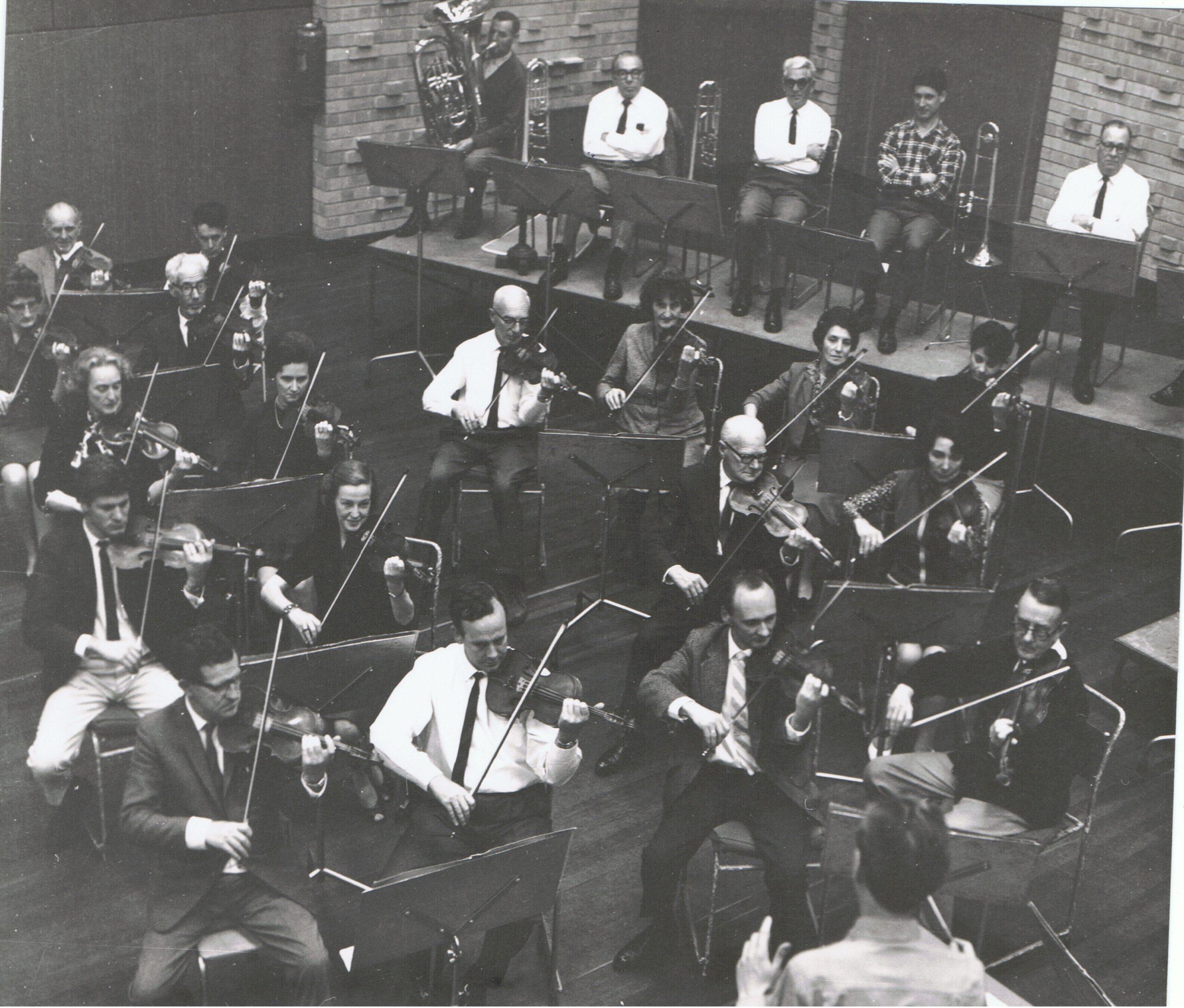
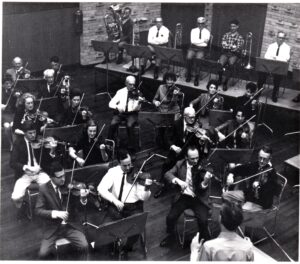
1967 WASO violin section
For the 1966 Festival of Perth he was invited to conduct four concerts by the WASO devoted to British and Australian composers. These programs included many works new to Perth including the first Western Australian performance of Symphony No 8 by Vaughan Williams and the first Australian performance of Little Symphony by Alexander Goehr.
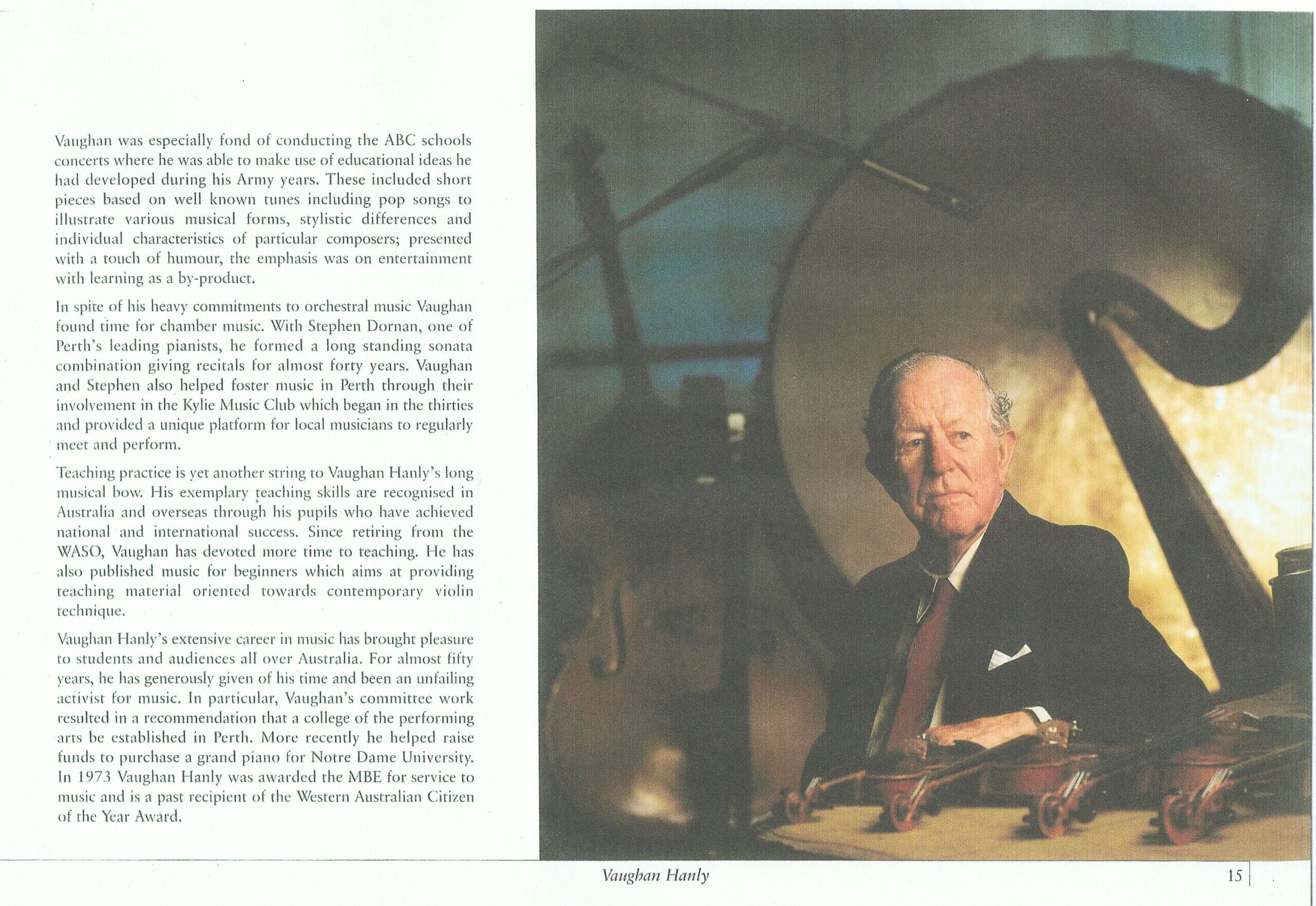
Vaughan was especially fond of conducting the ABC schools concerts where he was able to make use of educational ideas he had developed during his Army years. These included short pieces based on well known tunes including pop songs to illustrate various musical forms, stylistic differences and individual characteristics of particular composers; presented with a touch of humour, the emphasis was on entertainment with learning as a by-product.
In spite of his heavy commitments to orchestral music Vaughan found time for chamber music. With Stephen Dornan, one of Perth’s leading pianists, he formed a long standing sonata combination giving recitals for almost forty years. Vaughan and Stephen also helped foster music in Perth through their involvement in the Kylie Music Club which began in the thirties and provided a unique platform for local musicians to regularly meet and perform.
Teaching practice is yet another string to Vaughan Hanly’s long musical bow. His exemplary teaching skills are recognised in Australia and overseas through his pupils who have achieved national and international success. Since retiring from the WASO, Vaughan has devoted more time to teaching. He has also published music for beginners which aims at providing teaching material oriented towards contemporary violin technique.
Vaughan Hanly’s extensive career in music has brought pleasure to students and audiences all over Australia. For almost fifty years, he has generously given of his time and been an unfailing activist for music. In particular, Vaughan’s committee work resulted in a recommendation that a college of the performing arts be established in Perth. More recently he helped raise funds to purchase a grand piano for Notre Dame University. In 1973 Vaughan Hanly was awarded the MBE for service to music and is a past recipient of the Western Australian Citizen of the Year Award.
Western Australian State Living Treasure – Vaughan Hanly
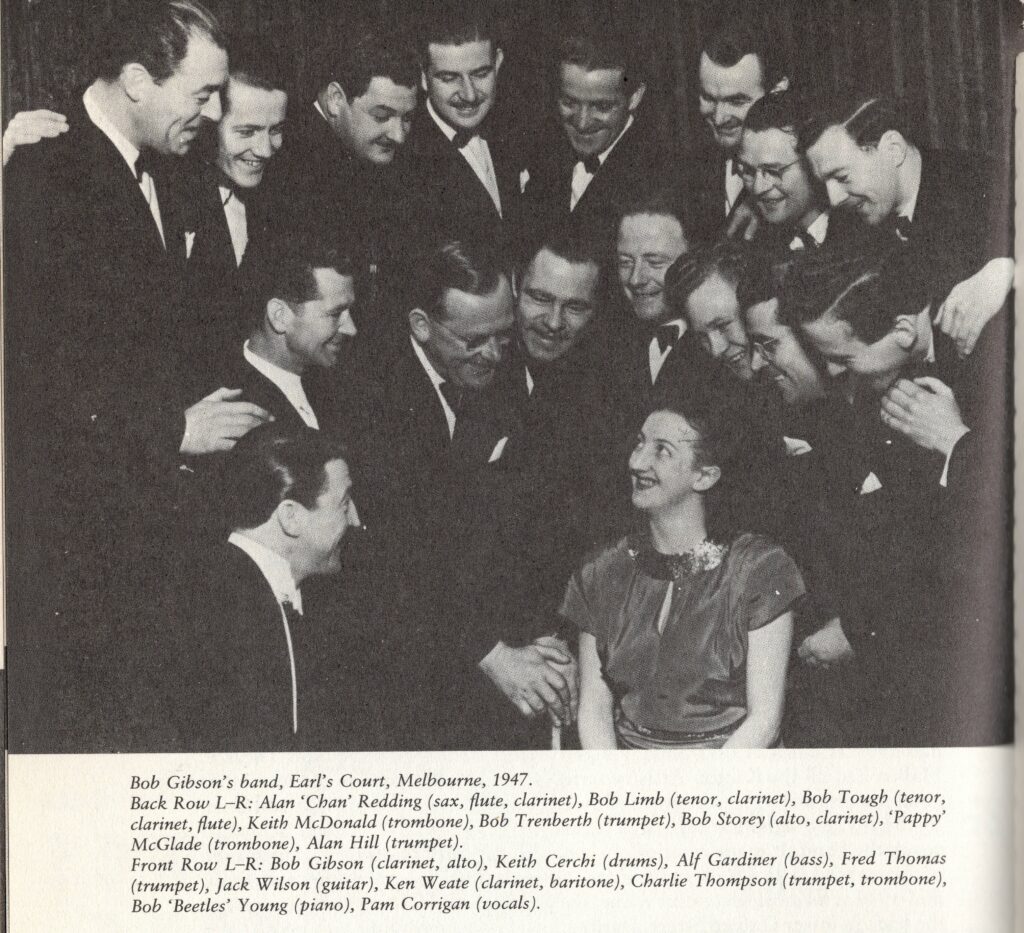
Bob Gibson was a Perth musician who began his career on violin, then learning clarinet and saxophone with Harold Moschetti. In Perth he initially played with the Doreen D’Arcy’s Orchestra, a six piece dance band, and then in Ron Moyle’s seven piece band at the Embassy Ballroom. Moyle toured to Melbourne and Gibson auditioned successfully in 1935 for the “Good Companions”.
1933
LOCAL BAND HONOURED – Engagements in Eastern States.
For the first time in broadcasting history a West Australian band has been engaged through the Australian Broadcasting Commission to give performances- over the air in the Eastern States. Ron Moyle and his ‘Westralians,’ a combination of local performers, will leave ‘ for Adelaide by the Great Western express on Saturday, night, and will be absent for about six weeks. The ‘Westralians’ will be heard over the air from 5CL, Adelaide, on December 21 and 22, and from South Australia they will go to Melbourne, where they will broadcast from 3LO- between January 6 and 27. It is possible that the band will; also visit Sydney. Ron Moyle himself is well-known to listeners in Western Australia, having been connected with broadcasting in this State for many years. His band, which is composed of the following players, was heard from 6WF during last dancing season: — Ron Moyle, A.T.C.L. (pianist); Bob. Gibson, L.A.B. (alto saxophone, clarinet and violin) ; George Caro, A.T.C.L. (tenor saxophone, clarinet and violin); Allan Gough, A.T.CJj. (alto saxophone, clarinet and violin); Viv. Nylander (trumpet and trombone); Kem. Fimmel (trumpet); Charles Thompson (trombone and trumpet);. Wally Hadley (banjo, flute and guitar); Cliff Adams (guitar, tap dancer and vocalist); Eddy Roberts (drums and vocalist); and Tom Bennett (bass). The band will give a final concert at the Ambassadors Theatre on Friday night. West Australian (Perth, WA : 1879 – 1954), Wednesday 13 December 1933, page 5
In 1935 the band the “Good Companions” was formed by Ern Pettifer at the Palais de Danse, St Kilda. “The formation of the “Good Companions” set music at the Palais on a forward-looking path, because Pettifer gave some talented young players a break. Auditions were held on a hot summer day and in the line of hopeful stretching around the corner was a gifted alto saxophonist from Perth, Bob Gibson. The audition piece was a tough arrangement of “Bugle Call Rag” by Frank Coughlan who was then with Pettifer. Gibson sailed through it because he had had a thorough classical training and had won many scholarships for his ability, and he knew dance work too. Gifted young players never appear out of nothing and Gibson was no exception. Perth had its own thriving dance bands.” Andrew Bisset, Black Roots White Flowers, 1987 Globe Press. page 55
1941
Talking Shop By “Finn” Westralian Wonder. From farther and farther afield come the stars of 3Aws “Youth Show” and the latest on the list is an amazing young man from Nedlands, Western Australia. He is nine year old Jack Harrison who surprised everyone by winning the first prize in the big 150 pound “Search for Talent”. He competed against allcomers and won by popular vote, although listeners had no knowledge of his age or identity. Jack started playing the mouth organ …he will feature in the broadcast from 3AW. The Listener In Complete Radio Newspaper February 22-28 1941 And 4BH. Teleradio Saturday March 1, 1941
Jack’s father tells me (per the P.M.G.) that he has met at least 14 W.A. people n Melbourne and Sydney who are tops in the eastern entertainment world. He cut out newspaper references to some of the W.A. people which have appeared during the few weeks he has been in the East and forwarded them to me. One about “Duffy” Newton (who used to act in 6WF plays) made about ten inches of type, had a double column heading and carried a photo. Other cuttings contained photographs of David Samuel (deputy-leader of Bert Howell’s Band and leader of last year’s “Youth Sow” band), Chester Bond (who is at present featured in a big radio serial), Bob Gibson and George Watson (a principal of the Drum Club). The Broadcaster February 1 – 8 1941
1949
19 February 1949 – PERTH JAZZ MEN ARE TOPS IN EAST
Recent news about WA dance musicians who have sought to establish national reputations is good news. At least 4 who have been questing after the big-time in the Eastern States have made it, some of them ranking amongst the top-salaried musicians of the day. Currently occupying press space in musical magazines and feeling the for and, against quips of critics in Sydney is Ray Hartley, onetime popular pianist at radio lunch-hour concerts in Perth. General gossip has it that Ray is sow in the high salary range although it is rumoured that the road has been long and very rough. At present Ray is featured with Paul Lombard’s outfit at the Celebrity Club which used to be Rose’s and spare time, as little as he may have, L being turned towards arranging and holding down a couple of radio spots. In addition to this Ray contributes to the Music Maker, the Australian Dance Band Editorial and his articles on prominent keyboard men are a worth while contribution to that magazine. Although his name is usually associated with lunch hour concerts, Ray’s success was first assured in renditions of the Ray Hartley Trio; a combination which he has reformed in Sydney.
One Of The Best Recognised as being one of the best musicians in Australia was Bob Gibson. Since leaving Australia some months ago to further his knowledge in England, little news has been heard of him. He is another W. A. man and at the age of 9 was a winner of eisteddfods and a gold medalist, but his future career was not restricted to his ability as a violinist alone, for at the age of 14-15, Bob commenced taking sax and clarinet lessons from Harry Moschetti, and very soon established himself on these instruments. In the early 1930’s, Bob took over the leading alto sax seat in the Ron Moyle outfit, a combination through which passed some of the finest musicians of the State, and when this outfit went on tour through the Eastern States, Bob Gibson still occupied alto seat but he never returned to W. A. With hard work and perseverance he finally cracked the ice in Melbourne and had occasion to look back. Just prior to the last war, he organised his own band and hit St. Kilda night spots which proved to be his first top liners. His subsequent success such as the Shell Show are now history and it is hoped that his success overseas will continue. Mirror (Perth, WA : 1921 – 1956), Saturday 19 February 1949, page 11
1950
April 1949 – Outstanding alto and clarinet man with the Sharp combination, George Caro, has had a colourful career in the game. At 15 he commenced the sax, and as George maintains, was completely self-taught. He first came to the public notice in 1930 when he was one of 18 who competed in the saxophone competition conducted by the Brass Band Association of WA. Winner was Cas Mitchell, now of the ABC Melbourne, second George Caro, Bob Gibson (now in England) was third, and fourth position was filled by Bob Trew (Perth ABC). In 1934, when the exodus was on, George made the Eastern States tour with the Ron Movie outfit, and when this orch. returned to WA, George decided to hit out for the overseas spots. His first working port o’ call was Colombo, where he played at the Mount Lavinia Hotel. From here he went to the Grand Hotel at Calcutta, before making the Malayan Peninsula in 1936, where he played in Singapore cabarets and the Eastern and Oriental Hotel in Penang. On his return to Australia, George linked up with pit work, played for the American Marcus ‘Show, North China Troupe, Dante, and various other visiting shows. During the war he played second cornet with the 28th Battalion Band, and at a later stage, while serving in Darwin conducted a Sunday night Swing Show featuring a 5piece outfit. Returning to civvy street, he joined Chris Gosper’s eight playing at St. Mary’s, Mt. Hawthorn. When Sammy Sharp returned from England, George moved in with Sammy and remained with him ever since. —’QUAIL.’Mirror (Perth, WA : 1921 – 1956), Saturday 23 April 1949, page 14
1950
On The Home Range – BOB GIBSON
Ask the boys in the strings and the winds about Bob Gibson. Gibson! they say with awe. He lives, eats, and drinks music. He has no other interests, only music, in which he strives for perfection. And in hushed tones they say, ” What an ‘ear’ that man’s got!” ASK “Melbourne’s thousands of dance fans. “Bob Gibson,” they say. “He’s more than a band leader. He is the perfect dance tempo!” To us Bob appears to be just an ordinary bloke, unassuming, dark, rather short, with a pleasant fluency. Local dance fans were desolate when Bob sailed for England in 1948. Now he’s back, after London successes, wondering whether to re-form his band in Sydney or in Melbourne. Few, if any, Australian band leaders have had a bigger personal following than Gibson. Before his London trip his band, then the only big-time, freelance combination in the country, was nationally famous for its work in hit radio – programmes such as The Shell Show, All Australian Hit Parade, Popularity Parade, and A.B.C. Shows. In addition, the Bob Gibson band, which incidentally was then costing about £500 a week to run, was in demand for Vice-Regal evenings and the top society balls of the season. Bob was something of a child prodigy. At 12 years of age, he was playing the violin in the newly-formed Perth Symphony Orchestra. In his early teens he was awarded his violin degree in Perth by the travelling examiner of the Royal Academy of Music. As a youth of 17 he stepped off the Overland in Melbourne into the St. Kilda Palais orchestra, the Palais being one of the biggest dance halls in the Commonwealth. He was lugging four cases — three for his violin, saxophone, and clarinet, and one for clothes. He fiddled and “doubled” on the sax and clarinet to such purpose that within a few years he was promoted to be Palais Orchestra arranger, probably the youngest in the Commonwealth. Then in 1939, only 25 years old, he formed his own orchestra. Bob went overseas to study entertainment trends in radio, television. and on the stage. He warns Australian musicians and theatricals that the competition over there is terrific. For every musician here there are at least 100 in London, competing for a limited amount of work. When a band vacancy occurs a dozen first-class players apply. for the position before it can be advertised. Only the fittest survive. Working conditions are much tougher than here, and the pay is not as good. There are many English musician anxious to migrate here. English artists and players are beginning to take a “dim view” of the increasing number of Australians reaching the top. But, Bob says, for every Dick Bentley, Kittys Bluett, and. Joy Nicholls at the top there are a score of Australians hovering on the breadline, many of them good artists. “Great talent is not enough in London,” he says, “You must have” luck too.” Gibson had his share. After doing a “study” tour with Tommy Trinder’s show, Bob was asked to form an orchestra of 25 players for the B.B.C. He also spent seven weeks in Paris and conducted a light orchestra which did the background”, music in a French film. Bob advises young theatricals and musicians to go to England for study, but to buy a return ticket before leaving! Gibson plans to return to London in 1951. In the meantime, he aims to. satisfy those dancing feet in Melbourne, or Sydney, perhaps! Smith’s Weekly (Sydney, NSW : 1919 – 1950), Saturday 18 February 1950, page 15
1953
Local Acts Compete for Record Prizes in Talent Final – Sixteen local acts will contest the grand final of Talent Hour, Australia’s most richly endowed talent quest, to be relayed from Melbourne Town Hall through UZ at 8 p.m., Tuesday, November 10. Each of the four section winners will receive £500, with minor placegetters receiving £250, £40 and £15. The best act of the night will be awarded an additional £1000. Awards will be made at the conclusion of the programme. Regular adjudicators, Dr. Herman Schildberger and Mr. Harry Sutcliffe; have been joined by Mr.-Garnet H. Carroll. Recorded semi-final performances of all artists will be featured in Talent Hour Preview, at 3 p.m. Sunday, November 8. Recorded grand final performances will be repeated, in Talent Hour Review, at 3 p.m. Sunday, November 15. Sydney orchestra leader, Bob Gibson will direct a 20-piece orchestra. The stage setting will include the appearance of leading Melbourne mannequins. Competitors are as follows;— Vocal: Joan Reed, soprano; Kenneth Sullivan, tenor; Theodor Sartory, bass-baritone; Leonard Delany, baritone. Instrumental: Roger Holmes, piano; Ian King, tuba; Eugene Danilov, clarinet; Mary Nevmet, violin. Pop Vocal: Reg Gray; Jack Bowkett; Margot Carroll, John Oldham. Novelty: Alfred Smith, monologuist; Don Harper Quartet; John Shingler and Kelvin McMillian, flute and saxophone duo; D.D.H. instrumental trio. Age (Melbourne, Vic. : 1854 – 1954), Thursday 5 November 1953, page 19
RED CARPET FOR MUSIC VIPs GET WELL WORN
Perth musicians are finding their red carpet (for rolling to welcome local members who have become VIP’s in the musical world) is wearing pretty thin. Latest to tramp across it will be Bob Gibson, on Monday night. He arrives from the Eastern States by ‘plane, will be an honoured guest at the Musicians’ Ball at the Embassy on Tuesday night. He has made his name not only as a musician and band leader, but also as an ‘ arranger. His work has been praised by ‘big name’ clarinettist Artie Shaw. Bob studied violin in Perth at an early age. While still in short pants he played at the old Prince of Wales Theatre. He turned to the saxophone later, left here in that capacity with Ron Moyle’s orchestra in 1933 for. what is believed to be! the first tour of a dance band under the ABC banner. He stayed in Melbourne, where he ‘saxed’ with Ern Pettifer’s orchestra at St. Kilda’s Palais de Dance, which was later taken over by Hal Moschetti, another West Australian. Later engagements included seasons with Bert Howell, of Capitol Theatre, and Shell Radio Show fame, Jay Whidden, Roy Fox and Dick Freeman. Bob formed his own combination at Melbourne’s Palm Grove, with a wealth of experience behind him. During the war he organised a band and toured forward areas as director of a US entertainment unit. After the war he returned to England as musical director of the Tommy Trinder Show (a job now held by Hal Moschetti). But the climate and ill-health (he developed pneumonia) sent him back to Australia, where he has carved himself a new niche. Mirror (Perth, WA : 1921 – 1956), Saturday 24 October 1953, page 12
SUNDAY, NOVEMBER 1st, 1953 – Jazz Festival Week Part Two: CAPITOL THEATRE – THE BOB GIBSON SHOW
Box Plans for both these attractions now open at Nicholsons. TICKETS 5/ The West Australian Saturday 17 October 1952 page 35
LISTENERS WILL HEAR GIBSON An agreement reached between the W.A. Musicians’ Association and the ABC resulted in last Sunday’s Jazz Jamboree (featuring The Bob Gibson Show) being recorded for broadcasting from 6WF. When the ABC heard that ace band leader Gibson would be the guest artist for the second part of Jazz Jamboree, it came to an agreement with organisers Sam Sharp and Harry Bluck for Gibson’s show to be recorded, and also agreed to pay the W.A. Musicians’ Association a fee for the right to record the show. The date of the broadcast will be published shortly. Gibson is now musical director for 2UW. Recently Gibson signed an agreement with the Columbia Recording Company. The first of his releases to be heard in Perth will probably be “Wild Horses” and “My One and Only Heart”. Gibson, who went to England in 1948 and returned in 1950, now favours big band. He records with a 28-piece band, and for concert and radio work he uses anything from 16 to 20 musicians. Two of his most popular programmes, heard from 2UW and Sportsman’s Parade and Musically Yours. Gibson said that any young musicians who hoped to go abroad needed plenty of capital and lucky breaks. He said that there were too many instances of a bandleader casually approaching a popular tune without having any idea of presentation.
Of the orchestra he conducted at the Jazz Jamboree on Sunday night, Gibson commented “They are a first class bunch of musicians. Considering they had such short notice to get together they gave a truly remarkable performance.” The band leader also praised individual performances. He believes that 17 year old Neil Boon could develop into a top line artist. Jack Harrison displayed plenty of versatility and gave a smooth performance, he said. Gibson also praised the responsiveness of the audience. “In modern music there is no greater encouragement” he said. The Broadcaster Saturday November 7 1953 Vol .20 No. 1023
BAND HAS BIG NAMES IN EVERY SECTION – When Harry (‘Powerhouse’) Phillips takes up his trumpet on the stage it is usually a signal for wild enthusiasm from rhythm fans who see in him a combination of Louis Armstrong, Harry James and a dozen other trumpet idols. Harry, who has been to WA for nearly 5 years, is from an English musical family which has been associated with big-name bands in England and on the Continent for many years. His brother Syd will always be remembered for his compositions and arrangements with the famous Ambrose. Another brother, Woolf, is equally well known. Before coming here Harry played in most of the capital cities of Europe and speaks several languages fluently. He has played lead trumpet with brother Syd’s band, with Ambrose, Mantovani and Harry Roy, as well as with his own groups. He can play a sweet trumpet, but is usually associated with the forceful style which gives him his name of ‘Powerhouse.’ Although this looks to be a difficult style, he achieves his effects from the modern non-pressure method, with which there is no great physical effort, despite the seemingly strained attitude of the player. Harry claims to be able to te ich this style easily. Associated with Harry in his band are a number of promising young musicians, notably saxophonist Neil Boon, a 17-y-o Dutch boy who literally stopped the show at last Sunday night’s Jazz Jamboree, when Bob Gibson was guest conductor. A great future is predicted for this boy, who has been playing saxophone for less than a year, but has played the clarinet for 4 years. His alto sax solo ‘I’m In the Mood for Love’ received such an ovation that compere Wally Hadley had to ask Harry to bring him forward and introduce him to the audience. Band’s guitarist Sid Vandervelde, also from London, was with the late Felix Mendilsohn’s Hawaiian Ensemble and the late Freddie Gardner, the great sax stylist. Sid works a6 a motor-mechanic in Perth and has been here for 2 years. Fans like the drive he gives the band with his solid rhythm on an amplified Spanish guitar. Brothers Don and Gordon Bates, who play piano and drums with the outfit, are local boys who have been well-known in the music game here since they had ‘their own band some years ago. Don is a saddler with his father and Gordon is with a City leather firm. Harry works as a planning engineer for a Perth firm.
The popular Harry Phillips combination which has delighted Perth rhythm fans: (PHOTO) From left: Syd Vanderveldt, guitar; Don Bates, drums; trumpeter Harry, Gordon Bates, piano; Neil Boon, sax and clarinet. Mirror (Perth, WA : 1921 – 1956), Saturday 7 November 1953, page 12
The youngest of the four children of Archibald Charles Callaway, an electrical engineer, Frank Adams Callaway was born in Timaru, New Zealand, on 16 May 1919.
When war broke out he enlisted for overseas service. He was rejected because of his poor eyesight, but the Royal New Zealand Air Force recognised his musical potential – he joined its Central Band as a bassoonist and arranger.
The Pied Piper Towards the end of his long life, his colleagues at the International Society for Music Education had this to say about Sir Frank Callaway: ‘It is probably true that Sir Frank Callaway must know, and be known by, more people in music education throughout the world than anyone else. The list of countries he has visited is staggering: at a modest estimate he must have covered well over a million miles – a feat which these days is only surpassed by astronauts. His vision for music education in its broadest sense is respected internationally.
It is unlikely that anyone else has devoted as much time and energy to the cause of music education and given such support and encouragement to musicians, music educators, composers and many others, as Sir Frank Callaway. His generosity of spirit and his seemingly endless vitality – despite his age – is still an inspiration to music educators regardless of the sphere in which they work or the generation to which they belong.’
The youngest of the four children of Archibald Charles Callaway, an electrical engineer, Frank Adams Callaway was born in Timaru, New Zealand, on 16 May 1919. His uncle, Sidney Callaway, played cricket for Australia in the 1890s, and passed on his passion for the game to young Frank, but it was music that the boy loved best. His parents had him taught the violin.
‘As a child, I simply loved being involved in music-making’, he recalled, ‘and after first experiencing the thrill of music-making as leader of an early children’s orchestra, this sort of activity became central to my life.’
Because of the depression, Callaway left school when he was 15. He started his working life with a firm of commercial stationers, eventually becoming a travelling salesman. Evening studies at Christchurch Technical College led to Otago University at Dunedin, where he set his sights on a Bachelor of Commerce degree. In 1939 he abandoned this and entered the Dunedin Teachers’ Training College. When war broke out he enlisted for overseas service. He was rejected because of his poor eyesight, but the Royal New Zealand Air Force recognised his musical potential – he joined its Central Band as a bassoonist and arranger.
In 1942 the Air Force gave Callaway leave so that he could succeed the inspirational Vernon Griffiths as Head of Music at King Edward Technical College in Dunedin. At the same time, Callaway played viola and bassoon in the New Zealand Broadcasting Services’ Orchestra, and continued his music studies music part-time at the University of Otago. He eventually gained his Bachelor of Music degree, plus sundry prizes, including the Phillip Neil Prize for New Zealand composers. In 1947 the university’s Fanny Evans Travelling Scholarship financed his trip to London – but the funds would not stretch to allow Callaway to take his young wife, the brilliant pianist Kathleen Allan.
At the Royal Academy of Music he studied conducting, general musicianship and composition, forwhich he won the Battiston Haynes and Cuthbert Nunn prizes. A Carnegie Travel Grant enabled him to explore music education in the United States, where he met people who shared and shaped his international vision for music education. In 1949 he resumed his work with King Edward Technical College, and also directed a regular series of orchestral concerts and large scale music festivals in Dunedin.
In 1953 Callaway accepted the post of Reader in Music within the Faculty of Education at the University of Western Australia. Six years later he became the university’s Foundation Professor of Music.
Starting with a staff of one (himself), a desk, an upright piano, and a small pile of music, Callaway built up a thriving Department of Music. When he retired at the end of 1984, he was farewelled by 14 full-time staff-members and a large team of part-time teachers. On the way he had developed what is widely regarded as Australia’s finest Music Library – the Wigmore.
Outside his university commitments, Callaway had created and edited Australia’s leading musicological journal, Studies in Music, and other scholarly publications. In association with the West Australian Symphony Orchestra he had organised a series of Composers’ Workshops that attracted many young forward-looking composers.
He had been appointed by the prime minister to serve with Bernard Heinze and John Hopkins on the first Advisory Board of the Commonwealth Assistance to Australian Composers scheme, organising national seminars and workshops for young composers. He had been the foundation president of the Australian Society for Music Education, and had edited its journal. He had served for many years on the Festival of Perth committee.
For a quarter of a century he had conducted the University Choral Society, making it one of Australia’s finest large choirs. He led it in many memorable performances with the West Australian Symphony Orchestra and visiting soloists, and he had been guest conductor for ABC orchestras in Western Australia and other states. In 1979 and 1984 he was organising chairman of the Indian Ocean Arts Festival in Perth.
Internationally, Callaway had been a member of the International Society for Music Education since it was founded in 1953 by many of the people he had met on his visit to the United States in 1949. He was its president from 1968 to 1972, then its treasurer and, in 1988, was elected honorary president, succeeding the celebrated composers Zoltán Kodály and Dimitri Kabelevsky. He was also founding editor of its journal.
As a member of the Australian Commission for UNESCO, Callaway represented Australia on the International Music Council; in 1980 he followed violinist Yehudi Menuhin as its president, establishing a close and lasting friendship with him. He was elected a life member in 1985. His UNESCO work took him to General Assemblies and Congresses in Moscow, Lausanne, Toronto, Montreal, Bratislava, Prague, Melbourne, Budapest, Stockholm and Dresden. In 1995 he received the UNESCO Medal, which rewards musicians who have contributed to the enrichment and development of music and who have promoted peace and understanding between peoples.
Other recipients have included Yehudi Menuhin and Russian composer Dmitri Shostakovich and Indian musician Ravi Shankar. At the time, Callaway was only the second person to be awarded this prize for music education (the other was Nadia Boulanger, in 1979). The organisation’s director-general hailed Callaway as ‘one of the great pioneers and ambassadors of music education in our time’.
Callaway was the dedicatee for Australian composer Peter Sculthorpe’s short orchestral piece Sun Song (1984), and for Dmitri Kabalevsky’s Fanfare for Brass Ensemble. Incredibly, in so full a life, Callaway found time to indulge his passions for gardening, and, all too rarely, composing. His Theme and Diversions for Strings, Theme and Variations for Strings and Prelude and Fugue for Violin and Organ won awards and were publicly performed, but in his later years Callaway preferred to forget them.
Callaway retired from the University of Western Australia in 1984. In his honour the university established the Frank Callaway Foundation for Music, with contributions from Callaway’s friends and admirers. The foundation supports musical activities at the university and works to enhance the strong community and professional associations of the School of Music. Its patrons include Lord Menuhin, Sir Charles Court and Janet Holmes a Court.
The foundation organises the annual Callaway Lecture and stimulates music and music education in Australia and internationally through the non-commercial and co-operative Callaway Centre for Research in Music and Music Education. The centre houses a number of significant collections including those of Callaway himself (including a number of autographed letters and scores by composers such as Liszt, Elgar and Delius), ethnomusicologist John Blacking, Percy Grainger (whom Callaway met during his first overseas study tour and whose ideas on music’s universality impressed him deeply), conductor Verdon Williams, pianist Eileen Joyce (a personal friend of Callaway’s), and music historian Peter Burgis. The Burgis Collection includes significant holdings of Dame Nellie Melba and Peter Dawson memorabilia.
Many of Callaway’s former students and colleagues participated in a joyous gala concert in the Perth Concert Hall on 16 May 1999 to celebrate their mentor’s 80th birthday. After a long period of ill health, Sir Frank Adams Callaway died in Perth on 22 February 2003. He was survived by his wife, Kathleen, who had accompanied him to many overseas conferences, and had a notable career of her own: she was an acclaimed pianist and harpsichordist, and a fine accompanist, particularly for lieder. She was active for many years in concerts and radio broadcasts.
Born in 1930, Wood participated in the Australian Youth Orchestra’s (AYO) original National Music Camps from 1949 to 1954. He later served as National Music Camp Director in 1979 and 1980 and was a tutor at many other National Music Camps. He was conferred as an AYO Life Member in 2006 in recognition of his dedication to music education.
In the 1950s Wood performed with London’s Royal Opera House orchestra, followed by three years at the London Philharmonic Orchestra. He then settled in Perth, WA, where he joined the West Australian Symphony Orchestra during its early development.
Within a week of our arrival I was ensconced in the first violin section of the WA Symphony Orchestra. The ABC had just moved into a brand new building in Adelaide Terrace and the orchestra’s studio [the Basil Kirke Studio] was claimed to be the latest state of the art broadcasting studio in the country. It certainly suited the small 50-piece band, which I discovered on my first day. By 2005, the ABC had moved out and the building was to be demolished!
The quality of the playing in 1960 left much to be desired. The ABC employed the WASO and we were all superannuated public servants, so it was difficult to sack a player who was not up to scratch! I sat on the outside of the second desk, behind the leader, Vaughan Hanly and Barbara Tyler. My desk partner was Margaret Poole-Johnson. I could fill volumes with details of some of the extraordinary characters who inhabited the ranks of the orchestra at this time. Space however limits me to mentioning just a few.
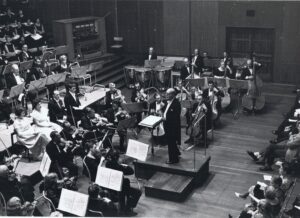
1967 WASO in Basil Kirke Studio
The resident conductor was John Farnsworth Hall. I had experienced some rotten conductors already, but Farnsworth really took the cake! An irascible charlatan of a fellow, he would fly into a rage at imagined slights or blame players when some mishap occurred, usually of his own doing. Fortunately he was also lazy and we could depend on days finishing early and calls being cancelled or cut short! This was a blessing in that we had time for our own individual pursuits, such as teaching and chamber music playing. Vaughan Hanly was a highly competent violinist with much experience and a high reputation as a teacher.
1965 John Farnsworth Hall conducting WASO in Winthrop Hall
Barbara Tyler was also competent, but rather neurotic, with a tendency to talk non-stop, to such an extent that she would froth at the mouth! Most of the others violinists were either ageing or young and inexperienced. John Dean led the viola section. I had met him at the University Conservatorium in Melbourne when we were both violin students there. He took to the viola when the principal position became vacant in Perth. We have been lifelong friends.
The front desk of the cello section was a hoot! Two mad Hungarians sat together there. Principal was Louis Moyser, a middle aged expatriate in the process of decay. He had the remains of a fine technique, but alcohol had infiltrated it. His desk partner was another alcoholic, Zoltan Barna, a plump clown of a fellow who had a large collection of musical tricks, amusing at first. The two of them caused our conductor a lot of strife. He called them “Buda” and “Pest”, which was about the only thing I admired him for.
Graham spent 24 years as the WASO’s associate concertmaster. The orchestra said of his passing:
’Graham will be remembered for his extraordinary artistry, beautiful tone, and wonderful sense of humour. Beyond the stage, Graham helped to shape WA’s music community through his dedication to teaching and mentoring, inspiring generations of violinists, including members of our Orchestra today.’
In 1974, Wood co-founded the Western Australian Youth Orchestra, for which he was most recently vice patron. The orchestra wrote on the social media: ’His enduring legacy has profoundly influenced the orchestral and artistic communities of Western Australia across multiple generations.’
Graham Wood participated in the Australian Youth Orchestra’s (AYO) original National Music Camps from 1949 to 1954. He later served as National Music Camp Director in 1979 and 1980 and was a tutor at many other National Music Camps. He was conferred as an AYO Life Member in 2006 in recognition of his dedication to music education. The CEO of the AYO said of Wood: ‘His impact on music and music education will continue to inspire and benefit future generations.’
He reminisces:
I was involved in the annual National Music Camps. My further drives east were usually to attend a Music Camp, now as a violin tutor. At this time the Camps were still held at Geelong Grammar School or St. Peters College in Adelaide. The founders of the organisation were still going strong. Ruth Alexander, John Bishop and Percy Jones, with Ron Maslyn Williams had established a tradition, which lasted for many years. The organization grew, evolving in the 21st century into the highly renowned Youth Music Australia. In the sixties students still slept in dormitories, assembled all together in the school refectory and sang grace at meals. There were strict lights out times and tight codes of behaviour. But everyone had [and still do have] a wonderful time. The staff received a tiny stipend, which only partly paid one’s drink bill, but we didn’t mind. These days they are paid professional rates for their time. One of the principal pleasures for us staff members was meeting with other musicians from all over the country, hearing the latest gossip and playing chamber music together. I continued my involvement with Music Camps for many years and in many differing roles – as conductor, Camp Director, member of the Board etc. My enthusiasm for the Music Camp movement stemmed from my own experience as a student, an experience which I’ve seen mirrored in hundreds of later Campers, an excitement and stimulation about music making which led me to the decision that being a musician was exactly what I wanted to do with the rest of my life.
His pivotal role as an educator also included his work as an examiner for the Australian Music Examinations Board, where he continued to work until 2022. He also adjudicated many of WA’s string competitions for young players.
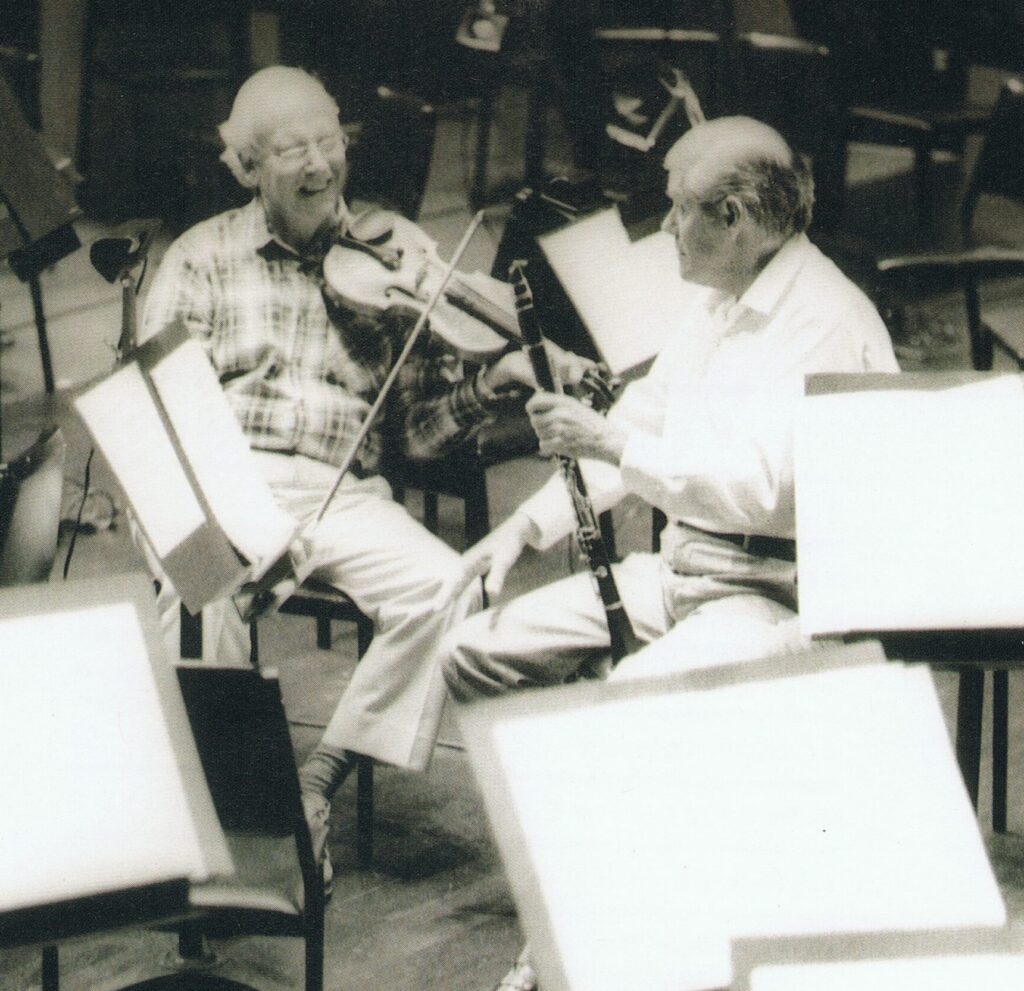
Graham composed a clarinet quintet which was premiered by Jack Harrison.
QUINTET FOR CLARINET AND STRINGS
1966 MUSIC LOVER’S DIARY
The Oriel String Quartet, of which Ashley Arbuckle is a member, will combine with clarinettist Jack Harrison to give a recital for the Kylie Music Club in the Skinner Galleries at 8.15pm on May 8. The programme will include Graham Wood’s Quintet for Clarinet and Strings. Proceeds will go to the W.A. Music Bursary Trust Fund.
The Chamber Music Society and the Kylie Music Club will hold a combined recital in the Skinner Galleries at 8.15 tomorrow. The Oriel String Quartet, of which Ashley Arbuckle is a new member, will be joined by clarinettist Jack Harrison in a concert. The proceeds will go to the W.A. Music Bursary Trust Fund. The programme will include Graham Wood’s Quintet for Clarinet and Strings. Mr Wood and Mr Arbuckle are beginning to make their marks as composers. Both are new bachelors of music. The Chamber Music Society welcomes guests at it s musical evenings and aims to have 150 to 200 members this year. The Kylie Club is also seeking new members.
May 8th 1966 -RECITAL WILL AID FUND – By Sally Trethowan
The Kylie Music Club and the Chamber Music Society combined their monthly meetings last night in a special program in the Skinner Galleries to aid the W A. Music Bursary Trust Fund. The Oriel String Quartet played works by Haydn and Brahms and with clarinettist Jack Harrison performed a quintet for clarinet and strings by the Oriel’s leader Graham Wood. Mr. Wood has much to say in his music and he communicates it in an idiom easily comprehended by even the conservative in the audience. His quintet is tightly constructed and the music, even in the scherzo’s taut rhythms, is romantic and appeals strongly to the listener’s emotions. The clarinet role is conceived as a solo song threading the string texture. Jack Harrison last night gave this part an eloquent reading especially in the wistful soliloquy that opens and concludes the work.
8.5.1966
Graham Wood Quintet for Clarinet and Strings WORLD PREMIERE
Jack Harrison (clarinet) Oriel String Quartet
Skinner Galleries Kylie Music Club Western Australia
Graham continued tutoring, composing, and studying music well into his eighties.
On 24 September 2005, Australian violinist and educator Graham Wood OAM died at age 95. Throughout his career, he was a highly influential and dedicated member of the Australian musical community, not only as a violinist but also as a passionate educator who shaped the development of string playing and teaching in Western Australia (WA).
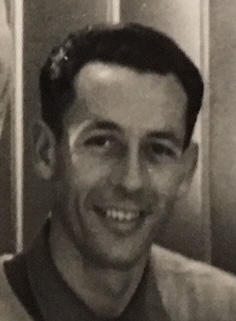
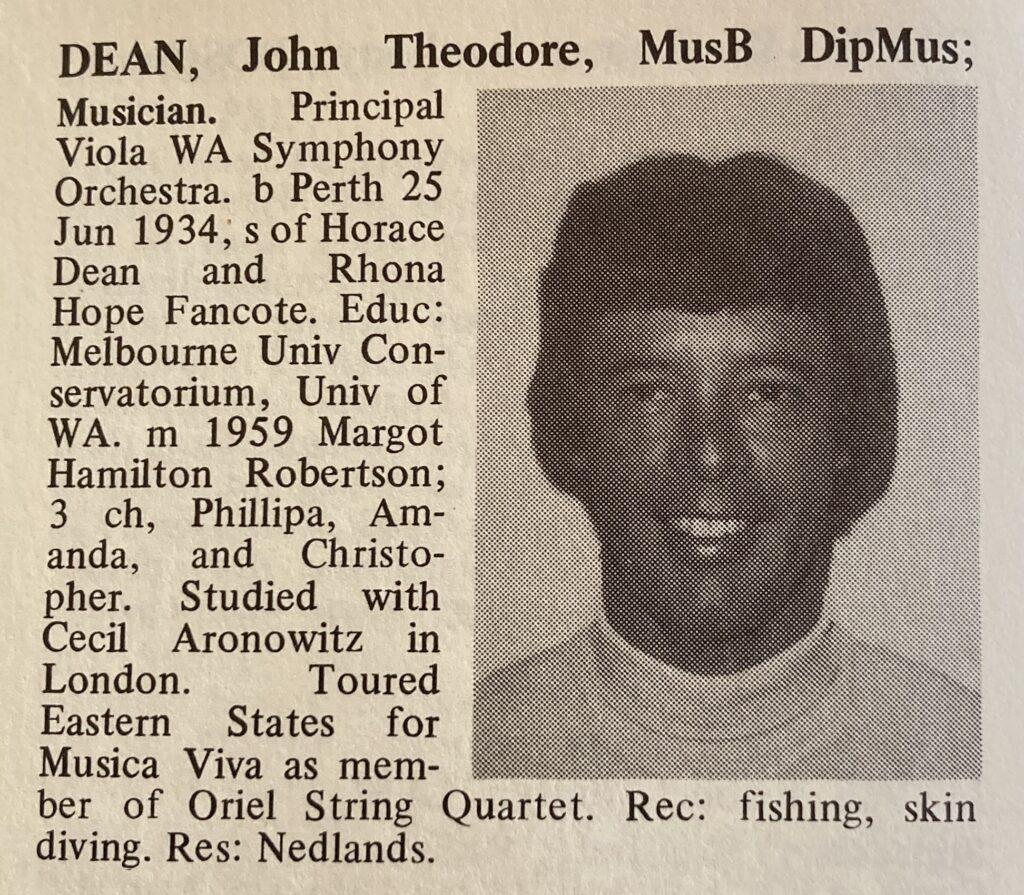
John Theodore Dean was born in 1934 to Horace (30) and Rhona Hope (nee Fancote) Dean (22).
In order to attend Sunday School at Saint Patrick’s Anglican Church in Mt Lawley, Marcia Chayter had walk past the house of Horace, Rhona, John and Michael Dean at 29 Rookwood Street, Mt Lawley.
1947 – aged 13
MUSIC AND ART OF SPEECH Exhibition And Diploma Winners Exhibitions were awarded at the September-November examinations in music and the art of speech conducted by the University of W.A. under the auspices of the Australian Music Examinations Board, as follows: Violin: Grade II, John Theodore Dean.
West Australian (Perth, WA : 1879 – 1954), Tuesday 16 December 1947, page 14
1950
This year the Kylie Music Club is meeting on the first Saturday of each month in the Women’s Service Guild hall. Because, however, there is a Musica Viva concert next Saturday, the Kylie May meeting has been advanced to this evening. The first half of the programme will be presented by young artists in John Dean and Bruce Shute (violin and piano), Pearl White (soprano), Betty Wright (piano) and Donald Cartwright (oboe). The concluding work will be a Brahms Sonata played by Vaughan Hanly and Marshall Sumner.
West Australian (Perth, WA : 1879 – 1954), Saturday 29 April 1950, page 21
MUSIC EXAM AWARDS Successful Students Announced The list of awards approved by the University senate in connection with the music examinations held by the Australian Music Examinations Board in September were released yesterday. VIOLIN. Seventh Grade: John Dean.
West Australian (Perth, WA), Wednesday 20 December 1950, page 14
1951
Awards In The Music Board Exams Awards made in connection with examinations held by the Australian Music Examinations Board have been announced by the University of W.A. Violin: JOHN THEODORE DEAN.
West Australian (Perth, WA : 1879 – 1954), Saturday 22 December 1951, page 14
1952
FANCOTE — FORBES A very lovely wedding was solemnised at St. George’s Cathedral, Perth, on Saturday, May 31, between Frederick George, son of Mr. and Mrs. F. Fancote, and June Francis, daughter of Mr. and Mrs. C. Forbes, both of Brookton. The officiating clergyman was the Very Rev. Dean Berivick of Perth. The bride was” beautifully gowned in white”- Chantilly lace over white satin, made with a fitting bodice, medicea collar, a very full skirt falling into a beautiful train, the “frock and train were edged all round with the natural scallops of the lace. Her three-tiered fingertip raw cut tulle veil was held in place by a halo of orange blossom. She carried a trailer of white carnations, gladioli, gerbera roses and bridal marguerite. The bride was attended by her sister, Miss Heather Forbes, in lemon, and her cousin, Miss Fay Nicholas, in blue. The bridesmaids wore lovely frocks of nylon lace and spotted tulle, made with bouffant skirts, allied to fitting bodices and fitting lace boleros with dovetail collars. They carried trailers of roses, asters and gerbera in pastel shades with matching posies in their little lace dutch caps. The bridegroom’s presents to the bridesmaids were diamante bracelets. The bride and bridesmaid’s frocks were made by Mrs. H. Grigo, an old friend of the family and former wardrobe mistress of the Tivoli Theatre, Perth. Mr. Frank Cox was best man and Mr. Phillip Cockcroft, the groomsman. The bride’s mother, assisted by the mother of the groom, received 120 guests to a buffet breakfast at Tintern Lodge, followed by a reception and dancing. During the evening Mr. Horace Dean and his son, John (both A.B.C. artists), favoured the guests with violin duets. The bride’s mother chose a crepe frock of beige’ grey colouring with a matching jacket, a junior navy hat and navy accessories and wore a shoulder spray of red roses. The bridegroom’s mother wore a lavender frock of light wool, lavender Velvet hat and grey accessories and chose a shoulder spray of gold roses. The three-tiered cake was made by the bridegroom’s mother and iced by Mrs. Frank White, of Brookton. The bride, for her going away outfit, chose a lovely pale blue suit trimmed with pearl buttons, a matching blue” hat and burgundy accessories.
The W.A. Musical Festival will end today. There will be no prize winners’ concert as in former years. This afternoon will be devoted to the finals of all the under-age sections up to 17 years, at the Perth Town Hall, Then, in the Burt Hall at 7.30, will bp contested the finals of the open piano and-violin sections, the champion ladies’ and men’s vocal solos, under18 piano and piano duets. A musical entertainment is included in today’s closing programme for the Arts Festival at the University. Beginning at 7.30 p.m. in Winthrop Hall, John Dean and Donald Thornton will play one of Beethoven’s violin sonatas, the Madrigal Singers will present medieval songs and madrigals, and Mr. Thornton will play Ravel’s Sonatine.
West Australian (Perth, WA : 1879 – 1954), Saturday 12 July 1952, page 15
FOUR WHO WON AT THE W.A. MUSIC FESTIVAL
Some of those who won the finals of their respective divisions when the West Australian Music Festival continued at the Burt Memorial Hall in Perth on Saturday night are shown above during their recitals. They are, from left to right: Mr. John Dean, winner of the open violin solo, Miss Brenda Howarth, winner of the ladies’ championship solo. Mr. R. E. Moran, winner of the open men’s championship solo, and Miss Janette Williams, winner of the open piano solo.
West Australian (Perth, WA : 1879 – 1954), Monday 14 July 1952, page 2
Women Excel In Champion Solos The singing heard in the women’s championship solo competition was superior to that of the men in their championship at the concluding session of the W.A. Musical Festival in the Burt Hall on Saturday night. This comment was made by the adjudicator Mr. Lindley Evans) in declaring Brenda Howarth the champion woman soloist, with Patricia Wyatt second The winner’s voice was an attractive soprano and her singing was intelligent and musical. Mr. Evans said. Romney Moran won the men’s solo championship. His baritone voice was described by the adjudicator as pleasant, and his performance as thoughtful, with accurate intonation. George Idle was second. Much interest was aroused by the appearance of an eight year-old competitor in the open violin solo final. He was Geoffrey Michaels, whose playing has recently been praised to a degree that suggests a prodigy. Great Talent Regarding young Michaels, Mr. Evans said: “This was quite a remarkable exhibition for so young a player, being fluent and in time. This is, of course, very great talent, which should be very carefully nursed.” Mr. Evans awarded the first prize to John Dean, whose playing he described as clear and careful, with fluent technique and true intonation. Geoffrey Michaels was second. The open piano solo was won by Janette Williams, whose playing of an “awkward” test piece was artistic and correct, Mr. Evans said. Roberta Manjon, whose tone and technique were declared to be satisfactory, won the piano solo (over 15 and under 18). Alan Speer was second. David Black and Alan Speer were first in the piano duet (under 18), with Adrienne Sinclair and Leslie Paterson second. Reviewing the festival, Mr. Evans said that the school choirs had been the outstanding feature, their singing having been exceptionally good. In the juvenile instrumental sections there had been much evidence of good teaching.
Following were the results of the juvenile sections- which were heard in the Perth Town Hall on Saturday afternoon. PIANO.–(Under 10): Maree Riddett, I; Roslyn Lang, 2. Solo (over 9, under 12): Barry Palmer and Susanne Maslen, dead heat, 1; Elsie Ottaway 2. Solo (over 12, under 14): Barbara Robinson, 1; Wendy Briggs, 2. Duet (under 13): Athena Hansen and Christine Hill, 1; Margaret Gallash and Barbara Carter 2. Solo (over 11, under 13): Pamela Goldsworthy and Donald McCully, dead heat, 1; Leslie Willcock, 2. Solo (over 13, under 16): Gwenyfred Zengheer-Herrmann, 1; Lynette Friere and Murray Burge, dead heat, 2. Duet (under 15): Helen Rudderham and Barbara Robinson 1: Elsie Ottaway and Rosalind Wasley, 2. VIOLN.–Solo (under 13): Brian Hanly, 1; Ashley Arbuckle, 2. Solo (under 15): Robert Ingram, 1; Ronald Thomas, 2. Solo (under 17): Pauline Thompson, 1; Norma Miller, 2. VOCAL.–Girls. Solo (under 16): Roberta Combs, 1; Natalie Sargent, 2. Boys. Solo: Barry Friere, 1; James Roger, 2.
West Australian (Perth, WA : 1879 – 1954), Monday 14 July 1952, page 5
The programme to be given in Wesley Church on Tuesday evening by the Perth Philharmonic Society to assist the fund being raised to enable the local contralto Nancy Ellis to proceed to the United States for further study, will include a tribute to Dr. R. Vaughan Williams, who tomorrow celebrates his 80th birthday. It will take the form of a composition of his published in 1950, a Fantasia (Quasi Variazone) on the Old 104th psalm tune, for piano solo accompanied by chorus and orchestra (in this case, the organ). Nancy Ellis herself will contribute a group of songs and John Dean will play violin solos.
West Australian (Perth, WA : 1879 – 1954), Saturday 11 October 1952, page 17
MUSICIANS AID FUND FOR SINGER (By P.K.). Songs by Nancy Ellis were the highlight of a concert which was held last night in Wesley Church in aid of a fund to send her abroad for further study. Her first song, “My Soul Rejoices” was a little unsteady and lacked the easy serenity that Bach’s songs demand. The Brahms item, however. contained much beauty and gave scope to the singer’s warm and vibrant tone. With closer attention to phrasing, dynamics and other musical “finishings” Miss Ellis should more than fulfill the expectations of those sponsoring the fund. A first Perth performance of Dr. Vaughan Williams’s Fantasia on the old 104th Psalm tune was the second feature of the programme. This work is a sequence of alternate piano and choral episodes-and the combination is not perhaps a very satisfying one. In this work and in the rest of the programme the Perth Philharmonic Society gave us some nicely balanced work. John Dean’s violin solos Bach’s “Arioso” and the ever popular “Ave Maria”had an extremely musical quality.
West Australian (Perth, WA : 1879 – 1954), Wednesday 15 October 1952, page 6
University Awards.
In Music The following awards have been announced in connection with examinations in this State, held by the Australian Music Examinations Board: W.A. Music Scholarship and Violin medal: John DEAN (honours in seventh grade violin).
West Australian (Perth, WA : 1879 – 1954), Saturday 27 December 1952, page 7
1954
A delightful chamber-music evening in her home was arranged by Dr. and Mrs. E. W. Arndt of Nedlands. Well known young artists of Perth contributed, including Dr. and Mrs. Arndt’s daughter Louise, who has completed two years’ violin study in. Amsterdam and is now a pupil at the Melbourne Conservatorium. Louise is returning to Melbourne this week after spending her vacation at home. Shown in the picture are nine-year-old GEOFFREY MICHAELS of Claremont, tuning his violin, for the third movement of the Mendelssohn concerto; MONICA WEINMAN of Claremont, and DAWN BALDWIN of City Beach. Other artists who participated were John and Michael Dean and Keith Middleton.
Western Mail (Perth, WA : 1885 – 1954), Thursday 21 January 1954, page 18
MELBOURNE
FESTIVAL HIGHLY PRAISED Warmly praising ‘Dandenong’s Festival, Mr. Williams said that there might be larger competitions and a lot with bigger prizes, but he felt that this was one that was doing more than any other, because they were giving the opportunities to youth, and they were assisting them in the form of Scholarships to advance their training. That was something he had been trying to get the bigger competitions to adopt. ‘ln this Festival you have something that is a rare thing,” he added. “Tonight every seat in this hall should have been full. You should support this Festival. Believe me it is worth it. This is a great civic effort and something Dandenong should be proud of.” Mr. Williams went on to make a number of helpful suggestions. Cr. Keith Terry, ‘president of the Festival Committee, then presented the Scholarships, Plaques and certificates.
Plaques for the outstanding performers in the several sections went to: John Dean (Violin)
Dandenong Festival of Music and Art last night. prizewinners at the festival included:— Dandenong Festival Violin Scholarship.—John Dean, St. Kilda.
Sun News-Pictorial (Melbourne, Vic.), Saturday 8 May 1954, page 14
Fine work by choir
The madrigal singing of the Oriana madrigal choir, directed by Leonard Fullard, is one of the most enjoyable musical experiences Melbourne can offer. At the Assembly Hall last night the work of the choir in music by Wilbye, Weelkes, Pilkington, Richard Carlton, Robert Jones, Byrd, and Purcell was no hit-and-miss affair. The singers kept their eyes on the conductor, the pitch was almost unfailingly ac-curate, and the tone un-forced and well-balanced. Such good results, all too rare amongst our smaller musical groups, can only come as the result of really thorough and intelligent rehearsal, and deserve the highest praise. In a Bach cantata, de-spite some good singing by Betty Fairbank, the performance sank to the more familiar level of the potentially valuable. Handel’s wonderful sonata in D major for violin and continue, played by John Dean and Maryjean Officer, completed the programme. DORIAN LE GALLIENNE.
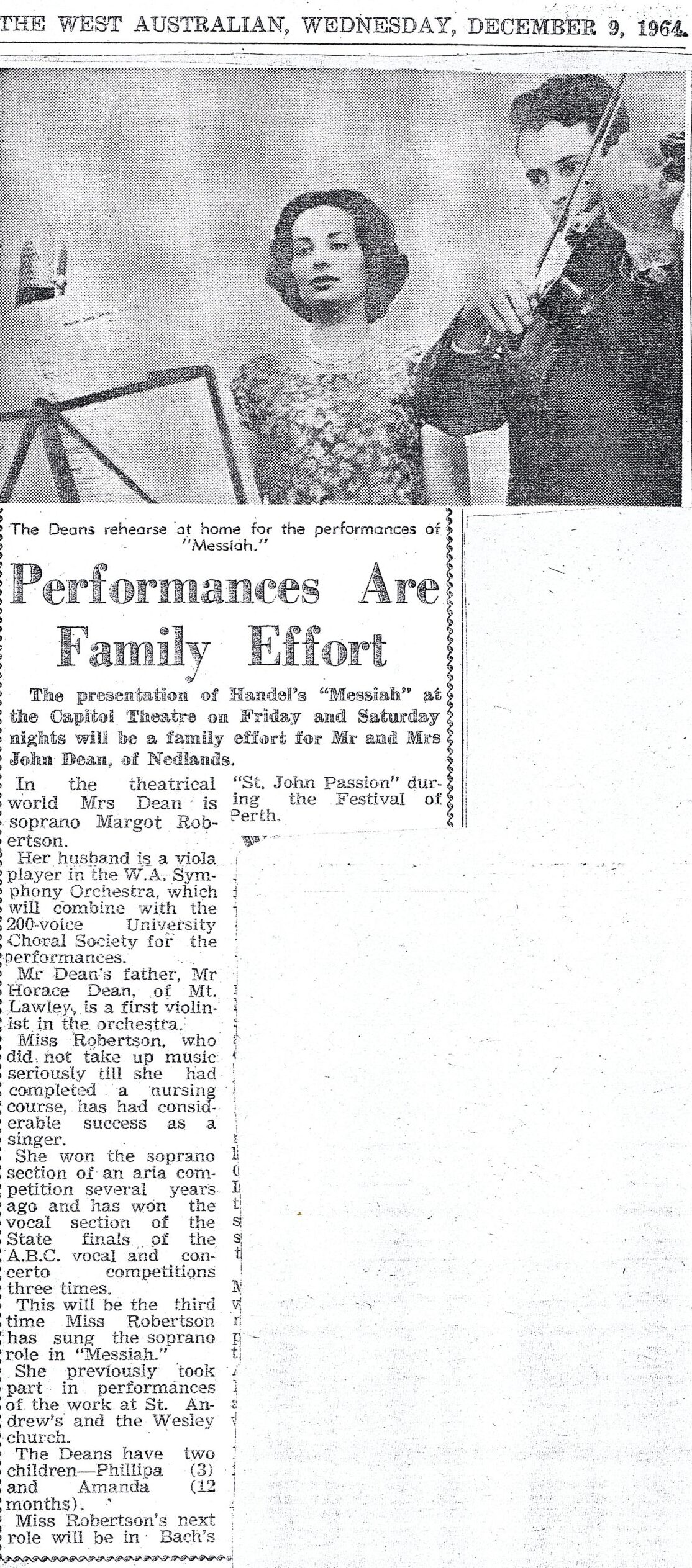
In 1957, Horace Dean, a member of the first violins during the earlier years (1942 – 69) of the West Australian Symphony Orchestra, had the pleasure of having his son john playing with him in the violin section of the orchestra. When a permanent position became available in the viola section, John moved to that instrument moving to the Principal chair several years later. John’s studies at the Melbourne University Conservatorium had been interrupted due to compulsory national service.
Harrison, Marcia. West Australian Symphony Orchestra Celebrating 75 Years. WASO Holdings Pty Ltd, 2003. Page 57.
1958
TALENTED ARTISTS TO VISIT YORK
An all star cast of leading Commonwealth and State artists will give a Concert in the York Town Hall on Saturday, 30th August. The occasion is the one hundred and sixth Anniversary of the York Methodist Church. Geoffrey Michaels, the fourteen year old violin prodigy, who last month, playing with the Sydney Symphony Orchestra, won the A.B.C’s Commonwealth Concerto Competition will be featured. Miss Patricia Connop who was last year’s winner and is at the present the star of the “Mikado” now playing at the Capitol Theatre, together with George Idle who plays opposite her in the same show, will be among vocalists. Miss Dianne Hosking, one of Perth’s leading actresses, will present speech items and John Dean and Bob Ingram, of the Perth Symphony Orchestra, will contribute instrumental items. Miss Margo Robertson, a West Australian finalist of Mobil Quest and Mr Ian Conochie, a leading base soloist in the “Messiah”, will also be vocalists. Duo-pianists of State fame who will perform are Josephine McKimmie and Michael Bartram; Wendy Prosser and Alan Speer. This is the finest line up of talent this State and York has enjoyed for such moderate charges. To make the evening a social success fitting for the occasion supper will be served the admission fee of six shillings will cover this. To obtain a good seat it is advisable to book at Efford’s Pharmacy, Beverley.
Beverley Times (WA : 1905 – 1977), Friday 22 August 1958, page 4
1959
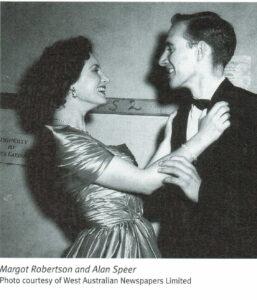
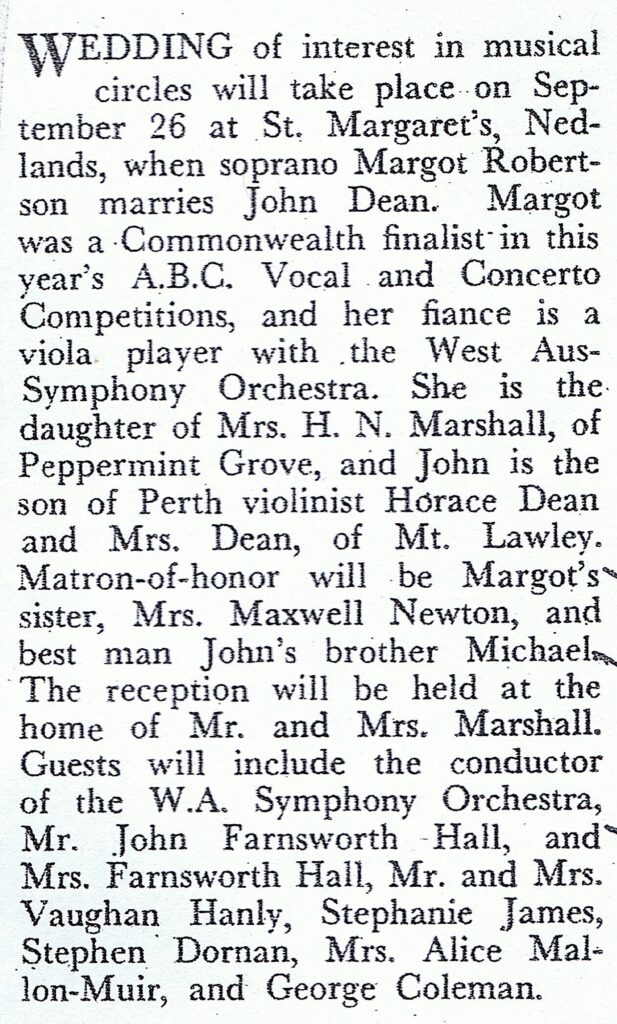
In 1959, John married soprano Margot Robertson.
Oriel String Quartet: Graham Wood, Ashley Arbuckle, Brian Meddemmen, John Dean
1961
8pm Sat 5th August 1961 – FESTIVAL CONCERT TONIGHT – WINTHROP HALL
World Premiere of David Farquhar’s prize winning Concertino for Piano and Orchestra. First Performance in Australia – Chamber Concerto No. 3 for Bassoon, Strings and Percussion by Elisabeth Lutyens. David Tunley’s Introduction and Scherzo for Clarinet and Strings. Plus works by Dvorak, Grieg, Delius, Elgar, Walton and others. UNIVERSITY ORCHESTRA conducted by Trevor Jones. Soloists: Michael Cole, Jack Harrison, Brian Pope. Assisting Artists: John Mowson, John Dean, Verdon Williams. Unreserved seats at door 10/ Students 7/6
The West Australian Saturday July 15 1961
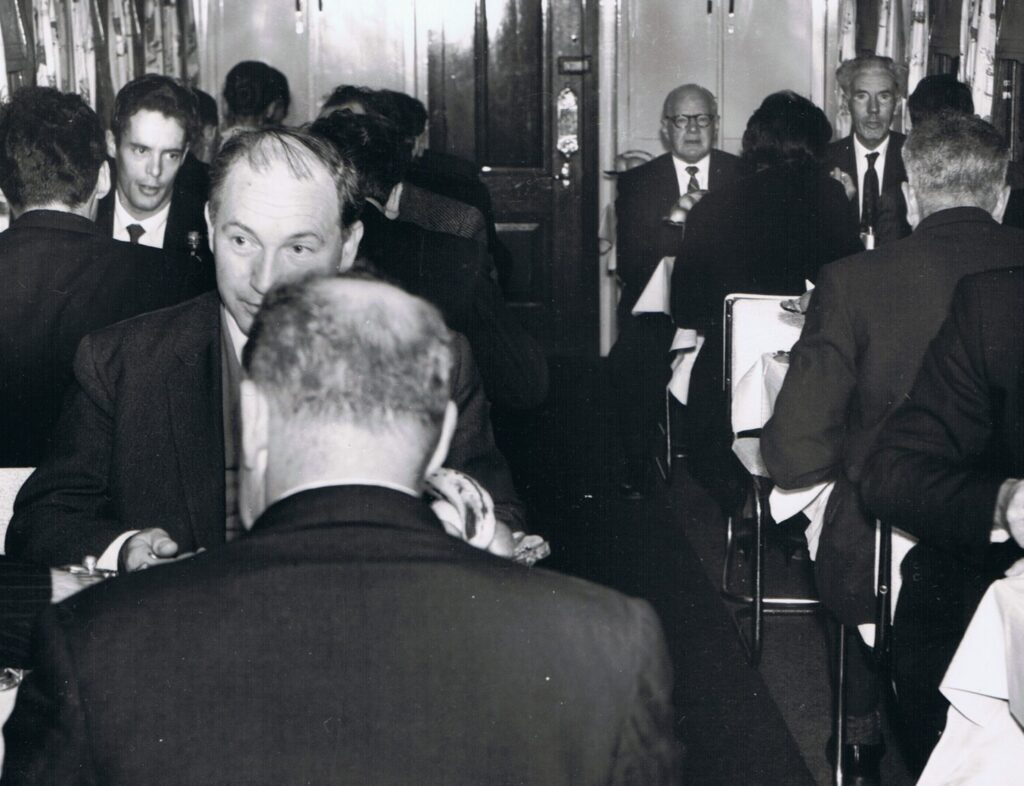
1963 WASO Geraldton tour dining train: John Dean (left) and father Horace (right)
1966
MAY 1966 – MUSIC LOVER’S DIARY
The fourth programme in the A.B.C.’s free recitals in the Basil Kirke Studio this year will be held at 3pm tomorrow. Jack Harrison, Graham Wood, John Dean, Brian Meddemmen and Stephen Dornan will perform trios by Mozart and Shostakovich.
1967: John Dean (right) with the West Australian Symphony Orchestra
1967
September 24 1967 – MUSIC – By Peter Hellstrom
There will be an all Beethoven programme at tomorrow afternoon’s recital at the A.B.C. Basil Kirke Studio beginning at 3 o’clock. It will consist of the Septet in E flat and the Serenade in D. Op.8. The performers will be Graham Wood (violin), John Dean (viola), Brian Meddemmen (cello), John Mowson (bass), Jack Harrison (clarinet), Neil Pierson (French horn) and Jill Harrison (bassoon).
1968
Sunday February 29 1968 – FEW HEAR FINE RECITAL – By Sally Trethowan
Fewer than 30 people attended yesterday’s free Sunday afternoon recital in the Basil Kirke Memorial Studio to hear what must have been one of the finest given this year by Perth artists. The oboe playing of Peter Randall in Mozart’s Quartet for oboe and strings was so good that an unchartered listener might’ve thought it was a simple piece. Mr. Randall gave such purity and accuracy to the naturally sharp clear tone of the oboe as to make even the accompanying strings in this piece seem cloudy in effect. It was duly wistful in the doleful minor keyed slow movement and cheerful in the finale where the virtuosic double-tongued passages were given within incisiveness, clarity and extreme rapidity. Violinist Graham Wood led seven other instrumentalists Stanislaw Kowarski (violin) John Dean (Viola) Brian Meddemmen (cello) John Mowson (bass) Patrick Brislan (Horn) Jack Harrison (clarinet) and Jill Harrison (bassoon) in the four movement Octet for Wind and Strings by the modern English composer Howard Ferguson. Mr. Ferguson seems to have a particular affection for clarinet and horn, and the success of the performance to some extent pivoted on Patrick Brislan’s horn playing which allowed no imperfection of tone to mar its richness. The program ended with a reduced version of Richard Strauss’s tone poem “Till Eulenspiegel’s Merry Pranks”. Originally scored for an orchestra of Wagnerian proportions of over 100 players, it was here rendered by five. Though without the percussion and heavy brass that in the full score are so graphic in describing the grotesque adventures of the mediaeval vagabond Till, it was a happy even witty performance. The final concert in the free Sunday afternoon series will be given in a fortnight.
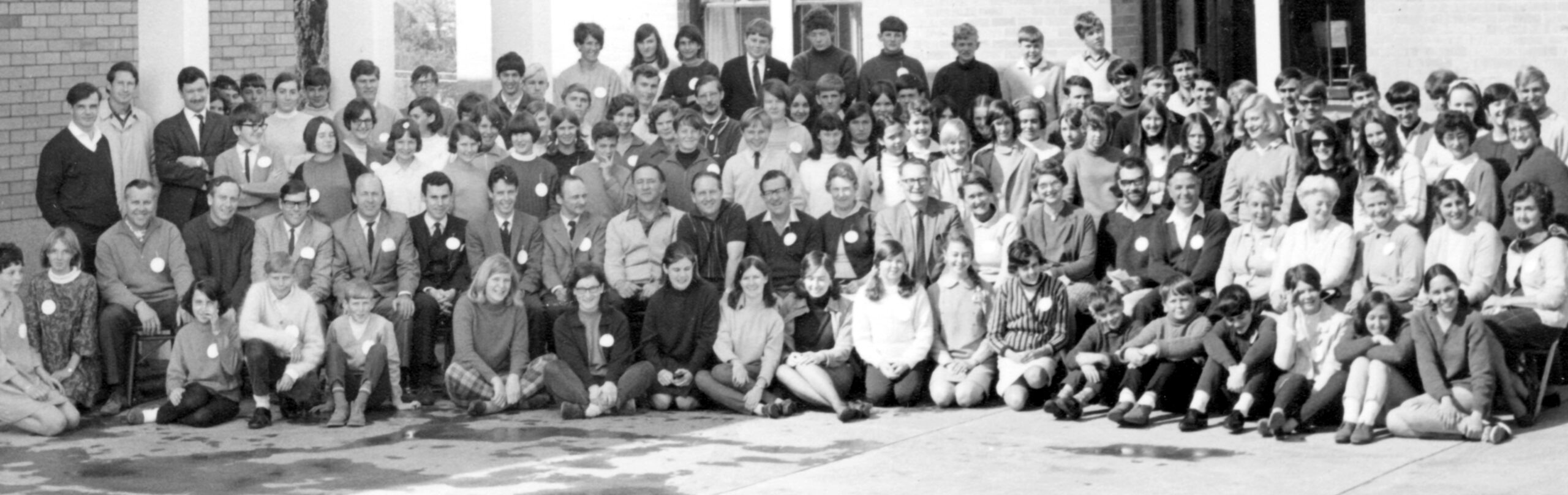
1969 WA Music Camp, Scotch College
1972 – LONDON
In 1972 John studied in Britain with Cecil Aronowitz. During this time he joined fellow Australians Ronald Thomas and Brenda Cullity as members of the English Chamber Orchestra.
1973 Coupled with Ashley Arbuckle, John was soloist with the orchestra in 1973.
1977 John was presented with medal for over 20 years service with the A.B.C.
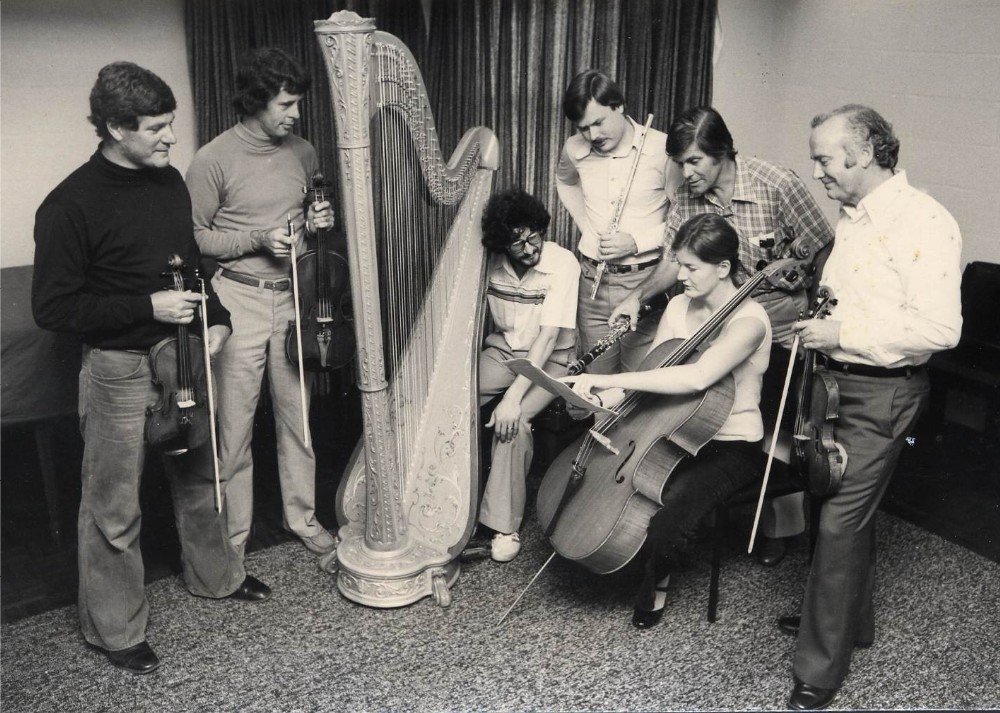
Wigmore Ensemble
1979
23rd April 1979 – Chamber Group off to a Good Start – By Derek Moore Morgan
The recently formed Wigmore Ensemble made its first public appearance last night with a delightfully varied program at the Octagon Theatre. A flexible group with no fixed numbers, it has the practical advantage of being able to present music of widely different genres some of which inevitably gets left on the shelf because it doesn’t quite fit a specific mould such as the string quartet or Trio. This was a University of W.A. music Society recital. The performers were Graham Wood and Ashley Arbuckle (violins), John Dean (viola), Jill Cole (cello), Neil Fisenden (flute), Jack Harrison (clarinet) and Anthony Madewell (harp). The final item, Ravel’s atmospheric and beautifully crafted “Introduction and Allegro” brought all the players together to produce a nice degree of sonority and delicacy capturing much of the subtlety of the masterpiece. Starting with the Mozart Quartet for Flute and Strings in D major a mellifluous example of the composer’s earliest style, the players gave us a bright indication of the bubbling and effervescent Gatty of the Rondo finale. The British composer Frank Bridge, himself a viola player, wrote a whole body of telling string music. His little known Trio (Rhapsody) from 1928 proved to be a forward looking piece for the difficult unless usual combination of two violins and viola, with mysterious opening and closing sections surrounding an energetic central portion. The Italian composer Malpiero’s “Sonata a cinque” (1936) is an appealing piece of writing which hangs on the air like a haunting elergy. Anthony Maydwell’s expressive harp playing came to the fore here. The Quartet for clarinet and strings by Rawsthorne is another piece of chamber music which is deftly written and manipulates varying moods. Jack Harrison’s neatly inflected clarinet tone was well handled.
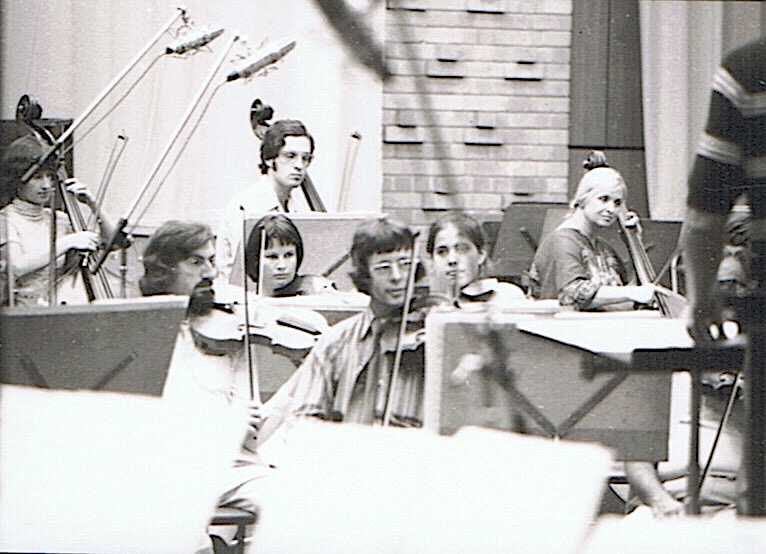
1979 WASO with Measham: Joan Wright, Dave Ellis (basses) Les Crockford, Marion Bonds, John Dean (violas) Aino Neumann (bass). ABC Basil Kirke Studio.
1985
Sunday July 21 1985 – Perth Chamber Soloists – UWA Music Auditorium
Robert Cooper, Neil Barclay, John Dean and Jill Cole. Guest artist Jack Harrison. Quintet for Clarinet and String Quartet (Bliss)
2024 OBITUARY
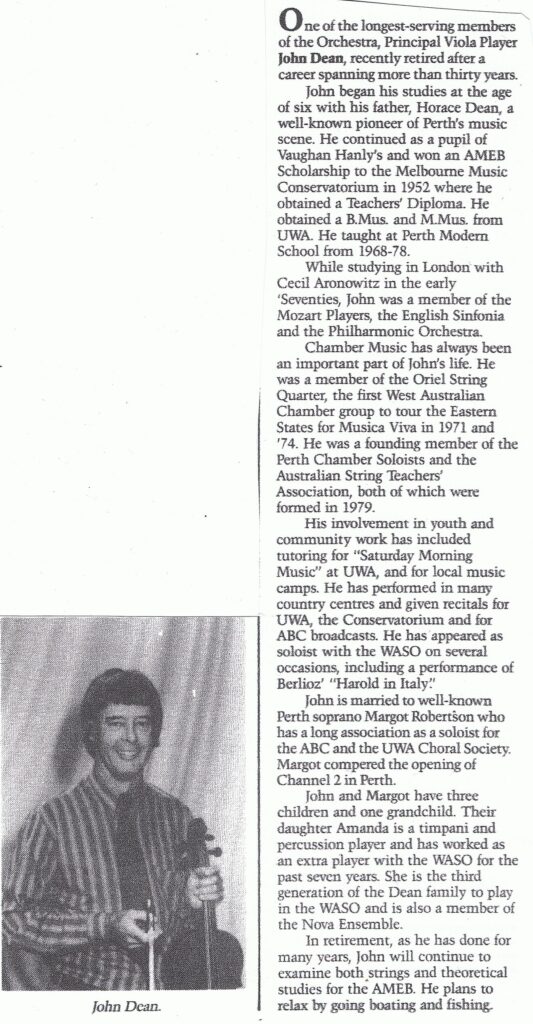
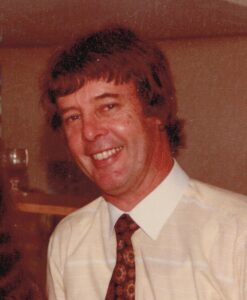
John Dean was the longest-serving principal viola in the Western Australian Symphony Orchestra’s history from 1970 to 1989
John Dean, a former long-standing member of the West Australian Symphony Orchestra (WASO) died on 6 August 2024, aged 90. Dean was a member of WASO for 33 years and was the longest-serving principal viola in the orchestra’s history.
Dean began studying the violin at the age of six with his father, Horace Dean, who was a WASO violinist from 1942 to 1969. In 1952, after studying with Vaughan Hanly, he was awarded an Australian Music Examinations Board (AMEB) Scholarship to the Melbourne Music Conservatorium, where he studied with Boris Stupel.
In 1956, he returned to Perth to explore employment opportunities. Upon a viola position becoming vacant in WASO, he learnt alto clef and passed the audition.
He served as principal viola from 1970 to 1989, becoming the longest serving musician in that position in WASO’s history.
He was honoured by WASO with the title of emeritus musician for his 33 years of service to the orchestra.
Dean pursued further studies in London with Cecil Aronowitz in the early 1970s and became a member of the Mozart Players, the English Sinfonia and the Philharmonic Orchestra.
After returning to Perth, he joined the Oriel Quartet, the first West Australian group to tour the Eastern States for Musica Viva. He was also a founding member of the Perth Chamber Soloists, and the Australian String Teachers’ Association (AUSTA) – which annually supports the AMEB’s John Dean Award for Best 7th/8th Grade Strings Candidate.
As an educator, he held a ten-year teaching engagement at Perth Modern School and taught in Bunbury, as well as theory at the Western Australian Academy of Performing Arts (WAAPA). He tutored for the University of Western Australia’s (UWA) Saturday morning music programme, as well as at local music camps and working as an AMEB examiner.
His work in the community saw him travel to perform in regional communities, giving recitals for UWA, and playing for ABC broadcasts. Dean appeared as a soloist with WASO on several occasions, including a performance of Berlioz’s Harold in Italy.
Dean is survived by his three children and wife, soprano Margot Robertson.
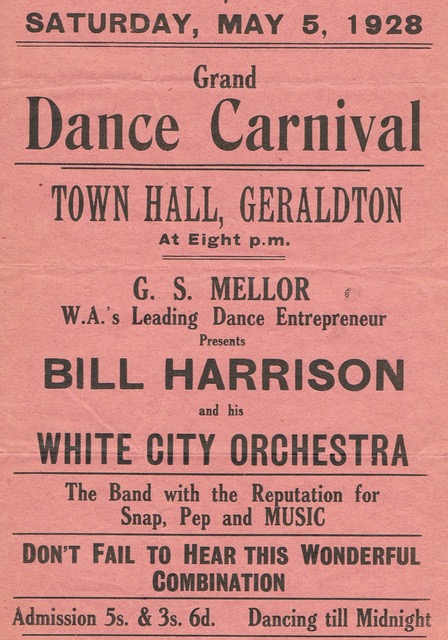
In May 1928 William Harrison’s “White City Orchestra” comprising of six instruments (Barney Barnard – drums, Bob Schenberg – violin, Billy Williams – trombone, George Mellor – trumpet, Vic Nicholls – saxophone, William Harrison – piano) played for a Grand Dance Carnival in the Town Hall at Geraldton. The poster advertising this event states “this band is noted for its snap, pep and good music, and has a state wide reputation, so that lovers of dancing should not fail to hear this wonderful combination.”
A CHAMPION MUSICIAN TO VISIT GERALDTONWITH WHITE CITY ORCHESTRA
Mr, Geo. Mellor, who will shortly be here as cornetist and manager with Bill Harrison’s Orchestra, is a man who has had many and varied experiences through life. Born in Newton, N.S.W., of a musical family, he commenced performing at the age ofeight. In those days band contests were very popular and little George was a yearly contestant at Sydney and Ballarat. He has won no less than thirty two medals, apart from prizes for cornet playing. Since coming to Perth he has been conductor of the Perth City Band and of later years the R.S.L. Band. During the war he was well known to Diggers as bandmaster of the popular 16th Batt. band. Since the war he has spent some years touring the world with the Australian Commonwealth Band, and has just, returned from America with that combination. George is recognised as the leading cornetist in the West.[1]
[1] The Geraldton Express Monday 23 April 1928 page 3
 TALENTED ARTISTS TO VISIT YORK
 In 1959, John married soprano Margot Robertson.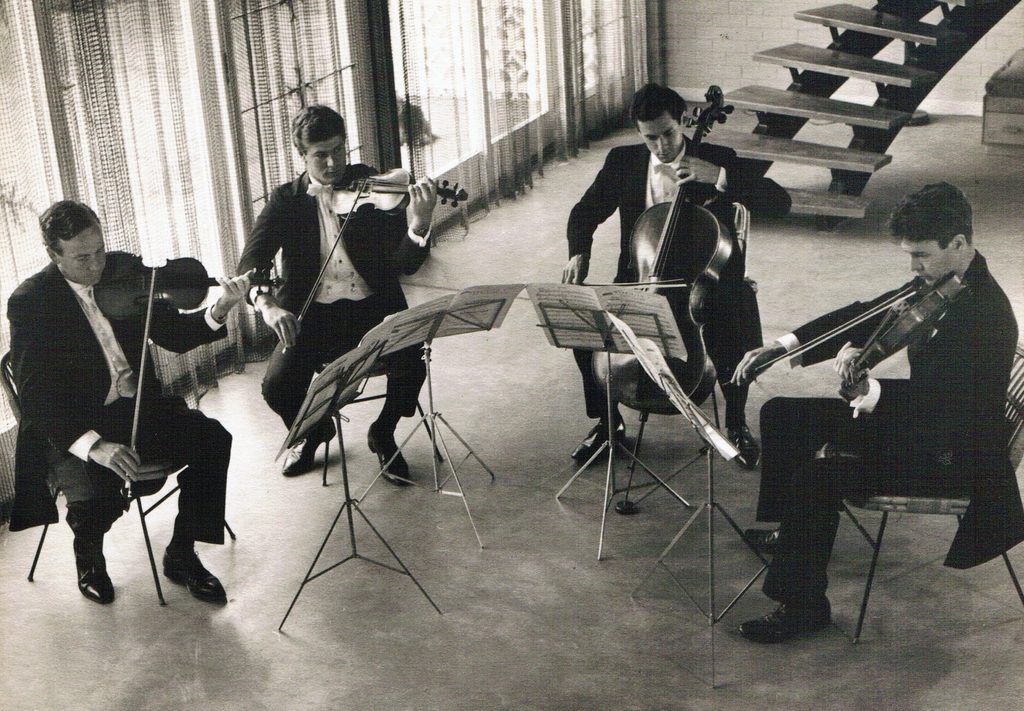
 1966
1966
 2024 OBITUARY