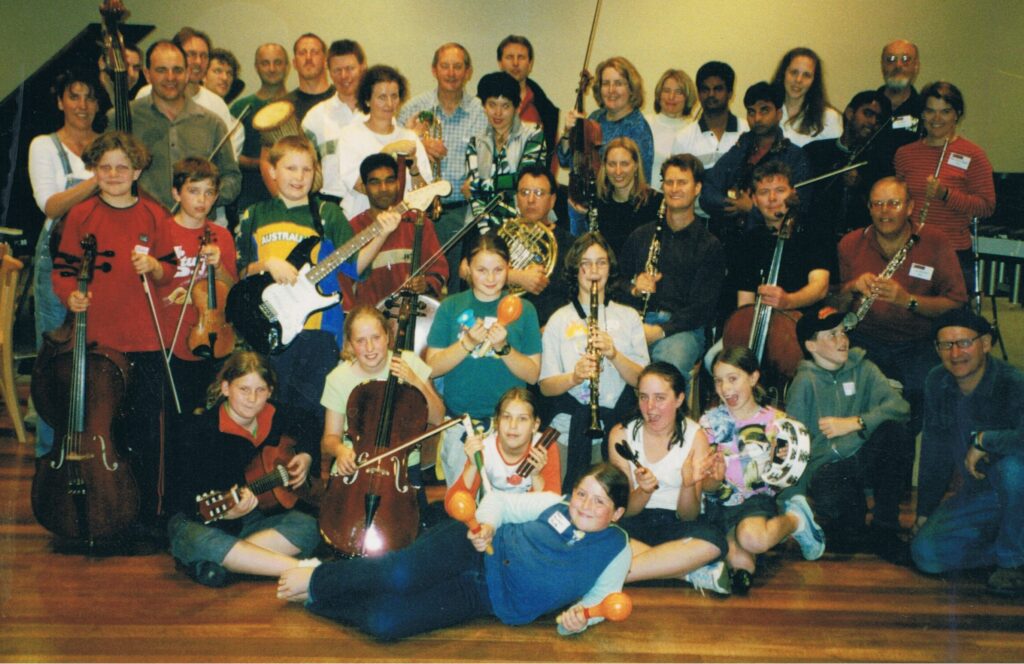
In September 2001 – a week before 9/11 – WASO’s EChO travelled to Sydney to participate in a week of education workshops with renowned educator and cellist, Matthew Barley.
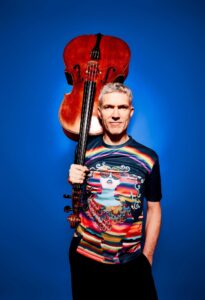 Matthew Barley – Biography
Cello playing is at the centre of Matthew Barley’s career, while his musical world has virtually no geographical, social or stylistic boundaries. His passions include improvisation, education, multi-genre music-making, electronics, and pioneering community programmes. Matthew is a world-renowned cellist who has performed in over 50 countries, including concertos with the BBC Philharmonic, Czech Philharmonic, Frankfurt Radio Symphony, Hong Kong Sinfonietta, Kremerata Baltica, London Sinfonietta, Melbourne Symphony, New Zealand Symphony, Royal Scottish National, Swedish Chamber, Vienna Radio Symphony orchestras and the Metropole Jazz Orchestra. With Viktoria Mullova he premiered and toured At Swim-Two- Birds, a double concerto by Pascal Dusapin, with the Leipzig Gewandhaus, London Philharmonic, Netherlands Radio Symphony, Orchestre National de France, RAI National Symphony and Seattle Symphony orchestras. Matthew’s collaborations include with Matthias Goerne, the Labèque sisters, Avi Avital, Manu Delago, Martin Fröst, Shai Wosner, Calefax, Thomas Larcher, Amjad Ali Khan, Julian Joseph, Nitin Sawhney and Jon Lord (of Deep Purple), appearing in venues ranging from Ronnie Scott’s and the WOMAD festivals to London’s Wigmore Hall, Amsterdam’s Concertgebouw, Vienna’s Konzerthaus, Sydney Opera House and Zürich’s Tonhalle. In the 2000s Matthew’s new music group, Between The Notes undertook over 60 creative community projects with young people and orchestral players around the world. Matthew has given premieres by Pascal Dusapin, Dai Fujikura, Detlev Glanert, Thomas Larcher, James MacMillan, Roxana Panufnik, and recently a concerto by Misha Mullov-Abbado with a cello part that is more than half improvised, at the London Jazz Festival for the BBC.Since 2003 he has recorded for Onyx and Black Box and is now a Signum Classics artist. His 2019 recording of Tavener’s The Protecting Veil with the Riga Sinfonietta was described by Gramophone as “A magnificent performance…Even if you have other recordings of The Protecting Veil, I recommend this utterly beautiful and originally framed version unreservedly.” His latest recording, Electric (“A sonic marvel”, The Strad) is an anthology of works for cello and electronics. The next project, Light Stories, is a new programme for cello, electronics and visuals from Yeast Culture with much of the music written by Matthew. A UK tour starts at the Southbank Centre in September 2024 along with the release of a new album. He is also launching a new charity to run workshops using creative music and theatre to help university students with their mental health.
www.matthewbarley.com
Memories of the Matthew Barley Sydney trip by Jody Harrison
In early September 2001, I managed a small ensemble from WASO (EChO) to participate in a week of music education activities held by the extraordinary cellist and educator, Matthew Barley. There was a choice of planes (Ansett – which collapsed the following week) and I arrived on the later one to be met at the airport by some animated players with the news “Allan Meyer (clarinettist) has been mugged and his clarinets have been stolen!”. For a manager, that’s a lot just there in one sentence.
When I arrived at the hotel Allan’s face was the shade of grey mud and he had gone into mild shock. He had visited his brother in the Blue Mountains, got a train to Sydney, looked up a map to see the quickest route to our hotel in Wooloomooloo and confidently strolled through a notoriously dodgy area. A gang of youths punched him, ripped his clarinet case off his shoulder (probably thinking it was a computer) and ran off. He was offered help by people who witnessed the event, but insisted he just go to the hotel.
He had informed the police and the WASO CEO had already organised for us to visit the Boosey and Hawkes factory the next day to borrow some clarinets so he could participate in the week’s events.
Allan and I took a taxi to Booseys first thing the next morning (as the others rehearsed), but it was the taxi driver’s first week driving in Sydney and he took the wrong freeway exit. I had lost my sense of humour by this stage and ripped the Melways street directory from the poor driver shouting (highly likely very dodgy) instructions to him about our destination. Finally there, the shattered Allan forlornly started to try some clarinets when his phone rang. It was Kings Cross Police asking him to come and see them.
Pretty soon afterwards he received a call from close friend Nigel Crocker, who had received a similar call from Kings Cross Police asking “do you know an Allan Meyer?” Not knowing quite how to respond, wondering if his usually mild mannered mate had committed a clarinet raged murder, replied he did and that is how the police had got Allan’s number. All the police would say was that they had found something belonging to Allan and would like to interview him.
Allan and I taxied to Kings Cross Police Station, which is like Fort Knox, requiring buzzers and interrogations just to enter. We sat in a small room filled with video surveillance gear, Allan wondering what was going to be shown to him and me wondering who else might have been interviewed in this room. Finally, some police officers brought Allan’s clarinet case in, explaining that his address book was in the pocket and the first Sydney number was “Crocker” – Nigel. Allan eagerly opened the case – the clarinets were there, but his mouthpieces (part of a clarinet player’s soul) were missing. The police told Allan the case had been found not far from where he had been mugged. They had been noticed and picked up by a street sweeper in the very early hours, who had kindly realised the case was something important and brought it in.
By this time Nigel had arrived, so we three enthusiastically embarked on the quest to find the missing mouthpieces armed with a description of where the case had been found. We immediately realised we were being watched as we poked around the street and gutters – even the rubbish bins (which contained syringes amongst other things) and realised that the huge south sloping water drains in Sydney might have swallowed the precious mouthpieces.
We came across a pile of paperwork, some camera cases and credit cards dumped in a bush – I took a couple of the cards. We then found a poor homeless man asleep in a gutter and decided we would at least go to Wooloomooloo Police Station to hand in the credit cards. It was also like Fort Knox. We were just handing the credit cards in when a man frantically burst thought the police station doors saying his car had been burgled and his cameras, wallet and files had been stolen! We left the police to assist him in recovering his belongings – he was actually more interested in getting the paper work back as everything else could be replaced.
Allan took Nigel and I out to lunch to thank us.