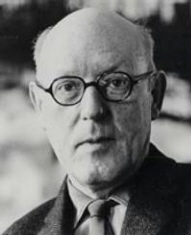
21.10.1908 – 31.10.1999
| The Irish pianist, musicologist, and composer, Howard Ferguson, was heard at the age of 13 performing in a music competition by the pianist Harold Samuel, who persuaded Ferguson’s understanding parents to let him come to London to study with him. Two years later Ferguson entered the Royal College of Music, studying composition first with the legendary pedagogue R.O. Morris and then with Ralph Vaughan Williams, and conducting with Malcolm Sargent; he also continued to study privately with Harold Samuel. It was through Morris that he met another composition student, Gerald Finzi, and they remained close friends, discussing each other’s music in depth; their correspondence is currently being edited for publication. Howard Ferguson was always a distinguished chamber musician and he first came to widespread attention through the publication of his First Violin Sonata (1931) and his Octet (1933), generally regarded as his most masterly work. The Octet was initially drafted as a quintet for clarinet and strings, but the canny Morris, observing that there was no companion piece to share the scoring of the Schubert Octet, suggested that Ferguson recast it accordingly. Through Harold Samuel, Ferguson had met Myra Hess, and at the outbreak of World War II he was enlisted by her to help run the series of concerts at the National Gallery which did so much to maintain wartime morale in London. The importance of the concerts was officially recognised when Ferguson was released from service with the RAF Central Band to continue his work with the Lunchtime Concerts. With the War over, Ferguson took up his concertising career again, maintaining two long-lived duos with musicians he had met through those National Gallery concerts, the violinist Yfrah Neaman and the pianist Denis Matthews. From 1948 until 1963 he also taught at the Royal Academy of Music, where Susan Bradshaw, Richard Rodney Bennett and Cornelius Cardew were among his students. In the meantime he was still composing, including a Second Violin Sonata in 1946, a Piano Concerto in 1950-1951 and a song-cycle, Discovery, that was later recorded by Kathleen Ferrier. Howard Ferguson closed his career in composition with two large-scale choral works, both written for the Three Choirs Festival: Amore langeo for tenor, chorus and orchestra (1955-1956) and The Dream of the Rood for soprano or tenor, chorus and orchestra (1958-1959). Howard Ferguson was unusual among composers in that he voluntarily called a halt to his composing career when barely past his 50th birthday; his musical energies thereafter were deployed in a number of parallel enthusiasms, not least musicology. His activities as a musicologist now filled the gap left by composition, and he produced a number of authoritative editions of early keyboard music; his musicological efforts were crowned in 1978-1979 with a complete edition of the Schubert piano sonatas. Howard Ferguson is published by Boosey & Hawkes. https://www.bach-cantatas.com/Lib/Ferguson-Howard.htm https://www.boosey.com/composer/Howard+Ferguson |
MUSIC
By Peter Hellstrom
Festival of Perth 1966
The Master of Queens Musick, Sir Arthur Bliss, has told the Festival Of Perth committee that the planning of the musical programs in the coming festival is a magnificent gesture to British music and should be more widely known. That it has become well known already in Britain is showing by letters from many leading authorities there they include congratulations from the executive of the Composers Guild of Great Britain. Though some prominent English music festivals like Cheltenham Aldeburgh and the longest established Three Choirs Festival feature their country music, no British festival has in recent times included such an extensive and exciting range of British music in one series. Works of nearly 70 composers are included. The Perth programs have been wisely spaced over the six week festival period and though many of the concerts will start at the customary 8 pm some will be at 6 pm to enable patrons to attend another festival attraction the same evening.
Works by Vaughan Williams Gordon Jacob, Howard Ferguson, Lennox Berkeley and Michael Tippett will be new to W.A. The London Symphony Orchestra conducted by Colin Davis will introduce Bliss’s “Discourse for Orchestra” to Australia in one of its Perth concerts. In the other, Tippitt’s Symphony No. 2 and Stravinsksy’s Symphony in Three movements will be played here for the first time. Leading W.A. musicians appearing as soloists in the festival will include soprano Molly McGurk who will sing Benjamin Britain’s song cycle Les Illuminations with the W.A. Symphony Orchestra. She will also sing the solo soprano part in the University Choral Society’s performance of Vaughan Williams A Sea Symphony. Stephen Dorman will be the accompanist for tenor David Galliver’s three British song recitals. He will also partner violinist Vaughan Hanley in a Sonata recital and will play the solo part in constant Lambert’s Concerto for Orchestra and Nine Instruments. Jack Harrison will be the soloist in David Tunley’s Clarinet Concerto and will be joined by the Oriole Quartet in Bliss Clarinet Quintet. Graham Wood will introduce James Penberthy’s Romance for Violin and Orchestra and Alice Carrard will be the pianist with the A.B.C. Wind Players in Rawsthorne’s recent quintet. Madame Carrard will be joined by Mr Dornan, Stephanie James and Michael Cole to perform Malcolm Williamson’s new Concerto for Wind Quintet and two pianos. The new university organist, Mr John Hind, will be soloist in a program which will feature the W.A. Bach Society. The Oriel Quartet will also be the soloists with the W.A. Symphony Orchestra in Elgar’s Introduction and Allegro for strings and will give a separate recital of works by Howells, Frank Bridge, John Exton (the newly appointed senior lecturer in music at the university) Gerald Finzi, Elizabeth Lutyens and Edmund Rubbra. [1]
FOURTEENTH ANNUAL FESTIVAL OF PERTH 1966
THE ABC PRESENTS
(in association with Festival of Perth Committee) Opening Concerts of
MUSIC OF BRITAIN SERIES
A 15-concert feast of music from the great heritage of British compositions and including many new works.
Tuesday Feb 8 1966
A.B.C. Festival Orchestra
Conductor: Vaughan Hanly
Soloist: Jack Harrison (clarinet)
Programme:
Symphony No. 4 (Boyce)
Little Symphony (Jacob)
Concerto for Clarinet and Strings – first performance (Tunley)
Serenade (Ferguson)
B Flat Divertimento (Berkeley)
WINTHROP HALL
Reserve Prices 11/-, 8/6, Unreserved from 5/ at hall after 7pm
| 27.7.1968 | Howard Ferguson Octet Op. 4 for clarinet, bassoon, horn, string quartet and double-bass (1933) AUSTRALIAN PREMIERE | Jack Harrison (clarinet) Jill Mowson (bassoon) John Mowson (bass) Patrick Brislan (horn) Oriel String Quartet | ABC Broadcast Basil Kirke Studio A.B.C. Adelaide Terrace, Perth, Western Australia |
FEW HEAR FINE RECITAL
By Sally Trethowan
Sunday February 29 1968
Fewer than 30 people attended yesterday’s free Sunday afternoon recital in the Basil Kirke Memorial Studio to hear what must have been one of the finest given this year by Perth artists. The oboe playing of Peter Randall in Mozart’s Quartet for oboe and strings was so good that an unchartered listener might’ve thought it was a simple piece. Mr. Randall gave such purity and accuracy to the naturally sharp clear tone of the oboe as to make even the accompanying strings in this piece seem cloudy in effect. It was duly wistful in the doleful minor keyed slow movement and cheerful in the finale where the virtuosic double-tongued passages were given within incisiveness, clarity and extreme rapidity. Violinist Graham Wood led seven other instrumentalists Stanislaw Kowarski (violin) John Dean (Viola) Brian Meddemmen (cello) John Mowson (bass) Patrick Brislan (Horn) Jack Harrison (clarinet) and Jill Harrison(bassoon) in the four movement Octet for Wind and Strings by the modern English composer Howard Ferguson. Mr. Ferguson seems to have a particular affection for clarinet and horn, and the success of the performance to some extent pivoted on Patrick Brislan’s horn playing which allowed no imperfection of tone to mar its richness. The program ended with a reduced version of Richard Strauss’s tone poem “Till Eulenspiegel’s Merry Pranks”. Originally scored for an orchestra of Wagnerian proportions of over 100 players, it was here rendered by five. Though without the percussion and heavy brass that in the full score are so graphic in describing the grotesque adventures of the mediaeval vagabond Till, it was a happy even witty performance. The final concert in the free Sunday afternoon series will be given in a fortnight.
[1] The West Australian September 1965