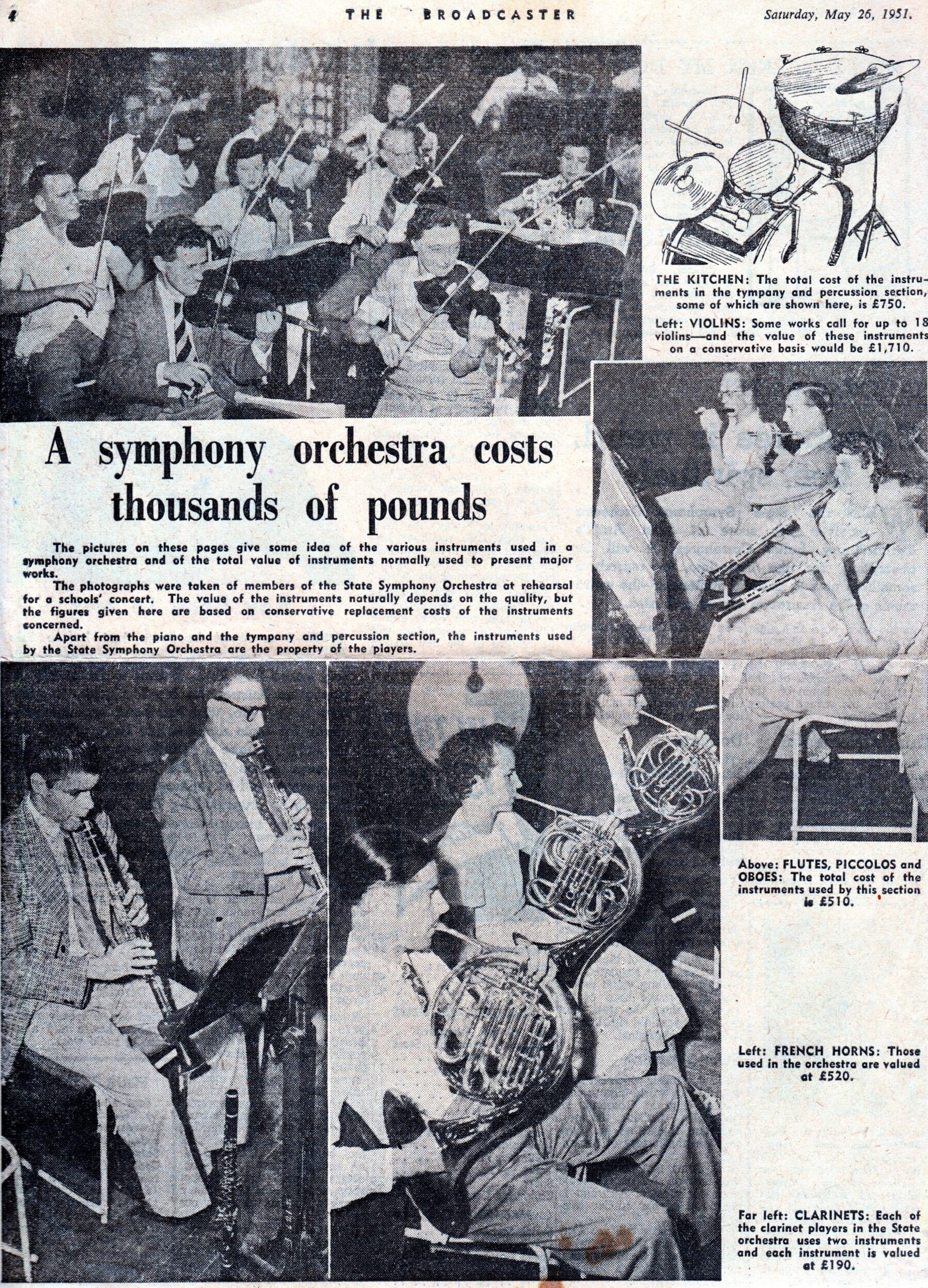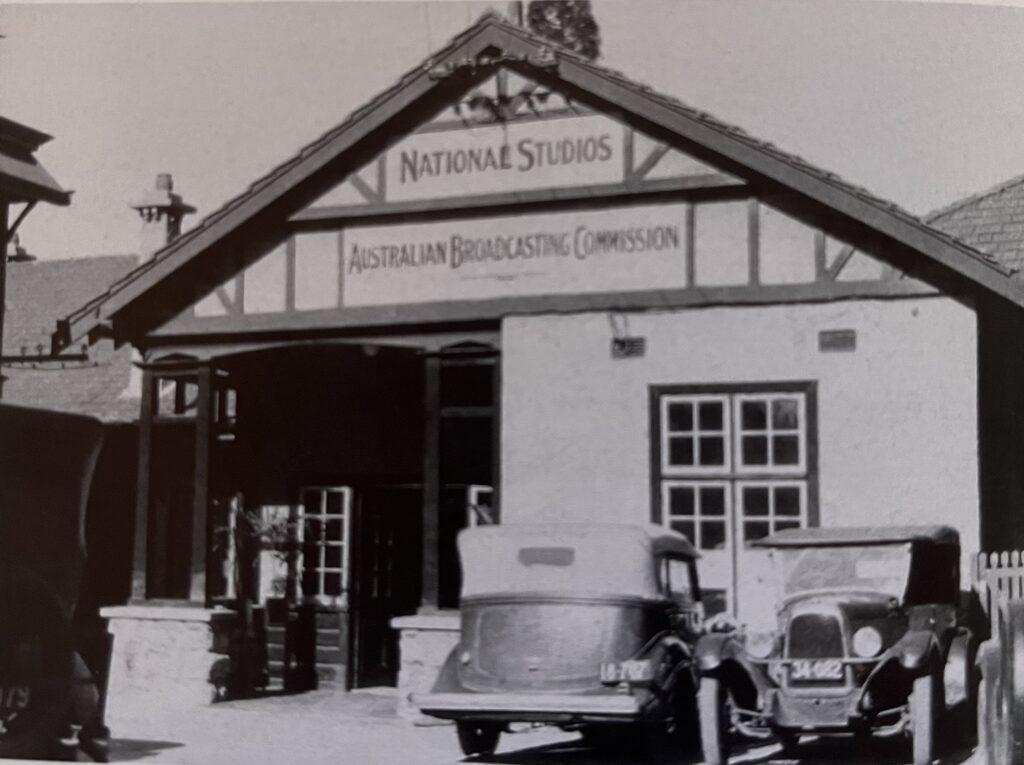
In 1937, the Perth Symphony Orchestra had settled into their new home in Broadcast House, to which the ABC had moved in late 1936.
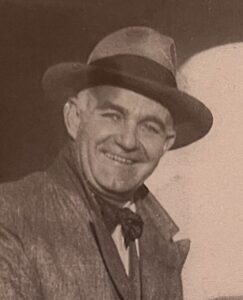
This move was largely due to the efforts of Basil Kirke, who had a reputation as an energetic and lively state manager.
The new studios were officially opened in June 1937 by W.J. Cleary, Chairman of the A.B.C. He advised his listeners that the A.B.C.’s expenditure in 1936 in Western Australia had been %10 more than the revenue received from. licences, due to the costs of the building renovation program.
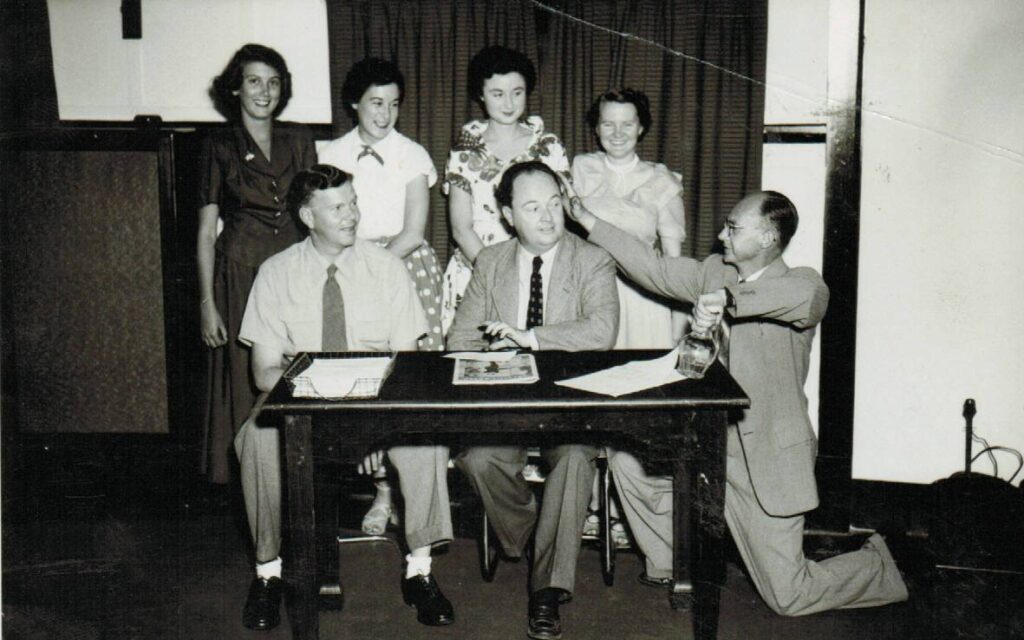
Broadcast House, with all its deficiencies, was vastly superior to the previous premises of the ABC on the corner of Milligan and Hay Streets. It was a pre-fabricated affair situated in St George’s Terrace next to the Supreme Court Gardens – a building exuding mystery and atmosphere. In a less tolerant era, the health authorities would have condemned this rabbit warren.
The central typing room was completely devoid of outside windows, being surrounded by a variety of departments – youth education, sound effects, booths for auditioning records and the dreaded accounts department, complete with a peep-hole window to enable the “Chief of Staff”, Hugh Griffiths, to keep a jaundiced eye on the collection of girls employed to keep the various departments running smoothly. In winter, a fire was lit to warm the room.
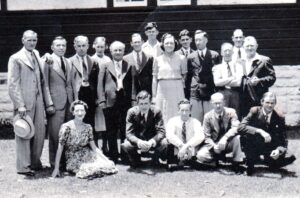
On the other side of the large typing room, a further passage led to Studio One – the rehearsing and broadcasting home of the Perth Symphony Orchestra, whose male members were required to wear a suit and tie even to rehearsals.
Broadcasts were ‘live’ because the acetate discs used for recordings could not accommodate a performance of any great length. They were therefore often punctuated by the noise of Moreton Bay fig tree “nuts” bouncing off the roof, or in winter, an exploding fire which was the only means of keeping the players warm. Herbert Claudius trundled the firewood from room to room by means of a small wooden barrow made especially for this purpose. Claud, as he was called, became so familiar with the orchestral placements that his job expanded to include setting up the stands and chairs both in Perth and on tour.
When Basil Kirke returned to Perth as A.B.C. Manager in 1953 he was shocked to see the intolerable conditions under which the staff worked. There was one occasion where he took important politicians over the old studios. John O’Connor reported that “it was summer when they came and Basil arranged for one of our hot studios to be used for their meetings. They stuck it for one morning and demanded a better place…And so we got our new building and air-conditioning as well”.
Harrison, Marcia, West Australian Symphony Orchestra Celebrating 75 Years, (WASO Holdings Pty Ltd, 2003), p14, 43.
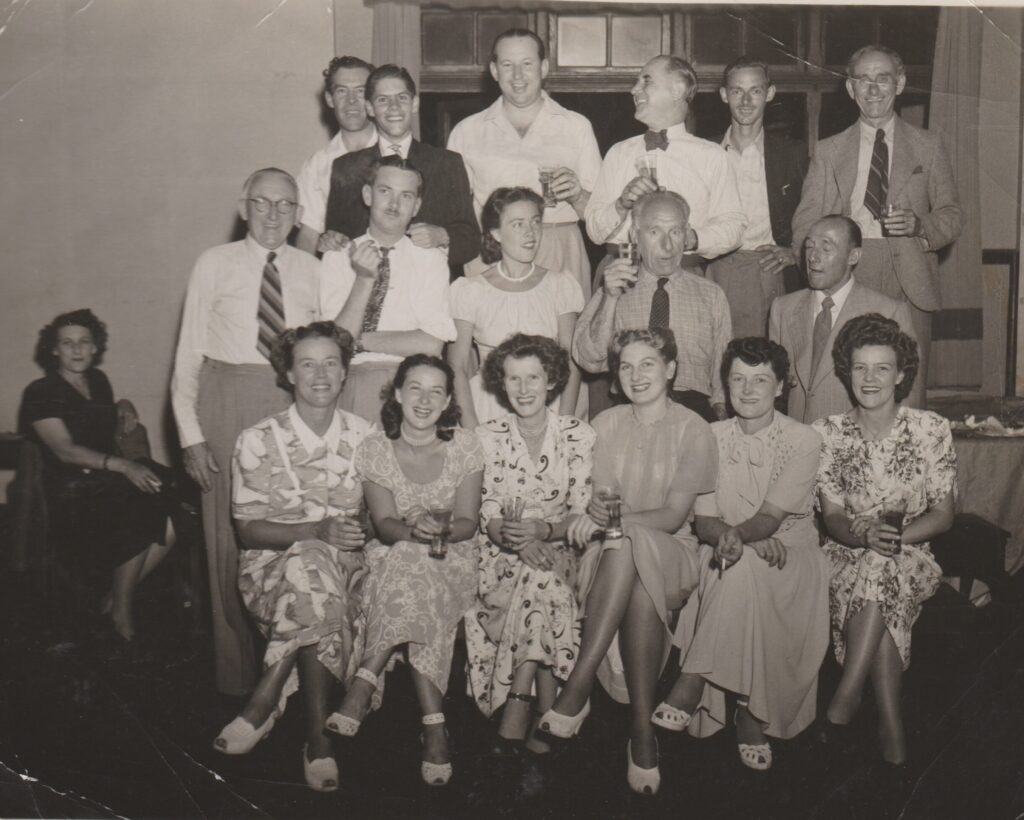
Radio broadcasting in Western Australia began with 6WF on Wednesday 4 June 1924, from a studio in the Westralian Farmers building in Perth.
The owner Westralian Farmers Ltd started the station with the purpose of providing “information and entertainment to rural areas”. The radio station began operating from the top floor of the company’s Wellington Street building. The original broadcast footprint covered most of the state of Western Australia. In 1929 the radio station was sold to the Australian Broadcasting Company. The Australian Broadcasting Company (1929-1932) period coincided with The Great Depression, a severe worldwide economic downturn, which started in 1930 and continued until the industrial effort for World War II lifted the economy out of the doldrums.
In 1930, the 6WF operation moved from the Wesfarmers building to the first floor of the English, Scottish and Australian Bank (E.S. & A.) building at the corner of Hay and Milligan Street, Perth. Under WA manager Basil Kirke’s direction, 6WF extended its programs and introduce new features. The value of this was shown by the rapid increase in licences, so that after three years, the company had increased the licences from 3,900 to 12,500. The Australian Broadcasting Company was nationalised by the Commonwealth Government, following a Royal Commission in 1927. The Australian Broadcasting Commission was founded in 1932, and 6WF became part of the national network.
The ABC studios and 6WF moved in 1937 to The Returned Soldiers’ Institute, also known as the Stirling Institute on St George’s Terrace, behind the Department of Agriculture and located in what was once the State’s only botanical gardens, Stirling Gardens, west of the Government House Ballroom and north of the Supreme Court buildings. The building was erected 21 years earlier and became the headquarters of the WA Branch of the Returned Sailors and Soldiers Imperial League of Australia (RSL) in 1918.
The RSL moved to the original ANZAC House at 28 St George’s Terrace in 1934. The ABC then leased the institute building from the State Government and renamed it Broadcast House, though as early as 1938, the Perth City Council had its eyes on the site for a new Town Hall.
The ABC in Perth managed for many years with substandard accommodation until purpose built facilities were constructed for both radio and for the introduction of public owned television in Western Australia in 1960.
After the ABC had moved to its new studios in Adelaide Terrace, construction on Council House began on the Stirling Gardens site in 1961. Rather than build a new town hall on the site, the Perth Concert Hall was built to the east of Government House Gardens, and opened in 1973.
The then ABC Perth studio complex in Adelaide Terrace was built in 1958, on the former site of Rose Hill House, at 191 Adelaide Terrace. ABC radio moved to the new facilities in 1959, whilst work continued on the television building on the lower part of the site, facing Terrace Road.
On Saturday May 7, 1960, ABW Channel 2 in Perth opened.
Hence the old Broadcast House site had served many uses over the years, firstly as public offices, post office, the Legislative Council and then Agriculture Department buildings, which stood in front of the former Soldiers’ Institute building, that later became the ABC’s Broadcast House, until they moved to Adelaide Terrace, and the launch of ABW Channel 2 in 1960.
The buildings on the Stirling Gardens site were demolished in 1961, to make way for the present Council House.
Much of the credit for the ABC building in Adelaide Terrace goes to Basil Kirke, who returned to Western Australia as manager in 1952 and lobbied tirelessly for new offices and studios. He fell seriously ill in 1957 and died in 1958, before the move to the new premises took place. In 1961 the large orchestral studio 620 was named in his honour.