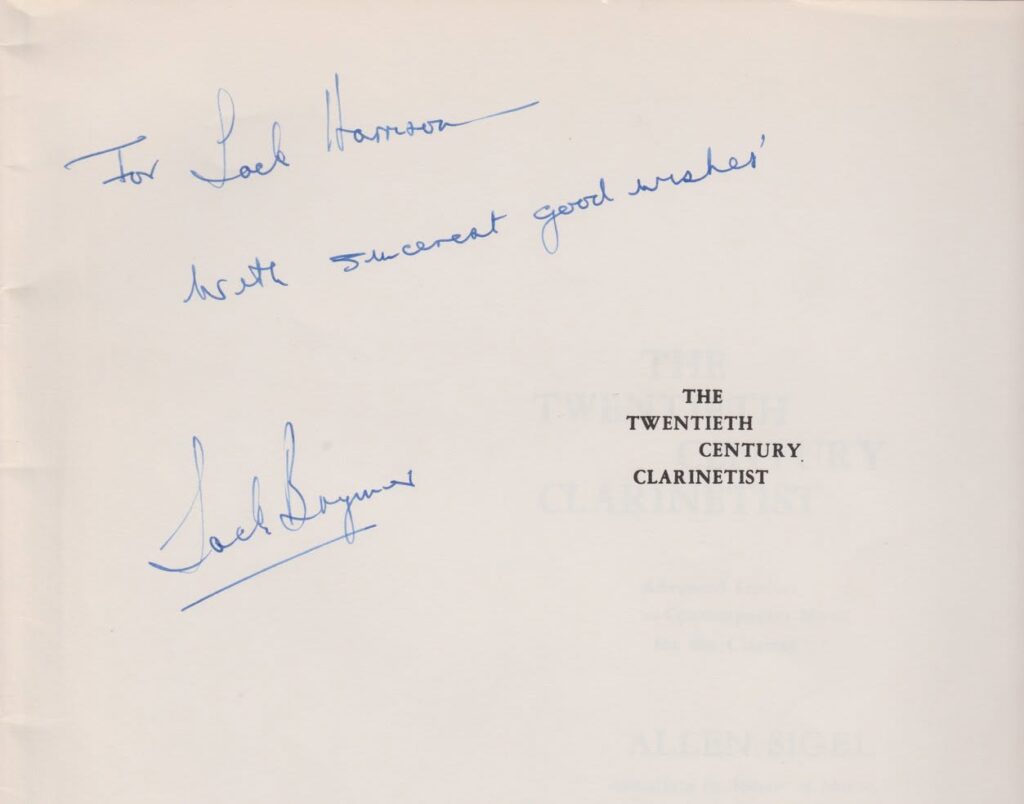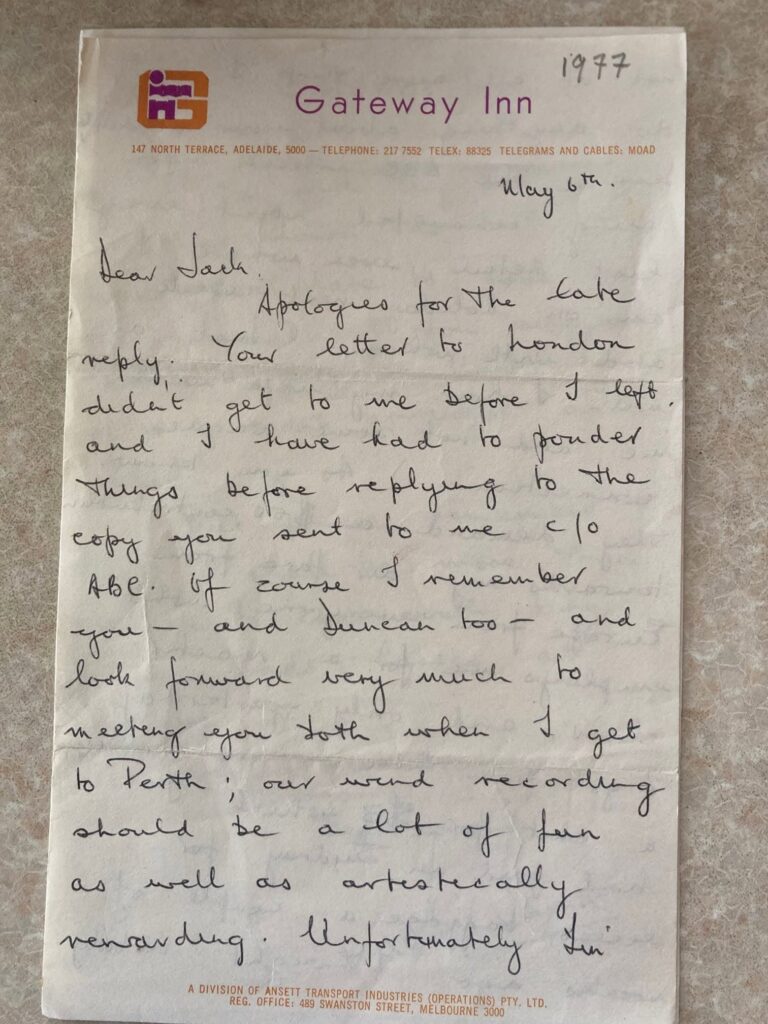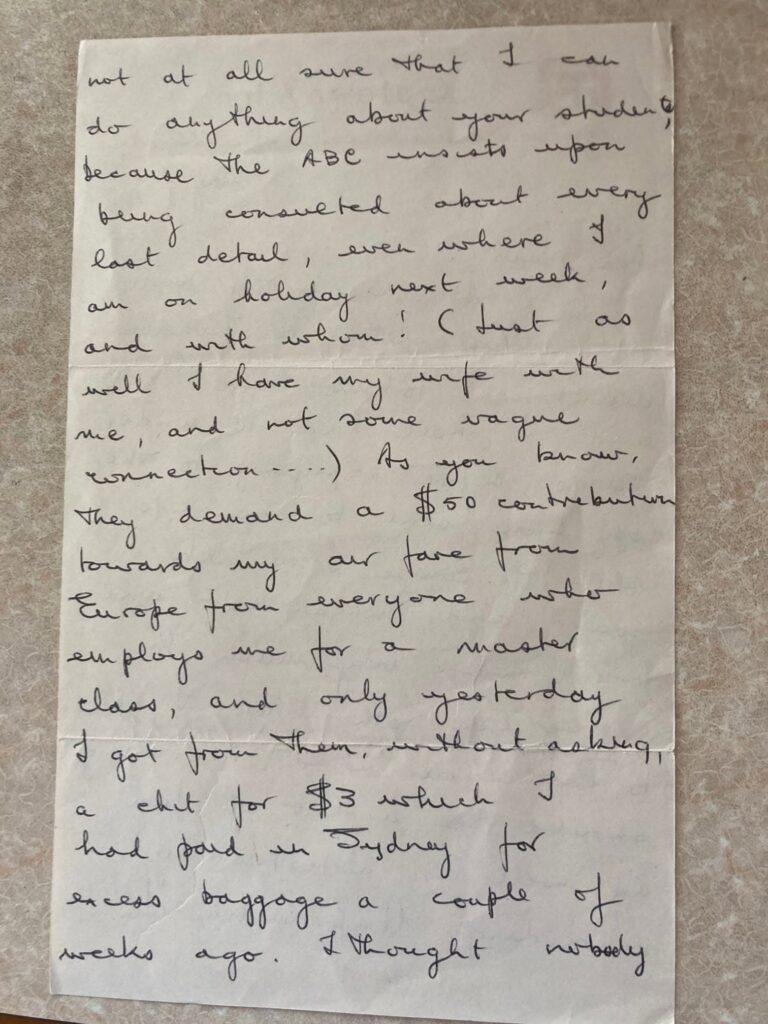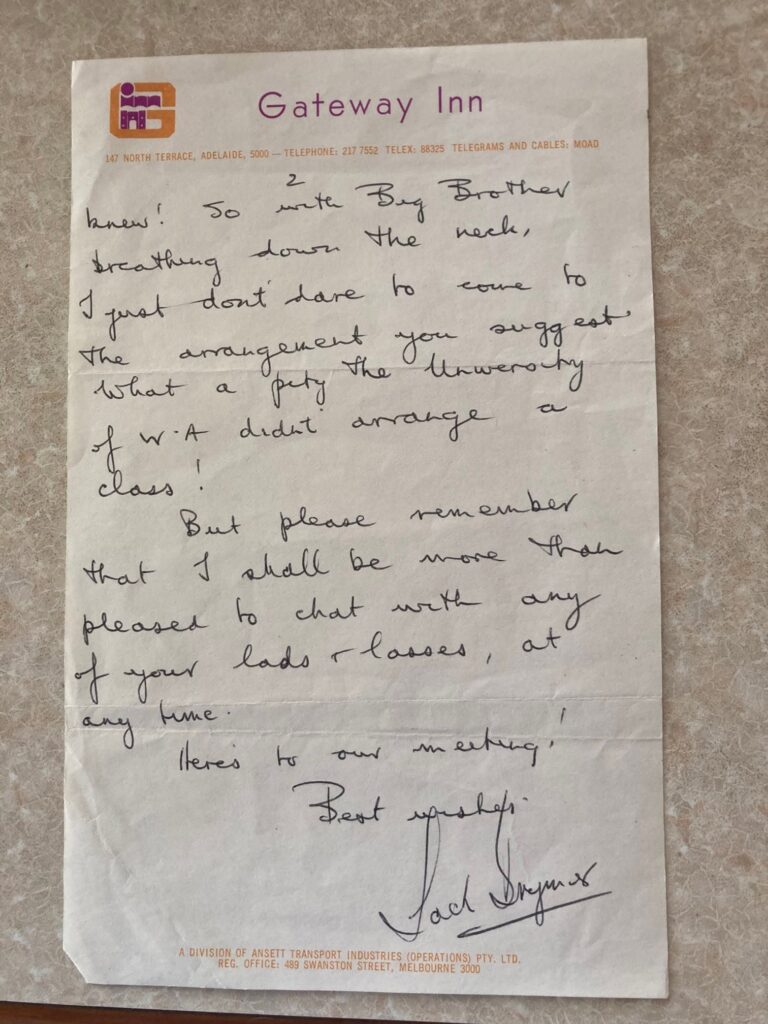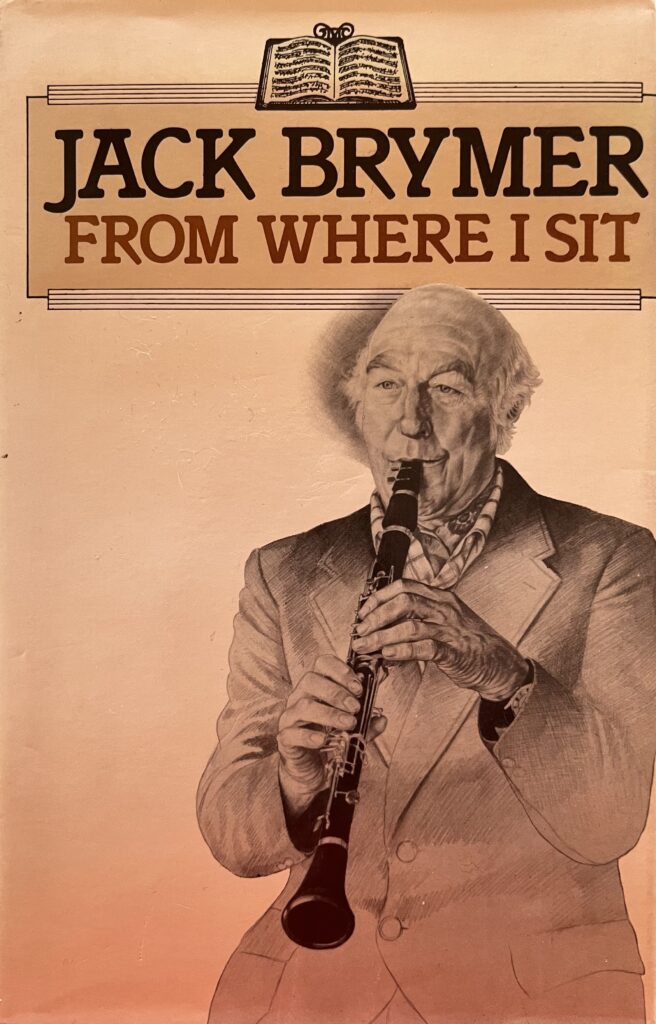
Sir Jack Brymer OBE, the doyen of 20th century British clarinettists, whom The Times dubbed “the leading clarinettist of his generation, perhaps of the century,” had a less than perfect clarinet when he started playing aged five!
Self-taught and a school teacher in Croydon initially, Brymer struggled for 13 years, with a sharp-pitch A clarinet, with a bit sawn off in the school woodwork room! Later as a professional orchestral musician, he’d claim the struggle was worth it. He could solve almost every problem he encountered.
Eventually when he’d saved enough, Brymer bought his first pair of Boosey & Hawkes 1010s for £19 in exchange for his old battered instruments, plus £2 extracted from the gas meter. They were the same instruments he played when he was chosen by Sir Thomas Beecham to join the new Royal Philharmonic Orchestra, which the maestro had founded just after the war.
Throughout his glory years with the RPO, the BBC Symphony Orchestra and London Symphony Orchestra, Brymer always found time to pursue all the musical genres he’d dabbled in as an amateur. He loved jazz and played the saxophone to an equally high level with professional jazz musicians in both the UK and USA.
He played in brass bands, with circus bands and appears on a couple of Beatles tracks. Later he’d declare: “There is not a single one of these [experiences] which has not been of great value to me professionally.”
Brymer also played in a number of important chamber ensembles, founding and directing the Wigmore Ensemble, the Prometheus Ensemble and the London Baroque Ensemble.
In addition to his many commercial recordings, he was recorded and broadcast countless times by the BBC where his fame also spread as a mellifluously voiced radio presenter. His program At Home was particularly popular with his listeners.
The trademark Brymer sound – lyrical and velvety – was in part “inspired by the oboist Leon Goossens.” He was 13 when he heard him play the oboe solo in Ravel’s Habanera on the BBC. “In that special moment I became aware of the sounds of the Spanish night, of warmth and mystery,” he recalled. From then on he sought out every opportunity to hear wind players, and to learn from their sound. For generations of music lovers Brymer personified the clarinet: elegant, mellifluous and effortless.
“They would have been astounded at the things they taught me, without a penny piece changing hands.”
John Alexander Brymer was born 27 January 1915, on the same day as Mozart, whose music he adored.
He was born in the north-east of England, “in South Shields, Tyneside, near the sea. My father was a builder and played the clarinet which he left on the mantelpiece. I was curious, picked it up and began to play. There wasn’t a lot of music at home, though we did play around the piano as everyone did then.”
By the age of 11, Jack was playing solos with the local military band and in amateur orchestras with musicians who were often a lot older than him. His first experience of ensemble playing was “in a tiny darkened room in a tram depot, sitting on a bench with about six other clarinet-blowing members of the DLI First Cadet Battalion Military band.”
Though he had no formal music tuition, Brymer always said no-one was entirely self-taught. “I learnt from everyone I heard play. Frederick Thurston and Reginald Kell unwittingly betrayed their methods to me, but I also decided that I wanted to play in certain ways that they had never done. They would have been astounded at the things they taught me, without a penny piece changing hands.”
“I used to leave the sax under the porch in the garden and climb through the window.”
At school Brymer excelled at rugby. There was little music in the curriculum, but as he put it “we were more interested in scholarships and football in that order. My ambition was to be a musician but at that time in the late 20s, talking films appeared and unemployment amongst musicians was very serious so it would have been silly to be one. So I decided to be a school teacher of physical training as this was also an interest and I could get to a London college to study it, so that’s what I did.”
In London training to be a teacher at Goldsmiths College, London University, Brymer met his future wife, the violist Joan Richardson. They played in various ensembles and married in 1939 when they were both 24 and had one son, Tim.
“Luckily there were people interested in orchestral music at college and that was my first taste of a really large symphony orchestra.”
Brymer wasn’t allowed to play jazz at college, but “I did actually sneak out of my hostel on a few occasions down to a local roadhouse with my illicit saxophone. These were very un-permissive days and we were expected to be indoors by about 10.45 instead of 1.15. I used to leave the sax under the porch in the garden and climb through the window.”
After graduation, Brymer joined the teaching staff of Heath Clark School, Croydon, the same town where his fiancée was living, teaching “physical training, English and music, in that order.”
Brymer impressed the all-girl classes with his sporting gifts and for his ability to make music live on an “appalling school piano,” in the music appreciation classes he led. Brymer was also a very competent pianist.
“I clambered down from the roof where I’d been spreading a little pitch after the bombing and a voice said: ‘This is Thomas Beecham. I believe you play the clarinet.’”
During the war years, Brymer joined the RAF and was posted to Morecambe on the north-west coast of England as a PE instructor.
His musical life continued there, playing in the Morecambe Central Pier dance band, dressed in his corporal’s uniform. One of the new friends he made there was the horn player Dennis Brain. A friendship that proved very serendipitous.
After the war, Brain suggested to Sir Thomas Beecham, who’d just founded his Royal Philharmonic Orchestra, that he might have just found the right man for the empty clarinet first chair in the orchestra.
Brymer said he got the shock of his life when the phone rang at home one day. “I clambered down from the roof where I’d been spreading a little pitch after the bombing and a voice said: ‘This is Thomas Beecham I believe you play the clarinet.’”
At first he thought it was a practical joke – someone imitating Beecham’s familiar lordly drawl – but it was the maestro and Brymer found himself playing one of Brahms’ clarinet sonatas at the conductor’s London home, while Beecham, suffering from gout in his fingers, attempted to play the piano accompaniment with bandaged hands.
“I joined in 1948 and Beecham died in ‘61, but I stayed on. He was not unpredictable but you had to be pretty wide awake because he was so wide awake. He wouldn’t ever let you know how a work was going to be performed until the actual concert. The rehearsal was to some extent just a familiarisation. He would then almost sculpt the work in front of your eyes in the concert. It was the most remarkable thing.”
His first concert was a broadcast of Berlioz’s epic opera The Trojans. Brymer was the envy of many of his colleagues. He never suffered from nerves and seemed never to have to practise much.
Another memorable occasion was the Strauss Festival, when the great German composer appeared alongside Sir Thomas conducting some of his music with the RPO. No one knew it was the last year of his life. Brymer recalled “an old man in a raincoat leaning over my shoulder advising me of how to play the delicate clarinet solo which comes immediately after Don Quixote has died. It was a wonderful baptism of fire to be in the presence of someone who was already a legend.”
“I played with nearly all of the great post-war conductors; the one I missed was Toscanini.”
Brymer remained with the RPO for 16 years, then in the mid-60s he joined the BBC Symphony Orchestra as co-principal clarinet. He and a number of players in the RPO were unhappy with the new management after Beecham’s death.
He stayed with the BBCSO from 1963 to 1971, but when Pierre Boulez arrived and wanted “a more avant-garde, harsher, more cutting sound,” he moved on to the LSO. “The BBCSO didn’t really suit me. There was so much avant-garde music and rehearsing it was quite painful.”
With the LSO, he particularly enjoyed the summer residencies in Glyndebourne, playing for the opera, taking his family there for the season. During his tenure which endured to 1986 he served under many great conductors like André Previn and Claudio Abbado. “I played with nearly all of the great post-war conductors; the one I missed was Toscanini.”
In his spare time, Brymer was something of an ambassador, touring to every European country, the former Soviet Union and the USA. He also travelled up and down the UK and entertained on cruises, demonstrating his clarinet’s possibilities and his extraordinary versatility. He’d play classics from baroque to 20th century works, and trad jazz.
His last public concert was on 18 July, 1997, at Wigmore Hall in London. He played the Mozart Clarinet Quintet with the Gabrieli Quartet, telling the audience the work and Mozart’s music more generally had held a special importance for him.
Sir Jack Brymer who was appointed OBE in 1960, died on 16 September, 2003. His ashes were interred in the churchyard of St Peter’s Church, Limpsfield in Surrey, close to the grave of Sir Thomas Beecham.
Brymer did it all and always with a great sense of humour. He once described himself as “soloist, chamber music player, broadcaster, quizzer, lecturer, disc jockey, jazz fan, saxophone quartet leader, transport organiser and map reader, agent, accountant and tax-gatherer for HM government!”
https://www.abc.net.au/listen/programs/legends/clarinettist-jack-brymer/104811110
https://en.wikipedia.org/wiki/Jack_Brymer