World War I was a global conflict centred in Europe that pitted the Allied Powers against the Central Powers.
World War I went from July 28th 1914 until November 11th 1918 (Armistice Day).
The trigger for this war was the assassination of Archduke Franz Ferdinand of Austria-Hungary by Gavrilo Princip on June 28th 1914.
Allied Powers: Great Britain, France, Russia (until 1917), Italy, Japan, and the United States (from 1917)
Central Powers: Germany, Austria-Hungary, the Ottoman Empire, and Bulgaria
There was an estimated 15 to 22 million military and civilian deaths.
It involved Trench Warfare with prolonged stalemates along the Western Front fought from muddy, fortified ditch networks.
New military technology meant widespread use of machine guns, poison gas, tanks, military aircraft, and submarines (U-boats).
The aftermath was the collapse of four major dynasties (German, Austro-Hungarian, Russian, and Ottoman) and the signing of the Treaty of Versailles in 1919.
Western Australia, as part of the Commonwealth of Australia, was officially committed to World War I on August 4, 1914.
When Britain declared war on Germany at 11 p.m. on 4 August 1914 (London time), all dominions of the British Empire, including Australia, were automatically at war. The official enlistment age for the Australian Imperial Force (AIF) was generally 18 to 45 years. While volunteers could join at 18 with parental consent, the standard minimum age was often 21, and some younger men falsified their age to fight. Initial 1914 requirements were stricter, but upper age limits were raised to 45 by 1915.
A total of 32,231 individuals from Western Australia enlisted, representing 37.5% of males aged 18 to 44.
Nearly 6500 West Australians were killed as a result of their service in World War I, accounting for roughly 20 percent of those from the state who enlisted. This number does not include those who died after returning from the war.
Many soldiers stayed on after Armistice Day to assist with clean up and demobilisation – the massive global process of returning millions of soldiers to civilian life, dismantling wartime economies, and shifting nations back to peacetime conditions.
By 1916, the pressure on the men of Subiaco to enlist was immense, with twice as many West Australians in favour of conscription as were against it as reflected in the 1916 and 1917 referendums. Those who did not enlist were often harassed by the families of those who did with white feathers deposited in letter boxes to indicate cowardice. At recruitment drives, they would sing “We Don’t Want to Lose You, but We Think You Ought to Go” and there was an unwritten consensus that at least one member of a family should enlist. It is estimated that ten percent of Subiaco’s entire population enlisted and therefore absent from the district throughout the war years.
Spillman, Ken, Identity Prized: A History of Subiaco, (University of Western Australia Press for the City of Subiaco, 1985). p. 203
Many Senior Cadets or those turning 18 began enlisting.
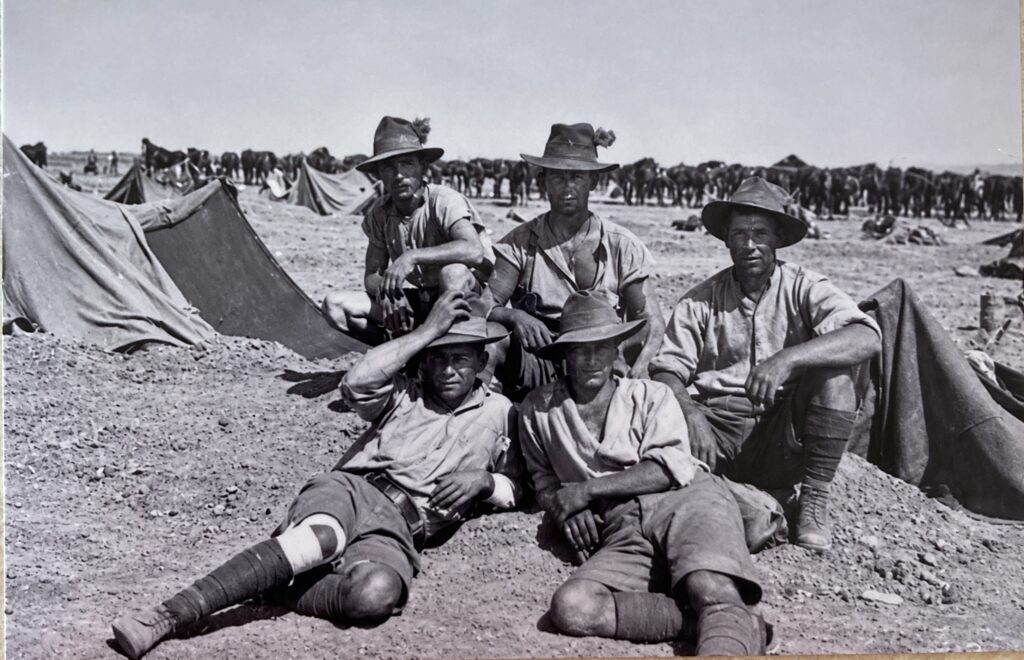
Soldiers in WWI