Person

GILLAM, Bruce

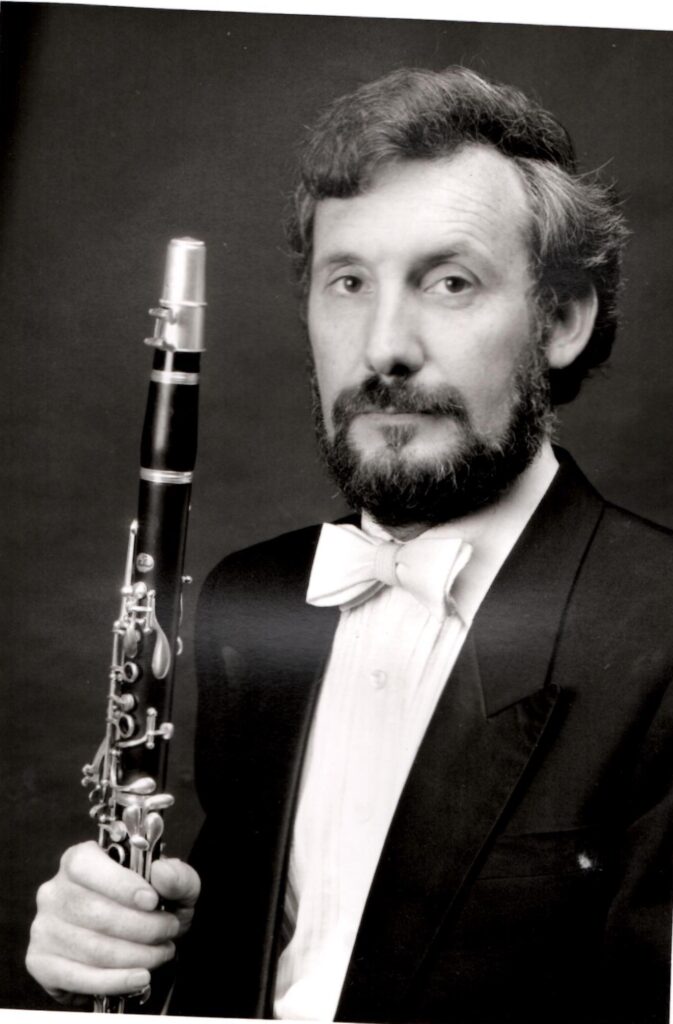
Born in Perth in 1961, Bruce Gillam grew up in a family where music was a central part of everyday life.

He began learning piano from his mother before discovering a passion for the clarinet. During his teenage years, he studied with renowned clarinet teacher Ted Lewis and was awarded his AMusA diploma in 1979.

The 1980s marked an exciting and formative period in Bruce’s musical journey. While completing a Bachelor of Science degree majoring in Physics, he studied with legendary clarinettist Alan Rule and served for three years as Principal Clarinet with the WA Youth Orchestra. He then successfully auditioned for the WA Arts Orchestra, performing professionally with this ensemble for six years.

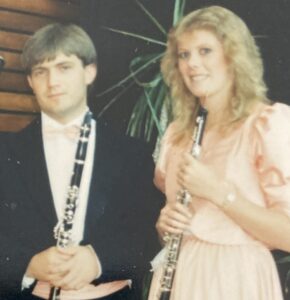
1984 Bruce Gillam and Jody Harrison

In 1984, Bruce was named a State Winner of the ABC Instrumental and Vocal Competition, performing Nielsen’s Clarinet Concerto with the West Australian Symphony Orchestra. Since then, he has enjoyed a long and varied freelance career, performing with orchestras and ensembles in concerts, musicals, and major choral works.

Bruce joined the West Australian Clarinet Quartet in 2010. The ensemble enjoyed considerable success, including an invitation to perform at the International Clarinet Association Conference in Assisi, Italy, in 2013. The quartet also recorded a recital for ABC Classic FM in the Perth Town Hall.

Alongside his performing career, teaching has been one of Bruce’s greatest passions. Since 1984, he has taught clarinet in government schools across the Perth metropolitan area, inspiring generations of young musicians.

Many of his former students have gone on to become music teachers and professional performers:

NOTABLE STUDENTS TAUGHT BY BRUCE GILLAM:

Catherine Cahill  – Clarinet Teacher at Churchlands Senior High School

Jacqui Edwick – Coordinator of Woodwind Teaching, Instrumental Music School Services

Ashley Smith – Chair of Woodwind and Contemporary Performance UWA

Alex Roberts – Clarinettist with Welsh National Opera Orchestra

Tania Swan  – CASSWA committee member

Chris Foster – Jazz pianist

Scott Collinson – Clarinettist with Australian Army Band, Canberra

Nicole Niewendijk – Clarinet Teacher, Instrumental Music School Services

Samantha Lillis – Clarinet Teacher, Instrumental Music School Services

Michael Hodgkins – Clarinettist with Fremantle Symphony Orchestra

Ashleigh Hill – Secretary WA Symphonic Wind Ensemble

Kristy Hopkins – Clarinet Teacher St Marks Anglican Community School

Bronwyn Rogers – Clarinet Teacher Corpus Christi College

Vicki Powell – Clarinet Teacher Instrumental Music School Services

Amanda Noordzy – Clarinet teacher Instrumental Music School Services


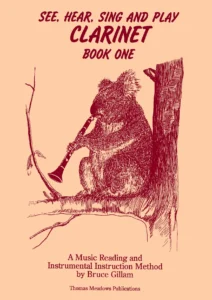
Bruce is also a respected author and educator. He has written and published several successful music education resources, including the popular See, Hear, Sing and Play series, written as a project for a Master of Music Education degree, the Roundabout series, which sold more than 20,000 copies, and Trendy Trios, a collection of accessible and enjoyable pieces for beginner clarinet students.

Today, Bruce continues to share his love of music through performing, teaching, and writing, helping musicians of all ages develop their skills and appreciation of the clarinet.

Bruce Gillam

BSc, MEd, AMusA, ATCL


Bruce said of Jack Harrison:

Although I never had formal lessons with your father, he did tutor me at many camps and youth orchestra sectional rehearsals.

At my first May camp I had never played in an orchestra before, and I was really floundering, especially with dynamics.

Jack came up to me and gave a special piece of advice, which I have never forgotten.

He said “Always play at a dynamic level that can be heard by the conductor.  If the conductor tells you to quieten down you’ve won!”

Instruments

Years

Person

ROBERTS, Alex

Alex is an Australian clarinettist based in the UK.

He is currently Sub-Principal Clarinet with the Welsh National Opera Orchestra, and has worked with the most of the major London orchestras.

He is a long-time member of Explore Ensemble, a boundary pushing new music group, working with some of the most exciting living composers, performers and improvisers in the UK and abroad.

Alex has also worked as a pianist and musical director with several large community choirs and was until recently Director of Music Programmes for Liberty Choir, a charity which creates and runs choirs in prisons, creating pathways to rehabilitation.

Alex studied with Allan Meyer and Paul Dean in Australia, before working with Nicholas Cox, Barnaby Robson and Linda Merrick at the Royal Northern College of Music.

After graduating he continued to take lessons and masterclasses with Andrew Marriner, Chi-Yu Mo, Francois Benda and Yehuda Gilad.

Instruments

Person

TREW, Robert

Robert Walker Trew was born in 1908.

In 1929 aged 21, was working at Perth Hospital and fell 30 foot from a ladder and fractured bones in his left foot.

He performed in “Bert Howell’s Stage Band”.

1934

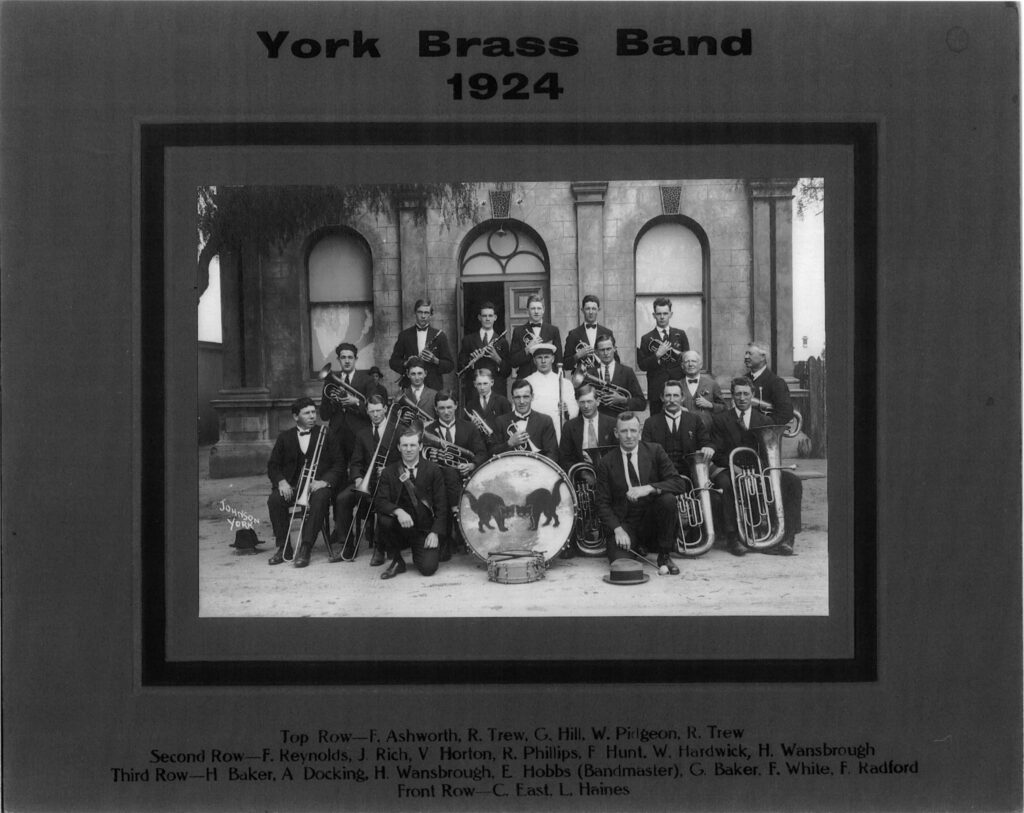
The musical career of second clarinet player Bob Trew, who joined the Perth Symphony Orchestra in 1934, began in 1920 in York, which at that time enjoyed both an orchestra and a brass band.  Trew was also a qualified plumber.

Harrison, Marcia. West Australian Symphony Orchestra Celebrating 75 Years. WASO Holdings Pty Ltd, 2003. Page 36

1938

TREAT FOR THE KIDDIES – Symphony Orchestra Pleases

The children’s concert held in His Majesty’s Theatre last week was a most successful one. Sponsored by the National Broadcasting Commission, a highly educational programme was performed by the A.B.C. (Perth) Symphony Orchestra conducted by E. G. Roberts. This musical body is now delivering the goods and is comprised of the usual studio orchestra, containing as it some of the finest musicians in Australia, and all of  whom are capable of giving a most exacting performance of their instrument. This was manifested when, reinforced by other players not on the permanent staff, the various leaders were called upon to show the children their instruments and play a few classical bars or lilting little ditty.

…Other woodwind soloists were Mr. Singleton (oboe) and the clarinet pair Mr. Percy Newton and Bob Trew, the latter delivering a delightful duet in a workman like fashion.

Mirror (Perth, WA : 1921 – 1956), Saturday 4 June 1938, page 2

1942

SYMPHONY MEN PLAY DANCE MUSIC.

An occasion unique in the history of South Australian rural entertainment, writes ”Jazzman,” was the playing of three symphony men in the dance band at the recent carnival at the Berri Co-op. Packing House. Being in a shed, the acoustics were naturally poor, but your scribe managed to get near the stand and was impressed with the sax work of Bob Trew, a clarinet player from the Perth Symphony and the A.B.C. network. He plays with a round, smooth tone, reminiscent of the American Negro, Benny Carter. Unfortunately no traditional jazz was played and this prevented his swinging improvisations. Another interesting musician was S/Sgt. V. Lombardi who played violin for part of the evening. Formerly a first violin of the Adelaide Symphony he handled the dance orchestrations deftly. The third symphonic figure was the Conservatorium pianist Frank Lellmann. His bass slapping is extremely powerful and his tremendous rhythmic drive literally kicked the melodic instruments along. A word to promoters of future “shed shows”: have the band centre of the floor. This idea has been tried in Adelaide with great success.

Murray Pioneer (Renmark, SA), Thursday 10 December 1942, page 4

Entertaining the troops WWII

1944

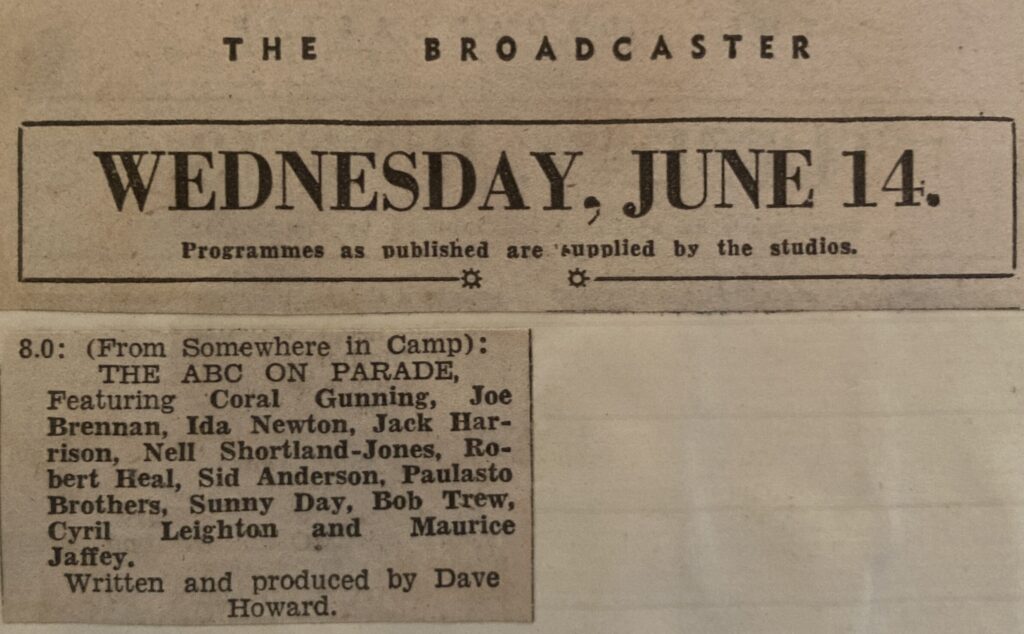
From somewhere in camp: ABC ON PARADE. Devised, arranged and produced by Dave Howard, with the ABC Theatre Orchestra, conducted by Ernest J. Roberts and including the following artists: Joe Brennan and Ida Newton, Sunny Day (Elsie Connoly), Olive Dunton, Jack Harrison, Eileen Moran, Vernon Sellars, Maurice Jaffey, Neil Shortland-Jones, The Paulasto Brothers. (Bob Trew 14th June)  Compered by Cyril Leighton. The Broadcaster Thursday February 24, Thursday April 20, June 14 1944

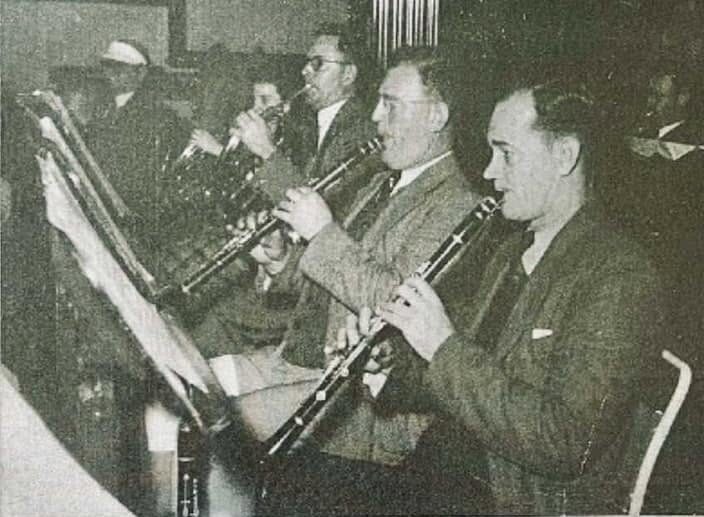
Robert Trew in 1949 Perth Symphony Orchestra clarinet section

1949

Outstanding alto and clarinet man with the Sharp combination, George Caro, has had a colourful career in the game. At 15 he commenced the sax, and as George maintains, was completely self-taught.

He first came to the public notice in 1930 when he was one of 18 who competed in the saxophone competition conducted by the Brass Band Association of WA. Winner was Cas Mitchell, now of the ABC Melbourne, second George Caro, Bob Gibson (now in England) was third, and fourth position was filled by Bob Trew (Perth ABC).

In 1934, when the exodus was on, George made the Eastern States tour with the Ron Movie outfit, and when this orch. returned to WA, George decided to hit out for the overseas spots. His first working port o’ call was Colombo, where he played at the Mount Lavinia Hotel. From here he went to the Grand Hotel at Calcutta, before making the Malayan Peninsula in 1936, where he played in Singapore cabarets and the Eastern and Oriental Hotel in Penang. On his return to Australia, George linked up with pit work, played for the American Marcus ‘Show, North China Troupe, Dante, and various other visiting shows.

During the war he played second cornet with the 28th Battalion Band, and at a later stage, while serving in Darwin conducted a Sunday night Swing Show featuring a 5piece outfit. Returning to civvy street, he joined Chris Gosper’s eight playing at St. Mary’s, Mt. Hawthorn. When Sammy Sharp returned from England, George moved in with Sammy Sharp and remained with him ever since. —’QUAIL.’  Mirror (Perth, WA : 1921 – 1956), Saturday 23 April 1949, page 14

1950 Broadcaster article Perth Musicians

1951

Only three months in the South Australian Symphony Orchestra, Jack returned to Perth on 8th February 1951 to fill the second clarinet position with the West Australian Symphony Orchestra after the sudden death on January 18 1951 of second clarinettist Bob Trew aged 43.

TREW (Robert Walker); A sincere tribute to the memory of Bob deepest sympathy to Mrs. Trew and family.  Inserted by the staff of the Australian Broadcasting Commission.

TREW (Robert W.): In memory of a great friend and associate. The Moore family.


Instruments

Years

Person

KIRKHAM, Bill

1947

JIVE TONIGHT

Hot music’s deepest groove in years will lead to the Capitol to-night, when 8 leading bands will stage Perth’s first Jazz jamboree. Outstanding combinations of  Merv Rowston, Chris Gosper, Sammy Sharp, John Stirling, Henry Cochrane, Ray Harley, Bill Kirkham and the Hounslow group will present a programme ranging from earliest jazz to modern and swing.Sunday Times (Perth, WA : 1902 – 1955), Sunday 12 October 1947, page 11


1948

JAZZ JAMBOREE OF 1948

Capitol Theatre

Sunday Night October 31

eight leading bands led by

Merv Rowston, Sammy Sharp, Chris Gosper, Harry Bluck, Ron Jenkins, Bill Kirkham, Jack Harrison, Ken Murdoch

Box plan at Nicholsons.  Adm 2/6 Proceeds to Charity.

Harry Bluck, who heads the A.B.C. Rhythmettes, is the brains behind the business and all proceeds go to the Musicians’ Benevolent Fund.

The Mirror Saturday October 23 1948 Vol 25. No. 1379


Jazz enthusiasts and the disciples of boogie-woogie, swing and be-bop (the translation of which has yet to be given to me) will be right in front of the eight-ball, so to speak, on Sunday night at the capitol theatre where the Jazz Jamboree of 1948 will take the stage as a charity concert.  Harry Bluck, who heads the A.B.C. Rhythemettes, is the brains behind the business and all proceeds will go to the Musicians’ Benevolent fund.  This year over 60 of Perth’s leading musicians will combine to make the show something for be-boppers (and others) to bop about.  Merv Rowston’s Orchestra, Jackie Harrison’s Quintette, Chris Gosper and his Concert Orchestra, Ken Murdoch’s Swing show Quartette, Sammy Sharp’s Orchestra, Harry Bluck’s Jazz Group, Ron Jenkin’s Band and Bill Kirkham and his Jive Five will all be on stage, in addition to the “1948 Mystery Band”.  This mystery band seems to be something of a mystery to all except the musicians in it.  Harry Bluck tells me that nobody know the personnel, the music they are likely to play, the instruments they will select or even if they will “give out” from the stage or the stalls.  But it seems like a great night and the cause will be a worthy one.  It should be well worth while to go along to find out exactly what bo-peep is (sorry) bo-bep (excuse), I mean be-pop.  Won’t somebody get me out? 

The Broadcaster October 1948


JAZZ CONCERT

At the Capitol Theatre on Sunday night the professional dance-band musicians of Perth will present a jazz concert. The programme, it is stated, has been planned to cover every style of modern Jazz idiom. Eight bands will be conducted by the following: Merv Rowston, Jack Harrison, Sammy Sharp, Harry Bluck, Ron Jenkins, Chris Gosper, Bill Kirkham and Ken Murdoch. The proceeds will be for charity. 

The West Australian Thursday 28 October 1948 page 24


AROUND PERTH in 1948 WITH HARRY BLUCK

PERTH RADIO STATIONS USING MORE BANDS

AND LIVE ARTIST SESSIONS

Quick survey of local musicians currently airing programmes in Perth shows what a keen interest is being shown by local radio stations, both national and commercial, in presenting “flesh and blood” shows, especially by members of the dance band fraternity.  Here are where a few of our leading “outfits” can be heard over the local ether.  Sammy Sharp’s Band (featuring a 15 piece combination) and vocalist Peter Boyd are prominent each Thursday evening over station 6PR with a Band Presentation and “Talent Quest” show.  Over the same network from Perth town Hall, Chris Gosper and his “Music for Moderns” are relayed from their weekly midday sessions, which have proved a huge success, and shows signs of developing into something really big.  From the same network come many other “live” shows including pianist Warrick Lever, Henry Cochrane and Jimmy Beeson.  George Hay and his “Hawaiians”, Billy Barnes’ Hill Billys, Accordionist Harry Bluck, saxophonist Jack Pateman.

On the Nationals the weekly show features the “Rhythmettes”, a novelty outfit led by Harry Bluck, while the Jackie Harrison Quintette and Emil also give occasional broadcasts, not forgetting of course, soloist Henry Cochrane.  Quick roundup of the other stations tells us of a weekly Sunday Show by the “400 Swingtette” over 6KY, where Chris Gosper and Ralph St. Clair play solo piano sessions, while a prominent Hill Billy movement is also aired by this station.

Theatre May Use More Music

News that Sammy Sharp’s Thursday night broadcasts shift into the Ambassador’s Theatre as part of the programme etc, may mean the thin end of the wedge for some other houses to follow suit and gradually reintroduce more musicians into local theatres.  From observation it appears that Perth picture houses are not doing terrific business mid week.  Perhaps some really good musical acts and support may be the answer, as indications from the other side of the show business points to outstanding houses for all flesh-and-blood performances.

The Jazz Jamboree

Already the bands concerned in this year’s “Jazz Jamboree” are working on their numbers for this colossal programme which shows every promise of superseding last year’s magnificent turn out.  The bands listed to appear so far are – Merv Rowston’s, Jack Harrison’s, Ron Jenkin’s, A Jazz Group, Bill Kirkham’s, Chris Gosper’s and Sammy sharp’s bands.  This year a box plan will be opened and so it is hoped to avoid the terrific crush and queuing that took place last year – the queue was four deep, entirely encircling a complete city block – and was there for a couple of hours in pouring rain.  Also – at last – proceeds from this year’s Jamboree go to the Musician’s own Benevolent Fund. 

Music Maker October 1948


JAZZ JAMBOREE OF 1948

Capitol Theatre, Sunday Night October 31

eight leading bands led by

Merv Rowston, Sammy Sharp, Chris Gosper, Harry Bluck, Ron Jenkins, Bill Kirkham, Jack Harrison, Ken Murdoch

Box plan at Nicholsons.  Adm 2/6 Proceeds to Charity.

Harry Bluck, who heads the A.B.C. Rhythmettes, is the brains behind the business and all proceeds go to the Musicians’ Benevolent Fund.

The Mirror Saturday October 23 1948 Vol 25. No. 1379


JAZZ CONCERT: At the Capitol Theatre on Sunday night the professional dance-band musicians of Perth will present a Jass concert. The programme. It is stated. has been planned to cover every style of modern lass idiom Eight bands will be conducted by the following: Merv Rowston, Jack Harrison, Sammy Sharp, Harry Bluck, Ron Jenkins, Chris Gosper. Bill Kirkham and Ken Murdoch. The proceeds will be for charity.

West Australian (Perth, WA : 1879 – 1954), Thursday 28 October 1948, page 25


1949

Followers of the Gosper combination will be with me in wishing Chris, who is now studying with the Melbourne Conservatorium all the best. They tell me that while Keith Whittle (Embassy drummer) and Chris were marking time In Melbourne recently, it was jointly decided to take on a temporary occupation with the South Melbourne Aviation Engineering Supply Co. transferring nuts and bolts by wheelbarrow from one part of the factory to another. In 3 days, the musicians ran into no end of humorous strife. Climax came when Chris was accidentally ‘crowned’ with a 5 foot crow-bar. Chris has been sitting in with the Stork Club and is now with George Watson’s Academy of Music, teaching modern pianoforte. L V A Ball: The Wednesday night ball held at the Embassy Ballroom in conjunction with the annual conference in Perth of the LVA, was attended by more than 700. Ball was preceded by a cocktail party on the balcony which was attended by a gathering of some 200 people. Music was supplied by the Goldenhour Old Time Dance Band. Thursday’s 50-50 two-band nonstop show continues to draw the crowds. Among this week’s personalities, noticed Jim and Sylvia Rowling of Scarborough celebrating their first wedding anniversary, and Sylvia’s 21st birthday with friends, Jeff Watts of Mt. Lawley, and Pat Atkinson, of South Perth. During the evening Sylvia cut the top tier of her wedding cake. The river view by night is always an attraction. On the balcony saw Joy Lague and Vernon Herd, of Wembley; also Gloria Stuart of Victoria Park with Eastern States visitor John Balcom, of Box Hill, Victoria …. South Perth’s Merle Cooper was on the floor . . . Marianne Higgs celebrated her 18th birthday with a cocktail party at her Claremont home, followed by dancing at the Embassy. She was attractively dressed in black ballerina with pink lace insets. Vocals this week were capably handled by Johnny Carlton, of the Goldenhour Old Time Dance Band. TIVOLI:  Current attraction at this theatre is selling well. One of the centre points of interest is Philip Edgeley, son of Eric Edgeley, of Edgeley and Dawe fame, who are well remembered In Perth. Another young personality, Bruce Beeby, son of Dr. Beeby, of the Patch Theatre is seen in the same play.

Mirror (Perth, WA : 1921 – 1956), Saturday 30 April 1949, page 14

PETER BOYD

Style and personality incorporated in Peter Boyd’s vocals may well have originated in his early school days, when, at the age of 10, he won packets of boiled sweets in singing competitions at his school. He has always been keenly interested in vocalising, but not seriously until 1944, when at 21 he joined a small 3piece outfit led by Morrie Cooperman, who was playing for an all-modern Saturday day night session at Mary Shaw Studios. From this, the first rung of the ladder, Peter moved across to the Rechabite Hall, where he carried the vocals for a trio in Jean Crammond, Mick Bartlet and Ted Campbell in a 50/50 programme. His real break came when he joined Viv Nylander’s Embassy Band, before that musician retired from the dance band world to occupy a chair at the ABC. Upon Viv’s retirement, Bill Kirkham took up the reins of the combination and Peter remained with the show until Sammy Sharp returned from England, whereupon he teamed up with the Sharp outfit, which subsequently presented the Sunday Serenaders (a programme over the ABC), the Sammy Sharp Show on the Scarborough promenade, Sunday afternoons and the Sea Crest Cafe programme presented by Sammy’s quartette and Peter handling the vocals. He was also later heard in the Battle of the Bands, and the 1948 Jazz Symphony. Peter favours the voice o John Charles Thomas, and selects as his favourite band, Stan Kenton’s. He is at present still handling the vocals for the Sharp outfit at the Embassy and the YAL. – ‘QUAIL’.

Mirror (Perth, WA : 1921 – 1956), Saturday 30 April 1949, page 14


JACK HARRISON CHEQUE BOOK:

4 JULY 1949

JACK Cheque to:                Jack Pope                 Womens College      £5/3

Colin Youlden           Womens College      £2/11/8

Bill Kirkham               Womens College      £2/11/8

Charlie Thompson   Womens College      £2/11/8

George Franklin       Womens College      £2/11/8

Bill Hendrie                Womens College      £2/11/8

Roy Coates               Womens College      £2/11/8


JAZZ JAMBOREE OF 1949

EIGHT OF PERTH’S BEST BANDS – Alvan St. Jazz Group, Harry Black’s Swingtette, Jack Harrison’s Quintette, Ron Jenkins Lido Quartette, Ken Murdoch’s Band, Bill Kirkham’s Jive Band, Merv. Rowston’s Band, Sammy Sharpe’s Band.

CAPITOL THEATRE, SUNDAY, OCTOBER 30th

ADMISSION: 3/6 (reserved). Box Plan at Nicholsons.  [6]

JIVE FANS

BIG moment in local jive lives will arrive Sunday week when another Jazz Jamboree will be held at the Capitol with 60 of Perth’s best musicians featured in 8 bands.

Alvan-street Jazz Group, Harry Bluck Swingtet, Jackie Harrison’s Quintet, Ron Jenkins Lido Quartet, Bill Kirkham’s Swing 7, Ken Murdock’s Band, Merv Rowston’s

Society 5 and Sammy Sharp’s Band. Fans will also appreciate a re-appearance of sensational blind singer Phyllis Frost. 

Mirror Saturday 22 October 1949 page 14


BIG JAZZ SHOW

Over 60 musicians will appear in the “Jazz Jamboree of 1949” in the Capitol Theatre on Sunday October 30.  Eight bands will feature every style from Dixieland to bop.  The concerts have been held since 1947 and have attracted very big audiences.  The proceeds for the show are donated to the musicians’ benevolent fund.  The bands taking part will be: Alvan-street Jazz Group, Harry Bluck Swingtet, Jackie Harrison’s Quintet, Ron Jenkins Lido Quartet, Bill Kirkham’s Swing 7, Ken Murdock’s Band, Merv Rowston’s Society 5 and Sammy Sharp’s Band. 

Jack Harrison scrapbook


MUSICIANS HERE DON’T LIKE BEPOP

Some of Perth’s leading jazz musicians were asked whether they agreed with caustic comment on bebop by the king of jazz trumpeters Louis Armstrong in Paris last week.  Armstrong said that bebop was nothing but friction and squeezing notes out of a bad trumpet.  “They play only mistakes and made weird sounds” he said.

Band leader-trumpeter Sammy Sharpe, who has played all over the world, thinks that Armstrong is the greatest jazz musician that has ever breathed.  “Bebop leaves me cold” he said.  “It’s an ultra modern idea of excitement in music, The music itself has a terrific construction with plenty of liberty with chords.”  Bandleader and radio swing session compere Ken Murdoch (clarinet and saxophone). Finds bebop “an interesting study”.  Band leader-saxophonist Bill Kirkham agrees with Armstrong’s criticism.  “It’s surrealism in music and the public doesn’t understand it.  I have music for bebop in my library, but my band never plays it,” Kirkham said.  Australia’s youngest band leader, clarinettist Jackie Harrison (18) likes listening to the style.  

Daily News Saturday 1949


1950

All Together With A Tra-la-la

EVERY musicker of note turned up at the Jack and Dudie Pateman’s Nedlands home for the serious business of wetting baby Graeme William’s head. They packed the women off to Sylvia Caporn’s home and the ”boys’ had a right royal time. During the arvo Harry Bluck cheffed up spag. savories and what have you. Pete Sullivan (not the curly headed one) brought a can of Indian curry. A spokeshavian playlet ‘Cinderella’ was produced by Maestro Beeson, featured Alan Gough, Cliff Adam, Pete Harrison, Merv Rowston and ‘Lily of the Valley’ Roberts. It was a real classic. Kev Logan even stopped hibernating and made an attempt to hydrate himself. They nearly sold him a sax. Bam Sharp put on a happy time and the beer flowed like wine. Ray Le Cornu did a job with the kegs. Chick helped the food along. Wally Hadley, Maurice Maurice, Keith Whittle. ‘Mule Train,’ George Caro, ‘Cigarettes’ Cooke, Baden Flxter, Butch Kirkby, Bill Kirkham, Henry Cochran. were ell in it. At nine o’clock sharp they drank a special toast to George Franklin— wherever he might have been between here and Curfew rang at 2 a.m and everyone departed for their homes. They tell me the Patemans have since bought a block and 3 tents in case of repercussions from neighbours who may dislike jazz, Dixieland — and just plain noise.

Mirror (Perth, WA : 1921 – 1956), Saturday 20 May 1950, page 12


AT THE CAPITOL

THIS SUNDAY NIGHT

20 August 1950

RHAPSODY IN JAZZ

Come and hear Jack Harrison, W. Kirkham and Colin Hicks and their orchestras. Supported by Betty Whittaker, Hazel Lewis, Michael Harrington-Martin, Phil Moron and other leading artists. Compered by Geoff Manion

Tickets at the door. Price 5/- and 3/. 

The Daily News Saturday 19 August 1950 page 22


1951

SUBIACO POLICE BOYS’ CLUB modern Dance. Drill Hall. Sat, nights. Bill Kirkham’s 6-pce. swing band. Dancing from 8-12 p.m. Adm. 2/6. –

West Australian (Perth, WA : 1879 – 1954), Saturday 20 October 1951, page 22


CAPITOL THEATRE

SUNDAY 28th OCTOBER 1951

JAZZ JAMBOREE

Featuring

12 of Perth’s Leading Dance Bands

Jazzstars, Cliff Adams, Norm Wrightson, Merv Rowston, Ron Jenkins, Harry Bluck, Jimmy Beeson, Bill Kirkham, Peter Clinch, Ken Murdoch, Jack Harrison, Sammy Sharpe.

Booking Opens at Nicholsons.  Friday 19th October 1951.


1952

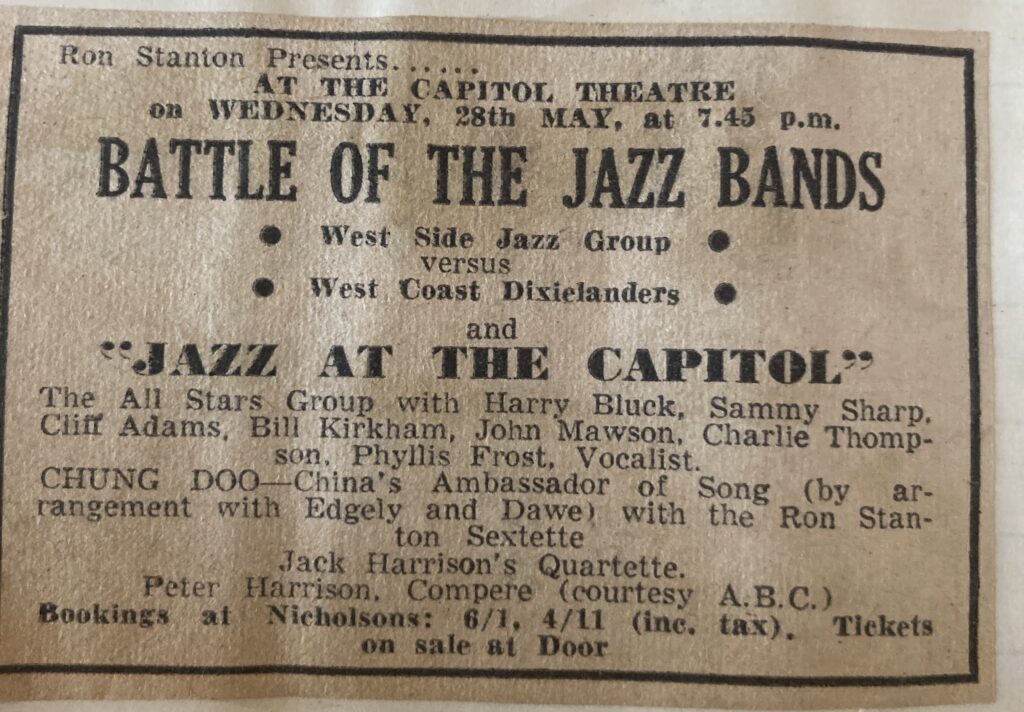
Wednesday 28th May 1952

Jazz At The Capitol

Lena Horne. Spike Jones. Mills Brothers. Harry Eddison. Lester Young. Ella

Fitzgerald. Ray Brown . . .

They’re just a few big names of modern music in the long list of acquaintances claimed by Ron Stanton, now in Perth. Ron, a Sydneysider, is a genuine young man of music. American tours have given him an intimate knowledge of techniques over there — and he’s bringing them to Perth.

Particularly impressed with the annual festival Jazz at the Philharmonic, he has formed a “leaders group” in Perth for Jazz at the Capitol. Group includes Harry Bluck, Sammy Sharp, Cliff Adams, Bill Kirkham, John Mowson, Charlie Thompson and Ron Stanton himself.

Program— at the Capitol on Wednesday night— will also include the “name bands” of Perth, Chung Doo, Stanton’s sextet and Jack Harrison’s quartette. 

Mirror Saturday 24 May 1952 page 8


Sunday October 26th 1952

Jazz Jamboree

DANCE BAND FANS!

BOOK EARLY And Avoid Disappointment for the

JAZZ JAMBOREE

CAPITOL THEATRE

SUNDAY, OCTOBER 26 At 8.45 p.m.

SAMMY SHARP HARRY BLUCK

MERV ROWSTON KEN MURDOCH

BILL KIRKHAM JACKIE HARRISON

THE JAZSTARS NORM WRIGHTSON

RON JENKINS JIMMY BEESON

COLIN HICKS CLIFF ADAM

Tickets 4/-

BOX PLAN NOW OPEN AT NICHOLSONS


Bill Kirkham is a motor engineer who takes time off from sorting out nuts and bolts to sort out crotchets and quavers. He amuses himself in his spare time with speedcar racing and he expects to have something, special for this season with a new car he recently brought over from Adelaide. Bill’s professional musical career resulted from the depression. When things were tough he teamed up with other musicians and he has been at It ever since. He has had his own band for the last 5 years. Kirkham’s favorite band— Glen Milller. Tops in his own instrument, the saxophone – Tex Beneke.

Mirror Sat 1 November 1952 page 6


1953

IMPROMPTU JAM STOLE THE SHOW

An impromptu jam session nearly stole the show at Thursday night’s WA Amateur Dance Band Concert at the Capitol Theatre. Composite band of members who had competed earlier, really went to town and had patrons rocking in their seats. Jam band was led by internationally known Harry Phillips on the trumpet and Sid Vandervelde on guitar. Boys really turned it on and the crowd went wild. Even when Sammy Sharp came forward to announce the night’s awards the audience clamoured for another spread of jam. So, a grinning Sammy waved the boys to continue. Night was a feast of bounce, jive and bop with the amateur instrumentalists showing enough promise to indicate that many will soon be making pro names for themselves. Hundreds were present to hear 13 outfits, ranging in size from 4 to 11 pieces, vie with one another in a variety of Jazz renditions. Judges Ken Murdock, Ron Moyle, Merv Rowston, Harry Bluck and Bill Kirkham were not set an easy task. Finally, they awarded the shield to the West Coast Dixielanders, a 7 -piece outfit led by Phil Battey on trumpet, George Battey, clarinet, Dick Hatton, trombone. Conn Goldsmith, bass, Bob Anderson, piano. Alan Blight, drums, and Vince Goldsmith, guitar. These boys have been playing together less than a year and decided at the last minute to enter the contest They will hold the shield until next year’s contests.

The Dixielanders all prefer the type of music their name suggests is their special dish and are keen on the Jelly Roll Morton school. Second place went to Neil Manno’s Quintette with the Jive Five led by Wynne Hammer third. Other awards were: Best Instrumentalist; Ray Taylor, trumpet. Best Guitar: Jimmy Taylor. Best Drummer: Wynne Hammer. Best Pianist: Thelma McGrath. Best Vocalist: Bill Groessler. Most promising reed player was 17-y-o Neil Boon, a Dutch youth. Organisers, the W A Musicians’ Union, Sammy Sharpe and compere Wally Hadley are to be congratulated on a good show which all agreed was a great improvement on previous contests and augurs well for the future of dance music in this State. Saw quite a sprinkling of musicians who have given up regular playing in the audience at the Capitol, including Harry Ward and Laurie McGrath.

Mirror (Perth, WA : 1921 – 1956), Saturday 25 July 1953, page 11


Instruments

Years

Person

CARO, George

April 1949

Outstanding alto and clarinet man with the Sharp combination, George Caro, has had a colourful career in the game. At 15 he commenced the sax, and as George maintains, was completely self-taught.

He first came to the public notice in 1930 when he was one of 18 who competed in the saxophone competition conducted by the Brass Band Association of WA. Winner was Cas Mitchell, now of the ABC Melbourne, second George Caro, Bob Gibson (now in England) was third, and fourth position was filled by Bob Trew (Perth ABC).

In 1934, when the exodus was on, George made the Eastern States tour with the Ron Movie outfit, and when this orch. returned to WA, George decided to hit out for the overseas spots. His first working port o’ call was Colombo, where he played at the Mount Lavinia Hotel. From here he went to the Grand Hotel at Calcutta, before making the Malayan Peninsula in 1936, where he played in Singapore cabarets and the Eastern and Oriental Hotel in Penang. On his return to Australia, George linked up with pit work, played for the American Marcus ‘Show, North China Troupe, Dante, and various other visiting shows.

During the war he played second cornet with the 28th Battalion Band, and at a later stage, while serving in Darwin conducted a Sunday night Swing Show featuring a 5piece outfit. Returning to civvy street, he joined Chris Gosper’s eight playing at St. Mary’s, Mt. Hawthorn. When Sammy Sharp returned from England, George moved in with Sammy Sharp and remained with him ever since. —’QUAIL.’  Mirror (Perth, WA : 1921 – 1956), Saturday 23 April 1949, page 14

Instruments

Years

Person

GIBSON, Bob

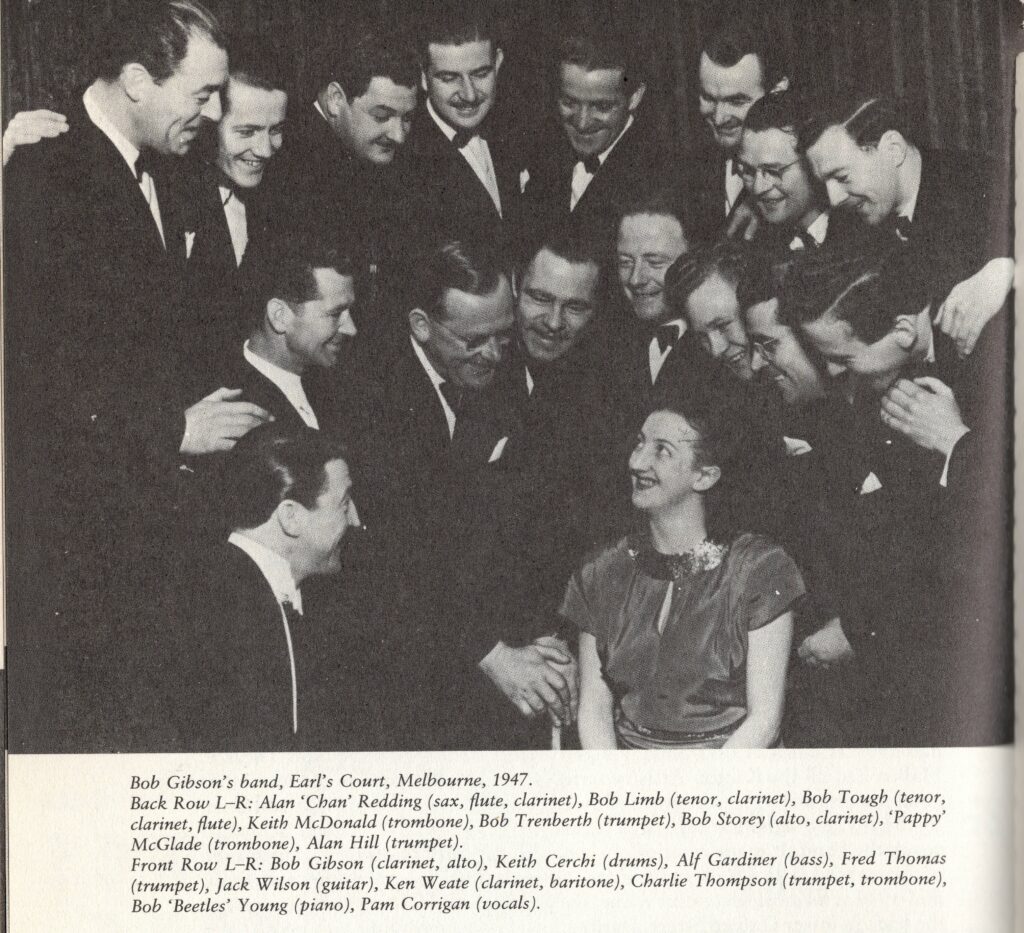
Bob Gibson was a Perth musician who began his career on violin, then learning clarinet and saxophone with Harold Moschetti.  In Perth he initially played with the Doreen D’Arcy’s Orchestra, a six piece dance band, and then in Ron Moyle’s seven piece band at the Embassy Ballroom.  Moyle toured to Melbourne and Gibson auditioned successfully in 1935 for the “Good Companions”.

1933

LOCAL BAND HONOURED – Engagements in Eastern States.

For the first time in broadcasting history a West Australian band has been engaged through the Australian Broadcasting Commission to give performances- over the air in the Eastern States. Ron Moyle and his ‘Westralians,’ a combination of local performers, will leave ‘ for Adelaide by the Great Western express on Saturday, night, and will be absent for about six weeks. The ‘Westralians’ will be heard over the air from 5CL, Adelaide, on December 21 and 22, and from South Australia they will go to Melbourne, where they will broadcast from 3LO- between January 6 and 27. It is possible that the band will; also visit Sydney. Ron Moyle himself is well-known to listeners in Western Australia, having been connected with broadcasting in this State for many years. His band, which is composed of the following players, was heard from 6WF during last dancing season: — Ron Moyle, A.T.C.L. (pianist); Bob. Gibson, L.A.B. (alto saxophone, clarinet and violin) ; George Caro, A.T.C.L. (tenor saxophone, clarinet and violin); Allan Gough, A.T.CJj. (alto saxophone, clarinet and violin); Viv. Nylander (trumpet and trombone); Kem. Fimmel (trumpet); Charles Thompson (trombone and trumpet);. Wally Hadley (banjo, flute and guitar); Cliff Adams (guitar, tap dancer and vocalist); Eddy Roberts (drums and vocalist); and Tom Bennett (bass). The band will give a final concert at the Ambassadors Theatre on Friday night.  West Australian (Perth, WA : 1879 – 1954), Wednesday 13 December 1933, page 5

In 1935 the band the “Good Companions” was formed by Ern Pettifer at the Palais de Danse, St Kilda.  “The formation of the “Good Companions” set music at the Palais on a forward-looking path, because Pettifer gave some talented young players a break. Auditions were held on a hot summer day and in the line of hopeful stretching around the corner was a gifted alto saxophonist from Perth, Bob Gibson. The audition piece was a tough arrangement of “Bugle Call Rag” by Frank Coughlan who was then with Pettifer. Gibson sailed through it because he had had a thorough classical training and had won many scholarships for his ability, and he knew dance work too. Gifted young players never appear out of nothing and Gibson was no exception. Perth had its own thriving dance bands.” Andrew Bisset, Black Roots White Flowers,  1987 Globe Press. page 55


1941

Talking Shop By “Finn” Westralian Wonder.  From farther and farther afield come the stars of 3Aws “Youth Show” and the latest on the list is an amazing young man from Nedlands, Western Australia. He is nine year old Jack Harrison who surprised everyone by winning the first prize in the big 150 pound “Search for Talent”.  He competed against allcomers and won by popular vote, although listeners had no knowledge of his age or identity. Jack started playing the mouth organ …he will feature in the broadcast from 3AW. The Listener In Complete Radio Newspaper February 22-28 1941 And 4BH. Teleradio Saturday March 1, 1941

Jack’s father tells me (per the P.M.G.) that he has met at least 14 W.A. people n Melbourne and Sydney who are tops in the eastern entertainment world.  He cut out newspaper references to some of the W.A. people which have appeared during the few weeks he has been in the East and forwarded them to me.  One about “Duffy”  Newton (who used to act in 6WF plays) made about ten inches of type, had a double column heading and carried a photo.  Other cuttings contained photographs of David Samuel (deputy-leader of Bert Howell’s Band and leader of last year’s “Youth Sow” band), Chester Bond (who is at present featured in a big radio serial), Bob Gibson and George Watson (a principal of the Drum Club).  The Broadcaster February 1 – 8 1941


1949

19 February 1949 – PERTH JAZZ MEN ARE TOPS IN EAST

Recent news about WA dance musicians who have sought to establish national reputations is good news. At least 4 who have been questing after the big-time in the Eastern States have made it, some of them ranking amongst the top-salaried musicians of the day. Currently occupying press space in musical magazines and feeling the for and, against quips of critics in Sydney is Ray Hartley, onetime popular pianist at radio lunch-hour concerts in Perth. General gossip has it that Ray is sow in the high salary range although it is rumoured that the road has been long and very rough. At present Ray is featured with Paul Lombard’s outfit at the Celebrity Club which used to be Rose’s and spare time, as little as he may have, L being turned towards arranging and holding down a couple of radio spots. In addition to this Ray contributes to the Music Maker, the Australian Dance Band Editorial and his articles on prominent keyboard men are a worth while contribution to that magazine. Although his name is usually associated with lunch hour concerts, Ray’s success was first assured in renditions of the Ray Hartley Trio; a combination which he has reformed in Sydney.

One Of The Best Recognised as being one of the best musicians in Australia was Bob Gibson. Since leaving Australia some months ago to further his knowledge in England, little news has been heard of him. He is another W. A. man and at the age of 9 was a winner of eisteddfods and a gold medalist, but his future career was not restricted to his ability as a violinist alone, for at the age of 14-15, Bob commenced taking sax and clarinet lessons from Harry Moschetti, and very soon established himself on these instruments. In the early 1930’s, Bob took over the leading alto sax seat in the Ron Moyle outfit, a combination through which passed some of the finest musicians of the State, and when this outfit went on tour through the Eastern States, Bob Gibson still occupied alto seat but he never returned to W. A. With hard work and perseverance he finally cracked the ice in Melbourne and had occasion to look back. Just prior to the last war, he organised his own band and hit St. Kilda night spots which proved to be his first top liners. His subsequent success such as the Shell Show are now history and it is hoped that his success overseas will continue. Mirror (Perth, WA : 1921 – 1956), Saturday 19 February 1949, page 11


1950

April 1949 – Outstanding alto and clarinet man with the Sharp combination, George Caro, has had a colourful career in the game.    At 15 he commenced the sax, and as George maintains, was completely self-taught. He first came to the public notice in 1930 when he was one of 18 who competed in the saxophone competition conducted by the Brass Band Association of WA. Winner was Cas Mitchell, now of the ABC Melbourne, second George Caro, Bob Gibson (now in England) was third, and fourth position was filled by Bob Trew (Perth ABC). In 1934, when the exodus was on, George made the Eastern States tour with the Ron Movie outfit, and when this orch. returned to WA, George decided to hit out for the overseas spots. His first working port o’ call was Colombo, where he played at the Mount Lavinia Hotel. From here he went to the Grand Hotel at Calcutta, before making the Malayan Peninsula in 1936, where he played in Singapore cabarets and the Eastern and Oriental Hotel in Penang. On his return to Australia, George linked up with pit work, played for the American Marcus ‘Show, North China Troupe, Dante, and various other visiting shows. During the war he played second cornet with the 28th Battalion Band, and at a later stage, while serving in Darwin conducted a Sunday night Swing Show featuring a 5piece outfit. Returning to civvy street, he joined Chris Gosper’s eight playing at St. Mary’s, Mt. Hawthorn. When Sammy Sharp returned from England, George moved in with Sammy and remained with him ever since. —’QUAIL.’Mirror (Perth, WA : 1921 – 1956), Saturday 23 April 1949, page 14


1950

On The Home Range – BOB GIBSON

Ask the boys in the strings and the winds about Bob Gibson. Gibson! they say with awe. He lives, eats, and drinks music. He has no other interests, only music, in which he strives for perfection. And in hushed tones they say, ” What an ‘ear’ that man’s got!” ASK “Melbourne’s thousands of dance fans. “Bob Gibson,” they say. “He’s more than a band leader. He is the perfect dance tempo!” To us Bob appears to be just an ordinary bloke, unassuming, dark, rather short, with a pleasant fluency. Local dance fans were desolate when Bob sailed for England in 1948. Now he’s back, after London successes, wondering whether to re-form his band in Sydney or in Melbourne. Few, if any, Australian band leaders have had a bigger personal following than Gibson. Before his London trip his band, then the only big-time, freelance combination in the country, was nationally famous for its work in hit radio – programmes such as The Shell Show, All Australian Hit Parade, Popularity Parade, and A.B.C. Shows. In addition, the Bob Gibson band, which incidentally was then costing about £500 a week to run, was in demand for Vice-Regal evenings and the top society balls of the season. Bob was something of a child prodigy. At 12 years of age, he was playing the violin in the newly-formed Perth Symphony Orchestra. In his early teens he was awarded his violin degree in Perth by the travelling examiner of the Royal Academy of Music. As a youth of 17 he stepped off the Overland in Melbourne into the St. Kilda Palais orchestra, the Palais being one of the biggest dance halls in the Commonwealth. He was lugging four cases — three for his violin, saxophone, and clarinet, and one for clothes. He fiddled and “doubled” on the sax and clarinet to such purpose that within a few years he was promoted to be Palais Orchestra arranger, probably the youngest in the Commonwealth. Then in 1939, only 25 years old, he formed his own orchestra. Bob went overseas to study entertainment trends in radio, television. and on the stage. He warns Australian musicians and theatricals that the competition over there is terrific. For every musician here there are at least 100 in London, competing for a limited amount of work. When a band vacancy occurs a dozen first-class players apply. for the position before it can be advertised. Only the fittest survive. Working conditions are much tougher than here, and the pay is not as good. There are many English musician anxious to migrate here. English artists and players are beginning to take a “dim view” of the increasing number of Australians reaching the top. But, Bob says, for every Dick Bentley, Kittys Bluett, and. Joy Nicholls at the top there are a score of Australians hovering on the breadline, many of them good artists. “Great talent is not enough in London,” he says, “You must have” luck too.” Gibson had his share. After doing a “study” tour with Tommy Trinder’s show, Bob was asked to form an orchestra of 25 players for the B.B.C. He also spent seven weeks in Paris and conducted a light orchestra which did the background”, music in a French film. Bob advises young theatricals and musicians to go to England for study, but to buy a return ticket before leaving! Gibson plans to return to London in 1951. In the meantime, he aims to. satisfy those dancing feet in Melbourne, or Sydney, perhaps!  Smith’s Weekly (Sydney, NSW : 1919 – 1950), Saturday 18 February 1950, page 15


1953

Local Acts Compete for  Record Prizes in Talent Final – Sixteen local acts will contest the grand final of Talent Hour, Australia’s most richly endowed talent quest, to be relayed from Melbourne Town Hall through UZ at 8 p.m., Tuesday, November 10. Each of the four section winners will receive £500, with minor placegetters receiving £250, £40 and £15. The best act of the night will be awarded an additional £1000. Awards will be made at the conclusion of the programme. Regular adjudicators, Dr. Herman Schildberger and Mr. Harry Sutcliffe; have been joined by Mr.-Garnet H. Carroll. Recorded semi-final performances of all artists will be featured in Talent Hour Preview, at 3 p.m. Sunday, November 8. Recorded grand final performances will be repeated, in Talent Hour Review, at 3 p.m. Sunday, November 15. Sydney orchestra leader, Bob Gibson will direct a 20-piece orchestra. The stage setting will include the appearance of leading Melbourne mannequins. Competitors are as follows;— Vocal: Joan Reed, soprano; Kenneth Sullivan, tenor; Theodor Sartory, bass-baritone; Leonard Delany, baritone. Instrumental: Roger Holmes, piano; Ian King, tuba; Eugene Danilov, clarinet; Mary Nevmet, violin. Pop Vocal: Reg Gray; Jack Bowkett; Margot Carroll, John Oldham. Novelty: Alfred Smith, monologuist; Don Harper Quartet; John Shingler and Kelvin McMillian, flute and saxophone duo; D.D.H. instrumental trio.  Age (Melbourne, Vic. : 1854 – 1954), Thursday 5 November 1953, page 19

RED CARPET FOR MUSIC VIPs GET WELL WORN

Perth musicians are finding their red carpet (for rolling to welcome local members who have become VIP’s in the musical world) is wearing pretty thin. Latest to tramp across it will be Bob Gibson, on Monday night. He arrives from the Eastern States by ‘plane, will be an honoured guest at the Musicians’ Ball at the Embassy on Tuesday night.  He has made his name not only as a musician and band leader, but also as an ‘ arranger. His work has been praised by ‘big name’ clarinettist Artie Shaw. Bob studied violin in Perth at an early age. While still in short pants he played at the old Prince of Wales Theatre. He turned to the saxophone later, left here in that capacity with Ron Moyle’s orchestra in 1933 for. what is believed to be! the first tour of a dance band under the ABC banner. He stayed in Melbourne, where he ‘saxed’ with Ern Pettifer’s orchestra at St. Kilda’s Palais de Dance, which was later taken over by Hal Moschetti, another West Australian. Later engagements included seasons with Bert Howell, of Capitol Theatre, and Shell Radio Show fame, Jay Whidden, Roy Fox and Dick Freeman. Bob formed his own combination at Melbourne’s Palm Grove, with a wealth of experience behind him. During the war he organised a band and toured forward areas as director of a US entertainment unit. After the war he returned to England as musical director of the Tommy Trinder Show (a job now held by Hal Moschetti). But the climate and ill-health (he developed pneumonia) sent him back to Australia, where he has carved himself a new niche. Mirror (Perth, WA : 1921 – 1956), Saturday 24 October 1953, page 12

SUNDAY, NOVEMBER 1st, 1953 – Jazz Festival Week Part Two: CAPITOL THEATRE – THE BOB GIBSON SHOW

Featuring Australia’s Outstanding Band Leader

WEST COAST DIXIELANDERS

NORM WRIGHTSON

MARTIN GISCHUS

JACK HARRISON

HARRY PHILLIPS

COLIN HICKS

KATH BASS

Box Plans for both these attractions now open at Nicholsons.  TICKETS 5/   The West Australian Saturday 17 October 1952 page 35

LISTENERS WILL HEAR GIBSON An agreement reached between the W.A. Musicians’ Association and the ABC resulted in last Sunday’s Jazz Jamboree (featuring The Bob Gibson Show) being recorded for broadcasting from 6WF.  When the ABC heard that ace band leader Gibson would be the guest artist for the second part of Jazz Jamboree, it came to an agreement with organisers Sam Sharp and Harry Bluck for Gibson’s show to be recorded, and also agreed to pay the W.A. Musicians’ Association a fee for the right to record the show.  The date of the broadcast will be published shortly.  Gibson is now musical director for 2UW.  Recently Gibson signed an agreement with the Columbia Recording Company.  The first of his releases to be heard in Perth will probably be “Wild Horses” and “My One and Only Heart”.  Gibson, who went to England in 1948 and returned in 1950, now favours big band.  He records with a 28-piece band, and for concert and radio work he uses anything from 16 to 20 musicians.  Two of his most popular programmes, heard from 2UW and Sportsman’s Parade and Musically Yours.  Gibson said that any young musicians who hoped to go abroad needed plenty of capital and lucky breaks.  He said that there were too many instances of a bandleader casually approaching a popular tune without having any idea of presentation. 

Of the orchestra he conducted at the Jazz Jamboree on Sunday night, Gibson commented “They are a first class bunch of musicians.  Considering they had such short notice to get together they gave a truly remarkable performance.”  The band leader also praised individual performances.  He believes that 17 year old Neil Boon could develop into a top line artist.  Jack Harrison displayed plenty of versatility and gave a smooth performance, he said.  Gibson also praised the responsiveness of the audience.  “In modern music there is no greater encouragement” he said.  The Broadcaster Saturday November 7 1953 Vol .20 No. 1023

BAND HAS BIG NAMES IN EVERY SECTION – When Harry (‘Powerhouse’) Phillips takes up his trumpet on the stage it is usually a signal for wild enthusiasm from rhythm fans who see in him a combination of Louis Armstrong, Harry James and a dozen other trumpet idols. Harry, who has been to WA for nearly 5 years, is from an English musical family which has been associated with big-name bands in England and on the Continent for many years. His brother Syd will always be remembered for his compositions and arrangements with the famous Ambrose. Another brother, Woolf, is equally well known. Before coming here Harry played in most of the capital cities of Europe and speaks several languages fluently. He has played lead trumpet with brother Syd’s band, with Ambrose, Mantovani and Harry Roy, as well as with his own groups. He can play a sweet trumpet, but is usually associated with the forceful style which gives him his name of ‘Powerhouse.’ Although this looks to be a difficult style, he achieves his effects from the modern non-pressure method, with which there is no great physical effort, despite the seemingly strained attitude of the player. Harry claims to be able to te ich this style easily. Associated with Harry in his band are a number of promising young musicians, notably saxophonist Neil Boon, a 17-y-o Dutch boy who literally stopped the show at last Sunday night’s Jazz Jamboree, when Bob Gibson was guest conductor. A great future is predicted for this boy, who has been playing saxophone for less than a year, but has played the clarinet for 4 years. His alto sax solo ‘I’m In the Mood for Love’ received such an ovation that compere Wally Hadley had to ask Harry to bring him forward and introduce him to the audience. Band’s guitarist Sid Vandervelde, also from London, was with the late Felix Mendilsohn’s Hawaiian Ensemble and the late Freddie Gardner, the great sax stylist. Sid works a6 a motor-mechanic in Perth and has been here for 2 years. Fans like the drive he gives the band with his solid rhythm on an amplified Spanish guitar. Brothers Don and Gordon Bates, who play piano and drums with the outfit, are local boys who have been well-known in the music game here since they had ‘their own band some years ago. Don is a saddler with his father and Gordon is with a City leather firm. Harry works as a planning engineer for a Perth firm.

The popular Harry Phillips combination which has delighted Perth rhythm fans: (PHOTO) From left: Syd Vanderveldt, guitar; Don Bates, drums; trumpeter Harry, Gordon Bates, piano; Neil Boon, sax and clarinet. Mirror (Perth, WA : 1921 – 1956), Saturday 7 November 1953, page 12


Instruments

Years

Person

ABERCROMBY, Duncan

Duncan Abercromby was born near Glasgow and moved as a child to Dornoch in the far north county of Sutherland, Scotland, where his father was employed as a peripatetic school dentist. Around 1964 he took up the clarinet, mastering “Stranger on the Shore”, a career that petered out until some years later. The family moved to Tasmania in 1965 and Duncan took up the clarinet again aged 16.   He moved to Sydney in 1969 and boarded in a boys’ hostel in Randwick.  He attended Sydney Conservatorium for half a year, but withdrew in order to concentrate on his clarinet practise with teacher Don Westlake.

Duncan auditioned for the National Training Orchestra and was accepted, despite his limited ability to read music, a skill he quickly learnt.   He secured augmenting work as second clarinet with the Sydney Symphony Orchestra and the Elizabethan Trust Orchestras in both Sydney and Melbourne, playing for operas and ballets.

In 1971 he sent an audition tape for the second clarinet position in the West Australian Symphony Orchestra which he won and worked sitting next to Jack Harrison until 1979.

In 1979 he was soloist with WASO in the Series 29 concerts. In 1979 he augmented the Tasmanian Symphony Orchestra’s tour to Greece and Israel with the Australian Ballet.  He stopped via Perth and learnt, whilst there that he had won the Principal Clarinet position with the Tasmanian Symphony Orchestra replacing Greg Blackman who had moved to the Adelaide Symphony.

Sylvia Leviston was appointed second clarinet where she played for three years until she retired, when the position was filled by one of his many students Chris Waller. He also taught other professional players including Kate Travers and Nick Harmsen who both still play with the Queensland Symphony Orchestra and Catherine McCorkill an ex-member of the Australia ensemble and Principal Clarinet with the Sydney Opera House Orchestra.

Duncan retired from TSO in 2011 and Andrew Seymour won the Principal clarinet chair.

Duncan sold his clarinets 6 weeks after he retired and replaced them with a boat, sailing around the Whitsundays and close to his home on the Huon River.

His wife, Stephanie Boys, is a pianist and French horn player and daughter Kirsten played bassoon and is now head of Criminal Defence with Legal Aid in Devonport.

He still lives in the Huon Valley in Tasmania, is an enthusiastic competition Bridge player and intends to write a book one day entitled  “100 uses for a clarinet reed that don’t include playing the clarinet”.

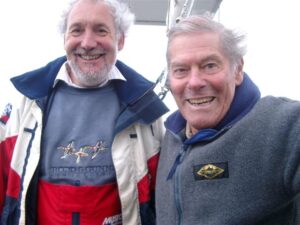
Duncan Abercromby and Jack Harrison

Instruments

Years

Person

BURROWS, Don

By 1942, aged 14, Burrows had begun playing clarinet and quit school. He began appearing at Sydney jazz clubs, and appeared on The Youth Show, a Macquarie Radio show. In 1944 he was invited to play and record with George Trevare’s Australians. He became well known in Sydney jazz circles and was performing in dance halls, nightclubs and radio bands. He was a member of Jim Gussey‘s ABC Dance Band for five years.

1953

Jazz man defer to pipes

Australian jazz legend Don Burrows celebrated his 74th birthday at Scotch College to the sounds of pipes and drums. He took time out from classic swing to listen to the school band with his WA mat, musician Jack Harrison and Kevin Hunt, one of Australia’s most highly regarded jazz pianists.  On Saturday, Don held a jazz workshop for Scotch music students.  Don and Jack have been friends for 49 years after a spontaneous meeting in Sydney. 

On his honeymoon, Jack called Don, whom he had not met, to ask where he was playing.  Don had heard Jack playing his clarinet on the Young Australia Show and told him to stand outside his hotel in King’s Cross with his clarinets and he would pick him up.  They have been friends ever since.  Jack said “Burrows is still the same Mr Nice Guy I met all those years ago, his enthusiasm for his profession has never waned.”  Jack, who was a student at Scotch in the 1940s said he and Don still shared a passion for music, and for passing it on to young musicians.  He said he and Don had sat like two grumpy old men playing jazz to the accompaniment of a computer program called Band in a Box.   [1]

[1] Claremont Nedlands Post August 31 2002 Vol. 28 No. 35

Jay Harrison, Don Burrows, Marcia and Kim Harrison at 11 Dodonia Gardens.

During the 1960s and 1970s Burrows had many engagements in Australia and the United States, including six years performing at the Wentworth Hotel in Sydney in quartets with Ed Gaston, George Golla, and various drummers. It was this association which made his name the “most familiar in Australian jazz”. In 1972, he was invited to perform at the Montreux Jazz Festival and later the Newport Jazz Festival.

The year 1973 was a watershed for Burrows as he received the first gold record for an Australian jazz musician for his record Just the Beginning,[8] instigated the first jazz studies program in the southern hemisphere, at the New South Wales Conservatorium of Music (under the direction of Rex Hobcroft) and was appointed a Member of the Order of the British Empire (MBE). In 1979 he was appointed Chair of Jazz Studies at the conservatorium.

Burrows performed to mostly classical music audiences through tours with Musica Viva and the Australian Broadcasting Corporation concert series. He led the nationally televised show The Don Burrows Collection for six years. He had an extensive recording career with his groups and performed on albums by others.

In the 1980s Burrows mentored and was closely associated with James Morrison. He formed the Don Burrows Quartet with George Golla (guitar), Ed Gaston (double bass) and Alan Turnbull (drums). He also worked with Frank Sinatra, Dizzy Gillespie, Nat King Cole, Oscar Peterson, Tony Bennett, Stéphane Grappelli, Cleo Laine, and the Sydney Symphony Orchestra.

In 1981 Burrows played woodwind on a Play School album, Hey Diddle Diddle: it was his only involvement with the show.

In 2005 Burrows toured with a small band that included the Australian jazz pianist Kevin Hunt. He used his photographic images with his music in a show called Stop, Look and Listen.

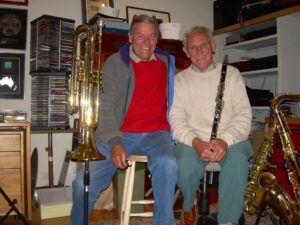
Jack Harrison and Don Burrows jamming
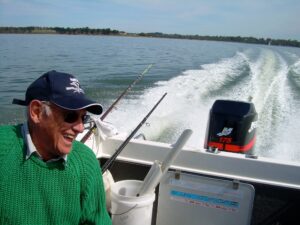
Don Burrows fishing trip on his boat
Don Burrows and Jack Harrison on a fishing holiday


Don loved fishing, a passion he shared with Jack Harrison.


Burrows had arthritis from age 38. In a 2008 interview with the Australian Broadcasting Corporation’s Andrew Ford, celebrating his 80th birthday, he said that “arthritis is not the greatest for playing a musical instrument. But playing a musical instrument is very, very good for arthritis”. In later years he had Alzheimer’s disease and lived in a nursing home in northern Sydney. He died on 12 March 2020, aged 91.

https://en.wikipedia.org/wiki/Don_Burrows

Allan Meyer, Don Burrows, Jack Harrison

IS THERE AN AUSTRALIAN who hasn’t heard of Don Burrows? Legendary musician Don Burrows (AO, MBE) has been at the forefront of the jazz world for most of his 60 years in the business. He’s a household name in Australia, renowned for his musicianship and his enthusiastic support for the jazz arts. He’s also highly respected internationally, where he’s toured numerous times to great acclaim annually since 1960.
This superb multi-instrumentalist plays flute, clarinet and all the saxophones, from alto to baritone. He’s a composer and arrange of great note, and one of the world’s finest interpreters of the jazz tradition. A Don Burrows concert is a journey from classic swing and the gentle sway of Brazilian bossa nova to exciting modern jazz.
Did you know that this Living National Treasure (named in 1988 and 1998) was the first Australian jazz artist to win a gold record, the first to play Europe’s famed Montreaux and the USA’s Newport festivals, the first to play in China, the first awarded a Creative Arts Fellowship, the first inducted into the ARIA Hall of Fame, the first Director of a Jazz Studies course. He has also found time to host his own television show, The Burrows Collection, for six years on ABC TV, has released close to forty albums, and regularly tours here and abroad, including South and North America, Europe, the Middle East and Asia. And just look at this who’s who of great recording and concert partners – Oscar Peterson, Dizzy Gillespie, Nat King Cole, Mel Torme, Stephane Grappelli, Tony Bennett, James Morrison, George Golla, Cleo Laine, Frank Sinatra, Kate Ceberano, the Sydney Symphony Orchestra and hundreds more.
Now in his 74th year, Don Burrows has not even begun to think about slowing down. He continues to tour Australia and the world regularly. In the last few years Don Burrows appearances have included China, Brazil, Argentina, Mexico, Venezuela, Cuba, New Zealand and all the major jazz festivals of Australia. His passion for jazz has seen him embark on several countrywide educational tours in recent years, taking his music and experience to schools in isolated corners of Australia, from Broome to Tasmania.
His 1995 Creative Arts Fellowship, under the auspices of which he tours schools, follows two earlier honours – an Order of Australia and an MBE – in recognition of his generous and unstinting work in promoting jazz. Each year the University of Sydney awards Honorary Degrees to people who have achieved great distinction in their field. On the 25th of May 2000, Don Burrows was awarded the degree of “Doctor of Music” [Honoris causa].
On the second of April 2001, Don Burrows was awarded for the second time the degree of “Doctor of Music” [Honoris causa] from the Edith Cowan University in Perth, Western Australia.
In October 2001, Don Burrows returned to Mexico and South America to perform with musicians from Brazil, Venezuela and Argentina. Recently he headlined the first International Jazz Festival in Nepal.
Don is now in his 60th year as a professional musician.
Throughout a long, varied and successful career Don Burrows has played just about every kind of venue, in front of just about every kind of audience, from nightclubs and festival stages to television studios and outback classrooms. His musicianship and his ability to communicate his passion for the music have become legendary. He remains one of Australia’s pre-eminent artists, veritably a Living National Treasure.

https://australianjazzrealbook.com/artists/don-burrows/


https://www.portrait.gov.au/people/don-burrows-1928

https://celebrating.waverley.nsw.gov.au/nodes/view/73135

https://johnshand.com.au/don-burrows-1928-2020/

https://www.abc.net.au/listen/jazz/features/specials/don-burrows-obituary/12053490


Instruments