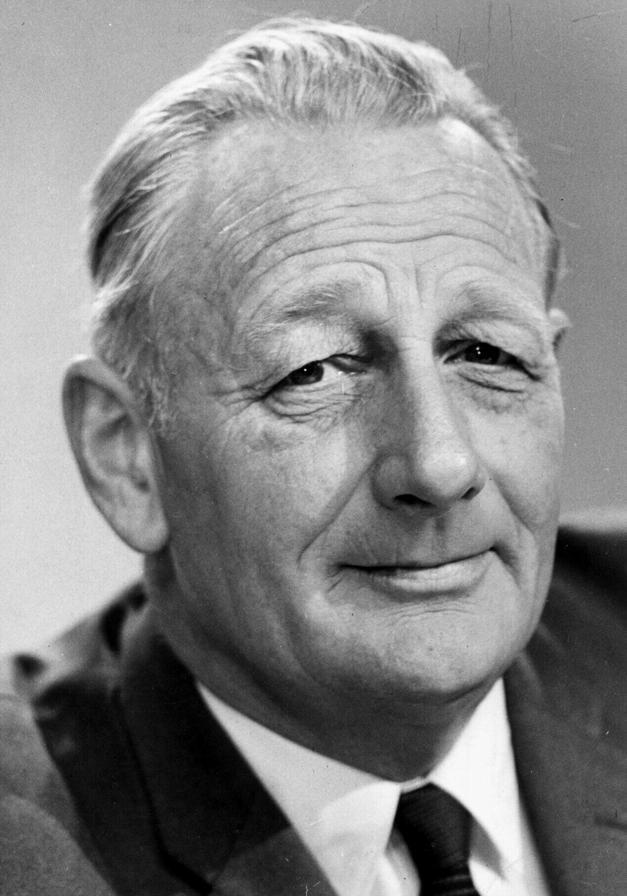
Alwyn Kurts was one of Australia’s most recognisable radio and television personalities, enjoying a remarkably varied career spanning journalism, wartime reporting, radio entertainment, television presentation, comedy and dramatic acting.
Born in Perth in 1915, Kurts began his professional broadcasting career in Western Australia before moving east, where he became a familiar voice on Melbourne radio and eventually a household name on Australian television.
Although best remembered for his portrayal of Inspector Colin Fox in the long-running police drama Homicide, Kurts was much more than an actor. He was an accomplished broadcaster, an engaging interviewer, a comedian and a versatile performer whose career reflected the transformation of Australian entertainment from the golden age of radio to the television era.
Alwyn Cecil Kurts was born on 28 October 1915 in Perth, Western Australia.
He was one of seven children. His father, Alwyn Cecil Kurts senior, was of Polish-Jewish background and subsequently became known in broadcasting circles under the name Donald Day. His mother was Laura Mabel Rosamond Claydon.
Kurts grew up in a family environment that was not without its difficulties. His father left the family during Alwyn’s childhood, and his mother was left to raise the children.
One of his sisters, Raigh Roe, later became a prominent Western Australian community figure, serving as a Country Women’s Association president and Australian Broadcasting Commission commissioner. She was named Australian of the Year in 1977.
The family’s connection with broadcasting and public life provides an interesting background to Kurts’s eventual career in radio and entertainment.
Kurts entered professional broadcasting in 1942, joining Perth radio station 6PR as a breakfast announcer.
He was in his mid-twenties and quickly demonstrated the personality and communication skills that would become the defining characteristics of his career.
Radio in the early 1940s was an important source of news, entertainment and companionship. Presenters were expected to be versatile, engaging and capable of connecting with audiences through the spoken word.
Kurts proved particularly well suited to this environment.
His early experience at 6PR gave him a foundation in broadcasting that would serve him throughout his subsequent career in journalism, radio entertainment and television.
Kurts’s career took an unexpected turn during the Second World War when he became an accredited war correspondent.
He travelled extensively with Allied forces, reporting from Burma, New Guinea and the Philippines. His experiences brought him into direct contact with Australian servicemen serving in some of the most difficult theatres of the Pacific war.
His wartime reporting included coverage of the Allied campaign to recover Singapore from Japanese occupation. In a 1975 interview with writer George Wilson, Kurts recalled:
“I was lucky enough to be one of the first 20 Allied people in on the recapture of Singapore.”
This was an extraordinary experience for a young Australian broadcaster and journalist, and one that gave him a perspective on military life that would later inform his radio entertainment.
Kurts also returned to war reporting in September 1950, when he travelled to Korea to interview Australian servicemen for Melbourne radio station 3XY. His reports were also broadcast through Sydney’s 2UW and Brisbane’s 4BK.
His ability to combine journalism with an engaging broadcasting style made him particularly effective in bringing the experiences of servicemen to Australian listeners.
Following the war, Kurts moved to Melbourne and joined radio station 3XY.
It was here that he established himself as a popular personality through a series of entertainment programmes, including:
-
Raising a Husband
-
Tye’s Radio Revue
-
Radio Revels
His programme Raising a Husband became particularly successful. It was a light-hearted entertainment and quiz programme involving married couples and domestic questions, allowing Kurts to display his considerable improvisational and comic abilities.
Another popular production was Radio Revels, which Kurts later recalled as a soldier show in which members of the armed forces were invited onto the stage to perform.
These programmes demonstrated his ability to work with live audiences and to create entertaining radio that combined humour, music and audience participation.
Kurts also became involved in radio station management and worked as an executive at 3XY, broadening his experience beyond presenting and performance.
The introduction of television in Australia in 1956 provided Kurts with another opportunity to demonstrate his versatility.
He successfully transferred his radio personality to the new medium, becoming the presenter of the television version of Raising a Husband on Melbourne’s GTV-9 in 1957.
Produced by Crawford Productions, the programme ran from 1957 to 1958. It involved married couples answering questions about domestic problems, with the aim of identifying the most human husband.
The programme was an early example of Australian television’s developing interest in audience participation and domestic entertainment.
Kurts subsequently presented a number of other television programmes, including:
Hutton’s Family Quiz
A quiz programme that allowed him to demonstrate his ability to engage contestants and audiences.
Don’t Argue
Another entertainment programme that drew on his experience as a radio presenter and comedian.
Fighting Words
A debate programme in which Kurts acted as compère, introducing contentious subjects and overseeing discussions between opposing viewpoints.
His television career was developing rapidly, but he was soon to discover that his greatest success would come through dramatic acting rather than presenting.
In 1968, Kurts appeared in the Crawford Productions police drama Homicide, which had premiered in Australia in 1964.
His initial appearances included guest roles, but in 1969 he joined the regular cast as Inspector Colin Fox.
The character became one of the most memorable figures in the series.
Fox was a country-based police inspector who brought a different personality and approach to the Melbourne homicide investigations. Kurts portrayed him as a tough, experienced and somewhat gruff policeman, combining authority with a dry sense of humour.
His performance was particularly effective because of his natural screen presence and his ability to communicate character through relatively understated acting.
Kurts remained with Homicide for approximately four years. His character was eventually killed off in July 1973.
His portrayal of Colin Fox made him a familiar face in Australian households and established his reputation as a leading television actor.
The series itself was enormously influential in the development of Australian television drama, and Kurts was an important part of its success.
Following his departure from Homicide, Kurts demonstrated that his acting abilities extended well beyond police drama.
He took the leading role of Ted Cook in the Crawford Productions comedy series The Last of the Australians.
The programme centred on an older war veteran whose attitudes and prejudices frequently brought him into conflict with the changing values of contemporary Australian society.
Kurts’s performance was particularly accomplished. He portrayed Cook as a stubborn, frequently exasperating character, but one whose behaviour also provided considerable comic opportunities.
His earlier experience in radio comedy and live entertainment was evident in his timing and delivery.
The role demonstrated that Kurts possessed a considerable talent for character comedy, a quality that had perhaps been less apparent during his years playing Inspector Fox.
His most significant film performance came in 1979 when he appeared in Tim, directed by Michael Pate.
Starring a young Mel Gibson alongside Piper Laurie, the film told the story of a young intellectually disabled man and his relationship with an older woman.
Kurts played Ron Melville, the father of the central character.
His performance earned him the 1979 Australian Film Institute Award for Best Actor in a Supporting Role, an important recognition of his achievements as a screen actor.
Other film appearances included:
| Year | Film | Role |
|---|---|---|
| 1980 | The Earthling | Christian Neilson |
| 1982 | Deadline | Jack McGinty |
| 1991/92 | Spotswood (The Efficiency Expert) | Mr Ball |
| 1993 | This Won’t Hurt a Bit | Psychiatrist |
| 1997 | Road to Nhill | Jack |
In Spotswood, Kurts appeared alongside Anthony Hopkins, Ben Mendelsohn and Russell Crowe, providing another memorable character performance.
His film career demonstrated his ability to work comfortably alongside some of Australia’s most accomplished actors and international performers.
Kurts continued working in television throughout the 1970s and 1980s.
His credits included:
-
Bellbird (1977), in which he played trotting trainer Wes Lewis.
-
Cop Shop (1982), in which he appeared as Senior Sergeant Reg Wallis.
-
The Flying Doctors.
-
A Country Practice.
-
Special Squad.
He also briefly appeared as the compère known as ‘The Beast’ in the Australian version of the television panel show Beauty and the Beast in 1973.
Although the programme was short-lived, it added another unusual chapter to an already diverse career.
Kurts married twice. His second marriage, to Eileen Margaret O’Hehir in 1940, lasted until his death.
He had three children: Nola, from his first marriage, and Michael and Elizabeth from his second.
His sister Raigh Roe’s achievements in community service and broadcasting are also worthy of recognition. Her selection as Australian of the Year in 1977 made her one of the most prominent members of the Kurts family.
The family’s connections with broadcasting, journalism and public service provide an interesting context for understanding the career of Alwyn Kurts.
Alwyn Cecil Kurts died in Melbourne on 4 May 2000, aged 84.
His career had encompassed almost six decades of Australian entertainment, beginning with Perth radio in 1942 and extending into television and film in the late twentieth century.
He is remembered principally for Inspector Colin Fox in Homicide and Ted Cook in The Last of the Australians, but his contribution to Australian broadcasting was considerably broader.
He belonged to a generation of performers who made the transition from live radio entertainment to television, bringing with them the communication skills, comic timing and versatility developed during radio’s golden age.
For Western Australia, his story is particularly significant. Before becoming a national television personality, Kurts began his career in Perth, establishing a connection with the State’s early commercial broadcasting history.
He deserves recognition as one of Western Australia’s notable broadcasting and entertainment exports.
INTERVIEW: