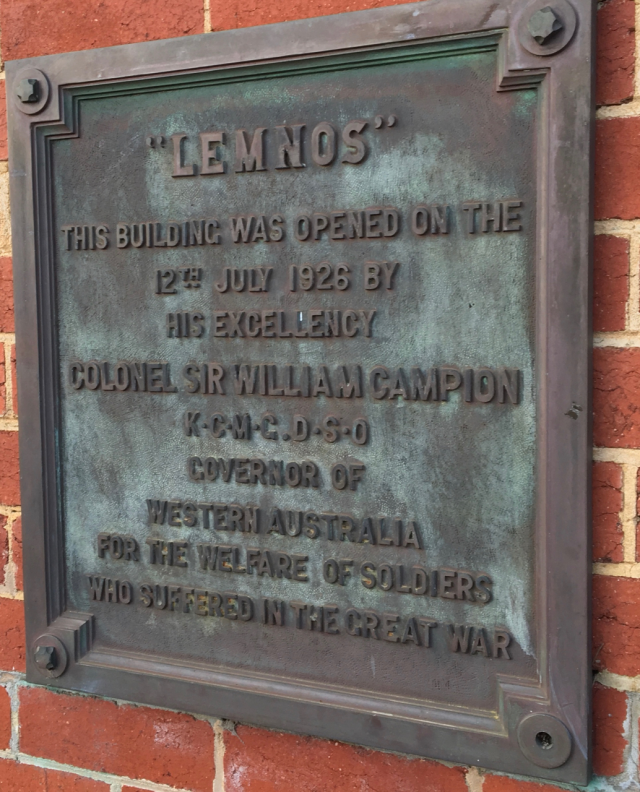
Lemnos was opened on 12 July 1926 to care for returned WWI servicemen experiencing mental illness and shell shock. Named after the Greek island of Lemnos, which hosted military hospitals during WWI. It was planned by Public Works Department architect W.O. Hardwick and Dr. J.T. Anderson in a domestic, Federation/Interwar filigree style meant to feel like a home rather than a large institution. The site includes a commemorative pine tree grown from a seed linked to Lemnos. It expanded after WWII with additional wards and later operated as part of the Selby-Lemnos complex and elderly mental health/rehabilitation services before Shenton College opened on the site in 2001.
1926
New Soldiers’ Home
MAGNIFICENT BUILDING Opening Ceremony To-day
An institution ideal for the purpose for which it has been provided is ‘Lemnos,’ the new mental home for returned soldiers, which was officially opened by His Excellency the Governor (Sir Wm. Campion) to-day. Occupying the crest of a hill adjacent to the West Subiaco railway station, the home commands a magnificent view of the surrounding country, the panorama embracing the Swan River and the Darling Ranges. There is ample interior accommodation, and the grounds arc spacious. Built, by mutual arrangement between the Federal and State Governments. ‘Lemnos’ is now nearing completion. The finishing touches are being administered, and it is anticipated that the whole of the men who will henceforth occupy the building will be transferred there about a month hence. An inspection of the institution, carried out to-day under the guidance, of the Inspector-General for the Insane (Dr. Anderson) was highly interesting. ‘Lemnos,’ in its surroundings, its lay-out, and its appointment, internally and externally, as little resembles a Mental Home as it could possibly be made to do. The whole institution bears rather the appearance and atmosphere of a palatial private residence. The furnishings tend to strengthen this impression, as the draped bay windows and the luxurious upholstered chairs, neat jarrah tables, and other fittings differ only slightly from those met with in a private home. The lay-out and appointments are actually the result of the collaboration of Dr. Anderson and the Principal Architect (Mr. W. B. Hardwick), who some time ago on a visit to the Eastern States took opportunities to make a close inspection and study of the designs incorporated in similar institutions there. They have missed None of the Essentials, and have supplemented them with ideas, which can only he regarded as the result of much careful forethought and consideration oil the welfare of the sufferers will occupy the home. Such institutions usually convey a forbidding impression or appearance, as if they rightly should be shut off from the rest of the ‘world.’ Not so with ‘Lemnos.’ The effect is just the reverse. There is a cosiness, and comfort about the whole place that is as welcome as it is unexpected. There are five blocks of buildings. Three are wards, A, B and C, D represents the kitchen and dining room block, and the remaining one comprises the administrative quarters. Convenience and comfort have been closely studied in modelling the institution. Each Of the wards is connected by covered ways laid with patent blocks. The buildings are constructed of pressed brick, which have allowed of a perfect structure, as substantial as it could possibly be. The outstanding feature of the wards is the provision they afford for ventilation. As a matter of fact there is More Window Space Than Wall Space. Besides the set of ordinary windows which range around all the walls of each ward, at intervals of about four feet there are smaller windows above the verandah. It is an ideal scheme of ventilation. The line of wards runs due south, and that farthest north will be occupied by the more acute cases. This ward will house 23 patients. Attached to it there are three single rooms which afford another classification in themselves. Here, it will be possible to exercise all necessary Control and Supervision over refractory patients. All the windows in these rooms are chocked in such a manner that the patient may be confined there in safety and yet the window may be kept open for a space of about six inches. There is a day room attached to this, and to all other wards. A billiard table, handsome upholstered chairs, book cases, and a cosy fireplace are provided while the bay windows are magnificently draped, and the walls plentifully decorated, with pictures. The effect secured is that of a cosy sitting room. Lavatories, bath rooms, linen presses and other rooms for stores are attached to each of the wards. Those for the quieter patients each contain 20 beds, and are all well lighted and ventilated. Altogether, the wards permit of about Five Classifications. The kitchen and servery is on modern lines, situated about midway the length of the wards, and on each side there is a dining room. The appointments of these reflect the same standard of excellence. There is a hot and cold water installation throughout, the cooking appliances are thoroughly up-to-date, and extensive store and larder accommodation is available. The boiler house and, refrigerating plan are other modern installations. In the administrative quarters the same impression of comfort, convenience, and modernity is conveyed. The Inspector-General is supplied with spacious office accommodation, Matron McDonald has a suite of rooms, comfortably appointed, while each nurse and maid has a room to herself, containing neat furnishings. , There is also a dispensary, and nurses dining and sitting rooms. As well as all necessary conveniences in this block. The staff building is a single storey structure and a balcony and verandahs surround the whole. A spacious verandah also runs, around each ward. The electric installation, in addition to light, provides for cheek clocks, telephonettes, and fire alarms. It is difficult to adequately describe all the features of the institution, but it can safely be said that a more modern or more appropriate institution could not have been devised. Horse teams are busily at work preparing the ground. A tennis court, cricket and football oval and lawns are in course of preparation. Avenues of trees and shrubs have already been planted, and when these have grown the home will be set in a veritable paradise of flowers and ornamental trees. ‘Lemnos’ will accommodate about 70 patients. To these men the Federal and State Governments owe a duty, and, by the provision of Lemnos and other arrangements made on behalf of the sufferers the authorities have shown that they are not unmindful of their responsibility. About 10 returned nurses will be included in the staff, which will also include eight orderlies who are returned men. The provisions required for the institution will be supplied from the Hospital for the Insane. Two cooks will be employed. The building of the home has been carried out departmentally under the supervision of Mr. Hardwick.
Daily News (Perth, WA : 1882 – 1955), Monday 12 July 1926, page 5
LEMNOS MENTAL HOME.
Officially Opened.
His Excellency the Governor, Colonel Sir. William Campion officially opened on Monday 13th. July, in the presence of a large gathering, Lemnos Home for mentally incapacitated soldiers. The speeches delivered at the opening by the Governor, Mr. S. W. Munsie. M.L.A., Colonel Semmens, Dr. Anderson and Colonel Collett have been reported in the daily press, as has also a full description of the buildings and their lay-out. It is not our intention to recapitulate on these matters. We only desire to express our pleasure at the consumation of a hard fight by the League and its friends in the endeavour to secure for their most unfortunate comrades the most modern treatment with comfort in congenial surroundings; to give them as much happiness as possible and therefore a better chance of recovery. All this appears to have been achieved at Lemnos and we desire to add our mede of praise to the Inspector General for the Insane, (Dr. J. T. Anderson), the Principal Government Architect (Mr. W. B. Hardwick), and others concerned with the erection of the home. There is barely a trace in all the buildings of the old institutionalism, the impression being that of a beautiful peaceful haven of rest. The home will be occupied by patients in about a month.
Listening Post (Perth, WA : 1921 – 1954), Friday 23 July 1926, page 11
LEMNOS MENTAL HOSPITAL Perth, Sept, 23.
In the Legislative Assembly today Mr. Sleeman asked how many patients had escaped from the Lemnos Mental Hospital, West Subiaco, since the returned soldier patients had been transferred there and whether the Government was satisfied with the result of placing male mental patients under the care of female nurses. Replying, the Chief Secretary said that four had escaped before the patients had properly settled down. The intention at Lemnos was to give the patients as much liberty as possible, and the Government was quite satisfied with the female nurse experiment.
Western Argus (Kalgoorlie, WA : 1916 – 1938), Tuesday 28 September 1926, page 28
LEMNOS MENTAL HOME
Not Available for All Ex-Soldier Menial Patients.
At the 10th Annual Congress of the W.A. State Branch held last October the following resolution was carried. Congress considers that ” Lemnos” should be open to all Mental ex-Soldiers, irrespective of the campaign or branch of the armed forces of the Crown in which they served.” The following interesting reply has now been received from the Chairman of the Repatriation Commission:— “I have to inform you that, under a comprehensive Agreement between the State Government of Western Australia and the Commission, “Lemnos” Mental Hospital was built to provide segregated accommodation, in various classifications, for discharged soldiers who served with the Commonwealth Naval or Military Forces, or any other branch of His Majesty’s Forces during the Great War. “The Agreement provides that half of the accommodation available shall be set aside for Repatriation patients, i.e., those ex-soldiers whose mental condition has been accepted under the Australian Soldiers’ Repatriation Acts as being due to service in the Great War. ” The Commission’s share of the accommodation is at present fully taxed. In the event of one of the Repatriation beds becoming vacant, the Commission could not allow it to be occupied by (say) an ex-Imperial soldier whose mental condition may be traceable to some frontier campaign in India, nor has it any power under the Act to provide treatment for other than ” Australian ” soldiers whose disabilities are attributable to service in the Great War. ” In the event of the Commission allowing such an ex-soldier to be accommodated, it would mean that on the bed being required for a Repatriation patient, it would be necessary for him to be accommodated elsewhere than at the very institution which was established for his welfare and treatment. The State is at liberty to use its half of the accommodation for ex-soldiers who served in the Great War, but whose mental disabilities cannot be accepted as due to war service, i.e., ” State ” patients. If in the future it is apparent that there is accommodation at ” Lemnos ” surplus to requirements for the purpose aforementioned, and the State represents to the Commission that it is desirous of using such accommodation or part thereof for the purpose of accommodating other than patients who served in the Great War, the Commission will be prepared to give consideration to the request in accordance with its Agreement. “I might add that the Commission has no power to provide accommodation by erecting additional structures or enlarging present ones, for the purpose of providing for Imperial and other Dominion ex-soldiers.”
Listening Post (Perth, WA : 1921 – 1954), Friday 22 July 1927, page 9
MENTAL HOSPITALS.
Quarterly reports of the boards of visitors to the Claremont Hospital for the Insane and Lemnos Soldiers’ Mental Hospital were tabled in Parliament on Tuesday. The report concerning the Hospital for the Insane states that on March 31 last patients totalled 1,039 (706 males compared with 1,095 (710 males) on March 31 1928. A statement in connection with the 1928 Christmas Cheer appeal showed that £110/5/11 was received ‘and £93/3/8 was spent. According to the report on Lemnos Hospital, patients numbered 65 on April 30 compared with 72 on the same date last year. Mr. H. S. Humphrey resigned from the board and was replaced by Colonel E. L. Margolin, as representative of the Returned Soldiers’ League. There was an absence of complaints, and the patients who came before the board appeared comfortable and contented.
West Australian (Perth, WA : 1879 – 1954), Thursday 1 August 1929, page 17
LEMNOS MENTAL HOSPITAL
The report of the board of visitors to the Lemnos Soldiers’ Mental Hospital, West Subiaco, for the quarter ended on July 31 last, which was presented to Parliament yesterday, shows that at that date there were 78 inmates, compared with 77 a year previously. Nineteen interviews with patients took place, and the board discussed with the matron the cases of several patients. The daily average number of patients employed about the hospital was 17. Several inspections were made of the wards and appurtenances, and on each occasion the board noted with pleasure the satisfactory condition of the premises. Patients were entertained at concerts held at the hospital, were taken to theatres and picture shows, a picnic and a motor trip, and were afforded facilities for playing tennis.
West Australian (Perth, WA : 1879 – 1954), Saturday 23 September 1933, page 8
LEMNOS PATIENT’S SUICIDE.
A finding of suicide was brought to by the Acting-Coroner (Mr. J. J. Lloyd. J.P.), at an inquest into the death of Herman George Jesson (50), a patient at Lemnos Hospital, who was found hanged at the hospital on the morning of January 3. The Acting-Coroner said that there was no doubt that the mental condition of the deceased was responsible for the happening. Cyril Edward Edlington, an orderly at the hospital, gave evidence that he saw the deceased sleeping peacefully several times on the night before he was discovered dead. He last saw him to bed at about 2.45 am. When he again visited the deceased’s bed at about 4.45 am the deceased was not there, but this caused him no concern as the deceased was one of the privileged patients who were given a certain amount of latitude. It was not unusual for the deceased to get up early and go for a walk, and he had been to particularly good spirits the night before. Another orderly, Michael McEwan, said that he was called by one of the nurses at 7.30 am on January 3, and found the deceased hanging from a branch of a jarrah tree near C block, dead. A ladder from the boiler house was leaning against the tree. James Bentley, Inspector-General of the Insane, said that the deceased was suffering from delusional insanity. Patients of this type sometimes, though extremely rarely, committed suicide on an impulse. ‘ Sergeant Delfs examined the witnesses.
West Australian (Perth, WA : 1879 – 1954), Friday 18 January 1935, page 4
CHRISTMAS PARTIES. At Lemnos.
THE annual Christmas cheer function for patients at Lemnos Hospital, organised by the Red Cross Society, took place yesterday afternoon when Matron J. McDonald received a large number of visitors. Lady Mitchell was present, accompanied by Mrs. Bailleau-Blackmore, a well-known Red Cross worker from the Eastern States. Other guests included Mrs. Jane Alexander, Dr. J. S. Bentley (Inspector-General of Mental Hospitals) and Mr. C. Taylor (Deputy-Commissioner for Repatriation). A concert programme organised by Mr. Keane, of Nicholsons Broadcasting Station, was held on the lawns. A “high tea” for the men followed at which they received gifts of cigarettes.
West Australian (Perth, WA : 1879 – 1954), Thursday 21 December 1939, page 4
1940
Maylands Women’s Auxiliary. R.S.L.. took a concert party to Lemnos recently. also supplying afternoon tea, cool drinks, sweets and Christmas parcels to the men. Music was supplied by Bob Christie’s orchestra.
West Australian (Perth, WA : 1879 – 1954), Friday 20 December 1940, page 6
1942
LEMNOS SUNDAY. On Sunday August 9, through the kind courtesy of the management of Suburban Theatres Ltd., the Auxiliary were, once again, able to entertain soldier inmates from Sunset, Home of Peace, and Lemnos to an excellent picture show, followed by a very dainty tea and a musical programme. About 100 guests were present and all thoroughly enjoyed the treat. The tables were beautifully arranged and loaded with good fare. The president, Mrs G. Randall, welcomed the guests, and also the Hon. Norbert Keenan, K.C., M.L.A., and Mr R. A. Wood. Who was present representing the sub-branch president. Several of the guests suitably responded and thanked the Auxiliary for their splendid effort to provide such a wonderful afternoon and evening. At the conclusion of the tea the hall was cleared and many indulged in dancing, followed by musical items by the following: Mrs Jacobs, Miss G. Hope, Mr Bob Donaldson and Master Jack Harrison, all being well received and enjoyed.
1943
LEMNOS HOSPITAL.
A deputation headed by Mr H. V. Shearn, MLA, was introduced to the Minister for External Territories (Senator Fraser) yesterday by the Speaker in the House of Representatives (Mr Nairn). The deputation desired to have improvements made at Lemnos Hospital and to have vocational training provided for the patients. Information was sought as to the Federal Government’s plans for accommodating shell-shocked and other mental casualties of this war. Senator Fraser stated that he promised the deputation he would confer with the State Minister for Health (Mr Panton) and the Federal Minister for Health (Mr Holloway).
West Australian (Perth, WA : 1879 – 1954), Friday 7 May 1943, page 3
1944
Lemnos Gets A Break
Lemnos soldiers’ hospital at Shenton Park, is to get a break at last.
Included in plans under consideration is a modern kitchen with gas, replacing
wood stoves. Gas will be installed in all blocks, a much-needed scullery provided.
Lemnos has never been really happy. There has been a sense of neglect, and individuals and R.S.L. sub-branches have often disapproved of conditions.
“Sunday Times” comments included the fact that cooks and often the overworked matron had to stand over wood stoves in sweltering heat while nearby private houses and other institutions had gas. Original plans submitted for matron’s approval were not satisfactory.
Now they are being revised with the O.K. of Health Under-Sec J. F. Huelin.
Further pep was given by a recommendation, from the Repat. Commission, recently in this State, that the work be done as soon as possible.
Sunday Times (Perth, WA : 1902 – 1955), Sunday 26 November 1944, page 12
Lemnos Patients Need A Piano
Behind the scenes little acts of mercy to help unfortunates are carried out by sympathetic West Australians. In particular those members of concert parties who brighten the lives of the ex Digger patients at Lemnos are deserving of praise. But the quality of these entertainments, which are held twice weekly by different Parties, has suffered on account of the dilapidated piano there. ‘The Mirror’ has been asked to mention this need in case there is someone who has a piano which they may feel inclined to generously make over to Lemnos. It would be most deeply appreciated.
Mirror (Perth, WA : 1921 – 1956), Saturday 1 September 1945, page 16
In the Mental Hospitals Department’s institutions in W.A. there are about 1500 patients, 1300 of whom are at the Claremont Mental Hospital.
Claremont Mental Hospital deals with all difficult mental cases and those not responsive to treatment. Heathcote Reception Home is for cases of nervous disorder and early mental cases likely to respond to treatment. Whitby Farm Colony deals with the quiet type of male mental patient capable of farm work. Greenplace, Claremont deals with quiet female patients. Lemnos is for soldier patients of World War I. In relation to the total number of patients there are few convicted criminally insane. Mental Hospitals Department is administered by seven doctors, six matrons and assistant matrons, 80 female nurses, 216 male attendants and orderlies. The remainder of the total of 427 are engaged in various jobs. Claremont Mental Hospital was first opened in 1906.
Daily News (Perth, WA : 1882 – 1955), Wednesday 11 February 1948, page 5
CONTENT AT LEMNOS Not one complaint was received at any of six meetings of the board of visitors to the Lemnos Soldiers’ Mental Hospital held during the six months ended June 30 last. the Minister for Health (Mrs. Cardell Oliver) said yesterday. At all times the hospital was found to be clean and tidy and the patients contented. Mrs. Cardell Oliver said that patients at the hospital at June 30 totalled 86, compared with 79 on the same date the previous year. They had received regular nvitations to a Perth picture theatre and had – been guests at many entertainments arranged by women’s auxiliary branches of the Returned Servicemen’s League. Band concerts had been given by the Salvation Army and films had been screened by the education section of the Department of Repatriation. Another activity had been handicraft work in the occupational therapy room.
West Australian (Perth, WA : 1879 – 1954), Wednesday 18 October 1950, page 18
INSTITUTIONS LOOK FORWARD TO XMAS
PEOPLE living in institutions of all kinds will enjoy a happily-celebrated Christmas. Even gaol prisoners will have a Christmas treat. Here is how people in some of Western Australia’s biggest institutions will spend Christmas Day:
Sunset Old Men’s Home: This Christmas will be as good as any before. A Christmas dinner of hams, nuts, fruits, cakes and puddings has been bought mainly through the Padbury bequest. The Swan Brewery will provide beer and each patient will receive a gift from the Red Cross and Returned Servicemen’s League auxiliaries. A free pipe will be distributed to every man.
Claremont Mental Hospital: Patients had their annual garden party yesterday, organised by the mental hospitals’ after care comforts fund. A Christmas dance and concerts have been arranged and patients have decorated wards throughout. A special dinner, visitors, parcels, and the Red Cross will brighten Christmas Day. Fremantle Gaol: Prisoners are each allowed to receive a food parcel to the value of £1. Roast dinner and plum pudding will be served on Christmas Day and picture shows will be screened at night. Huge Tree Heathcote: Patients have held a sale of work during the week to help pay for their Christmas celebrations. Each will receive a present from a huge Christmas tree together with a dinner of poultry, ham, plum pudding and Christmas cake.
Home of Peace: A special Christmas dinner and varied entertainments. There will be a Christmas tree and presents for each patient. Wooroloo: Staff have arranged a special concert for patients. Christmas dinner will be a “monster” with the menu of poultry, ham, cakes, puddings, nuts, fruit. Patients have decorated wards.
Lemnos: A strolling minstrel will add variety to Christmas with visits to each section of the building. Christmas will be brightened by concerts, and presents for each inmate. A good spread for Christmas dinner is assured.
Daily News (Perth, WA : 1882 – 1955), Friday 18 December 1953, page 14
Lemnos Hospital, Shenton Park was opened in 1926. First patients for this hospital were the large number of mentally incapacitated soldiers who returned home from WWI.
The parents and families of large numbers of mentally damaged sons who returned home after the end of WW1 were horrified to find there were few suitable places where they could be accommodated let alone treated. The war had been over for seven years or more for some men. It was a long wait until Lemnos was able to offer these men accommodation with specialised nursing, the latest treatment and the tranquility of beautifully kept gardens where the afternoon sea breeze would cool the wards.
It was named after Lemnos Island, Greece in the Aegean Sea which served as a base for Allied Forces particularly during the Gallipoli campaign. Soldiers could recuperate away from the horrors of war.
Lemnos Hospital was again used for WWII returning soldiers who were mentally ill.
The Administrative building reveals the beautiful West Australian jarrah wood used throughout. Of the original buildings Crete House, Borneo House, Alamein House remain as well as much of the landscaping and other features. Buildings such as Flanders House & Gallipoli House have been removed.
The last remaining Pinus Brutia known as Turkish red pine or Aleppo pine. The seeds were brought back from Lemnos and is same tree as those of Lone Pine. It is believed the whole driveway to Lemnos once grew this pines however due to disease were removed.
Lemnos Hospital is now part of Shenton College and the above building is the administrative offices – most original buildings have long gone, replaced by the vibrancy and energy of school students. Former patients would approve of these fine students of today using their former premises for the purpose of learning and would hope these fine young men and women of Western Australia will never endure the horrors of past wars as they did.
https://2nd4thmgb.com.au/story/12394/