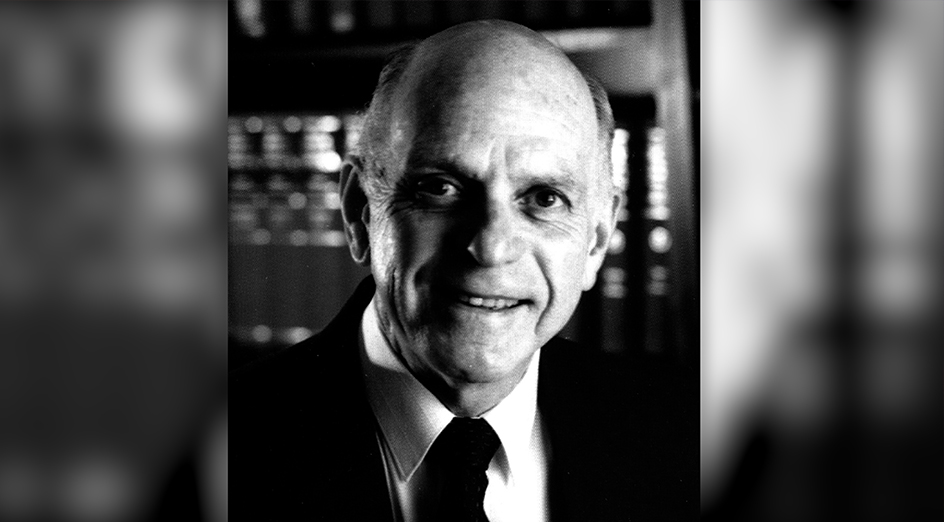
Emeritus Professor David Tunley, AM
MMus (Durham), DLitt, Hon. DMus (UWA), FAHA, DSCM, LTCL
Chevalier de L’Ordre des Palmes Académiques
Professor Tunley, along with Professor Callaway, established University of Western Australia as one of the most important music programs in Australia. Beginning at UWA in the late 1950s, Professor Tunley became a world authority in music of the French Baroque, having lived in Paris where he studied with Nadia Boulanger.
Generations of Australian musicians owe David a debt of gratitude for his undergraduate teaching, and for the scores of Masters and Doctoral students that he supervised with compassion and his encyclopaedic knowledge of the span of music history.
Professor Tunley’s compositional output is heard around the world, with his Concerto for Clarinet (1965) being a notable contribution to the repertoire. An author of 8 books, and more than 70 articles, he also held research positions in Oxford, and for the Rockefeller foundation in Italy.
He made a considerable contribution to the Perth Community, founding the much-loved York Winter Music festival and the Terrace Proms.
A former Head of School at UWA, Professor Tunley was often seen in his retirement at performances in venues around Perth, and attended many events at the UWA Conservatorium, showing great interest in student performances.
David died in 2024 aged 94.
Tunley’s “Introduction and Scherzo” for Clarinet and Strings to whom the composition was dedicated. The performance was on Saturday 5th August 1961 at 8pm in Winthrop Hall at the University of W.A. conducted by John Farnsworth Hall. It was broadcast live to air by 6WF.
The work was included a series of three concerts by the W.A. University Arts Union arts festival from July 18 to August 8 1961. The 1961 W.A. University Arts Union Festival was a massive inter-university student arts, music, and drama festival. Hosted by the Guild of Undergraduates at the University of Western Australia (UWA), it featured performances of chamber music, jazz, and folk music, as well as choral events, Asian dance, drama, and debating.
The Festival programme also featured the University’s A Cappella Choirwhich David Tunley had founded shortly after joining the music staff in 1958. Marcia Harrison was a member of this choir.
MUSIC by Peter Hellstrom
As a contribution to the W.A. Music Council’s bursary scheme, the University Music Society will hold a public concert in Winthrop Hall at 8 o’clock on Monday night. The programme will be presented by the University Orchestral Society, clarinettist Jack Harrison and the University’s A Cappella Choir. They will perform works by composers of the 16th Century to the present, including compositions by Perth musicians Jennifer Fowler, David Tunley and Trevor Jones. [1]
MUSIC by Peter Hellstrom
Three concerts in Winthrop Hall will be highlights of the W.A. University Arts Union arts festival from July 18 to August 5 (1961).
The first, on July 20, will be a free lunch-hour programme presented by the W.A. Symphony Orchestra conducted by John Farnsworth Hall. Soprano Lynette Howieson will be soloist.
The next will be presented by the Kiranta Trio during the lunch-hour on July 27. Members of the trio are pianist Patricia Burns, flautist William Frater and bassoonist Brian Pope.
The final concert, which will start at 8pm on August 5 will feature the world premiere of David Farquar’s Concerto for Piano and Orchestra. The programme will include works from the 16th Century to the present. The artists will be the University String Quartet, pianist Michael Cole, bassoonist Brian Pope and clarinettist, Jack Harrison. [2]
FESTIVAL CONCERT TONIGHT
World Premiere of David Farquhar’s prize winning Concertino for Piano and Orchestra
First Performance in Australia – Chamber Concerto No. 3 for Bassoon, Strings and Percussion by Elisabeth Lutyens.
David Tunley’s Introduction and Scherzo for Clarinet and Strings
Plus works by Dvorak, Grieg, Delius, Elgar, Walton and others.
UNIVERSITY ORCHESTRA conducted by Trevor Jones.
Soloists: Michael Cole, Jack Harrison, Brian Pope.
Assisting Artists: John Mowson, John Dean, Verdon Williams.
WINTHROP HALL
8pm Sat 5th August 1961
Unreserved seats at door 10/ Students 7/6
LIVE BROADCAST
MUSIC by Peter Hellstrom
Saturday 5th August 1961
The first performance of University lecturer David Tunley’s “Introduction and Scherzo” will be broadcast from station 6WF tonight during a concert beginning at 8pm. The work, which is for strings and clarinet, will be played by the W.A. Symphony Orchestra conducted by John Farnsworth Hall, and the soloist will be Jack Harrison to whom the composition has been dedicated. [3]
| May 1961 | David Tunley Introduction and Scherzo WORLD PREMIERE | Jack Harrison (clarinet) University Orchestral Society John Farnsworth Hall (conductor) | Winthrop Hall, University of Western Australia Radio Broadcast 6WF |
MUSIC
By Peter Hellstrom
The Master of Queens Musick, Sir Arthur Bliss, has told the Festival Of Perth committee that the planning of the musical programs in the coming festival is a magnificent gesture to British music and should be more widely known. That it has become well known already in Britain is showing by letters from many leading authorities there they include congratulations from the executive of the Composers Guild of Great Britain. Though some prominent English music festivals like Cheltenham Aldeburgh and the longest established Three Choirs Festival feature their country music, no British festival has in recent times included such an extensive and exciting range of British music in one series. Works of nearly 70 composers are included. The Perth programs have been wisely spaced over the six week festival period and though many of the concerts will start at the customary 8 pm some will be at 6 pm to enable patrons to attend another festival attraction the same evening.
Works by Vaughan Williams Gordon Jacob, Howard Ferguson, Lennox Berkeley and Michael Tippett will be new to W.A. The London Symphony Orchestra conducted by Colin Davis will introduce Bliss’s “Discourse for Orchestra” to Australia in one of its Perth concerts. In the other, Tippitt’s Symphony No. 2 and Stravinsksy’s Symphony in Three movements will be played here for the first time. Leading W.A. musicians appearing as soloists in the festival will include soprano Molly McGurk who will sing Benjamin Britain’s song cycle Les Illuminations with the W.A. Symphony Orchestra. She will also sing the solo soprano part in the University Choral Society’s performance of Vaughan Williams A Sea Symphony. Stephen Dorman will be the accompanist for tenor David Galliver’s three British song recitals. He will also partner violinist Vaughan Hanley in a Sonata recital and will play the solo part in constant Lambert’s Concerto for Orchestra and Nine Instruments. Jack Harrison will be the soloist in David Tunley’s Clarinet Concerto and will be joined by the Oriole Quartet in Bliss Clarinet Quintet. Graham Wood will introduce James Penberthy’s Romance for Violin and Orchestra and Alice Carrard will be the pianist with the A.B.C. Wind Players in Rawsthorne’s recent quintet. Madame Carrard will be joined by Mr Dornan, Stephanie James and Michael Cole to perform Malcolm Williamson’s new Concerto for Wind Quintet and two pianos. The new university organist, Mr John Hind, will be soloist in a program which will feature the W.A. Bach Society. The Oriel Quartet will also be the soloists with the W.A. Symphony Orchestra in Elgar’s Introduction and Allegro for strings and will give a separate recital of works by Howells, Frank Bridge, John Exton (the newly appointed senior lecturer in music at the university) Gerald Finzi, Elizabeth Lutyens and Edmund Rubbra. [4]
Tunley)
Serenade (Ferguson)
B Flat Divertimento (Berkeley)
WINTHROP HALL
Reserve Prices 11/-, 8/6, Unreserved from 5/ at hall after 7pm
Local Composer’s Work Earns Warm Ovation
By Stephen Wild
The first performance of a composition by West Australian composer, David Tunley, deservedly received an enthusiastic ovation at the third concert of British music at Winthrop Hall last night. The soloist for Mr Tunley’s Concerto for Clarinet and Strings was Jack Harrison to whom the Concerto is dedicated. The facility and musicianship with which Mr Harrison performed the solo part was misleading. It’s technical difficulties and subtleties could be navigated only by one of Mr Harrison’s capability. The work itself reveals a composer endowed with a wealth of musical ideas and the sensitivity and craftsmanship to mould those ideas into an artistic whole. Written over several years, the quality of inspiration is uneven. The second and third movements gain in musical worth over the first. The brooding and intense second movement was extremely moving, mainly because of Vaughan Hanly’s sympathetic conducting. The third movement is indebted to Bartok, and its difficult rhythms were not entirely successfully negotiated by the Orchestra.
A prince of instruments with an Australian note.
By James Penberthy
The most satisfying event in the Festival Of Perth is, for me, the first performance of David Tunley’s Clarinet Concerto. This performance was not a commendable crumb thrown to a local lad. It was a notable Australian musical event and the natural right of the composer. The Concerto was played by Jack Harrison and an orchestra conducted by Vaughan Hanly in Winthrop Hall last Tuesday night. This was only the first of many performances, for the work will be undoubtedly recorded and published. It will then become part of the standard repertoire for the clarinet which is, of course, one of the Royal princes among instruments. Some of the music of today baffles judgement and general appreciation. It is based on formulae which can be learned in 10 lessons by a child who failed in junior arithmetic. But Tunley is not like that; he expresses his feeling in music, feeling which is skilfully woven by song and harmony and charged with vital human rhythms. He is no baffled mathematician posing as a composer. In his Concerto for Clarinet and Strings, Tunley has given us music from the head and heart; music which though modern, is still recognisable in the listeners heads and hearts as music. I am sure that Jack Harrison’s clarinet playing is almost up to the composers ideal for a performance of this work. But Vaughan Hanly showed his one pronounced weakness in conducting he beats nice rhythms but he never electrifies them. He is strangely enough much gentle with the baton than with the violin. The Concerto’s first movement could perhaps be tightened up. That, of course, is the composer business. But if I may presume I would ask for more fluidity. The lyrical first subject germ seemed sacrificed to a nervous complaint in the disjointed episodes. It is fair to assume that the composer intended it just that way. The second movement from the first, uncertain note of the viola, had the stamp of creative intuition and originality. The bittersweet harmonic flavour, the delicate sighing; the strength, the gentleness all came to an end too soon. Movement three was eloquent and rich for the clarinet as well as the listener sighing – strings mounting to a fine climax – vital rhythms with again two little orchestral drama – the clarinet, leaping and gliding and crying in torment – and the end is final and beautiful as natural death. [5]
JACK HARRISON
From the printed programme
In the fifteen years since Jack Harrison first joined the clarinet section of the West Australian Symphony Orchestra, he has become a prominent figure in W.A. musical circles. Hi appearances as soloist with the orchestra include both saxophone and clarinet concertos. Notable highlights were the Australian premieres of the Aaron Copland Clarinet Concerto and the Richard Strauss Double Concerto for bassoon and clarinet. On this occasion, the bassoon soloist was his twin sister Jill. In addition to his orchestral work he has been associated with many chamber music ensembles and his own light music ensemble. The concerto to be performed this evening is of particular interest, for it was composed by David Tunley, Senior Lecturer in Music at the University of W.A. and was written for and dedicated to Jack Harrison.
MUSIC
A CONCERT
By Peter Hellstrom
Saturday August 5th 1967 8pm
An unusual and exciting concert will be given in Winthrop Hall on August 5 in aid of the building fund of St Columba the new university men’s residential college. Called “Concert Extraordinary”, the varied program will involve more than 300 performers including several leading W.A. musicians, all of whom will donate their services to the appeal. Directed by John Hind, the Bach Society Choir will sing Benjamin Britain’s “Hymn to St Cecilia” and the Perth Madrigal Singers will sing ”The Daniel Jazz” by Herbert Chappell. The University’s A Cappella Choir conducted by David Tunley, will sing English madrigals. The University Choral Society will join combined choirs in performances of works by Mozart and Handel which will be conducted by Professor Frank Callaway. The program will open with university organist, John Hind, playing Bach’s great “Toccata and Fugue in D minor”. Violinist Vaughan Hanly will play Saint-Saen’s “Introduction and Rondo Capriccioso” with pianist Stephen Dornan who will also be heard with soprano Margot Robertson and clarinettist Jack Harrison in Schubert’s “The Shepherd on The Rock”. Jack Harrison will also play harmonica solos.
MUSIC
By Peter Hellstrom
An aspect of the Festival of Perth already creating interest throughout Australia is a workshop series of four Australian composers to be presented by the A.B.C. in conjunction with the festival committee. The workshops will consist of programs of works mainly for Orchestra. Several will be first performances they will be given in the Basil Kirke Studio at 6 pm on February 15, 22 and 29 and March 7. Each program will have a different conductor. The conductors will be Henry Kripps, Patrick Thomas, John Hopkins and Thomas Mayer. A further special feature of each program will be the presence of at least one interstate composer who will come to Perth for the occasion. The composers are Nigel Butterley, Larry Sitsky, Felix Werder and Richard Meale. Other interstate composers whose works will be performed are Colin Brumby, George Dreyfus Helen Gifford, Peter Sculthorpe and David Ahern. The four W.A. composers contributing to the programs are James Penberthy, Dr John Exton, David Tunley and Jennifer Fowler. As a contrast to the formality of the normal concert presentation, the workshops will include discussion between conductors, composers and members of the audiences. In several of the concerts, provision has been made for some works to be played twice to give listeners a further opportunity of coming to grips with the new music. The chairman of the Festival Of Perth music committee, Professor Frank Callaway, said yesterday that W.A. compositions would include Mr Tunley’s Concerto for Clarinet and Strings (with soloist Jack Harrison), Dr Exton’s Movements for Orchestra, a recently completed string Quartet by Jennifer Fowler to be played by the Oriel Quartet and James Penberthy’s Cantata for Chorus and Orchestra “The Swan of Bibbulman”. This will be performed by the Lyrics Singers and the W.A. Symphony Orchestra. The work is set to a poem by Mary Durack. [6]
Tunley Nigel Butterley and Colin Bromley. Mr Butterley will direct the performance of his “Laudes” (1962). The other works will be performed by the W.A. Symphony Orchestra conducted by Henry Kripps with soloist Jack Harrison (clarinet). An illustrated talk by Mr Butterley will follow the music. The idea behind the workshops is to present composers’ work and then for the composers to discuss aspects of the music with the audience and performers. The works of all three composers at next Thursday’s workshop will attract attention but special interest will centre on Sydney born Nigel Butterley. His “In the head the fire”, a work for radio commissioned by the A.B.C., won the international Italia prize in 1966. He has written five film scores, song cycles, liturgical music, a ballet, a string Quartet and other works. David Tunley, senior music lecturer at the W.A. University, is doing research into 18th century French cantatas. Colin Brumby, a senior music lecturer at the Queensland University, has written three books on music. Several of his compositions have been recorded. [7]
Two Composers Talk about Their Work
By Sally Trethowan
Thursday February 15 1968
The series of four Australian Composers Workshops presented by the A.B.C. and presided over by Professor Frank Callaway is one of the most significant musical events included in our Festival Of Perth. The series which is free, has been organised to present to Perth audiences some of the principal facets of the contemporary Australian musical scene. Nearly all chairs were occupied in the Basil Kirke Memorial Studio last night for the first workshop. Three works were presented two of them introduced by their composers. West Australian David Tunley and Nigel Butterley from Sydney. When introducing his “Concerto for Clarinet and Strings” (1965), David Tunley remarked that the work was comparatively conservative and that it had been moulded by the clarinet style of the soloist Jack Harrison. It may be conservative if considered against the most advanced of today’s exploratory techniques, but this is no cause for disparagement. Indeed, the thematic structure is so loosely and adroitly plotted that the work can be grasped though not exhausted at a first hearing. The tone of the work is at times acrid, at times lyrical. Though there is no lack of wit, the core of the composition is the introspective and affecting musings of the slow movement. Jack Harrison’s skilled and sensitive realisation of the solo part was complimented by splendid playing from the string members of the W.A. Symphony Orchestra directed by Henry Kripps.
COMPUTED SEQUENCE
Mr Kripps also conducted the full Orchestra in a work written in 1963 for him and the South Australian Symphony Orchestra. Colin Brumby’s “Fibonacci Variations” employs the modern serial technique, the series in this case being a special sequence of numbers computed by the Italian mathematician Fibonacci. Though a score and plenty of time are necessary to follow through the abstruse patterning’s of such a work, Brumby’s music, which was brilliantly performed by conductor and Orchestra, made an immediate impact by its vitality. Nigel Butterley’s “Laudes” (“Praises”) written in 1962 is as impressive of work as its composer is a speaker. A man of intense personal faith which illuminates his music, he spoke simply and tellingly of the “Laudes” which is in four movements scored for eight solo instruments, and is prefaced by a quotation from the mystical poet Thomas Traherne. The work originated from visits made to various churches in Europe. For instance, the serene first movement was the result of contemplating the mosaics in the basilica in Ravenna and the third movement, the interior of Kings College Chapel Cambridge. Each movement has a distinctive character and beauty that may be appreciated whether or not the architectural associations are considered. The idiom used is a free serialism though as Nigel Butterley said, technical matters are not nearly as important as the ideas behind the music. [8]
This Talk is so Unnecessary
By James Penberthy
When a composer is present for the performance of his own work, he exposes himself, when he talks about his work as well, he exposure borders on indecency and is, or should be, unnecessary. There was too much talk and two little music at the first of the composers workshops held in the A.B.C. orchestral studio on Thursday evening. There was a very large and attentive audience present to hear music by David Tunley of W.A., Nigel Butterley of New South Wales and Colin Brumby of Queensland. There are not many towns in Australia that can furnish such a fine audience for contemporary Australian works and when Henry Kripps, the conductor of the West Australian Symphony Orchestra for the occasion, berated the audience and the Orchestra for their attitude, he was well wide of the mark. Mr Kripps had resented what he thought were unworthy words and laughter about the music of Nigel Butterley. The music should speak for itself if it is worthy of its mettle. I know some of the composers and some of the music which is to follow and I am afraid if the series of concerts is permitted to become a talk workshop instead of a music workshop, there will be unpleasant scenes. I was sitting well back in the hall and on every side I heard complaints about the amount of talk and very little about the modern music. The music was brooding, tense rhapsodic and syncopated when Jack Harrison played David Tunley’s work for clarinet and strings. There was nothing to puzzle the audience for the lines of rhythm and melody and the blocks of harmony were based on an accepted and well recognised tradition. Nigel Butterley’s “Laudes” for a small group of instruments was just as easy listening, provided the audience sat back in the air-conditioned comfort to let the music speak. The sounds inspired by four European churches were economically drawn and brought a quiet mood to the quiet, sensitive listener. One should not fight new music. It is like fighting the incoming tide. Colin Brumby’s Fibonacci Variations were built on mathematically deduced ideas. They were exciting and very dramatic. The orchestra, which often looks bored playing Beethoven, never looked bored while playing Brumby. [9]
TUNLEY
Soloist Jack Harrison
The Concerto for Clarinet and Strings combines elements of rich romanticism with the more pungent harmonies and buoyant rhythms of the 20th century “neo-classic” idiom. It was written for Jack Harrison, whose particular style of playing moulded much of the works character, particularly in the cadenza of the opening movement which is accompanied by a solo double base whose throbbing rhythms and deep sounds is reminiscent of the didgeridoo. The slow second movement catches an intensity of expression eminently suited to the solo instrument giving way to a lilting dance in the finale.
Concerto for Bassoon and Orchestra JAMES PENBERTHY
Soloist Jill Mowson
The Bassoon Concerto was written in November 1954 for the West Australian Symphony Orchestra’s John Cran. He never played it and the first performance was given by George Dreyfus with his own Melbourne Orchestra 15 years later. There were only two movements consisting of fast and slow sections showing the agility of the instrument in merry if not clownish mood, and in contrast and eloquence in a more reflective manner. A new second movement, very serious in nature, was written this year specially for the present Jill Mowson performance. The old second movement now becomes the third.
Tunley, James Penberty and Peter Sculthorpe. Tunley, as the only composer present, gave a brief background to his Concerto for clarinet and Strings in which Jack Harrison (to whom the work is dedicated) was the soloist. Possessed by a clarinet part of considerable technical difficulty, this piece was suave. Elegantly finished phrases and strings and soloist complimented each other in a deftly assorted variety of tempi, moods and rhythms.
James Penberthy, writing for larger orchestral forces, occasionally thickened his textures so that the rather reticent solo instrument in his Concerto for Bassoon and Orchestra had something of a struggle to survive. But bassoonist Jill Mowson played it with pleasantly controlled tone. Peter Sculthorpe’s recent “Mangrove” evokes a quality of “Australian” atmospheric sound, using conventional orchestral means in new and unusual ways. A brass prelude leading to a lengthy divisi cello passage moved to high wavering violin sounds. It travelled to percussion and brass for the ending to create a picture of some features of a desolate land. It is a piece that deserves rehearsing. [10]
A Shame this music remains a Stranger
By Anne Hodgson-Goodman
Why do composers today continue to write music when so few people care to hear it? That was the question reviewed by an ABC Workshop of contemporary Australian compositions in the Basil Kirke Studio last Sunday.
The orchestra’s performance must have satisfied David Tunley. The concerto was inspired by the technique of Jack Harrison, principal clarinettist of the WASO who, as soloist at the workshop met the considerable technical difficulties with mastery and style. Although the work is not easy to perform, Tunley never lost touch with musicality. In different ways, each of the three movements demonstrated a fine compositional ability. The general impression was matched by Jill Mowson, the soloist in James Penberty’s Concerto for Bassoon and Orchestra. But she had a more difficult task. The proliferation of ideas in the orchestra made at times an uncomfortable background for the comparatively soft-toned bassoon. Nevertheless, the tonal colour of the instrument was well employed throughout the work, and Jill Mowson demonstrated her technical expertise and understanding. Finally, the audience heard a recent work by Peter Sculthorpe – Mangrove for Orchestra. [11]
https://www.australianmusiccentre.com.au/work/tunley-david-concerto-for-clarinet-and-strings
[1] The West Australian Saturday (cut off) 1961
[2] The West Australian Saturday July 15 1961
[3] The West Australian Saturday 5 August 1961
[4] The West Australian September 1965
[5] The Sunday Times February 13 1966
[6] The West Australian Saturday December 23 1967
[7] The West Australian Saturday February 10 1968 page 23
[8] The West Australian Friday February 16 1968
[9] The Sunday Times February 18 1968 page 32
[10] The West Australian Monday September 24 1979 page 27
[11] The Sunday Times September 30 1979