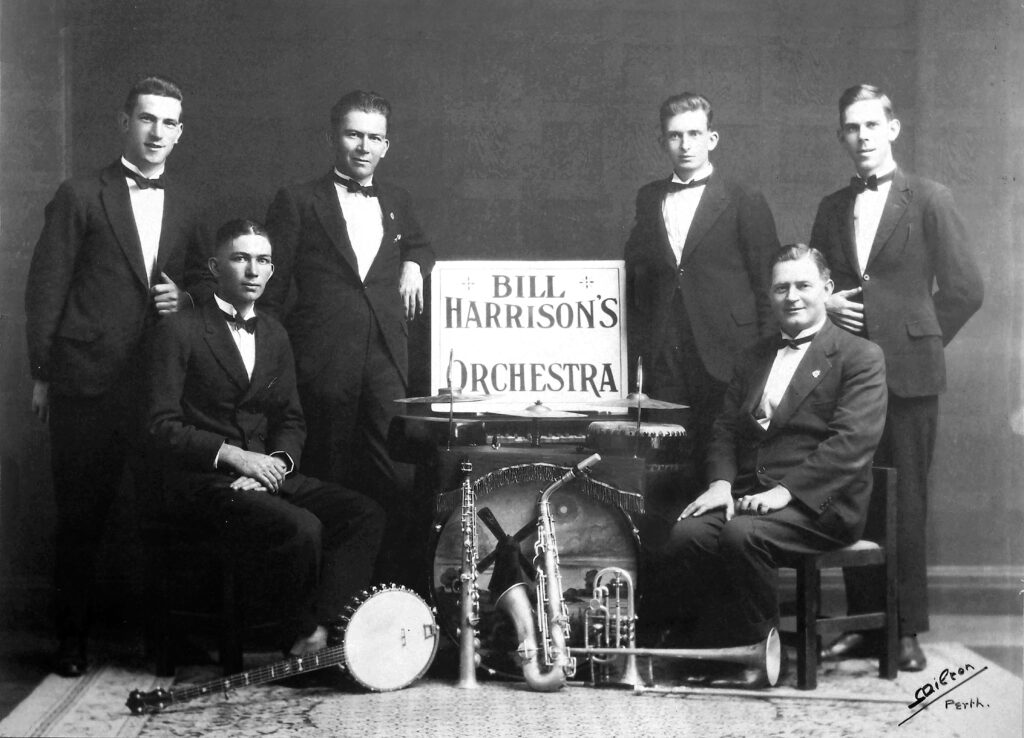
HARRISON, Charles George was Jack Harrison‘s Uncle
20.8.1907 – 26.8.1996
Charles George Harrison was the fourth and last child born to Arthur Dight Harrison and Phoebe Alice Parsons at 256 Perth Street, Subiaco. On arrival, he was a cherished fella as he was so much younger than his siblings.
From correspondence we know that Charlie didn’t enjoy good health as a child..
In January, 1908 his sister Nellie Harrison wrote to “Uncle Tom”, the editor and co-ordinator of the fundraising club the Sunshine League at the Daily News newspaper and asked to be put on the Sunshine League roll.
In 1909 Nellie wrote:
MY LETTER BAG
256 Perth-street, Subiaco.
Dear Uncle Tom, — I thank you for my prize which I received a little while ago. I have read it and Will has too. And dada is away in Albany. On Friday after school I went to Congdon-street to stay till Monday morning with Mrs. Richardson. Mama told me that Mr. Richardson built your ‘Daily News’ office and the Home of Peace, too. On Sunday while I was away our dear little baby Charlie was sick; and mama told to send for the doctor. It was convulsions, but he got up to-day. I am glad he is better. On Monday when Willie was at carpentry, he fainted, and he is sick now. Will asks me to say he would try and sell a few tickets for ‘The Carnival of Flowers’ on May 1. He will write when he gets up. I am sending three stamps for the Children’s Hospital. I am tired now, dear Uncle Tom. – Your loving little niece,
NELLIE HARRISON, aged 7 1/2.
Dear Nellie, – I have sent Willie a few tickets to sell for the ‘Carnival of Flowers, I shall be pleased to see you all present. You have sent me a lot of bad news this week. I hope you next letter will be full of good news – Uncle Tom.
Daily News 10 April 1909
MY LETTER BAG – 256 Perth Street Subiaco
Dear Auntie Nell, it is a long time since I have written to you, but I always read the Children’s Page. I used to write to ‘Uncle Tom,’ and I got three prizes from him. One was for an essay on ‘The Spider,’ and the others were for two letters. I have coloured the Scout and I am enclosing it. I have three brothers; two older than myself and one younger, and I am ten years old and will be eleven next September. I am in the higher fifth at school. I will now close, as it is bed time. Hoping you are well. I remain your loving niece,
NELLIE HARRISON.
Dear Nellie, I do not remember you writing to me before, it was possibly to ‘Uncle Tom’ that you wrote, and I have been so busy that I have not been able to look your letter up. Now that you tell me about the essay on ‘The Spider’ I shall find it and read it. Can’t you get., your brother to join, the League? Do you think you and your brothers could help in a pretty opera if we decide to give it in aid of the Children’s Hospital? With love, dear,
From yours lovingly, Auntie Nell
The Daily News Saturday 20 July 1910 page 2
256 Perth street Subiaco
Dear Auntie Nell,— I have not written to you for a long time, but I have not forgotten you. I was one of Uncle Tom’s nieces, and I have four prizes which I got from him. They are very nice books, the names of them are ‘Road Rail,’ ‘Sea Dorothy,’ ‘In Dormsdorp,’ and ‘Sunshine ‘ and the Fairy Queen.’ Our baby will be three years old, next Saturday. He is such a funny little fellow; his name is Charlie George, but he calls himself Charlie Mick Harrison. I will now say good-bye, dear Auntie. -Your loving little niece,
NELLIE F. HARRISON, aged 8.
Dear Little Nellie,— Yes, it, is a long time since you have written, and I thought you had forgotten all about me. What a lot of nice prizes you received from Uncle Tom. I hope you will try and win some from me too. You write a good letter for a little maid of eight years, and your writing is very good also. What a sweet little man Charlie must be. He must amuse you all very much with his dear, funny little ways. When he is big enough you must ask him to write me a letter— I should love to have him for a little nephew. Good-bye, dearie.
—Take much love and a kiss from yours lovingly, Auntie Nell.
Daily News Saturday 27 August 1910 page 11
Charlie Harrison attended Perth Boys School from 1913 until he attained 8th standard.
He was in the Scouts from January 1918 up until 1925 where he learnt to play the bugle.
Leader A. L. Harrison, who has just resigned, after seven years’ service, introduced his younger brother to take his place; Leader Harrison’s elder brother was also a member of the Troop.
The Daily News Saturday 12 January 1918 page 8
After training in mechanics at Perth Technical School in 1921, Charlie Harrison was employed from 1923 until 1928 at Bovell’s Motor Works Subiaco (according to his WWII record). He did up vehicles and sold them:
25 Oct 1924: T.T. Triumph, in perfect order, a bargain at £30. Harrison, Bovell’s Body Works.
Y.A.L.
Charlie Harrison played the bugle according to this reference of him touring interstate with the Y.A.L in December 1923/ January 1924 when he was 16:
(Jack Harrison) has taken part in many Y.A.L programmes and he is always a popular performer. His Uncle Charlie (Harrison) was a bugler on the “Boss” staff on an Interstate tour of 1924. That was long before Jack was born, but the family has kept in touch with the League ever since.
The Boomerang August 1943
The role of “bugler” was an important one as is detailed in this article:
THE Y.A.L. BOYS
FROM WEST TO EAST.
LIFE ON GREAT WESTERN EXPRESS.
(From Our Representative.)
With such material as 340 boys approaching the end of their school years, and others just out of that period it might be thought that the present Y.A.L. interstate tour for education travel, which started on December 30th might rather develop into an affair which would give the boys the opportunity kick over the traces and sow a harvest of trouble for themselves. So far there
has been no sign of this. The outstanding feature to date is the remarkable order maintained by the leader (Mr. J. Simons) and the 10 officers under him, each of whom is in command of a company of about 30 boys, from whom four prefects are selected, making 40 in all nominated by the leader for their steadiness and strength of character, to help in the maintenance of discipline. There is practically no insubordination, and probably less need for punishment than exists in the ordinary school, no wild outbursts and bravado, nobody who tries to hang out of the window by the toes while the train is in motion, and no young rascal who tests himself as a prospective wire walker by balancing on the railing at the end of the carriage. The traditions of the Y.A.L. do not lead to this sort of thing, which has been tried in the past with painful results to the chief actors. The boys know from what has happened in the past that there is no bluffing when it comes to dealing with wrongdoers. The newcomers learn all from the boys who have been on previous tours. The spirit of the Y.A.L. soon infused into the latest recruits, a that is largely why everything is running so smoothly. There is no jumping on and off trains at will. A bugler gives the signal. He also controls lights out 9.30 p.m. and rising at 7 a.m., before which no talk is permitted. There is an interesting example of what happens when the morning rule was not enforced on the second day from Perth. The train was rumbling along at daybreak. The boys were all believed to be asleep as were most of the officers, who had only retired about two hours before through attending to those who had to be picked up along the route. When the train suddenly stopped there was heard An Amazing Chorus
of argumentative high-pitched boyish voices from one end of the train to the other. They were awake with the birds and were equally as vocal. One after the other the officers were roused by the noise. That afternoon on parade it was earnestly pointed out that something nasty waited those who might again participate in such an outburst of youthful spirits before 7 o’clock. The order was obeyed implicitly, but they made up for this suppression of their energies when the bugle sounded, and there was no more sleep that morning.
The boys arc not leading a dismal life by any means. There is plenty of fun day and night, each to his own liking; literature (humorous and heroic), games and tales, comic and popular songs and choruses, and instrumental music-band instruments, and many of a humble and disagreeable type.
Breakfast at Karalee on the morning of New Year’s Eve was remarkable for its simplicity, sufficiency and despatch. With stomachs yearning for food since the incident at daybreak, the boys formed up in companies outside their carriages and filed through the railway’s barracks where in about 15 minutes all had received a cup of tea, a pie and a large piece of cake, and sat down anywhere outside and were well filled. Thus handicapped, the brass (band of 40 players) proceeded to have their morning “blow” under the conductor, Mr. Val Smith, who with 36 raw recruits to train, has made such progress that his band was able to march and play in Hay-street on the day before their departure for the Easten States, and have been greatly admired at stations across Australia.
The first part of the journey to Kalgoorlie was done in darkness, and consequently the boys were unable to see the beautiful country on the way to and beyond Northam, and the broad wheatlands stretching to eastwards. Many little crowds gathered at the various stations and wished them well, one of the most, enthusiastic being an old boy of the Y.A.L. now wearing a returned soldier’s badge, who bad travelled 23 miles to revive memories of a 12-year old tour in which he had participated.
The train dashed through old Coolgardie, once rich and famous for its alluvial gold deposits which thrilled the world, attracted thousands, and built a town whose (business centre was often as crowded as Hay Street, Perth. Its condition today pains those who knew it 20 years ago. Most of it has been dismantled. Only here and there stand a few weather-beaten structures in deserted streets. There were four or five people on the Station platform. Passing
the outskirts of the town, the young travellers get glimpses of some of the early alluvial diggings where hundreds of men made fortunes. Pot holes everywhere vividly visualised to them the feverishness of The Gold Hunt of bygone years when not a square foot of ground that gave promise of reward was not turned over. In the midst of these stood an old bearded prospector. The youngsters responded to his waving hand with a shrill chorus, in the middle
of which he dropped his arm, looked reflectively at the ground and walked away.
A few hundred yards further along four little children, bootless and hatless, ran from over the bill with upraised arms and roused a responsive yell from the train. They stood motioning their good-byes until lost to view, and eagerly awaiting the day when they may participate in an even bigger Y.A.L. tour.
Lunch was served at the Kalgoorlie Town Hall. The league had arranged to meet the situation in advance, and was assisted by a few friends in much the same way as at Karalee, so that feeding was speedily over, and, after a short march in Hannan Street, it was not long before the journey was resumed, with the addition of a party of 20 boys from the goldfields. The Mayor of Kalgoorlie called on Mr. Simons and his officers before they had left the Town Hall and wished them a successful tour.
The journey of 1,051 miles from Kalgoorlie to Port Augusta was accomplished under pleasant weather conditions.
What was lacking in scenery was made up by comfort on the Great Western express, the officials of which provided everything that the young tourists desired. All had sleeping accommodation, and the quality of the food was such that not a course was missed, and all plates were cleaned. In fact, it is expected that the 160Ib. of sausages, 2001b. of beef, and 2001b. of mutton, not to mention the vegetables and fruit, will have vanished with the serving of the last meal at Port Augusta. There were two dining cars; meals were served in relays of 40, and to meet the situation the railway staff had to be more than doubled.
The boys learned on the journey that an experiment was commenced a few months ago by Mr. P. J. Watson, of Mundrabilla station on the south, with the grazing of 2,000 sheep on the salt-bush and blue-bush land in the vicinity of Forrest, 651 miles east of Kalgoorlie, water being provided by the Commonwealth bores. The good news was also imparted that, as the result of recent rains, when there was hardly a week’s water in the dams, the supply will now occasion no anxiety for 12 months. The six million gallons dam at Tarcoola, it is stated, was filled to overflowing in an hour and a half. Prior to this the railway authorities had to cart water over the line for hundreds of miles from each end.
After passing the country east of Kalgoorlie timbered with salmon gums, kurrajongs, gimletwood and sandalwood, which cover the first 187 miles, there comes the fringe of the Nullarbor Plain lightly clothed with myall, mulga, and black oak for about 40 miles, the rest of the 400 miles being nothing but low saltbush and bluebush, through which the railway runs without a curve for 300 miles. Then there is the 50 miles belt of the Ooldea sandhills with its mallee gums, silky oak, black oak, native cork and myalls, the proximity of which is signalised by the Musgrave Range on the north-east. Red soil plains and undulating country characterise the track to the hilly country around Tarcoola. It is well grassed and timbered with black oak and myall and occasional eucalypts. The run down to Port Augusta from Tarcoola is mainly through the lake country, vast and shallow in the rainy reason, but mere sheets of salt in the summer. After a spin of about 50 miles through more plain country, relieved by flat-topped hills in the south-west, the terminus is reached at the head of Spencer’s Gulf. On a rainy morning with thunder and lightning, Port Augusta was reached about two and a half hours late owing to engine trouble occurring on the uphill run from Tarcoola, and the party was three hours behind by the time, the change was made to the narrow gauge line which winds its way for 120 miles through the hills to Terowie. The Cloud-capped Ranges,
lit by the morning sun, were a beautiful sight, and many owners of cameras were
busy snapping effects rarely seen in their own State. Notwithstanding that the night was well advanced, the boys were full of excitement with their near approach to Adelaide. Tea was speedily served on the platform at Riverton; the travellers rushed on again, the train still reducing the time lost since Tarcoola. Luggage was packed, and final touches were put on uniforms and band instruments ready for the appearance in the city. Steaming into the station, a few minutes before 10 p.m. on Wednesday, the youngsters finished off their lemonade, drinking 300 dozen bottles for the trip, and cheered and whistled with satisfaction at the conclusion of the long journey to the South Australian capital. A large number of people welcomed them. Lorries were waiting outside and baggage was taken to the Jubilee Oval, in North-terrace, whither the party marched with band playing and flags flying. Late tea was served, and before midnight, everyone was in bed in the grandstand receiving the benefits of open-air sleep.
Western Mail Thursday January 10 1924 page 38
The Y.A.L. boys now touring the East arrived in Melbourne from Adelaide last Tuesday afternoon. They will spend a week in the Queen City.
Sunday Times Sunday 13 January 1924 page 14
Y.A.L. TOUR: – Doings in Sydney
The Y.A.L boys have been out all day and to-night. They spent the morning at the Taronga Park Zoo to which they were carried across the harbour in a special ferry boat, and they cooled themselves in the afternoon at the Clifton Gardens baths. Tonight they were at the Rushcutters’ Bay Stadium enjoying a programme of boxing and vaudeville. The Lord Mayor of Sydney will tender a civic reception to the Y.A.L. party at noon tomorrow.
The West Australian Thursday 17 January 1924 page 9
Charlie was a groomsman for his brother William Edward Harrison when he married Edna May Kerr on the 25th July 1925.
January 16th 1926, William’s sister Nellie married Edward Francis McDavitt with Charlie Harrison as a groomsman:
McDAVITT-HARRISON.
A pretty wedding was solemnised at St. Mary’s Church, West Perth, recently, by the Rev. Riley, when Nellie, only daughter of Mr. and Mrs. A. Harrison, of Nedlands, was married to Edward F., son of Mrs. and the late Mr. E. McDavitt, of West Perth, The bride, who entered the church, on the arm of her father, made a charming picture in a gown of heavy morocain, richly embroidered. The train of morocain was lined with shell pink georgette, and the veil fell softly from a becoming chaplet of orange blossom. A shower bouquet of roses completed her toilette. The bride was attended by two bridesmaids, the Misses Lily Faddfson and Marion Hobbs, both of whom wore dainty frocks of shell pink and powder blue crepe de chine respectively and black picture hats. The bridegroom was ably supported by Mr. Keckwick,
and Mr. C. Harrison, brother of the bride, was groomsman. After the ceremony a reception was held at Wembley Hall, where a large number of guests were received by Mr. and Mrs. A. Harrison, the hostess wearing to advantage a gown of black morocain, with trimming of crystal beads and black hat with ospreys. Mrs. McDavitt, mother of the bridegroom, was gracefully attired in embossed, morocain, with hat en suite. After congratulations and good wishes had been expressed to the bride and bridegroom, a happy time was spent at the wedding breakfast. The customary toasts were honored, and later music and dancing were enjoyed. Mr. and Mrs. McDavitt left by car, the bride travelling in a pretty gown of saxe blue morocain, with touches of red and a. smart black hat. Many beautiful presents were received, including cheques. Their future home will be at Cottesloe.
In the 1928, Charlie Harrison played xylophone, drums and (apparently) bad saxophone in his brother William Harrison’s band.
Charlie lived with his parents Arthur and Phoebe at 18 Kitchener Street, Hollywood and in 1930 ran a milk supplier business and owned 2 horses. Charlie went into a shop on the corner of Lake & Aberdeen Streets to see if he could deliver milk. This shop was run by Ethel Longbottom, mother of sisters Ruby, Pearl and Emerald Koeford who lived at 105 Francis Street North Perth. Charlie initially dated Pearl and later married Emmie.
Charlie, who was apparently very handy and excellent with woodwork, was also listed as a carpenter in the early 1930 electoral roles, so was possibly involved in the Harrison building business.
This obviously didn’t work out:
13th July 1932
The engagement is announced of Bridget Mary, eldest daughter of Mr. and
Mrs. J. Downey, of Flinders-street, Mt. Hawthorn, to Charles George, youngest son
of Mr. and Mrs. A. Harrison, of Kitchener-street, West Subiaco.
11th December 1933
Motor wagon driven by Charles G. Harrison, of Kitchener-street, West Subiaco, collided yesterday with the Hyde Park fence when Harrison was attempting to avoid a collision with a motor car driven by Amy Earle of Vale-road. Mt Lawley.
CAR REGISTRATIONS
4689 Mr C. Harrison, Kitchener Street West Subiaco, Vauxhall
The West Australian Thursday 26 July 1934 page 6
In 1934, the Jack and Jill’s Godmother, using the name Dorothy Irene Harrison, married George Ray who was also an orphan at Parkerville. Charlie Harrison was their best man:
A pretty wedding was solemnised at Christ Church, Claremont, recently between Miss Dorothy Irene Harrison and Mr George Ray. The ceremony was performed by Rev. John Bell. The bride, who was given away by her old friend the Sister Kate, late of Parkerville, walked to the chancel steps with Mr. W. Kerr of Bayswater.
Mr C. Harrison was best man…
At the conclusion of the ceremony Mr and Mrs W. Harrison of Nedlands entertained friends of the bride and the bridegroom at a very pleasant wedding party. Mrs Harrison wore a becoming dress of hyacinth blue marocain, touched with silver. Among the guests were sister Kate and Sisters Hayman and Bennett of Tresillian Hospital where the bride spent many happy years.
Western Mail Thursday 18 October 1934 page 31
In 1936 the engagement is announced of Emerald Marion, younger daughter of
the late Mr. J. Koefod and Mrs. Longbottom, of Aberdeen-street, Perth, to Charles
George, youngest son of Mr. and Mrs. A. D. Harrison, of Kitchener-street, West Subiaco.
On 10th April 1937, 30 year old Charlie Harrison was married to 19 year old Emerald “Emmie” Koeford and his brother William Harrison provided the music. Brother Lou’s daughter, Judith Harrison, was a flowergirl:
Picturesque Wedding at St. Mary’s Church
Miss E. M. Koefod and Mr. C. G. Harrison
At attractive wedding was solemnised at it. Mary’s Church, Colin-street, West Perth, when Emerald Marrion Koefod. youngest daughter of Mrs. E. Longbottom, of Aberdeen-street. Perth, was married to Charles George Harrison, of Kitchener Street, West Subiaco. The Rev. Stillwed performed the ceremony.
The bride, who was given away by her foster-brother, was a charming figure in a frock of white Chantilly lace over white satin, and featuring a graceful frilled train. Her attendants were Miss Pearl Koefod (sister) and Miss Nellie Longbottom. They were dressed alike, wearing blue Chantilly lace over blue satin, and carrying bouquets of pink roses. The trainbearer, little Judith Harrison wore a dainty pink satin frock and carried a bouquet of pink and white roses.
The bridegroom was attended by Mr. Joe Koefod, brother of the bride, as best man and Mr. Ray Fullerton was groomsman.
The wedding breakfast was held at Keough’s Hall, the tables being artistically decorated, pride of place at the bride’s table being given to the handsome wedding cake. During the repast the customary toasts were honoured and telegrams read. Many of these came from relatives in the Eastern States.
Dancing and games were enjoyed, and excellent music was supplied by
Mr. William Harrison’s orchestra.
Later in the evening the bride and bridegroom left by car for a tour through the South-West, returning through the Great Southern districts. The bride’s twilling frock was a smart maroon ensemble of wool crepe-de-chine, with matching accessories. The bride and groom were the recipients of numerous beautiful presents.
Sunday Times Sunday 6 June 1937 page 3
In November 1937, Charlie and Emerald Harrison moved down to Harvey, a town located in the South West of Western Australia 140 kilometres (87 miles) south of Perth, between Pinjarra and Bunbury and bought the local car garage in Udoc Road which also sold cars and insurance. He serviced the cars and trucks for the local community, including the West Australian Condensed Milk Co. Ltd Harvey (whose manager A.H. Jeffries wrote Charlie a reference for his enlistment in WWII.)
It appears brother Lou Harrison’s family visited Charles and Emmie in Harvey with Valma and Lindsay both being mentioned at:
FANCY DRESS BALL
30th May 1940
CHURCH OF ENGLAND FUNCTION
On Friday night last, the Harvey Hall was en fete, when well over 100children took part in a fancy dress ball, arranged by members of the Church of England, Harvey.
They had two children during their marriage:
Their first child was son Lindsay Reginald born 1st February 1938.
On 26th August 1940 in Harvey, Charlie enlisted into the Royal Australian Airforce in which he was a fitter and mechanic.
WWII –
Royal Australian Air Force
Service Number 17540
Date of Birth 20 Aug 1907
Place of Birth SUBIACO, WA
Date of Enlistment 26 Aug 1940
Locality on Enlistment HARVEY
Place of Enlistment PERTH, WA
Next of Kin HARRISON, EMERALD
Date of Discharge 27 Nov 1945
When Charles Harrison enlisted in WWII in 1940 his army records contain a reference from the Karrakatta Cemetery Board dated 3rd July 1940:
TO WHOM IT MAY CONCERN
Charles George Harrison has been known to me since his boyhood days. As a member of the Young Australia League, of which I have been President during that time, he was always very popular and is of good character.
His home life has been of the best, his mother well known to me and took active part in many charitable movements in Subiaco where she resided for many years.
Yours faithfully
Lionel T. Boas. J.P.
Secretary
Charlie Harrison was an Airforce fitter and mechanic and initially stationed in W.A. and then Adelaide. He was transferred to New Guinea. In late 1943 or early 1944 he transferred from 4AD (4 Aircraft Depot) to 33 Squadron at Rabaul base. Whilst fixing a plane, Charlie was thrown off during a bombing raid and sustained back injuries.
Emmie and Lindsay stayed with Aunty Polly (in Melbourne?) and Jack and Bill Harrison visited Charlie during their trip East in 1941. Emmie returned to Perth and stayed with her mother for a few days and then moved to a rooming house in Leederville where Lindsay started school. (a rooming house was really just a house in which someone rented rooms out and the people renting shared the common facilities such as kitchen, laundry, bathroom etc.) I think there were quite a few rooming houses in Perth at that time as there were a lot of women from the country wanting to be able to see their husbands who had joined up but the trains and buses to the country towns were almost non-existent.
When Charlie’s mother Phoebe Harrison died on 29th May 1943, Charlie’s wife, Emmie, moved in at 18 Kitchener Street and helped her father-in-law, Arthur Harrison. Emmie Harrison remembered Arthur waking her one night to see if she had anything to wash his mouth out with – he had removed one of his teeth with a set of pliers as it had been troubling him! He washed his mouth out with salty water and then a large amount of whiskey! Arthur was still registered as a builder at this time.
On 9th June 1944 daughter Carol Ann – was born and Edna Harrison minded Lindsay. The family moved to 18 Kitchener Parade in Shenton Park in June 1944 when Carol was born. Nellie, Dad’s sister, I think organised it as she seemed to be a general organiser who looked after, amongst others, my mother and her father.
Corporal Charles Harrison was discharged from the R.A.A.F. on 27th November 1945.
He and Emmy moved back south to Harvey where Charlie ran the local garage and Emerald was very involved in community events and assisting locally.
By their time of retirement in 1968, Charlie and Emmy had 3 houses and a caravan in which they travelled around Australia.
In 1994 Charlie was diagnosed with Alzheimer’s Disease and went in to care at Kinross Nursing Home.
After a bad fall when he cracked several ribs, Charlie was admitted to Hollywood hospital, but developed pneumonia and then died from a massive stroke on 26th August 1996 and died at the age of 89.
HARRISON (Charles George)
Loved husband of Emmie, loved father of Lindsay and Carol, father-in-law of Kay and Alvin, grandfather of Denise, Wendy, Kristina and Paul. At Hollywood Hospital on August 26.
HARRISON (Charles George)
In loving memory of Dad who passed away suddenly but peacefully on 26 August. From Carol, Alvin, Kristina and Paul.
HARRISON (Charlie)
Very fond memories of our dear Uncle Charlie. Deepest sympathy to Aunty Emmy, Carol, Lindsay and families. From Bill, Ray, Jack and Jill Harrison and families.
HARRISON (Charles)
Loved brother-in-law of Pearl and Ray, uncle of don, Bertha, sons Sean, Douglas, Garry and their families.
HARRISON (Charles George)
In memory of a lasting friendship. Deepest sympathy to Emmie, Lindsay, Carol and families. From Mary Dragicevich.
Emerald “Emmie” Marion Harrison died on 25th May 2010 aged 91.