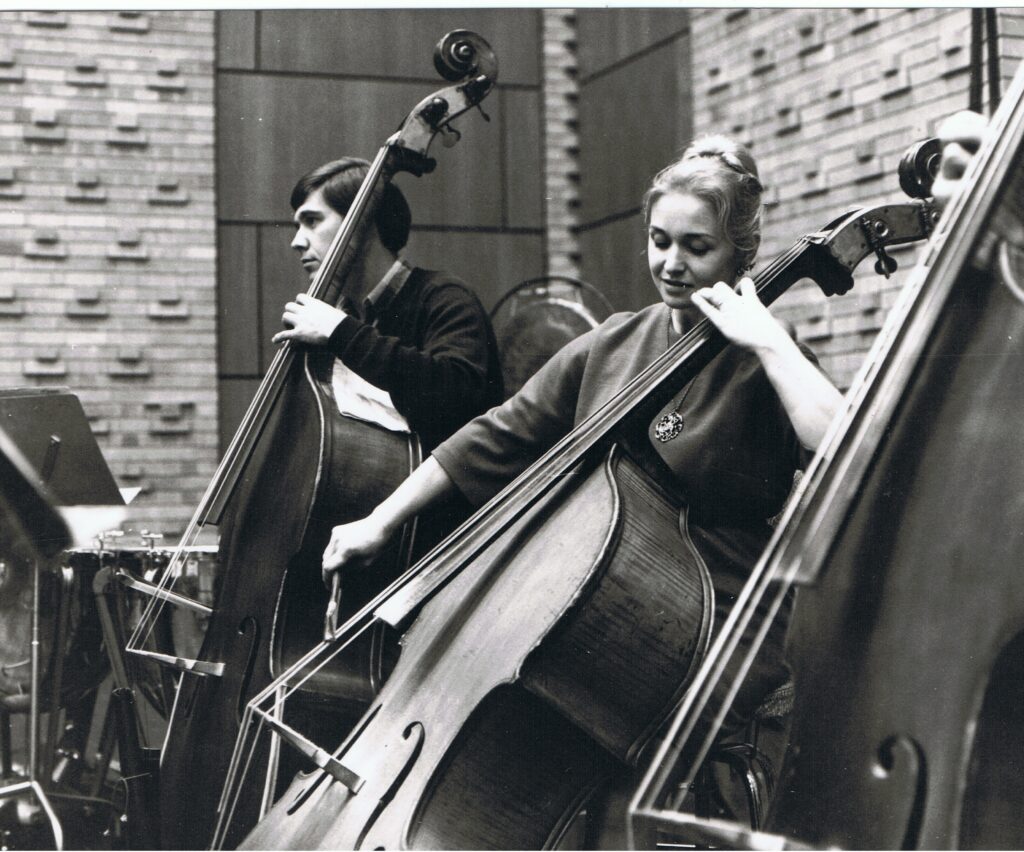
David Ellis was a double bass player performing with Jack Harrison both in jazz ensembles and in the WASO. He performed with Jack’s brother Ray, Billy Clowes, Jim Beeson and Ashley Arbuckle.
David reminisces: “I played the most with Billy Clowes mainly because he was free during the day; everyone else had day jobs. So while they were hard at work Billy and I were just as hard at it studying at the University of the Streets. There were no chord charts, make notes as you go”
PELICAN
Thursday April 23rd 1964
Jazz by Nessia Solomons
Jazz versatility in jazz
No classical music this week! Instead the fresh sound of modern jazz filled Winthrop Hall as the sounds of Jack Harrison (alto sax and clarinet) Billy Clowes (piano) David Ellis (bass) and Bill Tattersall (drums) presented a program on the changing styles of jazz. The Jack Harrison Quartet features the well-known Billy Clowes Trio while Jack Harrison is also a member of the W.A. Symphony Orchestra in which he plays clarinet. Although they play other styles of music, they enjoy playing jazz with a vibrant sound that is synonymous with modern jazz today. The opening number “9.20 special” a tune written for Count Basie, was of fast tempo and made the expectant audience sit up and listen. Unfortunately, the acoustics in Winthrop Hall caused the drumming to sound a little dominant at all times, however the smooth playing of both piano and saxophone tied this over to no disadvantage. Pianist Billy Clowes composed the next number played – a 12 bar blues – a style which has been popular at all times through the evolution of jazz to the present day. As always, when a composer plays his own tune, the result is an extra special sound with an atmosphere perfectly suited to its style. Perhaps it was just the Paul Desmondish sound of the alto sax or maybe some ultramodern chord forms, yet this and a few other numbers were reminiscent of Dave Brubeck’s style. The changing styles and jazz were illustrated through five numbers, the two most popular being a swinging version of “Alexander’s Ragtime Band” and an excellent takeoff Miles Davis in “So What”. Although the group was versatile as it had to be for that program, they seem to play with much greater ease the more modern numbers, especially “Work Song”. This number was played in great style – it possessed an interesting, varied beat as the drummer and the bass player really gave forth the jazz message in their solos. The musicians pleased an obviously critical audience with their versatility, as with showing by the applause for several numbers and on the whole, the jazz concert did lift, however slightly, the cultural curtain to edge a little way through the sound barrier that divides the two cults of music in the Western world today. [1]
[1] PELICAN Undergraduate Newspaper UWA, Vol 35 No. 5 Thursday April 23rd 1964