Benny Goodman (born May 30, 1909, Chicago, Illinois; died June 13, 1986)
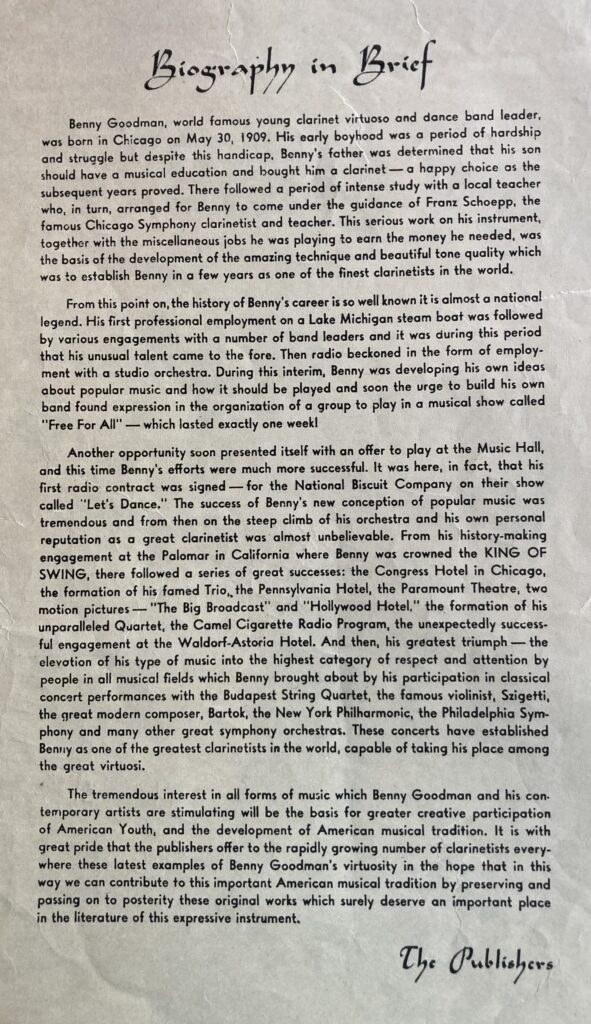
Benny Goodman’s reign as “King of Swing,” “Patriarch of the Clarinet,” and “Swing’s Senior Statesman” began when he helped many Americans see the silver lining around that cloud known as the Depression. The optimism and grace of swing music brought the nation through some of its darkest days.
Goodman was the ninth of 12 children born to Russian-Jewish immigrants. Although many boys at that time followed in their father’s footsteps in terms of profession, Goodman followed his heart and pursued a career in music. His first clarinet was borrowed from Chicago’s Kehelah Jacob Synagogue in order to play in the boys’ band there. The synagogue provided instruments and lessons to young boys who wished to play in the band. As jazz spread like wildfire through the Chicago music scene in the 1920s, the teenage Goodman became inspired by such jazz pioneers as King Oliver and Louis Armstrong.
At the age of 14, Goodman was already making money playing the clarinet in Chicago’s South Side speakeasies and dance halls. Goodman later met drummer Ben Pollack and headed off to New York with his orchestra. Not long afterwards, Goodman formed his own band to work for singer Russ Columbo. The band included Gene Krupa on drums, Joe Sullivan on piano, and Babe Russin on tenor sax. Goodman and his band worked for Columbo for a summer, then they got a job on a national New York-based radio show, “Let’s Dance” in a 10:30 PM to 1:30 AM time slot. The band was able to make its first extended tour because of the popularity of the radio show. However, Goodman’s segment was on too late for most New Yorkers so he was not well known in New York. Consequently, the turn-out for the band’s opening night was very disappointing. On opening night at Elitch’s Garden, in Denver, nightclubbers demanded a refund unless the band played waltzes. When the band got to California, though, crowds of people were lining up waiting to hear Goodman and his band. Being in a time zone three hours earlier than New York, the Californians had been listening to th on the radio show.
At this point, everything began to change. The band’s luck changed in a major way when they performed at Hollywood’s Palomar Ballroom. The crowd even stopped dancing to stand around the bandstand when Goodman played “King Porter Stomp” and “When Buddha Smiles.” By the time the band reached Chicago for what turned into an eight-month engagement at the Urban Room of the Congress Hotel, Goodman was being called “The King of Swing.” The band also started a new radio series and began a series of Sunday afternoon concerts at the Congress Hotel while they were in Chicago.
It was at the Congress that Goodman made an important breakthrough in race relations when he hired two black musicians, Teddy Wilson and Lionel Hampton. Goodman refused to appear without them, even in the deep south.
Goodman became the first jazzman to also achieve prominence in the genre of classical music, but it was swing music that brought the crowds out at dawn to line up at the entrances of dance halls such as the Manhattan Room of the Pennsylvania Hotel and even had people dancing in the aisles of New York’s Paramount Theater. Goodman received numerous awards during his 60 year-long career including an honorary doctorate from Yale University and the Peabody Medal from the Peabody Conservatory. He died in 1986 at the age of 77.
https://www.kennedy-center.org/artists/g/go-gz/benny-goodman
Benny Goodman commissioned several major classical and contemporary clarinet pieces that significantly expanded the instrument’s repertoire.
- Aaron Copland: Clarinet Concerto (1948) – Written for Goodman, featuring a jazz-influenced style and a famous concluding glissando.
- Béla Bartók: Contrasts (1938) – A chamber work for violin, clarinet, and piano inspired by Hungarian and Romanian dance traditions.
- Paul Hindemith: Clarinet Concerto (1947) – A major, technically demanding symphonic work commissioned by Goodman.
- Francis Poulenc: Sonata for Clarinet and Piano (1962) – Premiered by Goodman and Leonard Bernstein after the composer revised it for Goodman.
- Malcolm Arnold: Clarinet Concerto No. 2 (1960) – Composed for and dedicated to Goodman.
- Darius Milhaud: Concerto for Clarinet and Orchestra (1956).
- Morton Gould: Derivations for Clarinet and Band (1956)
https://www.britannica.com/biography/Benny-Goodman
1950’s GREATEST MUSICAL SHOW
Thursday, Oct. 5th Capitol Theatre at 8pm
Bruce Carroll presents
Symphony In Swing
With Harry Bluck’s Concert Orchestra and Dance Band
Over 50 Leading Musicians and Radio Artists
Wendy Nash — 12-year-old Virtuoso Pianiste
Jack Harrison — Clarinet Star of the West
Ossie Sanderson — 16-year old ‘London Fantasia’ Soloist
Phyllis Frost — International Broadcasting Vocaliste
Ronald Pollastrini — W.A.’s Outstanding Lyric Tenor.
Tritoff’s Trio — First appearance of Radio Vocal Trio
Kath Bass — Star Rhythm Vocaliste
Alan Golding — Leading Exponent of Hammond Electric Organ
Peter Clinch trio — Wizards of Swing
Dave Howard — and His Golden Voiced Saxophone (By Courtesy A. B.C.)
Keith Connolly — Sophisticated Humorist
Laurie Croissette — Tho ‘Different’ Western Entertainer
Symphony and Swing Club’s Entertainment Unit with West Coast Dixielanders — State’s smartest Jazz Ensemble
John Todd — 14-year-old Star Piano Accordionist
Rhythm Spinners — State’s leading Male Modern Vocal Group
Robyn Harwood — Boogie Woogie Specialiste
Beverly Beckwith — Co-Compere of S. and S. Club Group
Compere: Geoff Manion
Stage Production: Dave Howard By Courtesy A. B.C. – PRICES : 3/- 4/- 5/- (plus tax) – Box Plan at Nicholsons Limited.
The Daily News Monday 25 September 1950 page 12
Symphony In Swing – October 5 1950
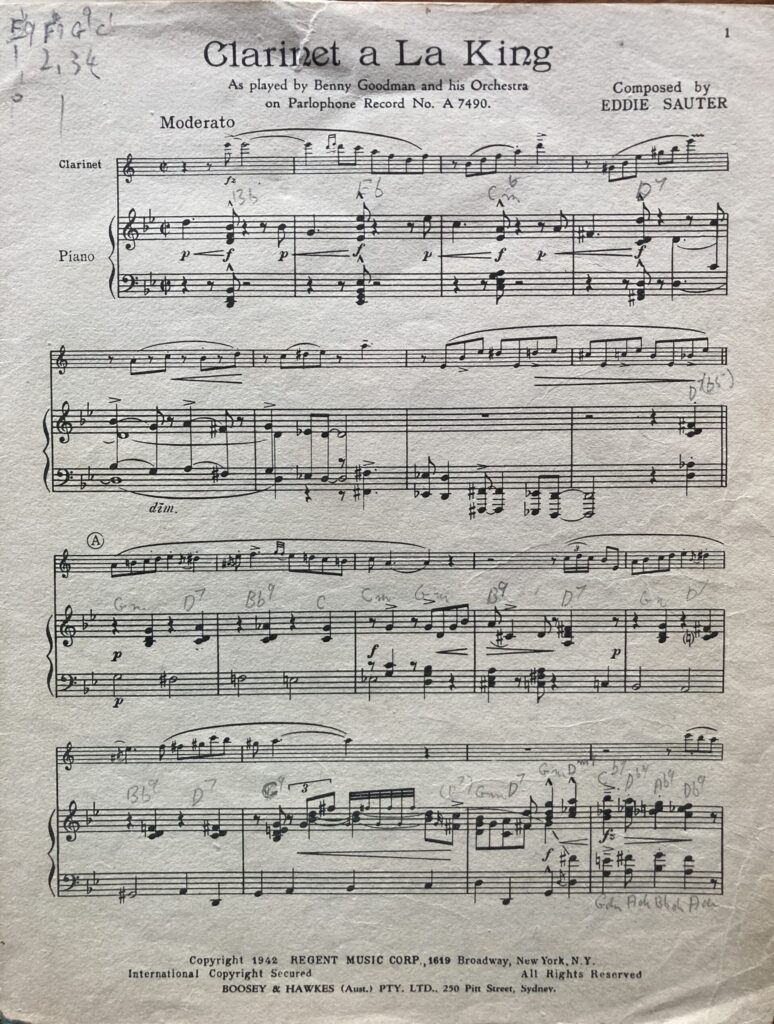
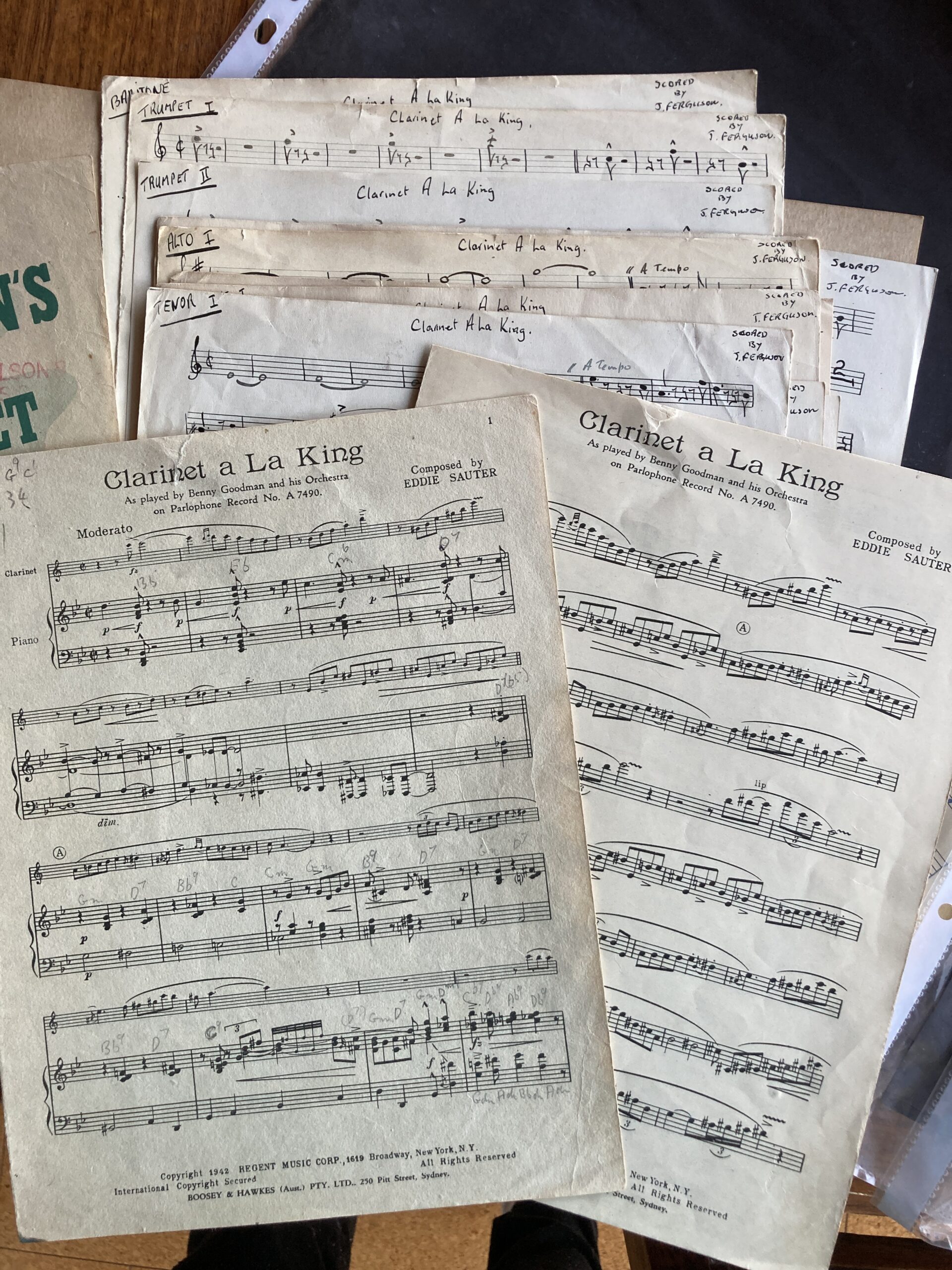
On October 5, a concert entitled “Symphony in Swing” will be presented in the Capitol Theatre. Produced by Harry Bluck, whose concert orchestra and dance band will give a number of items, the programme will include varied numbers by local artists, many of whom are under 20 years of age. The 12-year-old pianist, Wendy Nash, will give a classical group, Jack Harrison, the young clarinettist will give the first West Australian performance of a number entitled “Clarinet a la King,” and the 16-year-old pianist Ossie Sanderson, will present “London Fantasia.” Other artists will be Ronald Pollastrini, tenor, and a new vocal group, the Tritoffs, who will be making their first public appearance. They will be associated with Phyllis Frost, the blind vocalist. There will be many other singers and instrumentalists.
Western Mail Thursday 28 September 1950 page 23
| 5.10.1950 | Benny Goodman Clarinet a la King W.A. PREMIERE AUSTRALIAN PREMIERE? | Jack Harrison (clarinet) Harry Bluck and his Concert Orchestra and Dance band | Capitol Theatre Perth, Western Australia Bruce Carroll presents “Symphony in Swing” |