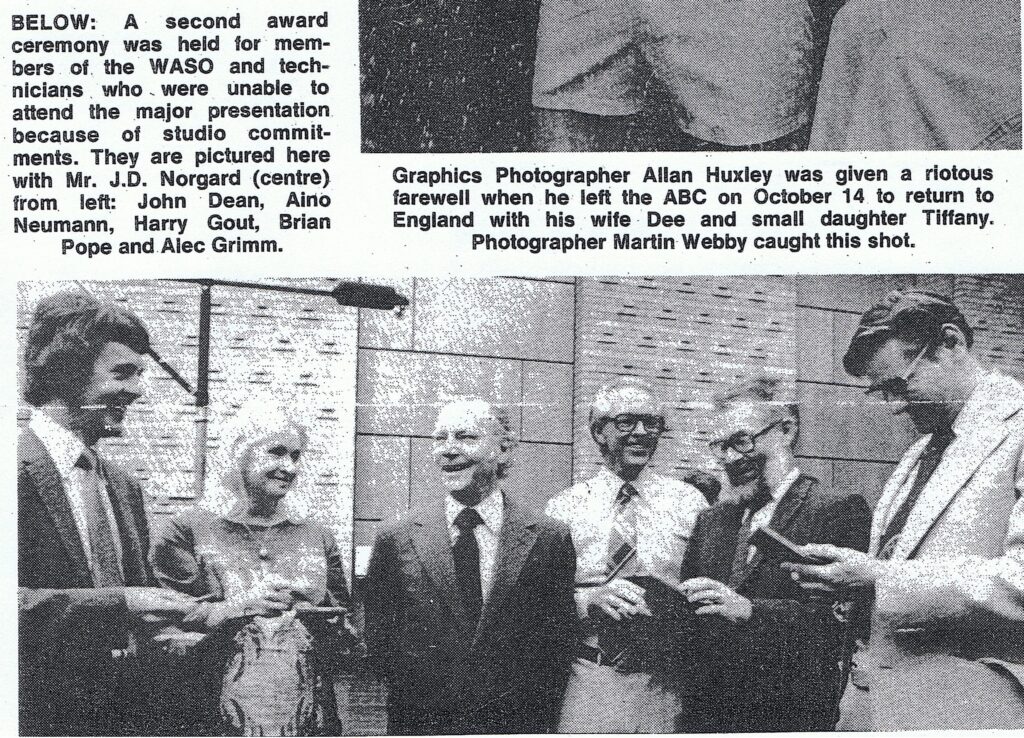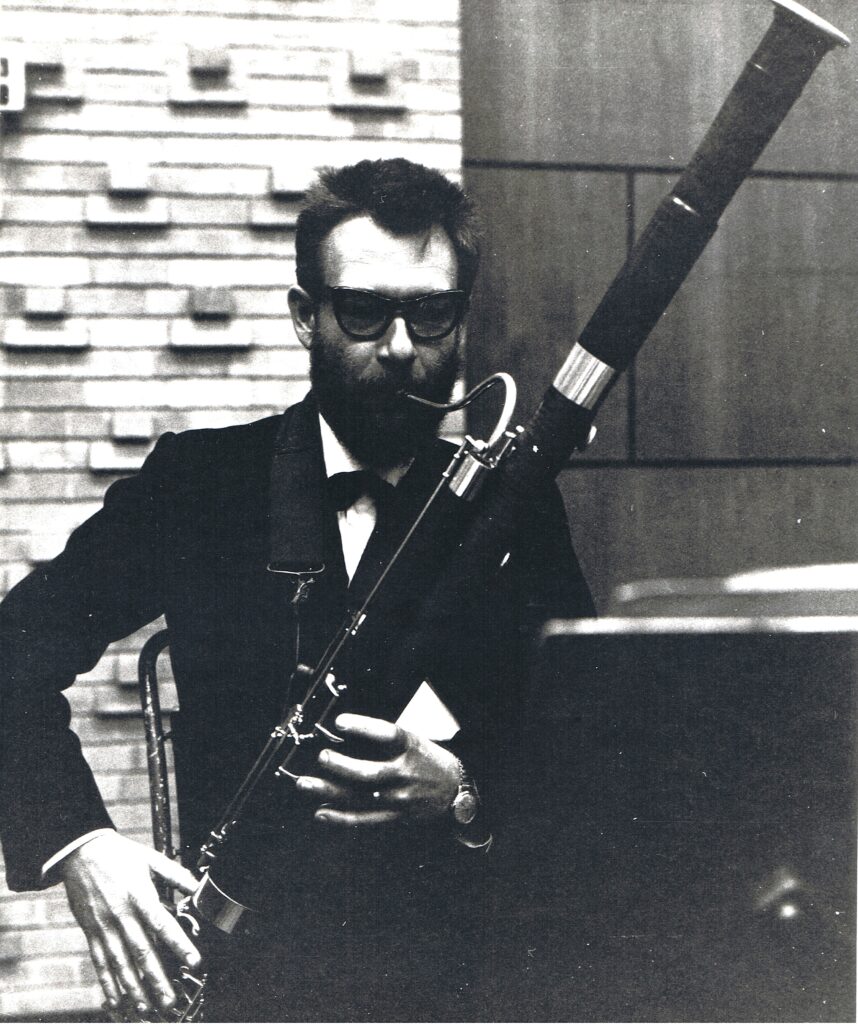
Brian Pope was Principal Bassoon of the West Australian Symphony Orchestra and colleague of Jack Harrison from 1959 up until having to retire in the mid 1970’s due to work related deafness.
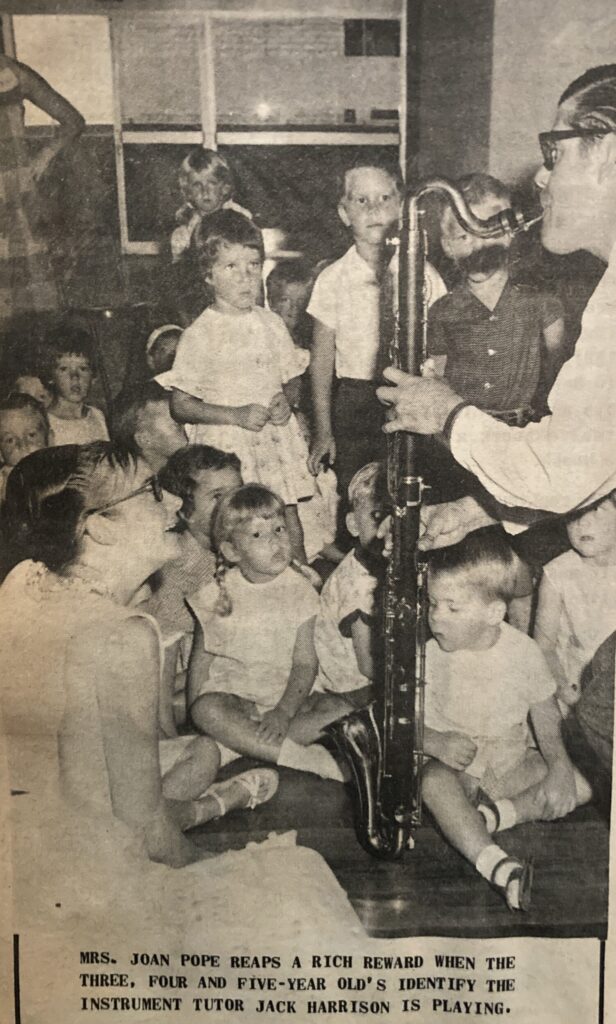
When Brian and his wife Joan Pope came back to Perth after couple of years in the Tasmanian Symphony Orchestra, Brian joined the Players’ association with Jack Harrison. In 1965, Brian and Joan created CATS (Children’s Activities Time Society) and Jack often joined Brian, George Coleman, Owen Fisenden and Graham Wood playing for little kids recitals.
1961
MUSIC by Peter Hellstrom
Three concerts in Winthrop Hall will be highlights of the W.A. University Arts Union Arts Festival from July 18 to August 5 (1961).
The first, on July 20, will be a free lunch-hour programme presented by the W.A. Symphony Orchestra conducted by John Farnsworth Hall. Soprano Lynette Howieson will be soloist.
The next will be presented by the Kiranta Trio during the lunch-hour on July 27. Members of the trio are pianist Patricia Burns, flautist William Frater and bassoonist Brian Pope.
The final concert, which will start at 8pm on August 5 will feature the world premiere of David Farquar’s Concerto for Piano and Orchestra. The programme will include works from the 16th Century to the present. The artists will be the University String Quartet, pianist Michael Cole, bassoonist Brian Pope and clarinettist, Jack Harrison.
The West Australian Saturday July 15 1961
8pm Sat 5th August 1961 – FESTIVAL CONCERT TONIGHT
World Premiere of David Farquhar’s prize winning Concertino for Piano and Orchestra
First Performance in Australia – Chamber Concerto No. 3 for Bassoon, Strings and Percussion by Elisabeth Lutyens.
David Tunley’s Introduction and Scherzo for Clarinet and Strings
Plus works by Dvorak, Grieg, Delius, Elgar, Walton and others.
UNIVERSITY ORCHESTRA conducted by Trevor Jones.
Soloists: Michael Cole, Jack Harrison, Brian Pope.
Assisting Artists: John Mowson, John Dean, Verdon Williams.
WINTHROP HALL – Unreserved seats at door 10/ Students 7/6
1963
Thursday June 27 1963 – WIND QUINTET IS REFRESHING – By Sally Trethowan
A concert by a rare composition of instruments – a wind quintet – makes a refreshing excursion from the string works that monopolise the field of chamber music. Though few composers have been attracted to the wind group as a medium for musical expression, they have not in general been cavalier in their treatment of it. Beethoven’s early Quintet Op. 16 played at yesterday’s free lunch-hour concert in Winthrop Hall, is as felicitous an example of fusion of form and content as any that can be found in the repertoire. The artists, Jack Harrison (clarinet), Peter Randall (oboe), Brian Pope (bassoon) and Harold Thornton (horn) with Stephen Dornan (pianist) , wove the interlaced counterpoint of their respective strands with a professional skill to give a nearly flawless reading. The other work on the programme, Mozart’s Quintet K 452, was given a less inspired though pleasant performance. Stephen Dornan is playing at his best and yesterday fulfilled his pivotal role in setting the tempo and maintaining the balance of the ensemble and gave coherence to the whole.
The West Australian Friday June 28 1963
1966
Tom’s Weekly Vol. 1 Issue No. 9 Saturday February 12 1966
1966
HARSH-TONED MUSIC ENTERTAINS
By Sally Trethowan
The last of the festival “Music of Britain” chamber concerts given in the Basil Kirk memorial studio last night offered some of the most complex and insistently dissonant music of the whole series. Yet each of the three works was so excellently performed that some measure of the composers musical thought in each case intense and highly individual must surely have impressed the general music lover no matter how unsympathetic he might have been to the harsh contemporary harmonic language. The first work “Quintet for wind and piano” by Alan Rawsthorne, was perhaps the most earnest in intention, and also the most abstruse and uncompromising. Much of it was concerned with working out, in terms of spasmodic tempi, unremitting dissonance and often exciting and original blends of wind colour, two moods, one apparently serene but masking disquieting emotional currents; the other desperately merry. This difficult music was persuasively presented by Alice Carrard (piano), Peter Randall (oboe), Jack Harrison (clarinet), Brian Pope (bassoon) and Neil Pearson (French horn). After this, Trevor Jones’s happy blend of whimsy lyricism and drama in his “Cantata Zoologica” was immensely entertaining. It was given a premiere late last year by the W.A. Bach Society choir and quintet and it was performed last night by the same artists except that the conductor on this occasion was Laughton Harris and the narrator was Neville Teede. Mr Harris’s cogent grasp, poetically and musically of the work was incisively conveyed through the unerring accuracy of his beat to which the choir and instrumentalists responded with brilliant execution. Mr Harris also conducted the final concerto for wind Quintet and two pianos (eight hands) by Malcolm Williamson. The wind players were joined by flautist Owen Fisenden and pianist Madame Carrard by fellow soloist Allyne Tilsed, Stephen Dornan and Michael Cole. This work exhibited complex interplay of tone colour. The finale, where the piano parts exploded in figuration of a Bartokian ferocity and aliveness was, I think, unrivalled in the festival music for sheer excitement of performance.
The West Australian Wednesday March 9 1966 page 17
1967
Sunday May 26 1970
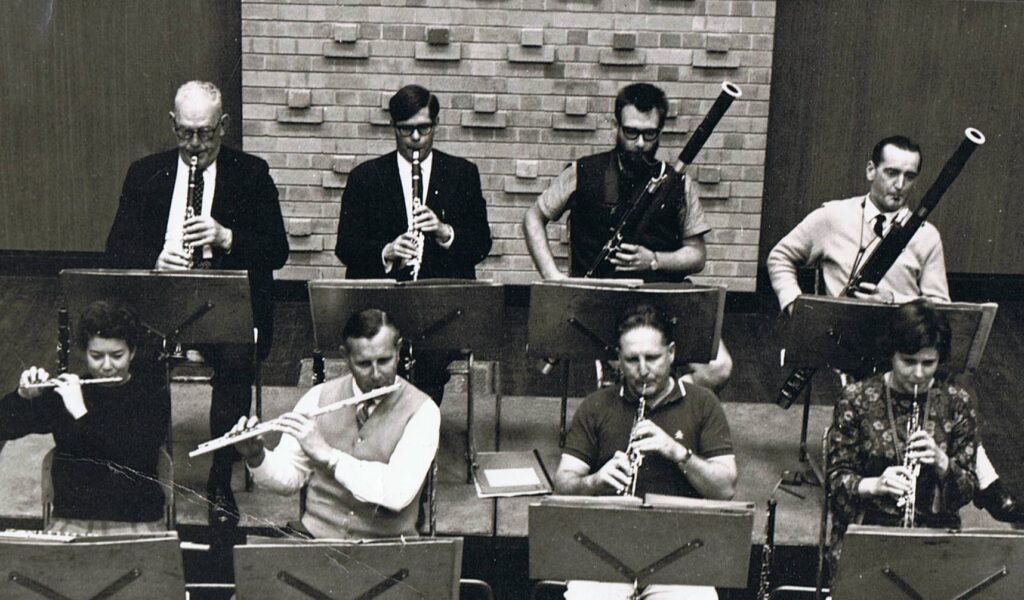
The second concert in Series I of this year’s A.B.C. recitals in the Basil Kirke Studio will be given tomorrow afternoon at 3 o’clock. A Rossini Quartet For Wind will be played by flautist Owen Fisenden, clarinettist Jack Harrison, horn player Neil Pierson and bassoonist Brian Pope. A Beethoven septet will be performed by clarinettist Jack Harrison, bassoonist Brian Pope, violinist Vaughan Hanly, violist John Gould, cellist Ray Fraser and double bass player Aino Neumann. One of the objects of the concert is to bring the best local artists playing chamber music before the public. Symphony concerts naturally attract more people because of the grandeur and perhaps a little because of the mere occasion. But we must not let the chamber music and solo recitals die. They are part of the backbone of music in Europe, the primary source of most music.
1972
Spectacular Performance – With Robert Gude
This week’s 1972 Youth Concert at Winthrop Hall began with a rather lethargic reading of Rossini spirited overture to The Thieving Magpie. Both conductor, Tibor Paul and the Orchestra seemed weary following the massive work devoted to Mahler’s Fifth only a few days before. Perhaps to compensate for a lack of crispness, Mr. Paul increased the tempo during crescendi allegro passages which made it difficult for the heavier brass to produce definitive articulation. The same tendency occurred during the major work Rimsky Korsakov’s Scheherezade in which perfectly etched brass textures were rushed. However, it was the woodwinds Mr Jack Harrison on clarine,t Mr Owen Fisenden on flute and Mr Brian Pope on bassoon which saved the suite in its more expressive moments.
1975
September 15 1975
The Alberni String Quartet
Schubert Octet in F Major Op. 166
With John McNeilly – bass; Jack Harrison – clarinet; Neil Pierson – horn; Brian Pope – bassoon.