Howard Ferguson’s Octet for Wind and Strings – Australian Premiere
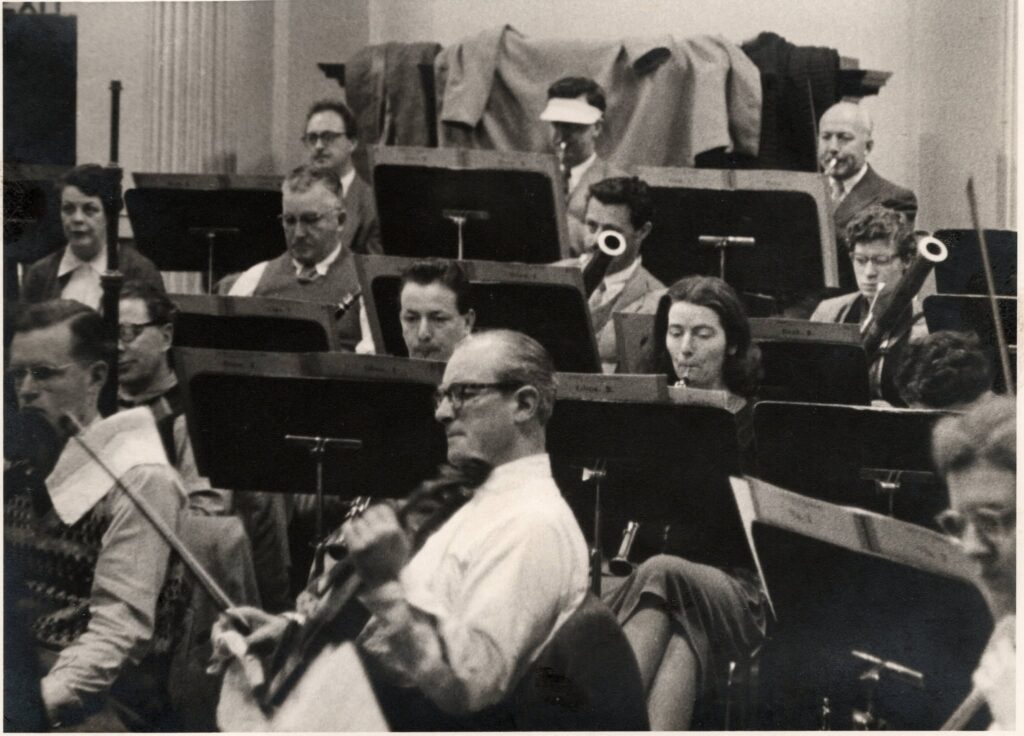
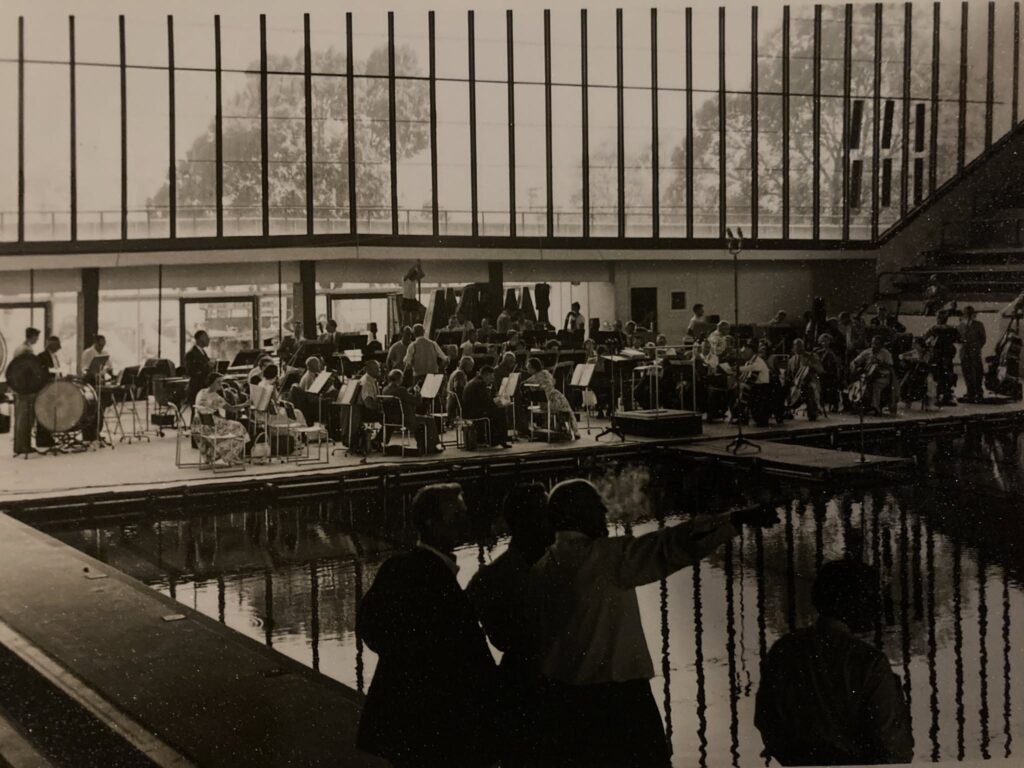
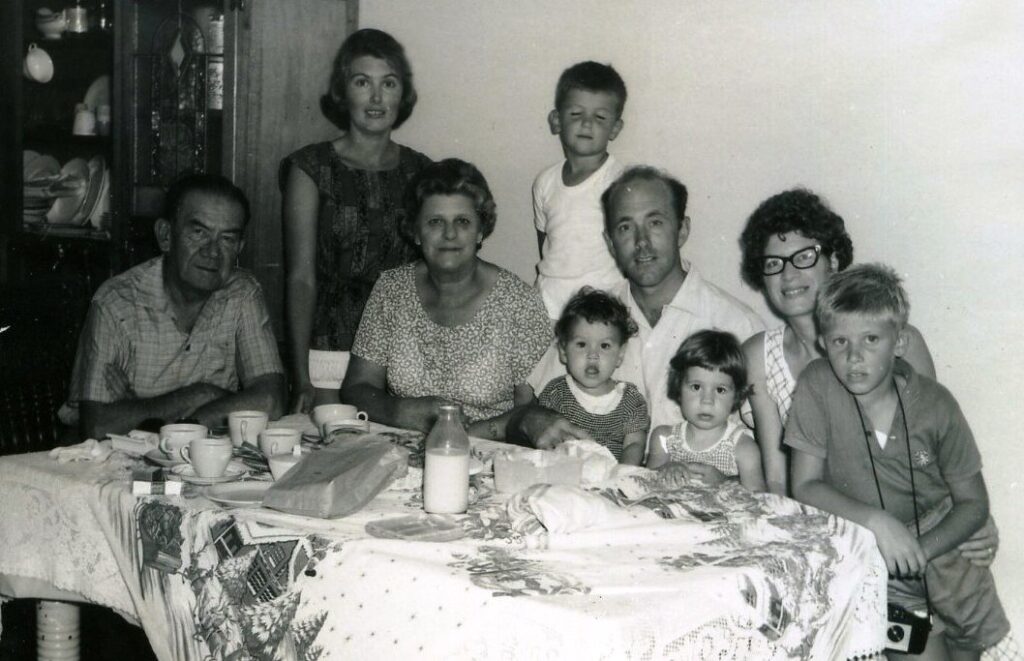
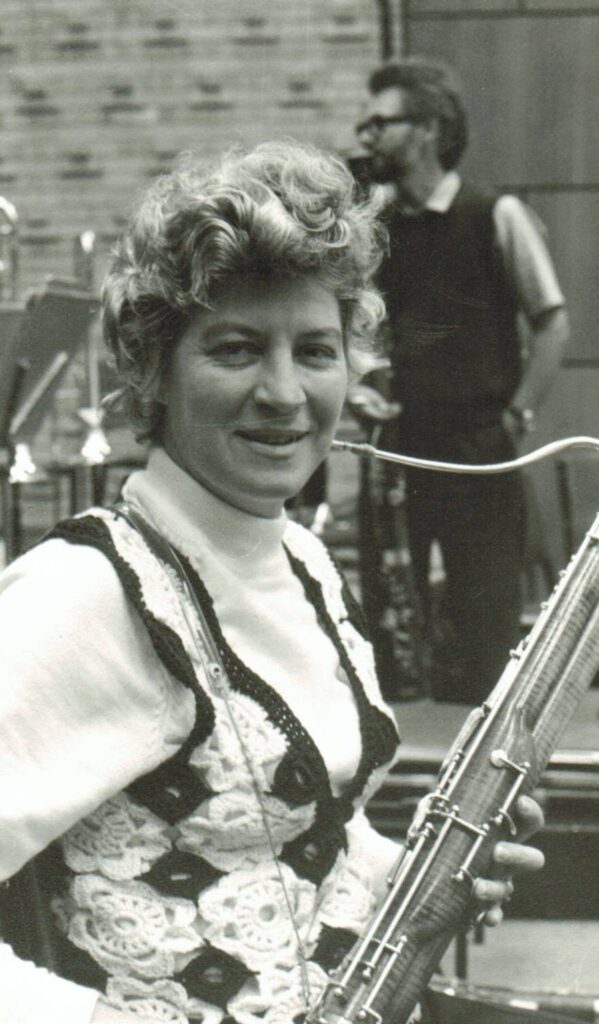
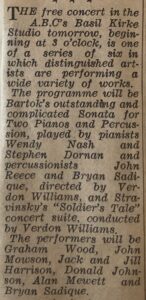
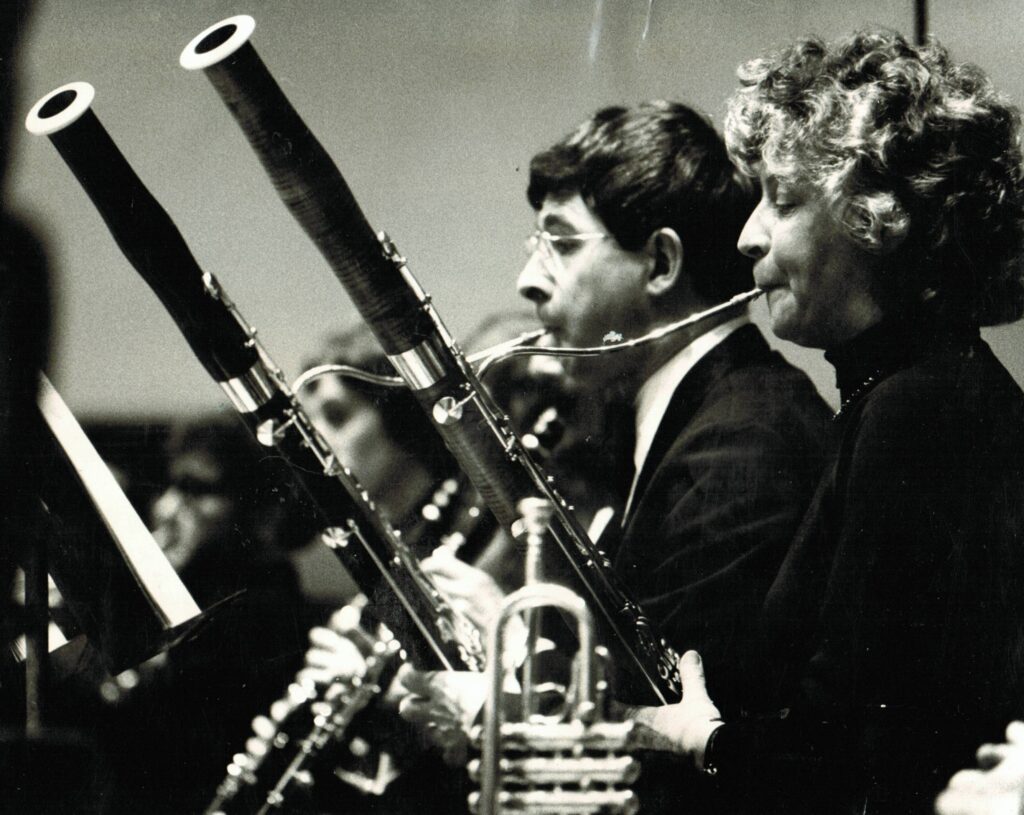
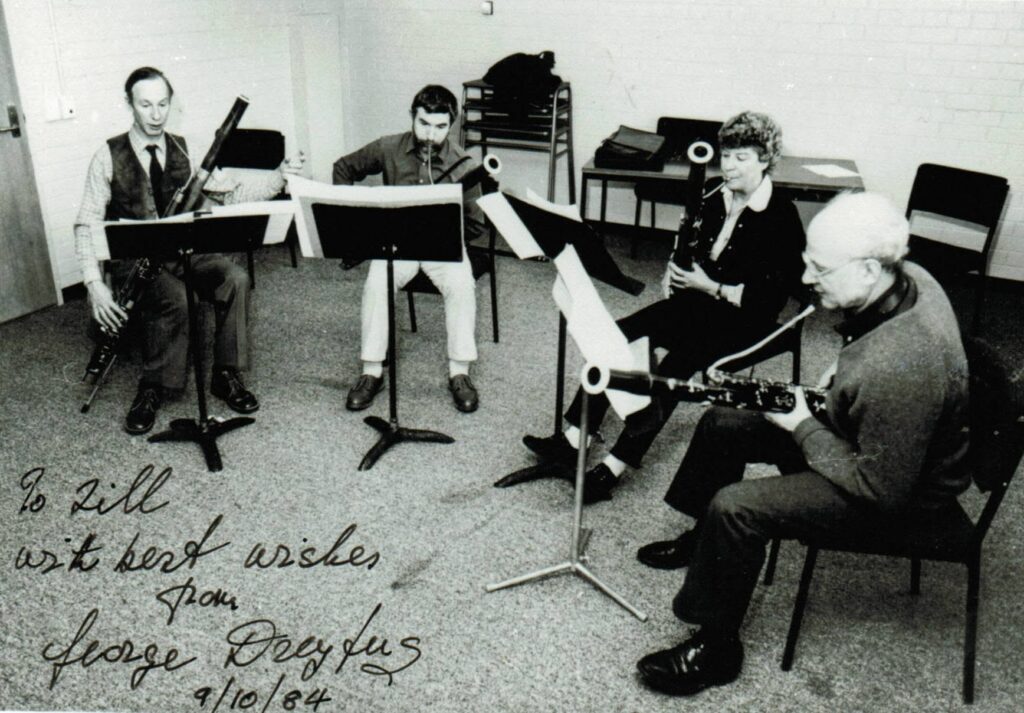
On 27th July 1968 Graham Wood and Stanislaw Kowarski (violins), John Dean (Viola), Brian Meddemmen (cello), John Mowson (bass), Patrick Brislan (Horn), Jack Harrison (clarinet) and Jill Harrison (bassoon) played the Australian premiere of Octet for Wind and Strings by Howard Ferguson. It was an A.B.C. Studio broadcast from the Basil Kirke Studio in Perth.
27.7.1968
Howard Ferguson Octet Op. 4
for clarinet, bassoon, horn, string quartet and double-bass (1933)
Fewer than 30 people attended yesterday’s free Sunday afternoon recital in the Basil Kirke Memorial Studio to hear what must have been one of the finest given this year by Perth artists. The oboe playing of Peter Randall in Mozart’s Quartet for oboe and strings was so good that an unchartered listener might’ve thought it was a simple piece. Mr. Randall gave such purity and accuracy to the naturally sharp clear tone of the oboe as to make even the accompanying strings in this piece seem cloudy in effect. It was duly wistful in the doleful minor keyed slow movement and cheerful in the finale where the virtuosic double-tongued passages were given within incisiveness, clarity and extreme rapidity.
Violinist Graham Wood led seven other instrumentalists Stanislaw Kowarski (violin) John Dean (Viola) Brian Meddemmen (cello) John Mowson (bass) Patrick Brislan (Horn) Jack Harrison (clarinet) and Jill Harrison (bassoon) in the four movement Octet for Wind and Strings by the modern English composer Howard Ferguson. Mr. Ferguson seems to have a particular affection for clarinet and horn, and the success of the performance to some extent pivoted on Patrick Brislan’s horn playing which allowed no imperfection of tone to mar its richness. The program ended with a reduced version of Richard Strauss’s tone poem “Till Eulenspiegel’s Merry Pranks”. Originally scored for an orchestra of Wagnerian proportions of over 100 players, it was here rendered by five. Though without the percussion and heavy brass that in the full score are so graphic in describing the grotesque adventures of the mediaeval vagabond Till, it was a happy even witty performance. The final concert in the free Sunday afternoon series will be given in a fortnight.
Richard Strauss Duet concertino for clarinet and bassoon – Australian Premiere
The Australian premiere of Richard Strauss’s Duet-Concertino for clarinet and bassoon was broadcast in June 1959 by the Australian Broadcasting Commission.
The Harrisons were always musical. The family used to get together in a one family band. Now the 27 year old twins – Jack and Jill – are the featured stars in a 40 minute broadcast from 6WF on Wednesday 24th June 1959 with the W.A. Symphony Orchestra. The programme: Richard Strauss’s Concerto for Bassoon and clarinet. Jill will be playing the bassoon and Jack the clarinet.
Brian Pope was Principal Bassoon of the West Australian Symphony Orchestra and colleague of Jack Harrison from 1959 up until having to retire in the mid 1970’s due to work related deafness.
When Brian and his wife Joan Pope came back to Perth after couple of years in the Tasmanian Symphony Orchestra, Brian joined the Players’ association with Jack Harrison. In 1965, Brian and Joan created CATS (Children’s Activities Time Society) and Jack often joined Brian, George Coleman, Owen Fisenden and Graham Wood playing for little kids recitals.
1961
MUSIC by Peter Hellstrom
Three concerts in Winthrop Hall will be highlights of the W.A. University Arts Union Arts Festival from July 18 to August 5 (1961).
The first, on July 20, will be a free lunch-hour programme presented by the W.A. Symphony Orchestra conducted by John Farnsworth Hall. Soprano Lynette Howieson will be soloist.
The next will be presented by the Kiranta Trio during the lunch-hour on July 27. Members of the trio are pianist Patricia Burns, flautist William Frater and bassoonist Brian Pope.
The final concert, which will start at 8pm on August 5 will feature the world premiere of David Farquar’s Concerto for Piano and Orchestra. The programme will include works from the 16th Century to the present. The artists will be the University String Quartet, pianist Michael Cole, bassoonist Brian Pope and clarinettist, Jack Harrison.
The West Australian Saturday July 15 1961
8pm Sat 5th August 1961 – FESTIVAL CONCERT TONIGHT
World Premiere of David Farquhar’s prize winning Concertino for Piano and Orchestra
First Performance in Australia – Chamber Concerto No. 3 for Bassoon, Strings and Percussion by Elisabeth Lutyens.
David Tunley’s Introduction and Scherzo for Clarinet and Strings
Plus works by Dvorak, Grieg, Delius, Elgar, Walton and others.
Thursday June 27 1963 – WIND QUINTET IS REFRESHING – By Sally Trethowan
A concert by a rare composition of instruments – a wind quintet – makes a refreshing excursion from the string works that monopolise the field of chamber music. Though few composers have been attracted to the wind group as a medium for musical expression, they have not in general been cavalier in their treatment of it. Beethoven’s early Quintet Op. 16 played at yesterday’s free lunch-hour concert in Winthrop Hall, is as felicitous an example of fusion of form and content as any that can be found in the repertoire. The artists, Jack Harrison (clarinet), Peter Randall (oboe), Brian Pope (bassoon) and Harold Thornton (horn) with Stephen Dornan (pianist) , wove the interlaced counterpoint of their respective strands with a professional skill to give a nearly flawless reading. The other work on the programme, Mozart’s Quintet K 452, was given a less inspired though pleasant performance. Stephen Dornan is playing at his best and yesterday fulfilled his pivotal role in setting the tempo and maintaining the balance of the ensemble and gave coherence to the whole.
The last of the festival “Music of Britain” chamber concerts given in the Basil Kirk memorial studio last night offered some of the most complex and insistently dissonant music of the whole series. Yet each of the three works was so excellently performed that some measure of the composers musical thought in each case intense and highly individual must surely have impressed the general music lover no matter how unsympathetic he might have been to the harsh contemporary harmonic language. The first work “Quintet for wind and piano” by Alan Rawsthorne, was perhaps the most earnest in intention, and also the most abstruse and uncompromising. Much of it was concerned with working out, in terms of spasmodic tempi, unremitting dissonance and often exciting and original blends of wind colour, two moods, one apparently serene but masking disquieting emotional currents; the other desperately merry. This difficult music was persuasively presented by Alice Carrard (piano), Peter Randall (oboe), Jack Harrison (clarinet), Brian Pope (bassoon) and Neil Pearson (French horn). After this, Trevor Jones’s happy blend of whimsy lyricism and drama in his “Cantata Zoologica” was immensely entertaining. It was given a premiere late last year by the W.A. Bach Society choir and quintet and it was performed last night by the same artists except that the conductor on this occasion was Laughton Harris and the narrator was Neville Teede. Mr Harris’s cogent grasp, poetically and musically of the work was incisively conveyed through the unerring accuracy of his beat to which the choir and instrumentalists responded with brilliant execution. Mr Harris also conducted the final concerto for wind Quintet and two pianos (eight hands) by Malcolm Williamson. The wind players were joined by flautist Owen Fisenden and pianist Madame Carrard by fellow soloist Allyne Tilsed, Stephen Dornan and Michael Cole. This work exhibited complex interplay of tone colour. The finale, where the piano parts exploded in figuration of a Bartokian ferocity and aliveness was, I think, unrivalled in the festival music for sheer excitement of performance.
The West Australian Wednesday March 9 1966 page 17
1967
1967 WASO Wind Section: Alan Rule, Jack Harrison, Brian Pope, John McCarthy, Allyne Tilsed, Owen Fisenden, Peter Randall and Joy Cummins
Sunday May 26 1970
The second concert in Series I of this year’s A.B.C. recitals in the Basil Kirke Studio will be given tomorrow afternoon at 3 o’clock. A Rossini Quartet For Wind will be played by flautist Owen Fisenden, clarinettist Jack Harrison, horn player Neil Pierson and bassoonist Brian Pope. A Beethoven septet will be performed by clarinettist Jack Harrison, bassoonist Brian Pope, violinist Vaughan Hanly, violist John Gould, cellist Ray Fraser and double bass player Aino Neumann. One of the objects of the concert is to bring the best local artists playing chamber music before the public. Symphony concerts naturally attract more people because of the grandeur and perhaps a little because of the mere occasion. But we must not let the chamber music and solo recitals die. They are part of the backbone of music in Europe, the primary source of most music.
1972
Spectacular Performance – With Robert Gude
This week’s 1972 Youth Concert at Winthrop Hall began with a rather lethargic reading of Rossini spirited overture to The Thieving Magpie. Both conductor, Tibor Paul and the Orchestra seemed weary following the massive work devoted to Mahler’s Fifth only a few days before. Perhaps to compensate for a lack of crispness, Mr. Paul increased the tempo during crescendi allegro passages which made it difficult for the heavier brass to produce definitive articulation. The same tendency occurred during the major work Rimsky Korsakov’s Scheherezade in which perfectly etched brass textures were rushed. However, it was the woodwinds Mr Jack Harrison on clarine,t Mr Owen Fisenden on flute and Mr Brian Pope on bassoon which saved the suite in its more expressive moments.
1975
September 15 1975
The Alberni String Quartet
Schubert Octet in F Major Op. 166
With John McNeilly – bass; Jack Harrison – clarinet; Neil Pierson – horn; Brian Pope – bassoon.
1994 WASO wind section: Clarinets – Jonathan Craven, Lorna Cook, Allan Meyer. Bassoons – Anne Henderson, Robert Weeks, Linda Luce
1997
1997 WASO bassoons Natasha Woodley, Anne Henderson, Robert Weeks, Wendy Cooper1997 Lorna Cook (clarinet), Anne Henderson (bassoon), Jane Geeson (harp) – WASO logo launch
Born in Bendigo country Victoria, David studied bassoon in his hometown with the wine-maker / bassoonist Stuart Anderson (Balgownie Bendigo, pioneers of 1970’s commercial winemaking in Victoria’s central goldfields region).
David toured to Hong Kong and China with the Melbourne Youth Orchestra, and was
Principal with the Australian Youth Orchestra.
David furthered his bassoon studies with Harold Evans (MSO Principal) at the Victorian College of the Arts.
David played a number of seasons with Victoria State Opera under the baton of Richard Divall, including on period instruments.
1981 WASO woodwind section
David considers himself very fortunate to have had his first full-time professional orchestral position playing contrabassoon and second bassoon in Anne Henderson’s WASO section.
David also had periods as WASO’s Acting Principal. This was in the period of the conductor David Measham – as well as the Austrian-Jewish / Czech maestro Albert Rosen. As Hans Swarowsky had been Rosen’s conducting teacher at the Vienna Academy of Music, David enjoyed Rosen’s ‘Old Europe’ directorship immensely.
Perth offered wonderful bodysurfing beaches, the Karri forests / wineries / coast of the Southwest corner, ballet / modern dance classes, Rottnest Island, and scuba diving with David’s WASO contemporaries.
In Perth David met his UK-born wife Hilary Nye.
Moving to a London base, David worked as a free-lance player – including master-classes with Milan Turkovic & Brian Pollard – and was live-in custodian of the Victorian Society’s Lynley Sambourne House museum.
David created Ensemble Australis to perform Australian music with Australian musicians in London.
After a period as Acting Principal of the Stavanger Symfoniorkester in Norway, David was appointed as Orchestra Manager for Sir John Eliot Gardiner’s Monteverdi Choir and Orchestra – a position he held for two decades.
Following the MCO and now living in Bristol England, David retrained as both a person-centred counsellor and a horticultural lecturer. In this period David also founded the performance organisation Bozarts.
David Adams – Wilderness Festival Orchestra
After running the City of Bristol College’s Horticulture Department for some years, David is now retired.
He divides his time between founding Cote House – an innovative Bristol cohousing community – and singing with unusual chamber choirs.
Hilary and David’s two children both live in Melbourne – event ticketing entrepreneur Sam and doctor Julia.
David plays on a Heckel No. 5552 bassoon owned originally by his former teacher Harold Evans. Wilhelm Heckel GmbH is a renowned German woodwind maker and the bassoon’s year of manufacture is 1919. This 5000-series instrument belongs to a highly regarded era of ‘pre-war’ acoustic craftsmanship. Bassoons from this era are celebrated for their small bore design, thinner wall construction, lightweight feel, warm resonance, and highly flexible, ‘golden’ tonal quality.
The youngest of the four children of Archibald Charles Callaway, an electrical engineer, Frank Adams Callaway was born in Timaru, New Zealand, on 16 May 1919.
When war broke out he enlisted for overseas service. He was rejected because of his poor eyesight, but the Royal New Zealand Air Force recognised his musical potential – he joined its Central Band as a bassoonist and arranger.
The Pied Piper Towards the end of his long life, his colleagues at the International Society for Music Education had this to say about Sir Frank Callaway: ‘It is probably true that Sir Frank Callaway must know, and be known by, more people in music education throughout the world than anyone else. The list of countries he has visited is staggering: at a modest estimate he must have covered well over a million miles – a feat which these days is only surpassed by astronauts. His vision for music education in its broadest sense is respected internationally.
It is unlikely that anyone else has devoted as much time and energy to the cause of music education and given such support and encouragement to musicians, music educators, composers and many others, as Sir Frank Callaway. His generosity of spirit and his seemingly endless vitality – despite his age – is still an inspiration to music educators regardless of the sphere in which they work or the generation to which they belong.’
The youngest of the four children of Archibald Charles Callaway, an electrical engineer, Frank Adams Callaway was born in Timaru, New Zealand, on 16 May 1919. His uncle, Sidney Callaway, played cricket for Australia in the 1890s, and passed on his passion for the game to young Frank, but it was music that the boy loved best. His parents had him taught the violin.
‘As a child, I simply loved being involved in music-making’, he recalled, ‘and after first experiencing the thrill of music-making as leader of an early children’s orchestra, this sort of activity became central to my life.’
Because of the depression, Callaway left school when he was 15. He started his working life with a firm of commercial stationers, eventually becoming a travelling salesman. Evening studies at Christchurch Technical College led to Otago University at Dunedin, where he set his sights on a Bachelor of Commerce degree. In 1939 he abandoned this and entered the Dunedin Teachers’ Training College. When war broke out he enlisted for overseas service. He was rejected because of his poor eyesight, but the Royal New Zealand Air Force recognised his musical potential – he joined its Central Band as a bassoonist and arranger.
In 1942 the Air Force gave Callaway leave so that he could succeed the inspirational Vernon Griffiths as Head of Music at King Edward Technical College in Dunedin. At the same time, Callaway played viola and bassoon in the New Zealand Broadcasting Services’ Orchestra, and continued his music studies music part-time at the University of Otago. He eventually gained his Bachelor of Music degree, plus sundry prizes, including the Phillip Neil Prize for New Zealand composers. In 1947 the university’s Fanny Evans Travelling Scholarship financed his trip to London – but the funds would not stretch to allow Callaway to take his young wife, the brilliant pianist Kathleen Allan.
At the Royal Academy of Music he studied conducting, general musicianship and composition, forwhich he won the Battiston Haynes and Cuthbert Nunn prizes. A Carnegie Travel Grant enabled him to explore music education in the United States, where he met people who shared and shaped his international vision for music education. In 1949 he resumed his work with King Edward Technical College, and also directed a regular series of orchestral concerts and large scale music festivals in Dunedin.
In 1953 Callaway accepted the post of Reader in Music within the Faculty of Education at the University of Western Australia. Six years later he became the university’s Foundation Professor of Music.
Starting with a staff of one (himself), a desk, an upright piano, and a small pile of music, Callaway built up a thriving Department of Music. When he retired at the end of 1984, he was farewelled by 14 full-time staff-members and a large team of part-time teachers. On the way he had developed what is widely regarded as Australia’s finest Music Library – the Wigmore.
Outside his university commitments, Callaway had created and edited Australia’s leading musicological journal, Studies in Music, and other scholarly publications. In association with the West Australian Symphony Orchestra he had organised a series of Composers’ Workshops that attracted many young forward-looking composers.
He had been appointed by the prime minister to serve with Bernard Heinze and John Hopkins on the first Advisory Board of the Commonwealth Assistance to Australian Composers scheme, organising national seminars and workshops for young composers. He had been the foundation president of the Australian Society for Music Education, and had edited its journal. He had served for many years on the Festival of Perth committee.
For a quarter of a century he had conducted the University Choral Society, making it one of Australia’s finest large choirs. He led it in many memorable performances with the West Australian Symphony Orchestra and visiting soloists, and he had been guest conductor for ABC orchestras in Western Australia and other states. In 1979 and 1984 he was organising chairman of the Indian Ocean Arts Festival in Perth.
Internationally, Callaway had been a member of the International Society for Music Education since it was founded in 1953 by many of the people he had met on his visit to the United States in 1949. He was its president from 1968 to 1972, then its treasurer and, in 1988, was elected honorary president, succeeding the celebrated composers Zoltán Kodály and Dimitri Kabelevsky. He was also founding editor of its journal.
As a member of the Australian Commission for UNESCO, Callaway represented Australia on the International Music Council; in 1980 he followed violinist Yehudi Menuhin as its president, establishing a close and lasting friendship with him. He was elected a life member in 1985. His UNESCO work took him to General Assemblies and Congresses in Moscow, Lausanne, Toronto, Montreal, Bratislava, Prague, Melbourne, Budapest, Stockholm and Dresden. In 1995 he received the UNESCO Medal, which rewards musicians who have contributed to the enrichment and development of music and who have promoted peace and understanding between peoples.
Other recipients have included Yehudi Menuhin and Russian composer Dmitri Shostakovich and Indian musician Ravi Shankar. At the time, Callaway was only the second person to be awarded this prize for music education (the other was Nadia Boulanger, in 1979). The organisation’s director-general hailed Callaway as ‘one of the great pioneers and ambassadors of music education in our time’.
Callaway was the dedicatee for Australian composer Peter Sculthorpe’s short orchestral piece Sun Song (1984), and for Dmitri Kabalevsky’s Fanfare for Brass Ensemble. Incredibly, in so full a life, Callaway found time to indulge his passions for gardening, and, all too rarely, composing. His Theme and Diversions for Strings, Theme and Variations for Strings and Prelude and Fugue for Violin and Organ won awards and were publicly performed, but in his later years Callaway preferred to forget them.
Callaway retired from the University of Western Australia in 1984. In his honour the university established the Frank Callaway Foundation for Music, with contributions from Callaway’s friends and admirers. The foundation supports musical activities at the university and works to enhance the strong community and professional associations of the School of Music. Its patrons include Lord Menuhin, Sir Charles Court and Janet Holmes a Court.
The foundation organises the annual Callaway Lecture and stimulates music and music education in Australia and internationally through the non-commercial and co-operative Callaway Centre for Research in Music and Music Education. The centre houses a number of significant collections including those of Callaway himself (including a number of autographed letters and scores by composers such as Liszt, Elgar and Delius), ethnomusicologist John Blacking, Percy Grainger (whom Callaway met during his first overseas study tour and whose ideas on music’s universality impressed him deeply), conductor Verdon Williams, pianist Eileen Joyce (a personal friend of Callaway’s), and music historian Peter Burgis. The Burgis Collection includes significant holdings of Dame Nellie Melba and Peter Dawson memorabilia.
Many of Callaway’s former students and colleagues participated in a joyous gala concert in the Perth Concert Hall on 16 May 1999 to celebrate their mentor’s 80th birthday. After a long period of ill health, Sir Frank Adams Callaway died in Perth on 22 February 2003. He was survived by his wife, Kathleen, who had accompanied him to many overseas conferences, and had a notable career of her own: she was an acclaimed pianist and harpsichordist, and a fine accompanist, particularly for lieder. She was active for many years in concerts and radio broadcasts.
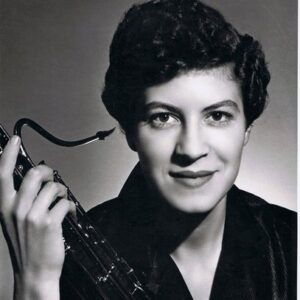
HARRISON, Jill Lois is the twin sister of Jack Harrison.
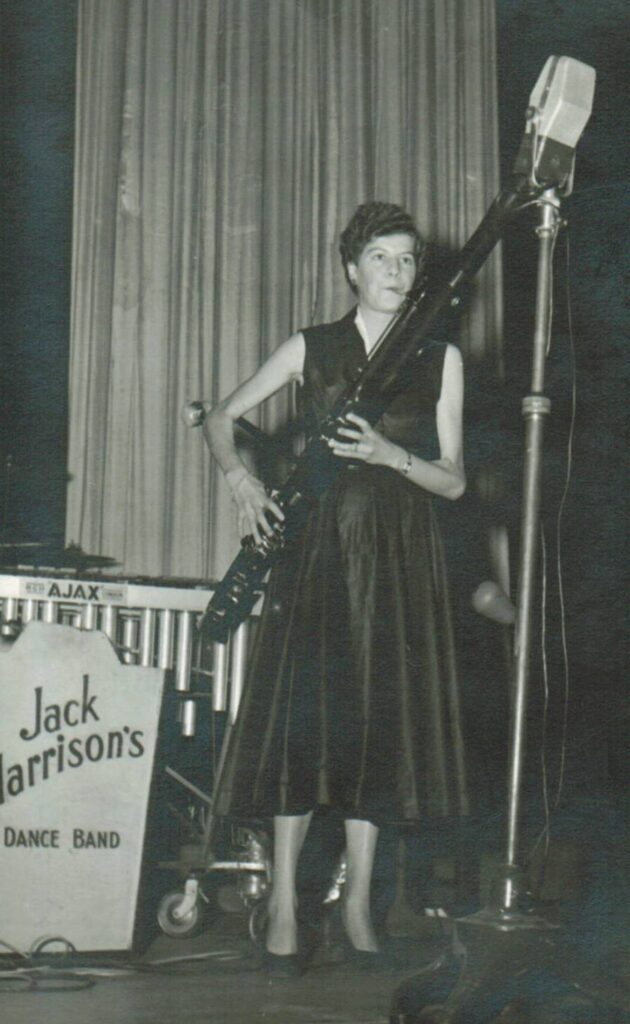
Jill holds the distinction of being the first professional female bassoonist in Australia when she was appointed Second Bassoon in the West Australian Symphony Orchestra in 1951 aged 20.
Jill was born the first twin on 12 August 1931 to William Edward Harrison and Edna May Harrison (nee Kerr). Jack was a surprise as Edna did not know she was expecting twins.
HARRISON On August 12, at Tresillian Hospital, to Mr and Mrs Harrison of 64 Bruce Street, Nedlands – a son and daughter (Jack and Jill)
Jack and Jill were baptized on 17th January 1932 at St Mary’s Church, Nedlands by A. Burton.
1932 Jill and Jack Harrison
The twins shared a memory from Bruce Street, sprinting home to their mother, screaming with terror at two huge birds coming towards them up the street. Edna investigated and returned to sooth her toddlers having confirmed it was two Catholic nuns in habits.
1935 Highway Nedlands, built by Arthur and Lou Harrison1937 Kalamunda shack: Bill Jnr, Edna, Bill Snr. Front: Jill, Jack Ray1937 Amy Kerr, Edna, Ray, Jack and Jill Harrison
1940 Nedlands Primary Fancy Dress DayJill with Puddin the cat
In 1937 Jack and Jill attended Hollywood Primary School for 6 months (corner Hampton and Williams Roads) and then Nedlands State School. Jill remembers having to play “English Country Gardens” on the piano – alternating with Donald Thornton – to assist the children march back to class after assembly.
1939 Edna, Jill, Bill & Jack Harrison on the couchJill Harrison1940 Jack and Jill Harrison with their canoe at Crawley Bay Nedlands
Jill also remembers being dive bombed and pecked by magpies during a walk home from school and living with a fear of birds from then on.
1938 William Harrison family
Jill learnt piano and music theory from the age of 6 from her father.
Jill’s older brother Ramon (or “Ray”) was also attending Nedlands State School and had started learning the drums with teachers Alf Schofield and Fraser Middleton-White. Oldest brother Bill Jnr was at Scotch College.
1944
In 1944 during her last year at Primary School, Jill began bassoon lessons with Billy Moore assisted by a bassoon book of tutorials and attended P.L.C. for two years.
World War II had been dominating everyone’s lives. Young boys found these times exciting, especially when Lancaster bombers flew over and one could observe the gunners sitting in their turrets. Both the McMeikan and Harrison Highway Nedlands homes had air-raid shelters dug in the back yards. John’s house had cracks in the walls caused by the Catalinas flying just feet above the house.
When Victory Day finally came on May 8th 1945, Jack decorated his bike with streamers for the occasion.
1945 Sunday nights became “jam session” night at the Harrison’s Nedlands home, with all four children (Bill Jnr on saxophone) joining in.
Jack & Jill Harrison – Highway Nedlands
Ray Harrison’s Swing Band
In October 1945, Ray Harrison’s Swing Band (Ray, Jack and Jill Harrison) entered in the 1945 Sportsmen’s Amateur Quest which was a prominent talent competition aimed at showcasing local performers. The first final of this competition, described as the “W.A. Sportsmen’s £150 Amateur Quest,” was held at the Perth Town Hall on Sunday, October 28, 1945. The event was a high-profile entertainment competition during the immediate post-war period in Perth.
Sunday, 8.45 p.m. PERTH TOWN HALL – FINAL £150 W.A. SPORTSMEN’S AMATEUR QUEST
VOCAL SECTION: Mr Lloyd Taylor, Miss Pauline Jordan, Mr Ernie Mulcahy, Miss Julia Pusey, Miss Betty Elder, Mr Geo. Townsend. NOVELTY SECTION: Mr Ernest Ritter, Miss Fay Robinson, Mr John Sutton, Miss Pauline Thick, Ray Harrison’s Swing Band, Mr Frank Jenkins. The Daily News Thursday 8 November 1945 page 12
The voting results determining the artists to progress to the final were:
Result 2nd Final £150 W.A. – Sportsmen’s Amateur Quest – Artists Selected to Appear Grand Final
No. 10. HARRISON’S SWING BAND 191
No. 9. Mr. JENKINS 182
No. 6. Mr. ERNIE MULCAHY 180
No. 11. Miss JULIA PUSEY 139
No. 2. Miss BETTY ELDER 137
No. 5. Mr JOHN SUTTON 133.
The Daily News Wednesday 7 November 1945 page 13
Jill Harrison practising in the music room at 24 Highway NedlandsJill Harrison in Hay Street
The Harrisons” performed as a trio for the MLC Old Girls’ Association Ball held at the Myola Club Hall in Claremont in July 1946:
MLC Old Girls’ Association is doing a great deal to revive its activities, which were curtailed during the war years, and the highlight of its social events held recently was the Old Girls’ Ball held at the Myola Club Hall, Claremont, when the president, Mrs. Margaret Way, received guests wearing a frock of black marquesette showing a satin tartan stripe. She was assisted by members of the committee, and secretary June Bear. Miss G. Walton, former mistress of the college, and the present headmistress, Miss J. Bowden, patrons of the association, were amongst those who enjoyed a delightful evening. A festive note was added with gay caps and hats, the handiwork of artistic members. Music was supplied by “The Harrisons” and incidentally, young Jack Harrison, who plays the harmonica, was successful “Amateur Hour” winner in a recent contest. Sunday Times Sunday 21 July 1946 page 7
1946 Ray Harrison Trio “Search for Talent”
Jill’s brother Ray Harrison’s drumming talent received state wide recognition when in November 1946 the “Ray Harrison Swing Band”, consisting of Ray on drums and Jack on clarinet and saxophone and Jill on piano came third in the 6PM-AM “Search for Talent” Competition held at Fremantle Town Hall.
Last Friday night at the Fremantle Town Hall the winners of the 6PM-AM £50 Search for Talent contest were announced. Phil Moran, tenor, won the competition while the Machlin sisters, a singing cowgirl trio, were second and Ray Harrison’s Swing Band was third. Ray, with his sister and brother Jill and Jack, were third in the contest with their combination as an orchestra. Ray plays the drums, Jill is the pianist and Jack plays the saxophone and clarinet. Jack won an Australian Amateur Hour in 1940 when he appeared at the age of nine as a mouth organist.
The Broadcaster Saturday November 9 1946
Judy Grace, Jack and Jill in her P.L.C. blazer
1947
In 1947, Jill left P.L.C at the insistence of her father and being held by a promise that she would devote her life to music practise. Her father, William, went from room to room supervising the music practise of his children. From 1947 Jill became a full time professional musician.
1947 Bridesmaid Jill Harrison at the wedding of her brother William to Mavis Sansom
On the 15th February 1947 Jack’s brother William Arthurmarried Mavis Mary Sansom and Jill was a bridesmaid.
1947 Jill Harrison, Mavis and sister Dot Sansom – wedding of William Harrison Jnr and Mavis.
Jack and Jill Harrison
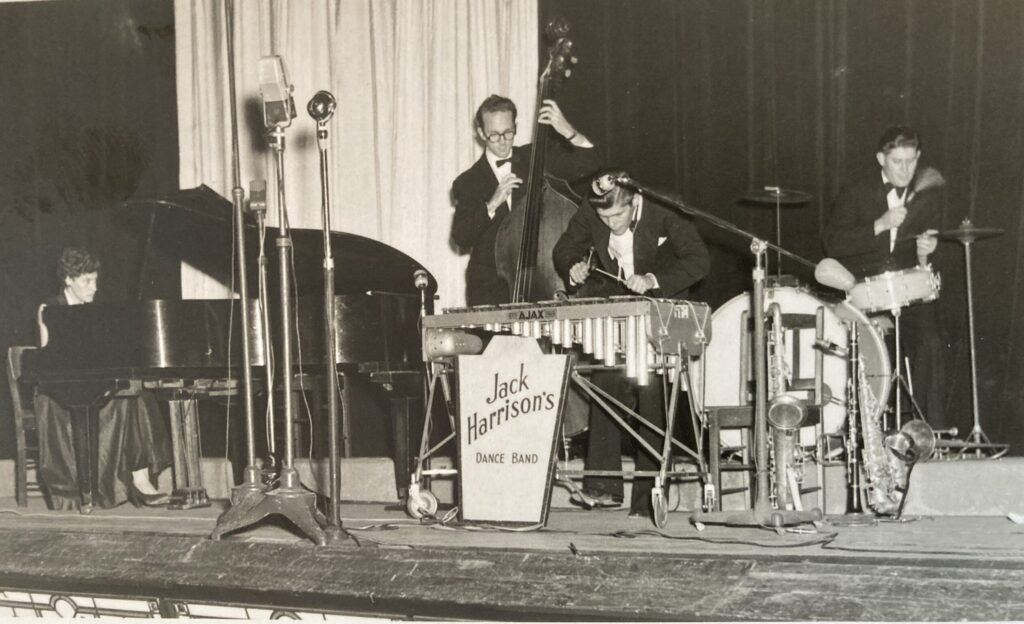
Jack Harrison formed his own dance band with his twin sister Jill and brother Ray and they performed jazz with “dash old-time” at “The Blue Room” and regularly at North Perth and Leederville Town Halls.
Pen Points on Perth – By Harry Bluck – A young man who is quickly coming into prominence in the local dance-band world is up-and-coming-altoist Jack Harrison. I had seen this name featured in many current dance-hall adverts., so snooped around to find who this “stranger” was fronting his own small outfit in quite a few nice little jobs, and was agreeably surprised to find former harmonica-wizard Jackie Harrison (now 15 years of age) tootling away on sax and clarrie with as much ease and confidence as many a veteran. “SOMETHING OF A SENSATION” He seemed to be reading almost anything around the place as well as finding his way around many of the old “fakies” with plenty of improvising. This may sound a tall yarn for one so young, but readers should remember that Jack Harrison was featured here in W.A. as somewhat of a sensation with his brilliant harmonica work and, after capturing all the local radio spots that he could, he went east to Sydney (when only 9 years of age) and there, after topping the poll in an Australian Amateur hour programme, fulfilled many radio dates with prominent Sydney radioites – Jack Davey’s Shows, the Youth Show and others. Thence to Melbourne to do a round of their Tivoli circuit and came happily back to Groper-land (NOT the least bit swell headed!!). Since his return Jack has been studying music very seriously, besides keeping many radio engagements, throughout each year – and now the fruits of his studies seem to be bearing well – judging by his easy switch to reed instruments in his own band.
1947 “Jack Harrison Trio” in front of 24 Highway Nedlands1947 Jack Harrison Trio – red lapels black jackets
IT RUNS IN THE FAMILY
Music is an integral part of the Harrison family, as veteran pianist Bill Harrison is Jack’s proud poppa, a sister plays piano in Jack’s outfit while a brother wields the drumsticks. Jack is being ably coached in his sax work by Ken Murdoch, while h is also studying “legit” clarinet with A.B.C. woodwindist Alan Rule. Apart from these few activities, plus his harmonica appearances, plus his home rehearsals, plus his rehearsals with the A.B.C. Amateur Symphony Group, plus his private practice – Jack still finds time to be a modest 15 year old Aussie. All his many friends in local musical circles predict quite a musical future for young Jack – so we wish him the best of luck!!
Music Maker July 21 1947
1948 Jack, Jill and Ray Harrison
Harrison family Again – Sixteen-year-old Musician to give further broadcast
Western Australia was represented last week in “National Fair” from 6IX-WB-MD by twins, Jack and Jill Harrison and elder brother Ray. The Harrison family was put up as the best musical family in Australia. Jack Harrison, the 16 year old lad who played both the saxophone and clarinet, was such a success that the producers asked him to put up another challenge, so he is again appearing in the programme next Wednesday as the best clarinettist in Australia. Jack will again be accompanied by his twin Jill on the piano, and his brother Ray on the drums. This time Jack will be playing the clarinet only. His item will be “Special Delivery Stomp” one of Artie Shaw’s favourites. So far this is the first time two challenges have been put up by the same person. The West Australian selectors hope that this challenge is unbeatable, but listeners can decide that for themselves when they hear what the other States can produce to take up this challenge. The other five states also will be presenting their “exhibits” on Wednesday night at 8 o’clock, some again challenging and others answering challenges previously set. If anyone who knows of anything or anybody who could possibly be used as an “exhibit” in “National Fair”, he or she is asked to communicate with W.A. Broadcasters Ltd., Lyric House, Perth.
The Broadcaster Saturday January 17 1948 Vol. 14, No. 720
1949 Jill Harrison at the piano
On the Dial – The success of the Harrison Family (Jack, Jill and Ray) in the 6IX-WB-MD session “National Fair”, was demonstrated by the fact that they were engaged by the sponsors for a repeat performance the following week. When they were heard in the session for the first time Jack, who is 16 years of age, was nominated as the best clarinettist in Australia. So far no one has disputed the claim. There are no cash prizes for “National Fair”, but the session enables West Australian talent to be heard in the Eastern states. The programme is broadcast each Wednesday night at 8 o’clock.
The Broadcaster Saturday February 14 1948
1949 Jill and Jack
On the Dial – Jack Harrison will enter the “National Fair” arena once again on Wednesday night. The 16 year old Perth musicians will take up a challenge from Victoria to find a better harmonica player than Brucy Skurry. Jack’s harmonica solo in this 6IX-WB-MD session will be “Smoke Gets in your eyes”. He appeared in two early “National Fair” programmes with his brother Ray and twin sister Jill. They were nominated in the first instance as the best juvenile music-makers. Jack was nominated as the best clarinettist in Australia. To date, no other State has accepted either of the challenges from this versatile family.
The Broadcaster Saturday March 13 1948
Jack and Jill with clarinet and bassoon
MUSICAL FAMILY OFFERED OWN SHOW BY A.B.C. – Harrisons Hit Jackpot in “National Fair”
Although “National Fair” (2UW Wednesday Night) has only been on the air a few weeks, already one of the “exhibits” has received an offer to appear on the A.B.C. This offer was made to the Western Australian Harrison family who appeared twice on “National Fair”, once as the “most musical family” in Australia and the second time Jack Harrison, accompanied by his twin sister Jill and elder brother Ray, appeared as the “best clarinettist”. “National Fair” is a new nation-wide radio competition in which each State of the Commonwealth puts up an “exhibit” which they claim to be the best of its kind in Australia. This “exhibit” which takes the form of a challenge to the other States, can be anything from a singing parrot to a dance band, or a pearl diver to a pianist – and so on. So far neither of the challenges issued by the Harrison family has been taken up by any of the other states in the commonwealth. The A.B.C. has engaged these clever, young musicians and they will soon be heard on their own half hour programme once a week on the State network. The producers of “National Fair” hope that this programme will bring to light many more talented people. Interesting entries continue to come in from all the States, some fantastic, amazing, others like the Harrison family, representing their State with their musical talent. Music Maker February 20 1948
1948 Jack, Valmai and Jill at KalamundaJill, Jack with his chev and Valmai1948 Battle of the Bands program
1948 BATTLE OF THE BANDS – a fund-raising competition was announced in Perth in April 1948 for the Perth Chest Clinic: TB COLONY – To help raise funds for the Wooroloo after-care colony, a Hospital Queen contest will be held. It will be launched this month and will end in a health week and a musical, dramatic and dancing festival about the end of June.
The Daily News Wednesday 7 April 1948 page 7
Thursday, July 1, 8 p.m. Popular Dance Band Contest – CAPITOL THEATRE. Guest Band .. .. Sammy Sharp and his Boys. Compere: Geoff Manton. PROCEEDS IN AID HOSPITAL QUEEN CONTEST The West Australian Monday 28 June 1948 page 12
On July 1st 1948, Jack’s trio won £25 in “Battle of the Bands” at the Capitol Theatre. It was attended by His Excellency the Lieutenant-Governor, Sir James Mitchell G.C.M.G. and raised funds for Wooroloo hospital with Margot Elfverson, who was also the receptionist at the Murray St Chest Clinic, as the Public Health Candidate. This gave the Trio nation wide exposure.
THURSDAY JULY 1 1948 AT 8PM – BATTLE OF THE BANDS CAPITOL THEATRE, WILLIAM STREET, PERTH
1949 Jill and Fraser Middleton-White
From 1948 through to the end of 1950, Jill was employed for hundreds of dances, radio broadcast, weddings and parties with the fully professional Jack Harrison Ensembles.
1949 Ray, Jill and Jack Harrison with Jack Pope (trumpet)
Rhythm Round-up
NURSES and DEBUTANTS 1949
SEVENTY certificated nurses were presented with their diplomas by Governor Sir James Mitchell and Lady Mitchell at the annual Graduation Ball of the Australian Trained Nurses Association at the Embassy this week. Lack of ballroom décor- rations was particularly noticeable in comparison with other balls of the season. Lack in this direction however, was more than compensated by the gay and friendly atmosphere which rendered one of the happiest events.
Balcony chatting saw Ronda MacKay and Jean Keogh with friend Harry Prestwood, of England. Ronda looked startlingly attractive in blue taffeta and silver lame, while Jean chose blue taffeta also with white lace effect. Now of Rockingham, and one of the city’s former ballroom dancing instructors, Stan Grey (in tails) was back on the floor. One of the largest floorside lounge parties consisted of Mount Hospital nurses. Norma Mills gold sequined aqua crepe with Arthur McDougall, of Perth. Her sister, Audrey, in cyclamen crepe, Marie Park looking cool in white lace, Graduates Peg Park and Joyce Grose chose red velvet top with a skirt of green, and red taffeta and white marquisette and silver lame respectively…Kath Nicholls in taffeta and blue lace …. Gazing down upon the dancing mass, espied Florence Kinsella of Wembley, whose order for the night was a blue taffeta ballerina and black ballerina shoes with Owen Fitzgerald of Mt. Lawley … Cabaret table party, mostly RPH nurses, comprised Margaret Lewis, Pat Cartwright, Betty Rice, Maxine Davis; June Rosier and Mr. and Mrs. Athol Ipsen, of Manjimup.
JILL HARRISON
Biography: Prominent young girl pianiste always in the limelight in dance band circles is Jill Harrison, of Nedlands, twin sister of Jack Harrison, noted clarinettist, who was featured recently in this column. Jill is only 17 years of age, and although she has occupied a piano chair with the Harrison group since Its inception, some 2 years ago, she first came into prominence when this group was successful in the Battle of the Bands, conducted at the Capitol Theatre in July, 48, when 6 of the city’s bands competed for the honors. Since that event, the Harrison group has climbed up the ladder and Jill’s efforts have been a contributing factor. Jill, although a very serious student of music, is possessed with a definite modern outlook and cultivates a style of her own. Evidence of her desire to carry the dance band profession further is to be found in the fact that Jill devotes a lot of time to practice, also studies harmony and counter-point. On top of all this, she is receiving instruction on the bassoon!
The Mirror Saturday 2 July 1949 page 12
Bill Jnr, Mavis Samson, Jill, Norma Webber, Ray and Edna Harrison
1950 – Adelaide
Jill in Adelaide
On 17th January 1950, William Snr (aged 52), Jack and Jill (aged 18) sailed to Adelaide where Jill had won a two year scholarship to study bassoon and piano at the Adelaide Elder Conservatorium.
Three girls hitchhike – 90 miles to Clare and back to Adelaide
On Friday, November 16, three attractive young girls hitchhiked from Adelaide to Clare. They were Jill Harrison (20) ff Perth, Brenda Bice (19) of Perth and Mary Warnecke (18) of Adelaide. All three reside at the Miethke Hostel in Kent Town and are attending musical studies at the Adelaide Conservatorium. Jill is studying the bassoon and piano, Brenda singing and piano and Mary the piano and cello. Desiring a weekend break in picturesque, scenic surroundings, they decided to hitchhike to Clare. First vehicle was a TAA bus to Parafield ; then a truck to Willaston; they walked some distance North of Gawler when two girl motorists – “Pat” and “Marge” – telephonists – picked them up. Their surnames are unknown to the hitchhikers and they were reported on the way to Leigh Creek. But they were kind enough to motor them through Mintaro and Farrell Flat to see some of the best scenic parts of the mid north, and then into Clare to Bentley’s Hotel. They were attired in walk out dress with satchels and haversacks. One wall pedal pushers. When we interviewed them in our office they were smartly attired in filmy summer dresses. They were thrilled at their adventure and we wished them the best of luck hitchhiking back to Adelaide on Sunday. They impressed us as fine, cultural and happy Australians.
Music school students let their hair down at their social in South Hall on Saturday, May 20. Snappy Jazz numbers from Jill Harrison on piano and Kevin Makin on drums so set their feet tapping that the gathering began with an impromptu dance. Later in the evening, Kevin Miller and Len Porter ran a quiz and Members of the drama class put on a comical sketch to round off a successful evening. Supper was served in the North Hall.
On Dit. Adelaide Monday July 3, 1950 Vol.18 No. 6.
1950 Jill and Jack Harrison, Marcia Chayter and Susan Harrison with Jack’s Chev
In August 1950, twin brother Jack Harrison was invited to join the South Australian Symphony Orchestra as second clarinet by conductor Henry Krips. He accepted the position starting in November.
This meant he missed the wedding of his brother, Ray.
Marcia and the Chayter family were invited.
1950 Dec 16th Ray Harrison and Norma Webber’s wedding: Jill, Norma and her sister1950 Ray’s wedding – Marcia Chayter and Jill Harrison
On 16th December 1950 Jack’s brother RamonKerr married Norma Laurel Webber. Jill was a bridesmaid.
1950 – PERTH TWINS TO STUDY HERE
Two young Perth musicians, 19 year-old twins Jack and Jill Harrison, are in Adelaide to further their musical careers. Yesterday, Jack began his duties as second clarinettist with the S.A. Symphony Orchestra under conductor Henry Krips. Jill has been in Adelaide since March studying piano and bassoon at the Elder Conservatorium under an A.B.C. Scholarship. Music is a family affair with the Harrisons. In Perth, Jack had his own dance band trio with Jill at the piano, older brother Ray on the drums and himself playing the saxophone and clarinet. Mr Harrison senior, who plays the piano, has his own dance band and Bill, the eldest son, plays the same instruments as Jack. Jack and Jill have ideas of forming their own band in Adelaide – “something on the lines of a Benny Goodman quartet or quintet,” they say. “But don’t get the idea that I’m keener on swing than the classics, because I’m not” Jack said today. “Otherwise I wouldn’t have tried for the job with the Symphony Orchestra.” Jack worked under Henry Krips before when Krips conducted the A.B.C. Symphony Orchestra in Perth before coming to Adelaide. He and his sister said today the winning of a Perth dance band contest in 1948 really gave them the incentive to go on. A few months ago Jack was a finalist in the concerto competition in Perth. Jill expects to spend all next year at the conservatorium, and hopes eventually to join the State orchestra which is being formed in Perth. Apart from his job, Jack’s main interest is in cars. He and his sister are busy searching for a flat, and hope to find one with a garage. The News Adelaide Wednesday November 8 1950
Harrison Trio’s Separate Plans – The latest news from the musical Harrison family of Nedlands is that Ray Harrison, the elder brother of Jack and Jill, who are twins, has decided to finish up with his drumming work. This decision was made because of his marriage which took place on Saturday. Jill is at present in Perth on holiday from the Adelaide Conservatorium of Music where for the past year she has been studying bassoon and piano under an Australian Broadcasting Commission scholarship. She is taking every advantage of the rest from studies, but is freelancing as a pianist for local dance bands. Jack is settling into his new job as second clarinettist with the Adelaide Symphony Orchestra under the direction of Henry Krips. He left Perth about six weeks ago to take up the position and, as symphony work is a vast changeover from his previous dance band work, he is taking every opportunity to acquaint himself with orchestral work. It is believed that he may soon form a swing quartet for the A.B.C. in Adelaide. Already plans are in hand for him to lead a quintet in the Adelaide Jazz Jamboree next year. Although he is liking his new job, he says he hopes to return to Perth eventually. The Broadcaster Saturday December 30 1950
After only three months in the South Australian Symphony Orchestra, Jack returned to Perth on 8th February 1951 to fill the second clarinet position with the West Australian Symphony Orchestra after the sudden death on January 18 1951 of second clarinettist Bob Trew.
Young Australia – Adelaide pianist Audrey White, winner of the instrumental section of this year’s Concerto and Vocal Competitions in S.A., will present the “Young Australia” session on Tuesday at 1 o’clock from 5AN. Young Perth bassoonist Jill Harrison will be her associate artist. Miss Harrison will play “Lied Ohne Worte” (Julius Wisesenborn), Theme and Variations (Adolph Schreiner) and Allegretto (William Hurlstone). Radio Call, Wednesday June 27 1951
1951 Anne Poynton, Jack, Marcia, Jill and Kevin Meikan percussionist from ASO (on holiday in Perth)1951 Jill, Anne Poynton, Marcia, Jack, Kevin Meikan on a boat on the Swan
The first broadcast of “Jack Harrison and His Music” was on September 1951 on 6WN. Jill was copying the music charts in Adelaide.
JACK HARRISON’S SEXTET OPENS ON 6WN – On September 2 Jack Harrison’s Sextet opens on 6WN. The programme will probably consist of light classics, arranged modern ballads, and bright numbers of the samba, tarantella and bolero type. Last year Jack studied under the Sydney musician Clive Amadio and it is quite likely that Jack’s sessions will resemble the well-known Amadio Quintet. Jack reports that the members are James Drummond (violinist), Stephanie James (pianist) who recently returned from Europe, Kenneth Murdoch (saxophonist) John Mowson (bass) and his father, William Harrison (organ and vibes). Jack will play first clarinet and second saxophone. He will have a guest singer for each session. Kath Bass, Phyllis Blott and Elise Longwill would probably be the first three he says. Each number will be arranged for the sextet. Jack and his father are doing some of this work. Some work by an Eastern States arranger is available provided it is copied. Sister Jill is doing this in her spare time in Adelaide. The Broadcaster Saturday August 18 1951 Vol. 18 No. 907.
Jill & Edna Harrison in 24 Highway Nedlands kitchen
1952 BBQ at Highway Jill, John, John Cran,William Snr, Tom Whiteman (Bassoon)
John Cran was Principal Bassoon of WASO at this time and later became Principal Bassoon with the Sydney Symphony Orchestra.
Jill was 20 when she joined the West Australian Symphony Orchestra. WASO hours were about 24 hours together each week working from 10am until 5pm. If it was a performance week they would often rehearse Wednesday, Thursday, Friday morning and perform Friday and Saturday. Bass player John Mowson and Jill started dating.
TWINS JACK AND JILL ARE BOTH IN WA SYMPHONY ORCHESTRA – THERE are now two Harrisons in the WA Symphony Orchestra. Jill, the 20-year-old twin sister of clarinet star Jackie Harrison, has been appointed second bassoonist with the orchestra. Dark-haired Jill (pictured at practice with Jackie) has been studying bassoon and piano at the Elder Conservatorium, Adelaide, for two years. She arrived home last week.
Both Jack and Jill will start duty with the orchestra after the holidays. Jill was the pianist for her brother’s orchestra before leaving for Adelaide. Another brother was drummer.
The Daily News Saturday 12 January 1952 page 11
JILL JOINS JACK IN ORCHESTRA – Perth Sat: Jill Harrison, 20, who has been studying bassoon and piano at the Elder Conservatorium, Adelaide for two years, has been appointed second bassoonist with the W.A. Symphony Orchestra. That makes two Harrisons in the orchestra – the other is her twin brother clarinet player Jack Harrison. Jill was pianist for her brother’s orchestra before leaving Perth for Adelaide. Another brother was a drummer.
COLLEGE DAYS RECALLED – There were 12 guests at a reunion party at old school friends given yesterday evening by Jill Harrison, of Nedlands, who has recently returned after two years’ study of the bassoon and piano at the Adelaide Conservatorium. Next month she’ll play bassoon with the Perth Symphony Orchestra. The guests and hostess were former students of Presbyterian Ladies’ College. (picture) BELOW: Brenda Bice, of Cottesloe, who is also studying at the conservatorium, Jill Harrison, Judy James, of Camamah, and Barbara Gibson, of Peppermint Grove.
The Daily News Thursday 24 January 1952 page 8
Jill continued to play jazz gigs with her brothers Jack and Ray. In 1952, Jack’s jazz ensemble (now consisting of Jack, Jill, Ray, John Mowson (bass) and Cliff Adam (guitar) was broadcast nationally on the ABC’s Swing Club. Jazz gigs and concerts were juggled between classical concerts and broadcasts with W.A.S.O.
Jill with John Mowson (bass), Jack (vibes) and Ray (drums)
W.A. BAND ON NATIONAL HOOK-UP EARLY IN APRIL 1952
Thursday night Swing Club listeners in all States of the Commonwealth are to hear a broadcast by Jack Harrison’s Swing Quintette, one of Perth’s most outstanding modern style outfits. The group recently recorded a session for the Australian Broadcasting Commission, which is now due for an early airing. This band is to some extent a family concern, with Jack himself, alto, tenor and clarinet; twin sister, Jill Harrison, piano; and Ray Harrison, drums. The remaining members of the group are one-time Brokensha bass man John Mowson and Cliff Adam guitar. Cliff is a well known Sydney musician and has played for many years at the Trocadero – the harbour city’s number one dance hall. In 1949 the family group won the “Battle of the Bands” in Perth and has been doing regular broadcast work since, in addition to its usual dance engagements. An interesting fact regarding Jack and Jill Harrison, and also John Mowson, is that they are still under twenty one years of age. In addition to this all three are members of the West Australian Symphony Orchestra. The group’s manager is yet another member of “the family” – William E. Harrison. (TOM STERNE). Music Maker Magazine April 1952
1952 Jill Harrison and Neil Willington (who married her cousin Bernice)
Radio Broadcast May 17 1952 – The A.B.C.’s Thursday Night Swing Club is almost a family affair for there are three members of the Harrison family in the Jack Harrison Swing Quintette. Twenty year old Jack is on the saxophone and clarinet, twin sister Jill is pianist and Ray is drummer. Other members are John Mowson (bass) and Cliff Adam (guitar). Jack has been associated with radio shows for 12 years having appeared as a mouth organist in an amateur hour in 1940. Jack and Jill have graduated through swing music to the W.A. Symphony Orchestra. John Mowson is also a permanent member of the orchestra and Cliff Adam is well-known in Sydney as a member of the Trocadero Band.
The Broadcaster Saturday May 17 1952 Vol. 19 No. 946
Jack and Jill’s 21st
On 12th August 1952 at Jack and Jill’s 21st birthday, which they celebrated at a party held at the Nedlands Tennis Club,
Jack’s engagement to ABC typist Marcia Chayter was announced. According to the press Marcia “looked a dream in pale blue tulle studded with rhinestones. Jill showed off her brunette attractiveness with emerald green taffeta. Lots of attractive lasses and their partners danced to the Ron Jenkin’s Orchestra. Pam Sampson looked sweet in pale blue organdie and Berwyn Allen in pale pink faille. Others there were Ann Poynton, Deirdre Schorer, Tom Twentyman, Bob Pope, Jess and John Woodland”.
THE Harrison twins. Jack and Jill celebrated their 21st birthday last Tuesday with a coming of age party given by their parents, Mr. and Mrs. W. Harrison, of Nedlands, at the Nedlands Tennis Club. Jill looked delightful in a striped taffeta ballerina length frock. During the evening Jack’s engagement to Marcia Chayter, of Mt. Lawley, was announced. Marcia was looking most attractive in a soft blue tulle frock for this very special occasion.
Mirror Saturday 16 August 1952 page 10
1952 Jack and Jill’s 21st at Nedland’s Tennis Club
WHAT a wow of a party those young attractive, twins Jill and Jackie Harrison had on Tuesday night to celebrate getting the key of the door! Added thrill for Jackie, for he has obtained a promise from a lovely person, Marcia Chayter, who looked a dream in pale blue tulle studded with rhinestones. Jill showed off her brunette attractiveness with emerald green taffeta. Lots of attractive lasses and their partners danced to Ron Jenkins’ orchestra. Pam Sampson looked sweet in pale blue organdie and Berwyn Allen in pale pink faille. Others there were Ann Poynton, Deirdre Schorer, Tom Twentyman, Bob Pope, Jess and John Woodland.
Sunday Times Sunday 17 August 1952 page 9
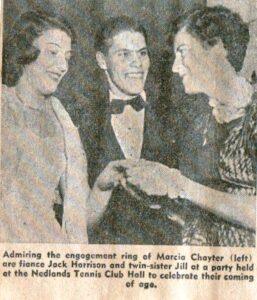
1952 Engagement article” Marcia chayter, Jack Harrison and Jill Harrison
PEOPLE YOU LISTEN TO (photo) Admiring the engagement ring of Marcia Harrison (left) are fiancé Jack Harrison and twin sister Jill at a party held at the Nedlands Tennis Club to celebrate their coming of age. Since he was five, Jack Harrison has been associated with the musical world together with his twin sister Jill. Both recently celebrated their 21st birthday at a party which included many of the musicians. Jack and Jill are now members of the W.A. Symphony Orchestra playing the clarinet and bassoon respectively. He has won numerous prizes and at the age of eight won an Amateur Hour contest in Sydney. He worked in his father’s band until he decided to form his own which consisted usually of himself, Jill, elder brother Ray and guitarist Bill Hendrie. Jack has played in A.B.C. shows and at the present time has a session in which his quintet plays light classical music. He was for a while in the Adelaide Symphony Orchestra and studied the clarinet under the late Percy Newton (brother of John Nugent Hayward), Alan Rule and Clive Amadio. At the party Jack’s engagement to A.B.C. typist Marcia Chayter was announced.
The Broadcaster Saturday August 16 1952
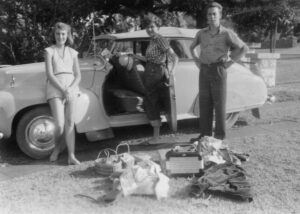
1952 Marcia, Jill & John with Jack’s Vauxhall in driveway Highway
Jack, Jill and John were all tutors at the first Music Camp ever to be held in Western Australia from November 14 – 17 1952 at Point Peron.
The following tutors have agreed to give their services at the Point Peron Music Camp to be held from November 14 – 17: Mr Vaughan Hanly, Miss Barbara Smith, Mr John Mowson (strings); Miss Jill Harrison, Mr Jack Harrison, Mr John Cran (woodwind); Mr Charles Court (brass). The Director of Music will be Mr. O. G. Campbell Egan assisted by Mr Edgar Nottage. Mrs Honor Nottage will be the camp chaperone. A full timetable of sectional of sectional rehearsals, films, talks and recitals (by the tutors) has been arranged. Recreation will be organised by Mr Ross Bromilow of the National Fitness Council.
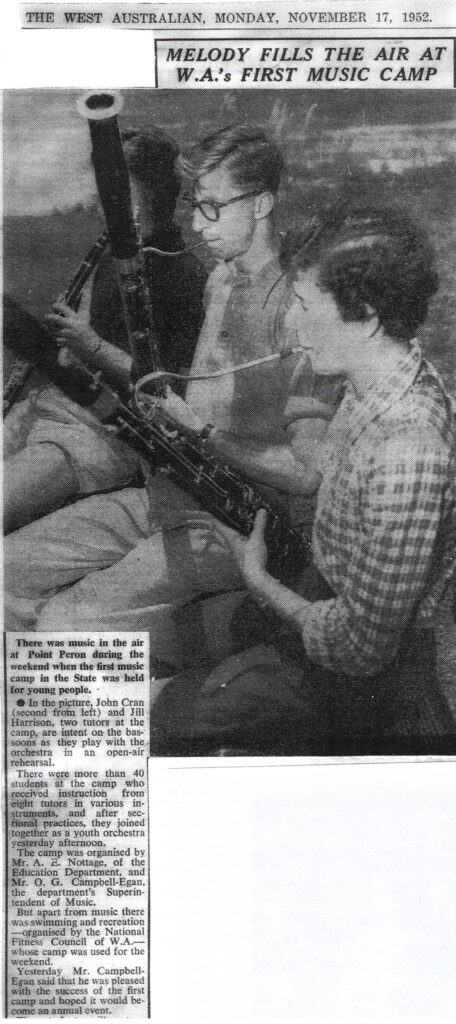
1952 John Cran and Jill Harrison – bassoons
MELODY FILLS THE AIR AT W.A.’S FIRST MUSIC CAMP
There was music in the air at Point Peron during the weekend when the first music camp in the state was held for young people. John Cran and Jill Harrison, two tutors at the camp, are intent on the bassoons as they play with the Orchestra in an open air rehearsal. There were more than 40 students at the camp who received instruction from eight tutors in various instruments and after sectional practices they joined together as a youth orchestra yesterday afternoon. The camp was organised by Mr A .E. Nottage of the Education Department and Mr O. G. Campbell-Egan the Department Superintendent of Music. But apart from music, there was swimming and recreation organised by the National Fitness Council of W.A. whose camp was used for the weekend yesterday. Mr Campbell-Egan said that he was pleased with a success of the first camp and hoped it would become an annual event.
The West Australian Monday November 17, 1952
In late November 1952, Jill Harrison became engaged to John Mowson. Jack and Marcia announced their wedding would be in December 1953. As the ABC orchestras only offered holidays at Easter and over Christmas, Edna Harrison suggested a double wedding, as she didn’t think two weddings in December 1953 was feasible. Marcia didn’t want a double wedding & Jill and John didn’t want to wait, so planned their wedding for the Easter of 1953.
1952 Mary and John Mowson, Jill Harrison engagement
HARRISON-MOWSON: Mr. and Mrs. W. E, Harrison have much pleasure in announcing the engagement of their only daughter. Jill, to John, eldest son of Mr. and Mrs. A. T. Mowson, of Melbourne.
Congratulating her son John (centre) on his engagement to Jill Harrison (right), Mrs. Mary Mowson (left) has a savory before the dinner party given by Mr. and Mrs. W. E. Harrison at their Nedlands home last night to announce their daughter’s engagement. Both John and Jill are members of the WA Symphony Orchestra.
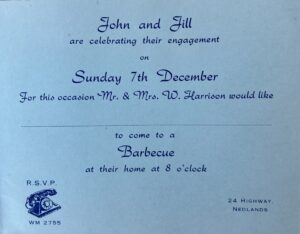
1952 Jill and John’s engagement party invitation
Engagement Party To celebrate
To celebrate the engagement of their daughter, Miss Jill Harrison, to Mr John Mowson, Mr. and Mrs. Bill Harrison gave an outdoor party at their home in Nedlands last night. Miss Harrison wore a pretty, flared frock of pale-blue waffle pique. Among the guests were Mrs. A. Mowson, who arrived from Melbourne recently Mr. and Mrs. John Mathews, Mr. and Mrs. T. Bennett, Mr. and Mrs. A. Ackland, Mr. and Mrs. Alan Cole, Misses Stephanie James, and Shirley Flesflader. Miss Harrison and her fiancé plan to be married early next year.
Jill Harrison bassoon
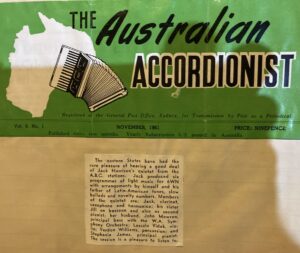
THE AUSTRALIAN ACCORDIONIST MAGAZINE
PERTH: Any ideas that may be held by unenlightened persons that harmonica players are not musicians could be rapidly dispelled by hearing of the activities of Jack Harrison of Perth. Jack is a clarinettist with the Symphony Orchestra in that city and is State Finalist in the A.B.C. Concerto Competitions on clarinet. In addition to these activities he has his own dance band and has formed his own quintet known as the Jack Harrison Quintet”. The quintet comprises Stephanie James (1st piano), Brenda Cullity (violin), John Mowson (bass), Jill Harrison (Vibes, Celeste, Bassoon, 2nd piano and Vineta) and Jack himself (Clarinet, Bass Clarinet, Saxophones and harmonica). Jack is a grand example to everyone of a young musician who started on the harmonica and who, at the same time, worked seriously on another instrument. All readers will join with us in wishing you every success and in looking forward to the time when we may be able to hear your group on records. The Australian Accordionist July 1953 Vol. 1 No. 3
1953 Young Musician Receives Loud Applause – A saxophone solo by 17-year old Neil Boon was loudly applauded in the Capitol Theatre last night at the final session of the Jazz Jubilee. The young musician, who arrived in Australia from England four years ago with no knowledge of music appeared in an orchestra with the veteran trumpeter Harry Phillips. He played an arrangement by the late Freddy Gardiner of “I’m In the Mood for Love.” Another artist on the same programme was Jack Harrison, who played six instruments in a ten-minute “jam session.” He played the alto and bass saxophone, clarinet, vibraphone, trombone and the piano accompaniment to his sister Jill when she moved from the piano to play the oboe (bassoon!) in “bebop” tempo. The West Australian Monday 2 November 1953 page 4
Jill playing jazz bassoon
SHOWER TEA: Miss Ann Poynton (centre, above) gave a shower tea at her home in Nedlands last night for Miss Jill Harrison, whose marriage to Mr. John Mowson will take place at St. Andrew’s Church, Perth, next week. With the hostess are Miss Betty Dawkins (left), of Nedlands, and Miss Marcia Chayter, of Mt. Lawley. The West Australian 27 March 1953 page 15
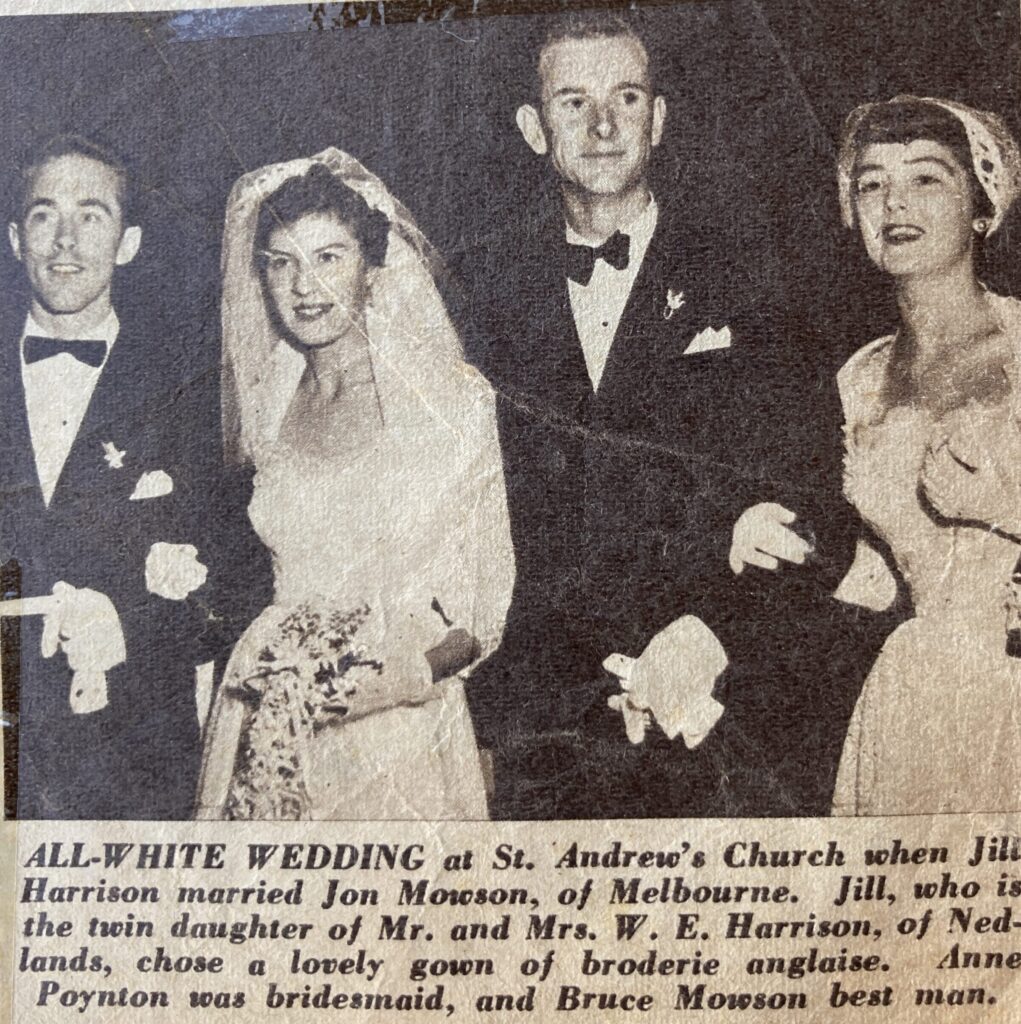
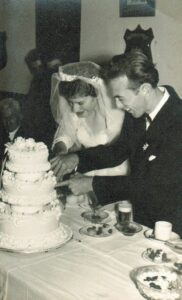
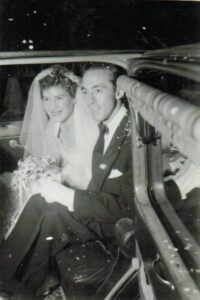
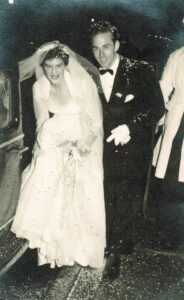
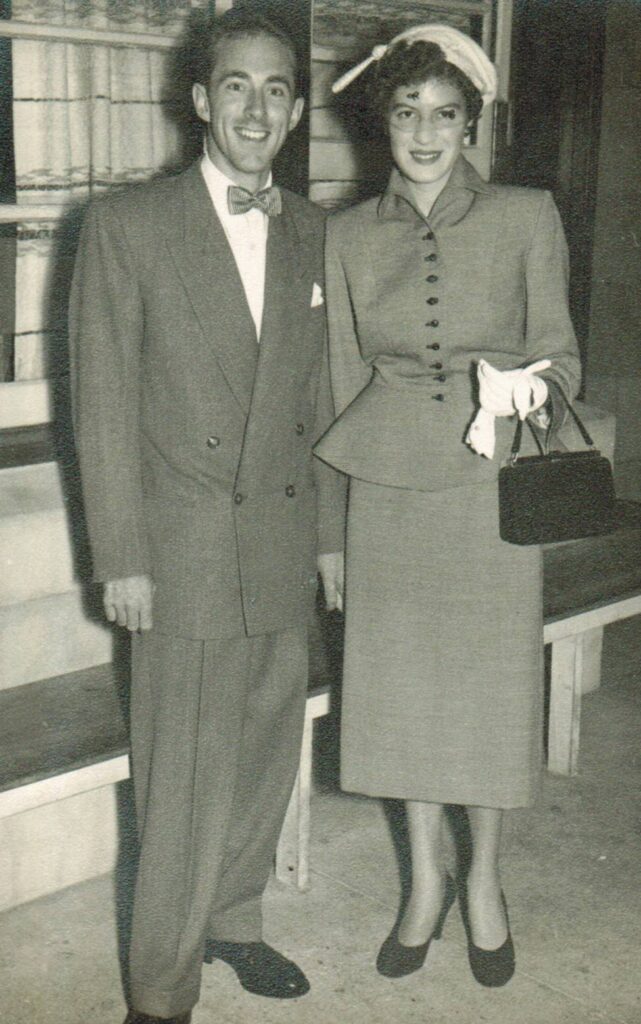
On April 2nd 1953 Jack’s twin Jill Lois married John Alan William Mowson. John’s brother, Bruce Mowson, flew over from Melbourne to be best man, and it was the first time he met Jill.
Married at Saint Andrew’s
A full skirt frock of crisp embroidered Swiss organdie with a fitted long sleeved bods was worn by Miss Jill Harrison when she was married to Mr John Mowson, the son of Mr and Mrs A. T. Mowson of Caulfield Victoria, at Saint Andrew’s Church, Perth on Thursday evening. A halo or fresh flowers held her veil of raw cut tulle. Her bridesmaid, Miss Ann Poynton, wore a ballerina length frock of fine white organdie with a halter-neck bodice and an extremely full skirt. Mr Bruce Mowson was best man. After the ceremony, the bride’s parents, Mr and Mrs W E. Harrison of Nedlands, held a reception at the Nedlands Tennis Club.
1953 Mowson – Harrison wedding article2nd April 1953 Jill and John Mowson1953 wedding of Jill Harrison and John Mowson1953 John and Jill Mowson departing
SATURDAY MAY 30 1953 – ROCKINGHAM – Sammy Sharp Jack and Jill Harrison, Shirley Browne, Niddy Roberts, Stan Grey present: Crazy Capers at the Trocadero, Rockingham, Saturday, May 30. Entries for Marathon and Endurance Dances. Ring B2141. Rockingham 232. The West Australian Saturday 30 May 1953 page 27
CELEBRATE CORONATION at the TROCADERO – Rockingham, Saturday, May 30th
Marathon Endurance – Novelty Dancers – Knockout competition — Barbecue Supper. Crazy caper entertainments by Sammy Sharp, Jack and Jill Harrison, Niddy Roberts Ted Miles etc. The Daily News Tuesday 26 May 1953 page 14
SATURDAY MAY 30th 1953 ROCKINGHAM DANCE – Last Saturday night a Coronation Dance for teenagers was held at the Trocadero Ballroom, when about 150 young people gathered and made merry. The organiser. Mr. Stan Grev. had made all arrangements for a marathon dance around the main town block but was unable to get any starters ~ he even had the band wagon ready with piano and drums set up to supply the music for the dancers. Attempts by comedian Niddy Roberts to drum up some contestants resulted in him getting a well aimed custard pie in the face. Jivey music was supplied by Sammy Sharpe his band. A competition was held among the dancers to select a couple to attend the Rockingham Bowling Club’s Ball on the following night. This was won by Graham Burket and Val Burkett who danced the Pride of Erin and won 2 complimentary tickets by popular acclaim.
(HILARIOUS incorrect quote!:) Jack and Jill Harrison, professional dancers from Perth, gave a floor show including a Mexican song and dance to the “Love Song of Rainoldi”. Miss Harrison’s Mexican costume was a red skirt with a lavishly embroidered and towelled blouse, designed and made by her mother and herself.
After the dance, dancers attended a barbecue organised by Mr. Grev. when chops were grilled over braziers and served with rolls. Teeners voted the night the best ever. Coastal Districts Star Thursday 11 June 1953 page 3
Monday 1 June 1953 – Radio Broadcast – Easy Listening Classical Music – 7pm Young Westralia: The Woodwind Players; Jack Harrison (clarinet), Jill Harrison (bassoon), Donald Cartwirght (oboe). Trio, Pastorale, Scherzo, Andante, Final, Musette – 6WN
1953 Walter Susskind – signed photo
CONDUCTOR IN THE GROOVE
Conductor-pianist Walter Susskind, currently in Perth to give a series of concerts and recitals, last Sunday evening deserted the concert platform to “getin the groove” with a group of Perth’s most ardent swing fans. The maestro has always been tolerant of modern music – he has expressed admiration for works by Gershwin and Woody Herman. With this in mind a group of Perth’s young swing fans sent him an invitation to join them on Sunday evening at Geoff Forsaith’s home in Crawley, where they would beat out a few bars. Prominent in the group were the West Coast Dixielanders – who only a few nights before had been placed first in the 1953 Dance Band Contest – John Mowson and Jill and Jack Harrison, and ABC announcer and record wrangler Peter Harrison. The bars were being duly “beat” when the doorbell rang to announce a new arrival at the festivities, and to their delight the swingsters were being introduced a few moments later to Walter Susskind. The evening which followed was a complete success. The guest of honour regaled the musicians with anecdotes on his experiences while travelling in America and on the Continent and the musicians in turn treated him to a selection of modern music which would have sent their fans green with envy. And although he declined an invitation to take over the pianist’s seat for a few numbers, Walter Susskind left the impression that he would have been only too happy to have done so had it not been for the fact that there were serious things ahead for him on the morrow. The Broadcaster Saturday August 1 1953 Vol. 20 No. 1009
Thursday 27 August 1953 – NOTES ON THE DANCE BANDS – The Inkspots, not the famed colored outfit, but a group of well-known business, sporting and musical folk who usually gather at popular Clive McMillan’s home, held a ladies’ night at the Continental, Claremont, on Thursday last. Guests included the following: Clive McMillan, Steve McHenry, Murray Church, Merv Rowston, Morry Maurice, Cliff Adam, Jim Beeson,Wally Hadley, Roy Delamere, Reg Benjamin, Jack and Jill Harrison, Johnny Mowson, Dr. Willington, Cyril Bird and Reg North. Mine host Harry Ward entertained on the banjo and joined the boys on trombone in several jam sessions. Mirror Saturday 29 August 1953 page 13
Jill, Marcia and Edna at Highway
THE WORLD OF MUSIC AND THE THEATRE – This afternoon’s programme at the Kylie Club meeting will be given by the Woodwind Players: Jill Harrison (bassoon), Jack Harrison (clarinet) and Donald Cartwright (oboe) and the Madrigal Singers (conducted by Barbara Levien). The West Australian Saturday October 3 1953 page 28
Winthrop Hall on October 20 1953 – WA YOUTH TO SHOW TALENT
FIFTY-THREE young players will feature in a concert. All members of the youth orchestra, their ages range from nine to 21 years. The youngest are Jennifer Gawell (9) and Ashley Arbuckle (10). This group of instrumentalists was formed in 1945 under the leadership of Superintendent of Music and Speech O. G. Campbell Egan. Its object is to provide experience and training in orchestra playing. It was the first youth orchestra to be formed in Perth. Already at least four of its members have graduated into the ranks of the WA Symphony Orchestra. They are Jack and Jill Harrison (clarinet and bassoon) Don Cartwright (oboe) and his brother Jim (flute). One of the orchestra’s former members, Don Westlake, recently won first place Australia in the ABC concerto competition. A feature of this year’s concert will be the appearance of four members of the orchestra playing movements from the concerto repertoire! Choral work will be provided by the East Perth school choir under the direction of Mrs. Irene Smyth. Eater this year, members of the youth orchestra will take part in their second annual musical camp at Point Peron. Guest conductor will be WA Symphony Orchestra leader Vaughan Hanly. His son, Brian, plays the violin in the youth orchestra. Free tuition by members of the State orchestra will be given at the camp. The Daily News Saturday 10 October 1953 page 12
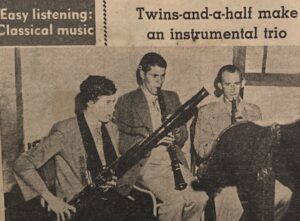
Twins and a half
TWINS-AND-A-HALF MAKE AN INTRUMENTAL TRIO
Members of the W.A. Symphony Orchestra at Broadcast House now include (pictured) Jill Harrison (bassoon), Jack Harrison (clarinet) and Donald Cartwright (oboe). Jack and Jill (22) and Don (23) is one of the twins. Combining their instruments and talents, the three have formed themselves into the Woodwind Trio. They will be heard in the Young Westralia Programme from 6WN at 7pm on Monday November 30. Cartwright’s twin brother plays flute but is not a professional musician. He is at present motor-cycling around Australia on a working holiday. The Broadcaster October 1953 page 38
Jill and John Mowson travelled to Melbourne during their December 1953 ABC Christmas holidays in order for Jill to meet the Mowson family and therefore had to miss Jack and Marcia’s wedding on 14th December 1953.
Jack and Jill on Dodonia driveway
Women Are Prominent In W.A. Orchestra
A Melbourne flautist, Miss June Lindsay, complained recently that in England there was a great prejudice against women in orchestras. But there seems to be no such feeling in the West Australian Symphony Orchestra.
A group of 15 musicians who will play when the: Queen attends the women’s reception at the University, includes six women. They are Misses Margaret Sharp and Denise Dingwell (violinists Barbara Smith (viola), Beatrice Pether (cellist), Stephainie James (pianist), and Aino Neumann (double For many years the deputy leader of the orchestra has been Mrs. Vera Rees, and she took over as first violinist during World War I. Born and trained in London, she has played in the. orchestra here for 20 years. She finds the life of a musician very interesting. “You have to be very meticulous with your work,” she says. ‘Cello, Horn The ‘cello section plays under Miss Wendy Tyler, of Nedlands, who has held the position for. three years. She studied under Laurie Ken nedy in Sydney and then returned to her home State. .’Another. – unusual.. instrument for a girl to play is .the French horn, .but Miss.Thelma Moire, of Claremont,. has gained the position of third horn in the orchestra. She studied at the Melbourne Conservatorium for four years: Miss Moore is a member of a musical family. “All of them have been” musicians at some stage.” she said. Her brother, Frank, is second flute in the orchestra. She sailed for England in the Orontes this week with her par-ents. ‘During her six months. overseas she hopes to be able to get some further musical experieince. Miss Jill Harrison, of Cottesloe, has been the second bassoon player for two years. She is the only professional woman bassoonist in Australia and studied at the Elder Conservatorium, Adelaide. A veteran-musician is Miss W. Wright who studied the viola at the Royal Academy of Music in London under Sir Henry Wood. She returned ‘to Australia for some years.and then decided to go back to England. Her intended stay of one year did not eventuate and it was 20 years before she returned to Perth and joined the orchestra here. Debutantes For ·Ball Plans are .already being made for the annual ball of the Order of the Eastern Stat which will be held at the Embassy on June 29. The secretary (Mrs. A. Mc Kirby), said yesterday that there were some vacancies in the list of girls who would make their debut at the ball. Any girls who were interested should get in touch with her at her home in Mosman Park.
West Australian (Perth, WA : 1879 – 1954), Wednesday 24 March 1954, page 26
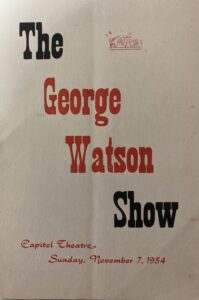
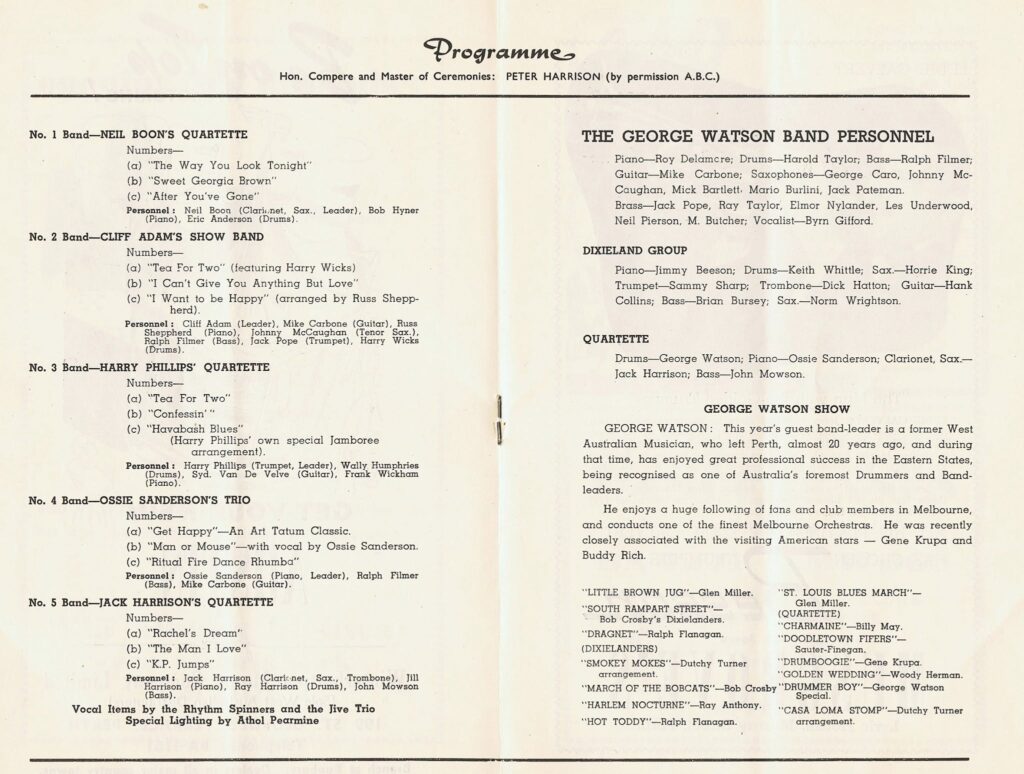
1954 George Watson Show1954 Watson George program
JAZZ CONCERT 1955
No. 5 Band – JACK HARRISON QUARTETTE
Numbers –
“Rachel’s Dream”
“The Man I Love”
“K.P. Jumps”
PERSONNEL: Jack Harrison (Clarinet, Sax, Trombone), Jill Harrison (Piano), Ray Harrison (Drums), John Mowson (Bass).
1956
MELBOURNE ON THE GRAPEVINE – With Geoff Brooke – BOON WILL BOOM WITH HIS BOOP-BOOP-A-DOO
One night last week I had the pleasure of working with a young musician who has just arrived here from Perth, and I have no hesitation in naming him as one of the most promising clarinettists in town today. He is 19 year old Neil Boon and his very easy style (which shows a distinct Goodman influence) and excellent tone, had the boys in the Joe Marchesani trio very enthusiastic indeed concerning his future prospects in the music game. The boy’s playing was full of ideas and his technique is a tribute to the thorough teaching of Alan Rule in Perth. Rule was well known to Melbourne theatre audiences as a member of the Regent orchestra for years and built an excellent reputation here as a teacher, before returning to home in the West. He is a big husky fellow and a fine player himself. Another of his prize pupils who is frequently mentioned when swing musicians are discussing the country’s top clarinet men is Jack Harrison of Perth, whose sister Jill was recently appointed to the Melbourne Symphony Orchestra in the bassoon chair.The Argus Melbourne Saturday March 31 1956
Melbourne Symphony Orchestra 1956
Jill and John Mowson were offered positions in the Victorian Symphony Orchestra, now the Melbourne Symphony Orchestra, performing with many great conductors including Sir Charles McKerras, Richard Bonynge, Sir Eugene Goosens and Otto Klemperer. For the Opening Ceremony of the 1956 Olympic Games in Melbourne, M.S.O. combined with the Sydney Symphony Orchestra playing in the presence of Prince Phillip.
1956 MSO at the Olympics1953 Jill outside1959 Jill and John Mowson, Jack & Marcia Harrison outside 11 Dodonia Gardens
Hometown brings “a change”
For the past three weeks Mrs John Mowson of Melbourne has been making up for a year of indoor life in Melbourne. Between swimming, picnicking and barbecue teas, she has managed to spend nearly all the time outside enjoying some summer weather for a change. “Melbourne is wonderful but it’s climate is not especially when one is used to Perth weather” she said yesterday. Mrs Mowson was well known to Perth people as Miss Jill Harrison. She and her husband are holidaying with her parents Mr. And Mrs W E. Harrison of Nedlands. Both are members of the Melbourne Symphony Orchestra – Mrs. Mowson is a bassoonist and her husband plays the double base. They formerly played with the W.A. Symphony Orchestra. “A musician’s life was harder work in Melbourne because longer hours each week were devoted to rehearsals and concerts” Mrs Mowson said “however, playing with such a big orchestra (it has 80 players) was a wonderful experience. Much more ambitious works could be undertaken and each player could devote himself entirely to his particular instrument without having to double up on other parts. Rehearsals were held in the Albert Street Baptist Church because it had excellent acoustics” she added.
The West Australian 1956
BBQ Jill, John, Jack & Marcia
WEEKEND MAIL JANUARY 1956 – It was at a barbecue part given by Mr and Mrs Jack Harrison at their City Beach home. Two of the guests (left) were Eastern states visitors Mr and Mrs John Mowson.
1958
Marcia, Norman Bourke and Jill
MUSIC FOR LEISURE – FAMILY TIES
These three players of Jack Harrison’s group are all relations and will be heard in “Music for Leisure” on Sunday night November 13 from 3AR-7ZL at 9.15. They are from right: Jack Harrison of Perth, clarinet, his sister Jill, bassoon; and husband John Mowson, bass. The A.B.C. Weekly Vol. 20 No. 46 12 November 1958
1954 John Mowson, Jack Harrison, Norman Bourke (Sound Engineer) & Don Sanders (ABC Announcer) . Jill Harrison back left. Jack and Marcia Harrison, Bruce Mowson, Jill & John Mowson at Reno restaurant June 1959
1959
The Australian premiere of Richard Strauss’s Duet-Concertino for clarinet and bassoon was broadcast in June 1959 by the Australian Broadcasting Commission. It was performed by the West Australian Symphony Orchestra, featuring Jack Harrison on clarinet and Jill Mowson (née Harrison) on bassoon.
The Harrisons were always musical. The family used to get together in a one family band. Now the 27 year old twins – Jack and Jill – are the featured stars in a 40 minute broadcast from 6WF on Wednesday 24th June 1959 with the W.A. Symphony Orchestra. The programme: Richard Strauss’s Concerto for Bassoon and clarinet. Jill will be playing the bassoon and Jack the clarinet. The West Australian Friday June 19 1959
Mavis, Marcia, Edna, Norma & Jill Harrison
RADIO BROADCAST – Light Music by Family – When Perth’s versatile instrumentalist Jack Harrison and his quintet play, it’s a family affair. In a series of six programmes of light music starting this Tuesday at 8pm from 6WN, Harrison will play the harmonica, saxophone and clarinet. He and his father have made special arrangements of Latin-American tunes slow ballads and novelty numbers for the programmes. Members of the quintet will be Harrison’s twin sister Jill (bassoonist and second pianist) her husband John Mowson (principal bass with the W.A. Symphony Orchestra), Laszlo Vidak (violin), Verdon Williams (percussion) and Stephanie James (principal piano).
1960
In June 1960 Jill was bassoon soloist for a series of A.B.C. Schools Orchestral Concerts with the WASO conducted by John Farnsworth Hall. She performed the last movement on the Concerto in B flat major for bassoon and orchestra by Mozart.
1961 Australian Accordionist
BROADCASTS – The Eastern states have had the rare pleasure of hearing a good deal of Jack Harrison’s quintet from the A.B.C. stations. Jack produced six programmes of light music for 6WN with arrangements by himself and his father of Latin-American tunes, slow ballads and novelty numbers. Members of the quintet are: Jack, clarinet, saxophone and harmonica; his sister Jill on bassoonist and also as second pianist; her husband John Mowson, principal bass with the W.A. Symphony Orchestra; Laszlo Vidak, violin; Verdon Williams, percussion and Stephanie James, principal piano. The session is a pleasure to listen to.
The Australian Accordionist Vol. 8 No. 1 November 1961
1960 Olive, Edna, Jill and Bessie and dogs
1962
Tricia and Adrian Wood; Jill and Peter Mowson – born the same day.
On the 2nd May 1962 John and Jill Mowson had their second child, Peter John.
Peter was born in the same hospital on the same day as Adrian Wood, son of violinist WASO colleague Graham Wood and his wife, Tricia.
1965
In 1965 Jill and John were invited to go to London with the Sydney Symphony Orchestra for the Commonwealth Festival of Arts. During their stay, the Orchestra was invited to lunch with Prince Phillip. Jill was tapped on the shoulder and told not to smoke until the Prince arrived.
1965 Jill and John Mowson Jill and on tour with Sydney Symphony
Australian composer James Penberthy composed a bassoon and double bass duet dedicated to Jill and John Mowson which was performed in a government sponsored concert of W.A. Composers’ works in the A.B.C.s Basil Kirke Studio in 1965.
Perth music lovers should soon hear a husband and wife virtuoso team play a difficult work being written by W.A. composer James Penberthy. The W.A. Symphony Orchestra’s Principal Double Bass, John Mowson, who is regarded as one of the finest exponents of his instrument in Australia, asked Mr Penberthy to write a work for double bass and bassoon.
Jill was part of the ensemble “The Perth Bassoon Consort” with Brian Pope, Trevor Jones and Don Casson. In addition to performing in WASO and classical chamber music, Jill also performed in “Jack Harrison and His Music” broadcasts which were often recorded on a Sunday.
1966
NEW PROGRAM OF “EVERGREENS” FROM W.A. – JACK HARRISON AND HIS MUSIC
A new series of popular all-time favourite music will start on Monday on May 16 1966 at 8.30pm on the First Network.
It will be presented by six members of the West Australian Symphony Orchestra led by Jack Harrison. Special arrangements have been written for their combination of bassoon, bass, violin, piano and percussion with the leader doubling on clarinet and saxophone. There are five programs in the series to be titled “Jack Harrison and his Music”. Jack Harrison will occasionally introduce his first love the mouth organ. He is a versatile musician and once made a multi recording in which he played 14 instruments including percussion and piano. He has been a member of the W.A. Symphony Orchestra for 15 years during which he has appeared frequently as soloist in clarinet and saxophone Concertos. Highlights of these performances were the Australian Premiere of the Aaron Copland Clarinet Concerto and the Richard Strauss Double Concerto for Bassoon and Clarinet. On this occasion the bassoon soloist was his twin sister Jill who also joins him in his new series doubling on piano and percussion. Items in the first program are “Mice on the Move”, “Gigi”, “Sidewalk”, “Petite Waltz”, “Holiday in Honduras”, “Comedian Gallop” The Pygmy Patrol”, “Will O‘ Wisp” and “Forever Samba”. The other artists in the series Laszlo Vidak violin John Mowson bass Stephanie James piano and Verdon Williams percussion.
1965 William, Marcia, Edna and Kim Harrison, Peter, John, Penny and Jill Mowson, Jay Harrison
1966 CHILDREN’S ANTICS DELIGHT AUDIENCE
Actors coming in late on cues, making extra movement, forgetting to leave the stage when their item was finished and interjections of “mummy” did nothing to spoil a special concert at the Wembley Kindergarten. The children’s unconventional stage activiy only made the concert more enjoyable. A small charge was made to the audience of parents and friends. The money will help pay for the Dolly’s Corner which was recently fitted at the kindergarten. Added entertainment was given by a trio from the W.A. Symphony Orchestra – Jack Harrison, his twin sister, Jill and his brother-in-law John Mowson. The trio played suitable music for children, elephant music on the bass, Three bears music and the children banged their hands in time against their knees.
1967 Jack Harrison, Paul and Jill Mowson
On 22nd December 1966 Jill and John had their third child, Paul James.
Jill Harrison, a former principal bassoonist with the W.A. Symphony Orchestra, will spend next week in Adelaide as Principal Bassoon in the South Australian Symphony Orchestra for three subscription concerts. She will replace for a week the orchestra’s principal bassoonist Jos de Groen, who has been appointed Principal Bassoon in the Melbourne Symphony Orchestra.
1967
In June 1967 Jill and John played with the Melbourne Symphony Orchestra in Montreal for Expo, whilst Jill’s parents minded their 3 children – Penny 7, Peter 5 and Paul aged 1. The MSO was in Honolulu for its performance at the Waikiki Shell, which received great reviews. After being selected by the ABC to represent Australia at The Montreal World Festival, which was part of Canada’s Expo ’67, the musicians made a stop in Hawaii on their return journey. The event was an historic one, as it marked the first time an Australian orchestra had performed in the United States.
MUSIC – By Peter Hellstrom – September 24 1967
There will be an all Beethoven programme at tomorrow afternoon’s recital at the A.B.C. Basil Kirke Studio beginning at 3 o’clock. It will consist of the Septet in E flat and the Serenade in D. Op.8. The performers will be Graham Wood (violin), John Dean (viola), Brian Meddemmen (cello), John Mowson (bass), Jack Harrison (clarinet), Neil Pierson (French horn) and Jill Harrison (bassoon).
FEW HEAR FINE RECITAL – By Sally Trethowan – Sunday February 29 1968
Fewer than 30 people attended yesterday’s free Sunday afternoon recital in the Basil Kirke Memorial Studio to hear what must have been one of the finest given this year by Perth artists. The oboe playing of Peter Randall in Mozart’s Quartet for oboe and strings was so good that an unchartered listener might’ve thought it was a simple piece. Mr. Randall gave such purity and accuracy to the naturally sharp clear tone of the oboe as to make even the accompanying strings in this piece seem cloudy in effect. It was duly wistful in the doleful minor keyed slow movement and cheerful in the finale where the virtuosic double-tongued passages were given within incisiveness, clarity and extreme rapidity. Violinist Graham Wood led seven other instrumentalists Stanislaw Kowarski (violin) John Dean (Viola) Brian Meddemmen (cello) John Mowson (bass) Patrick Brislan (Horn) Jack Harrison (clarinet) and Jill Harrison (bassoon) in the four movement Octet for Wind and Strings by the modern English composer Howard Ferguson (AUSTRALIAN PREMIERE). Mr. Ferguson seems to have a particular affection for clarinet and horn, and the success of the performance to some extent pivoted on Patrick Brislan’s horn playing which allowed no imperfection of tone to mar its richness. The program ended with a reduced version of Richard Strauss’s tone poem “Till Eulenspiegel’s Merry Pranks”. Originally scored for an orchestra of Wagnerian proportions of over 100 players, it was here rendered by five. Though without the percussion and heavy brass that in the full score are so graphic in describing the grotesque adventures of the mediaeval vagabond Till, it was a happy even witty performance. The final concert in the free Sunday afternoon series will be given in a fortnight.
The Australian premiere performances of Till Eulenspiegels lustige Streiche, Op. 28 by Richard Strauss arranged for five instruments by Austrian composer Franz Hasenöhrl in 1954 and Octet for Wind and Strings (1933) by Howard Fergusonwas performed by (Graham Wood (Violin) Jack Harrison (Clarinet) Jill Harrison (Bassoon) Patrick Brislan (Horn) John Mowson (Double Bass) on Sunday February 29 1968 in the A.B.C. Basil Kirke Studio as part of the Festival of Perth.
The Harrison’s of City Beach are a family who are what they are because their parents are what they are and their grandfather still is. They are music lovers and musicians. They practise partly because it is one of the things they do because they should, but also because they like to. There is no” do what I do, not do what I say” psychology in parental attitude from the parents. No lines of demarcation between popular music (what the young like) and classical (parents’ choice) any more than there is between a music lover and a musician. When four year-old Jody knocks out little tunes on the piano she is enjoying herself, but she is also being a serious creative musician and is treated seriously. And why not? These people do not learn music beginning with five finger exercises. They live it. When Jody’s father Jack found a little mouth organ in his Christmas stocking when he was five he began his musical career. When in a few years he had one 10 silver cup,s $1000 in fees, topped the voting list in an amateur hour session and being on Eastern state tours playing his mouth organ, he backtracked according to conventional musical training ideas. He learned the piano from his father, worked hard at the clarinet and started consolidating a theoretical background. Now the States leading clarinet player in the ABC Symphony Orchestra, he has a solid knowledge of harmony, counterpoint and all that un-jazz. He still plays popular music as well as orchestral work and teaches. His son Jay, 13, has inherited the clarinet his grandfather bought for his son Jack from a member of Johnny Turck’s US Army band during the war. He plays it in a modern group of youngsters who play Dixieland and call themselves “The Five Saints.” He also likes Mozart and playing hockey at Hale school and will sing in the school production of “Oliver”. Before the clarinet, Jay learnt the piano from his grandfather, Mr. William Harrison, as his seven-year-old brother Kimberley is doing now on Sunday night. The Harrison’s go to tea with the grandparents in Nedlands and the music lesson is sandwiched in. Bill Harrison Senior was a part-time picture theatre pianist in the silent days with that wonderful repertoire of mood music which gave the old flicks another emotional dimension. He had to wait to resign from a government job to be a full-time musician, took a band up to the Murgoo races every year for 10 years, had a dance band and took his teaching diploma after the war. When his son had a group playing for radio, Bill Harrison did their arrangements for them. Now Jack Harrison does his own arrangements. Bill Harrison, now more than 70 and still playing and teaching on a restricted scale, belonged to that generation of parents who wanted their families to make music together. He drew his children into his own band- son Bill on saxophone. Ray on drums( he still does some playing) and twins Jack and Jill on clarinet and bassoon. At 16 the twins and Ray formed their own dance band. Playing for a Perth College dance, Jack met pretty Marcia Chayter and later married her. She is not a professional musician. She plays the piano usefully and enjoys singing in the chorus of the Gilbert and Sullivan Society as contentedly as Kimberley plays one hymn, arranged by his father, for his Sunday school.
John Mowson now Principal double bass player in the W.A. Symphony Orchestra came from Melbourne and married Jill Harrison the bassoon player nearly 3 years ago. John and Jill were invited to join the Sydney Symphony Orchestra on a tour which included the Commonwealth Arts Festival in England and in Asian countries. They left their two children with Jill’s parents. Two years later they were asked to join the Melbourne Symphony Orchestra for Expo 67 in Canada. There was then another little Mowson, so Penny, now eight, Peter showing musical promise at six and baby Paul were farmed out among the family. The family is scattered around Perth. Jack and Marcia Harrison have a delightful, modern, open-planned home at the end of the Dodonia Gardens City Beach with the coast down to Fremantle as picture in a picture window. The young have learnt to be quiet when music is going on in such a house, to listen with appreciation. But the whole family looks forward to having a music room so that making a noise when one wants to isn’t so important. Daily News, Monday June 3 1968 page 10
1968 Soldier’s Tale Perth premiere
Sunday September 29th 1968 – Free A.B.C. Concert
The free concert in the A.B.C.s Basil Kirke Studio tomorrow beginning at 3 o’clock is one of a series of six in which distinguished artists are performing a wide variety of works. The program will be Bartok’s outstanding and complicated “Sonata for two pianos and percussion” played by Wendy Nash and Stephen Dornan and percussionists John Reece and Brian Sadique directed by Verdon Williams and Stravinsky’s “Soldiers Tale” concert suite conducted by Verdon Williams. The performers will be Graham Wood (violin), John Mowson (bass), Jack Harrison (clarinet), Jill Harrison (bassoon), Donald Johnson (trumpet), Alan Mewitt (trombone) and Brian Sadique (percussion). The West Australian Saturday September 28 1968
Igor Stravinsky’s The Soldier’s Tale Concert Suite (July 1920) is scored for septet: Clarinet (in A and B♭), Bassoon, Cornet, Trombone, Violin, Double Bass and percussion. The West Australian premiere was performed on Sunday September 29th 1968 in a free concert put on by the A.B.C. in the Basic Kirke Studio. Directed by Verdon Williams, the performers were Graham Wood (violin), John Mowson (bass), Jack Harrison (clarinet), Jill Harrison (bassoon), Donald Johnson (trumpet), Alan Mewitt (trombone) and Brian Sadique (percussion).
CLASSICS THE FORTE OF A ONE-MAN BAND – By James Penberthy
This week, Perth’s first government sponsored feature film with specially written music required to one man bands to perform in it soundtrack. Jack Harrison of City Beach, the first clarinet player in the West Australian Symphony Orchestra, was one of them. In “Welcome to City” Harrison played the mouth organ, clarinet, bass clarinet, saxophone and a number of other things. Harrison was handed a mouth organ at the age of six by well-known teacher and piano player – his father. “Play this” he was instructed and he did. He became one of the best mouth organists in Australia and now has the biggest collection of poor man’s wurlitzers in the State. Then Harrison Senior directed his son to the piano, the clarinet and the saxophone, to jazz, pop, commercial, light and classical music of all sorts. While Jack excelled, so did sister Jill who became a pianist and one of Australia’s top bassoonists. Jack has now turned his attention away from all but classics. When his teacher, the ace clarinettist Alan Rule, decided to step down from first to second clarinet in the West Australian Symphony Orchestra, his mantle fell on the shoulders of his brilliant student. Harrison now plays first and Rule on the less demanding second, basks in a reflected and perhaps more satisfying glory for the student is a great credit to himself and his master. Jack has formed a new generation of musical Harrisons. His two sons Kim and Jay are learning and their sister has a gleam in her eye. Jill Harrison married Australian bass virtuoso John Mowson and put her bassoon aside for a while in favour of the needle and saucepan. The Sunday Times January 19 1969 page 34
1969
In 1969 they returned to Melbourne where John was appointed Principal Double Bass player for the MSO.
Jill worked on a casual basis while Paul started school.
Mrs. Jill Mowson formally, Perth musician Jill Harrison, who with her twin brother Jack is well known on the Australian music scene is making a quick visit to Perth. Jill has been acting Principal Bassoonist with the Victorian Symphony Orchestra for the past two months. Her husband John Mowson is the Principal Double Bass player and the couple live in Brighton with their children Penny, Paul and Peter Tomorrow Jill leaves Perth for Adelaide where both she and her husband have been invited to tutor at the National Music Camp. Only Penny accompanied her mother to Perth where they stayed with Jill’s mother Mrs W. Harrison of Nedlands. Among those who entertained the visitors were Mr. And Mrs. George Coleman of Dalkeith (she is pianist Stephanie James) and there was a family reunion with Jill’s other brothers, Mr. Ray Harrison and Mr. Bill Harrison and Mr Jack Harrison and their wives and children.
The Government decided to expand the State Orchestra and new jobs became available in 1973.
For 18 years Jill was Principal Bassoon of the Victorian State Orchestra (Elizabethan Trust Orchestra) which played for the Australian Opera, the Australian Ballet and the Victorian Opera Company.
1980 Jill Mowson and Max Neil
During these years Jill toured to Perth, Sydney, Brisbane and Adelaide, played for Placido Domingo and worked with Simone Young in her early performances as a conductor when she looked to be no more than 18.
Jill performed at a charity performance of Swan Lake attended by Princess Anne, who she met backstage later. She was also fortunate to be part of many performances with Joan Sutherland and Richard Bonynge.
1976 Penny, Paul and Jill Mowson
1977
On May 2nd 1977 Jill’s father William Edward Harrison died. Edna sold 24 Kingsway Nedlands and all its furniture and bought a unit on Stirling Highway opposite the rose garden.
1977 William Harrison Snr death – article Noted Musician
NOTED WA MUSICIAN DIES
One of the State’s oldest musicians, Mr Bill Harrison of Nedlands, died on Monday. He was aged 79. Mr Harrison was a prominent pianist and band leader between the 1930s and 1950s and two of his children are leading musicians in orchestras in Perth and Melbourne. The secretary of the Musicians’ Union, Mr Harry Bluck, said yesterday that Mr Harrison’s son Jack was the senior clarinettist in the W.A. Symphony Orchestra. His daughter Jill was a bassoonist with the Melbourne Elizabethan Theatre Trust Orchestra. Mr Bluck said that Mr Harrison senior had devoted a lot of time to encouraging and promoting young musicians. The West Australian Wednesday May 4 1977
1978
Jill with Edna in her new unit on Stirling Highway
Jill with her son Peter, a QANTAS pilot1981 Jill Mowson and Edna Harrison1981 – Jack and Jill’s 50th and their mother Edna’s 75th
1981 – 50 years old
Edna Harrison and daughter, Jill1981 jam session with Ray, Jack and Jill to celebrate their 50th birthday.
In 1981 Jill and twin Jack turned 50 and their mother, Edna, 75.
1981 – Jack, Dodo (their Godmother)and Jill
A party was held at Jack’s house and the band got back together for a jam.
1984
Jill and her son Paul1984 John, Bill, Jack, Dodo, Jill, Norma, Mavis, Kim, Edna
1984 bassoon quartet – Jill with George Dreyfus
1991 60th birthday of Jack and Jill and mother Edna’s 85th at 11 Dodonia Gardens
1991 – 60 years old
1991 – Jack and Jill’s 60th, Edna’s 85th – jamming
Jill retired as a music professional in 1991 and returned across the Nullarbor to settle back into Perth after an absence of 23 years.
Jack and Jill turned 60 and their mother, Edna 85.
1991 – Jill’s 60th with Paula and David Tunley and Roland Hahnel at Dodonia
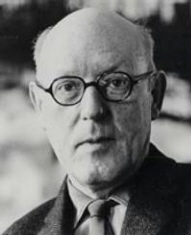
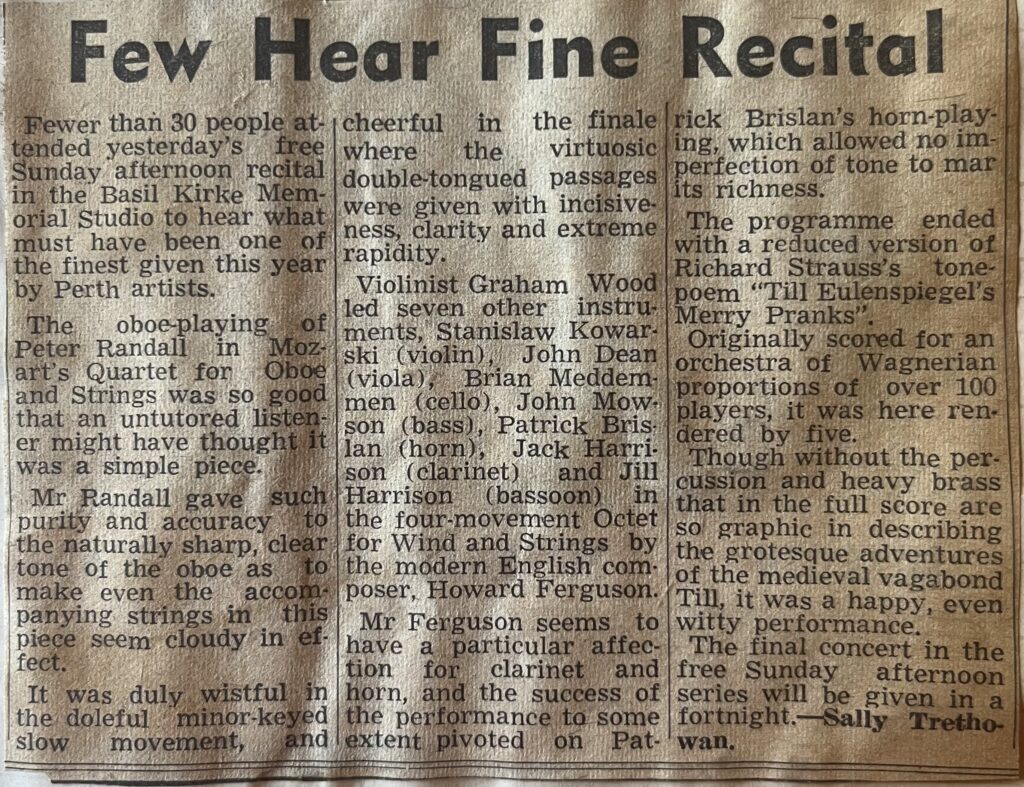
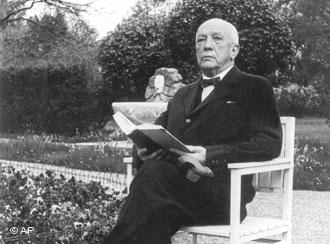
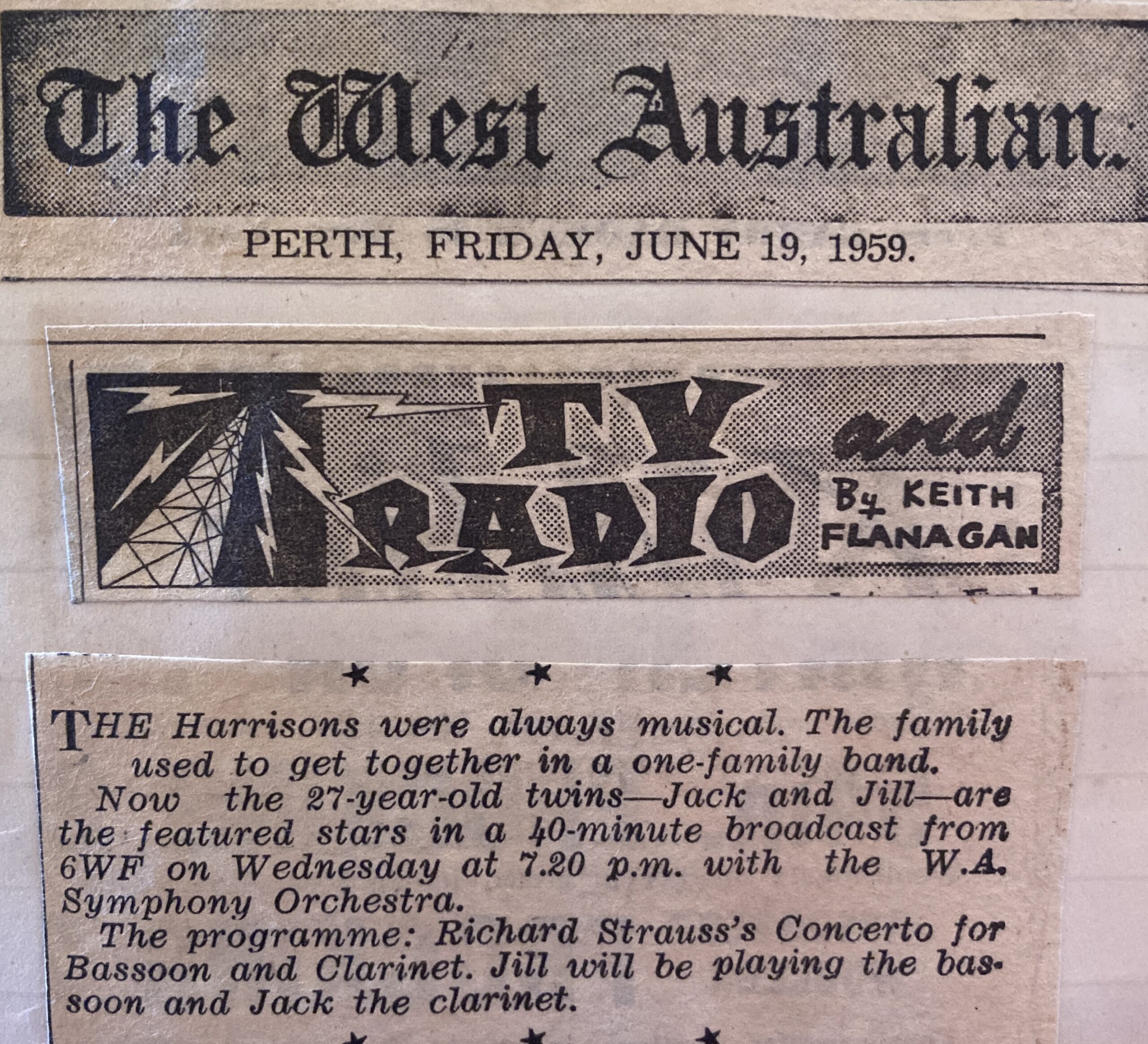
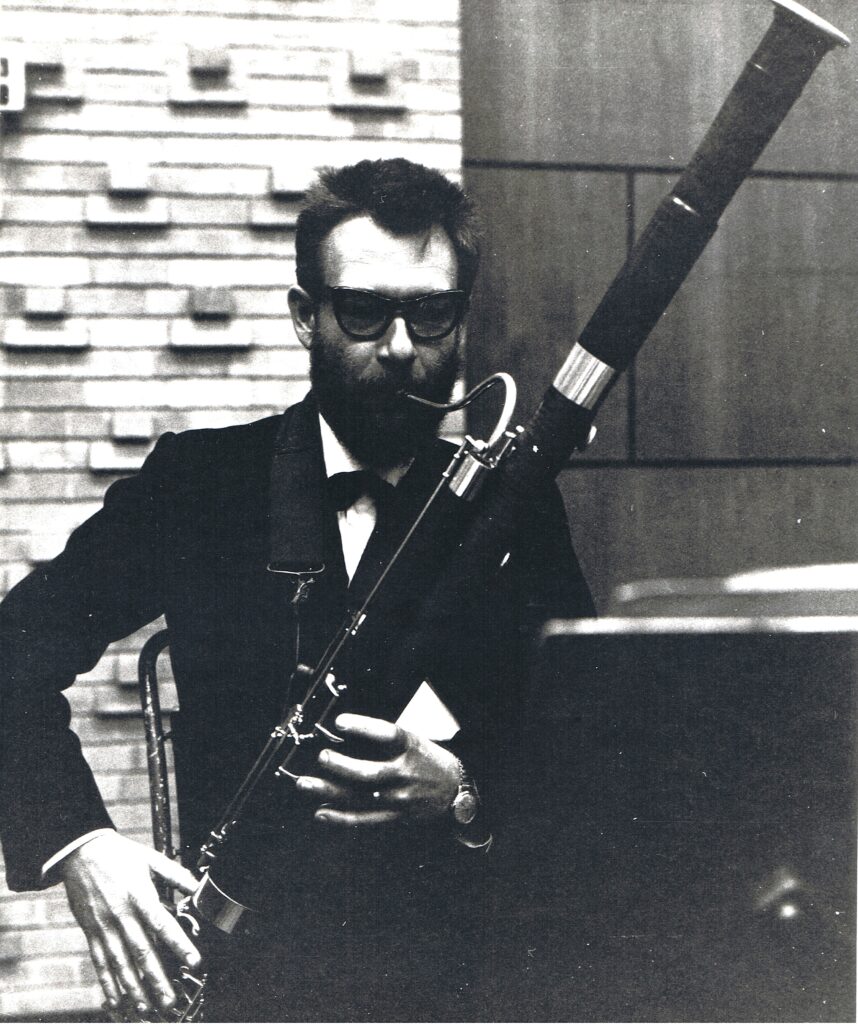
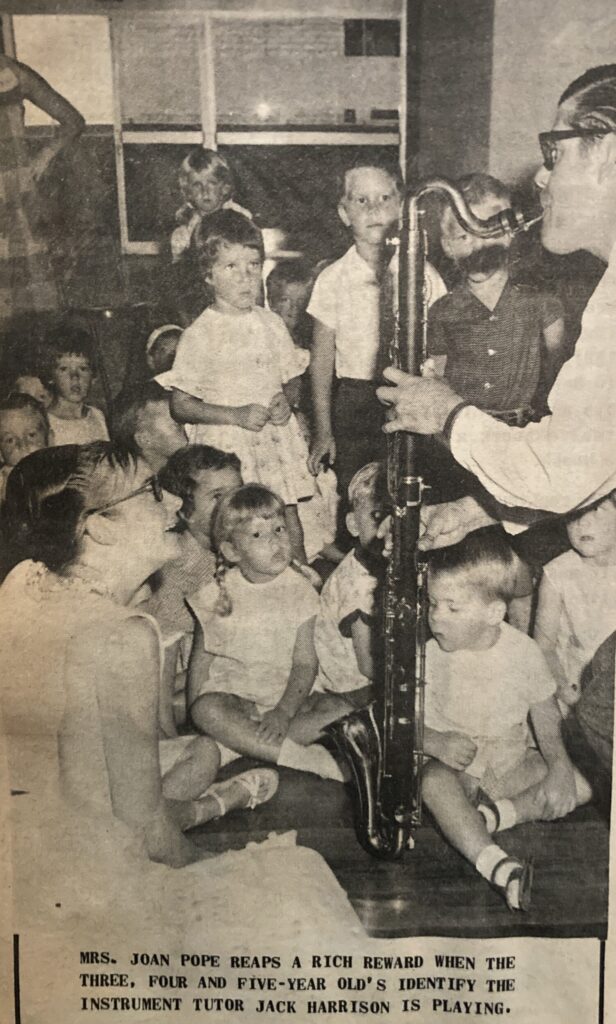
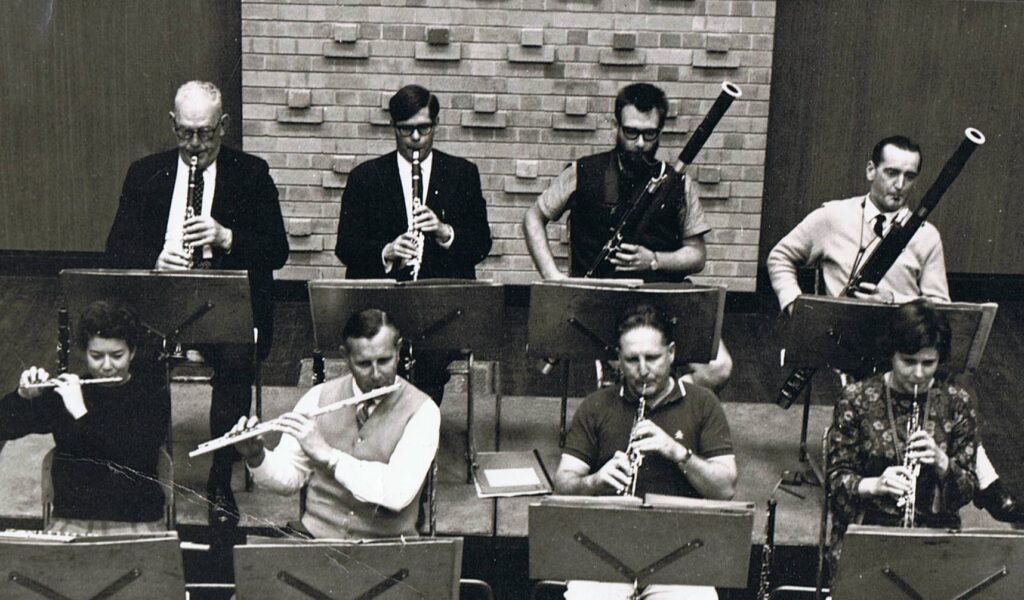
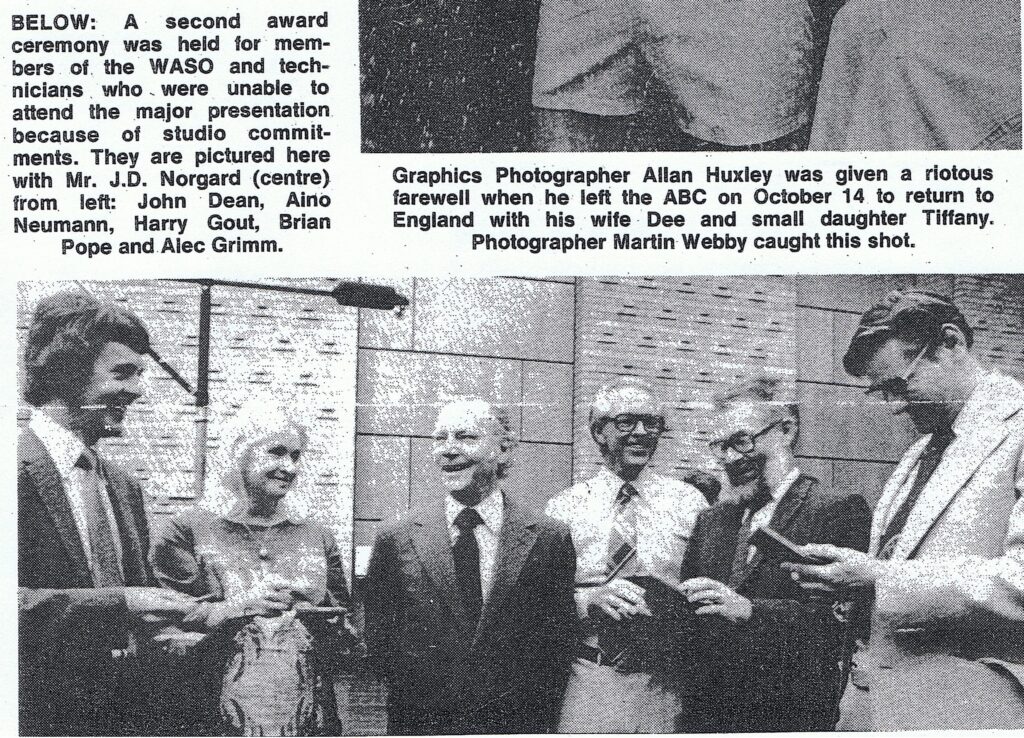
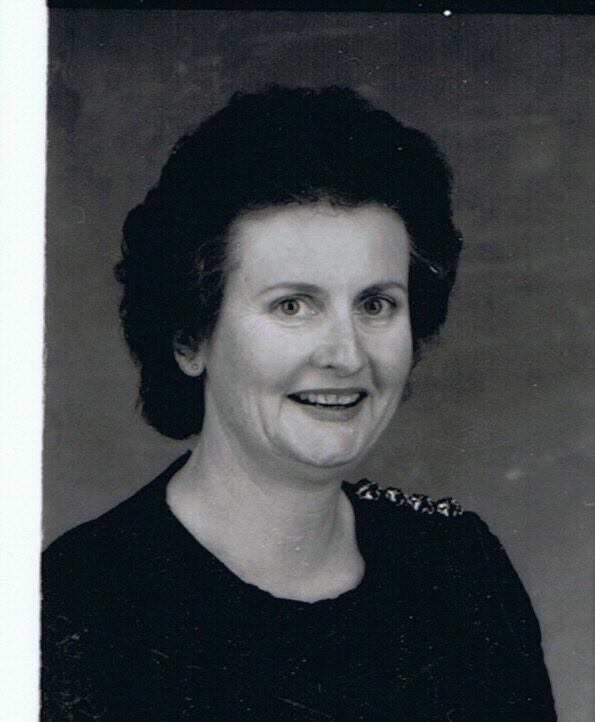
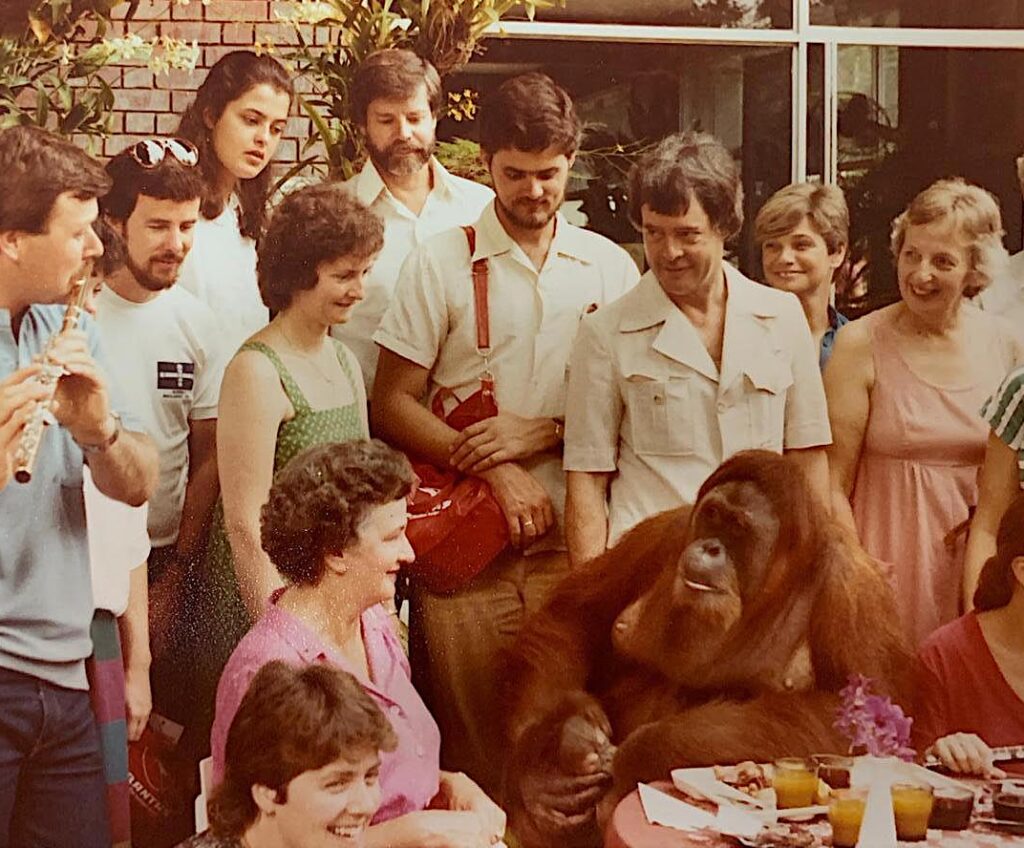
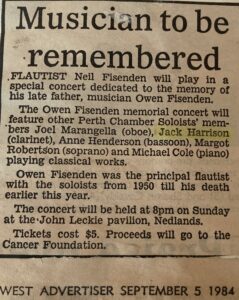
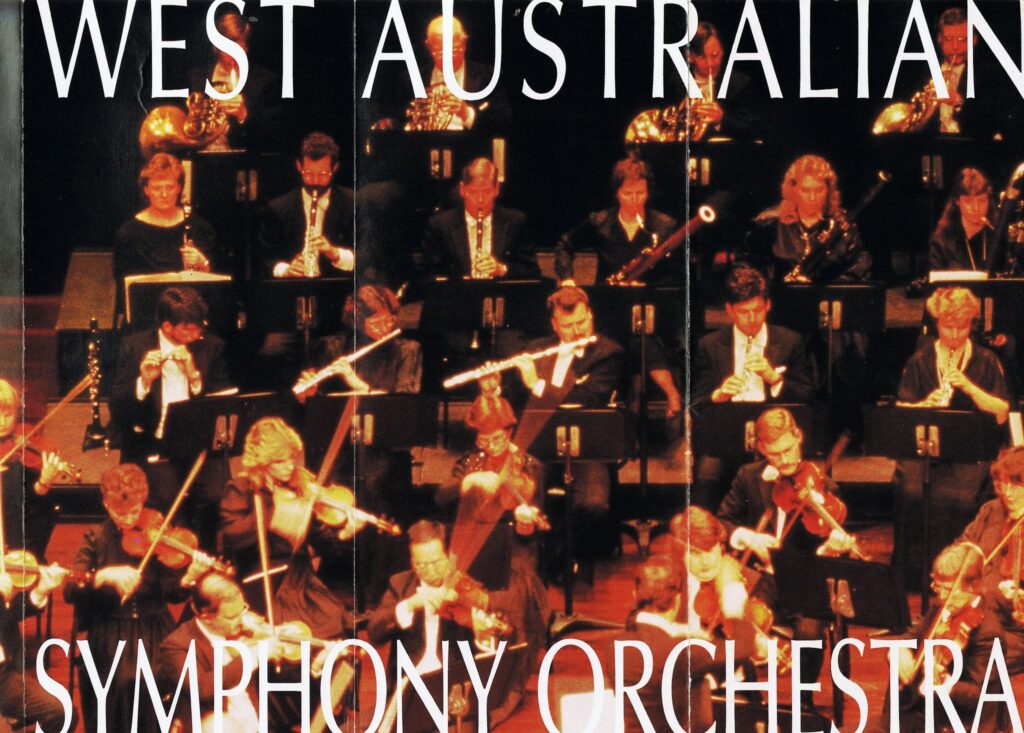
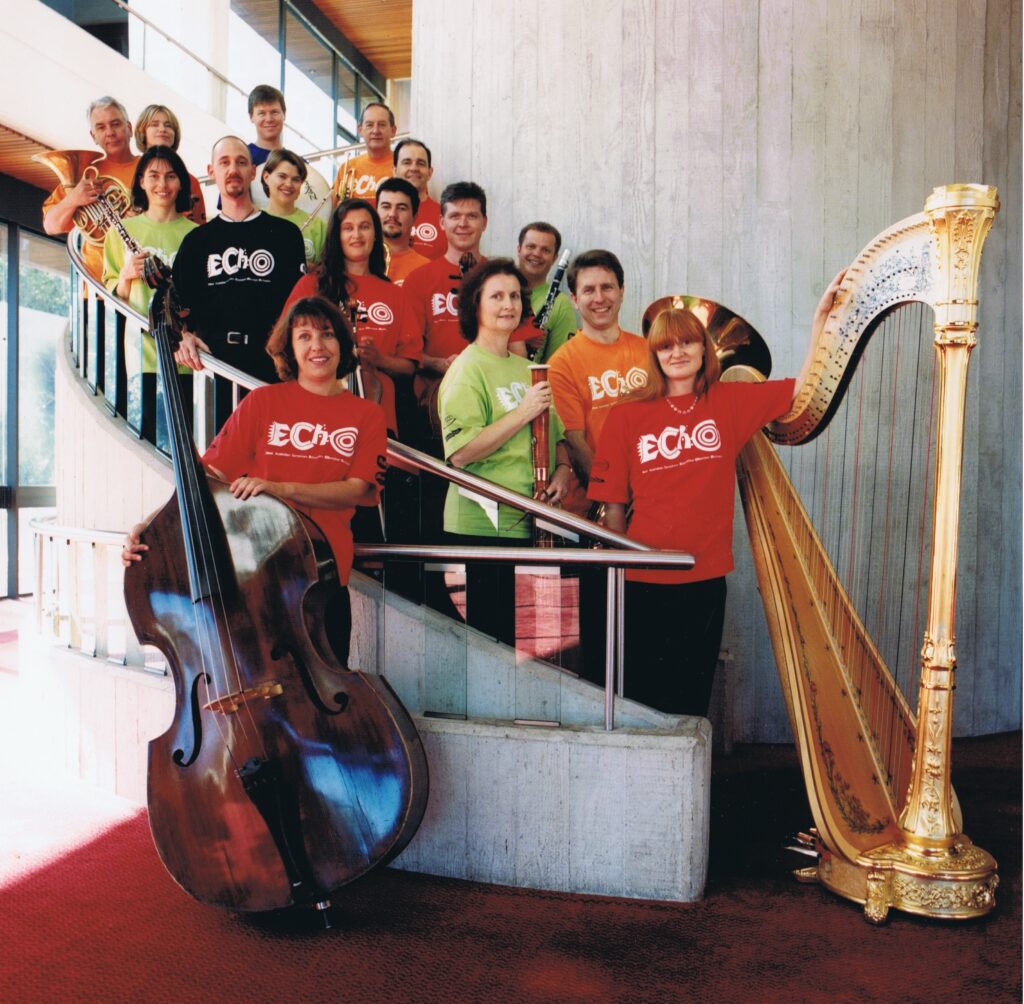
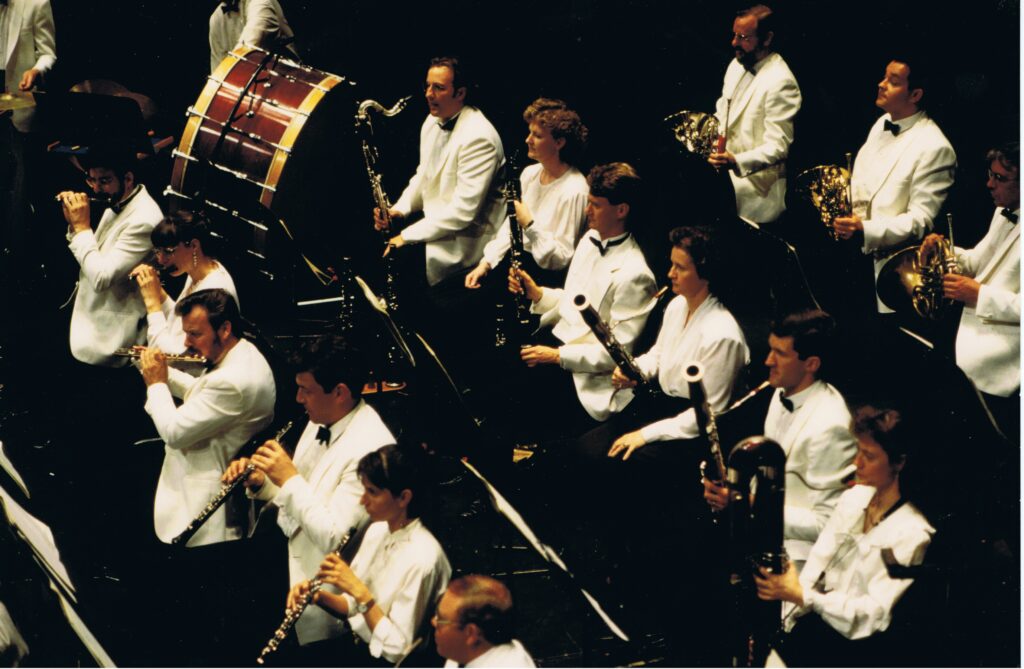
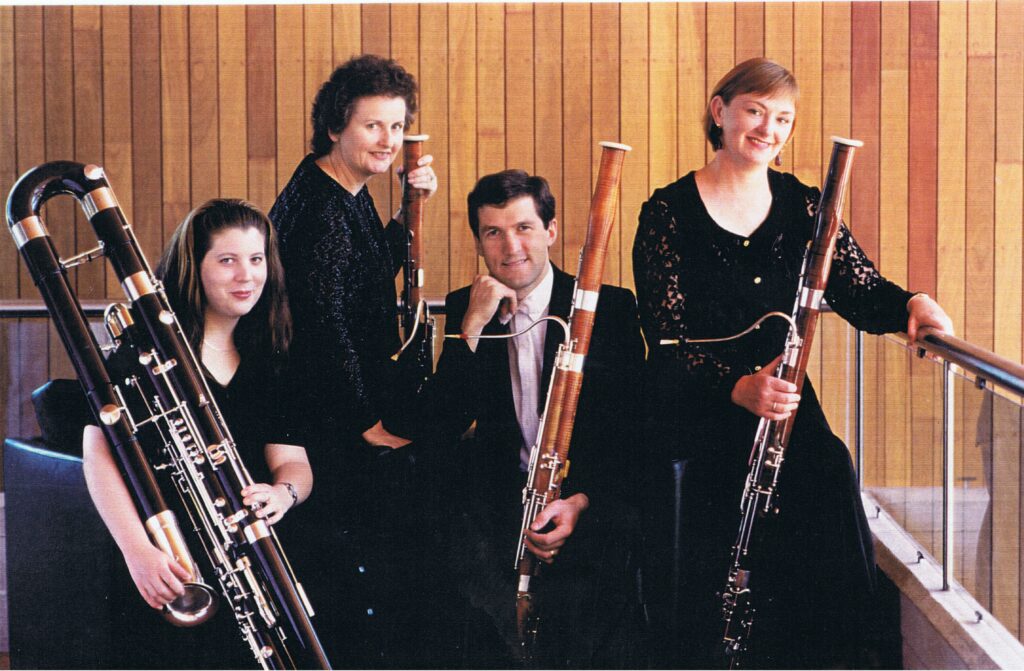
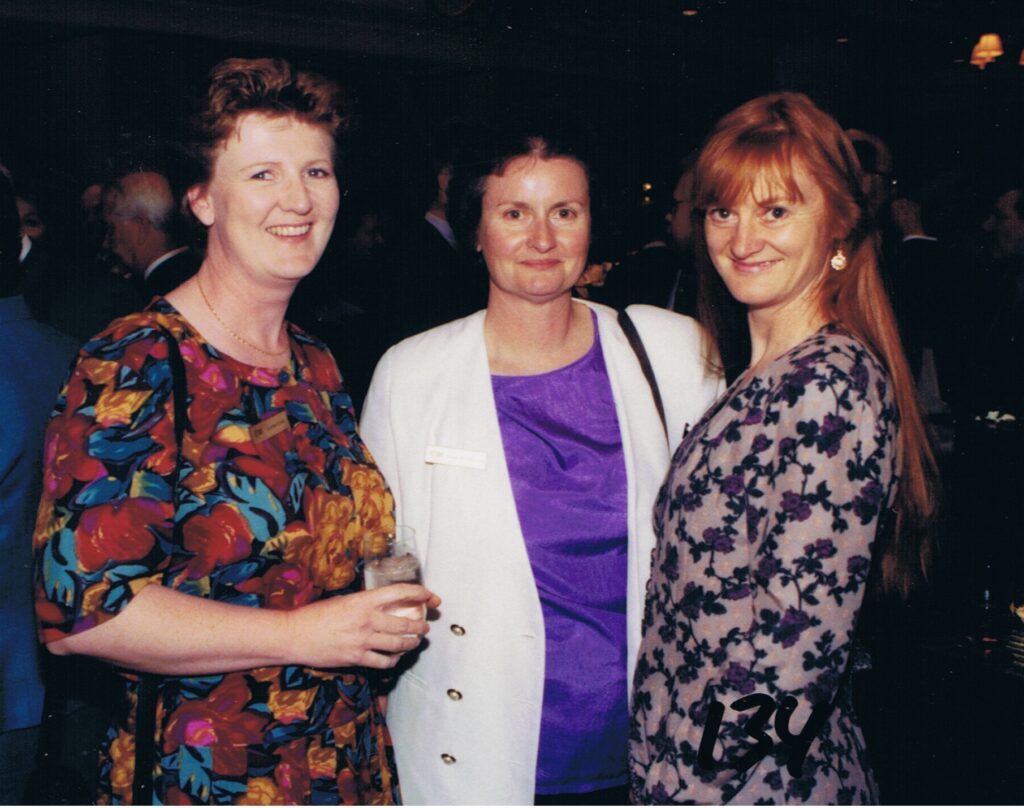

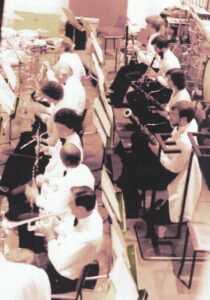
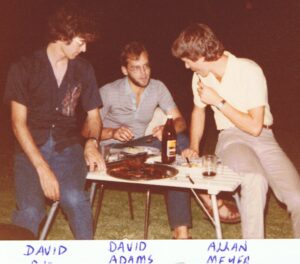 David also had periods as WASO’s Acting Principal. This was in the period of the conductor David Measham – as well as the Austrian-Jewish / Czech maestro Albert Rosen. As Hans Swarowsky had been Rosen’s conducting teacher at the Vienna Academy of Music, David enjoyed Rosen’s ‘Old Europe’ directorship immensely.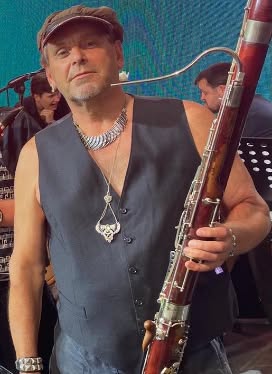
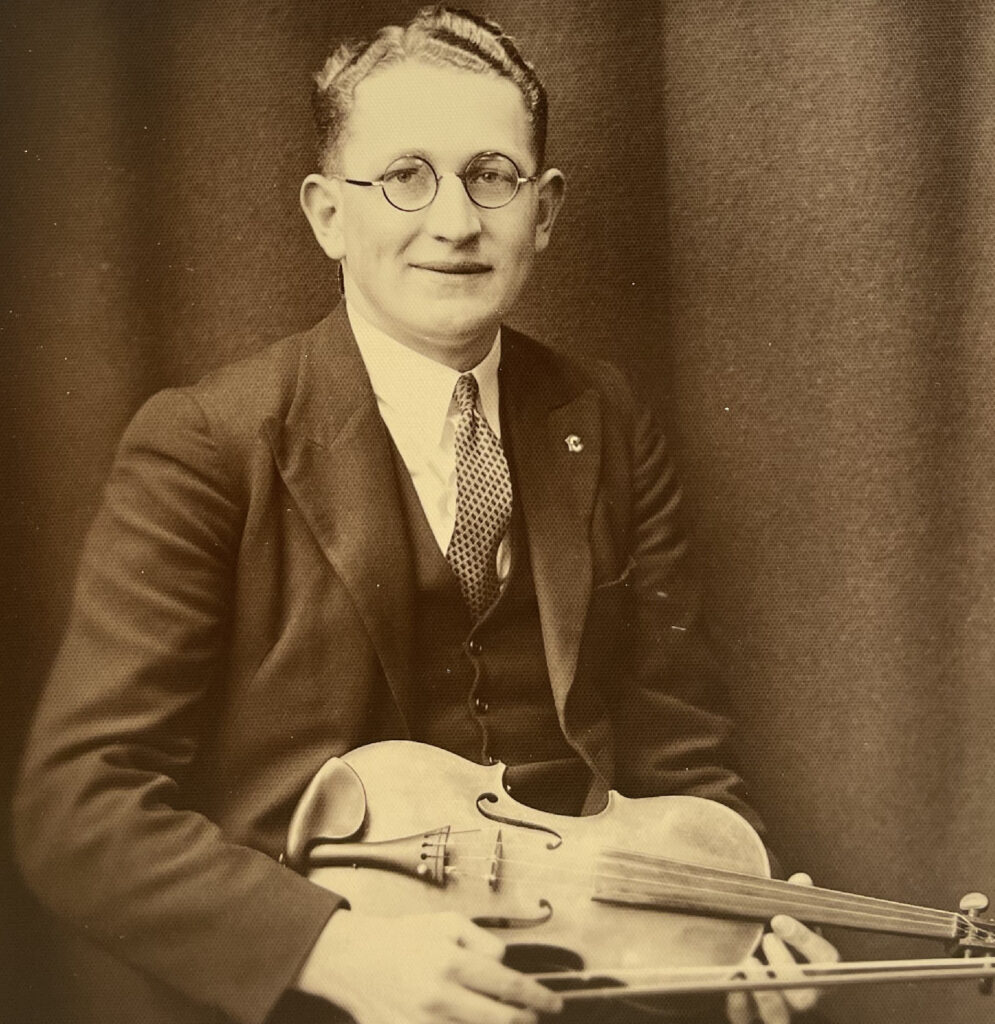
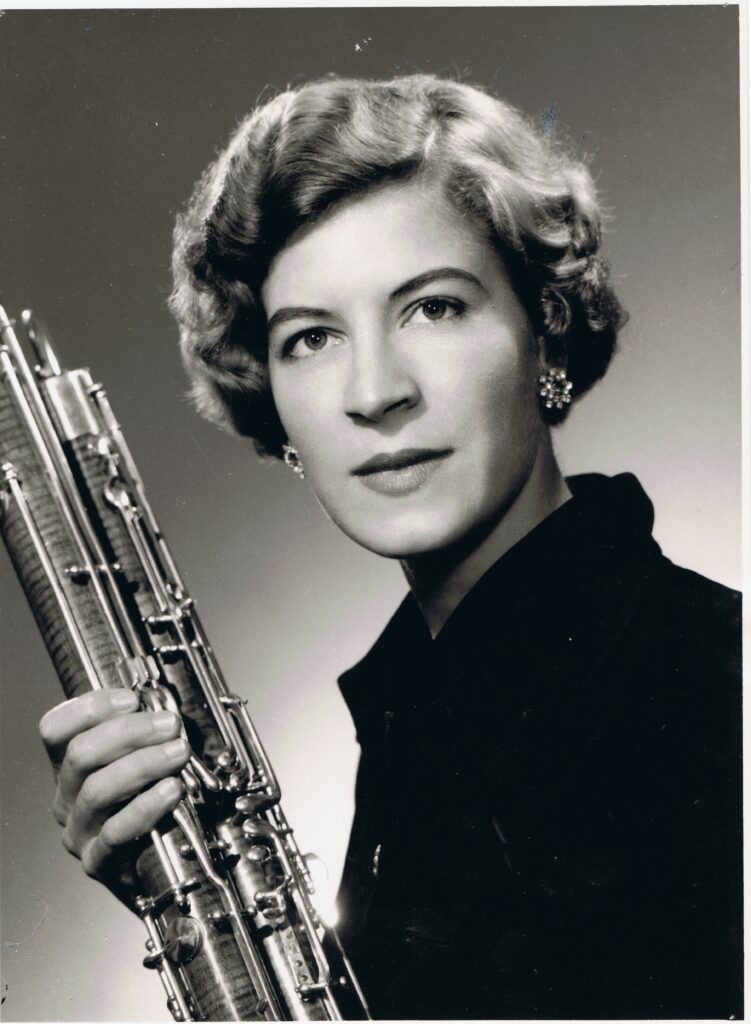
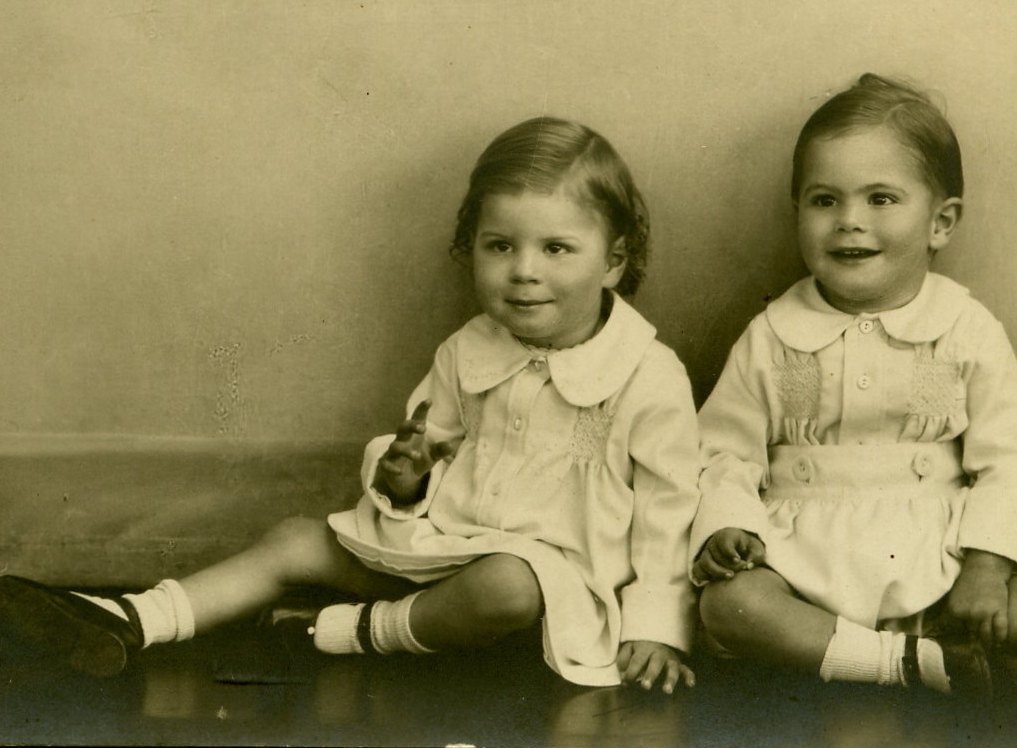
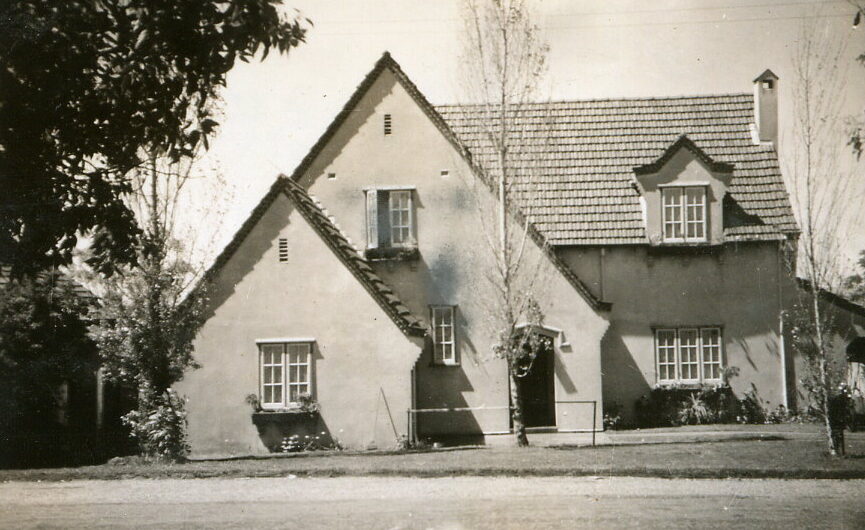
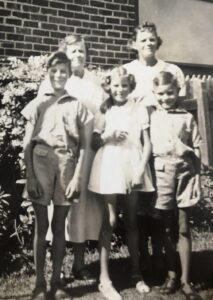
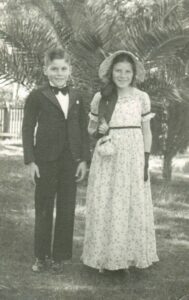
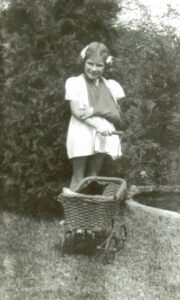
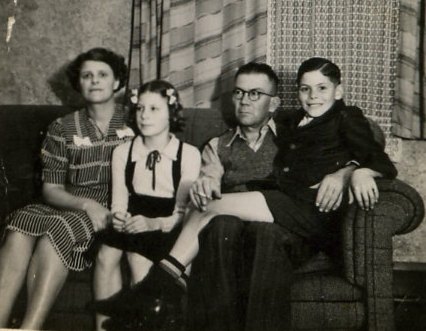
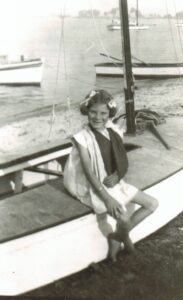
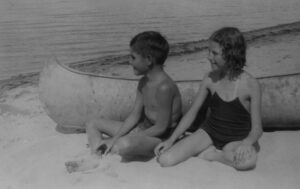
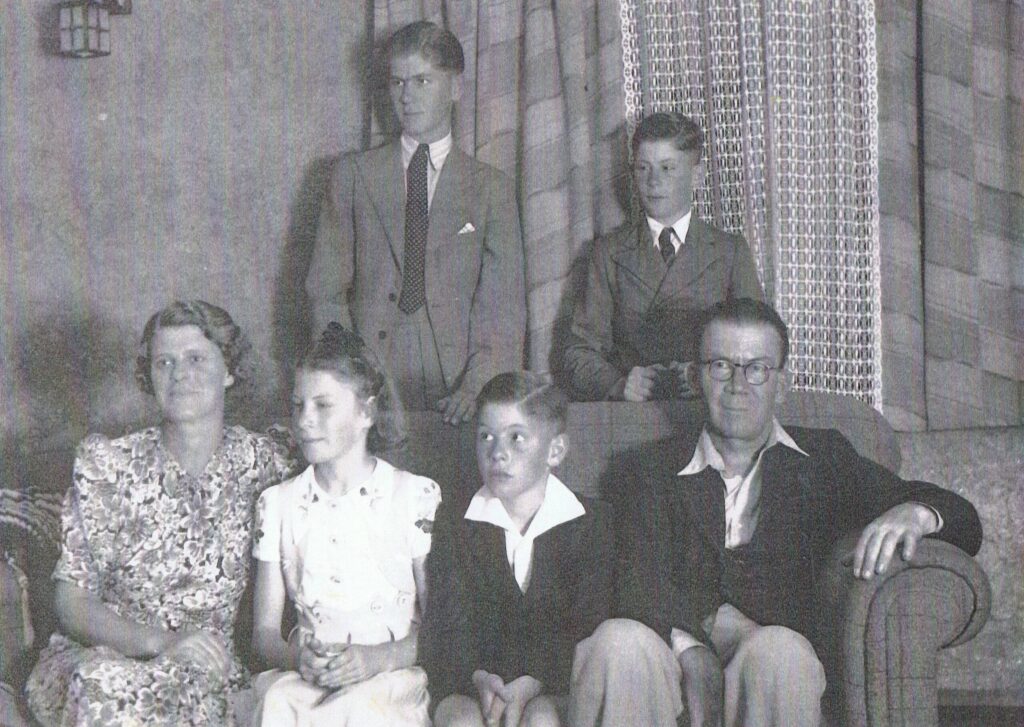
 In 1944 during her last year at Primary School, Jill began bassoon lessons with Billy Moore assisted by a bassoon book of tutorials and attended P.L.C. for two years.
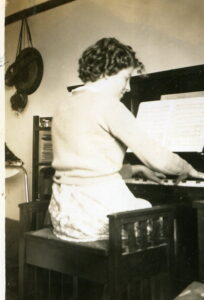
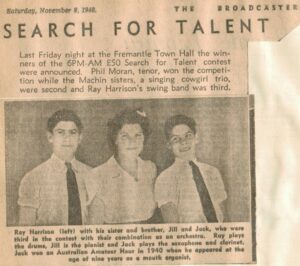
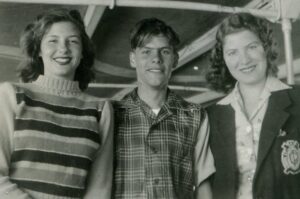
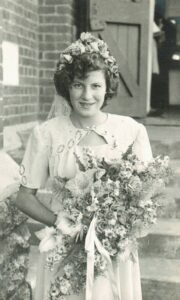
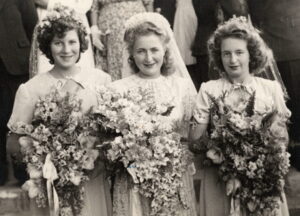
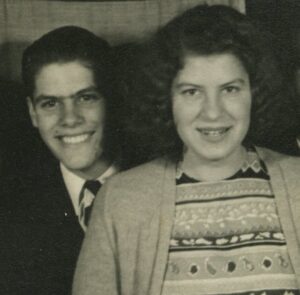
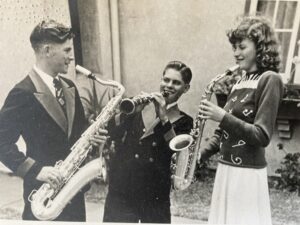
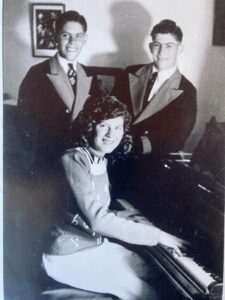
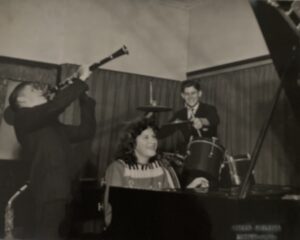
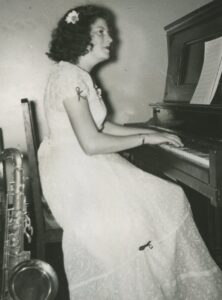
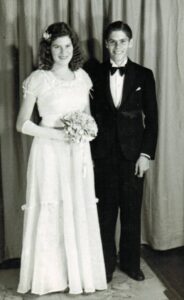
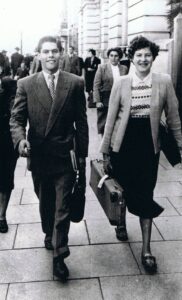
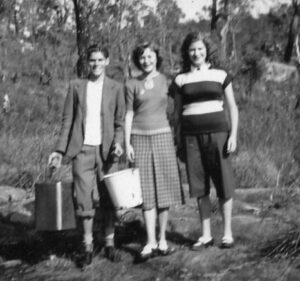
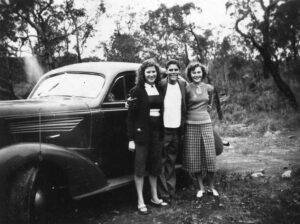
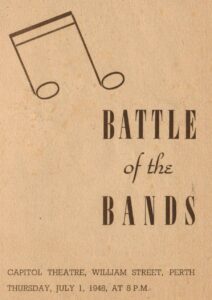
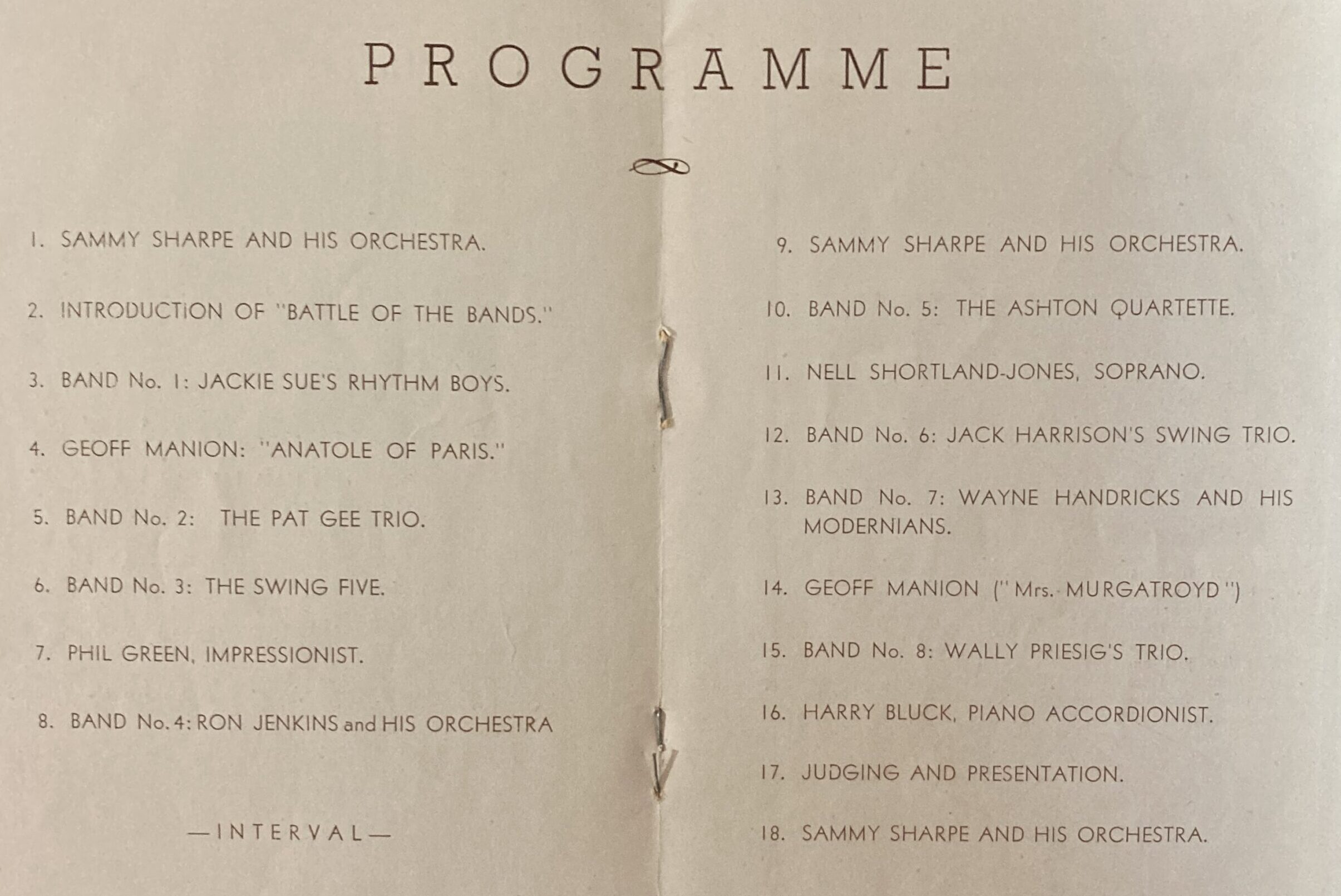
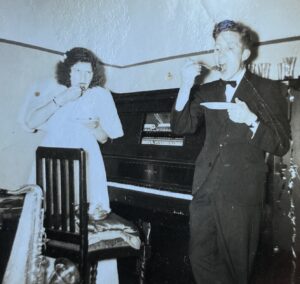
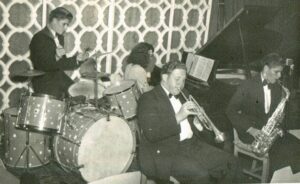
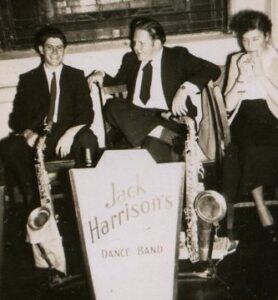 Balcony chatting saw Ronda MacKay and Jean Keogh with friend Harry Prestwood, of England. Ronda looked startlingly attractive in blue taffeta and silver lame, while Jean chose blue taffeta also with white lace effect. Now of Rockingham, and one of the city’s former ballroom dancing instructors, Stan Grey (in tails) was back on the floor. One of the largest floorside lounge parties consisted of Mount Hospital nurses. Norma Mills gold sequined aqua crepe with Arthur McDougall, of Perth. Her sister, Audrey, in cyclamen crepe, Marie Park looking cool in white lace, Graduates Peg Park and Joyce Grose chose red velvet top with a skirt of green, and red taffeta and white marquisette and silver lame respectively…Kath Nicholls in taffeta and blue lace …. Gazing down upon the dancing mass, espied Florence Kinsella of Wembley, whose order for the night was a blue taffeta ballerina and black ballerina shoes with Owen Fitzgerald of Mt. Lawley … Cabaret table party, mostly RPH nurses, comprised Margaret Lewis, Pat Cartwright, Betty Rice, Maxine Davis; June Rosier and Mr. and Mrs. Athol Ipsen, of Manjimup.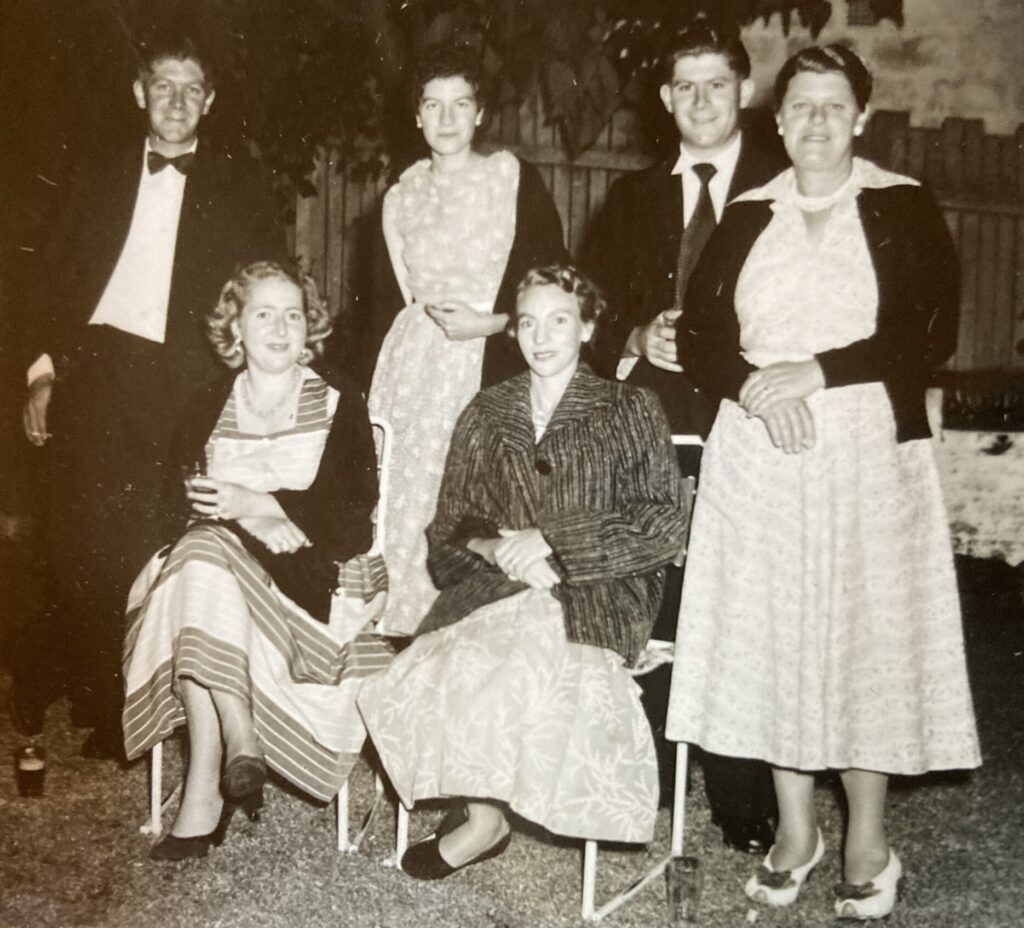

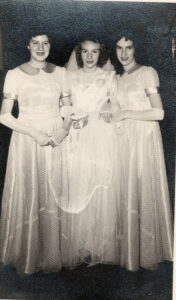
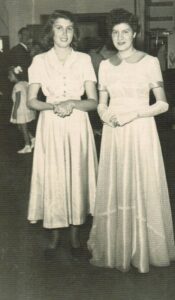
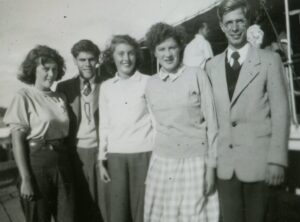
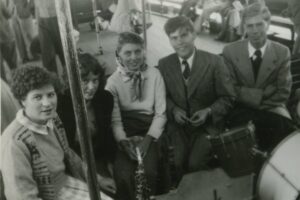
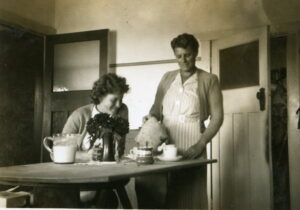
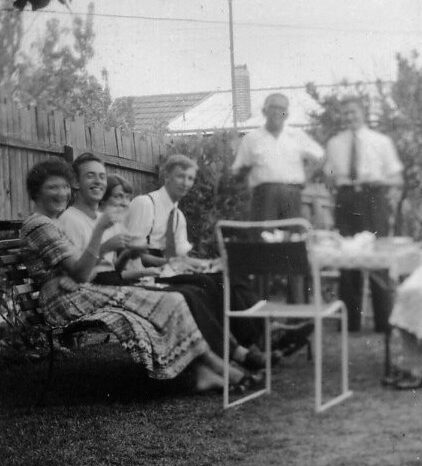
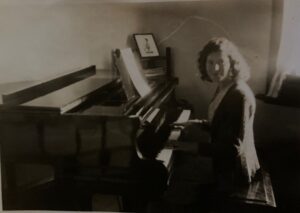 JILL JOINS JACK IN ORCHESTRA – Perth Sat: Jill Harrison, 20, who has been studying bassoon and piano at the Elder Conservatorium, Adelaide for two years, has been appointed second bassoonist with the W.A. Symphony Orchestra. That makes two Harrisons in the orchestra – the other is her twin brother clarinet player Jack Harrison. Jill was pianist for her brother’s orchestra before leaving Perth for Adelaide. Another brother was a drummer.