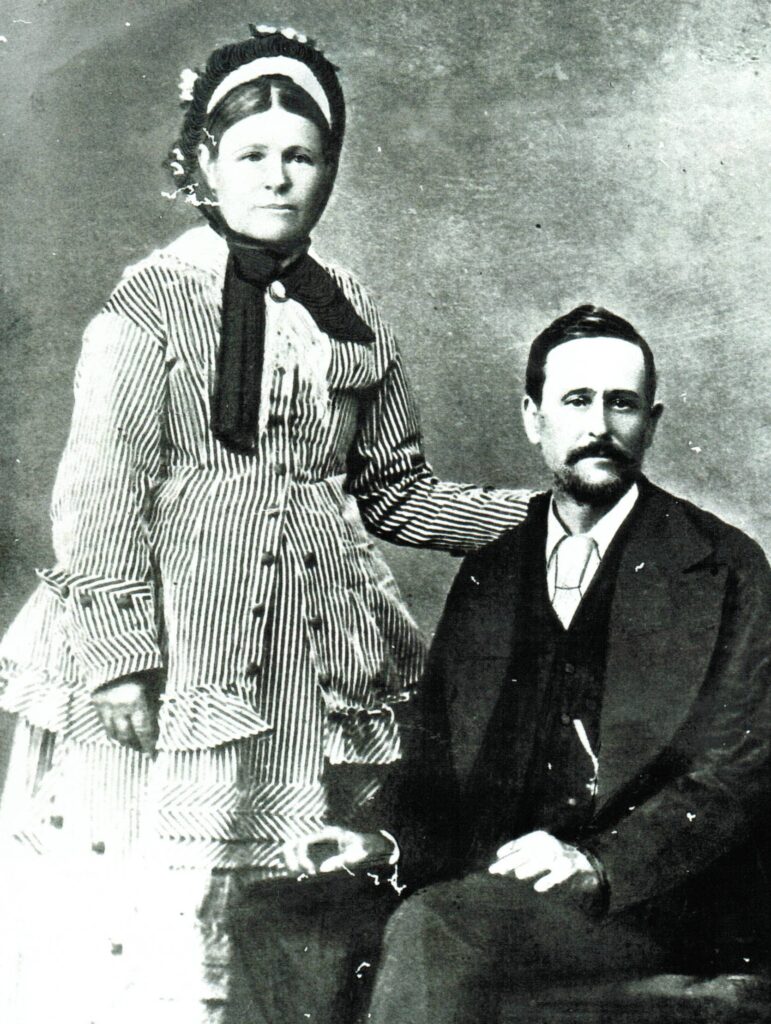
RUSSELL
Russell (from the Latin Russus meaning red)= English, Scots and Irish from Rousel a common Anglo Norman French nickname for someone with red hair.
The earliest known Russells come from Dorset, though Odo de Roussel was meant to be a Norman adventurer who came over with the Conqueror.
According to the Russell Family Bible, HENRY EDWARD RUSSELL was born on 6.11.1827 in London, the son of WILLIAM RUSSELL (died 1835?) a glazier, and HANNAH PAGE. Hannah’s parents were John (a timber measurer) and Ann Page (née Mickelson, born 9.2.1780 and dying in her 92nd year on 30.4.1871).
PARKHURST BOYS
The Parkhurst boys were juvenile offenders from the Isle of Wight’s Parkhurst Prison, who were transported to the Australian and New Zealand colonies between 1842 and 1861. The boys were to be granted pardons under certain conditions such as permanent exile from England and, in the case of younger boys, undertaking apprenticeship in the colonies. 1,499 boys are recorded as being sent to the colonies where, particularly in New Zealand, the scheme was seen by some as de facto convictism. In Western Australia, the need for labour at that time appears to have made the young exiles acceptable.
3c Parkhurst Prison and its Convicts Between 1842 and 1849, 234 male juvenile convicts, aged 10 to 20 were despatched from Parkhurst Prison in the Isle of Wight to the ‘free’ colony of Western Australia.
Despite repeated references to them in contemporary sources as ‘lads’, ‘boys’, ‘youths’ or ‘juvenile immigrants’, they may be legitimately regarded as convicts: they had all been convicted in British courts and sentenced to ‘Transportation beyond the seas’. They were just as much convicts as any of the thousands of men, women and children sent to New South Wales or to Van Dieman’s Land.
During the period 1842 to 1849 juvenile offenders were sent out to Australia to be indentured to suitable colonists for periods of up to five years being effectively the completion of sentences imposed by English courts. Their masters provided a home and, while not all the boys learned a trade, most would have gained useful skills working and living under conditions no more difficult than many pioneers endured. Some of the crimes for which these young children were convicted were for as little as stealing a hen or loaf of bread or simply playing truant from school.
Up to the early 1800s it was not unknown for young children to be condemned as convicts for crimes which today would bring to a minor no more than a caution. Mr Paul Buddee who visited Parkhurst and made a close study of the system and quoted in a letter to Murray Russell (around 1982) the crimes of “stealing a four pound loaf of bread”, “stealing a hen” and “playing truant from school” as typical of the offences for which Parkhurst Boys were committed. In a paper in “western Ancestor Vol 1, pp20-22, September 1979, Buddee noted that “the scheme succeeded in W.A. largely due to remarkable efforts by a young lawyer named John Schoales and later a government servant, Frederick Dirk Wittenoom, who were the guardians of the boys”. He concluded that “those who are looking for an early settler ancestor could do worse than find their great-grandfather was a Parkhurst Boy”. Schoales adopted the policy of concealing the identity of his wards.
In 1984 Paul Buddee produced a book on the Parkhurst boys Fate of the Artful Dodger: Parkhurst boys transported to Australia and New Zealand 1842-1852 (364.36 BUD). He deposited his research material, including lists of all 1,499 boys and their personal details, with the Battye Library. A detailed listing of this material (ACC 3693A, 3694A, 4233A) can be found at MN 1214.
- ACC 4046A/98-112: Series of files compiled by Andrew Gill providing information on all 234 Parkhurst boys sent to Western Australia 1842-1849
See MN 1299for a detailed listing of records. The files are restricted and permission to view must be obtained from Andrew Gill.
The only Parkhurst boys with a name resembling Russell were:
Russ
Henry 3130 b. 1822, d. 18 Nov 1894
Russel
George 8390 b. 1837
Russell
Alexander 8398 b. 1831
George 8390 b. 1837
Joseph 8395 b. 1818, d. 1 Sep 1891
Robert 5620 b. 1824, d. 1 Feb 1871
Thomas 9279 b. 1843
Based on his marriage certificates, it is believed that the person later known in the Swan River Colony as Henry Edward Russell was named “William Porter” in the Parkhurst lists. Born about 1827, in 1840 “William Porter” at the age of 13 was sentenced to 7 years for Felony at the Newington Gaol, Surrey. He served time at the Isle of Wight before being transported to Western Australia.
HO107 405/17 folio 6 Parkhurst Prison Carisbrooke, Isle of Wight, Hampshire, William Porter, 13, prisoner not born Hampshire.
https://www.geni.com/people/Henry-Edward-Russell-Parkhurst-Boy/6000000006946770026
1843
The ‘Shepherd’ left the Isle of Wight on June 6, 1843 and arrived in Fremantle, Western Australia on October 26, 1843. She carried 31 passengers including 28 Parkhurst boys. Records show that William Porter, boy number 425, committed robbery on board during journey.
GOVERNMENT JUVENILE IMMIGRANTS.
Twenty-eight more lads of the above description have arrived in the Shepherd; they landed in excellent health and condition. It appears that five of these boys were concerned in a regular system of robbery on board ship, one of whom has been committed to jail to stand his trial next Quarter Sessions, this lad’s offence we understand, was coupled with gross breach of trust. The guardian of these lads has been instructed, we believe, not to permit the four remaining lads concerned in this offence to be apprenticed unless on written application, certifying that the applicant has been fully informed of the bad behaviour of these lads, and is yet willing to have their services. This wise precaution will set at rest any idle clamour about the impropriety of allowing such lads to remain. One thing at least is certain, that, if possible, they will be subjected to even a stricter watch than the rest. We perceive that the London prints make a mighty fuss about the immigration of these lads; this is really a senseless outcry, and had our brethren of the broad-sheet taken the pains to ascertain the working of the system before they decried it, we are of opinion that their rash and has ty ebullitions of wrath would have been changed into praise. We have taken pains to investigate the working of the system with the 18 boys placed in Mr. Scholes charge about 15 months ago and we are satisfied that had 18 lads of unblemished fame been submitted for the time to the same unceasing Puritanism they would scarcely have borne the trial so well. Impertinence to masters, and once or twice insubordination and refusal to work, have been the worst charges, and the utmost punishment inflicted was on eloping from service, as an excuse for which the boy alleged ill-treatment. Nay more, we know many Masters “who nave these’ lads as domestic servants, and who would not exchange them’ for any other in the Colony to use the words of one,” I would look hard at forty pounds before I would lote him” . While the System-thus works well, the no gooding our London friends thus fighting imaginary evils, “they make the giants first, and then they kill them;” the attempt to reclaim these boys is most philanthropic; it is said it has failed elsewhere, here at least it is eminently successful, a gratifying fact, and one which must be attributed in great degree to the extreme care taken by the Governor in the selection of masters, and the untiring vigilance of the Guardian. The Perth Gazette and Western Australian Journal Saturday 4th November 1843
| Bio | Porter has a page in “Forced Labour for the West” |
- [S362] 1841 England Census, online Findmypast.com, https://www.findmypast.com.au/transcript
- [S391] Andrew Gill, Forced Labour for the West, pg 134.
- [S249] Steve Errington, Locked Up in Fremantle, pg 189.
After his arrival, Bicentennial Dictionary W.A. records show William Porter as a Parkhurst boy apprenticed to R. Waiter (I can’t find this person) as a gardener Upper Swan 1844.
He was indentured on 17 11.1843 to R. Logue for a term of 5 years working as a farm lad. https://www.waconvicts.fhwa.org.au/g0/p817.htm#i20425
possibly: LOGUE, Joseph Keys, b. 30.8.1798, d . 28 . 4. 1884 (Swan), son of Major (a farmer of Ireland), arr. 22.8.1837 per Hero with family & 4 servants, al. Elizabeth GOODWIN b. 1793 (Ireland) d. 26 . 10.1876 (P1njarra). Chd . Robert b . 1820 d . 1857, Elizabeth (Bess) Frances b. 1822 d . 1912. Joseph b. 1823 d. 1888 , Major b. 1826 d. 1900, Henry b. 1827 d . 186 7, Catberine b. 1828 d. 1915, William b. 1832 d . 1912, Matilda b . 1834 d . 1965, John Thompson b. 1838 d. 1931, George Washington b . 1839 (WA) d. 1931. He owned land at Chittering & leased property “Down Farm” near Northam: was farming on 60 acres in Swan district io 1853 & bt. 68 acres in 1860. Residence ” Ivy Cottage” . He opened an “Academy of Learning for Sons of Gentlemen” at Guildford 1853, (he had been studying at Trinity College. Dublin for MA). His wife selected land at Harvey and the family moved there after 1860. They employed 7 T/L men there on occasions 1864-1874. C/E.
1844
On 24.10.1844 the settlers of York, at an annual general meeting of the Agricultural Society, petitioned for more Parkhurst Boys to be made available to the district because of the serious shortage of farm labour.
Elizabeth Branscombe Ree was 13 years old, living with her mother Sarah and step father, convict Thomas Henshaw. They were living and working in Beverley, ploughing at Charles Pratt’s property farmed by Dempster. The original owner of Buckland Estate was Charles Pratt, a London merchant, who arrived in the Swan River Colony in 1830 and was granted approximately 8,000 acres (around 3,200 hectares) of land in the Avon Valley. He named the southern square of his land grant “Buckland” which is situated between Toodyay and Northam. Pratt leased the farm to James MacLean Dempster (a former seaman from his ship, the Eagle), who later married Pratt’s daughter, Ann Ellen Pratt. James MacLean Dempster made the farm a well-run and profitable venture. Although he leased and managed the property for many years, the property never belonged to James MacLean Dempster himself; it passed into the Dempster family through his wife and was later inherited by their son, Charles Pratt Dempster. The original stone farm buildings at the Buckland Estate date from 1836 onwards, including the main two-storey house built in the 1860s. The property, now known as the Buckland Estate, has been restored and functions as a heritage estate and venue.
1849
The first official record of HENRY EDWARD RUSSELL in W.A. is his marriage on 24.5.1849 to ELIZABETH BRANSCOMBE REES (misspelt Reece) in York, Western Australia, by Reverend William Mears (#291). It was in the presence on Thomas Boys Wall and his son George Wall who farmed in the York district since 1837 and was known to have employed at least one other Parkhurst boy.
In BDM WA it is recorded:
Marriage 1849/272 York; Porter, William Russell to Reece, Elisth.
It was then corrected to:
Marriage 1849/291 York; Russell, Henry Edward to Reece, Elizabeth. This marriage (certificate 291) has Parkhurst Boy “William Russell Porter” crossed out, and “alias Henry Edward Russell ” added. It records that his father was William Russell, glazier.
“William” used his real name on the marriage certificate – Henry Edward Russell, but was identified as a Parkhurst Boy in a handwritten note on the certificate. Reverend Mears would have known the Parkhurst Boys in the region and it was no doubt meant as a smear on his name, but without it we might never have known why he came to the Swan River Colony.
Thomas Boys Wall, the witness at their marriage, was born in 1793 and arrived in W.A. on the “Marquis of Anglesea” in August 1829 with his wife and children including son George born in 1821.
Thomas & Matilda WALL & 3 chn: George, Mary Ann, & Matilda; carpenter; d. York c. 65-70.
In the 1832 Census, Thomas Wall is said to be 31, a carpenter from Kent. He seems to have been successful enough to buy a Fremantle Town Lot in 1854, presumably to build a house (roughly where the Pizza Addiction shop next to His Majesty’s Hotel now stands).
Erickson:
WALL, Thomas Boys, b. 1793/1801 (Eng), d. 19.10.1865 (York), Arr. 23.8.1829 per Marquis of Anglesea with family, m. (Eng) Matilda STIRING b. 1794/1800 d. 30.5.1865 (York). Chd. George b. 1824, Emma Matilda b. 1826, Mary Ann b. 1828 d. 1906. Carpenter, granted 3,000 acres. Selected 50 acres in Avon district. Employed by Harbour Master as boat builder 1829-1830. Bt. Frem. Town Lot 40 [6-8 Mouat St] 1854. Listed in York Census [1859] as living with his son-in-law Thomas Morse.
Wall was in the York district from 1837 and in 1844 employed a Parkhurst Boy George Clayton (born 1829), who arrived on the “Shepherd” on 26 October 1843. It is possible that Henry worked with Wall either under indenture or as a farm labourer after his indenture period has expired. This is the only conjecture that would account for both of the Walls being witnesses at the wedding.
MEARS. Rev. William, b. 1809, d . 1889 (Swan), arr. 19.11.1840. York CI E Colonial Chaplain 1842- 50 & temporary Chaplain Frem. Convict Estab. 9.1852. To Pinjarra 1853 & then again to Frem. Perth, Chaplain Convict Estab. 1857. Appointed as Private Sec. to Bishop Hale 1861. To Bunbury 1863. During 1869- 74 at Perth, he was at St . George’s CathedraL Became blind in old age.
Henry was a “Labourer and general servant” according to his wedding certificate. On subsequent documents he is shown as farm labourer, bricklayer, stonemason, builder and messenger for the Colonial stores.
1850
On 4.9.1850 Henry bought a one-acre block in York for five shillings. He bought another 12 acres for seven pounds ten shillings in 1861. Bearing in mind that Elizabeth had a child ten months after she was married, and another five in the following seven years, it must have been an extremely challenging time for them.
Houses at this time would have been crude, especially considering the financial circumstances Henry and Elizabeth would have found themselves in. A description by a (no doubt wealthier) Mrs Millett of a York house at this time: “the walls of this house were built of “pug” which means simply, well pounded mud, and has the disadvantage of refusing to adhere firmly to the jams of doors and casements so that the banging of either in windy weather is apt to bring large pieces of the material crumbling down and the house never looks tidy.” Windows had no glass in them. The floors were of mud, brick and wood and often the ceilings (if there were any) were made of calico, which if was not fastened adequately would give way in windy weather.
Oliver, P. Architecture in York 1831 – 1911, chapter 2
Sixty letters were kept by Henry’s sister Eliza (married Wooley) who was a joint executor of her father’s estate and were luckily subsequently handed down through the Bessen and Pittoring family to Murray Russell.
1852
In 1852, Henry Edward’s sister Annie Jackson sent her first letter to him (fitting with him arriving in 1843) and in it tells him that she has been married for 8 years and has had four children, two of whom had died. Obviously there had been no contact between Henry and his family during that time.
1854
In 1854 it appears Henry’s property was destroyed by fire. The following appeared in the newspaper and he still identifies himself as William Porter, perhaps as he was known by that name in the district:
Inquirer (Perth) Wednesday 15 February 1854:
To the Editor of “The Inquirer.”
Sir,— Having had the misfortune to lose my property by fire, I beg to trouble you to insert in your columns the sincere gratitude I feel towards those individuals who kindly subscribed for me on the late unhappy occasion. At the same time, I wish to mention that, owing to the malice of some evil minded person, a report has been circulated in the district that the accident was wilfully occasioned by me. I am sorry to find that such persons are resident among us, and who have neither the feeling to assist the unfortunate, nor humanity enough to refrain from wounding the feelings of persons already weighed down with trouble. At the same time I feel it but doing justice to myself to notice this report publicly, at the same time earnestly invite the insidious slanderer to disclose his name, or to come forth openly, and speak his thoughts, if he has any, on the subject.
I shall, at any time feel happy in having an opportunity of clearing myself of the base report cast upon me by those whom I am happy to say are considered of very little importance in the eyes of the public, and whose opinion, either upon that or any other subject, is of too little importance to occasion any doubt in the minds of those who are better informed.
I am, Sir,
Yours most obediently,
WILLIAM PORTER.
York, Feb. 5, 1854.
1855
Perth Gazette and Independent Journal of Politics and News Friday 19 January 1855
Brought in from the Bush. 2 HAMs about 2 year’s old, mark, nick in both ears, no brand. Any one claiming the same can have them on paying expenses.
- E. RUSSELL, near York.
In a letter to his sister in 1855 Henry had complained that “the floods had spoiled all his wheat”.
1859
In a letter written to him in 1859, his grandmother (by then widowed and remarried to James Elliot) says “Before you receive this I dare say that you have received a letter from your Uncle Edward Russell. But if I was you I should take little or no notice of it…glad I got away from them they did not…help you when you needed their love and assistance.” This correspondence seems to support the claim that Henry may have been a Parkhurst Boy.
1860
Perth Gazette and Independent Journal of Politics and News Friday 24 February 1860:
YORK TEA AND PLEASURE GARDEN.
HIT OR MISS!
THE proprietor, H. E. Russell, begs to acquaint his friends and the public that visitors wanting refreshments, may depend upon good accommodation and moderate charges.
Superior Ginger Beer, Spruce Beer, Lemonade, Superior Lemon Syrup, and all other summer beverages; also a variety of Colonial and other Fruits.
York, Jan. 7, 1860.
1861
Battye Library book of letters from the Surveyor-General to land applicants 18.1 1858 – 14.4.1864
Land Correspondence – York June 3rd 1861
To
The Honorable the Surveyor-General
Sir wishing to become the purchaser of a piece of land one acre or there abouts on the new line of road leading from York to Guildford I wish to know from you if there is any deposit to pay and what the up set price will be the piece that I require you will be able to judge by a sketch I have sent over leaf the Grant with the crop in is the one that I want which is not surveyed so has to leave one grant vacant between Mr Pikes Grant and the one that I want if I can become the purcher – Please let me know by return of Posts.
Your Humble Servant
(signed) H.E. Russell.
(sketch on back of land next to Mr Pikes on Guildford Road close to a plot owned by Mr T. Bailey across the road.)
Battye Library SDUR/R1 29
1861 June 5
To H.E. Russell
In reply to your letter of 3rd inst., I have to inform you that the smallest quantity of country land (outside of town-site) that can be disposed of under present Regulations is 40 acres and beg to refer you to the Resident Magistrate at York for further particulars as I cannot understand the position of the land you are desirous of purchasing.
(signed) A.W.
Interesting that The Surveyor General of the Swan River Colony in 1861 was John Septimus Roe, a pivotal figure who served in that role from the colony’s inception in 1829 until his retirement in 1871, famously mapping out Perth and much of Western Australia, though he was actually on leave in England during the census year of 1861. I’m not sure who A.W. was who filled in for him.
1862
The Inquirer and Commercial News
Wednesday 14 May 1862:
Sale of Valuable and Important Freehold Property, within one mile of York.
- J. T. MONGER will offer to public competition, at the Castle Hotel, York, on Saturday, the 31st May instant, at 2 o’clock p.m. precisely, subject to such conditions as will be then and there produced, (unless previously sold by private contract, of which due notice will be given) —
ALL that piece or parcel of Freehold Land, late in the occupation of Mr H. E. Russell, containing 11 acres, more or less, all in good cultivation, including about 1 acre of a very productive vine-yard, an excellent newly-erected dwelling house containing 3 rooms, detached cottage, stabling, an excellent well of capital water, &c, &c.
To suit the convenience of parties, one half of the purchase money can remain on mortgage.
Auction Office, York,
May 7, 1862.
1864
The Perth Gazette and West Australian Times Fri 7 Oct 1864
sold York: Avon location Y17: Sale by Auction by Mr. R.G.MEARES, at York Fair on the Showgrounds: Property (described) near York, with Cottage and improvements thereon, portion of Avon location Y17 formerly in the occupation of Mr. Edward Henry Russell
After some years in the York district where he tried his hand at farming and later at operating a “tea house”, Henry fell in to debt and the family moved to Perth sometime after the birth of Eliza Ann in July 1862.
His employment after leaving York is indicated on the birth certificates of his children.
Henry spent a short time as a constable in the police force, joining as a foot constable in November 1864.
He was transferred to Fremantle on 17.7.1865 apparently in response to a request for a man who could write to take charge of the lock-up. In the Fremantle Police Station occurrence book, entry dated 10.1.1866, reported that P.C. Russell had applied for a position of warder because he had a very large family and could not manage on his police pay.
The Perth title’s office shows that Henry sold a one-acre block of land in York on 13.4.1875 for thirty pounds. The other 12 acres were discharged as part of a debt payment.
Grandson Ernest Russell (born 1878, son of Henry Edward Russell Jnr) visited Henry Snr in the house he built in Pier Street (then known as Mackie Street) near the corner of Wellington Street. He bought the land on 1.12.1870 for 25 pounds from George Lazenby. He subdivided some of the land and sold it one, one piece to the Dean of St George’s Cathedral. (The construction of St George’s Cathedral began in 1880 and was completed in 1888. The Deanery was built in 1859). Granddaughter Mrs Doreen Day whose father James Murrice Russell (born 1871) would have lived in the house as a child, claimed the house became a cycle repair shop and survived until after the Second World War.
This must have been the family home for a number of years as some of the grandchildren and great grandchildren remember having had the house pointed out to them by their parents.
From family stories it was said he lived at some time in Mount Street, Perth.
This ad ran until May 1882:
The Inquirer and Commercial News Wednesday 4 May 1881:
- E. RUSSELL, BAZAAR TERRACE, PERTH
BUILDER, House Decorator, Painter, Glazier and Paper-hanger. Every description of House cleaning undertaken promptly.
From letters Henry received from his relatives between 1852 and 1886 we are able to gather that he and Elizabeth and their large family (14 children in 28 years) lived in poor circumstances for most of this time. Despite that, he donated to the Orphanage Fund and was associated with the building of the orphanage.
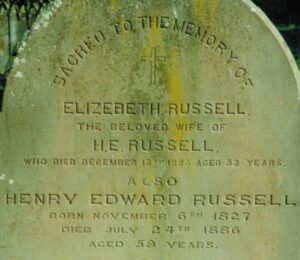
From the moment she was married Elizabeth Russell became pregnant and then proceeded to bear fourteen children in twenty-eight years until she was 46 years old. Having buried her last child from diphtheria early that year, Elizabeth died at the age of 52 on 18 Dec 1883 from the measles. Apparently, a very malignant strain of measles broke out in Perth and Fremantle and about a hundred people died from the epidemic within the space of a few months.
Elizabeth Russell is buried with Henry in East Perth Cemetery.
1885
After Elizabeth’s death Henry, labourer, remarried to widow and “laundress” Elizabeth Holland on 25.12.1885 (W.A. Reg. Gen. 6134/1885) celebrated in Fremantle in the presence of Rebecca Russell and Samuel James Gane (husband of Emily Amelia.
The marriage obviously didn’t go well:
The Daily News 23 Jan 1886 and 25 Jan 1886
The Inquirer and Commercial News 27 Jan 1886
PUBLIC NOTICE.
I will not be answerable for any debts contracted by my wife, Elizabeth Russell (formerly Elizabeth Holland), from this date, and the person or persons who feloniously took three boxes from my house, if not returned with contents in one week, will be prosecuted as the law directs. W.E. RUSSELL, Sen. Perth, Jan. 23, 1886
Henry died only seven months later on 24.7.1886 aged 58 as a result of pneumonia.
Copies of probate documents show that Henry’s will was made on 23.7.1886, the day before he died. When his death appeared imminent someone must have realised that, without a suitably worded will, his family might have been disinherited in favour of his second wife. At the time of his death he was employed as “messenger Colonial Stores Department.” The Executors and Trustees were George Randall of Perth and Henry’s daughter Eliza Wooley.
Distribution:
- A legacy of thirty pounds to William Alfred Stone. K Crowley in “Australia’s Western Third”, Melbourne 1960, noted that in the 1800s “Western Australia was in the hands of the ‘Six Hungry Families’ and their pocket-borough legislature”. He included the Stones in this group. Why Henry left such a wealthy family a legacy in his will might have been to repay a debt or in recognition of gratitude for some service rendered by William Alfred Stone.
-ten pounds to the Perth Protestant Orphanage
– after funeral expenses etc the balance of the estate was to be divided equally among all surviving children when his youngest child by his first wife (i.e. James Murrice) became 21 years of age. Provision was made for sale of personal estate and investment of the proceeds. It was also required that a mortgage to the Perth Benefit Building Society be satisfied.
The West Australian (Perth) Friday 27 August, 1886:
NOTICE TO CREDITORS.
“In the matter or Henry Edward Russell, Deceased.
WHEREAS, on the 5th day of August, 1886, Probate of the last Will and Testament of Henry Edward Russell, late of Perth, in the colony of Western Australia, messenger, deceased, was granted by the Supreme Court of the said colony, in its ecclesiastical jurisdiction, to George Randell, of Perth, and Eliza Wooley of the same place, the executor and executrix in the said Will named.
Now, notice is hereby given, pursuant to the Ordinance 22nd and 23rd Victoria. No. 35, adopted by 31 Victoria, No. 8, that all creditors and other persons having claims or demands against the estate of the said deceased, are hereby required to send particulars of such claims or demands to the said executors, on or before the 15th day of September now next, and further that the said executors will, immediately after such date, proceed to distribute the assets of the said deceased among the creditors and persons entitled thereto, having regard only to those claims of which they shall then have had notice, and the said executors will not be liable for the assets, or any part thereof so distributed or dealt with to any person of whose claim or demand they shall not then have received notice. Dated at Perth this 10th day of August, 1886. STONE & BURT, Solicitors for George Randell and Eliza Wooley, the said executors.”
George Randall was a businessman. Perhaps a friend. See following articles.
………………
This notice is probably about property owned by Henry Edward Russell, senior., above:
The West Australian Tuesday 29 November 1892:
JAMES MORRISON has received instructions from the Trustees and Executors of the will of H. E. Russell, deceased, to offer for SALE by PUBLIC AUCTION, at the Exchange Buildings, corner of St. George’s-terrace and Barrack-street; at 12 o’clock on WEDNESDAY, 7th DECEMBER.
PORTION OF PERTH TOWN LOT Q8,
66 links frontage to Mackie-street, together with Cottage thereon, occupied by Mr. Geo. W. Randell.
Also at same time and place, by order of Messrs. Lewis John and Wm. J. Birch, the eastern moiety of
PERTH TOWN LOT W 27.
Having depth of 2 1/2 chains, and 1 chain 50 links frontage to Mackie-street. Tenets and conditions at time of Sale.
For further particulars, apply Geo. RANDELL, Esq., or JAMES MORRISON.
Perth, Nov. 21, 1892.
……….
George Randall, named as Executor in the Will; and Geo. W. Randall named in the above auction who is likely to be his son. They both died 1915.
The 14 children of Henry and Elizabeth Russell:
1. Henry Edward William “Harry”
Born York W.A. 13.3.1850 W.A. Reg.Gen 1428/1850. Informant Mrs Amelia Cook. Married Perth 2.11.1876 to Emeline Ellen Matilda McGregor. Witnesses Harry’s sister Amelia and Henry Tichbon. Groom described as a boatbuilder. Officiated by Jos. Gegg.Died 19.6.1922 in Albany: boatbuilder. Child – Ernest – born Perth 27.8.1878, married Albany 23.11.1912 Florence Louisa Cooper, died Sydney 23.8.1966. (Parents of Murray Russell Cooper who transcriber the “letters from home” and compiled the Russell history).
2. Thomas Frederick
Born York W.A. 19.10.1851. Died aged 2 years 10 months in York 18.8.1854 from “inflammation of the brain”.
3. Sarah Elizabeth
Born York, W.A. 26.10.1856. Married widower William Green at St George’s Cathedral, Perth in the presence of Henry Edward Russell and Amelia Russell (W.A. Reg.Gen 4399/1877). Married Samuel Barnett. Died 20.6.1936 • St Peters, City of Norwood Payneham & St Peters, South Australia.
4. Hannah Sophia
Born York, W.A. 18.4.1854. Married George Parker in 1875, then Robert Lack in 1924. Died 5.1.1933 in Rivervale, Perth, W.A., Australia
5. EMILY AMELIA
Born 13.10.1856 in York, W.A. Married SAMUEL JAMES GANE 11.7.1878 in St George’s Cathedral, Perth, W.A. Died 18.9.1907 Fremantle.
6. Samuel Charles
Born York, W.A. 17.1.1858. Died 1920 Northam, Western Australia
7. Eliza Ann
Born York 25.7.1862. Married 10.6.1883 William Wooley. Died 4.7.1943 Fremantle, Western Australia
8. John Curtis
Born 14.2.1865 Perth. Married 6.9.1885 Ada Gee. Died East Perth 16.10.1933.
9. Thomas twin born/died aged 1 day Perth 1867
10. George twin born/died aged 1 day Perth 1867
11. Rebecca
Born Perth 18.1.1869. Married Perth 1886 John Calhoun. Died Perth 4.1.1911
12. James (Tupp) Murrice
Born Perth 1871. Married Fremantle Lydia Burnell. Died Perth 7.6.1953
13. Florence
Born Perth 6.10.1874. Died Perth 13.11.1874 aged 5 weeks
14. Helen Helena
Born Perth 15.1.1878. Died Perth 22.3.1883 of diptheria aged 5 years
Their daughter,
EMILY AMELIA RUSSELL
married
SAMUEL JAMES GANE
in St George’s Cathedral on 11.7.1878.