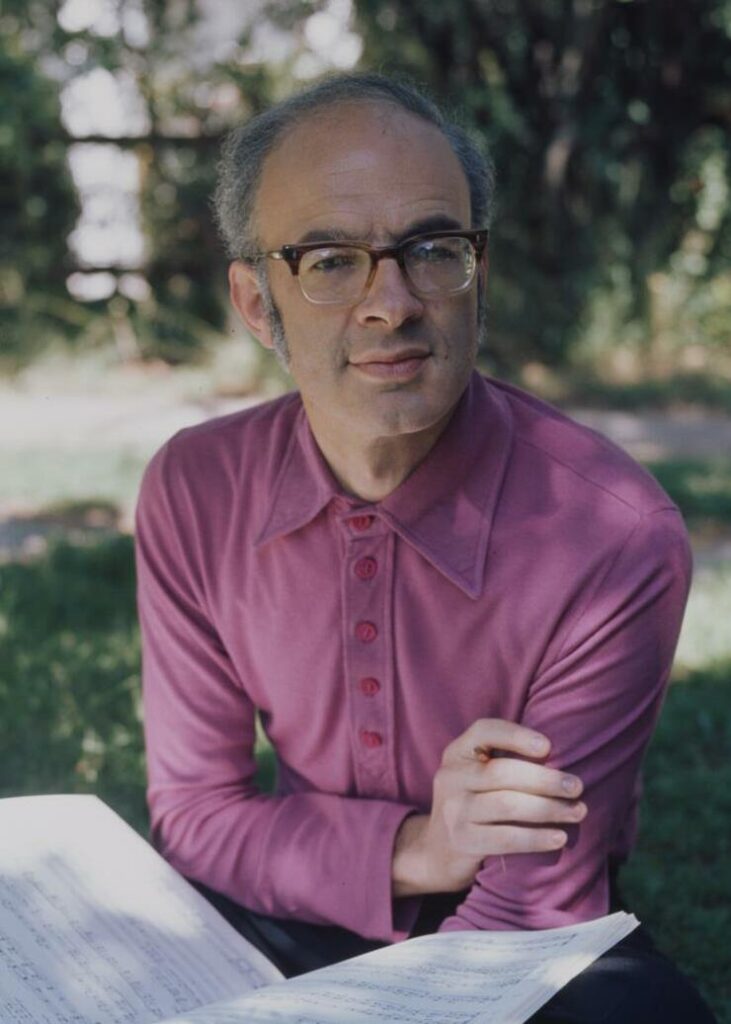
George Dreyfus (born 22 July 1928, Wuppertal, Germany) is one of Australia’s most distinctive composers. Fleeing Nazi persecution, his Jewish family emigrated to Melbourne in 1939.
Trained as a bassoonist, he played in the J.C. Williamson opera seasons and joined the ABC’s Melbourne Symphony Orchestra in 1953, later studying in Vienna.
Largely self-taught as a composer, he became a leading figure in Australian new music, writing symphonies, operas and chamber works alongside celebrated film and television scores, most famously the theme for the 1970s series Rush.
His German-premiered operas include Rathenau (1993) and Die Marx Sisters (1996).
Honoured as a Member of the Order of Australia (1992) and with the Bundesverdienstkreuz (2002), Dreyfus marked his 90th birthday in 2018.
1956
COMPOSER IS PROVOCATIVE
February 21, 1956
By “Fidelio”
A West Australian composer, James Penberthy, offered us last night what in some ways the most adventurous Australian composition so far heard in the Art Gallery programmes. This includes, notably, his medium of expression; a wind quintet consisting of flute, oboe, clarinet, horn and two bassoons. For this unusual combination Mr Penberthy had produce a work in short, linked movements, based on the music and life of Australian aborigines. He obtained interesting effects in the way of atmosphere and drastic colourings, but his score sounded very fragmentary. It seemed often to be hovering uncertainly between outright imitative realism and the freer imaginative flight which, we felt, should not convincingly emerge. Another unusual inclusion was a set of three nicely fanciful songs for soprano and flute (no piano) by John Gordon, the words being taken from Chinese. The rest was chiefly light music, generally pretty in a conventional style. There were two pieces for flute and piano by A.C. Black (a West Australian), clarinet and piano pieces by Dulcie Holland and Moneta Eagles, songs by Horace Keats and Elizabeth Mills. The performers were Sylvia Biddle (soprano), Owen Fisenden (flute), Jack Harrison (clarinet), Neil Pierson (horn), Ron Richmond (oboe), George Dreyfus and Claude Welling (bassoons) and Phyllis Allen (accompanist).
1968
MUSIC – FESTIVAL OF PERTH 1968
By Peter Hellstrom
An aspect of the Festival of Perth already creating interest throughout Australia is a workshop series of four Australian composers to be presented by the A.B.C. in conjunction with the festival committee. The workshops will consist of programs of works mainly for Orchestra. Several will be first performances they will be given in the Basil Kirke Studio at 6 pm on February 15, 22 and 29 and March 7. Each program will have a different conductor. The conductors will be Henry Kripps, Patrick Thomas, John Hopkins and Thomas Mayer. A further special feature of each program will be the presence of at least one interstate composer who will come to Perth for the occasion. The composers are Nigel Butterley, Larry Sitsky, Felix Werder and Richard Meale. Other interstate composers whose works will be performed are Colin Brumby, George Dreyfus, Helen Gifford, Peter Sculthorpe and David Ahern. The four W.A. composers contributing to the programs are James Penberthy, Dr John Exton, David Tunley and Jennifer Fowler. As a contrast to the formality of the normal concert presentation, the workshops will include discussion between conductors, composers and members of the audiences. In several of the concerts, provision has been made for some works to be played twice to give listeners a further opportunity of coming to grips with the new music. The chairman of the Festival Of Perth music committee, Professor Frank Callaway, said yesterday that W.A. compositions would include Mr Tunley’s Concerto for Clarinet and Strings (with soloist Jack Harrison), Dr Exton’s Movements for Orchestra, a recently completed string Quartet by Jennifer Fowler to be played by the Oriel Quartet and James Penberthy’s Cantata for Chorus and Orchestra “The Swan of Bibbulman”. This will be performed by the Lyrics Singers and the W.A. Symphony Orchestra. The work is set to a poem by Mary Durack. The West Australian Saturday December 23 1967
1979
The Australian Broadcasting Commission presents a
FREE AUSTRALIAN COMPOSERS’ WORKSHOP
(from the printed program)
Concerto for clarinet and strings DAVID TUNLEY
Soloist Jack Harrison
The Concerto for Clarinet and Strings combines elements of rich romanticism with the more pungent harmonies and buoyant rhythms of the 20th century “neo-classic” idiom. It was written for Jack Harrison, whose particular style of playing moulded much of the works character, particularly in the cadenza of the opening movement which is accompanied by a solo double base whose throbbing rhythms and deep sounds is reminiscent of the didgeridoo. The slow second movement catches an intensity of expression eminently suited to the solo instrument giving way to a lilting dance in the finale.
Concerto for Bassoon and Orchestra JAMES PENBERTHY – Soloist Jill Mowson
The Bassoon Concerto was written in November 1954 for the West Australian Symphony Orchestra’s John Cran. He never played it and the first performance was given by George Dreyfus with his own Melbourne Orchestra 15 years later. There were only two movements consisting of fast and slow sections showing the agility of the instrument in merry if not clownish mood, and in contrast and eloquence in a more reflective manner. A new second movement, very serious in nature, was written this year specially for the present Jill Mowson performance. The old second movement now becomes the third.
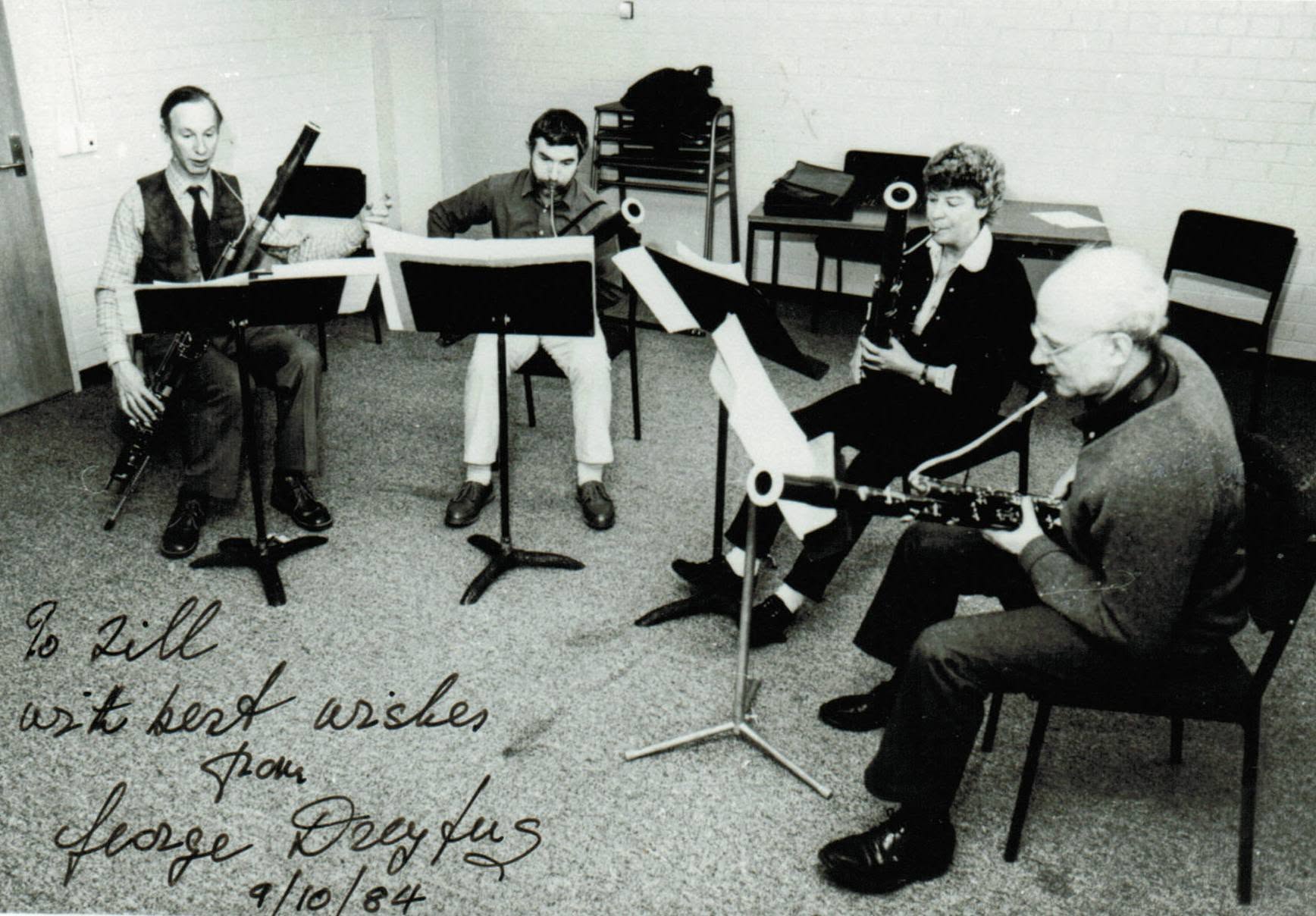
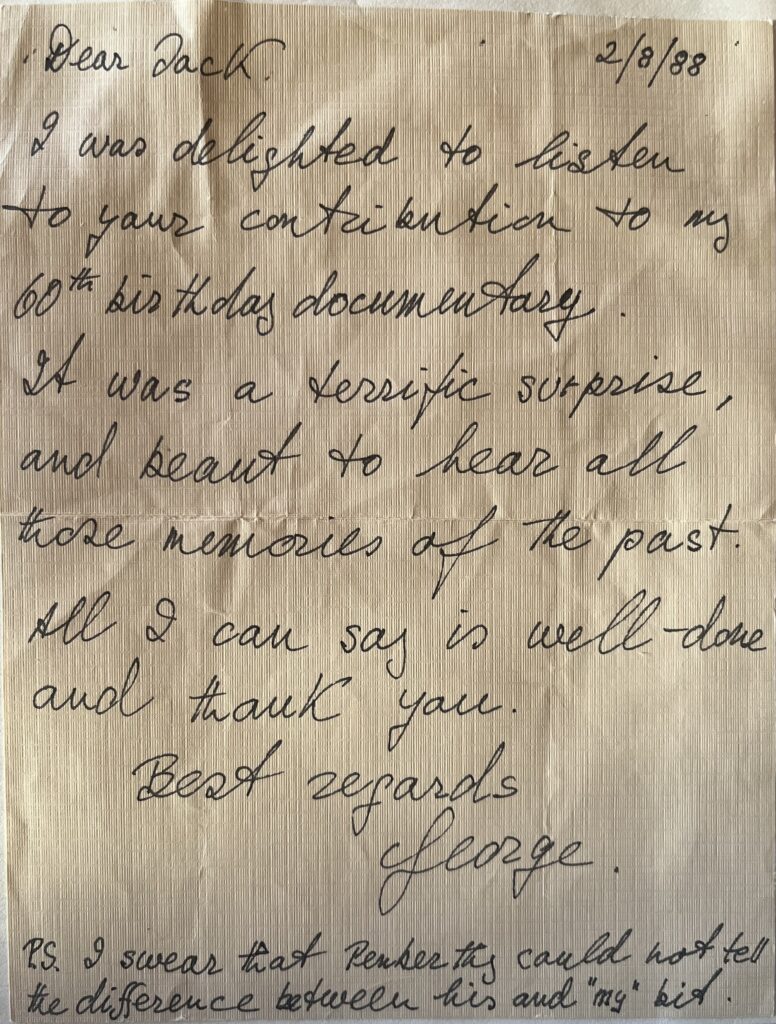
1988 – 60th birthday
https://www.australianmusiccentre.com.au/artist/dreyfus-george