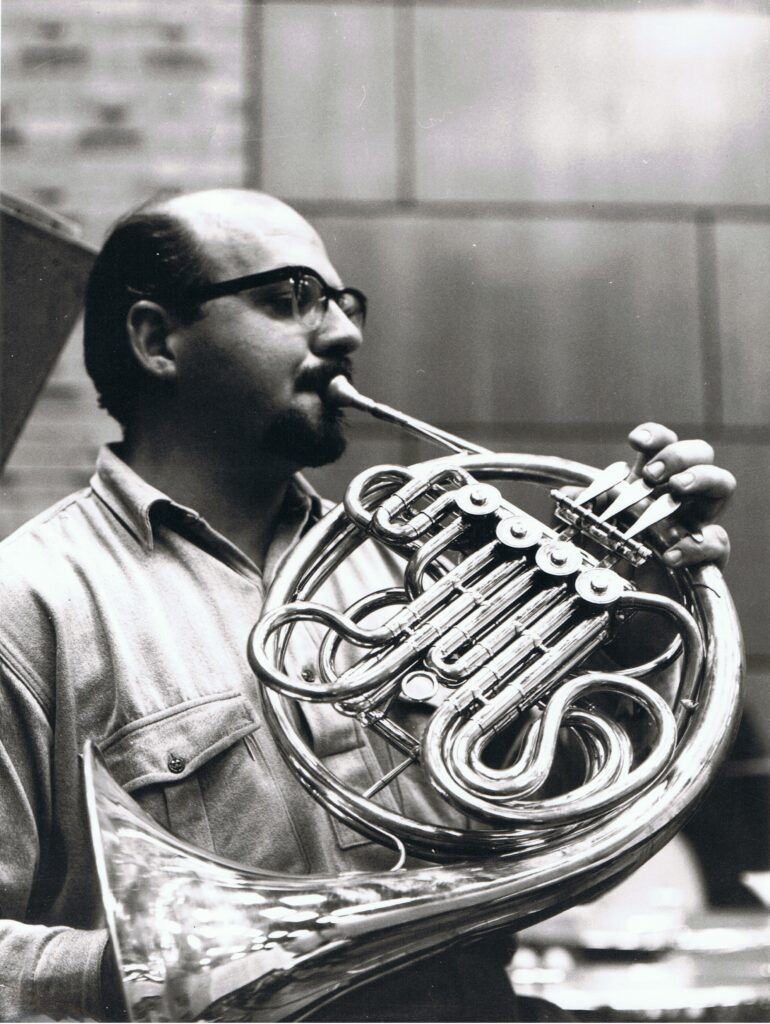
Husband and wife team Aino Neumann and Neil Pierson both studied at the Sydney Conservatorium. They married in 1952 and moved to Perth the following year, Aino to play bass with the West Australian Symphony Orchestra while Neil played trombone with a band at His Majesty’s Theatre. Later, on advice from Rudolf Pekarek, he studied french horn as a second instrument and joined the orchestra in 1956 playing that instrument.
Harrison, Marcia, West Australian Symphony Orchestra Celebrating 75 Years, (WASO Holdings Pty Ltd, 2003). p.57
1954
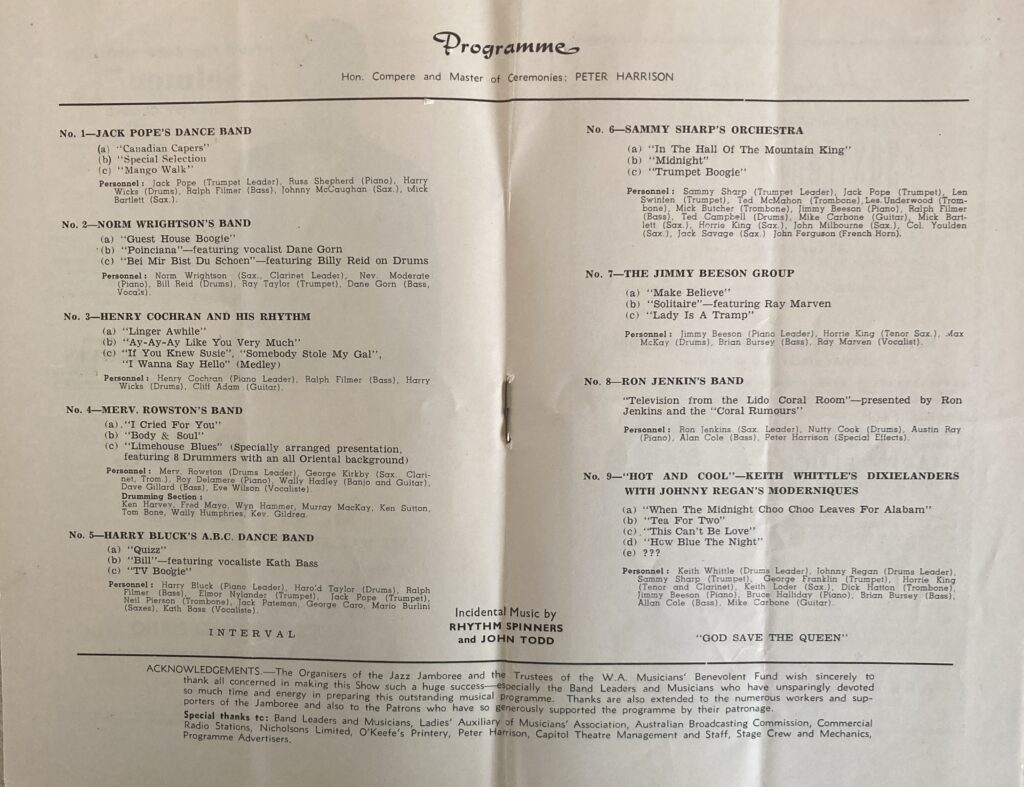
1956
COMPOSER IS PROVOCATIVE
February 21, 1956
By “Fidelio”
A West Australian composer, James Penberthy, offered us last night what in some ways the most adventurous Australian composition so far heard in the Art Gallery programmes. This includes, notably, his medium of expression; a wind quintet consisting of flute, oboe, clarinet, horn and two bassoons. For this unusual combination Mr Penberthy had produce a work in short, linked movements, based on the music and life of Australian aborigines. He obtained interesting effects in the way of atmosphere and drastic colourings, but his score sounded very fragmentary. It seemed often to be hovering uncertainly between outright imitative realism and the freer imaginative flight which, we felt, should not convincingly emerge. Another unusual inclusion was a set of three nicely fanciful songs for soprano and flute (no piano) by John Gordon, the words being taken from Chinese. The rest was chiefly light music, generally pretty in a conventional style. There were two pieces for flute and piano by A.C. Black (a West Australian), clarinet and piano pieces by Dulcie Holland and Moneta Eagles, songs by Horace Keats and Elizabeth Mills. The performers were Sylvia Biddle (soprano), Owen Fisenden (flute), Jack Harrison (clarinet), Neil Pierson (horn), Ron Richmond (oboe), George Dreyfus and Claude Welling (bassoons) and Phyllis Allen (accompanist).
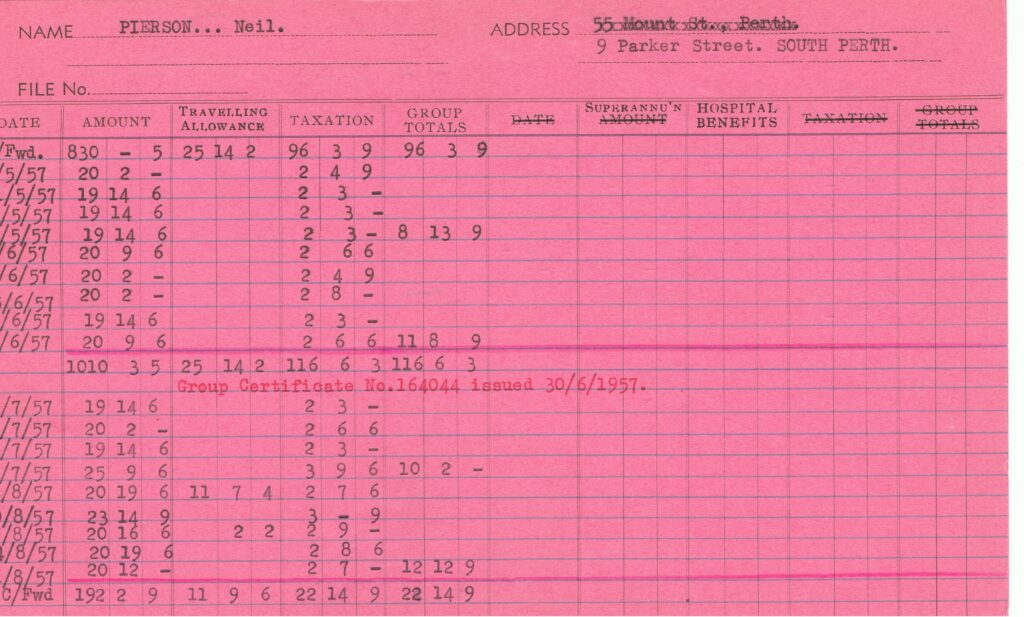
1957
1967
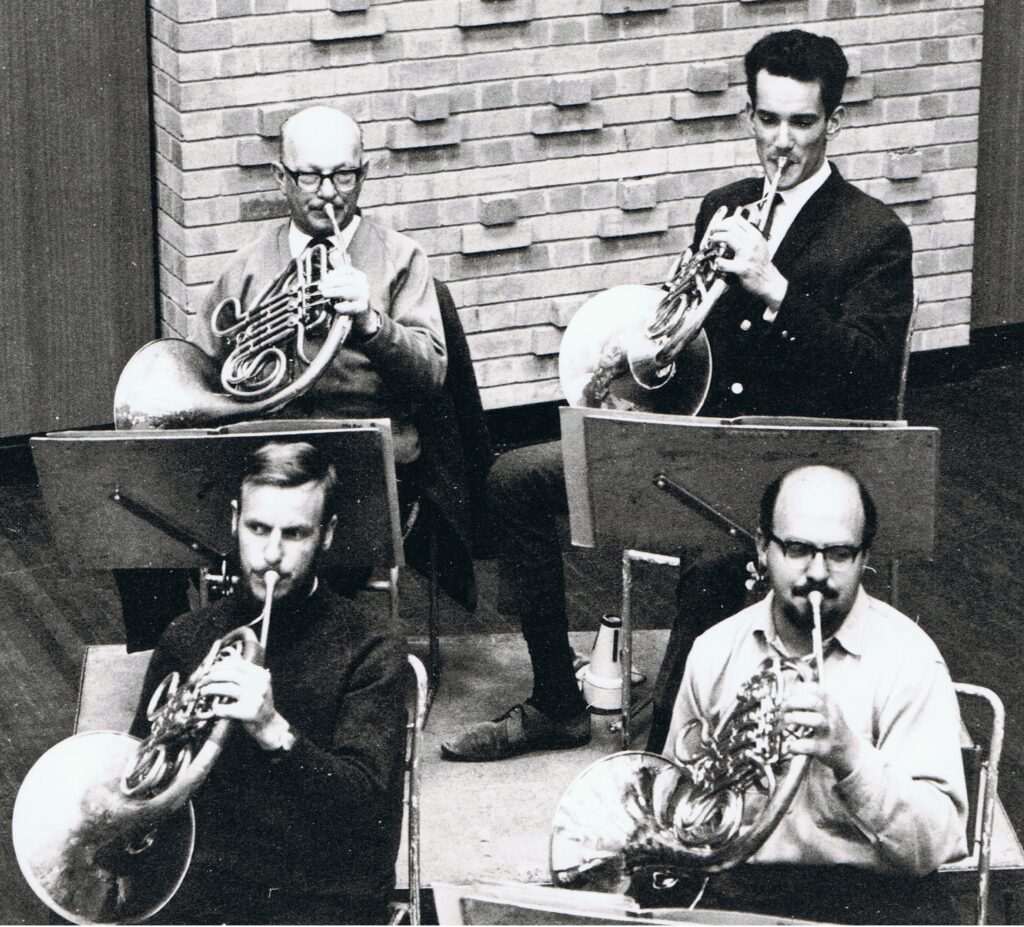
MUSIC – By Peter Hellstrom
September 24 1967
There will be an all Beethoven programme at tomorrow afternoon’s recital at the A.B.C. Basil Kirke Studio beginning at 3 o’clock. It will consist of the Septet in E flat and the Serenade in D. Op.8. The performers will be Graham Wood (violin), John Dean (viola), Brian Meddemmen (cello), John Mowson (bass), Jack Harrison (clarinet), Neil Pierson (French horn) and Jill Harrison (bassoon).
1970
SWING TIME AT THE PLAYHOUSE – By Peter Hellstrom
The playhouse will really swing on February 10, 17, 24 and March 3 when four Perth’s best jazz groups go through their paces in a series that will be part of the Festival Of Perth. These late afternoon jazz concerts starting at 5:45 pm, will each consist of two widely different types of performance. There will be first class fare for those like the trad jazz and for those more attuned to mainlining. One of the groups, Don Johnson’s Octet, includes five members of the West Australian Symphony Orchestra who will thus reveal the versatility. Members of the Octet are Robert Johnson (trumpet), Neil Pierson (French horn, trumpet and trombone), Peter Clinch (alto saxophone), Jack Harrison (tenor saxophone), Harry Retting (piano) Brian Bursey (bass), Bill Tattersall (drums) and Bill Farnham (trombone). The West Australian Saturday January 31 1970
Sunday May 26 1970
The second concert in Series I of this year’s A.B.C. recitals in the Basil Kirke Studio will be given tomorrow afternoon at 3 o’clock. A Rossini Quartet For Wind will be played by flautist Owen Fisenden, clarinettist Jack Harrison, horn player Neil Pierson and bassoonist Brian Pope. A Beethoven septet will be performed by clarinettist Jack Harrison, bassoonist Brian7, violinist Vaughan Hanly, violist John Gould, cellist Ray Fraser and double bass player Aino Neumann. One of the objects of the concert is to bring the best local artists playing chamber music before the public. Symphony concerts naturally attract more people because of the grandeur and perhaps a little because of the mere occasion. But we must not let the chamber music and solo recitals die. They are part of the backbone of music in Europe, the primary source of most music.
1972
Congratulations – we’re lucky to have you, Mr Paul
By Robert Gude
If conductor Tibor Paul thought the rousing ovation he received at this week’s Youth Concert was simply urging him on for an encore, he misjudged his young audience. It is customary for audiences who want more for their money to stomp and holler hoping for a kind of bargain basement addition to the printed program. Such was not the case following the WASO’s fine performance of the titanic Fifth. Every section without exception excelled in alternating dynamics and delicacy, Mr Paul conducting without a score, was in complete command with his subtle sweeping cues and characteristically spare, precise beat. Jack Harrison was heard in a fine reading of Stanford’s Clarinet Concerto. Mr Harrison alone saved this plain, uninteresting work bearing shades of Elgar and a momentary sally in Wagner. For one brief moment, an elegant melody carried by the entire string section could have lent unusual character to this concerto – had Stanford continued variations on this theme for solo clarinet, developing and alternating this material into meaningful music. Mr Stanford chose however to leave this melody suspended in mid-air, a la Bruckner, never to be heard again. Mr. Harrison came upon this work during his recent Churchill Foundation study tour and brought it to us as an example of fine writing for clarinet. This it was beyond doubt propelled by Mr Harrison’s undoubted skill and this was reflected in the fine reception he received from a young audience which appreciates his enormous talents. The program opened with Stravinsky’s orchestral suite from the ballet “The Fairy’s Kiss” one of this great Russian, French, American’s gentler works. What could go unnoticed was the excellence of harpist, Michael Jefferies, the first chair solo quartet provided by leader Vaughan Hanly, Stanislav Kowarski (second violin) George Coleman (viola) and Raymond Fraser (cello) and, again risking reputation, the WASO’s splendid horn section led by Neil Pierson. Concert audiences in Liverpool, England still recall with awe and admiration Mr. Paul’s appearance on the podium of the Royal Liverpool Philharmonic last October. Here, beyond question, is a conductor of world standing. The A.B.C. the WASO and Perth concert audiences should appreciate the nature and global reputation of Mr. Paul while he is with us, they should count themselves fortunate.
Sunday Independent May 14 1972
Night of Russian Musical heritage – By John Meyer
Friday June 23 1972
In an evening of Russian music at the ABC orchestral subscription concert in Winthrop Hall last night three works illustrating different facets of that nations musical heritage were featured. The highlight was a controlled and well-defined performance of Tchaikovsky’s Fifth Symphony in E minor played by the West Australian Symphony Orchestra and conducted by Tibor Paul Mr. Paul’s total view of this symphony seem to be an admirable one. He did not emphasise only it’s obvious emotional qualities but gradually built up the drama from the sombre opening for clarinets to the triumphant climax of the final. In this last movement he was well supported by the Orchestra. The performance throughout was distinguished by some fine solo playing especially by Neil Pierson Horn and Jack Harrison and Peter Clinch clarinets.
The West Australian Saturday June 24 1972
1973
Albert Herring Proves to be a Bad Catch
With Robert Gude
Ten minutes late getting underway to a two-fifths empty house at the Octagon, the opening night of the W.A. Opera Company’s production of Benjamin Britten’s “Albert Herring” was already too moribund to resuscitate. The plotting in Act One induced the muse of Morpheus simply because it was virtually impossible to decipher what anyone on stage was singing about. The company threw away the key to the plot which remained undiscovered right to the last bar of Act Three. Patricia Whitbread remained prominent both vocally and socially in her role as the imperious Lady Billows. Her larger than life characterisation lent itself to projecting both voice and diction into the lifeless acoustics of the Octagon. The rest of the cast had equal opportunity but for some inexplicable reason underplayed and undersang Britten’s brilliant operatic farce. An occasional word or two was intelligible. isolated by bar after bar of baffle. The less said about Martin Clare portraying the mumbling Mayor the better. Mr Clare’s pitch was pathetic, his onstage efforts inept. Between Miss Whitbread and Mr Clare this small cast was totally inadequate for the operatic task required.
What redeems Albert Herring is the splendid production by John Milson. Act Two Scene One had the magic Milson touch: Jeffrey Weaver as Harry enduring functional discomfort during choir practice; Cliff Arndt’s bedrock boredom of wearisome waffle from windbags; John Nicholson’s stunned mullet manner and accepting homage as though facing the gallows with a recommendation for preferential treatment. Kristan Fredrickson’s articulate set and consummate costumes were colourful. Allowance should have been made, however, for a costume change amongst characters who could afford more than one ensemble thus enhancing the illusion of a passage of stage time. Conductor Geore Tintner seemed determined that Britten’s 12 member orchestra should overwhelm his singers at every opportunity. Strings were insecure throughout, with the exception of Aino Neumann, contrabass; Neil Pierson’s horn; Jack Harrison’s clarinet; Peter Randall’s oboe; James Hopkinson’s flute and most commendable, Michael Jefferies impeccable harp held Mr Tintner’s orchestra together. This festival fare is indigestible, not worth a candle and most certainly not worth the price of admission. If Britten’s Herring performed at it was on opening night is the W.A. Opera Company’s first production for the Festival Of Perth it could well be the last.
Sunday Independent February 4 1973
1975
September 15 1975 – The Alberni String Quartet
Schubert Octet in F Major Op. 166
With John McNeilly – bass; Jack Harrison – clarinet; Neil Pierson – horn; Brian Pope – bassoon.
1978
Neil Pierson retired from WASO after 22 years service.
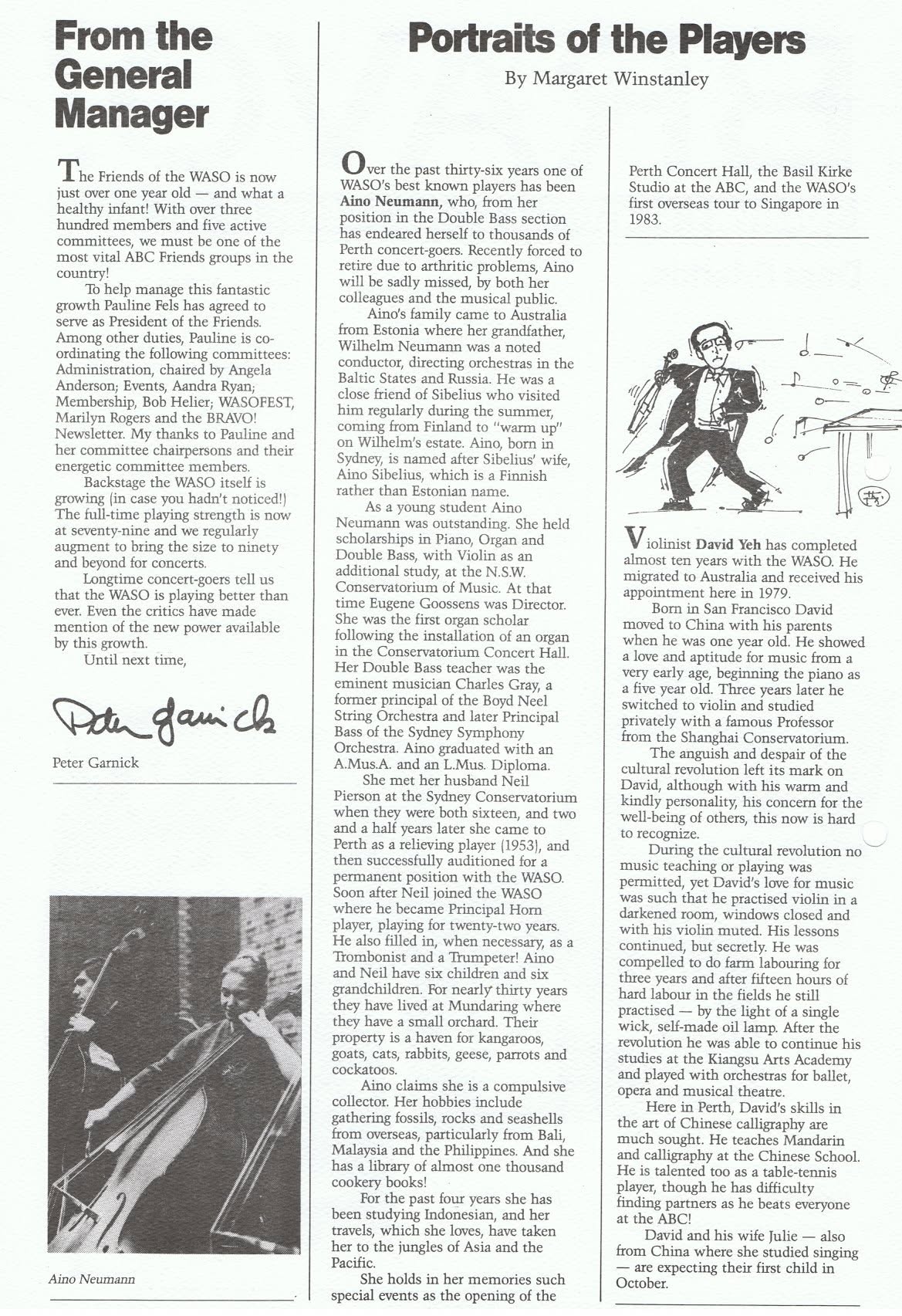
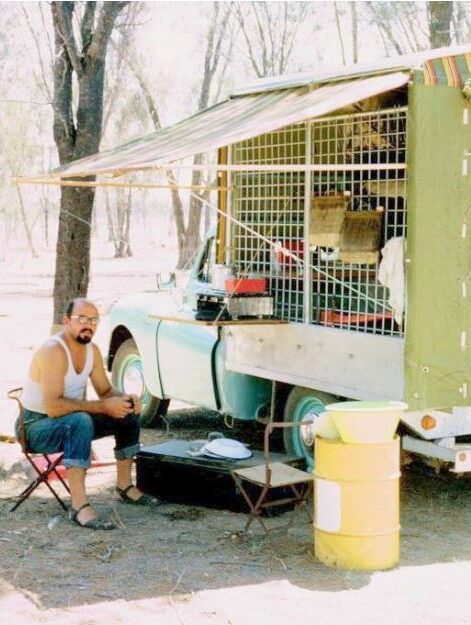
Neil Pierson died on 5th November 2011 aged 76.