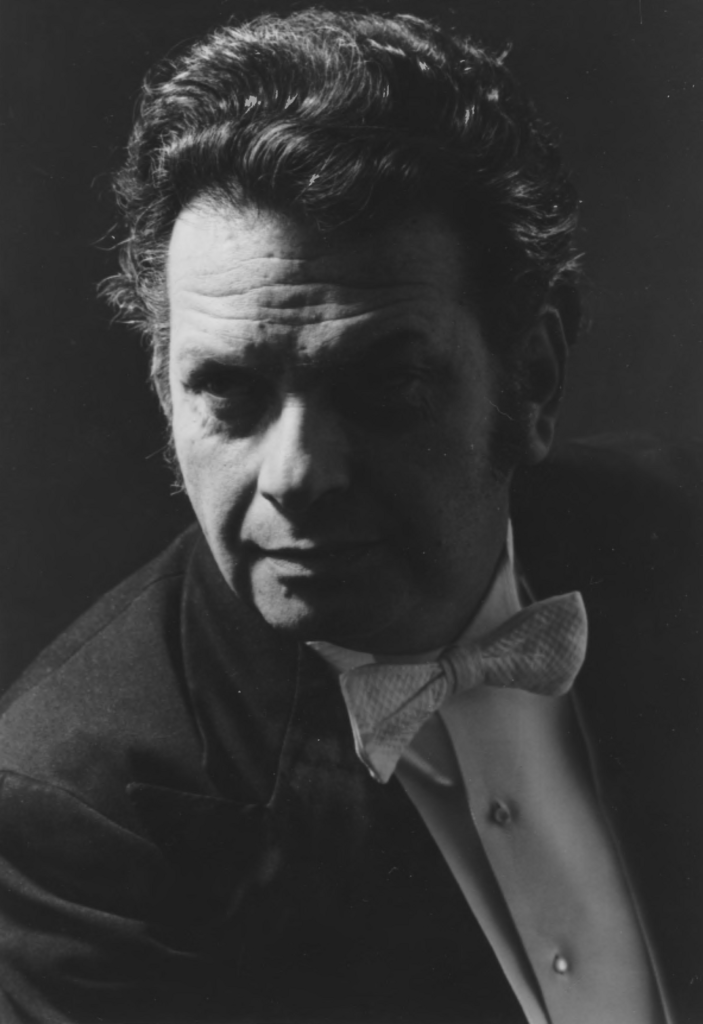
Albert Rosen first appeared as a guest conductor with the West Australian Symphony Orchestra in 1979.
In 1980 he was appointed Chief Conductor, a position he held until 1985. The previous Chief Conductor, David Measham, was appointed Principal Guest Conductor.
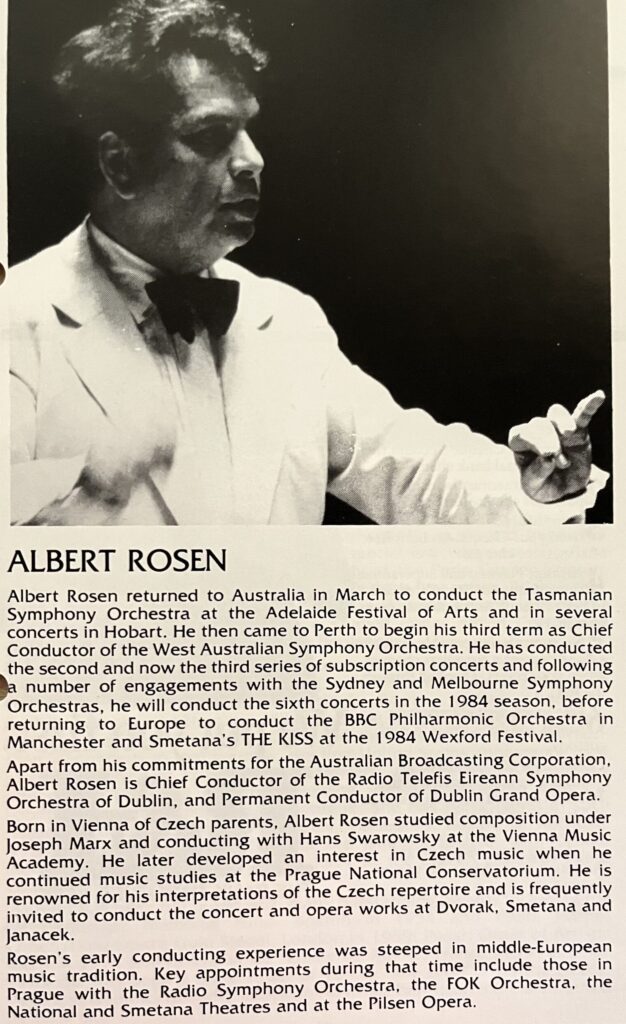
Rosen was greatly admired by the orchestra with one of his most notable concerts being with Death and Transfiguration by Richard Strauss, Nigel Kennedy performing the Elgar Violin Concerto and the greatly augmented brass section basking in the glory of Janáček’s Sinonietta.
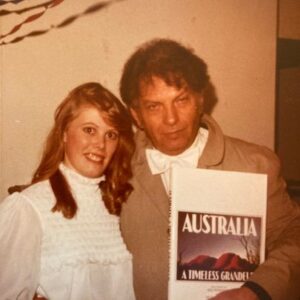
Albert Rosen has a special place in the heart of this website owner.
In June and July 1983, Rosen coached the West Australian Youth Orchestra on a weekly basis for their performance of Dvorak’s “New World” Symphony.
Rosen conducted Mahler’s First Symphony in 1984 in which four members of Jack Harrison’s family performed.
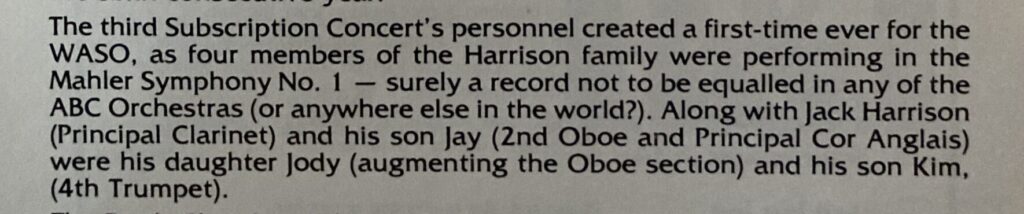
In 1984, Rosen also conducted the State Finals of the A.B.C. Instrumental and Vocal competition in which Jody Harrison was a finalist on cor anglais.
Rosen returned regularly as a guest conductor of the WASO right up until 1997 during which time it was painfully obvious he was losing his battle with cancer. Rosen commented at this time “that his arms were the only part of his body still working properly.”
Harrison, Marcia, West Australian Symphony Orchestra Celebrating 75 Years, (WASO Holdings Pty Ltd, 2003), p.113.
Albert Rosen died in 1998 of lung cancer.
Rosen, Albert (1924–97), orchestra conductor, was born 14 February 1924 in Vienna, Austria, second child and only son of Dr Ludwig Rosen, an Austrian lawyer, and Teresia Rosen (née Ruzickova), of Czech ethnicity. The household was not especially musical, and Rosen’s talents were late to emerge. The family moved to Prague, Czechoslovakia, where he received his primary and secondary education. After studying piano, composition, and conducting at the Vienna state academy, he moved to the Prague conservatory, where, amid an important musical renaissance in the city, his training included thrice-weekly turns at conducting the conservatory orchestra, led by Josef Suk. Engaged on graduation as a conductor with the Pilsen (Plzeň) opera (1949), he honed his skills in the company’s wide repertoire of opera, ballet, drama, and background and incidental music. Appointed (1960) a resident conductor at Prague’s National Theatre, the country’s principal opera company, he became a conductor of the Prague Symphony Orchestra (1964) and director of the Smetana Theatre (1965), the city’s second opera company.
Rosen’s long association with Ireland commenced in 1965 when he made a huge impression conducting the Radio Telefís Éireann Symphony Orchestra (RTÉSO) at the Wexford Opera Festival in Massenet’s ‘Don Quichotte’. Return visits to Wexford, to conduct Donizetti’s ‘Lucrezia Borgia’ (1966) and Rossini’s ‘Otello’ (1967), led to his appointment as principal conductor of the RTÉSO; the third occupant of the post, he served the longest tenure to date (1968–80). A popular choice with both musicians and the public, he immediately restored coherence and direction to the orchestra after the uncertainty that followed the controversial departure of the Hungarian conductor Tibor Paul (the orchestra’s second principal conductor (1961–7), coming after the Yugoslav Milan Horvat (1953–8)). Rosen developed the orchestra’s repertory, embracing numerous contemporary offerings but with a solid grounding in the classical and romantic tradition, and continued the policy of programming works by Irish composers, including premieres of new compositions by Seoirse Bradley, Brian Boydell (qv), and A. J. Potter (qv). He conducted such eminent visiting soloists as Robert Casadesus, Ruggiero Ricci, and James Galway, and also programmed solo engagements by members of the orchestra. Throughout his tenure the RTÉSO’s base was the St Francis Xavier Hall, Upper Sherrard St., Dublin; taking the orchestra to other Dublin venues and to provincial locations, especially Limerick and Cork, Rosen reached a yet broader audience through the increased frequency of television broadcasts in addition to the long-standing radio performances. He regularly conducted in the Dublin Festival of Twentieth Century Music; particularly memorable were the premiere of the symphonic portrait ‘Jonathan Swift’ by Gerard Victory (qv) in St Patrick’s cathedral (1972), and a performance of Olivier Messiaen’s ‘Turangalîla-symphonie’ in the composer’s presence and with the composer’s wife and sister-in-law as soloists (1976). In March 1976 Rosen led the RTÉSO on a tour of seven English and Welsh cities, followed by its first three performances in continental Europe, playing to especial acclaim in Antwerp. For the orchestra’s second and longer European tour (1980) he teamed with Colman Pearse (who would succeed him as the orchestra’s fourth, and first Irish-born, principal conductor); Rosen identified a Paris performance of Mahler’s fifth symphony as a highpoint of his career.
Rosen’s foremost love and métier was always opera, followed by the lush, opulent scores of nineteenth-century romanticism, and the music of his native Czechoslovakia. Integral to the development and success of the Wexford festival, he conducted eighteen operas there, more than any other conductor; highlights included a passionate production of ‘Kát’a Kabanová’ by Janáček (1972), and a spine-chilling interpretation of Britten’s ‘The turn of the screw’ (1976). He was skilled at adapting big romantic scores to the 46-piece orchestra necessitated by the diminutive Wexford pit. He also conducted some 165 performances of twenty-four operas for the Dublin Grand Opera Society (latterly Opera Ireland), starting with ‘Die Fledermaus’ by the younger Johann Strauss (1969), and including the first Irish performance of Janáček’s ‘Jenufa’ (1973), and a modern-dress ‘Così fan tutte’ by Mozart (1983 and 1984), one of the company’s most acclaimed productions.
With a family and continuing career in Czechoslovakia, Rosen found difficult the years following the suppression of the ‘Prague spring’ liberalisation, which coincided with his Dublin appointment, and in 1971 he resigned his Prague positions. He once observed that under the Czech communist system if a thing was organised by the state it was organised well, but if it was not state-organised it did not exist; while basking in the greater artistic freedom and scope for individual initiative in the west, he frequently bemoaned the paucity of state support for the arts in Ireland. Resigning as principal, Rosen became chief guest conductor (1980–94) of the RTÉSO (from 1990, the National Symphony Orchestra of Ireland (NSOI)); on his seventieth birthday he received the unique appointment of conductor laureate (1994–7). One month after the venue’s opening, he debuted (4 October 1981) at the orchestra’s new home, the National Concert Hall, with a programme of Bruckner, Rachmaninov, and ‘The banks of Sullane’ by Seán Ó Riada (qv). Appointed chief conductor of the Western Australia Symphony Orchestra, Perth (1982), he later became principal conductor of the five orchestras of the Australian Broadcasting Corporation, based in Adelaide. A guest conductor with orchestras throughout Europe, he had an astonishing capacity to deputise at short notice for a scheduled conductor. His numerous international opera credits included acclaimed engagements in San Francisco, San Diego, and Paris, and with the Scottish Opera and the English National Opera.
A rugged giant of a man, who lumbered to the podium like a great bear, Rosen was a kinetically ebullient presence on the platform, constantly moving about with the emotion of the music, dubbed by the RTÉ musicians ‘the bouncing Czech’ for his propensity to spring into the air at particularly dramatic moments. A throwback to the nineteenth-century school of conducting, he eschewed the modern predilection for total command and finely rehearsed exactitude, favouring rather a flexible and improvisatory accommodation to the unpredictable character of every performance, valuing above all a sincere and unconditional surrender to the music as performed. Lively, engaging, and bon vivant, his impeccable old-world manners touched with a raffish streak, he was modest about his talents and unpretentious about his art. Twice married and twice divorced in Czechoslovakia, he had a daughter by his first marriage and a son by his second. An incessant smoker, he fell ill with lung cancer in 1996. He returned to Dublin from Australia in May 1997 to conduct the last night of the Bank of Ireland/RTÉ proms and record a session of Czech music, but was admitted to St Vincent’s hospital, where he died on 23 May 1997. A memorial service was held in St Stephen’s (the ‘Peppercanister’) church, Upper Mount St. Crescent (27 May). The NSOI performed a tribute concert under the baton of Oliver von Dohnanyi, music director of Prague’s National Theatre (28 September 1997).
ITWW; Ir. Independent, 14 Feb. 1994 (profile); Ir. Times, 18 Mar. 1994 (profile); ibid., 24, 26, 30 May 1997; Times, 11 June 1997; Pat O’Kelly, The National Symphony Orchestra of Ireland 1948–1998: a selected history (1998), passim; Michael Kennedy (ed.), Oxford dictionary of music (2001)
Publishing information
DOI: https://doi.org/10.3318/dib.007802.v1