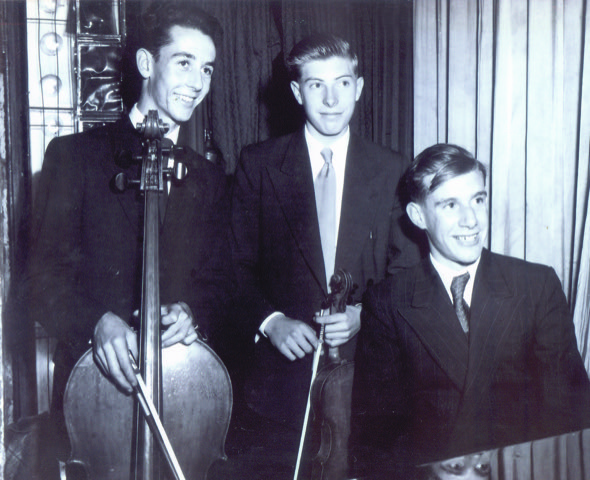
Robert (Bob) James Ingram (June 1937 – August 1999)
Western Australian born Robert (Bob) Ingram was one of Australia’s leading violinists during the second half of the 20th century. He commenced violin studies in his 12th year: somewhat late compared to most professional violinists. Initially studying with Cyril Phillips, he made rapid progress and subsequently commenced studies with Vaughan Hanly, Perth’s leading violin teacher and long serving concertmaster of the Western Australian Symphony Orchestra (WASO).
Young Perth Orchestra Improves (By P.K.)
Judging by the performance in Winthrop Hall last night, the Youth Orchestra under Edgar Nottage has made considerable progress during the months that have elapsed since we heard it last. The group, which now stands at the record number of 53, had more precision and vitality in its playing last night than on previous occasions, and although there were some moments when things went a little astray, there were other moments of fully integrated playing. From the ten soloists-two of whom were not much bigger than the violins they played-we had some very promising and interesting work, such as a duet for flute and clarinet. Synchronisation and balance between soloist and orchestra was best in the “Impromptu” from Rachmaninoff’s Concerto in C Minor, in which Lynette Jamieson gave quite an accomplished solo performance. Other pleasing items were the Tschaikowsky violin “Melodie” played with a lovely singing tone by Ron Thomas, a “Hungarian Dance” played by Maurice Chiswell, and violin concerto works played by Daphne Smith and Robert Ingram. Choral works by the East Perth school choir were also included.
West Australian (Perth, WA : 1879 – 1954), Wednesday 21 October 1953, page 10
Ingram moved to Sydney in 1955 to attend the Sydney Conservatorium of Music where he studied with Florent Hoogstoel and Ernest Llewelyn (concert master of the Sydney Symphony Orchestra). He was forced to leave the Conservatorium after only 18 months study due to financial constraints and take a job with the SSO, playing in the first violin section. In December that year he returned to Perth to join WASO and to continue his studies with Vaughan Hanly.
In 1958, Ingram reached the State finals of the Vocal and Concerto competition (forerunner of the ABC Young Performers Awards), playing the first movement of the Sibelius violin concerto.
In January 1959, Ingram departed Perth to continue his studies in Europe and the UK. He initially studied violin with Jean Fournier in Paris and chamber music with Sandor Vegh and Pablo Casals. After six months in Paris, Ingram returned to London to study with Erich Gruenberg, Concertmaster of the London Symphony Orchestra.
Whilst in London, Ingram played as a casual in all the major symphony orchestras and several chamber orchestras, including the English Chamber Orchestra, the Academy of St Martins in the Field and as Associate Concertmaster in the Philomusica of London under the legendary harpsichordist, George Malcolm.
1965 saw Ingram return to Australia where in 1966 he was appointed second violin in the newly formed Sydney String Quartet (SSQ) alongside Harry Kirby (violin), Robert Pikler (viola) and John Painter (‘cello). Ingram joined the Robert Pikler Chamber Orchestra (RPCO) in 1969 as leader and frequent concerto soloist. The Orchestra toured extensively within Australia.
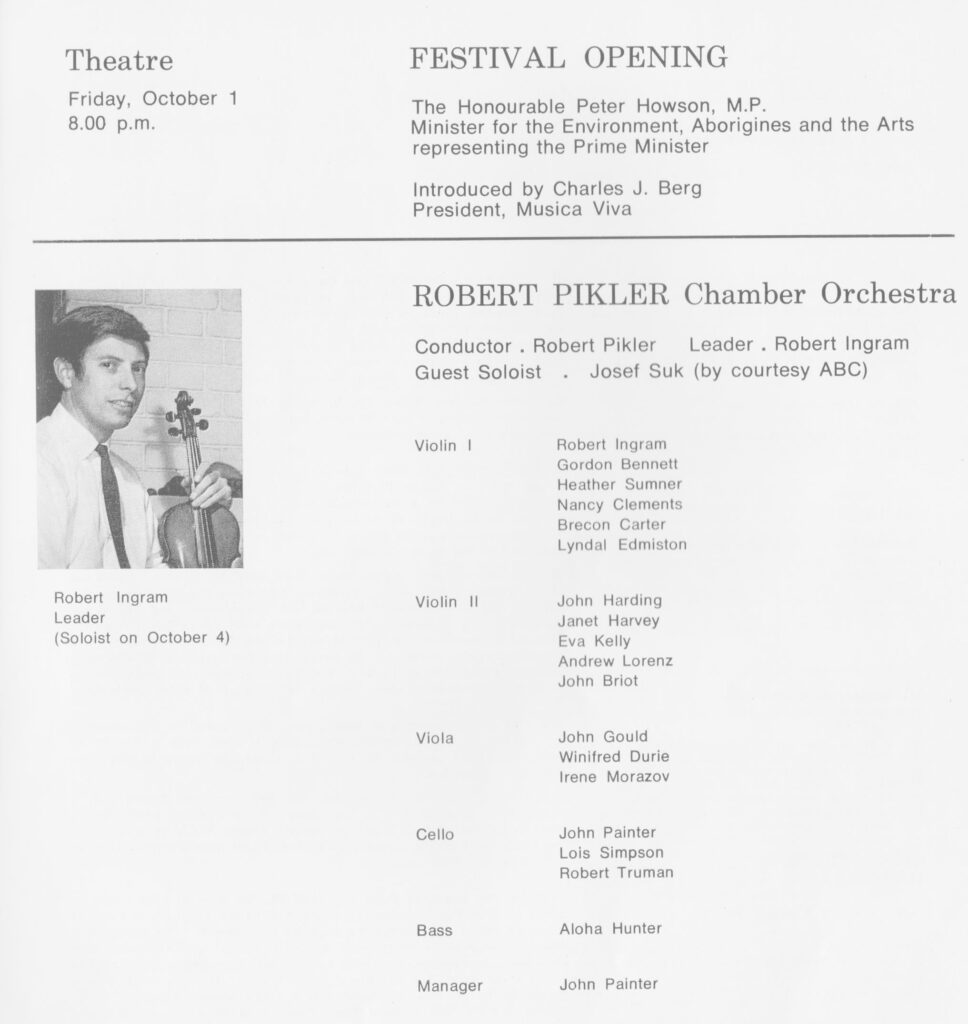
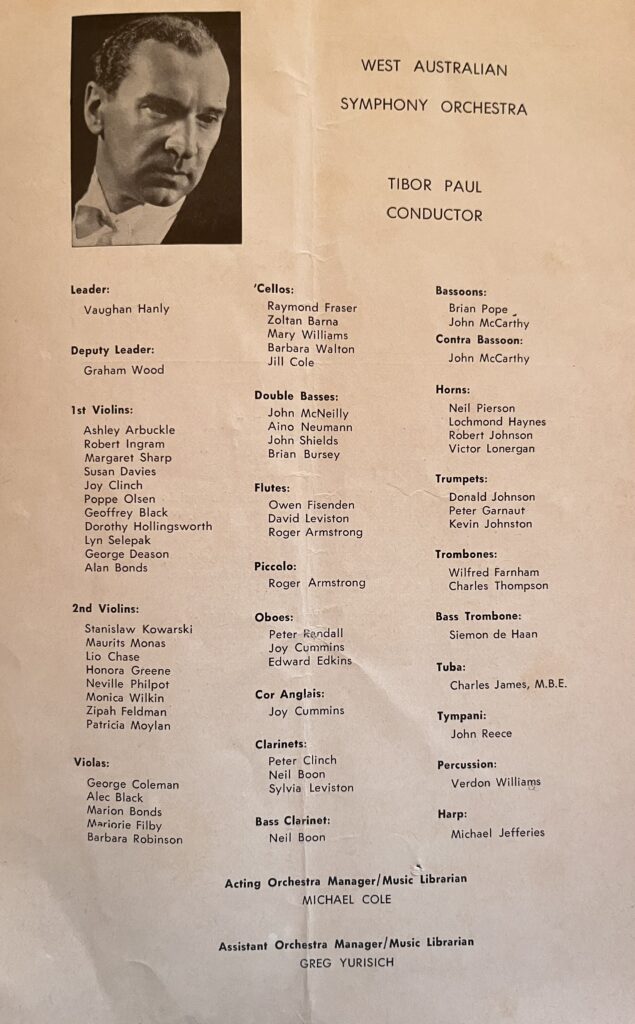
1973 to 1977 saw a change of direction for Ingram, with his appointment as Concertmaster of the Elizabethan Sydney Orchestra (ESO) (later The Elizabethan Philharmonic Orchestra and finally the Australian Opera and Ballet Orchestra (AOBO)). This was a period of major development in the Australian opera world, including the building of the Sydney Opera House and the considerable involvement of International stars such as Joan Sutherland, Luciano Pavarotti and conductor Richard Bonynge. Whilst concertmaster of the ESO, Ingram organised and frequently performed in chamber music recitals involving members of the orchestra.
From 1975 to 1980, Ingram was leader of and frequent concerto soloist with the Australian Chamber Orchestra (ACO), playing extensively throughout Australia and taking the ensemble on its first international tour to SE Asia and Japan where he performed Vivaldi’s Flour Seasons to packed audiences in Tokyo.
From 1980 onwards, Ingram worked extensively as a free-lance violinist and organiser/fixer. During this period he was concertmaster of various orchestras under visiting celebrity conductors, guest concertmaster for the AOBO (on numerous occasions) and two three month stints with WASO. He was a juror on a number of violin competitions and eisteddfods and was a frequent recitalist and chamber music performer for ABC radio and at various music clubs in Sydney.
In 1992, Ingram joined with pianist Gerard Willems and cellist Georg Pedersen to form MozartTrois to record all of the Mozart piano trios on the Tall Poppies label. Throughout his career, and particularly in Sydney, Ingram had the good fortune to play with many of the finest musicians in Australia. He played on a Gagliano violin until 1976 when he purchased a very fine Guadagnini violin from international soloist, Gyorgy Pauk.
In 1979 Ingram was appointed a Member of the British Empire (MBE) in the Queen’s New Year Honours list for his services to music in Australia.
He died in 1999 aged 62 from cancer. He was married to Beverley Powrie and they had three children.