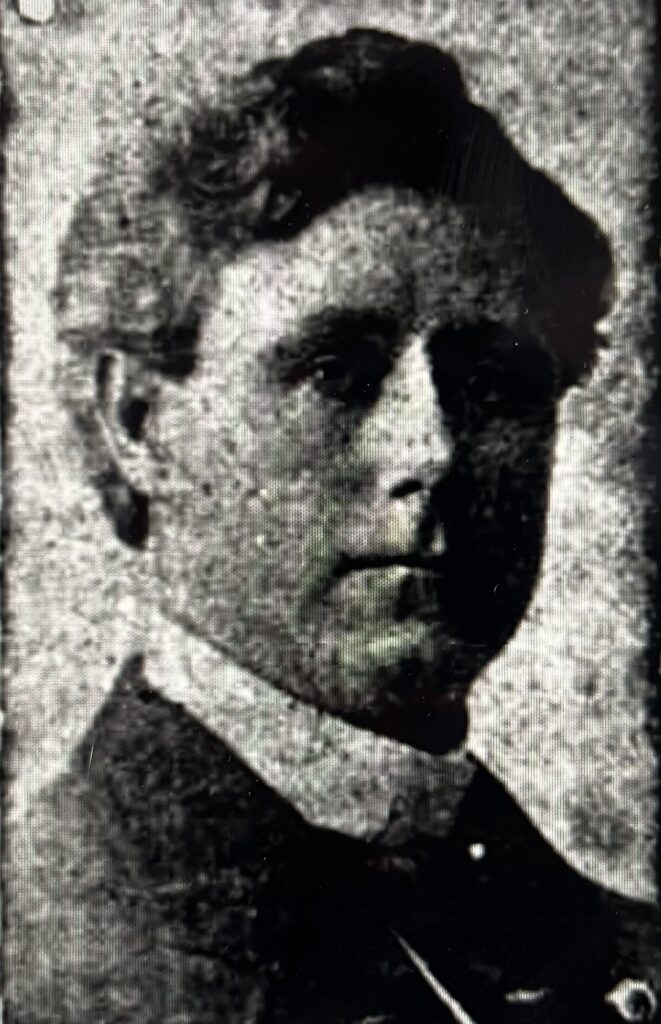
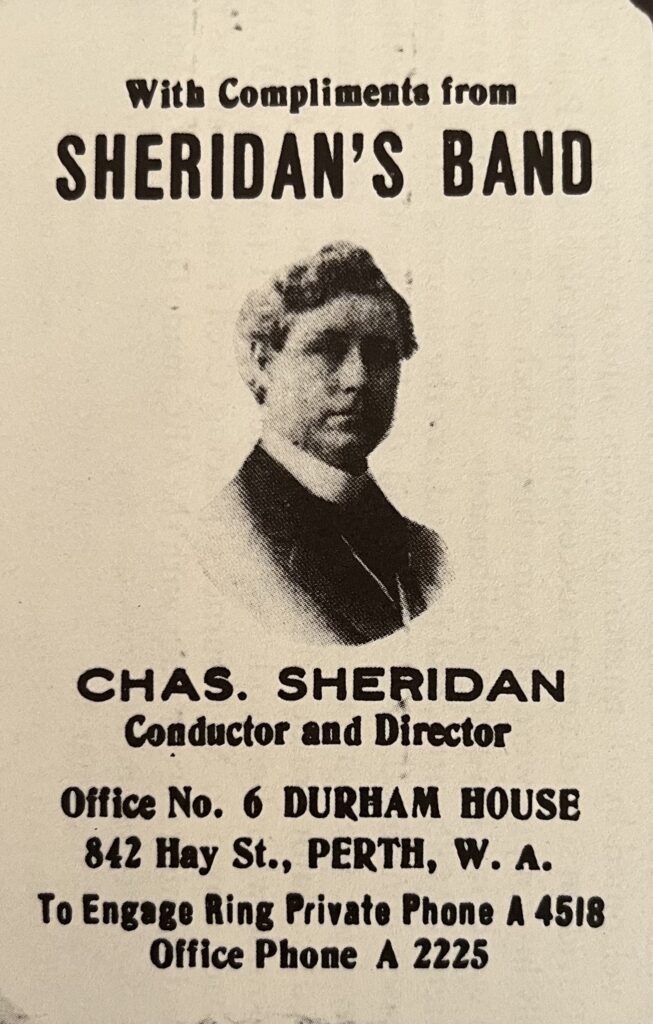
Charles Sheridan’s Piccadilly Cabaret Band was a prominent Perth dance orchestra active in the 1920s, led by violinist and businessman Charles Sheridan Snr.
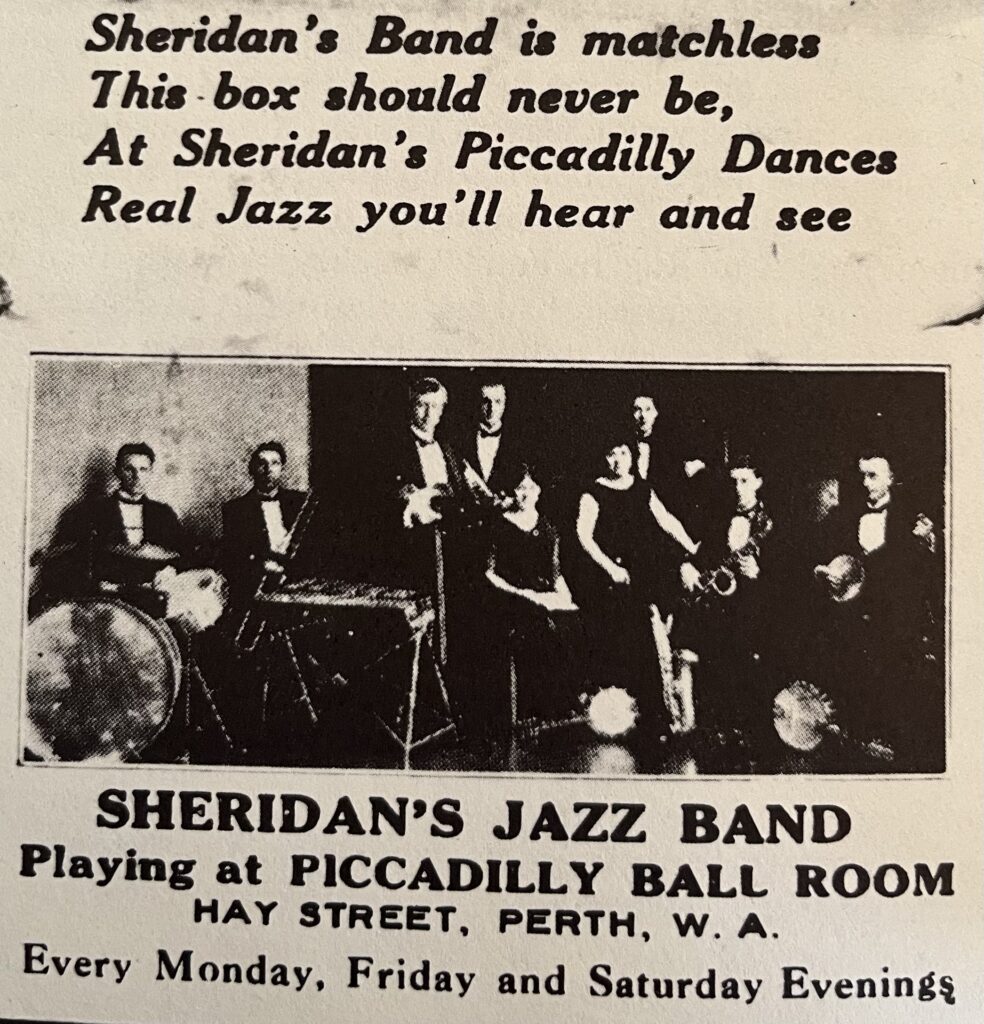
Sheridan moved to Perth from Victoria in 1901 with his violin and formed a chamber quartet that evolved into the popular Charles Sheridan Orchestra by 1906. He managed his musical bookings and rehearsals alongside an importing business from his office in the Eagle Chambers on Hay Street. In the late 1920s, Sheridan directed “Sheridan’s Cabaret” at the Piccadilly Ballroom on Hay Street. Advertised in 1928 as “Perth’s Only Cabaret,” the event featured evening dress dancing from 8:30 PM to 12:30 AM every Monday night with music provided by his band. During Western Australia’s centenary celebrations in 1929, the Piccadilly Cabaret Band embarked on a major regional tour across 65 country towns.
As in the east, dance musicians were the first to be interested in jazz in Perth. The Vice-Regal band led by Charles Sheridan Senior was the longest established dance band. Sheridan started it in 1903 and the band played the popular tunes of the day. For the dance in honour of Field Marshall the Right Honourable Viscount Kitchener of Khartoum on 24th of January 1910, the band included the ragtime number “Old Faithful” by Abe Holtzman. The Tivoli opened in 1913 to provide a suitable venue for touring vaudeville acts but it was not until 1924, when Bert Ralton’s Original Havana Band stopped off on its way home to England that Perth heard the new style of playing at first hand. Ralton did a series of tea dansants at the Piccadilly Ballroom in High Street. Sheridan made sure his son Charles Junior (born 1908) received some tuition on sax from Ralton. Sheridan supplied the music at the Picadilly which had punkahs hanging from the ceiling to stir the air, and it was the plum job in Perth until 1929 when the Temple Court and the Capitol Theatre opened at the foot of William Street. From the mid 20s jazz gained enthusiasts in Perth. By 1926, wireless magazines were receiving complaints that there was too much of it on the air. Perth’s first important crop of jazz players were from the group of men who came into their teens during this period and got their breaks in the established dance bands. Billy Naughton was a pianist who quickly got the right ideas and improved his style by having records, arrangements and magazines sent to him from America. Charles Sheridan Junior went into his father’s band in 1925 and became musical director of it the next year. In 1928, he went to Melbourne to play at Leggett’s Ballroom at Prahran and took lessons from Walter Beban of the “Californians”.
Bisset, Andrew, Black Roots White Flowers, (Globe, 1987), p. 56-7.
When Charles Sheridan first packed up his belongings and took the train to Melbourne to catch the boat to Perth at the tender age of 21, he took with him the one thing he could make a living with – his violin. A trained classical violinist in Ballarat, Charles had won several musical awards. While many others made their way out West in those days to seek their fortune in gold rush era Coolgardie and Kalgoorlie, typhoid fever was rampant in the Goldfields at the time; and young Charles’ mother feared for his life, making him promise not to look for work there. So, Charles found himself coming to Perth with a violin case, rather than a miner’s pick and shovel.
By 1906, Charles had transformed his chamber quartet into a dance orchestra (still mostly comprised of musician friends from Victoria). The band was in high demand at social and formal functions, and Charles even organised supper dances at the Piccadilly and Ambassador Theatres. In those days, long before touchscreens and video streaming, this was a significant form of night-time entertainment. Charles rented an upstairs office in the Eagle Chambers on Hay Street in Perth CBD, from where he ran an importing business, practised with the band, and booked performances. The Charles Sheridan Orchestra made him well known around town and his talents were well appreciated.
https://sheridans.com.au/sheridans-a-slice-of-wa-history/
1906
SOCIAL NOTES. (By “Adrienne.”) The nurses of the Perth Hospital were pleasantly entertained by some of the gentlemen of Perth at a dance in the Hibernian Hall last evening. Sheridan’s Band supplied good music, and the floor was in excellent order. A sprinkling of nurses in uniform among the evening dresses that were worn with dainty effect made a decidedly pretty and quaint picture.
West Australian (Perth, WA : 1879 – 1954), Tuesday 31 July 1906, page 6
1907
MISTAKEN IDENTITY To the Editor. Sir,-In your account of the Good Shepherd Ball in St. George’s Hall on the 26th inst. it was stated that the music was supplied by Docwra’s Band, whereas as a matter of fact my band (Sheridan’s Band) was engaged for, and actually played throughout, on that occasion. I am sure the mistake was unintentional and that there was no intention on the part of your reporter to do me any damage.-Yours, etc., CHAS. SHERIDAN, Perth, June 29.
West Australian (Perth, WA : 1879 – 1954), Wednesday 3 July 1907, page 8
1910
SOCIAL NOTES. (By “Adrienne.”) The annual plain and fancy dress ball in aid of the West Australian Trained Nurses Association took place on Friday evening in St. George’s Hall. Sheridan’s Band supplied delightful music for the dancers. There were three fancy sets which gave colour to the grand march held under the guidance of Mr. Lapsley. The Australian stock riders set was very smart, the ladies wearing khaki coloured short frocks and red silk belts and ties, and felt hats to match, their partners being also in khaki, with felt hats and red shirts, across which was worn the stockwhip. This set included Miss O’Dwyer (organiser), Miss Edwards, the Misses Still (2), the Misses Moynahan (2), Miss Sutherland, and Miss D. Dwyer, and Messrs. Waugh, Wilcox, Tottin”ham, Mills, Norrish, Rose, Campbell, and ‘elan. Another bright set was the “Mephistopheles” set in scarlet sateen with masks, in which Mrs. Beck, Mrs. Watson Miss Wittock, Miss Fletcher, and Messrs. Watson, Bick, Maynard, and Bromilow took part. A set of nurses daintily uniformed in white was danced in by Nurse Johnston, Nurse Terry, Nurses Coomer (2), and Nurse Knapton, and Miss Shean. also Dr. Bentley, Dr. Haynes, Jnr., Mr. Haldane, Mr. Martin, Mr. Wilkins, and Mr. Baker. The committee responsible for the success of the evening included Dr. Haynes, Jnr., Mrs. Rick, Mrs. Watson, Mrs. Harry Williams, Nurse Johnston, Miss McDonald, Mr. Miller, Mr. Rose, Mr. Wilkins, Nurse Farquhar, Mrs. Holman, Mr. Martin, Nurse Smith, Nurse McCallam, Nurse Ryan, with Mr. Wilkins and Mr. Stone as joint honorary secretaries. Among others present were:Mrs. Makeham, Mrs. Harry Williams, Mrs. Latimer, Mrs. Whologan and Miss Whologan, Mrs. Tydell, Miss Sylvester wearing a pretty dress as Queen of Clubs; Miss Rosetta Toll, Mrs. Swan, Miss Snowden, Mrs. Hazelwood, and Miss Dagnall.
West Australian (Perth, WA : 1879 – 1954), Monday 3 October 1910, page 3
1911
Musicians’ Union.
Evils of the Contract System.
During the Musicians’ Union’s case recently before the Arbitration Court, Sheridan’s band got much unpleasant advertisement. Three witnesses swore
to receiving only 9/- in one instance for work done at Government House, and the files proved that Sheridan got £1 1/- per man. A municipal function paid 15/- per man to Sheridan ; he paid 9/-. Sheridan is a gentleman with much hair and more assurance. He is the proprietor of a laundry in East Perth, a violinist in a picture show at night, and a contractor to supply bands as well. Mr. Sheridan is a member of the union, draws his men from that union, and then treats them to a little of the Trust methods. He cross-examined Mrs. Cort, but retired discomfited. She informed him she did not want his work. On principle, she objected to help support an unlicensed employment broker. She also fired at him the provisions of the Truck Act. This union is standing solid for equal pay for equal work. Such has always been the custom, and the management of some of the small shows want women at £2 a week. They must get them cheap, or not at all. “The women are inferior,” quoth one gentleman.
The Musicians’ Union will be obliged if people requiring bands for any purpose, of any number, will apply to Mr. Key, 51 Clifton-street, North Perth, the Secretary, Mrs. Madge Cort, 24 Daphne-strect, North Perth, or to Mr. J. Slocombe, conductor of the well-known Eight Hours Day Pavilion Orchestra, of which Mrs. Cort is a member. No commission is deducted from performers’ earnings, and employers can rely on getting picked musicians. All musicians in the union have to pass an examination and this is a guarantee of their efficiency. Mr. Sheridan has built up a reputation for his band on an “”honorable understanding” that Sheridan might get all he could out of the men who made his name for as little as possible. Good old “honorable understanding”; good old contract system! But after this there is not much likelihood of a similar band being formed, unless it be composed of non-unionists, of which there are very few in Perth.
Westralian Worker (Perth, WA : 1900 – 1951), Friday 26 May 1911, page 8
 1918
The 48th Battalion trench comforts ball will take place on the 17th inst. A popular programme of excellent music, rendered by Sheridan’s band, combined with several prizes and an excellent supper, should ensure a delightful evening.
West Australian (Perth, WA : 1879 – 1954), Saturday 6 July 1918, page 7
SOCIAL.
The Guildford Golf Club bad another of their enjoyable dances on Thursday evening of last week in the Vaudeville Theatre. Sheridan’s jazz band provided excellent music, and the enthusiastic committee had thought of every detail which makes for success, a good floor, inspiriting music, dainty supper, and plenty of menfolk, all of which, combined provided a delightful time for all present.
Western Mail (Perth, WA : 1885 – 1954), Thursday 18 September 1919, page 34
1922
MUSICIANS AT LAW
“NOT A CIRCUS BAND” “DELIGHTFUL CHANGE OF MUSIC.”
There were many smiling faces, coupled with much suppressed laughter, at the City Court yesterday throughout the hearing of a case by Mr. W. A. G. .Walter, P.M, in which Edson Richard Banks, charged Charles Sheridan with having unlawfully detained a piece of music rojoicing in the title ‘Undae Maris,’ valued at an amount not exceeding £10. A topical touch was lent to the case by the fact that ‘Undae
Maris” was to be played by a band conducted by one of the parties at the Animal ball that night. Mr. Norman Cowan ap-peared for Banks, and Mr. C. Greif for Sheridan. Complainant said that in August last year he lent defendant the piece of music in dis-pute. Later he sent an agent with instruc tions to get it back from Sheridan. Sheridan said he couldn’t find it, and gave the agent 2s instead. When he (Banks) got the 2s he put it in an envelope and sent it back. Mr. Greif: Is. not the only value it has a sentimental one? Witness: No. It spoils my dances, be-, cause I cannot put it on. I had it given to me in 1914. It is a very ordinary piece of music, is it not ?- No no could play it unless he had memorised it like Sheridan has done. You run the Literary Institute dance and Sheridan St. George’s Hall. Has not that caused some bad feeling? — None whatever. At this stage counsel produced some newspaper cuttings, and a postcard on which cuttings had been gummed. One of them read, “This magnificent band is a circus band.” Mr. Greif pointed out that there had been an advertisement ‘This
magnificent band is not a circus band,” but the ‘not’ had been cut out, and the slip posted to Sheridan. Complainant said the piece of music was worth, £5 to him. He would, admit it cost 2s originally. Tho clerk who went to ask Sheridan for the piece said he gave Sheridan a receipt for 2s, which was given in lieu of the mu-sic. Sheridan said the receipt “might come in handy.” Charles Sheridan said there had been a dispute about music on river trips, and the matter had been decided in his favor. The large attendances at his dance were af- fecting Banks ‘s dance considerably. He didn’t think Banks understood music at all. The piece was just an old-fashioned waltz. His band always played it from memory. Mr. -Cowan: Did you put in “This band is not a circus band”? — Yes. It was mere-ly retaliation for his “delightful change of music” after I left him. After further length evidence by Sheridan’s pianiste, Mrs. Hugo, the P.M. made an order for the return & the music, or value, 2s, without costs.- (Great laughter.)
Daily News (Perth, WA : 1882 – 1955), Thursday 13 July 1922, page 5
CORRESPONDENCE.
[The Editor doos not necessarily identify himelf with the opinions expressed by correspondents. ]
THAT JAZZ BAND.
TO THE EDITOR.
Sir—Could you please spare a space in your paper for the following letter re Moor a Show Society and Dance, also Soldiers Memorial reports of which appeared in the ” Midlands Advertiser ” of July 28th 1922. The main article being the Soldiers Memorial for which there is a strong appeal for subscriptions towards erecting a Memorial in memory of the fallen heroes of the Moora district. Surely this is more deserving of support than the other idiotic idea of the Show Society paying the Sheridan Jazz Band the extortionate sum of £18 for a few hours’ music to wear away shoe leather. Whereas, a piano, violin and cornet would be just as equal and only cost a third of the amount, and would it not be far better to engage a piano, etc, and subscribe the balance of the £i8 to those who fought for King and Country.
Yours, etc.,
PATRIOTIC ONE. Moora, 10-8-22.
Midlands Advertiser (Moora, WA : 1907 – 1930), Friday 18 August 1922, page 2
SHOW BALL
His secretary reported, that everything was well forward for the forthcoming ball. He had received a letter from Sheridan’s band, stating that they were looking forward to giving an attractive programme of music, and that they were bringing up for the jazz dances the full kit of jazz instruments, which are acknowledged, to be very bright and funny. The leader (Mr. Sheridan) remarks that he had refused no less than four engagements for this No. 1 band, as he had contracted to come to Moora.
Moora Herald and Midland Districts Advocate (WA : 1914 – 1930), Friday 8 September 1922, page 3
1923
CABARET FOR PERTH
CHARLES SHERIDAN INTERVIEWED
LATEST EASTERN IDEAS
Perth has long been waiting for something to brighten it up. People from the Eastern States say that, as far as amusements go, we are stagnant, and that there is absolutely nothing here to take the place of the cabarets and palais de dance that are such a brilliant feature of the night life over the Bight.
The very name of “cabaret” conjures up all manner of romantic vision-soft lights and sparkling music, beautifully-dress people jazzing amongst the tables, the tinkle of glasses, laughter and gaiety. We all, even the most sedate of us, have a hankering after the gay life, and an occasional visit to a palais de danse just gives that fillip to life, that little bit of spice-even if it is more imaginative than real-that we want.
Perth is at last going to get line with practically all the big cities of the world in having a cabaret where the gay mad joyous spirits can meet the trip the light fantastic amongst the most pleasant and exhilarating environment and help to chase dull gloom away for that evening at least.
During the week a “Sunday Times” representative met Hr. Chas. Sheridan, who has just returned from the East brimming over, with ideas for the new cabaret he is starting in the Economics Buildings. What is this rumor we have heard about a cabaret? he was asked. “It is no rumor,” replied Mr. Sheridan. “We hope to open the second or third week in April We have a magnificent ballroom over the Piccadilly Cafe. It is the breadth of both this cafe and the chemist’s shop adjoining, and is about 150 feet long. A special parquet floor has been put in at very great expense, and this, when planed and polished, will make a dancing floor as smooth as glass. The roof is supported by many big pillars which will be decorated by jet black arabesques on the white back-ground. It should be rather startingly attractive. The whole decorative scheme will be carried out in black and white, with jazz effects. All the very latest novelties in lighting effects will be made use of, and I can guarantee that the lighting will be something worthy of the splendid hall. Many electric fans will be placed around the walls.”
“Messrs. Epstein are undertaking all the decorating, and they are spending
over £ 1200 on the job. They are also to have charge of the catering side of the cabaret. Special cloak-rooms are being built for men and women, and special attendants will be in charge of them. Everything is being done thoroughly and well and on a lavish scale, and I can guarantee that Perth will have something to be proud of.”
Will it be open every night?
“No, only on Monday, Friday, and Saturday nights. Monday will be a special society night, only people in full ball evening dress being allowed to enter, for which the admission will be ? (illegible) 6d and which will cover all dancing
and amusement tax. On the other two sights, however, evening dress is optional, charge of admission 2s 6d. which includes all dances and tax. Therefore it will not be an expensive night’s enjoyment”.
You gained a lot of ideas from the East?
“Rather! I inspected every cabaret and palais de dance in the Commonwealth from Brisbane to Hobart, and saw many new novel ideas and novelties which I intend to introduce.”
You got quite a lot of new music, I suppose?
“Yes, over a hundred new items; all the very latest. I was especially lucky in meeting Billy Edwards over there. He is very well known in musical circles here, and is making a big name for himself over East as a composer. He composed “Dreamy Honolulu” and “I Am Going.” I obtained all his latest numbers, including some that have not yet been released. They are equal to anything I have heard. Eighty thousand copies of “I Am Going” have already been sold. I intend one evening to play his numbers only. 1 am taking a very special feature of my jazz band, and I am Introducing banjoes and saxophones, as in the East, to bring it right up to date. The first night’s proceeds, bye the bye, will be given to the Children’s Hospital.”
You will have the same band this season, I suppose?
“Yes, still the same enthusiastic members of my orchestras, with several additions.”
What do they dance in the East now?
“The fox-trot, but it is danced quicker and with a different step there, and the band plays a livelier rhythm. I am going to try and introduce it here. The waltzes are very slow and dreamy. The one-step is danced a lot, but the half-time seems to have quite gone out of fashion, the jazz waltz taking its place.”
Your bands will still play at various other dances?
“Of course. “We also cater hugely for country dances. This Easter I am taking a band of five up to York for their four days’ carnival, per motor. Last season we went to Moora, Beverley, York, Northam, Armadale, Dowerin, and many other places. We nearly always go by car, so that obviates any waiting at country hotels for trains, and is also much quicker.”
With all these new developments, and your hands so full, are your Austral Engraving and Stamping Works being maintained at the standard of excellence?
“Certainly! Just latterly I have extended the factory very considerably and have brought much new plant over with me from the other side. One is a celluloid button-making machine, so now all the buttons for the various button-days can be made locally.”
Do you think the idea of the cabaret will catch on here?
Yes I am sure it will. In the East tremendous prices are charge, yet hundreds of people patronise them every night. As the prices we intend to charge are so very reasonable, indeed, we expect it to boom. The entrance to the ballroom is up a flight of steps just to the right of the Piccadilly Cafe, and I hope, in a very-few weeks, to watch a big crowd going up them.”
It is evident that Mr. Sheridan is introducing a novelty to Perth which should quickly catch on, and his name connected there with is a guarantee that a high standard in management will be reached.
Sunday Times (Perth, WA : 1902 – 1955), Sunday 1 April 1923, page 16
Salon De Danse Goes Big.
Last Monday night marked the opening of Chas. Sheridan’s Salon de Danse and Cabaret at the Piccadilly ball-room. There was a wonderful attendance, but in this big hall dancing was nevertheless comfortable. The floor was in excellent order, the music by Sheridan’s Jazz band perfect, and the catering all that could be desired. The artistic decoration of the hall came in for much comment. It is not overdone, but is most striking. The electrical decoration is elaborate and the installation of fans is a pleasing feature of the ballroom. To-night the big “One Week of Love” ball will be held in this ballroom, and the fixtures will be carried on every Monday, Friday and Saturday throughout the season, evening dress being essential on Monday nights.
Call (Perth, WA : 1920 – 1927), Friday 4 May 1923, page 10
Sheridan Dances
The promoters of Sheridan’s Salon de Danse which has caught the fancy of Perth’s dancing fans, have decided to concentrate on two big nights weekly. Monday will be restricted to evening dress and Saturday night is styled ‘The Popular Night for all People.’ These cabaret dances in the Piccadilly ballroom are the last
word in high class dancing fixtures. The parquet floor is unequalled in Perth, while Sheridan’s own jazz band defies parallel. Novelty dances will be introduced at both evenings, and Sheridan da Fiddle intends to make them THE dances of Perth.
Mirror (Perth, WA : 1921 – 1956), Saturday 12 May 1923, page 3
1926
SHERIDAN’S CABARET.
The one night of the week looked forward to with pleasure by the dancing public of Perth and suburbs is Monday night at Sheridan’s Cabaret, held in the Piccadilly ballroom. Next Monday is the final of this season’s cabarets, and with the music supplied by Sheridan’s Special Jazz Band. The big crowd sure to be present at the final carnival should have a night of keen enjoyment.
Daily News (Perth, WA : 1882 – 1955), Thursday 21 October 1926, page 10
1927
SHERIDAN’S PICCADILLY CABARET.
To-night being a holiday night only a few tables are available for parties wishing to be present at the cabaret. An orchestra of the standard of Sheridan’s Band is always an attraction for dance fans, and the pep and rhythm of their present combination are fine. During the evening Mr. Maurice Rebe and his dainty partner will give an exhibition of the ‘ ‘Black ‘ Shuffle’ – and, other ballroom dances.
Daily News (Perth, WA : 1882 – 1955), Monday 25 April 1927, page 8
1928
SHERIDAN’S CABARET
So popular has the cabaret become that one has to book early to avoid disappointment. Charles Sheridan’s band is in attendance. Tables for the cabaret next Monday night, are being rapidly booked.
Daily News (Perth, WA : 1882 – 1955), Friday 8 June 1928, page 10
1929
SHERIDAN’S PICCADILLY CABARET
To mark the 100th birthday of Perth City, a special Centenary carnival will be held at the Piccadilly Cabaret on next Saturday night. Dancing begins at 8.30 p.m., and evening dress is essential. Charles Sheridan’s band will supply bright and snappy music, and a good night’s fun is assured.
Daily News (Perth, WA : 1882 – 1955), Wednesday 14 August 1929, page 3
1933
CHARLES SHERIDAN’S BAND
“An Observer” writes: At the Advertising Arts’ ball recently held at the Embassy, through my partner’s failure to arrive, I wandered around the ballroom, looking for something to grumble about, as compensation for my misfortune. I must give credit where credit is due. The function was well planned, and was obviously executed to a timetable. The ballets and comedy turns were snappy, and well “put on.” But the outstanding feature of the ball was, I think, the band, and, oh, boy! what a band! Charles Sheridan and his band, whoever they might be-five saxophones playing at once for a short while, then three violins, followed by five clarionets and three trumpets respectively. The stage seemed to be packed with glittering musical instruments of all shapes and sizes! The happy looking, youthful musicians, resplendent in evening suits, led by a man much younger than I had expected to see in charge of such a band, seemed to be enjoying the function as much as the dancers themselves. Many times the dancers stood on the floor after several encores had been played, and simply “yelled” for more, refusing to leave the floor until they were satisfied. During the rendering of the waltzes, particularly when the ballroom lights were low and the violins were playing, I was reminded very much of Mr. Bert Howell’s orchestra which played at the Ambassadors Theatre some time ago. In conclusion, the least I can say is that
if this band keeps up its present standard it may look forward to an interesting future.
Sunday Times (Perth, WA : 1902 – 1955), Sunday 3 September 1933, page 1
1953
A DRUMMER’S SCRAPBOOK TAKES YOU DOWN MEMORY LANE – OLD TUNES THAT STILL LIVE
A glance through popular Perth drummer Merv Rowston‘s scrap book is a musical journey down the years which cannot fail to bring back many a pleasant memory tucked away in the nether crevices of the mind.
Music was Merv’s first love even as a boy, and his book opens up with the musical program for a Parliament House ball in honor of ‘Field Marshal the Right Honorable Viscount Kitchener of Khartoum’ in 1910. Tops In two-steps that night was Teddy Bear’s Picnic. But Merv’s own story really commences in 1910, when he got his first drum kit, an elaborate looking affair lavishly decorated by a painting of a glamor girl in front. ‘The year of corn,’ writes Merv of 1927 on & page reserved for the autographs of musical celebrities right through to 1944 ‘Hot Diggety.’ Few Perth artists of note fail to appear on this page. Merv, top-hatted and really going to town with the drumsticks, is pictured in 1928 when he did a short season at the old Kit-Kat Cabaret. His business card is interesting for the fact that his phone number at West Perth was ‘A5452.’
In 1929 Merv was really in business as WA celebrated its 100th birthday. His first break into the big time came with an engagement in Charles Sheridan’s Piccadilly Cabaret band. With them he did a centenary country tour of 65 towns. At one of the many metropolitan balls of that year the opening waltz was the Vagabond King, the fox-trot Rubinesque. Who will ever forget the blues, Glad Rag Doll? On the list as a request item from the, ‘old days’ of 1929 was the waltz Blue Danube, seemingly immortal. They shook a carefree leg in the old Varsity Drag. Many times have they revived the melodious waltz Honey. Remember how it lilted ‘Im hi love with you, honey, say you love me too, honey. No one else will do, honey, seems funny but it’s true’? What a wonderful old number that one was! Recall the old blues number, ‘Ten little miles from the railroad station, ten little miles from town’? No. 16 on the list was one that made mother drop an odd tear was the fox -trot ‘Sunny Boy’. And a program of melody to delight the heart closed with the Desert Song Waltz. Another program of the year featured the catchy Rio Rita, and who will forget the tuneful Carolina Moon?
Later that year, Merv made the Capitol Theatre under the baton of Harry Cross. Then there was the Temple Court Cabaret (now Embassy).
1932 it was Fred Nice’s band and Merv’s first radio broadcast from the old 6ML. 1933— underneath the Arches, Can’t We Talk It Over, We Just Couldn’t Say Goodbye, Tiger Rag, Kiss Me Again, Shuffle Off to Buffalo, the naughty number of the year, Farewell to Arms, Play Fiddle, Play, Forty second Street, Just an Echo in the Valley.
1934 Merv was off to England to ‘learn’ from Max Abrams. 1938 he was back with Fred Nice. Next year- saw the opening of the Miami Night Club in National House and Merv formed his first band. 1938 it was the ‘New’ Embassy Cabaret, then the Three Crochets with Jim Riley and Austin Ray. 1939 the P and A Parade through 6IX. 1940 saw Dixieland swing with Merv looking for students and finding plenty. 1941 the ABC’s old time dances with Merv conducting the band. 1943 the club Cabarita Coconut Cabaret, 1944 the US Navy Band and Merv Rowston. ‘Drummer Boy’ Merv, the popular maestro, can refresh some wonderful memories flicking through that scrap book.
Mirror (Perth, WA : 1921 – 1956), Saturday 5 September 1953, page 13
Outside of music, Sheridan founded a successful badge-making and engraving business in Perth in 1913, which still operates today as Sheridan’s Badges & Engraving.