1977
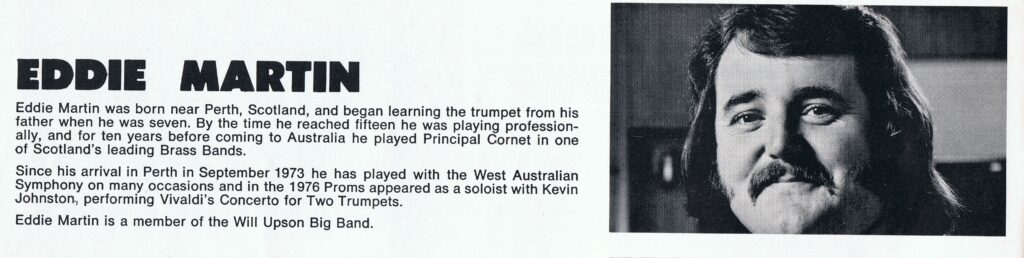
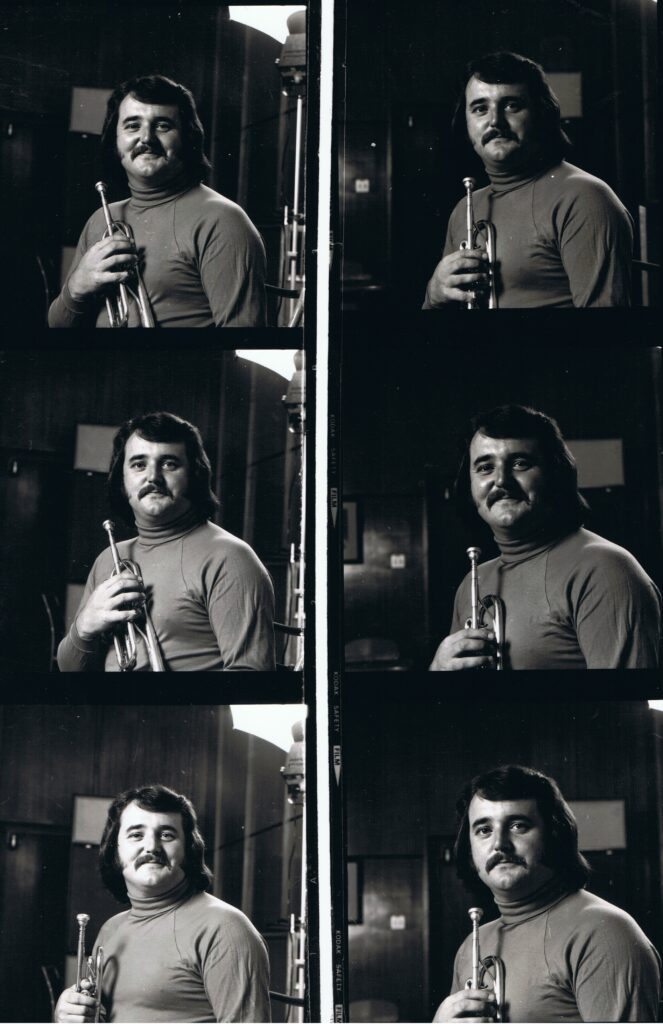
1983
Soloists West Australian Symphony Orchestra Tour to Singapore
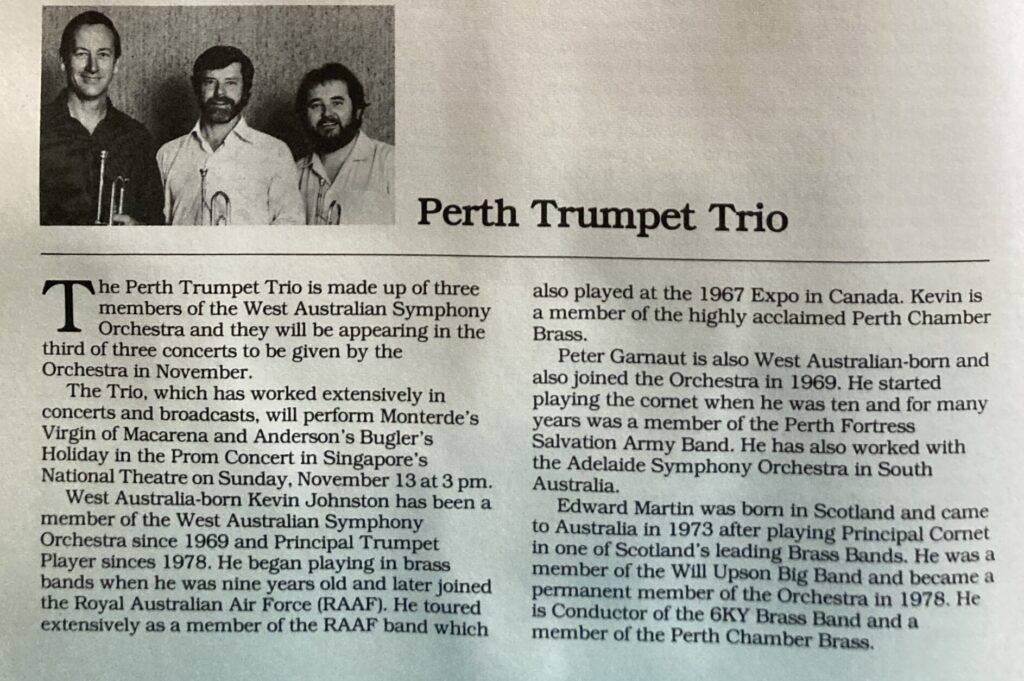
1991
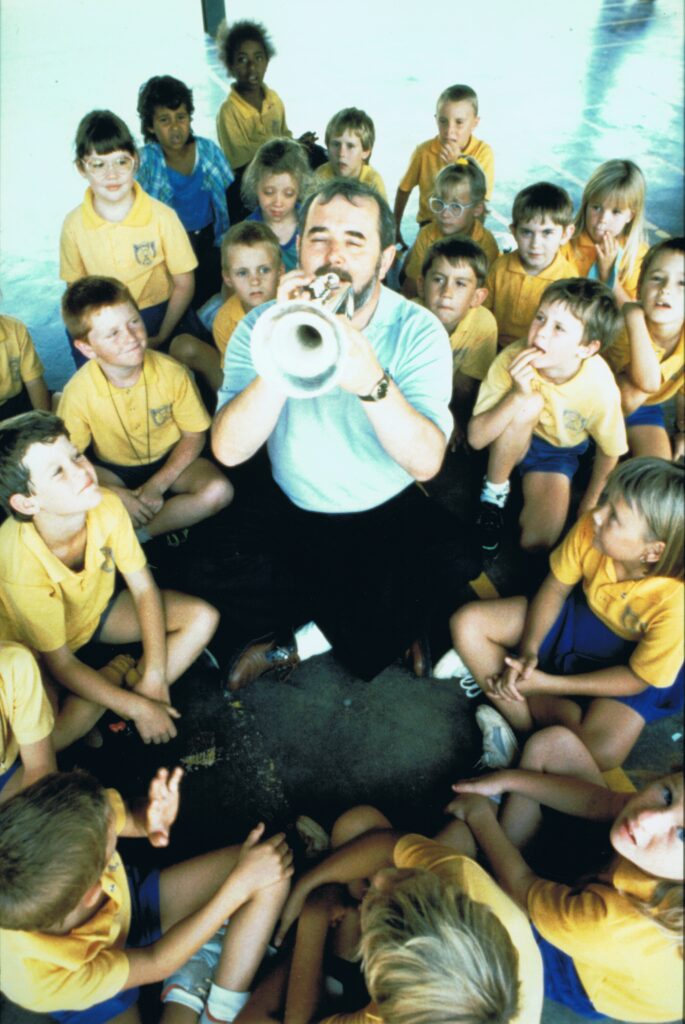
WASO Tour – Karratha
1997
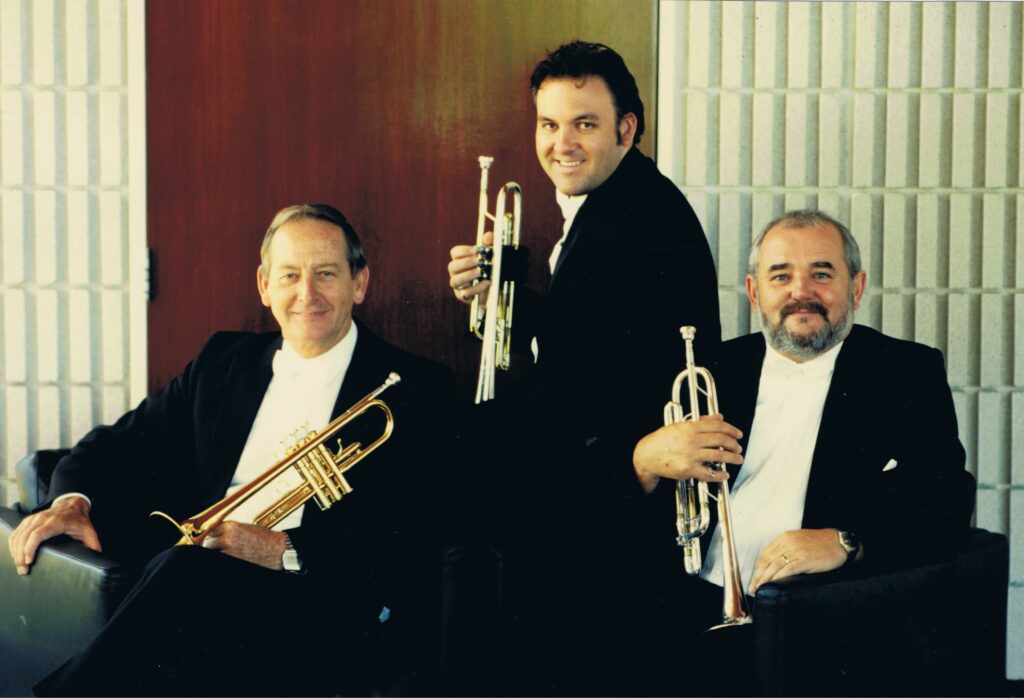
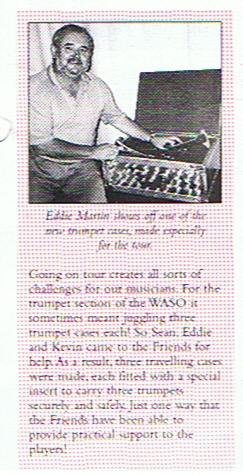
Person
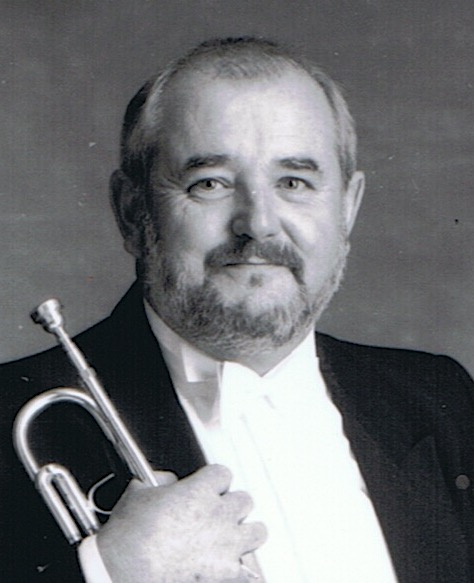
1977
1983
Soloists West Australian Symphony Orchestra Tour to Singapore
1991
WASO Tour – Karratha
1997
Person
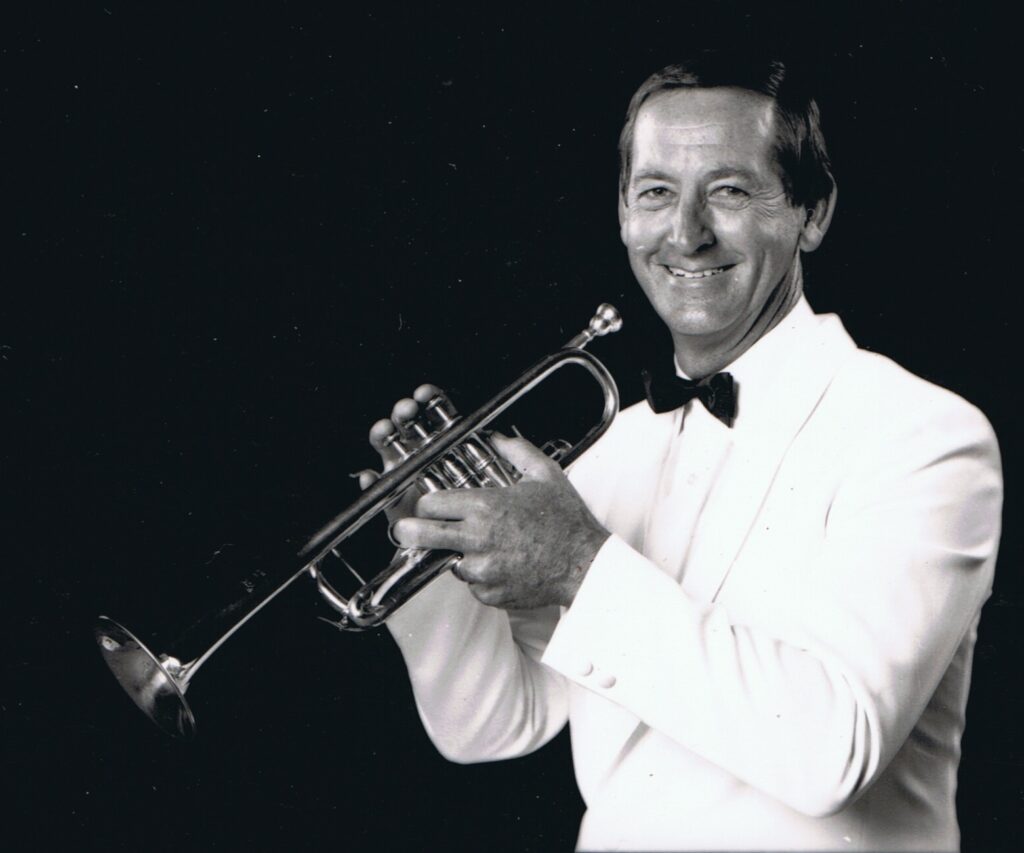
1976
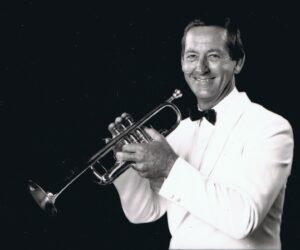
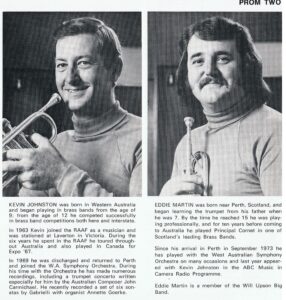
1983
Soloists West Australian Symphony Orchestra Tour to Singapore
1997
Person
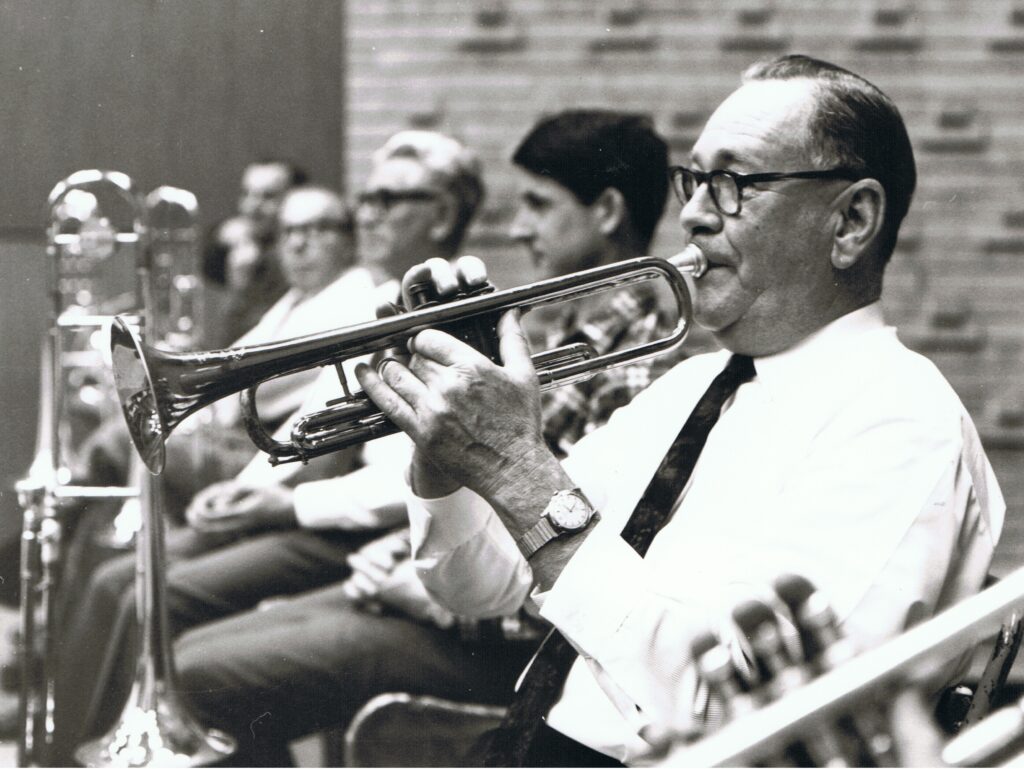
Richard Ivan Nylander was born on 5th September 1904 in Boulder.
1924
CORNET TEST SOLO.
Won by I. Nylander, of McMahon’s Concert Band, with 92 points., A gold medal was donated for tee winner of this event by Mr. W. Kaeshagen. Adjudicator’s comments: — “Robin Adair.” Maestoso: Tone rather thin -at opening. Recit. well done, though you missed top B. Another slip later. Low G rather weak at finish of movement. Andante: You should not slur bar 14. Correct playing. Slip on last bar. Thema: Nice tone and style here. Melody well played. Var. 1: Wrong notes at bar 3 and 4. Rest of variation well played. Tempo di bolero: Fine playing up to poco lento, which was also well played. Top G at bar 44 missed. This was a very clean performance. Rests not minded in the last two bars. A. With the exception of a few slips this was a very nice clean performance. No serious mistakes noticed.
South Western Times (Bunbury, WA), Saturday 5 January 1924, page 5
CHAMPIONSHIP BAND CONCERT.
In the Government Gardens tomorrow evening, Mr. Hugh McMahon’s champion band will render the numerous items which secured for him the State championship at Bunbury. His own arrangement of Verdi’s ‘Othello,’ the ‘A’ grade special selection, will be given, along with the test piece ‘Parsifal’ by Wagner. The champion hymn ‘Peace Be Still.’ and the triple duet ‘Ida and Dot’ played by two members still in their ‘teens, will be items of interest. The champion cornetist Ivan Nylander, will play ”Neath Austral Skies.’ The grand concert march ‘Twentieth Century,’ with which the band secured the highest points in music for the street march and the quickstep, will open the programme. Mr. McMahon will accompany the solos and duet at the piano. Seats are available for early patrons.
West Australian (Perth, WA : 1879 – 1954), Saturday 5 January 1924, page 12
FREMANTLE NAVAL BAND – POSTPONED CONCERT TO BE HELD NEXT SUNDAY
Owing to being called out to the South African Fallen Soldiers’ Memorial Service in King’s Park, Perth, on Sunday last, the Fremantle Naval Band were unable to give their programme in the Queens’ Gardens at the corner of High and Parry streets. The programme as advertised will be played there on Sunday afternoon next, commencing at 3.30. Roll up and hear a musical treat. Own Choice contest selection “Maritana”, contest march, “Adelaide,” triple tongue polka “The Pro,” soloist Mr. Ivan Nylander, champion cornetist of the State. Don’t miss this.
Advertiser (Fremantle, WA : 1921 – 1932), Friday 17 October 1924, page 3
1928
WILLYS-KNIGHT CLUB VISITS WOOROLOO
On Sunday, February 26, some 17 cars of the Willys-Overland-Whippet Club assembled at Shack’s Garage at 10 a.m. where 27 members of the R.A.M.R. Band, under Bandmaster E. McCormick, were picked up and conveyed to the Wooroloo Sanatorium. The institution was reached by I p.m. where a supply of hot water was made available, and the ladies of the motor club prepared lunch, which was much enjoyed by all. The programme of music was commenced at 2.30 and was a most excellent selection, and was much enjoyed by the inmates and by the visiting party. A pleasing feature of the run was that Captain Potter, M.L.C., and Mrs. Potter, came along with us and helped in the conveyance of the band. At the conclusion of the ceremony the President of the Club (Mr. W. Winfield), introduced Captain Potter, M.L.C, and in a very able address thanked the bandmaster and band for the excellent spirit, in which they had come along, assisted, of course, by the members of the motor club. Everyone was much impressed by the beautiful situation and the layout of the place. Afternoon tea was prepared by the institution for the band, and a start for home was made about 5 p.m. Among those who assisted by bringing along their instruments were Mr. Dan Egan, of Kalgoorlie; Mr. Fred Barnes, of Boulder, and Mr. Nylander, of Fremantle. The two Nylander brothers rendered a beautiful cornet solo.
Advertiser (Fremantle, WA : 1921 – 1932), Friday 9 March 1928, page 4
1928
LATE MR. ALFRED G. NYLANDER Mr. Alfred George Nylander. who was well known as a prominent bandsman throughout the State for the past 30 years, passed away on October 27 at his late residence, Pamment-street North Fremantle. at the age of 58 years. Mr. Nylander was also a member of the Painters’ Union, and was well known in the trade. He was a member of the Boulder Band, the State Implement Works Band, and the Fremantle Naval Band until overtaken by ill-health. He played with McMahon’s Concert Band when they won the competitions at Bunbury and Fremantle. Mr. Nylander is survived by a widow and a family of three sons and one daughter. The funeral took place on Monday afternoon, October 29, in the Church of England portion of the Fremantle Cemetery, and was attended by many friends. The chief mourners were: Mrs. Nylander (wife), Messrs. Ivan, Vivian, and Elmore Nylander (sons), Miss Lily Nylander (daughter), Messrs. J., H., P., and E. Caesar (brothers-in-law), Mesdames J. and E. Caesar (sisters-in-law), and Mr. E. Nylander (nephew). The pall-bearers were: Messrs. L. C. McKenzie (Fremantle Naval Band), W. Broderick and H. Day (Painters’ Union), H. Wittmer (Luxor Theatre), J. Cooper, and T. W. Alp. Many handsome wreaths were placed on the grave, and numerous communications of sympathy have been received by the bereaved relatives.
Daily News (Perth, WA : 1882 – 1955), Tuesday 6 November 1928, page 10
1930
SPARKLING LUXOR SHOW
It’s a sparkling show at the Luxor where the merry musical comedy revue ‘Manicure Sir?’ is the chief attraction. Ivan Nylander before the second half kicks off does a fine cornet solo, and during the revue a wealth of fun and tuneful singing is served up. ‘Stud’ Foley is brilliant and Nat Phillips has ample comedy opportunities. Nellie Lafferty of the harmonious voice, and delightful Heather Jones, are among the stellars, and the bright Keith Connelly, Jack Delroy, Stella Lamond, Daisy Merritt and Ces Scott work hard to make the show go with a swing. There’s a happy first half, too.
Mirror (Perth, WA : 1921 – 1956), Saturday 12 July 1930, page 5
1931
Fremantle Hospital
On Sunday afternoon, the 12th inst., members of the Fremantle Town Band very kindly arranged to be present at the local institution and rendered a number of very fine selections of music for the benefit of the patients receiving treatment therein. These privileged to listen were loud in their praises for the selections chosen and the way same were rendered. The band in question is comprised of local musicians and is under the very capable directorship of Mr. Ivan Nylander, and if their recent efforts can be taken as evidence, they should develop into a particularly fine band, and become a credit to the district. Owing to the absence of the secretary, who was unavoidably prevented from being present during the performance. Dr. Bossence, the S.R.M.O.. very cordially thanked the members of the band for their kindness in giving up their afternoon for the benefit of the sick poor of the community, and expressed the hope that it would not be long before they again visited the institution for a similar purpose.
Advertiser (Fremantle, WA : 1921 – 1932), Thursday 23 July 1931, page 3
FREMANTLE CITY BAND – Broadcast Champion
Messrs. Ivan Nylander and Richard Hough, bandmaster and secretary, respectively, of the Fremantle City Band, were elated today with the success of their band, which annexed the broadcast band championship of the State. The achievement is particularly creditable considering that the band was reorganised only eight months ago, being reconstructed from the defunct Fremantle Town Band.
By dint of constant practice the bandsmen improved so that when the time came for the broadcast contest the bandmaster and his men were confident that they would secure a large number of votes and be close to the top of the poll. Mr. Nylander, though a young man, has, with his brother and late father, been prominent in band music for many years past. He was bandmaster of the Naval Band, which won the ‘C’ Grade championship in 1925, and is a brilliant cornet player. CONCERT IN PERTH
On Tuesday night next the winning band will give a concert in Government Gardens, the proceeds of which will be devoted to the Orphans’ Christmas Cheer Fund, conducted by ‘The Daily News.’ In addition to varied numbers by the band, there will be items by broadcasting favorites in Phyllis Blott, Dorothy Manning, Aileen Hart, Paul Daly and Harold Neat.
Daily News (Perth, WA : 1882 – 1955), Friday 11 December 1931, page 7
1932
Orchestral Society
The Fremantle Orchestral Society, whose concert announced for Thursday, May 12, is already creating a stir among, music-lovers at the Port, acquitted itself splendidly at the opening concert in the Winthrop Hall. The orchestra, made up of 55 instrumentalists, put forward a capital programme and, in the fitness of things, began with the march from “Tannhauser,” with its tremendous fanfare of trumpets and general magnificence of orchestral tone. The society then gave Haydn’s “Clock” symphony, which was followed by the lovely tone-poem universally known by the name of “The Unfinished Symphony,” by Schubert. This was perhaps the finest playing of the evening, the wood wind sections being faultlessly performed, Mendelssohn’s “War March of the Priests” and the melodious “Pirates of Penzance” selection were much admired, the solo by Mr. Ivan Nylander, bandmaster of the Fremantle City Band, being one of the gems of the concert. The assisting artists were Miss Betty Gravenall (piano), Miss Marcia Hodges (soprano), Mr. Leo. Chase and Miss Margaret Sharp Violinists) and Miss Phyllis Browning-Turner (contralto).
Fremantle Advocate (WA : 1926 – 1942), Thursday 21 April 1932, page 8
1936
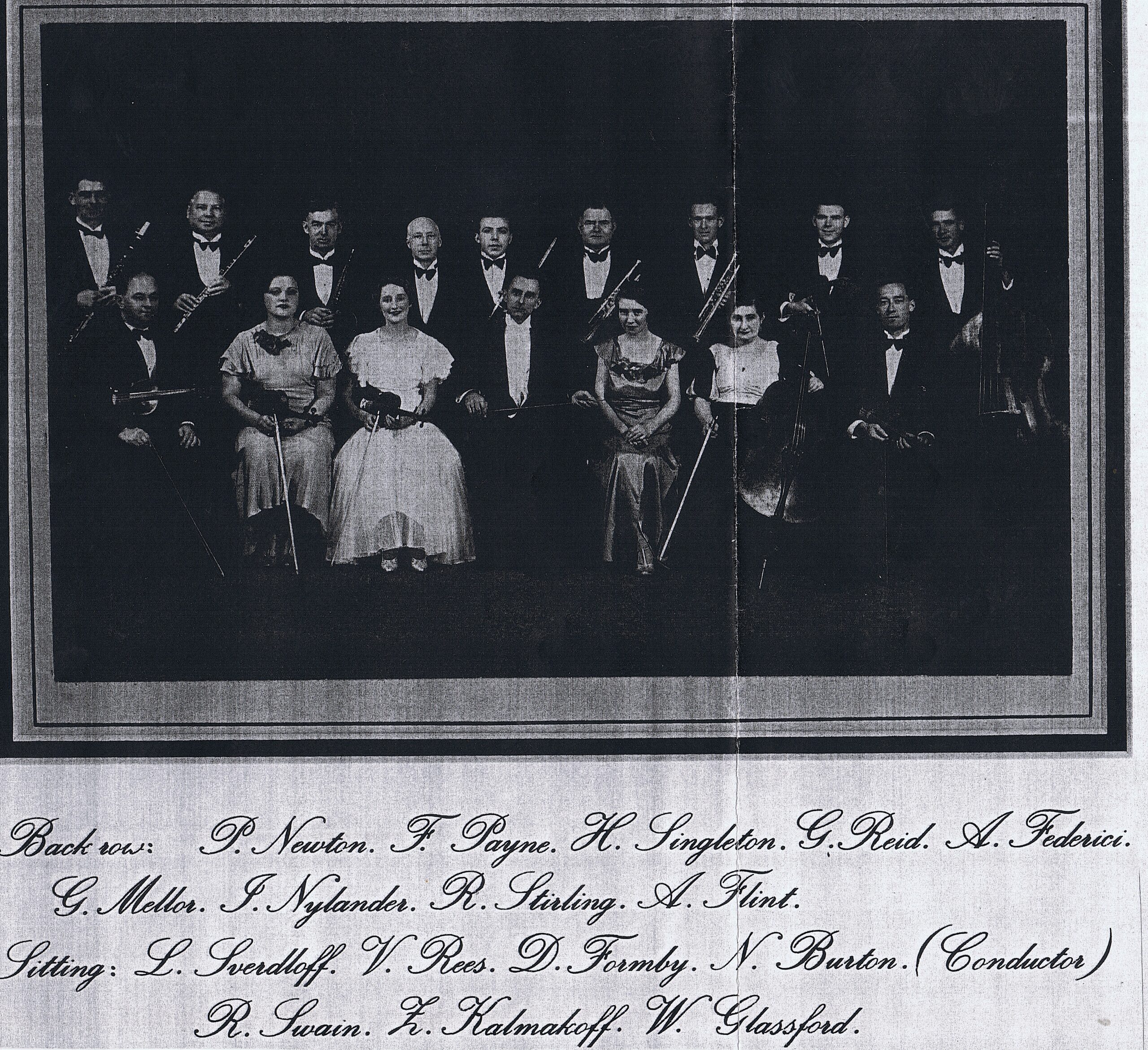
In 1936 auditions, overseen by Ernest J. Roberts, were held in order to establish a nucleus of Perth musicians to augment the 6.W.F. Studio Orchestra for public concerts given by the Perth Symphony Orchestra.
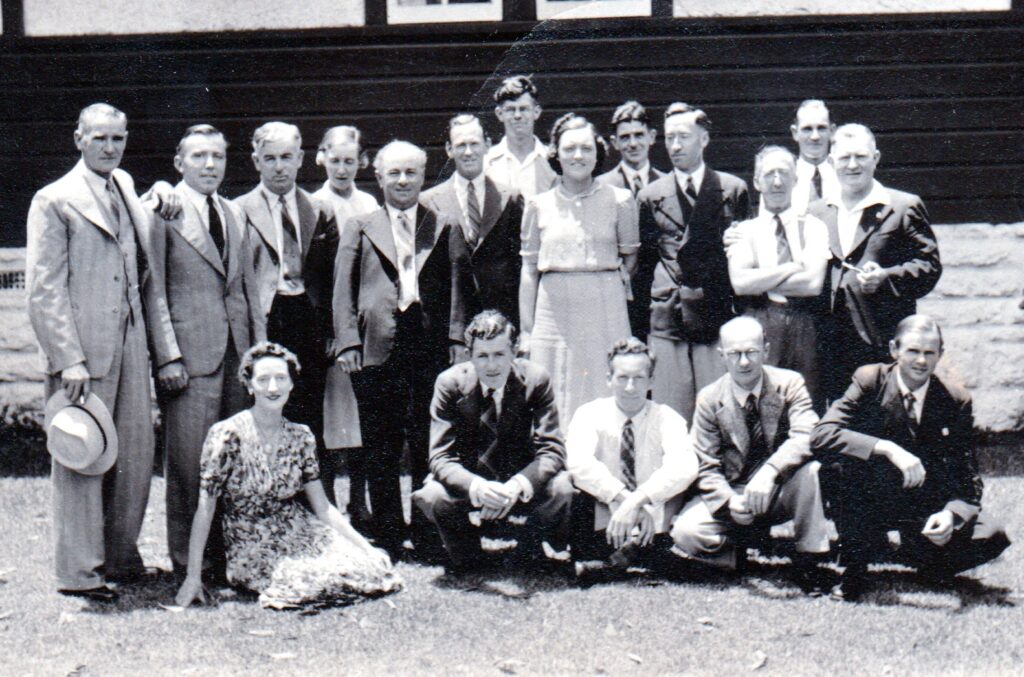
BACK L-R: Fred Flint, Tony Federici, Harry Singleton, Rima Swain, Lazar Sverdloff, Ivan Nylander, Alec Black, Vera Rees, Percy Newton, William Glassford, George Davies, Bob Trew, George Mellor.
FRONT: ?, Vaughan Hanly, Dave Kember, Harold Thornton, ?.
Those chosen for the coveted positions were: Vera Rees (Waterman) as the leader, Lazar Sverdloff and Dorothy Formby 1st violins, Bill Glassford 2nd violin, Bob Stirling viola, Zlata Kalmikoff cello, Freddy Flint bass, Harry Singleton oboe, Fred Payne flute, Percy Newton clarinet, George Mellor 1st trumpet, Ivan Nylander 2nd trumpet, Tony Federici trombone, George Reid drums and Rima Swain piano.
Harrison, Marcia, West Australian Symphony Orchestra Celebrating 75 Years, (WASO Holdings Pty Ltd, 2003). P.11
1944
AID FOR WOOROLOO. Concert Next Sunday. Theatrical artists are expressing their goodwill towards the patients of Wooroloo with a benefit concert in aid of the Sanatorium Colony, at the Ambassadors Theatre on Sunday, commencing at 3 o’clock. The Australian Broadcasting Commission has consented to present a performance of “The ABC on Parade,” which will be the first public appearance of this broadcast show, recently returned from a tour of military camps. The producer and compere is Dave Howard, with theatre orchestra under the direction of Ivan Nylander and Tony North at the organ. Guest artists include Betty Hatfield (soprano), Eileen Moran (entertainer), Olive Dunton (xylophonist), Tony North (wizard of the wurlitzer), Vaughan Hanly (virtuoso violin), Neil Shortland-Jones (popular vocalist), Maurice Jaffey (tenor), Jack Harrison (W.A.’s miniature Larry Adler), Hannah Colley (trumpet soloist) the Paulasto Brothers (entertainers) and those nitwits of the network Joe Brennan and Ida Newton, The second half of the concert programme opens with the US Navy Band compered by Stan Gervas of 6PM-AM Professional vocalists, entertainers and vaudeville acts will also appear in sequence with a grand finale by the U.S. Band. The Ambassadors Theatre for this concert was made available to the Wooroloo Farm Colony Committee by Mr S. W. Perry, resident manager for Hoyts Theatres, Ltd. Dr Park, Commissioner of Public Health, will briefly indicate that the concert opens a week of intensified effort to interest the public in the colony development and welfare of the patients at Wooroloo. Seats for the concert may be reserved at Nicholsons, the admission prices being 4/, 3/ and 2/.
The West Australian Wednesday 13 September 1944 page 4
1945
Bandsmen Meet
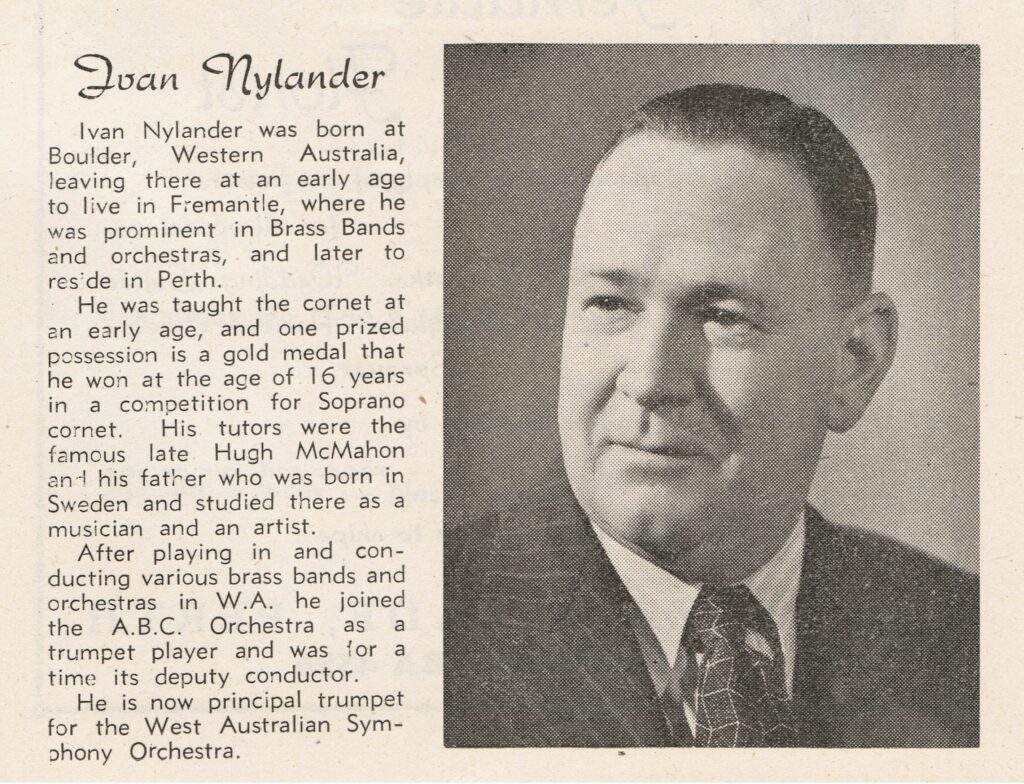
THERE were no discords at Monash House on the evening of November 27, when a reunion of bandsmen organised by present members of the Western Command Band took place. Guests included ex-members of the 10th Garrison and 5th Brigade Bands, also several prominent bands-men, including Messrs Reid and Palmer (Perth Portress Band), George Mellor (R.S.L. Band), Ivan Nylander (V.D.C. Band), and exW/O Bob Denison, who was the foundation bandmaster 10th Garri-son Band.
W/02 George Pestell, the present bandmaster, was in the chair, and presided over a gathering of about 70. Approximately 100 players have served with the Western Command Band since it was formed about six years ago, and seven of the original members are now playing. A number of toasts were effectively handled, perhaps the most humorous speech of the evening being made by Cpl A. Burnham, who proposed the toast of “ex-members” and enumerated the peculiarities of many of those, present. In honouring the toast to fallen comrades, the chair-man referred to the recent demise of an original member of the band, the late Mr Frank Knight.
Drum-Major D. Chaloner proposed the toast of the visitors, which was responded to by Bandmaster W. Palmer, supported by Bandmaster Ivan Nylander. The toast of the Western Command Band was proposed by Bandmaster George Mellor, of the War Loan Council. Responses were made by W/O George Pestell, Captain J. Smith, and Bandsman J. Noble.
Western Mail (Perth, WA : 1885 – 1954), Thursday 13 December 1945, page 61
1948
Subiaco Band Hope To Go Abroad
Subiaco Municipal Band may make an overseas goodwill tour in about two years’ time. This is one of many tours planned by the band and revealed by bandmaster Ivan Nylander. The band is leaving by train tonight on a good will tour of South Australia and Victoria This tour is claimed by Mr. Nylander to be the first of its kind since 1912. In that year the Perth City Band visited the Eastern States to compete in band competitions. No Outside Aid. ‘Our Eastern States visit is rather a feather in our caps,’ Mr. Nylander said to day. ‘Finance for the trip has been raised by the band without any help from outside sources. ‘Our coming tour is only the start of many similar tours. ‘We hope to make an overseas tour in about two years’ time.’ The Subiaco band will be away for three weeks on its present tour. It will not be taking part in competitions as the Band Festival is not until October. Subiaco Municipal Band was, during the war, the V.D.C. band. It is well known to trotting followers through its regular attendance at Gloucester Park. Bandmaster Nylander is also deputy conductor of the A.B.C. Orchestra.
Daily News (Perth, WA : 1882 – 1955), Friday 2 January 1948, page 5
Down beat
IN the Daily News on January 2 you reported Ivan Nylander to have stated that his band would be the first to tour the Eastern States since 1912.
This is not quite correct; the Perth Salvation Army Fortress Band in 1927 visited Adelaide, Melbourne, Ballarat, Sydney and Newcastle, and in 1936 again went to Adelaide and Melbourne. On each occasion members paid their own fares. —EX-BANDMASTER, N. Perth. Bandmaster Nylander and Subiaco Municipal Band have left the State on their goodwill tour of South Australia and Victoria.
Daily News (Perth, WA : 1882 – 1955), Wednesday 7 January 1948, page 2
1949
BAND CONCERT The series of Sunday afternoon concerts in the Perth Town Hall by brass bands which will compete at the forthcoming Silver Chain contest was continued yesterday by the Subiaco Municipal Band under the direction of Mr. Ivan Nylander. A bright and varied programme, including selections from grand opera and light opera was presented. A trio for trumpets was played by V. and I. Nylander and RI Perry, and a cornet solo, “Lead Kindly Light,” by E. Kemp. Mrs. 1. Nylander, contributed songs, and Mr. Alan Smirke violin solos.
West Australian (Perth, WA : 1879 – 1954), Monday 8 August 1949, page 17
BAND CONCERT The series of band concerts given on Sunday afternoon by metropolitan bands was continued in the Perth Town Hall yesterday. The entertainments are a prelude to the brass and pipe band contests promoted by the Silver Chain District and Bush Nursing Association to be held on October 8 and 9. The programme yesterday was given by the Subiaco Municipal Band, under Mr. Ivan Nylander. It consisted of bright popular numbers, which included a selection from Gilbert and Sullivan’s opera “The Gondoliers,” a wedding waltz in which was featured a glockenspiel, and a trio for trumpets. Next Sunday, the Perth City Band will give a concert.
West Australian (Perth, WA : 1879 – 1954), Monday 29 August 1949, page 9
1950
BRASS BAND CONCERT Under the baton of the honorary conductor (Ivan Nylander) the Subiaco Municipal Band gave a concert in the Perth Town Hall yesterday afternoon. This was the penultimate of a series of twelve Sunday concerts provided by three senior, bands of the metropolitan area. On October 7 and 8 band contests, organised by the Silver Chain District and Bush Nursing Association, will be held.
West Australian (Perth, WA : 1879 – 1954), Monday 28 August 1950, page 22
1951
NOTED BAND CONDUCTOR Concert At Subiaco On April 8
At Subiaco Oval on the afternoon of April 8, massed bands under the direction of Lieut.Col. H. E. Adkins, who recently retired from the position of director of Kneller Hall, the Royal Military School of Music in England, will give a jubilee concert. The bands participating will be Western Command (conductor, Warrant-Officer C. P. James), Subiaco Municipal (I. Nylander), Perth City (H. Halvorsen) and R.S.L. Memorial (C. W. Court). Items by the massed bands will include the entrance fanfare “Coliseum,” composed by Col. Adkins himself. The bands will also play individually. The concert will be broadcast over national and regional stations from 3 p.m. to 4.30 p.m. Lieut-Col. Adkins, who will arrive from the Eastern States on Saturday, was one of the principal conductors at the Coronation of the present King and Queen. He is in Australia as one of the A.B.C.’s jubilee visitors. Since he came to this country in 1933 to conduct the A.B.C. Military Band, which was formed specially for his visit, he has twice toured Canada with the renowned Kneller Hall band, has appeared in America and has given many concerts in London and other British cities, as well as conducting at Paris and Brussels. He will return to England in the Orontes on April 10.
West Australian (Perth, WA : 1879 – 1954), Thursday 29 March 1951, page 15
Harrison, Marcia, West Australian Symphony Orchestra Celebrating 75 Years, (WASO Holdings Pty Ltd, 2003). P.22
1952
Stimulating Symphony – By Dr. B. V. Pusenjak
Eugene Goosens presented last night at the Capitol a quite unusual program featuring, among others, Shostakovich’s Concerto for piano, trumpet and strings.
This Concerto is a pleasing contrast to his so disappointing fifth symphony, heard last year and shows Shostakovich at its best, not yet bowing his art to the dictator.
Pianist, Igor Hmelnitzky’s interpretation was filled with caressing nuances and brilliant phrasing but the Lento particularly required a more delicate touch. Ivan Nylander, the trumpeter, showed strong technical capacity. Brahms F Major Sym-phony which followed, is certainly in overall construction, the most impressive of the four as well as the shortest. Mr. Goosens and the orchestra gave it poise and shapeliness.
Sunday Times (Perth, WA : 1902 – 1955), Sunday 21 September 1952, page 7
MUSIC ROMANTIC AND MIRTHFUL (By “Fidelo.”)
Wagner, brooding: Tschaikowsky, passionately eloquent, in that order; on their heels a skittish Shostakovitch: “A truce to sentiment and seriousness! Pouf! Let’s away!”
Thus his frivolous challenge one fancied, and in a flash off we were-or rather, young, slender Igor Hmelnitsky was, scampering up and down the keyboard, while Ivan Nylander stood by with trumpet for bits, of popular tune and irreverent flourishes. This was the order of things for the first half of last night’s concert at the Capitol. There is a lot of good entertainment in the Shostakovitch concerto. (composed in 1933), provided by a nimbly inventive, bright mind, but the lively finale goes on too long, we thought. In the slow movement the composer becomes serious, and conjures up “atmosphere” quite compellingly. The soloist team of Igor and Ivan–happy conjunction of names-was entirely admirable. Brahms To Mr. Goossens we were indebted for choosing a well-balanced, well-varied programme, and drawing from the W.A. Symphony Orchestra some exceptionally good performances. Among the evening’s pleasures was the “singing” of the upper strings, notably in the lovemusic of Tschaikowsky’s “Romeo and Juliet” (which was stirringly done) and in the second movement of Brahms’s Symphony No. 3. We have now heard all four Brahms symphonies in Perth, two of them in this current season. None is more endearing and warmly romantic than No. 3. Its appealing second movement, a mingling of tenderness and solemnity, was beautifully rendered last night. But indeed Mr. Goossens maintained throughout the work a high level-in clarity (notwithstanding the typical Brahmsian complexities), in breadth of outline and sensitive. expressive articulation. Study Of Faust The Wagner of “A Faust Overture,” opening the programme, is rather different from the Wagner of richer, better-known masterpieces. In the nature of the case this study of the aged Faust and his longings is subdued in colouring; but there are fine, imaginative strokes in the work and its revival was welcome. In the concert’s second part, to take us forthwith from the symphonic voice of Brahms to a pair of Slavonic dances (closing the evening) was a little unorthodox. But who, hearing these piquant. effervescent and entirely delightful things of Dvorak’s, could find it in his heart to cavil?
West Australian (Perth, WA : 1879 – 1954), Saturday 20 September 1952, page 4
FINE PERFORMANCE OF “MESSIAH” (By P.)
Many times during the performance of the “Messiah” at His Majesty’s Theatre on Tuesday night we were given fine music that brought to us the full magnificence of Handel’s work. Some of the loveliest music came from Florence Taylor in her arias “He Shall Feed the Flock” and “He Was Despised.” She sang in a true Handel style with smooth phrasing and effortless production and her contralto voice, with its beautiful, almost husky quality, was admirably controlled to give g moving effect of restrained emotion. The bass, T. C. Miller, also seemed at his ease in the Handel sphere. He gave us strong singing with broad phrases and assured notation. In his recitatif “For Behold Darkness Shall Cover the Earth” he introduced drama most successfully and later gave us a fine vigorous rendering of the famous air “Why Do the Nations.” The other two soloists were not so successful. Betty Hooper, the soprano, has a powerful voice which is capable of a very beautiful tone. Unfortunately, last night she seemed to lack direction in her singing and gave us too many “scoops” and not enough of the easy sweeping periods we would have liked. Fred Williamson, the tenor also did not achieve the right style and consequently made his singing rather uneven, with a far too slow tempo in his solos at the end of the section “Death of the Messiah.” Nevertheless, his voice, with its pleasing resonant quality, contributed many beautiful notes. The choir of the Perth Philharmonic Society is large and was admirably controlled by the conductor, Mr. E. S. Craft. Some of the choruses were splendid in their vigour and full tone, especially “All They That See Him Laugh Him to Scorn” and the final “Worthy is the Lamb.” However, the members had a tendency to sing loudly all the time and this produced a strained tone and prevented the parts blending. The orchestra was very competent and we had some skilled woodwind playing in the Pastoral Symphony. Now and again a preponderance of brass produced an unbalanced ensemble but the trumpeter, Ivan Nylander, made amends for this fault with his fine solo. The organist, Thelma Bassett, also contributed to the success of the performance with competent accompaniments. There was a large attendance.
West Australian (Perth, WA : 1879 – 1954), Thursday 11 December 1952, page 6
1954
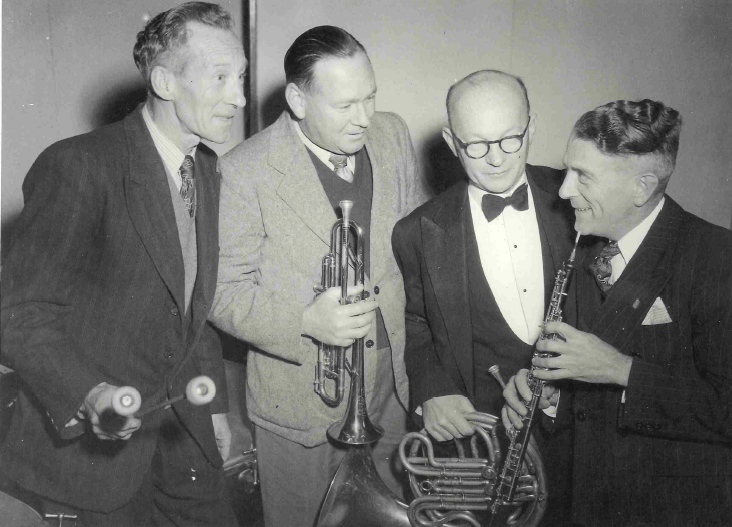
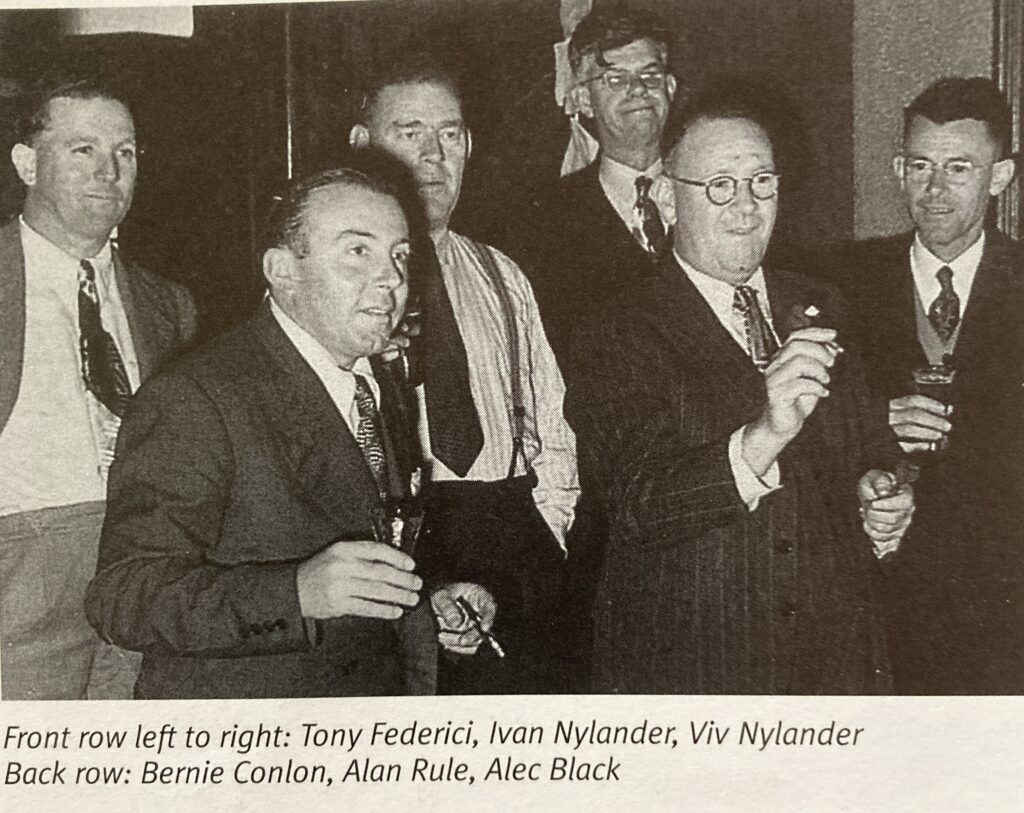
An impromptu pre rehearsal trombone solo is given by W.A. Orchestral player Bernie Conlon for the entertainment of trumpeter Ivan Nylander and flautist Owen Fisenden. All three players will accompany the Orchestra when it makes its Great Southern tour in the middle of September. Concerts will be given in York, Wagin, Narrogin and Beverley.
Narrogin Observer (WA : 1918 – 1955), Thursday 9 September 1954, page 1
1965
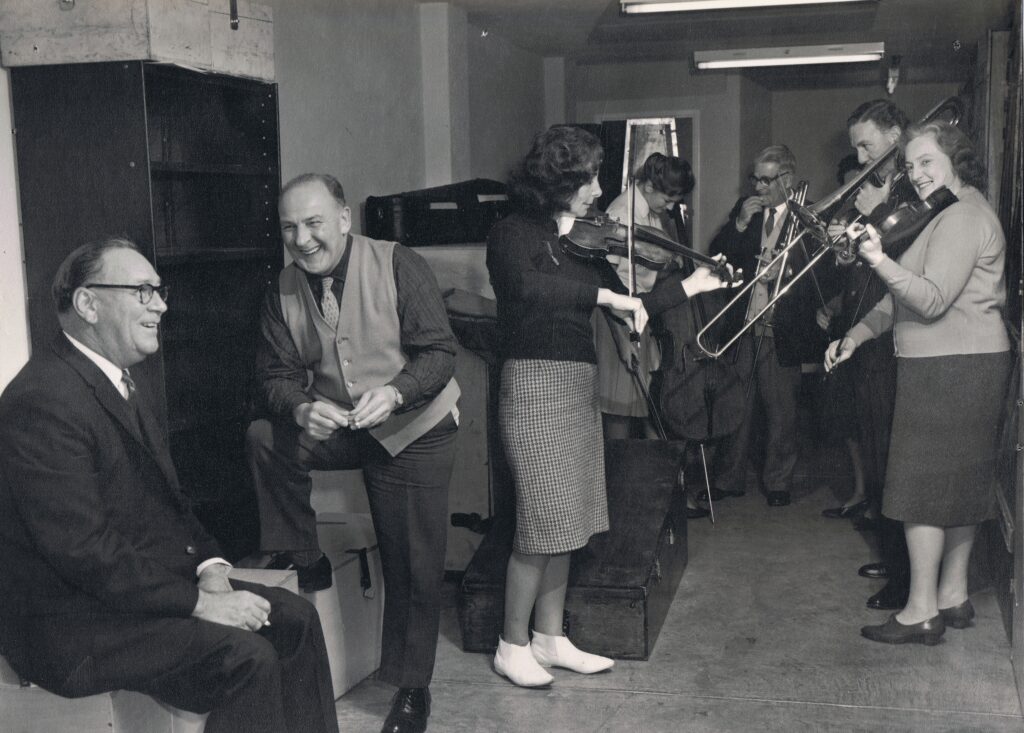
1967
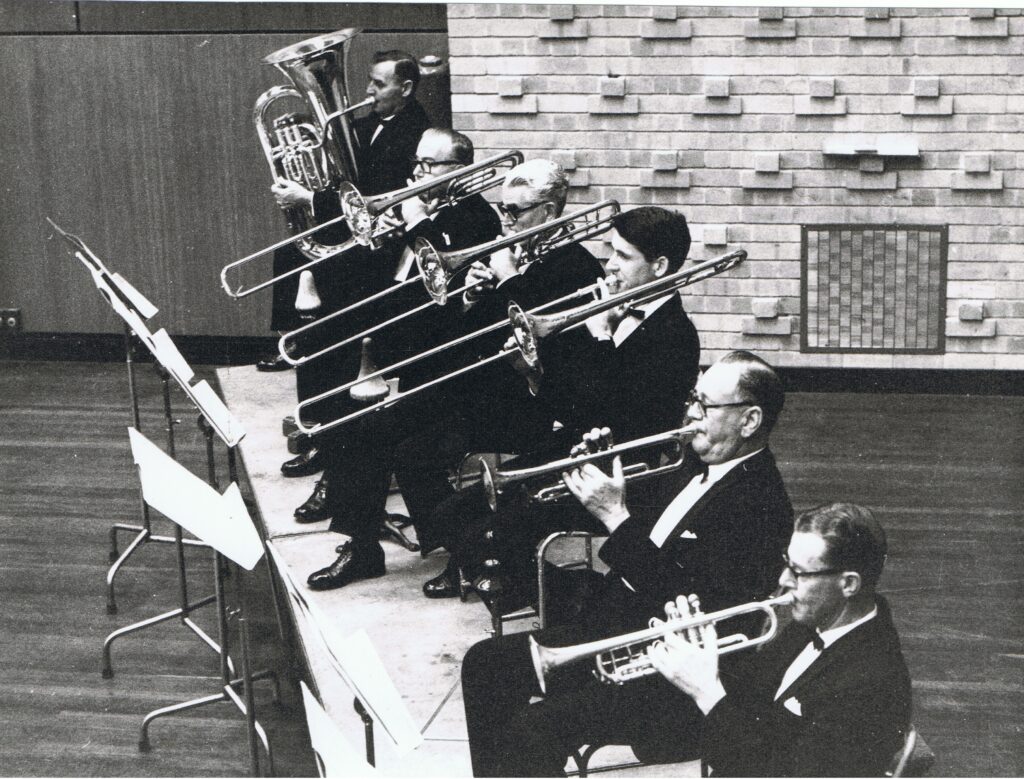
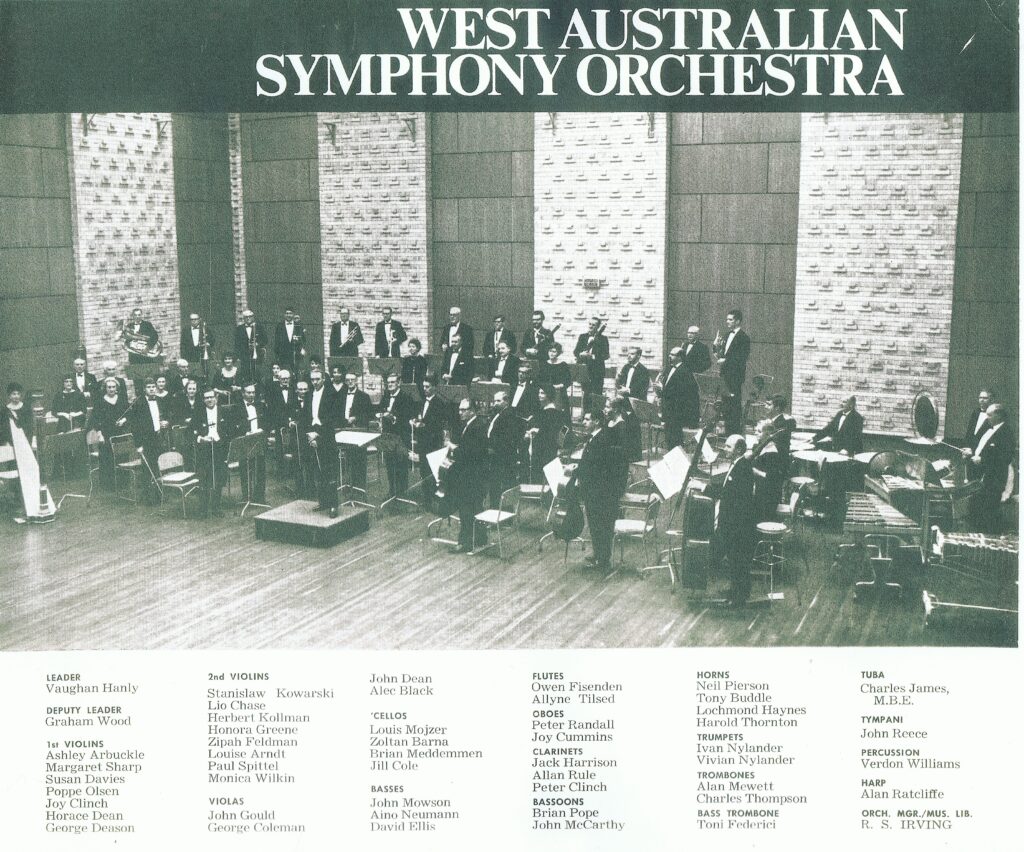
Ivan retired from the WASO in 1968 and was recognised with a bronze medallion in 1970 for over 20 years service.
Ivan died on the 16th June 1996 aged 91.
Person
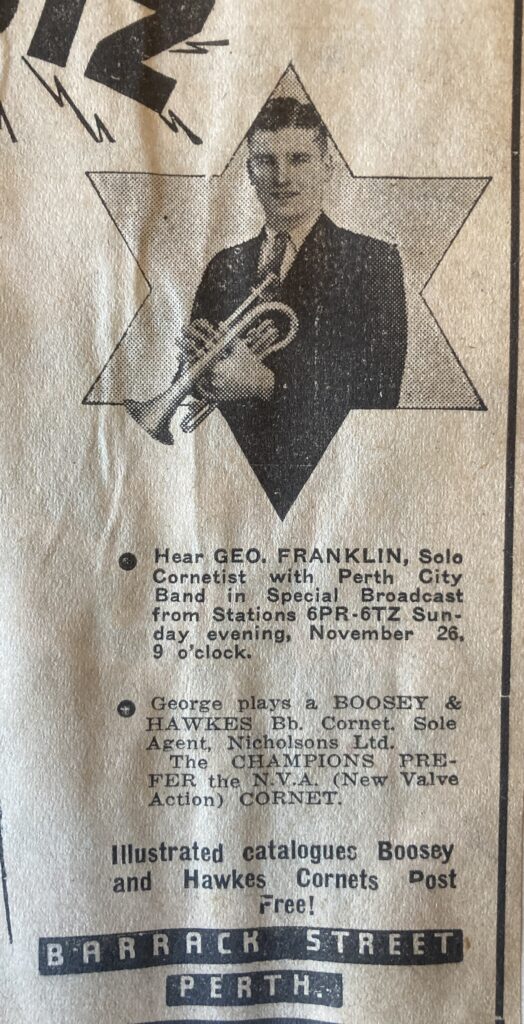
Perth Musician and World War Two veteran George Franklin was the longest serving member of the City of Perth band, living to over 104. He started playing the cornet at the age of seven, before joining the City of Perth Band in 1934. Mr Franklin served in the Royal Australian Air Force during World War Two, and after that, he joined a military band until he was retired. He died in 13 July 2026 aged 104.
1931
YOUTH TO THE FORE – Y.A.L. Band Contest
From comments he made subsequent to the contest it is apparent that Mr. G. Mellor, adjudicator of the Y.A.L. Band contest which was held last night, was well satisfied with the performances he had heard. He said that the standard of the playing was much improved on that of last year and he was much impressed with the band presentation. While some of the individual soloists were not quite up to the standard of last year, the younger players were a great improvement on previous years. Also in attendance at the contests were Mr. George Reid, first musical director, and Mr. Val Smith, second musical director. They too- expressed appreciation of the contest, and in course of a few remarks, observed that it brought back some happy rmemories of the day when they held positions with the band. The finals for the champion of the league solo for all finalists will be held on July 23, when the championship of the league will also be decided. The winner will be entitled to hold the cup presented by the officers of the league. The contest last night was conducted by Mr. Ron Rees, musical director of the Y.A.L. RESULTS. The results were: — Trumpeters’ Solo (‘Fanfare’): Norman Williams (35 points), 1. Drummers’ Solo (own choice) : Douglas King (40), 1. ‘B’ Grade Cornet Solo (‘Sweet Spirit Hear My Prayer’): Billy Weston (35), 1. ‘A’ Grade Cornet Solo (Raff’s ‘Cava-tin’) : Norman Law (30). 1. Champion Solo: (”’Neath .Austral Skies’): Charles Thompson (40). Tenor Horn Solo (‘Goodbye, Sweetheart’): Clarie Gray (3G), 1. Baritone Euphonium Solo (‘Melody in T’): Roy Facey (36), 1. Trombone Solo (‘Kathleen Mavourneen’) : Robert Lockwpod (33). 1. Bass Solo (‘Flower That Bloometh’) : Em Negus (33). 1. ? ‘B’ Grade Duet (‘Ever of Thee’): George Franklin and Billy Mangini (33). ‘A’ Grade Duet – ‘Robin Adair’) : Norman Law and Fred Brunsgard (33).
Daily News (Perth, WA : 1882 – 1955), Saturday 4 July 1931, page 3
1934
In 1934, George Franklin joined the City of Perth Band.
1935
Anzac Commemoration Broadcasts.This evening at 8 o’clock a special Anzac programme will be relayed by €WF from Anzac House, where the Perth’ Symphony Orchestra (under Mr. G. J. Reid) will be assisted by Isobel Reith (soprano), WiU Savage (baritone), and George Franklin (cornetist).
West Australian (Perth, WA : 1879 – 1954), Wednesday 24 April 1935, page 3
1939
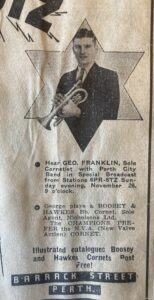
6PR – 6TZ – Jack Harrison, Winner (final) Charlie Carter’s Juvenile Amateur Trials conducted by Stations 6AM-6PM. Jack will broadcast from stations 6PR-6TZ Sunday morning November 26 Radiola Rhythm Program. Don’t fail to hear this remarkable broadcast. Jack plays a Harmonica stocked by Nicholsons Ltd. Hear George Franklin, Solo Cornetist with Perth City Band in Special Broadcast from Stations 6PR-6TZ Sunday evening November 26, 9 o’clock. George plays a Boosey and Hawkes Bb cornet. Sole agent Nicholsons Ltd. The CHAMPIONS PREFER the N.V.A. (New Valve Action) CORNET. Illustrated catalogue: Boosey and Hawkes Cornets post free!
The Mirror Saturday Night November 25 1939
1940
When World War II broke out, George served five a half years service from 1940 aged 18 in the Royal Australian Air Force. George was pulled from air crew duties once he discovered he was colourblind. He was then sent to Noonkanbah Station in Western Australia’s north where he re-fuelled and re-armed US heavy bombers, which were fighting the Japanese, but was glad he did not “see any action” on the front line.
1946
After finishing his military service, Mr Franklin went on to join the Army Band, playing the trumpet. He said he has since played the Last Post at funerals for other veterans more times than he could remember.
“So, I wouldn’t mind a pound for every time I’ve played the Last Post somewhere,” he said.
Mr Franklin said it was difficult to say goodbye to so many comrades, as the number of living veterans declines rapidly. “You see it in a different light when you’re in the band … when you’re playing the dead march to bury a guy,” he said. “You’re playing the Last Post when he’s in there [the coffin], you’ve got to forget about it.”
PHOTO Aged 18, Mr Franklin joined the Royal Australian Air Force during World War Two. (ABC News: Bridget McArthur)
It was then that he joined the City of Perth Band, where was only months away from becoming the new Guinness World Record holder for the title of the world’s oldest band conductor.
https://www.cityofperthband.org.au/about-us/band-history
1949
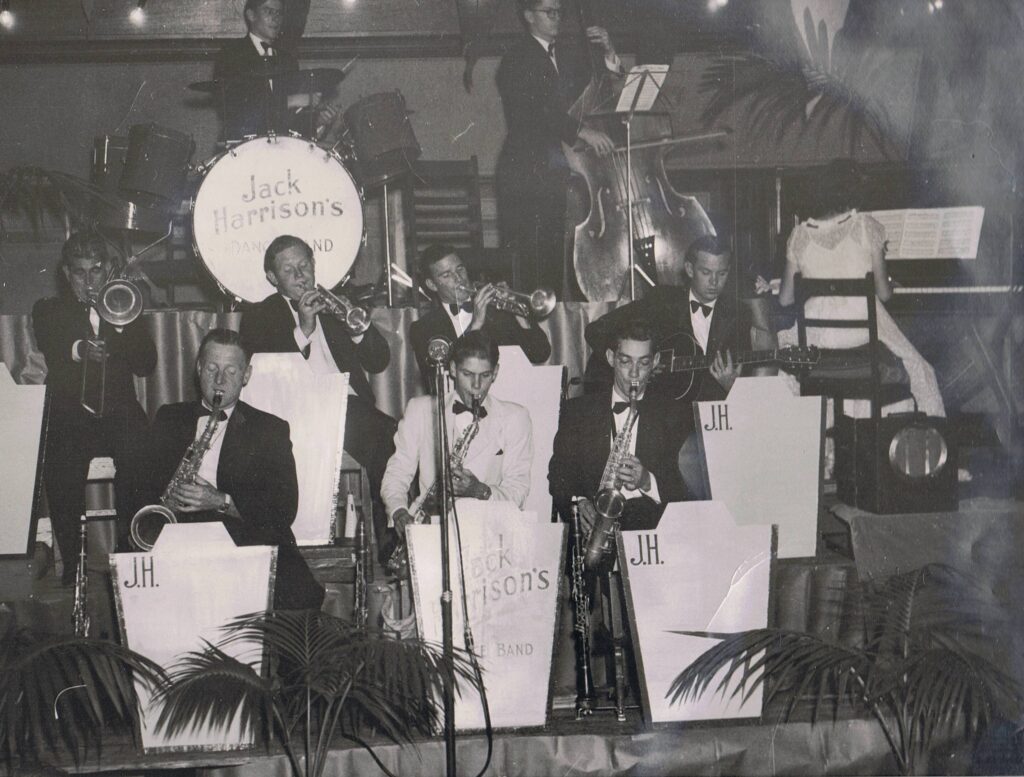
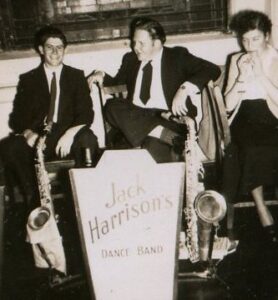
In 1949 the main dance music influences at the time were Glenn Miller, Benny Goodman and Artie Shaw. Old time dancing was interspersed with the new swing and jazz movement and the big names performing around town were Harry Bluck, Colin Hicks, Ron Jenkins and Jack Harrison. Jack augmented his swing band according to the requirements of functions, sometimes up to ten players, such as the April 22nd 1949 University of Western Australia Graduation Ball at Winthrop Hall. Players were issued with a cheque on 5th May 1949 and were paid 3 pound 2 and 6 for the gig. Players paid were: Norm Wrightson (saxophone), George Kirkby, Jack Pope (trumpet), George Franklin (trumpet), Charles Thompson (trumpet), Bill Hendrie (guitar), Roy Coates, Ray Harrison (drums), Jill Harrison (piano) and Jack Harrison (band leader, sax, clarinet) was the tenth band member.
GRADUATION BALL – 8.30pm – 2am – April 22 1949 Winthrop Hall, University
In Aid of World Student relief. ADMISSION Double Ticket 24/7 (inc tax.)
Jack Harrison’s Ten Piece Orchestra – bookings at Nicholsons
AROUND PERTH – WITH HARRY BLUCK
Ball Season Starts Rolling in Perth – Heavy Bookings as Biz Booms
The annual outcrop of balls generally makes its presence felt about this time of the year and already some of the earliest have taken place. This season promises to be a busier one than previously and some large-sized bands should be seen on the various stands. Already, youthful Jack Harrison has made a good start by fronting a 10 piece outfit at the University Graduation Ball, and from all accounts the ultimate sound of the band justified the Harrison judgement in selecting good players as his support. It’s in The Family! Jack Harrison’s Trio, winners of Perth’s “Popular Dance Band Contest” for 1948. This talented threesome have remarkable polish, considering their extreme youthfulness, and have certainly made their presence felt in the comparatively short time for which they have been associated with the dance band business. From L to R: Jack Harrison (saxes), Ray Harrison (drums), jill Harrison (piano). Jack and jill are both aged 16 and Ray is 18. Since this photo was taken, Jack Harrison has blossomed out with a 10 piece band, with which he played at the Perth University Graduation Ball. (Photo by Arthur Fielding Ruskin). Music Maker and Dance Band News May 1949
JACK HARRISON’S CHEQUE BOOK:
5 MAY 1949
JACK Cheque to: Norm Wrightson Grad Ball £3/2/6
George Kirkby Grad Ball £3/2/6
Jack Pope Grad Ball £3/2/6
George Franklin Grad Ball £3/2/6
Charles Thompson Grad Ball £3/2/6
Bill Hendrie Grad Ball £3/2/6
Roy Coates Grad Ball £3/2/6
Ray Harrison Grad Ball £3/2/6
Jill Harrison Grad Ball £3/2/6
Bands “JOHN” writes: I am 18 and I would very much like to play a trumpet. Could you tell me of any band I could join and learn to play? The obvious reply to your question is the Y.A.L. band, but I understand there are no instruments to spare in that band just now. There is the North Perth Police Boys’ Club band, the R.S.L. junior band, the Perth City band, and the Nedlands military band, just to mention a few of them. For the North Perth Band and the Perth City Band, you could make inquiries by visiting the band room on the corner of Fitzgerald-st., and Stuart-st., during practices on Thursday evenings or Sunday morning. For the Nedlands military band, you should inquire from Mr. F. Kendall, care of the Nedlands Road Board. Mr. Charles Court, 125 St. George’s-ter., Perth, will give details of the R.S.L. band. Inquiries for the Y.A.L. band should be made to the bandmaster, Mr. George Franklin, at Y.A.L. headquarters, Murray-st. — MARY FERBER.
Daily News (Perth, WA : 1882 – 1955), Thursday 12 May 1949, page 16
George travelled to Eastern States and met a soprano singer…
1950 DIARY OF JACK HARRISON – SYDNEY
Thu 26th Jan 1950 (arrive Sydney)
Got up at 6.15am because we wanted to see the boat coming in. It was in the heads. It was quite a good sight but it was quite foggy and you could not see very far away. The best part was going under the bridge. Got into Sydney at 7.45am and got a taxi to the YMCA. Wandered around town a bit with Mr Whitelock, Mr Anthill and the Chappells. Had lunch at the YMCA and messed around in the afternoon. Had early tea and went out to Kurt Jacob’s place but he was not home. Waited for about an hour then gave up and went to the Trocadero where there was a swing concert. It was very good. The band was Frank Coughlan’s. Went up and spoke to Jim Riley (ex Perth boy) and told him the WA news. At half time I saw George Franklin and sat with him the rest of the concert. Got to bed at 11pm.
Wed 1st Feb 1950
After I did some mouthorgan practice, had a spell and did some clari. Went and booked TAA to get home (19 pounds) and drew money out of the bank. Went to 2UE and met Mr Dawe who told us to come and see the Palmolive show [variety and quiz shows for the Colgate-Palmolive Radio Unit.] in rehearsal on Friday. After lunch went for a walk and met George Franklin. At 3pm we went to the Celebrity to find that the auditions were yesterday. Went around a few picture shows. Caught the train at 5pm to Bankstown and met Colin and then had tea. Colin showed us pictures and on the way home we called into Colin’s shop at the Course. Got to bed 11pm.
1953
PERTH MUSICIANS PLAN BIG WELCOME FOR RAY HARTLEY
ON HIT PARADE
Local-boy-made-good Ray Hartley will step off the Strathnaver onto the proverbial red carpet rolled out by WA musicians when he arrives in Fremantle Tuesday week. Busy drawing up plans and specifications for a monster concert featuring local artists at the Capitol is band leader Sammy Sharp. Many other suggestions about ways and means to honor the writer pianist must be shelved until Ray has been consulted, but certain it is that Ray’s rapid rise in the entertainment world will be appropriately recognised. Present vague information about his ‘working holiday’ stay in Perth will not allow the mapping of any schedule. In fact, it’s thought that the concert at the Capitol will have to wait til a week or so after his arrival because of theatre bookings. How polished pianist Ray broke through the formidable barrier to success with his catchy ‘Let’s Do It Again’ soon after his arrival in London is well known. For some weeks the local radio hammered Donald Peers’ rendition of the number, and it was the same in England and America, where the tune topped the hit parade. Ray’s is truly a ‘rags-to-riches’ story— from a laundry hand to a celebrity in a few years, which seem incredibly short. He put his RAAF discharge in his pocket and went to work in a Perth laundry. Seven years ago he was 6 PM’s station pianist and supplemented his income with odd engagements at the ABC and a dancing school. He made steady local progress and moved across to Sydney in early 1948. There his services were in demand on radio and stage, and in his spare time he collected his A.Mus.A. at Sydney Conservatorium. This was the signal for his departure for London, where he quickly got his feet on the ladder of success. It’s almost 4 years now since Ray landed in London full of hopes and ambition, and since then he’s had at least 16 tunes published, including 2 best sellers. BBC and Radio Luxembourg have sought out his services, and he has made the screen with M-G-M and Pathe. Definite it is that Ray will be heard in 4 broadcasts from the ABC while in his home town. A week after his arrival he will appear in ‘What Next?’ ?
This well – known Perth band is heard weekly in Hit Parade all over Australia and by the troops in Korea. It is the noted combination of Harry Bluck and the conductor-arranger himself is shown at the far left, front row, Next to him in front, from left: Sylvia Caporn, Johnny McCaughan, Mario Burlini, George Franklin, Cliff Adam. Back row: Ralph Filmer, George Caro. Jack Pateman, Ted Mc-Mahon. Arch Waddell.
Mirror (Perth, WA : 1921 – 1956), Saturday 18 July 1953, page 12
1955 – Jazz Jamboree
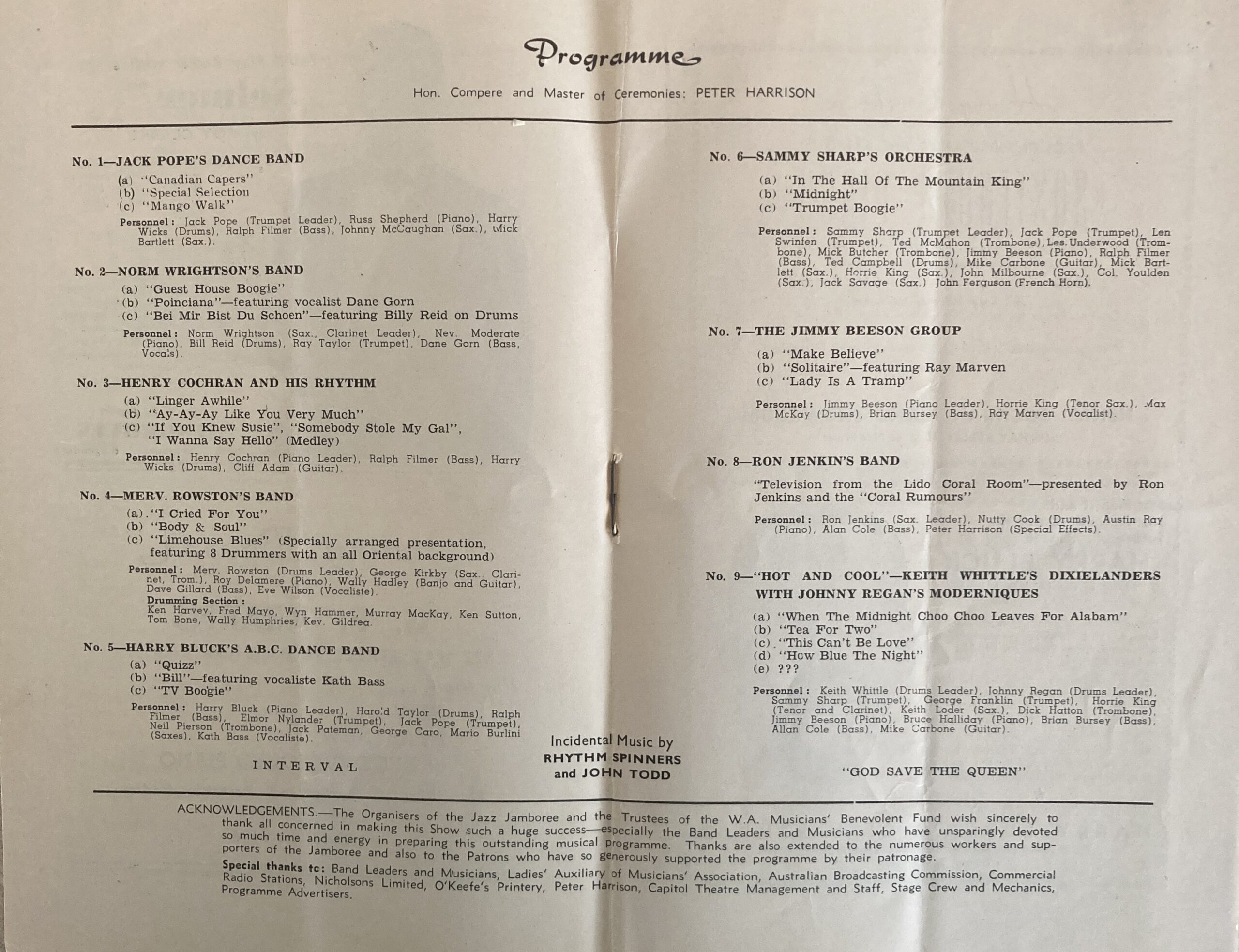
No. 9 – “Hot and Cool” – KEITH WHITTLE’S DIXIELANDERS WITH JOHNNY REGAN’S MODERNIQUES.
Personnel: George Franklin (Trumpet)
1965
George was the Corporal 1st cornet leader of a very good group of four outstanding cornet soloists in the Western Command Band when Bob Keatch was posted to Perth.
1974 – Conductor Perth City Band
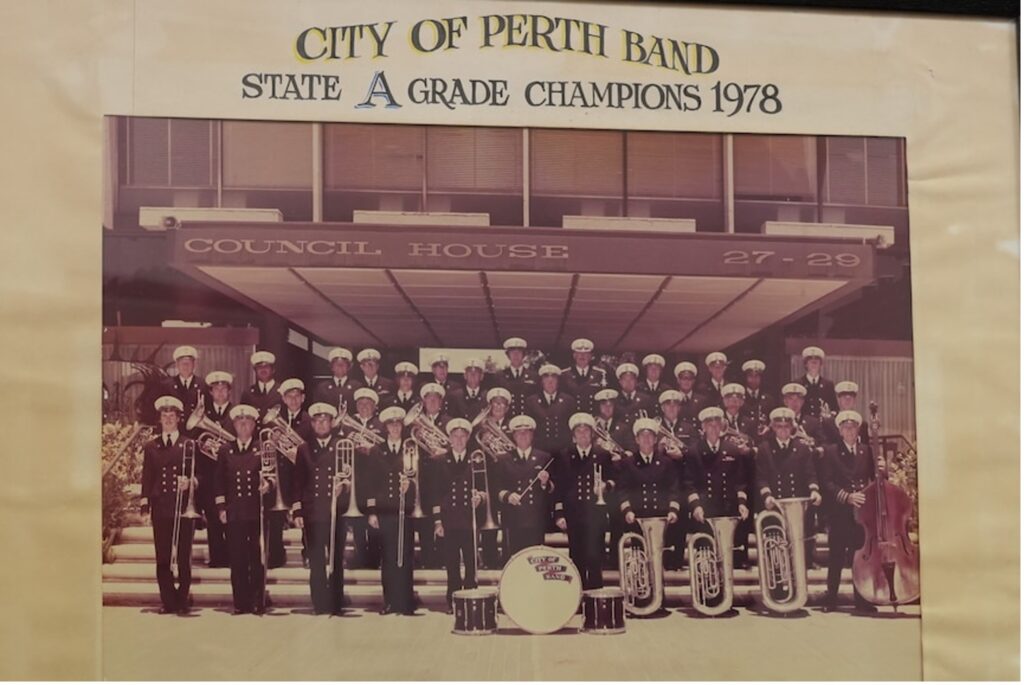
Mr Franklin was the conductor of the City of Perth brass band from 1974
In 1978, City of Perth Band were state A Grade champions.
PHOTO:
Mr Franklin was the conductor of the City of Perth brass band from 1974. (ABC News: Lauren Smith)
2013 – aged 103
Band Leader George Franklin
Fremantle’s famous old barber shop, Norm Wrightson’s Hairway, is celebrating its 80th year and marking the occasion with a variety packed concert called ‘Salute to Fremantle’. The Magic Dream Big Band were one of the main acts performing in the Fremantle Town Hall.
https://www.flickr.com/photos/simon_corston/10513007923
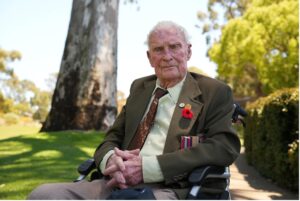
George Franklin is a World War II veteran. (ABC News: Chloe Henville)
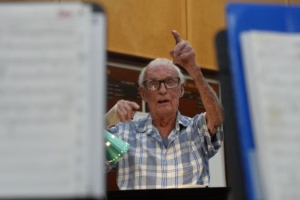
https://www.abc.net.au/news/2025-11-11/veterans-mark-rememberance-day-as-numbers-dwindle/105997254
2026 – aged 104
Legendary Perth big band conductor George Franklin passes away
RIP George Franklin – 104 year old legendary Perth Big Band conductor decided it was finally time to hang up his baton. A great trumpeter in his day. Retired Perth cornet player and brass repairer, Max Douglas told me once “I never heard him miss”.
https://www.facebook.com/groups/perthbigbands/posts/3172814449593169/
https://www.facebook.com/reel/1025055272853262
https://www.facebook.com/watch/?v=1199218768257717
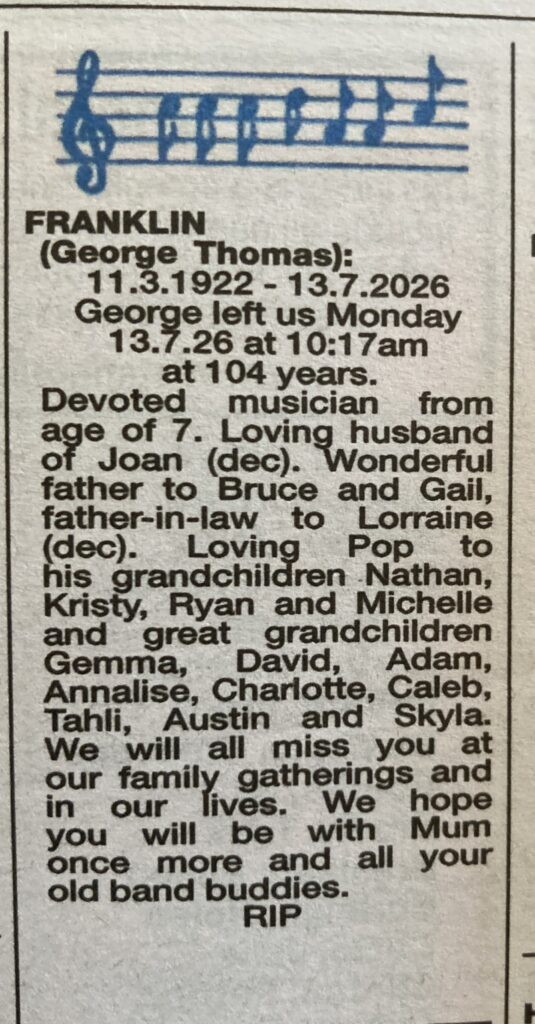 Vale – George Franklin by Bob Keatch
Greetings OLD CONTEMPTIBLES.
Some sad news. George Franklin passed away last week. He was surrounded by family and at peace. A fall recently saw him in hospital with broken bones and some complications. A sad end after a brilliant life very well lived. George was well regarded, much admired and deeply loved far and wide. George was the Corporal 1st cornet leader of a very good group of four outstanding cornet soloists in the Western Command Band when I was posted here in 1965. Lots of excellent memories over the years including my time as his big band Drummer in more recent times.
Funeral arrangements:
2 pm Wednesday 29th July 2026
Norfolk Chapel. KARRAKATTA.
Person
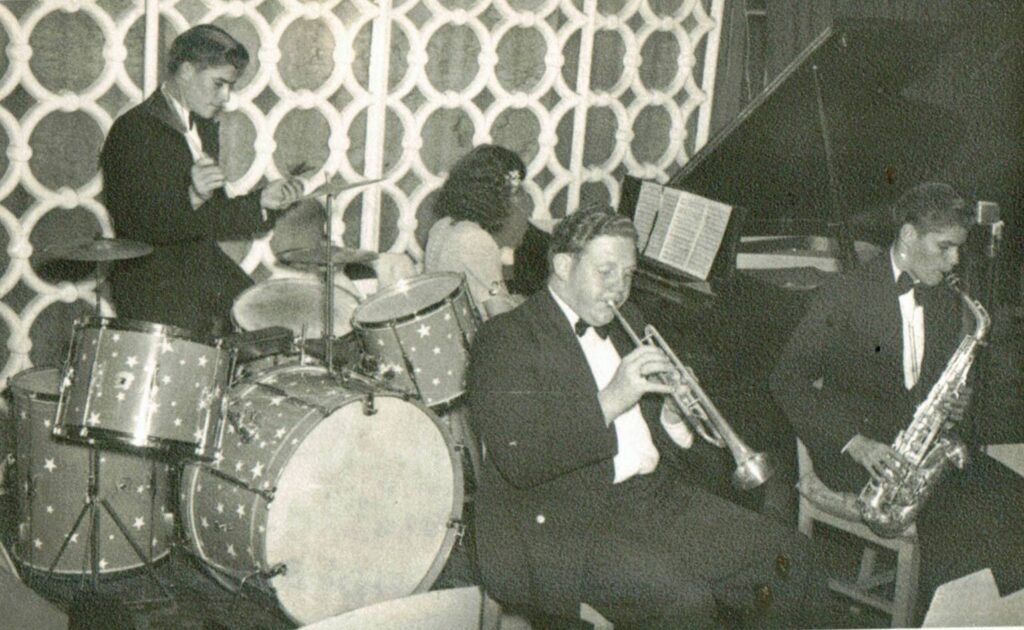
1949
Jack Harrison augmented his swing band according to the requirements of functions, sometimes up to ten players, such as the April 22nd 1949 University of Western Australia Graduation Ball at Winthrop Hall. Players were issued with a cheque on 5th May 1949 and were paid 3 pound 2 and 6 for the gig.
Players paid were: Norm Wrightson (saxophone), George Kirkby, Jack Pope (trumpet), George Franklin (trumpet), Charles Thompson, Bill Hendrie (guitar), Roy Coates, Ray Harrison (drums), Jill Harrison (piano) and Jack was the tenth band member.
5 MAY 1949
JACK HARRISON Cheque Book – to:
Norm Wrightson Grad Ball £3/2/6
George Kirkby Grad Ball £3/2/6
Jack Pope Grad Ball £3/2/6
George Franklin Grad Ball £3/2/6
Charles Thompson Grad Ball £3/2/6
Bill Hendrie Grad Ball £3/2/6
Roy Coates Grad Ball £3/2/6
Ray Harrison Grad Ball £3/2/6
Jill Harrison Grad Ball £3/2/6
4 JULY 1949
JACK Cheque to: Jack Pope Womens College £5/3
Colin Youlden Womens College £2/11/8
Bill Kirkham Womens College £2/11/8
Charlie Thompson Womens College £2/11/8
George Franklin Womens College £2/11/8
Bill Hendrie Womens College £2/11/8
Roy Coates Womens College £2/11/8
1950
MUSICAL INSTRUMENTS.
TRUMPET for sale, Conn. Silver plated, excellent condition. Jack Pope. 41 Somerset-st., Vic. Park.
West Australian (Perth, WA : 1879 – 1954), Saturday 21 October 1950, page 40
WESLEY BALL Tuesday 18th July 1950
Jack Harrison Band – Wesley Ball 8pm – 1am
Friday 4th August 1950
Jack: Cheque to: Jack Pope Wesley £7/12/9
1953
Ladies’ Night Was One To Be Remembered
Secretary Mrs. Le Cornu (Sylvia Caporn) and an energetic committee really pulled one out of the bag for Musicians’ Union Ladies’ Auxiliary’s first night at Anzac House lower hall on Tuesday. Musical items were contributed by Phyllis Frost and Bryn Gyfford, drummers Merv Rowston, Keith Whittle, Murray McKay and Max McKay, sax players George Caro, Sonny Henderson, Johnny McCaughan, trumpeter Jack Pope, pianists Nell Sheridan, Roy de la Mere and Henry Cochran, guitarist Hank Collins and Dane Gorn on bass. It was a jam session extraordinary, and it was enjoyed by all. Auxiliary’s next function is to be an afternoon tea on Aug. 29 at 2.30 in the Musicians’ Union offices. 102 Beaufort-st.
Mirror (Perth, WA : 1921 – 1956), Saturday 15 August 1953, page 13
1954
To the followers of the WEDNESDAY NIGHT DANCE QUEENS HALL, BICTON You are advised that commencing WEDNESDAY, 9th FEBRUARY, the weekly dance will be held as usual until the return of your popular promoter. Five-Piece Orchestra Featuring: Nev. Moderate (Piano) Al Cole (Bass) John Regan (Drums) Horrie King (Sax. and Clarinet), Jack Pope (Trumpet and Leader) MODERN MUSIC AS YOU LIKE IT Lucky Spots — Dancing 8-11.30 ADMISSION 2/10
Daily News (Perth, WA : 1882 – 1955), Monday 8 February 1954, page 10
1955
Cliff Adam Band one of best on WA radio
Heard and enjoyed often on local stations are popular members of the Cliff Adam Band (below from left to right) Jack Pope, Harry Wicks, Cliff Adam, and John McCaughan. Leader Cliff Adam -something special with a guitar, a song, and formerly a tap dance – is among the most experienced of WA musicians.
He left Perth to tour the Eastern States with. Ron Moyle’s “Westralian” in 1933 and, finding things over that way to his liking, stayed for several successful years.
He played in famous Melbourne cabarets and toured with the Bert Howell band, one of Australia’s best in Sydney. He played with the tuneful Jay Whidden unit and had success on the air with the Colgate – Palmolive, Fred Hartley and other well-known radio bands. Now he broadcasts with his Hawaiian ensemble,, the 55-60 Show with the ABC Variety Band and. of course, his own Cliff Adam show.
Drummer and vibraphone player Harry Wicks moved here from Sydney two years back with the smash-hit Moreton and Kaye show He liked the place, decided to stay, and is heard in many local commercial shows. Harry hails originally from New Zealand but he has the Australian “bounce” in abundance.
Trumpeter Jack Pope, a member of Harry Bluck’s ABC Melodians, is heard
also on commercial stations. So does tenor-sax maestro John McCaughan, a momentous Melodian with the ABC. The quartet play together several times weekly in Cliff’s dance band. Other members of the band, pictured, are Russ Shepgeard pianist, and Ralph Filmer, bass.
Sunday Times (Perth, WA : 1902 – 1955), Sunday 9 January 1955, page 20
1955 THE YOUNG AUSTRALIA LEAGUE
Presents Another
“JAZZ FANTASIA”
with Sammy Sharp and his Orchestra.
35 of the State’s Finest Musicians featuring …
Louise D’Arcy — Jack Harrison — Jimmy Beeson — Horrie King, Jack
Pope — Martin Gischus — Colin Youlden — Lisa Ray — Keith Whittle
— Ralph Filmer — Evelyn Wilson.
SPECIAL FEATURE ATTRACTION
A NOVEL PARADE OF MEN’S FASHIONS
By ELWOODS
PAN AMERICAN
“STYLE STORE FOR MEN”
CAPITOL THEATRE
SUNDAY, 20TH NOVEMBER
Box Plan Now Open at Nicholsons. Adm. 5/.
The Daily News Wednesday 16 November 1955 page 26
PHOTO: Summary
L-R: Peter Boyd (vocalist), Sam Sharp (trumpet, leader), Peter Clinch (tenor saxophone, clarinet), George Caro (alto saxophone, clarinet), Ralph Filmer (bass), Les Mackay (alto saxophone), Keith Whittle (drums), Cliff Adam (guitar), Jim Beeson (piano), Charles Thompson (trombone), Norm McMahon (trumpet), Jack Pope (trumpet), Phyllis Frost (blind English vocalist).
https://pro.nfsa.gov.au/titles/82XV9ACE
Person
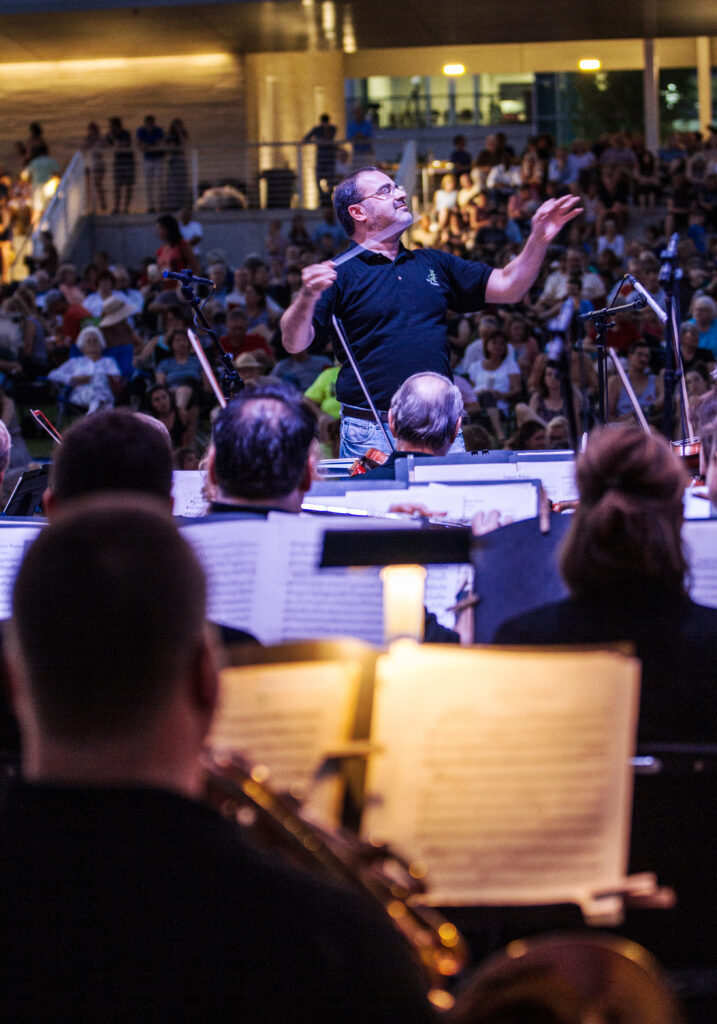
Australian conductor Ron Spigelman is an honors graduate of the Royal Academy of Music, London.
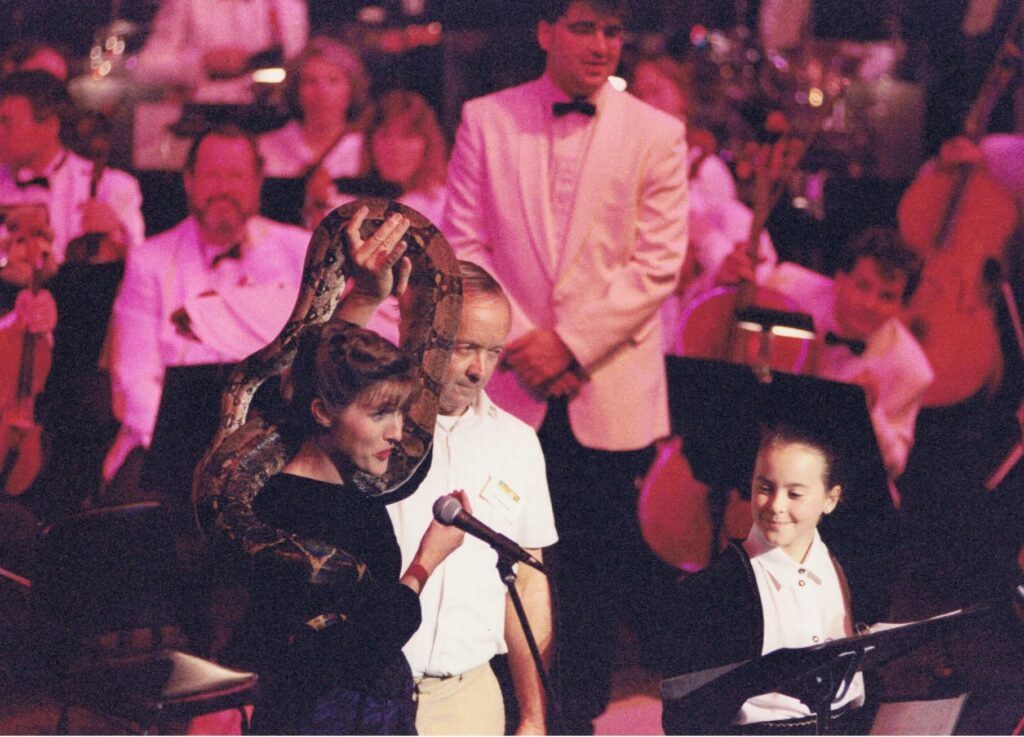
He began his career in Australia in 1992 as a conductor-in-training with the West Australian Symphony, the Queensland Symphony Orchestra in 1993 and then assistant conductor of the Adelaide Symphony Orchestra in 1994 – with who he recorded an album entitled Dream Children that was nominated for an ARIA award and still receives radio play on the ABC. His career moved to the United States in 1994 when he won the position of Associate Conductor of the Fort Worth Symphony (Texas) and then the Buffalo Philharmonic (New York), subsequently becoming Music Director of the Fort Worth Dallas Ballet, the San Angelo Symphony, Texas Chamber Orchestra, Springfield Symphony (Missouri), and the Lake Placid Sinfonietta (NY) where he is now conductor emeritus. He has also served as Principal Pops Conductor of the Fort Worth and Syracuse Symphonies and is now in his second season as Principal Pops Conductor of the Buffalo Philharmonic developing and conducting approximately 12 programs each season.
Guest conducting appearances have included the Atlanta, St. Louis, Baltimore, Utah, Oregon, Kansas City, Vancouver, Milwaukee, Grand Rapids, Colorado, Dallas and Nashville Symphonies, as well as the Florida Orchestra, Louisville Orchestra and the Minnesota Orchestra.
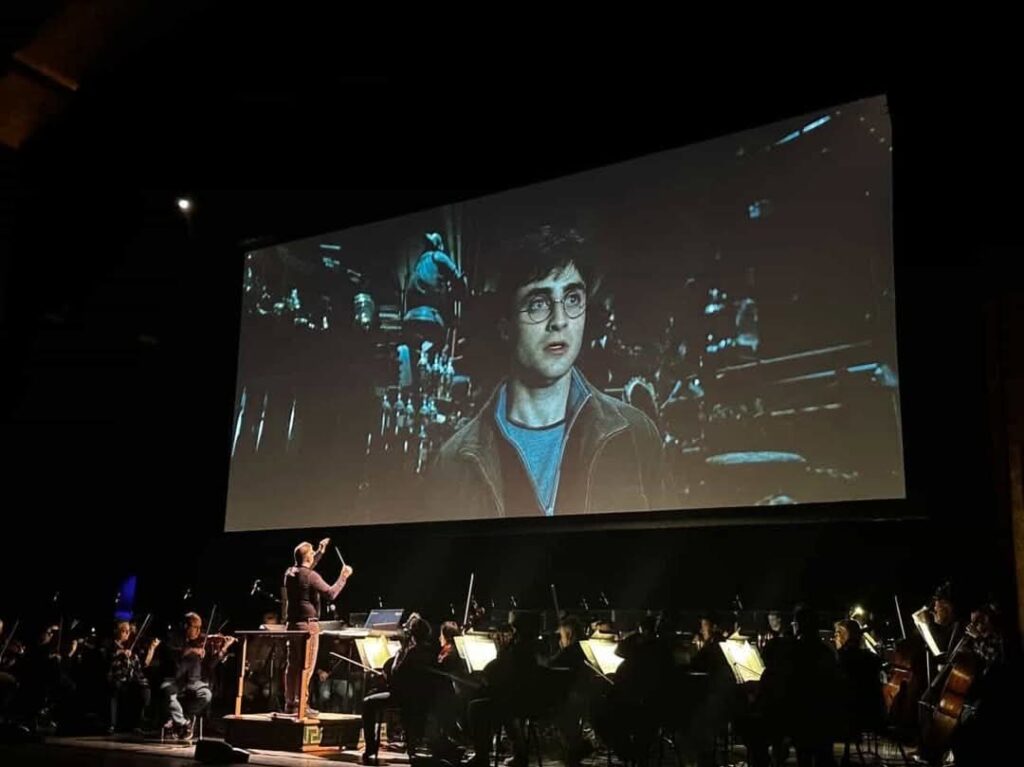
He has conducted Symphonic, Ballet, Opera, Musical Theatre and Pops plus over 30 live-to-film productions including all eight of the Harry Potter films. Guest artists he has accompanied include Horacio Gutierrez, Rachel Barton Pine, Richard Stoltzman, Marvin Hamlisch, Peter Paul & Mary, James Taylor, Leslie Odom Jr., Vanessa Williams, Gladys Knight, Arturo Sandoval, and many others.
Career highlights include the world premiere of Pegasus by Lowell Liebermann with the Dallas Symphony, his Carnegie Hall debut with the Buffalo Philharmonic in 2004, and the world premiere recording of Sylvan by Michael Torke with the Lake Placid Sinfonietta for their centennial season in 2017.
Ron lives in Tulsa, Oklahoma with his wife Laura, and they have a combined 6 children. He is board president of Harmony Project Tulsa, bringing instrumental instruction to underserved youth in collaboration with the Tulsa Public Schools and he is a frequent conductor of the Tulsa Symphony Orchestra. In 2024 he graduated summa cum laude with a bachelor’s degree in Family and Human Development at Arizona State University receiving the dean’s medal for academic excellence and in May of 2026 completed his Master of Liberal Studies degree – also from ASU – graduating with academic distinction. His applied project was a graduate course for conductors in the vital communication, leadership and social skills needed to become a resonant leader and effective music director on and off the podium.
Person
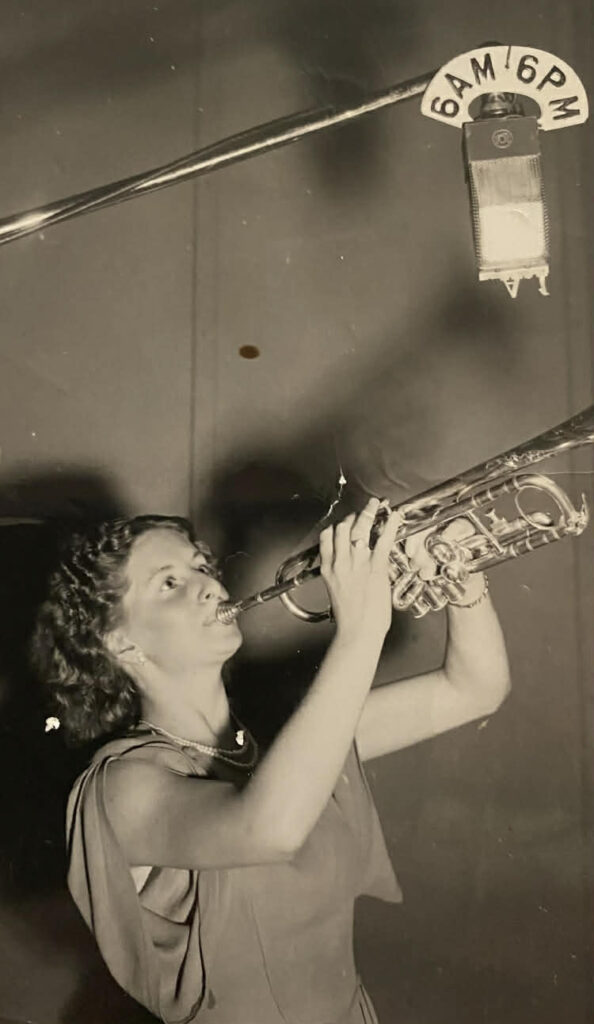
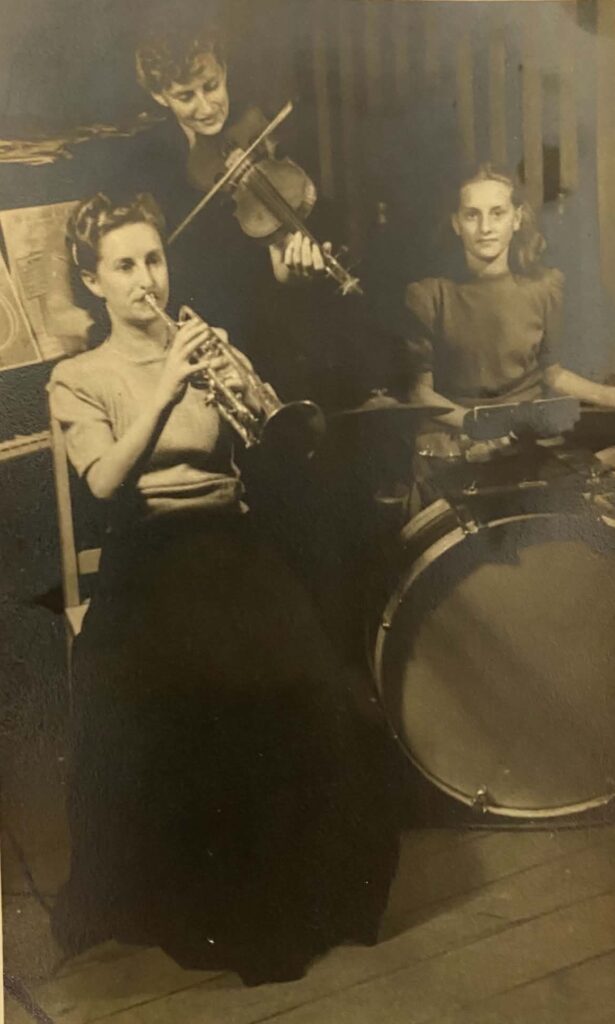
The Colley Sisters, Hannah (trumpet), Laura (violin, vocals) and Thelma (drums), used to play over 6pm Relax community concerts as well as in concert parties.
1937
DUTY TOWARDS ABORIGINES. Mr. Neville Addresses Soldiers’ Wives. THE usual monthly social of the Friendly Union of Soldiers’ Wives was held at Anzac House yesterday afternoon, the president (Mrs. Harold Dean) being in the chair. A welcome was extended to the president of the British Ex-Service Women’s Organisation (Mrs. McDonald) and to several new members. The speaker for the afternoon was the Commissioner for Native Affairs (Mr. A. O. Neville) who spoke of the people’s duty towards the natives. Those concerned with the welfare and uplifting of natives were convinced of the importance of taking the long view of the position, Mr. Neville said. One of the first steps in this direction was the prevention of the near whites, the third and fourth generations, from living as natives in camps. Sister Kate’s Home at Queen’s Park was doing invaluable work in this direction. The next matter was the absorption of the native into the white population. Mr. Neville did not mean by this that the black and white races should inter-marry, but that by a gradual process, the native should be fitted to take his place in the community. To render absorption possible, the matter of health was all-important and great attention had been paid to this aspect of native affairs by the department during the last few years. Out of 7,000 cases examined in Western Australia over a period of two years, the total amount of disease among them, in spite of malnutrition and other draw-backs, was only 7 per cent. Education of Children. The education of native children was a necessary step towards absorption. At present, Mr. Neville said, there were 5,000 native children under the age of 14 in need of education and only 860 of these were receiving instruction, some from State schools and the rest at missions. Under present conditions, there was not sufficient money to pay for more extensive education, relief and rescue work forming a big item of expenditure. It was pleasing to find, Mr. Neville added, that there were more natives working either for their keep or for small wages in Western Australia than in any other State. Mr. Neville concluded by reading two important resolutions passed at the initial conference of the Commonwealth and State aborigine authorities at Canberra which he attended early this year. These dealt with absorption and education and were along the same lines on which Mr. Neville had spoken. A vote of thanks to Mr. Neville was moved by Lady Hobbs and seconded by Mrs. T. C. Wilson. The remainder of the afternoon was devoted to a musical programme arranged by the secretary (Mrs. E. Clear) and afternoon tea. A popular item was a piano duet given by two members aged 76, Mesdames O. J. Foote and C. O. Cliff. Little Hannah Colley, aged 11, rendered a cornet solo and recitations were given by Master James Purvey.
West Australian (Perth, WA : 1879 – 1954), Friday 5 November 1937, page 7
EX-SERVICEMEN ENTERTAINED
On Tuesday afternoon the patients in the Edward Millen Home were.en-tertained to afternoon tea by various members of the Victoria Park R.S.L. Women’s Auxiliary. Afterwards com-munity singing and items were rendered by little Hannah Colley (cornet solos and recitations), and Patricia Farrell (songs and dances), which were greatly appreciated. At the conclusion of the programme the men were each given a small gift on behalf of the auxiliary by the little girl artists. The visitors were thanked by Mr. Foster on behalf of the matron and the patients and on behalf of the latter Mrs. Tolmie (president) was presented with a very nice basket as a token of appreciation of the work done on their behalf by the auxiliary. The programme was arranged by Mrs. Prue, and Mrs. Farrell obliged at the piano.
Sunday Times (Perth, WA : 1902 – 1955), Sunday 26 December 1937, page 15
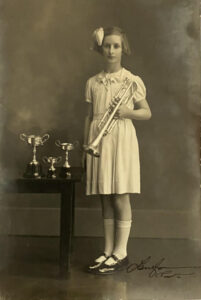
1938
44TH BATTALION AUXILIARY
VICTORIA PARK On December 21 the auxiliary paid their Christmas., visit to the boys at the Edward Millen Home, providing a short programme and afternoon tea. Items were given by Hannah Colley (cornet solos and recitations), and Patricia Farrell (songs and dances), interspersed with community singing. Mrs. Farrell obliged at the piano. At the conclusion of the programme, each patient was
handed a small gift by the little girl artists, on behalf of the auxiliary, and the visitors were thanked very heartily by Mr. Foster, on behalf of the matron and the inmates, and as a token of appreciation of the regular visits of the auxiliary to the Home, Mrs. Tolmie (president) was presented with a very nice basket.
Listening Post (Perth, WA : 1921 – 1954), Tuesday 18 January 1938, page 31
1940
WENT TO GAOL BUT DIDN’T STAY
An enjoyable concert was presented at Fremantle gaol last Sunday by Mrs. Page Lennon’s party. Those helping were: …Hannah Colley
Mirror (Perth, WA : 1921 – 1956), Saturday 13 July 1940, page 16
1941
WHAT WOMEN ARE DOING Mrs. Page Lemmon’s concert party visited the Fremantle prison on Sunday and entertained the inmates with a varied programme and community singing. Those assisting on this occasion included the Raolto Swing Sand. Misses Hannah Colley, Mary Shaw, Jenny Deering. Nellie Kershaw. Dorothy Hanley. Ada Coultas, Messrs. Jess Frankish, Jack Samseis, Ivan Warnes. Sydney Court, Bert Brielley and George Parsons. Mrs. Roy Deering was the accompanist, and Mr. Jess Frankish arranged the programme. Thanks are due to the following who conveyed the artists to and from the prison: Mrs. Streker, Messrs. Arthur Sullivan, Will Taylor, Charies Toil. Jack Fitzgerald and Jack Samnuels.
West Australian (Perth, WA : 1879 – 1954), Wednesday 15 January 1941, page 12
A.B.C. Orchestral Concert. Tonight at 8.15 the first of a series of five concerts arranged by the Australian Broadcasting Commission will take place at the Capitol Theatre. Many will be interested in the appearance of the young West Australian pianist, Stephen Dornan, who will be the soloist. Professor Bernard Heinze will conduct the Perth Symphony Orchestra. Patrons are asked by the Commission to be seated not later than 8.10 o’clock, as the doors will be closed during items. “Parade of Youth” Concert. A “Parade of Youth” community concert, proceeds of which were handed to the East Perth Police Boys’ Club, was presented in the Perth Town Hall on Thursday to an enthusiastic audience. A feature of the programme of vocal, instrumental and comedy numbers was the girls’ six-piece orchestra under the leadership of Miss Carmel Burrows and conducted by a 17-year-old youth. Every artist was under the age of 21 years and the performers included Beryl Bevan, Gwen Moore, Jack and Evelyn Chiswell, Harold Thurkle, Thelma Green, Ron Thomas, Hannah Colley, and Carmel Burrows. Orchestral items and 24 community numbers completed the lengthy programme. The concerts will be continued each Thursday to aid the appeal for funds to complete the supply of equipment for the club.
West Australian (Perth, WA : 1879 – 1954), Saturday 3 May 1941, page 4
1942
SUNDAY CONCERT
“The workings of the Police Boys Clubs” is the subject of Constable W. Scott has chosen for his address to-morrow afternoon at the seventh Pleasant Sunday Afternoon in the North Perth Town Hall. Concert will commence at 3 p.m., includes items by Miss Nell Shortland-Jones, the Y.A.L. Band, Mr Bill Talbot, Master, Jackie Harrison, the Mace String Quartette, Mrs Marjorie Cook, Miss Hannah Colley. Accompanist will be Miss Stephanie Nash. Proceeds will go to the Northern Suburbs Police Boys’ Club.
Daily News (Perth, WA : 1882 – 1955), Saturday 3 October 1942, page 12
Pleasant Sunday. Tomorrow (Sunday), commencing at 3 p.m., In the Maylands Town Hall, a Pleasant Sunday Afternoon, arranged by Cr. W. L. Menkens, will take place. It will be in aid of the Perth Road Board Red Cross Prisoners of War Fund (Maylands ward committee). The chair will be taken by Mr. H. V. Shearn, M.L.A., and the speaker Mr. R. Lloyd Thomas, whose subject will be ‘Planning World Peace.’ An excellent musical programme will be contributed to by Miss Nell Shortland – Jones, Miss Marjorie Payne, Miss Joy Hobley, Miss Hannah Colley, Mr. David Lyle, Mr. Will Savage, Master Jackie Harrison, with Miss Stephanie Nash as accompanist. Mirror, Saturday November 7 1942 page 19
1943
Pleasant Sundays
Third of the series of Pleasant Sunday Afternoons arranged by Cr. W. L. Menkens in the North Perth Town Hall will take place on Sunday week, June 6. Chair will be taken by Mr. H. Shearn, MLA, and the speaker will be Professor Walter Murdoch, who will speak on ‘The Tragedy of the Jew.’ The following artists will contribute to the musical programme: Mrs. W. L. Pitman, Mrs. W. L. Menkens, Mr. David Lyle, Miss Hannah Colley, and a military band under the baton of Cpl. G. E. Meagher.
Mirror (Perth, WA : 1921 – 1956), Saturday 29 May 1943, page 17
SUNDAY CONCERT
‘The Tragedy of the Jew’ is the subject chosen by Professor Walter Murdoch for his address at the Pleasant Sunday Afternoon in the North Perth Town Hall on Sunday. Programme will commence at 3 p.m. and proceeds will go to the Jewish Women’s Red Cross Company Prisoners of War Appeal. Musical programme will include items by Mr David Lyle, Miss Stephanie Nash, Mrs W. L. Menkens, Mrs W. L. Pitman, Miss Hannah Colley and Miss Florence Prain, with music by a military band. Visitors from the city are advised to catch a No. 22 tram and alight at Albert Street, North Perth.
Daily News (Perth, WA : 1882 – 1955), Friday 4 June 1943, page 4
PATRIOTIC EFFORTS. Pleasant Sunday Afternoon. Arranged by Cr W. L. Menkens to assist the Jewish Women’s Red Cross Company prisoners of war appeal, the third of a series of Pleasant Sunday Afternoons was held in the North Perth Town Hall yesterday. Mr H. V. Shearn, MLA was in the chair and an address was given by Professor Walter Murdoch. Cr Menkens presented a cheque for £50 collected at the previous gathering to Superintendent Hope of the North Perth division of the St John Ambulance Brigade. The programme was contributed by Mesdames M. L. Pitman and W. L. Menkens, Misses Hannah Colley and F. Prain, Messrs D. Lyle and R. Donaldson, and an Army band conducted by Cpl G. E. Meagher.
West Australian (Perth, WA : 1879 – 1954), Monday 7 June 1943, page 6
1944
RAAF Comforts Fund.
Here amongst the local artists I found first-class talent. Hannah Colley, 5ft of blonde daintiness, performed magnificently on the trumpet-Hannah, I believe, was to tour the World, but the war intervened, and Hannah is still with us. Something to be grateful for.
Western Mail (Perth, WA : 1885 – 1954), Thursday 27 April 1944, page 31
A.C.W. Hannah Colley, who has just returned from Ascot Vale, where she was the only woman m the R.A.A.F. Band and also played at Officers’ Administration Pass-out ceremony at the Melbourne University, has been chosen as the candidate for R S.L Women’s Auxiliary Popular Lady Competition for P.O.W. Fund. Donations would be gratefully received by Mrs. Luber Smith.
Westralian Judean (Perth, WA), Friday 1 September 1944, page 27
REMEMBRANCE DAY. ARMISTICE ANNIVERSARY. – Traditional Silence Observed. The 26th anniversary of the armistice which brought hostilities to an end in the 1914-18 war was observed in Perth at 11 o’clock on Saturday; morning, when traffic in the city was brought to a standstill and the people stood in silence for two minutes in remembrance of the fallen. After the lapse of 26 years and with another war having intervened the armistice itself now has little significance in the annual commemoration, which is almost wholly a day of remembrance for the fallen and as such has come to be known as: “Remembrance Day.” The commencement of the silence at 11 am was heralded by the firing of the Observatory gun. All tram, street and pedestrian traffic immediately came to a halt and a strange quietness fell like a mantle over the city. Amidst the hush came thei sounding of the last post by buglers stationed at many intersections and vantage points. The firing of the gun ended the silence and, with the sounding of the short rouse of the reveille by the buglers, traffic and transport was resumed and the populace was again on its way. Particular interest was shown in the ceremony at the Hay and Wilham streets intersection, where the bugle calls were sounded by a woman bugler, ACW Hannah Colley, of the RAAF. Sometime before 11 am a large crowd formed a circle in the roadway around the diminutive bugler and all traffic was held up until after the ceremony had ended.
West Australian (Perth, WA : 1879 – 1954), Monday 13 November 1944, page 6
Mrs. Colley, of Mt. Lawley, has written in regard to the paragraph we published in the November “Listening Post” about the services of her daughter, Miss Hannah Colley, on Armistice Day. Following the newspaper account, we stated that Miss Colley received her musical training from her father, Mr. A. W. Colley, In doing so, we inadvertently did an injustice to an old friend. Mrs. Colley points out that Hannah’s father commenced teaching her at any early age, but she was with him only for six or eight months. All other credit for her outstanding success as a trumpeter goes to another old and [popular member of the League, Mr. George Mellor, who was bandmaster of the 51st Bn. in the last war, and subsequently of the R.S.L. Memorial Band. For many years, George has been trumpeter in the Perth A.B.C. Wireless Orchestra. We thank Mrs. Colley for supplying added information.
Listening Post (Perth, WA : 1921 – 1954), Friday 1 December 1944, page 6
PATRIOTIC EFFORTS.
Concert for P.O.W. Funds. A concert will be held tonight at the Assembly Hall. Pier-stret. at which the. solo artists will include ACW Hannah L. Colley (trumpeter). “Levato” (child trick. cyclist) and Jack Anstey’s Singing Group.: The concert will be produced and compered by Nell Shortland-Jones and the proceeds will aid the POW fund.
West Australian (Perth, WA : 1879 – 1954), Tuesday 5 December 1944, page 6
“POPULAR GIRL” Munitions Candidate’s Success. Excitement ran high in the R.S.L. Hall, Salford-street, Victoria Park, when the popular girl contest run by the women’s auxiliary of the Victoria Park RSL in aid of the POW Appeal was concluded. Miss Betty Parley (Munitions candidate) topped the poll, followed closely by the Victoria Park RSL Women’s Auxiliary candidate (Miss Hannah Colley) and Miss Sylvia Hodgson who was sponsored by the sub-branch. Al three girls polled well and raised a considerable sum by their united efforts. During the evening prizes were presented by Dr Palandri who was recently repatriated. He also gave a talk on conditions in a POW camp. On Sunday afternoon the auxiliary entertained the patients of the Edward Millen Home at afternoon tea, followed by a musical programme. Each patient received a Christmas gift and the auxiliary was thanked by the oldest member of the home.
West Australian (Perth, WA : 1879 – 1954), Friday 22 December 1944, page 3
1945
Women’s Auxiliaries – STATE EXECUTIVE
The last executive meeting of 1944 was held on December 15, all members being pre sent. Mrs. McKinlay (State President) presided. The agenda this meeting was a full one, which dealt mostly with Christmas cheer for present and exservice men and women. On December 20 at Anzac House a luncheon and afternoon tea was given to 100 convalescent service men and women from Hollywood, Lady Mitchell and John Nicholson Homes. An excellent luncheon was prepared by members of the executive. Official visitors were Mr. Anderson (State President R.S.L.), Mr. Benson (State Secretary), Mr. Leslie, M.L.A., and Mr. Yeates, O.B.B. A programme of music was arranged by Miss Nell Shortland Jones, assisting artists being Miss Merrimee Holt (piano), and A. C. W. Colley (trumpet). This function was made available by a very generous donation from Southern Cross Auxiliary.
Listening Post (Perth, WA : 1921 – 1954), Monday 1 January 1945, page 21
Women’s Auxiliaries …a farewell gift was also given to Miss Hannah Colley on the eve of her departure to the Eastern States. Hannah has always helped us at our socials, and we shall miss her.
Listening Post (Perth, WA : 1921 – 1954), Monday 1 October 1945, page 22
1947
SUB BRANCH
The dance held on 11th October at Leederville Town Hall was a good dance in every respect except one, the exception being that we should have been glad to see about two hundred more dancers. We were unfortunate to clash with the only show night held since anybody cares to remember but it is doubtful if that was entirely responsible. Anyway, it serves as an excuse if not much of a solace. From all other angles the night was a success and we think everybody enjoyed the evening thoroughly including the meditative sportsman who spent two -thirds of the evening trying to get in at reduced rates. At each refusal this potential cash customer relapsed into deep thought, coming up at the end of each second dance with another offer of a slightly lower figure. He finally got in for nothing when: the doorman took the floor with an exhibition of the can-can, and performed quite creditably for the last two dances. Our thanks are due to the committee, comprising members of the Women’s Auxiliary and of our own sub-branch who worked so hard to make the evening a success. We would like also to express our thanks to Mrs. McMahon who played the piano in the very excellent orchestra and, as on many previous occasions for the auxiliary and sub -branch, gave her services as a donation. Another member of the orchestra who donated her services for the evening was Miss Hannah Colley who played the silver trumpet, a solid looking instrument and quite an unusual one for a girl to wrestle with. Our impression, generally speaking, is that girl trumpet players are as scarce as female bagpipe blowers; but perhaps that is only our lack of a musical education. Anyway, the little lady performs on the trumpet not only with delightful technique but with a surprising robustness and confidence. Those who attended., at the evening given to Lemnos patients will remember the beautiful solo numbers given on that occasion by Miss Colley and thousands of service personnel were entertained by her during the dark and dismal days of war.
Subiaco Weekly Gazette (WA : 1947 -1960), Thursday 16 October 1947, page 4
1948
After sounding the Last Post and Reveille at three Anzac Day services, 23-year-old exservicewoman Hannah Colley, of Mt. Lawley, ended her busy day yesterday by playing at a Greek wedding. She started yesterday at 10.15 a.m., finished about 1 a.m. today. Tiny (4ft. 10£in.) fairhaired Miss Colley has blown the Last Post and Reveille at Anzac Day services since 1944. In 1945 she sounded the calls at six services, her day beginning that year with the Dawn Service. After a year in the WAAF Miss Colley joined the, army entertaining unit and played at camp concerts She has been playing the trumpet and bugle since she was 11. Yesterday she sounded the calls at the Mt. Lawley War Memorial. St. Giles Church and the Synagogue.
Daily News (Perth, WA : 1882 – 1955), Monday 26 April 1948, page 4
1950
SEARCH FOR TALENT
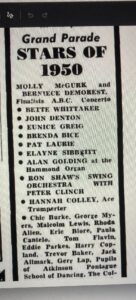
The last heat of the Blighty Association’s £10 Grand Talent Competition will be held at the association’s variety concert at Perth Town Hall tomorrow afternoon. The Sunday concerts and conducted to raise money for the Daily News Orphans’ Christmas Cheer Fund. Artists at tomorrow’s concert will include Elayne Sibbritt Hannah Colley, Peggy Garden, Tom Flavin, Hugh Albrecht, George Myers and pianist Billy Edwards. Final auditions for the talent contest will be held at 3 Howard-st, Perth, at 8p.m. today.
Daily News (Perth, WA : 1882 – 1955), Saturday 18 November 1950, page 17
1952
 SISTERS HERALD DAWN
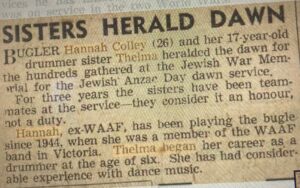
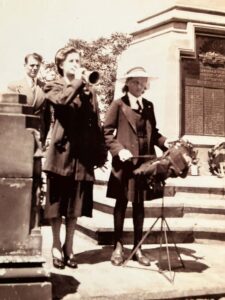
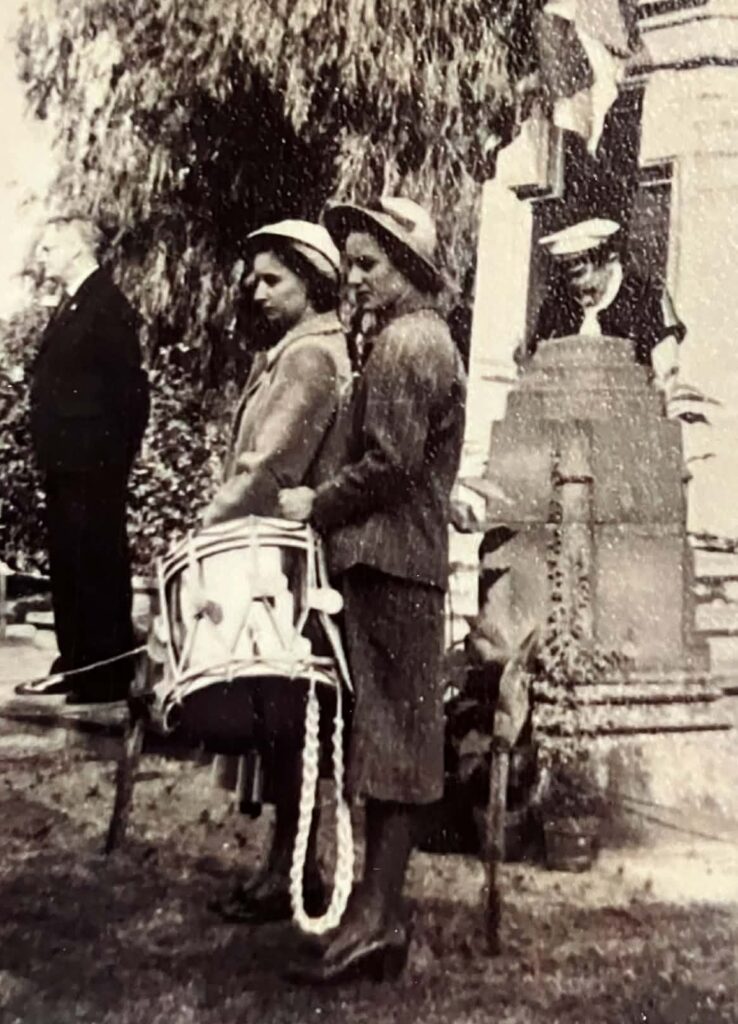
BUGLER Hannah Colley (26) and her 17-year-old drummer sister Thelma heralded the dawn for the hundreds gathered at the Jewish War Memorial for the Jewish’ Anzac Day dawn service. For three years the sisters have been team-mates at the service— they consider it an honour, not a duty. Hannah, ex-WAAF, has been playing the bugle since 1944, when she was a member of the WAAF band in Victoria. Thelma began her career as, a drummer at the age of six. She has had considerable experience with dance music.
Daily News (Perth, WA : 1882 – 1955), Friday 25 April 1952, page 2
Anzac Day
The Dawn Service was held at the Jewish War Memorial immediately following that at the State War Memorial and was attended by a record crowd. Delegates from the R.S.L., Legion of Ex-Servicemen and Women and Air Force Association were invited and honoured us by their presence. Rabbi L. Rubin-Zacks officiated at the service and wreaths were laid by 19 Jewish organisations, Miss B. Lewis and the Air Force Association. The calls were sounded by Mrs. Hannah Hoffman and Miss Thelma Colley. The Association was well represented in the afternoon at the Synagogue where a most impressive service was conducted. It is to be hoped that in future year-, the Jewish Community will be as well represented.
Westralian Judean (Perth, WA), Thursday 1 May 1952, page 5
Person
1935
Success of Perth Orchestra in Ceylon and India
Local musicians will be interested to know that Miss Leoni (Dot) Salter and her orchestra of Western Australian professional musicians have made a sensational hit throughout their engagements in India. Leaving Perth late last year, they went to Colombo under engagement to the Hotel Mount Lavinia, and after a most successful season of several months they were then booked for the Grand Hotel, Calcutta, by appointment to His Excellency the Earl of Willingdon, Viceroy of India, where a further outstanding success was achieved. They were the highest-paid artists in any Calcutta hotel. Their performances attracted a great deal of interest, and local residents gained the impression that it was an All-American band, and great was their surprise to know that it consisted entirely of Australians.
Finishing their engagement at the Grand Hotel, they are now doing a return season at the Hotel Mount Lavinia. Accompanying Miss Salter are the Misses Edna and Leah Waterman, and Messrs. Niddy Roberts, Wally Hadley, Sam Sharp and George Caro.
Sunday Times (Perth, WA : 1902 – 1955), Sunday 8 September 1935, page 25
1952: Sammy Sharp, who led a 17 piece band at last Sunday night’s jamboree, is the man who first introduced the idea to Australia. Sammy, one of our leading trumpeters, left Perth for overseas in the early 30’s. With Wally Hadley he toured a number of Eastern countries before eventually settling in England. Here he played with many world famous orchestras, including Eric Winstone, Ted Heath and Louis Levy. Impressed with the interest created in London by the annual Jazz Jamboree, Sammy Sharp decided to organise a similar concert In Perth in 1946. Held in connection with the Miss Australia contest, it was an instantaneous success. Since then the Jazz Jamborees have gone from success to success. Sammy Sharp is one of the few who works full time at music. He teaches trumpet and is also band master for the YAL band.
1946 – Fresh from European triumphs, trumpeter Sammy Sharp brought plaudits from old Perth colleagues with his “Out of Nowhere” at a musicians’ get-together. [1]
A.B.C. CONCERT Conductor and Pianist Triumph (By “actus.”) It was reasonably expected that the second of this season’s A.B.C. Perth Symphony Orchestral concerts at the Capitol Theatre on Saturday would attract a large audience. There was the alluring prospect of two celebrities and a programme containing two important works, hitherto unperformed in Perth, but with which many had gained an acquaintance through recorded versions. In all respects hopes were realised, for the auditorium was filled with what must have been a record assemblage of music lovers. The visiting artists established themselves in the warm appreciation of the audience, the orchestra made a fine response, and an evening of musical enjoyment, interspersed with many thrilling moments, resulted. Warwick Braithwaite impressed as a man of personality with a comprehensive outlook on music whose meticulous care of detail leads on to a realisation of the full pictorial value of the work in hand. The melodic grace of Schubert’s “Rosamunde” overture was achieved with finely drawn legato under the influence of a free and expressive handling of the baton.
A Pleasant Surprise. The overshadowing effect of war conditions doubtless explains why the rise to fame of the Chilean pianist, Claudio Arrau was comparatively unknown to many Australians. The brilliance and artistry of his playing, therefore, came as a startling and very pleasant surprise. He possesses an extraordinary technique and uses it to express consummate art. His presentation of the Liszt Concerto in E Flat Major was a musical experience that will be long remembered. He was accorded a great reception and was recalled to the platform many times.
When Tchaikowsky wrote the Overture Fantasy on “Romeo and Juliet,” he achieved a supremely beautiful musical conception of the Shakespearean story of love and tragedy. The solemnity, poignancy, and emotional colour of this work was given subtle interpretation, and the loveliness of the orchestration effectively revealed. The happy mood which is a pervading element of the Symphony No. 2 in D Major, Op. 73 (Brahms) made a suitable climax to a concert of exceedingly pleasant listening. It was new to the orchestra and at times its complexity of design tested the efficiency. All difficulties were compassed, however, and the beautiful work was commendably played, especially the fine and massive finale. Recitals by Claudio Arran will be given in the Capitol Theatre on Tuesday and Thursday. Midday Programmes At The Capitol Tomorrow, from 1 p.m. till 2.30 p.m., and on Thursday, at the same time, lunch-time recitals of a popular type will be given in the Capitol Theatre by the A.B.C. Orchestra, with the tenor Ante Soljanic, Dave Howard, saxophonist, and Jack Mortimer (clarinet). On Wednesday, from 12.30 p.m. till 2 p.m., Sammy Sharp‘s band (of “Sunday Serenade” note) will provide a programme in which Les’ Raphael will give songs at the piano.
MIDDAY CONCERTS Large Audience Shows Enthusiasm The lunch-hour concert by the Australian Broadcasting Commission’s orchestra, conducted by Ernest J. Roberts, attracted a large audience to the Capitol Theatre yesterday and aroused such enthusiasm that the future popularity of similar entertainments seems assured. Today, from 12.30 p.m. till 2 p.m. Sammy Sharp‘s band will provide the programme, and tomorrow from 1 p.m. till 2.30 p.m. another concert will be given by the A.B.C. orchestra and associated artist. [3]
LUNCH-HOUR MUSIC Despite the wet weather, there was another good attendance at the Capitol Theatre for yesterday’s lunch hour concert which was provided by Sammy Sharp‘s Dance Band, with Les Raphael as associate artist. Today, at 1 p.m., the last concert for the week will take place, the programme to be provided by the Perth Symphony Orchestra, under the baton of Ernest J. Roberts, and by the Yugoslav tenor, Ante Soljanic. [4]
Monster Concert TONIGHT – 8.45 – CAPITOL – 2/
Stanley Clarkson, Perth Symphony Orchestra, Ante Soljanic, Perth Highland Pipe Band, Sammy Sharp‘s Band, C.T.A. Choir, Betty Wright, Vaughan Hanly, Subiaco Brass Band, Henry Cochran, Radio Players, Lorna McKean, and “MISS RADIO”. [5]
Ice Skating Star
TWEED-CLAD, with a gay painted Jacgmar scarf knotted casually around her neck, London style, Mrs. Wally Hadley, formerly Miss Joan Lovell, one of England’s ice skating stars called in last week. This tall, slight young woman with ashblonde hair, her West Australian banjoist husband and three young sons are among recent arrivals from England. Staying at Cannington with Mr. and Mrs. George Hadley, they had come up to spend the day with dance-band leader Sammy Sharpe and bis wife, old friends whom they had not seen for eight or nine years. Mrs. Hadley who began her ice skating career at 19, said she had given it up five years ago when her third child was born; looking after a family in wartime England was a full-time job on its own, she declared. With the Phil and Meagan Taylor Winter Sports Show for a number of years, Mrs. Hadley said she had skated in almost every town , in England, as well as touring Holland. But for family responsibilities, Australia would have met her years ago when the Phil and Meagan Taylor Company toured the Commonwealth. The Hadleys will probably settle in Perth, when Mr. Hadley’s Australian tour is over, but with plans so indefinite, Mrs Hadley seemed content to wave off the future while concentrating on adjustments to a life “so completely different” to that which she had known. Change of environment had apparently been no setback to the three young Hadley hopefuls aged 12, 10 and five. The elder two are already settled down in Cannington school and hoping to take part in localshow day events, while the five year old, although he had completed a year’s schooling in England, was able to revel in an unexpected holiday, still being below school age here. [6]
NORTHAM, MONDAY, DECEMBER 15, 1947 “THE SAMMY SHARP SHOW”
A MUSICAL TREAT FOR BOTH DANCERS AND LISTENERS NORTHAM’S BIGGEST MUSICAL SENSATION ! ! ! After terrific success in Perth’s leading Ballrooms and Radio Studios. Professional Musicians straight from the recent “Jazz Jamboree” which overflowed the Capitol Theatre. The “Sammy Sharp Show” includes Sammy Sharp with his Sunday Serenaders,” “Rhumba Band,” “Jazz, Group,” “Embassy Ballroom Band.” Also featuring the following well-known Dance-band and Radio Artists:— HARRY BLUCK—Well-known Radio artist and Compere PETER BOYD—Crooner from the Embassy and A.B.C. SYLVIA CAPORN—From Commercial & National Stns. JIMMY BEESON—Sensational Boogie-Woogie pianist. KEITH WHITTLE—The “Gene Krupa” of the West and Drummer-man from the Embassy and A.B.C., NORM and TED McMAHON—of the famous McMahon Cornet-playing family, GEORGE CARO—the famous Multi-instrumentalist. SAXOPHONE QUARTETTE. DANCING—Modern & Old Time, from 8 o-clock until midnight. JAZZ — JIVE — BOOGIE-WOOGIE — SWING — JAM SESSION DIXIELAND AND THE WHOLE WORKS ! ADMISSION.—Main Floor, 3/6 (incl. tax); Gallery, 2/7 (incl. tax) [7]
“THE SAMMY SHARP SHOW”
At the Northam Town Hall on Monday night the “Sammy Sharp Show,” which has become a firm favourite w.th West Australian radio audiences over the past year, will make a first appearance here. The show is being brought to Northam and other country centres by Sammy Sharp and Harry Bluck, but the operations of the shows are being carried out on a cooperative basis by all the members of the band of whom there are fifteen. The show will comprise of specialty presentation musical number s with instrumental and vocal solos and throughout the whole programme dancing to modern and Old-time music will be a main feature. Of the fifteen members of the band, there are twelve ex-servicemen and full-time professional musicians. Sammy Sharp himself, who is the conductor of the Australian Broadcasting Commission’s W.A. Danceband and popular “Sunday Serenades,” was throughout the War in London and other parts of Great Britain. He served as a Fire-watcher and A ambulance-driver during the ‘blitz and- later toured England and the Continent with ENSA, entertaining the troops with Geraldo’s band. He was also a member of Eric Winstone’s band which was the first concert party to follow the troops into Germany after D-Day. Many others in the show are well known radio personalities and among them are Harry Bluck—compere and entertainer, Sylvia Caporn —radio pianist, the famous McMahon brothers—Trumpet and trombone, Peter Boyd—Crooner, a saxophone quartette. The programme should be equally of interest to listeners and music-lovers as it will be to dancers. The visit will be an opportunity for musiclovers to hear a big radio-band in the flesh and sec many of their favourite entertainers. [8]
Northam Advertiser (WA : 1895 – 1956), Friday 12 December 1947, page 7
JIVE TONIGHT – Hot music’s deepest groove in years will lead to the Capitol to-night, when 8 leading bands will stage Perth’s first Jazz jamboree. Outstanding combinations of Merv Rowston, Chris Gosper, Sammy Sharp, John Stirling, Henry Cochrane, Ray Harley, Bill Kirkham and the Hounslow group will present a programme ranging from earliest jazz to modern swing. [9]
JAZZ JAMBOREE PLANS FOR PERTH – With 8 leading hot outfits galloping the groove, Perth will have its first public jam session at next Sunday’s Capitol theatre jazz jamboree. Boogie, jive, swing, Dixieland styles will tangle the tempo in high powered arrangements and streamlined solos. Bands taking part will be the combinations of Merv Rowston, Chris Gosper, Sammy Sharp, John Stirling, Henry Cochrane, Ray Harley, and Bill Kirkham, with the Hounslow jazz group giving an unusual first concert performance of old style hep. Compere will be Harry Bluck of radio and dance band fame. Over 50 musicians will give jazz a symphonic-scale entourage. Ray Hartley’s trio will play arrangements based on American King Cole’s guitar, bass and piano combinations. [10]
1947 DANCE MUSIC – Thursday November 13 – 8.0 Sammy Sharpe’s Dance Band
Assisting Artists: Jack Harrison (harmonica), June Phillips (soprano), Phyllis Blott (pianist). Continuity by Valerie Sisson. [11]
1947 BEAUTY QUEST ENDS “Miss Press” Wins State Contest With the choice of greyeyed, brunette Miss Erica Drake-Brockman (“Miss Press”) as “Miss Western Australia,” three West Australian-born girls will now compete for the title of “Miss Australia.” The names of the finalists in the State quest were announced last night to a hushed and expectant audience at the Capitol Theatre. Long before the doors opened, a long queue waited for cancelled seats and when the show started at 8.45 p.mn., the theatre was filled to its seating limit of 2,500. The compere, Dick Fair, flew to Perth for the show. No one–not even the contestants themselves knew the names of the finalists until the sealed envelopes containing the judges’ decisions were opened on the stage. The second place went to “Miss Radio” (Gloria Swain) and third was “Miss Motoring” (Joan Higgs). Winner of £50 for raising the most money, apart from the first three finalists, was “Miss Entertainment” (Beryl Appelt).l The other three finalists were “Miss: Perth” (Mary Ryan), “Miss Silver! Chain” (Marina Nicholas) and “Miss Jockey” (Alison Thomas).’ Altogether 21 contestants qualified for the judging. The contest, which has been running for nearly six months, has raised a total of £ 10,000. The final amount will be equally divided between the Silver Chain and Bush Nursing Association and the Kindergarten Union of W.A. As the entrants walked on to the stage they were greeted with prolonged applause from the audience and the finalists were given a tremendous ovation. During the show each contestant was presented with a posy of fresh flowers and a powder compact with her name engraved on it. At the conclusion, Dick Fair received a presentation in recognition of his services. Apart from the announcement of the finalists’ names, a programme was presented by many artists, including Betty Hatfield and Ante Soljanic (vocalists), Phyllis Blott (accompanist) and a dance band under the direction of Sammy Sharp. Miss Drake-Brockman, who is 18 years old, is a member of the “Sunday Times” staff. She is slightly built A member of an old West Australian family, she is used to both town and country life, having spent part of her childhood in the South-West. As winner of the contest she received a cheque for £250, a gold cup valued at £25 and a swimsuit, and will have a trip to Sydney, where she will face the final judging. Miss Swain received £100, in addition to a swimsuit and Miss Joan Higgs a cheque for £50. (PHOTO) [12]
Lyric Theatre Reopening
Holiday makers in Bunbury will be well catered for during the holiday season commencing on December 24 when a dance will be held every night , at the Lyric Theatre. ‘ Prior to that date a weekly dance on Saturday night will be conducted with a six-piece band providing the music. A special feature “has been arranged for December 29 when Sammy Sharp‘s 15-piece orchestra which has been touring the South-West will arrive in Bunbury, and present a four hour programme of dancing interspersed with items by members of the band. [13]
Lyric Packed With 900 Dancers – Approximately 900 people thronged the Lyric Ballroom on Monday night, representing the largest crowd ever seen in that hall. The attraction was Sammy Sharp‘s 15-piece band which entertained with brackets of swing numbers between each dance. Individual vocalists rendered items of a standard comparable with overseas bands and the huge crowd were obviously delighted with the feast of swing music, The management hopes to bring Sammy Sharp’s band down again, so enthusiastic was the response on Monday evening. [14]
On The Beach. Boogie woogie, jazz, jive, swing music and request items will be given in popular musical recitals which will be held on the beach at Scarborough on Sunday afternoons this summer. The first of the series will take place tomorrow at 3 p.m., with Sammy Sharp conducting a 16-piece orchestra. The recital will be compered by Harry Bluck, and Peter Boyd will sing at the microphone. It will be broadcast by a commercial radio station. [15]
Music While You Swim – Sammy Sharp’s 16-piece dance band will play on the beach at Scarborough tomorrow. The show, which will start at 3 p-m., will be compered by Harry Bluck. [16]
1948 Dance Music
Wednesday Jan 7 1948 at 8pm
Sammy Sharp’s Dance Band with Mary Malone and Peter Boyd (vocalists); Jack Harrison (clarinettist), The Paulasto Brothers (comedians), Betty Bahen, Betty Hooper (soprano), Jimmy Condon (compere), Phyllis Blott (pianist). -6WF [17]
1948 May – APPEAL CONCERT
Donations to Funds by Audience. An audience which filled the Capitol Theatre attended a concert last night organised by the Highgate Sub branch of the R.S.L. in aid of the Food for Britain and the Red Cross Funds Appeal. The entertainment consisted of a programme of numbers by leading local artists and bands…. The artists were R.S.L. Band (conductor Charles Court), W.A. Caledonia Pipe Band; Sammy Sharp’s Dance Band with Henry Cochran (King of the Keyboard) and Jack Harrison (Ace Clarionetist) …Several hundred pounds was donated in the theatre at the close of the performance…[18]
MISS HARMONY (NANCY BAIRD) – Sponsored by Civilian Maimed and Limbless Association Presents
HARMONY HIGHLIGHTS OF 1948 Star bands from the “Jazz Jamboree” with Western Australia’s leading concert artists in one combined colossal programme of music for all tastes… Including Sammy Sharp’s Swing Band, Jack Harrison’s Quintette, Harry Bluck’s Swing Group. His Majesty’s Theatre Thursday December 9th Box Plan at Nicholsons Admission 3/3 4/6 Unreserved 2/-
Tuesday April 6 1948 VARIETY SHOW
7.15pm: featuring Sammy Sharp’s Orchestra with Betty Whittaker, vocalist; Jack Harrison, clarionette, Harold Morrow, entertainer; George Wallace Jnr., and Al Reynolds, comedians; and Stella Wilson, soprano.
1948 APPEAL CONCERT – Donations To Funds By Audience
An audience which filled the Capitol Theatre attended a concert last night organised by the Highgate Sub-branch of the Returned Servicemen’s League in aid of the Food for Britain and Red Cross Funds Appeals. The entertainment consisted of a programme of numbers by leading local artists and bands, and several members of the “No, No, Nanette” company, and was as varied as it was excellent. Several hundred pounds was donated in the theatre at the close of the performance as a result of an appeal made from the stage by Fred Murray. The president of the Highgate sub branch of the R.S.L. (Mr. Gordon Hack), who thanked all who had contributed to the success of the concert, said it was the first of a series of functions arranged for the cause during the present month, and he stressed the worthiness of both objects. The artists were: R.S.L. Band (conductor, Charles Court); W.A. Caledonian Pipe Band, and Helen Reni Campbell, highland dancer (directed by Pipe-Major Campbell); Sammy Sharp’s Dance Band, with Henry Cochran and Jack Harrison; the Eight Rascals (acrobatics); Ante Soljanic, Dawn Hack, Albert Chappelle, Betty Hatfield (vocalists); Phil Lewis, Lily Moore, Fred Murray and Miriam Lester (entertainers Frances Moran (solo pianist Carmel Burrows (violinist George McDonald (flautist); Sylvia Caporn, Frances Moran, Keith Carter and Mrs. McDonald (accompanists). [19]
Part of printed programme
SAMMY SHARP’S DANCE BAND
Henry Cochrane – King of the Keyboard and in paper demoing, Jack Harrison – Ace Clarionetist And By Courtesy of J.C. Williamson Ltd.: FRED MURRAY AND MIRIAM LESTER Tivoli
June 1948 Popular Dance Band Contest
CAPITOL THEATRE. Thursday, July 1, 8 p.m. Guest Band .. .. Sammy Sharp and his Boys. Compere: Geoff Manton.
PROCEEDS IN AID HOSPITAL QUEEN CONTEST [20]
August 1948 CAPITOL THEATRE SHOW – VENTURE PROVES HUGE SUCCESS
WOOROLOO HOSPITAL QUEEN CONTEST
With a theatre almost packed to capacity hundreds of enthusiasts enjoyed an evening of boogie-woogie, jive, jazz and swing music which formed the principal part of the Capitol Theatre entertainment on 1st July last. During the evening Sammy Sharp’s fifteen piece Orchestra rendered latest numbers from overseas. The Battle of the Bands proved most interesting, the honours going to the smallest ensembles in the contest. Sixteen year old Jack Harrison, with his twin sister and eighteen year old brother took home the colours in the form of a silver cup and a cheque for £25. Judgement of the winning band was based on applause by the audience and results were very close. Ron Jenkins and his band ran Jack Harrison a very close second, with Mrs Ashton’s Quartette third on the list. Prizes were presented by “Miss Liberty” (Elma Palmer) who afterwards thanked many people and organisations for very valuable assistance rendered to the cause. A good profit was the result of the evening. The Harrisons generously donated five pounds of the prize money to “Miss Liberty’s” Appeal. Shows of this nature prove conclusively that the Legion is fully capable of running large functions, and we feel sure that this addition to the cause will be much appreciated. To members of the Hospital Queen Committee and to all members of the Legion who rendered assistance we express our sincere thanks. We also extend our sincere thanks and appreciation to the many firms whose assistance in various matters added tremendously to the success of the evening. To the contesting bands we owe a particular vote of thanks. Without the band there would not have been a contest. We feel that this Contest stimulated interest in the jazz-band world and we hope that in the future it will be possible to organise other functions of a similar nature. [21]
1948 AROUND PERTH WITH HARRY BLUCK – PERTH RADIO STATIONS USING MORE BANDS
AND LIVE ARTIST SESSIONS
Quick survey of local musicians currently airing programmes in Perth shows what a keen interest is being shown by local radio stations, both national and commercial, in presenting “flesh and blood” shows, especially by members of the dance band fraternity. Here are where a few of our leading “outfits” can be heard over the local ether. Sammy Sharp’s Band (featuring a 15 piece combination) and vocalist Peter Boyd are prominent each Thursday evening over station 6PR with a Band Presentation and “Talent Quest” show. Over the same network from Perth town Hall, Chris Gosper and his “Music for Moderns” are relayed from their weekly midday sessions, which have proved a huge success, and shows signs of developing into something really big. From the same network come many other “live” shows including pianist Warrick Lever, Henry Cochrane and Jimmy Beeson. George Hay and his “Hawaiians”, Billy Barnes’ Hill Billys, Accordionist Harry Bluck, saxophonist Jack Pateman. On the Nationals the weekly show features the “Rhythmettes”, a novelty outfit led by Harry Bluck, while the Jackie Harrison Quintette and Emil also give occasional broadcasts, not forgetting of course, soloist Henry Cochrane. Quick roundup of the other stations tells us of a weekly Sunday Show by the “400 Swingtette” over 6KY, where Chris Gosper and Ralph St. Clair play solo piano sessions, while a prominent Hill Billy movement is also aired by this station. Theatre May Use More Music News that Sammy Sharp’s Thursday night broadcasts shift into the Ambassador’s Theatre as part of the programme etc, may mean the thin end of the wedge for some other houses to follow suit and gradually reintroduce more musicians into local theatres. From observation it appears that Perth picture houses are not doing terrific business mid week. Perhaps some really good musical acts and support may be the answer, as indications from the other side of the show business points to outstanding houses for all flesh-and-blood performances.
The Jazz Jamboree
Already the bands concerned in this year’s “Jazz Jamboree” are working on their numbers for this colossal programme which shows every promise of superseding last year’s magnificent turn out. The bands listed to appear so far are – Merv Rowston’s, Jack Harrison’s, Ron Jenkin’s, A Jazz Group, Bill Kirkham’s, Chris Gosper’s and Sammy Sharp’s bands. This year a box plan will be opened and so it is hoped to avoid the terrific crush and queuing that took place last year – the queue was four deep, entirely encircling a complete city block – and was there for a couple of hours in pouring rain. Also – at last – proceeds from this year’s Jamboree go to the Musician’s own Benevolent Fund. [22]
Sunday Night October 31 – JAZZ JAMBOREE OF 1948 – Capitol Theatre
eight leading bands led by Merv Rowston, Sammy Sharp, Chris Gosper, Harry Bluck, Ron Jenkins, Bill Kirkham, Jack Harrison, Ken Murdoch. Box plan at Nicholsons. Adm 2/6 Proceeds to Charity. Harry Bluck, who heads the A.B.C. Rhythmettes, is the brains behind the business and all proceeds go to the Musicians’ Benevolent Fund.[23]
JAZZ JAMBOREE Of 1948 CAPITOL THEATRE SUNDAY night October 31 1948
Eight leading bands led by Merv Rowston, Sammy Sharp, Chris Gosper, Harry Bluck, Ron Jenkins, Bill Kirkham, Jack Harrison, Ken Murdoch. Box Plan Nicholson’s. Adm 2/6. Proceeds to charity
1948 JAZZ CONCERT – Sunday 31st October 1948
To raise funds for the Musicians Benevolent Fund, of WA, a concert under the name of Jazz Jamboree of 1948 will be held in the Capitol Theatre tomorrow night Sunday 31st October. [24]
Jazz enthusiasts and the disciples of boogie-woogie, swing and be-bop (the translation of which has yet to be given to me) will be right in front of the eight-ball, so to speak, on Sunday night at the capitol theatre where the Jazz Jamboree of 1948 will take the stage as a charity concert. Harry Bluck, who heads the A.B.C. Rhythemettes, is the brains behind the business and all proceeds will go to the Musicians’ Benevolent fund. This year over 60 of Perth’s leading musicians will combine to make the show something for be-boppers (and others) to bop about. Merv Rowston’s Orchestra, Jackie Harrison’s Quintette, Chris Gosper and his Concert Orchestra, Ken Murdoch’s Swing show Quartette, Sammy Sharp’s Orchestra, Harry Bluck’s Jazz Group, Ron Jenkin’s Band and Bill Kirkham and his Jive Five will all be on stage, in addition to the “1948 Mystery Band”. This mystery band seems to be something of a mystery to all except the musicians in it. Harry Bluck tells me that nobody know the personnel, the music they are likely to play, the instruments they will select or even if they will “give out” from the stage or the stalls. But it seems like a great night and the cause will be a worthy one. It should be well worth while to go along to find out exactly what bo-peep is (sorry) bo-bep (excuse), I mean be-pop. Won’t somebody get me out? [25]
Sammy Sharp, Ron Jenkins, Bill Kirkham and Harry Bluck. [26]
1948 JAZZ CONCERT
At the Capitol Theatre on Sunday night the professional dance-band musicians of Perth will present a jazz concert. The programme, it is stated, has been planned to cover every style of modern Jazz idiom. Eight bands will be conducted by the following: Merv Rowston, Jack Harrison, Sammy Sharp, Harry Bluck, Ron Jenkins, Chris Gosper, Bill Kirkham and Ken Murdoch. The proceeds will be for charity. [27]
THURSDAY DEC. 9 1948 HIS MAJESTY’S THEATRE – MISS AUSTRALIA QUEST
MISS HARMONY (Nancy Baird) presents: HARMONY HIGHLIGHTS OF 1948 featuring the following top line artists:
SAMMY SHARP‘S BAND, BETTY WRIGHT Pianist, GWEN READ Light Dramatic Soprano, HARRY BLUCK’S JAZZ GROUP, JACK HARRISON’S QUINTETTE, WALLY BADLEY Internationally famous banjoist, GRAY BARNDON Baritone, IRENE STANCLIFFE Coloratura Soprano, PHIL GREEN Light Comedy, JOHN WALDECK Violinist, Duo pianists: MONA SANDELL AND KATHLEEN McDONALD, Associate artists: JEAN BREDE, GWYN BROCKWAY, MADAME ROSENTHALL. Compere: GEOFF MANION. Producer: HARRY BLUCK. Booking Nicholsons: Prices 3/3 (no tax) 4/6 (no tax); Unreserved seats. 2/. Sponsors: Civilian Maimed and Limbless Association. [28]
1948 APPEAL CONCERT
Donations to Funds by Audience
An audience which filled the Capitol Theatre attended a concert last night organised by the Highgate Sub branch of the R.S.L. in aid of the Food for Britain and the Red Cross Funds Appeal. The entertainment consisted of a programme of numbers by leading local artists and bands…. The artists were R.S.L. Band (conductor Charles Court), W.A. Caledonia Pipe band; Sammy Sharp’s Dance Band with Henry Cochran (King of the Keyboard) and Jack Harrison (Ace Clarionetist) …Several hundred pounds was donated in the theatre at the close of the performance…[29]
AROUND PERTH in 1948 WITH HARRY BLUCK – PERTH RADIO STATIONS USING MORE BANDS
AND LIVE ARTIST SESSIONS
Quick survey of local musicians currently airing programmes in Perth shows what a keen interest is being shown by local radio stations, both national and commercial, in presenting “flesh and blood” shows, especially by members of the dance band fraternity. Here are where a few of our leading “outfits” can be heard over the local ether. Sammy Sharp’s Band (featuring a 15 piece combination) and vocalist Peter Boyd are prominent each Thursday evening over station 6PR with a Band Presentation and “Talent Quest” show. Over the same network from Perth town Hall, Chris Gosper and his “Music for Moderns” are relayed from their weekly midday sessions, which have proved a huge success, and shows signs of developing into something really big. From the same network come many other “live” shows including pianist Warrick Lever, Henry Cochrane and Jimmy Beeson. George Hay and his “Hawaiians”, Billy Barnes’ Hill Billys, Accordionist Harry Bluck, saxophonist Jack Pateman. On the Nationals the weekly show features the “Rhythmettes”, a novelty outfit led by Harry Bluck, while the Jackie Harrison Quintette and Emil also give occasional broadcasts, not forgetting of course, soloist Henry Cochrane. Quick roundup of the other stations tells us of a weekly Sunday Show by the “400 Swingtette” over 6KY, where Chris Gosper and Ralph St. Clair play solo piano sessions, while a prominent Hill Billy movement is also aired by this station.
Theatre May Use More Music News that Sammy Sharp’s Thursday night broadcasts shift into the Ambassador’s Theatre as part of the programme etc, may mean the thin end of the wedge for some other houses to follow suit and gradually reintroduce more musicians into local theatres. From observation it appears that Perth picture houses are not doing terrific business mid week. Perhaps some really good musical acts and support may be the answer, as indications from the other side of the show business points to outstanding houses for all flesh-and-blood performances.
The Jazz Jamboree
Already the bands concerned in this year’s “Jazz Jamboree” are working on their numbers for this colossal programme which shows every promise of superseding last year’s magnificent turn out. The bands listed to appear so far are – Merv Rowston’s, Jack Harrison’s, Ron Jenkin’s, A Jazz Group, Bill Kirkham’s, Chris Gosper’s and Sammy Sharp’s bands. This year a box plan will be opened and so it is hoped to avoid the terrific crush and queuing that took place last year – the queue was four deep, entirely encircling a complete city block – and was there for a couple of hours in pouring rain. Also – at last – proceeds from this year’s Jamboree go to the Musician’s own Benevolent Fund. [30]
JAZZ JAMBOREE OF 1948
Capitol Theatre, Sunday Night October 31 eight leading bands led by Merv Rowston, Sammy Sharp, Chris Gosper, Harry Bluck, Ron Jenkins, Bill Kirkham, Jack Harrison, Ken Murdoch. Box plan at Nicholsons. Adm 2/6 Proceeds to Charity. Harry Bluck, who heads the A.B.C. Rhythmettes, is the brains behind the business and all proceeds go to the Musicians’ Benevolent Fund.[31]
1949 RHYTHM ROUNDUP
Rumour has it that ABC’s musical program director Dave Howard proposes to present 4 city bands in a rhythm program. Believe the 4 proposed bands will include Sammy Sharp‘s 10 piece outfit, Harry Bluck’s sextet, Jack Harrison and a Dixieland Group. It is to be hoped that this session will be the forerunner of many to follow. Congratulations, Dave! Wednesday night’s Embassy was a picture of color. HMAS Australia sailors were present in convincing manner. Charming Betty McNalr and Pat Bradley, both of Belmont, were discussing the band from the balcony . . . Engrossed in a quiet chat, saw Kath Coonan of Perth with Jack Richardson of Subiaco . . . Jill and Jack Harrison of Nedlands were there with Dave Hilliard and Lois Matthews, respectively. Jack agreed with me that it’s good to have a night off for a spot of dancing . . . Loge party consisted of Bob and Marj Long of Bayswater, Jeff Watts and Pat Atkinson of South Perth, Gladys and Lorna Wetters of Bayswater. Bob and Jeff are ex-members of Z Special force … Seen on the floor, Sue Anders of North Perth. [32]
Four bands will be featured for the first time by the Perth A.B.C. in a studio jazz presentation on Jun 23 at 7.15pm from 6WF and regionals. Entitled “Rendezvous with Rhythm”, the programme will be given by the W.A. Jazz Group, Jack Harrison Swing Quartet, Harry Bluck’s Rhythmettes and Sammy Sharp’s Swing Band. Continuity will be by Valerie Sisson and Dave Howard will produce.
Swing Show – 9 June 1949
Organised by A.B.C.’s Dave Howard on Thursday evening at the Burt Memorial Hall from 7.15 to 7.45pm was attended by a mixed crowd of more than 300, who thoroughly appreciated the program broadcast over WF. The four bands which took part were as follows: WA Jazz Group (Dixieland outfit), the Jack Harrison Quartet, Harry Bluck’s ABC Rhythmettes and Sammy Sharp’s 10 piece outfit. Among the dance band fans was Dorothy McMeikan of Nedlands and Joan Bullmore also of the Nedlands district.[33]
Swing Show Thursday 23 June 1949
Organised by A.B.C.’s Dave Howard on Thursday evening at the Burt Memorial Hall from 7.15 to 7.45 p.m. was attended by a mixed crowd of more than 300, who thoroughly appreciated the program broadcast over WF. The four bands which took part were as follows: WA Jazz Group (a Dixieland outfit), the Jack Harrison Quartet, Harry Bluck’s ABC Rhythmettes and Sammy Sharp‘s 10 piece outfit. Among the dance band fans saw Dorothy McMeikan, of Nedlands and Joan Bullmore also of the Nedlands district. A family group was present in Judy Grace and brothers Don and Doug of Mt. Lawley, who were discussing the show with Barbara Swift of Nedlands. Visitor Margaret Jacobs of Narrogin noticed chatting with Betty and Bill Clowes of Perth and Yvonne Bell of Bassendean. Ardent swing fan and record collector Ann Poynton, of Nedlands was one of many who thought that there should be more of this type of show. This is the first occasion in which a program has been presented by local bands over the air in this State, and it should be a forerunner to others along the same lines. [34]
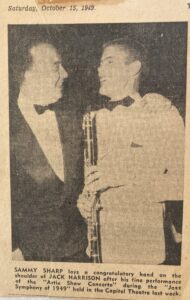
THURSDAY, OCT. 6 1949 – JAZZ SYMPHONY OF 1949 – CAPITOL THEATRE (One Night Only).
1949’s BIGGEST MUSICAL SHOW
Surprise Exclusive Engagement of Australia’s Topline Film, Radio Actor and Producer Star of “Overlanders” Film, Founder and First Conductor of Perth Symphony Orchestra JOHN NUGENT HAYWARD Conducting THE JAZZ SYMPHONY ORCHESTRA IN GERSHWIN’S “RHAPSODY IN BLUE” Featuring LOUISE D’ARCY – A.B.C. Concerto SOLOIST. HUGE LINE-UP OF THE STATE’S BEST PROFESSIONALS ! ! ! SAMMY SHARP‘S JAZZ SYMPHONY ORCHESTRA of 28 Leading Musicians. ALBERT CHAPPELLE Dramatic Baritone in W.A.’s first presentation of the famous “SOLILOQUY” with Orchestra.
JACKIE HARRISON First Performance in W.A. of the thrilling ARTIE SHAW “CONCERTO FOR CLARINET” with Orchestra.
PHYLLIS FROST Sensational Blind B.B.C. Singer. CLIFF ADAMS and “NIDDY” ROBERTS hilarious Comedy Duo. “SOPHISTICATED LADIES” STRING ENSEMBLE All-femme String ensemble heard with success over A.B.C., PETER HARRISON Well-known Radio Personality and Announcer, also prominent “Old'” Jazz Authority. HARRY BLUCK Producer who successfully directed the “Jazz Symphony of 1948”, “Jazz Jamboree,” “Battle of Bands” and other successes. ADMISSION – 3/-, 4/-, 5/- (plus tax) BOX PLAN AT NICHOLSONS. BOOK EARLY TO AVOID DISAPPOINTMENT. [35]
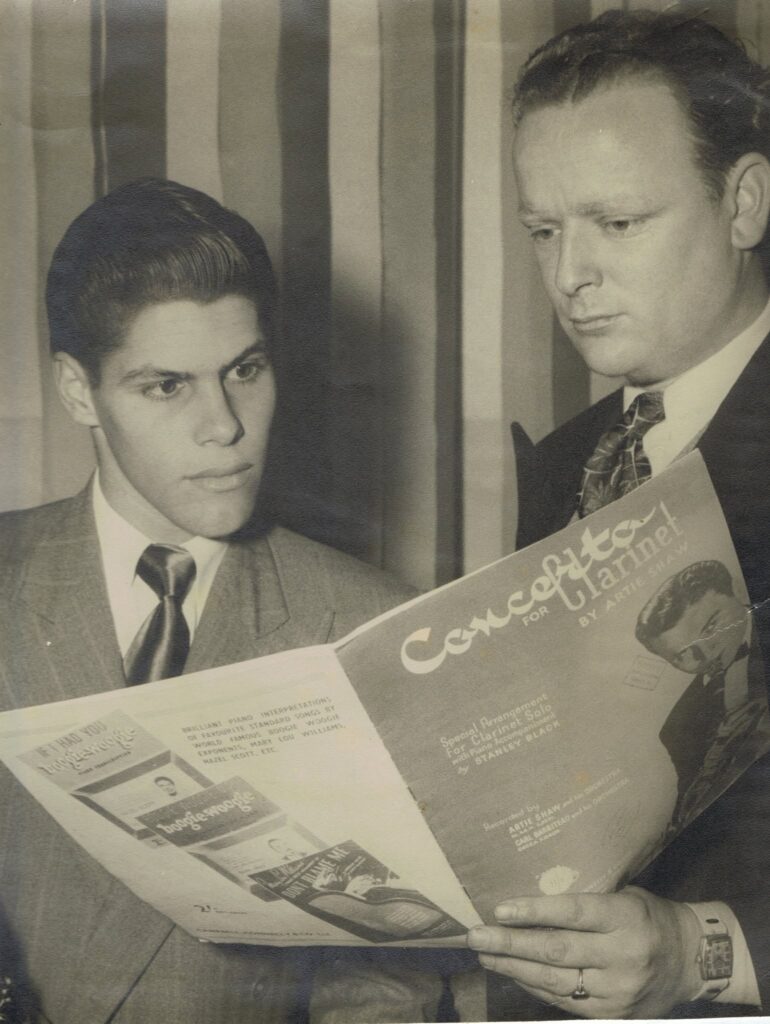
1949 – BLIND SINGER GIVES BIG AUDIENCE THRILL
I don’t think I was the only one that got a kick out of Jazz Symphony of 1949 which packed the Capitol Thursday night. I really believe the audience enjoyed themselves thoroughly. In a grand show it’s hard to single out any particular artist but I hand the palm to blind singer Phyllis Frost (she’s ex-BBC). Her St. Louis Blues was outstanding. Jackie Harrison’s Concerto for Clarinet and Albert Chappelle’s Soliloquy (with full Sammy Sharp orchestra) we’re 2 other winners. So, too, was the big orchestra’s Rhapsody in Blue, in which Louise D’Arcy, piano, and John Nugent Hayward, conducting, were in splendid form. For humor, a talented musical trio in Niddy Roberts, Cliff Adams and Harry Bluck did a top-ranking job. Judging by the size of the audience, jazz concerts are the vogue. Should be a big gathering at the jamboree on October 30. [36]
JAZZ JAMBOREE OF 1949 – CAPITOL THEATRE, SUNDAY, OCTOBER 30th
EIGHT OF PERTH’S BEST BANDS – Alvan St. Jazz Group, Harry Black’s Swingtette, Jack Harrison’s Quintette, Ron Jenkins Lido Quartette, Ken Murdoch’s Band, Bill Kirkham’s Jive Band, Merv. Rowston’s Band, Sammy Sharp’s Band. ADMISSION: 3/6 (reserved). Box Plan at Nicholsons. [37]
1949 – BIG JAZZ SHOW
Over 60 musicians will appear in the “Jazz Jamboree of 1949” in the Capitol Theatre on Sunday October 30. Eight bands will feature every style from Dixieland to bop. The concerts have been held since 1947 and have attracted very big audiences. The proceeds for the show are donated to the musicians’ benevolent fund. The bands taking part will be: Alvan-street Jazz Group, Harry Bluck Swingtet, Jackie Harrison’s Quintet, Ron Jenkins Lido Quartet, Bill Kirkham’s Swing 7, Ken Murdock’s Band, Merv Rowston’s Society 5 and Sammy Sharp‘s Band. [38]
MUSICIANS HERE DON’T LIKE BEPOP
Some of Perth’s leading jazz musicians were asked whether they agreed with caustic comment on bebop by the king of jazz trumpeters Louis Armstrong in Paris last week. Armstrong said that bebop was nothing but friction and squeezing notes out of a bad trumpet. “They play only mistakes and made weird sounds” he said.
Band leader-trumpeter Sammy Sharp, who has played all over the world, thinks that Armstrong is the greatest jazz musician that has ever breathed. “Bebop leaves me cold” he said. “It’s an ultra modern idea of excitement in music, The music itself has a terrific construction with plenty of liberty with chords.” Bandleader and radio swing session compere Ken Murdoch (clarinet and saxophone). Finds bebop “an interesting study”. Band leader-saxophonist Bill Kirkham agrees with Armstrong’s criticism. “It’s surrealism in music and the public doesn’t understand it. I have music for bebop in my library, but my band never plays it,” Kirkham said. Australia’s youngest band leader, clarinettist Jackie Harrison (18) likes listening to the style. [39]
April 1949
Outstanding alto and clarinet man with the Sharp combination, George Caro, has had a colourful career in the game. At 15 he commenced the sax, and as George maintains, was completely self-taught. He first came to the public notice in 1930 when he was one of 18 who competed in the saxophone competition conducted by the Brass Band Association of WA. Winner was Cas Mitchell, now of the ABC Melbourne, second George Caro, Bob Gibson (now in England) was third, and fourth position was filled by Bob Trew (Perth ABC). In 1934, when the exodus was on, George made the Eastern States tour with the Ron Movie outfit, and when this orch. returned to WA, George decided to hit out for the overseas spots. His first working port o’ call was Colombo, where he played at the Mount Lavinia Hotel. From here he went to the Grand Hotel at Calcutta, before making the Malayan Peninsula in 1936, where he played in Singapore cabarets and the Eastern and Oriental Hotel in Penang. On his return to Australia, George linked up with pit work, played for the American Marcus ‘Show, North China Troupe, Dante, and various other visiting shows. During the war he played second cornet with the 28th Battalion Band, and at a later stage, while serving in Darwin conducted a Sunday night Swing Show featuring a 5piece outfit. Returning to civvy street, he joined Chris Gosper’s eight playing at St. Mary’s, Mt. Hawthorn. When Sammy Sharp returned from England, George moved in with Sammy and remained with him ever since. —’QUAIL.’[1]
[1] Mirror (Perth, WA : 1921 – 1956), Saturday 23 April 1949, page 14
JACK HARRISON’S DIARY : Wed 15th Feb 1950 SYDNEY
Did some clari practice and went for a walk. Read till half past then went to Clive Armadio’s place and had a lesson and learnt quite a lot. Came home, quickly got changed and then went to Martin Place and met Mr Reid [George Reid conducted the original Perth Symphony Orchestra and his son Harold gave lessons to Sammy Sharp, Ken Murdoch and Merv Rowston] [40]. Went to the Reid’s for tea by ferry. Met Nancy and Valma. Played the clari and Valma sang. Had supper and came home – got to bed 11.30pm.
THEY WON’T ALL PLAY AT ONCE Three bands will be a feature of the Movie Ball at the Embassy Monday, Aug 20 – Sammy Sharp‘s, Cliff Adams’ and Highland pipers.Novelties include Disney. Terrytoon and Tom and Jerry Cartoons and Sing Songs. 2000 extra lights are being installed and decora-tions will be lavish. A few tickets aro available at the Embassy. [41]
Saturday September 16 1950 – REHEARSAL FOR SAMMY SHARP’S JAZZ FANTASIA
(photo) from left to right: Jack Harrison, Jim Beeson, Betty Wittaker, Sammy Sharp and Keith Whittle. [42]
October 1 1950 “JAZZ FANTASIA” – The Young Australia League – will present Sammy Sharp and his orchestra of 25 in the third annual Jazz Fantasia at the Capitol Theatre on October 1. Supporting artists will include Louise D’Arcy, Jack Harrison, Betty Whittaker, Bryn Gifford, Phyllis Frost and Keith Hounslow. The compere will be Peter Harrison. [43]
Sunday, October 1 1950 – A BLITZ IN MUSIC WILL FOLLOW THE BAND
The Young Australia League band will march through the city as a prelude to Perth’s third Jazz Fantasia at the Capitol Theatre on Sunday, October 1. Sammy Sharp and his Jazz Symphony Orchestra, with many supporting artists will provide the programme at the theatre. One of the featured works will be a performance of London Fantasia, with pianist Louise Darcy as soloist. It is a musical story of the spirit of London during the blitz. Othe. artists will include clarinettist Jackie Harrison; a State finalist in the concerto and vocal competition this year, Phyllis Frost; a blind singer who has been featured with Claude Brampton’s All Blind Orchestra in- London; and Betty Whittaker, star of the Repertory Club’s Maritza. The show will be’ produced by Sammy Sharp and compered by Peter Harrison and Terry Scanlon. [44]
Sunday, October 1st 1950– CAPITOL THEATRE – Y.A.L. Presents “JAZZ FANTASIA”
With SAMMY SHARP and his 25-piece Jazz Symphony Orchestra. Comperes; TERRY SCANLAN, compere Ice Follies (by courtesy David N. Martin, Mgr. Dr. Tiv. Circuit Aust. Pty. Ltd.); PETER HARRISON (by courtesy A.B.C.). Guest Artists Include- LOUISE D’ARCY. Soloist of “London Fantasia”: Jack Harrison in “Clarinet Concerto” and Betty Whittaker, Bryn Gifford, Phyllis Prost, Jimmy Beeson. SAMMY SHARP will be featured in Harry James’s arrangement of “Concerto for Trumpet.” Prices 5/ 4/ 3/ plus tax. Box plan at Nicholsons. [45]
SUNDAY 28th OCTOBER 1951 – CAPITOL THEATRE – JAZZ JAMBOREE Featuring 12 of Perth’s Leading Dance Bands Jazzstars, Cliff Adams, Norm Wrightson, Merv Rowston, Ron Jenkins, Harry Bluck, Jimmy Beeson, Bill Kirkham, Peter Clinch, Ken Murdoch, Jack Harrison, Sammy Sharp. Booking Opens at Nicholsons. Friday 19th October 1951. [46]
Wednesday 28th May 1952 – Jazz At The Capitol
Lena Horne. Spike Jones. Mills Brothers. Harry Eddison. Lester Young. Ella Fitzgerald. Ray Brown . . . They’re just a few big names of modern music in the long list of acquaintances claimed by Ron Stanton, now in Perth. Ron, a Sydneysider, is a genuine young man of music. American tours have given him an intimate knowledge of techniques over there — and he’s bringing them to Perth. Particularly impressed with the annual festival Jazz at the Philharmonic, he has formed a “leaders group” in Perth for Jazz at the Capitol. Group includes Harry Bluck, Sammy Sharp, Cliff Adams, Bill Kirkham, John Mowson, Charlie Thompson and Ron Stanton himself. Program— at the Capitol on Wednesday night— will also include the “name bands” of Perth, Chung Doo, Stanton’s sextet and Jack Harrison’s quartette. [47]
September 14 1952 – GRAND VARIETY CONCERT – Capitol Theatre, Sunday, Sept. 14, 8.45 p.m. Proceeds in aid Musicians’ Benevolent Fund. Artists Appearing. Include Sammy Sharp, Jack Harrison, Vaughan Hanly, Irene Stancliffe, Harry Bluck’s Melodians, Laurie Croisette, Westernairs, Louise d’Arcy, Edgley and Dawe. Madelon Garnier, A.B.C. Perth Singers together with full concert orchestra. 2 bands and 2 dance teams. Book Tomorrow at Nicholsons Price 4/2 (incl.). [48]
1952 – EIGHTY IN VARIETY
At least 80 musicians will take part in a variety concert at the Capitol Theatre on September 14. Bands include the W.A. Symphony Orchestra, the Perth City Band and the Caledonian Pipe Band and two dance bands. Jack Harrison will play the Artie Shaw Concerto for clarinet and trumpeter Sammy Sharp will feature in a solo item. James Bailey and company will feature in a sketch and Edgley and Dawe will provide the comedy in another act while vocals will come from Harry Bluck and the Melodians. Violinist Vaughan Hanly and pianist Louise D’Arcy will both appear with the W.A. Symphony Orchestra. [49]
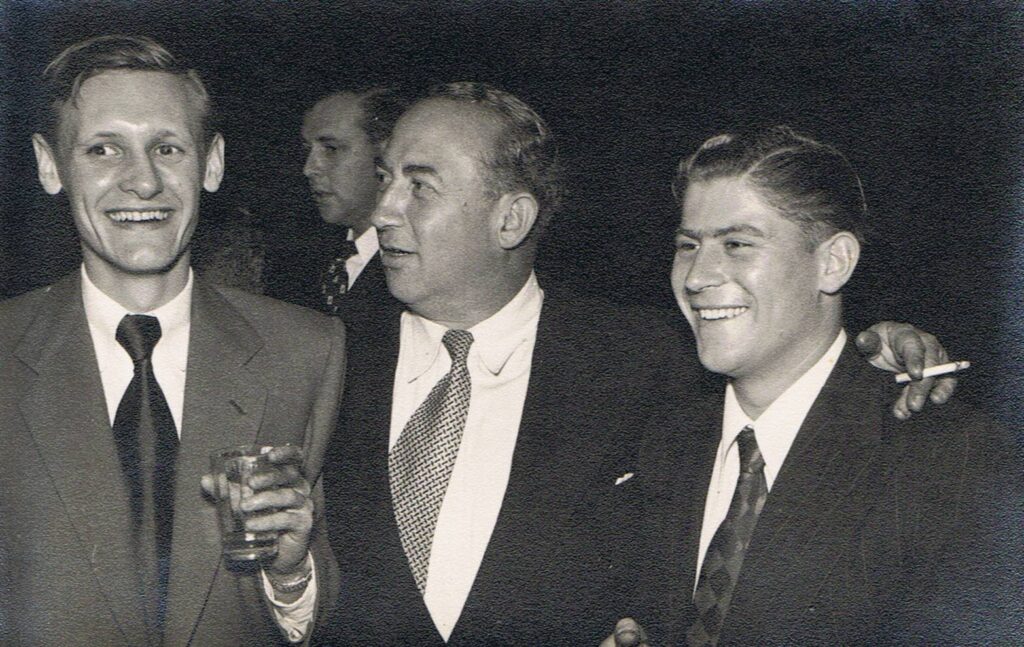
Sunday October 26th 1952 at 8.45pm – Jazz Jamboree – DANCE BAND FANS!
BOOK EARLY And Avoid Disappointment for the JAZZ JAMBOREE CAPITOL THEATRE
SAMMY SHARP, HARRY BLUCK, MERV ROWSTON, KEN MURDOCH, BILL KIRKHAM, JACK HARRISON, THE JAZSTARS, NORM WRIGHTSON, RON JENKINS, JIMMY BEESON, COLIN HICKS, CLIFF ADAM. Tickets 4/- BOX PLAN NOW OPEN AT NICHOLSONS
1952: Sammy Sharp, who led a 17 piece band at last Sunday night’s jamboree, is the man who first introduced the idea to Australia. Sammy, one of our leading trumpeters, left Perth for overseas in the early 30’s. With Wally Hadley he toured a number of Eastern countries before eventually settling in England. Here he played with many world famous orchestras, including Eric Winstone, Ted Heath and Louis Levy. Impressed with the interest created in London by the annual Jazz Jamboree, Sammy Sharp decided to organise a similar concert In Perth in 1946. Held in connection with the Miss Australia contest, it was an instantaneous success. Since then the Jazz Jamborees have gone from success to success. Sammy Sharp is one of the few who works full time at music. He teaches trumpet and is also band master for the YAL band.
Sammy Sharp, Jack and Jill Harrison, Shirley Browne, Niddy Roberts, Stan Grey present: Crazy Capers at the Trocadero, Rockingham, Saturday, May 30. Entries for Marathon and Endurance Dances. Ring B2141. Rockingham 232. [50]
Saturday, May 30th 1953 – CELEBRATE CORONATION at the TROCADERO Rockingham,
Marathon Endurance, Novelty Dancers, Knockout competition — Barbecue Supper. Crazy caper entertainments by Sammy Sharpe, Jack and Jill Harrison, Niddy Roberts Ted Miles etc. [51]
SATURDAY MAY 30th 1953 ROCKINGHAM DANCE
Last Saturday night a Coronation Dance for teenagers was held at the Trocadero Ballroom, when about 150 young people gathered and made merry. The organiser. Mr. Stan Grev. had made all arrangements for a marathon dance around the main town block but was unable to get any starters ~ he even had the band wagon ready with piano and drums set up to supply the music for the dancers. Attempts by comedian Niddy Roberts to drum up some contestants resulted in him getting a well aimed custard pie in the face. Jivey music was supplied by Sammy Sharp his band. A competition was held among the dancers to select a couple to attend the Rockingham Bowling Club’s Ball on the following night. This was won by Graham Burket and Val Burkett who danced the Pride of Erin and won 2 complimentary tickets by popular acclaim. Jack and Jill Harrison, professional dancers from Perth, gave a floor show including a Mexican song and dance to the “Love Song of Rainoldi”. Miss Harrison’s Mexican costume was a red skirt with a lavishly embroidered and towelled blouse, designed and made by her mother and herself. After the dance, dancers attended a barbecue organised by Mr. Grev. when chops were grilled over braziers and served with rolls. Teeners voted the night the best ever. [52]
1953 – LISTENERS WILL HEAR GIBSON
An agreement reached between the W.A. Musicians’ Association and the ABC resulted in last Sunday’s Jazz Jamboree (featuring The Bob Gibson Show) being recorded for broadcasting from 6WF. When the ABC heard that ace band leader Gibson would be the guest artist for the second part of Jazz Jamboree, it came to an agreement with organisers Sam Sharp and Harry Bluck for Gibson’s show to be recorded, and also agreed to pay the W.A. Musicians’ Association a fee for the right to record the show. The date of the broadcast will be published shortly. Gibson is now musical director for 2UW. Recently Gibson signed an agreement with the Columbia Recording Company. The first of his releases to be heard in Perth will probably be “Wild Horses” and “My One and Only Heart”. Gibson, who went to England in 1948 and returned in 1950, now favours big band. He records with a 28-piece band, and for concert and radio work he uses anything from 16 to 20 musicians. Two of his most popular programmes, heard from 2UW and Sportsman’s Parade and Musically Yours. Gibson said that any young musicians who hoped to go abroad needed plenty of capital and lucky breaks. He said that there were too many instances of a bandleader casually approaching a popular tune without having any idea of presentation. Of the orchestra he conducted at the Jazz Jamboree on Sunday night, Gibson commented “They are a first class bunch of musicians. Considering they had such short notice to get together they gave a truly remarkable performance.” The band leader also praised individual performances. He believes that 17 year old Neil Boon could develop into a top line artist. Jack Harrison displayed plenty of versatility and gave a smooth performance, he said. Gibson also praised the responsiveness of the audience. “In modern music there is no greater encouragement” he said. [53]
SUNDAY 27 JUNE 1954 – JAZZ AT THE CAPITOL – TEN TOP BANDS TO BEAT OUT JAZZ
That Jazzbo Collins’ quip ‘Be you round, be you square, it’s guaranteed to curl your hair,’ could well be applied to tomorrow’s ‘Jazz at the Capitol.’ Perth fans have always rushed these shows and judging by the crowd round the box office during the week this one will be no exception. Ten of Perth’s top bands will get together to boost the Wendy Nash Appeal. And in the midst of all this jazz Wendy herself will take the spotlight and play a couple of classical numbers— Clare de Lune (Debussy) end Khatchachurian (Toccato). Organiser Harry Bluck says that though these compositions are definitely in the classical sphere he is sure they will go across well with the jazz lovers. Listed for the program are the Harry Bluck Sextette, Ray Le Cornu’s Band, Cliff Adams’ Sextette, The Jazstars, Jack Harrison’s Quartette, Norm Wrightson’s Band, the Jimmy Beeson Group and Merv Rowsten’s Band. Popular trumpeter Sammy Sharp will be sitting in with Merv. All these outfits, with the exception of Merv Rowston, will play 3 numbers. He will present his own arrangement, ‘Merv’s Music in the Modern Manner.’ Ray Le Cornu’s Band will give out with ‘Tuxedo Junction,’ made famous by the mighty Glen Miller Orchestra. It will be interesting to see how he puts this number across. Also on Ray’s list is the ‘Woodchoppers’ Ball,’ old favorite of which Woody Herman made such a great recording. King’s Park dance-goers know what a terrific job Jackie Harrison makes of the ‘Golden Wedding.’ The hall comes to a standstill when Jackie gets up on the stool to extract those last few high notes from the liquorice stick. Ron Jenkins has built a great reputation with his top class music and comic acts. Ron and his quartette will serve up ‘Crazy Man Crazy’— guaranteed to make everyone ‘go mad.’ Norm Wrightson has a certain touch of class about his presentations. He gets a beautiful tone out of his clarinet — which should be well to the fore. His selections are all numbers played by Benny Goodman groups —’I Got Rhythm.’ ‘South of the Border’ and ‘Undecided.’ Those who were at the Jazz Jamboree last, November will no doubt remember the great reception Martin Gieschus got when he sang ‘That Old Black Magic.’ He had to sing it again. Tomorrow night he is singing current pops-top ‘Answer Me My Love’ with the Jimmy Beeson Group. Jimmy’s other 2 items are ‘Sometimes I’m Happy’ and ‘Cheek to Cheek.’ Jazstars are billed for 2 oldies in ‘Tiger Rag’ and ‘That’s a-Plenty.’ Liza Ray provides the vocal of their third number, ‘Somebody Loves Me.’ Harry Bluck sextette will feature ‘Lullaby of Birdland,’ a number popularised by the inimitable George Shearing. Kath Bass exercises the vocal chords singing ‘The One I Love Belongs to Someone Else’ with the Bluck group. Cliff Adams’ outfit will play ‘The Continental,’ ‘Cumana’ and ‘Long John Stomp.’ It’s no wonder all seats have been taken except 200 to be sold at the door. [54]
AMATEUR NIGHT IN THE DANCE – BAND WORLD
Next Thursday a dozen dance bands will battle it out for the title of WA’s top amateur group at die annual dance-band contest. As well as the prizes, there is the added incentive for the winner of playing as the house band at the Musicians’ Ball later this year. This will be the winner’s first professional engagement. Bands range from trios to 8-piece outfits. Every phase of dance-band work from Latin-American to Dixieland is covered. Idea of the contest is to boost the music business I generally, as well as giving these youngsters a good start in the music world. From these contests will come the new blood so essential to keep up the standard of local modern music. Many musicians who play on Thursday will be recruited by established bands; some groups will enter the professional field as a unit. Not only does this concert help the newcomer, but it also spurs the old hand on to greater efforts. If, for instance, a clarinet man shows out at the contest, all licorice stick exponents here will endeavour to give their best all the time for fear they are given the axe in preference to these newcomers. Age of the players range from 16-20. A few are older. Bands are not restricted in any way in their choice, and this freedom adds much to the show. Each band can select any 3 numbers, only stipulation being that it has to have a set for dancing. Speaking about the advantages of the contest during the week, trumpeter Sammy Sharp said: ‘We feel that there is no back-door to the music business. It’s no good a musician spending his time in a dead-end job hoping that a big break will come some day. Often it doesn’t arrive and WA loses many prospective stars.’ Many Perth maestros donate prizes for the show for instruments as well as for combinations. Among them is one donated by Harry Bluck for the night’s top pianist. Sammy Sharp donates the trumpet prize. Way the popularity of the band contest has grown is illustrated by the number competing. When initiated 3 years ago, there were only 5 entrants, made up to 7 just before the show. This year, apart from the 13 competing bands, many had to be turned away because of lack of time to fit them in! High hopes are held for a further increase over the next year or so. Last year’s winners, the West Coast Dixielanders, lost little tune in getting established in the professional dance world. In a matter of a few months they worked their way into the Jazz Jamboree, which is now looked upon as the showcase of our I dance bands. Unfortunately, this group has now broken up because a couple of its personnel had to leave Perth. Contest has been referred to by some musicians as a minor edition of the Melody Makers’ Poll. This famous dance band contest covers the whole of Britain and assures the winners permanent employment in the music world.
PHOTO: Gathered round Sammy Sharp are the new bloods of the WA Dance Band world. Picture was taken while they were being briefed for the dance band contest (see story left). Happy smiles belie the fact that on Thursday they will be in deadly earnest to win the competition and get a break with some of the bigger bands around town. *VISITING drummer, Buddy Rich and band leader Artie Shaw, on clarinet, rehearsing at their Sydney hotel this week. [55]
KRUPA NOT FOR PERTH
AMERICAN drummer Gene Krupa will not be coming to Perth. Perth orchestra leader Sammy Sharp said today that he received a telegram to this effect. It had been hoped that Krupa would give a performance in Perth on Wednesday, August 25. But Krupa’s reception in Melbourne and Sydney had been so overwhelming that he was giving a return concert in Sydney on August 24 and two return concerts in Melbourne on August 26. If he flew to Perth he would not be able to appear in Sydney on the Tuesday night. a Mr. Sharp said that it would have cost £2000 to bring Krupa to Perth.[56]
BUGLER (10) TO STILL CITY
PHILLIP Mulcahy (10) will be one of nine buglers who will sound in tomorrow’s Armistice Day silence at 11 a.m. Phillip, who lives at Evandale-st., Floreat Park, has been taught the cornet for the past year or more by musician Sammy Sharp. Now Phillip— about 4ft. 3in.— plays first cornet and solo for the Young Australia League brass band . Tomorrow he will be at the Murray-Barrack-sts. .intersection to play the Last Post and Reveille marking the two minutes’ silence which commemorates the end of a World War I. J Eight other buglers will be stationed at other major city T intersections. Phillip is also a singer and his voice is regularly heard over radio children’s sessions. [57]
SUNDAY, 20TH NOVEMBER 1955 THE YOUNG AUSTRALIA LEAGUE presents
Another “JAZZ FANTASIA” with Sammy Sharp and his Orchestra.
35 of the State’s Finest Musicians featuring …Louise D’Arcy — Jack Harrison — Jimmy Beeson — Horrie King, Jack Pope — Martin Gischus — Colin Youlden — Lisa Ray — Keith Whittle — Ralph Filmer — Evelyn Wilson. SPECIAL FEATURE ATTRACTION A NOVEL PARADE OF MEN’S FASHIONS By ELWOODS PAN AMERICAN “STYLE STORE FOR MEN” CAPITOL THEATREBox Plan Now Open at Nicholsons. Adm. 5/. [58]
https://www.forestleaves.blog/post/all-that-jazz-a-sentimental-journey
Photo:
L-R: Peter Boyd (vocalist), Sam Sharp (trumpet, leader), Peter Clinch (tenor saxophone, clarinet), George Caro (alto saxophone, clarinet), Ralph Filmer (bass), Les Mackay (alto saxophone), Keith Whittle (drums), Cliff Adam (guitar), Jim Beeson (piano), Charles Thompson (trombone), Norm McMahon (trumpet), Jack Pope (trumpet), Phyllis Frost (blind English vocalist).
https://pro.nfsa.gov.au/titles/82XV9ACE
Interview
Wally Hadley and Sammy Sharp interviewed by Andrew Bisset for the History of jazz in Australia collection [sound recording]
https://catalogue.nla.gov.au/catalog/4604482
REFERENCES:
[1] Sunday Times (Perth, WA : 1902 – 1955), Sunday 4 August 1946, page 8
[2] West Australian (Perth, WA : 1879 – 1954), Monday 19 May 1947, page 13
[3] West Australian (Perth, WA : 1879 – 1954), Wednesday 21 May 1947, page 10
[4] West Australian (Perth, WA : 1879 – 1954), Thursday 22 May 1947, page 13
[5] Sunday Times (Perth, WA : 1902 – 1955), Sunday 17 August 1947, page 13
[6] Western Mail (Perth, WA : 1885 – 1954), Thursday 9 October 1947, page 4
[7] Northam News (WA : 1947 – 1954), Wednesday 10 December 1947, page 4
[8] Northam Advertiser (WA : 1895 – 1956), Friday 12 December 1947, page 7
[9] Sunday Times (Perth, WA : 1902 – 1955), Sunday 12 October 1947, page 11
[10] Sunday Times (Perth, WA : 1902 – 1955), Sunday 5 October 1947, page 11
[11] The Broadcaster November 13 1947
[12] https://trove.nla.gov.au/newspaper/rendition/nla.news-article46815693.txt
[13] South Western Times (Bunbury, WA : 1932 – 1966), Thursday 18 December 1947, page 16
[14] South Western Times (Bunbury, WA : 1932 – 1966), Wednesday 31 December 1947, page 1
[15] West Australian (Perth, WA : 1879 – 1954), Saturday 27 December 1947, page 8
[16] Daily News (Perth, WA : 1882 – 1955), Saturday 3 January 1948, page 14
[17] The Broadcaster January 1948
[18] The West Australian Monday May 3 1948
[19] The West Australian Monday May 3 1948 page 10
[20] The West Australian Monday 28 June 1948 page 12
[21] The Legion (Legion of Liberty) August 1948
[22] Music Maker October 1948
[23] The Mirror Saturday October 23 1948 Vol 25. No. 1379
[24] The daily News Saturday October 30 page 9
[25] The Broadcaster October 1948
[26] The Mirror Saturday 23 October 1948 page 4
[27] The West Australian Thursday 28 October 1948 page 24
[28] The West Australian Wednesday 8 December 1948 page 33
[29] The West Australian Monday May 3 1948
[30] Music Maker October 1948
[31] The Mirror Saturday October 23 1948 Vol 25. No. 1379
[32] Mirror Saturday 14 May 1949 page 13
[33] The Mirror Saturday June 11 1949, Vol. 26, No. 1412.
[34] The Mirror Saturday 25 June 1949 page 15
[35] The West Australian Friday 30 September 1949 page 37
[36] Mirror Saturday 8 October 1949 page 12
[37] The West Australian Wednesday 19 October 1949 page 30
[38] Jack Harrison scrapbook
[39] Daily News Saturday1949
[40] Andrew Bisset, Black Roots, White Flowers, p.57
[41] Sunday Times (Perth, WA : 1902 – 1955), Sunday 12 August 1951, page 4
[42] The Broadcaster Saturday September 16 1950
[43] The West Australian Tuesday 19 September 1950 page 12
[44] The Daily News Thursday 21 September 1950 page 12
[45] The West Australian Wednesday 27 September 1950 page 37
[47] Mirror Saturday 24 May 1952 page 8
[48] The West Australian Wednesday 3 September 1952 page 19
[49] The Broadcaster Saturday August 30 1952
[50] The West Australian Saturday 30 May 1953 page 27
[51] The Daily News Tuesday 26 May 1953 page 14
[52] Coastal Districts Star Thursday 11 June 1953 page 3
[53] The Broadcaster Saturday November 7 1953 Vol .20 No. 1023
[54] The Mirror Saturday 26 June 1954 page 13
[55] Mirror (Perth, WA : 1921 – 1956), Saturday 31 July 1954, page 12
[56] Daily News (Perth, WA : 1882 – 1955), Monday 16 August 1954, page 1
[57] Daily News (Perth, WA : 1882 – 1955), Thursday 10 November 1955, page 18
[58] The Daily News Wednesday 16 November 1955 page 26
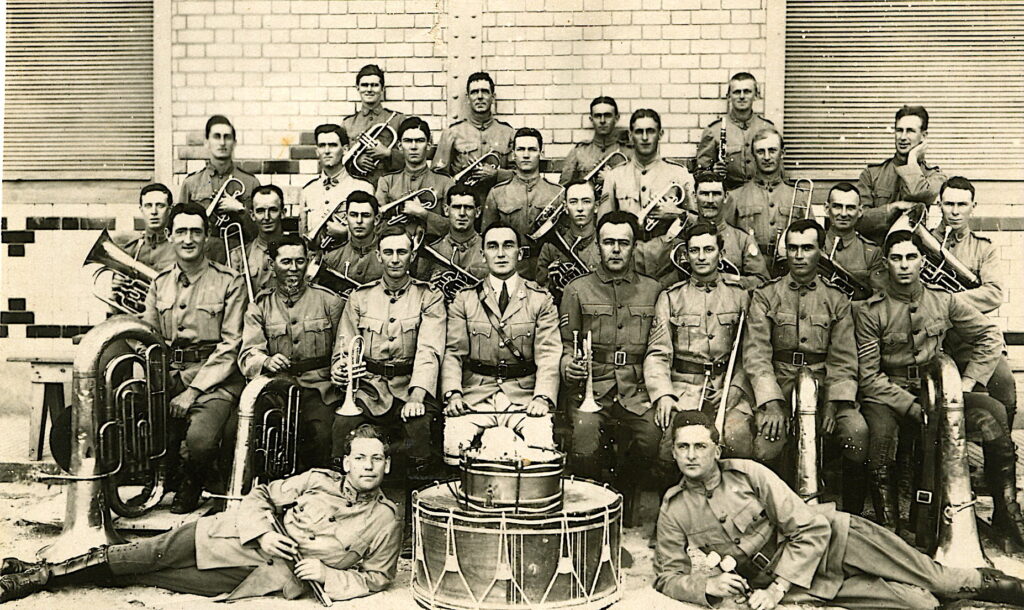
Hidden among the familiar stories of the battles, suffering and sacrifice of the Australian Light Horse lies an extraordinary story of 30 soldiers who could fight, ride—and make music. These were no part-time entertainers. The musicians of the Anzac Mounted Division were fully trained soldiers who were expected to put down their instruments, tie up their donkeys, sling rifles over their shoulders and fight alongside their brigades when called upon.
From 2 September 1917 in Palestine, these remarkably multi-disciplined ANZAC soldiers began to form what became the ANZAC Mounted Division Band. More than a century later, the story of this largely forgotten ensemble is being pieced together through a remarkable combination of a single band photograph and the wartime diaries of one of its members, the solitary Western Australian soldier and musician William Edward Harrison of Subiaco.
As is the case with Harrison’s diary, it details rather dull facts coupled with remarkable ones. Detailed daily army grind eventually whittles away to single sentences as conditions and the sheer challenge of staying alive become challenging. Life revolves around food, letters from home and not being killed by a mortar shell or disease. Teenage morals give way to necessity and Harrison lies, steals and boasts about survival feats that his parents would no doubt have punished him for back home in Subiaco.
Previously uncharacteristic behaviour is displayed by most band members as the war dictates their dreadful living conditions and their fragile mortality becomes evident. Brushing shoulders with highly esteemed officers and royalty is mentioned in the same sentence as how much alcohol was consumed after a performance. Passionate care of their equine partners is interspersed with violent assaults for a few oranges and what trumpet part was being performed that day.
Thirty ordinary blokes aged from 18 to 40 left Australia to fight for King and Country and were in the right place at the right time to throw together a functional band in Palestine. The joy of being able to play music together was clearly evident and the acknowledgment through financial assistance and permanent appointment to Chauvel’s headquarters placed this unlikely group at the front to provide much needed morale to send ANZAC soldiers to battle.
William Harrison’s diary details 140 performances over 20 months from their appointment until 28th May 1919. Details of disease, disciplinary action and tactical circumstances swell and reduce the band numbers, with Harrison’s choice on discharge from hospital to stay two extra few weeks preferring “to go back to the Unit” indicative of the bond that was formed.
Person
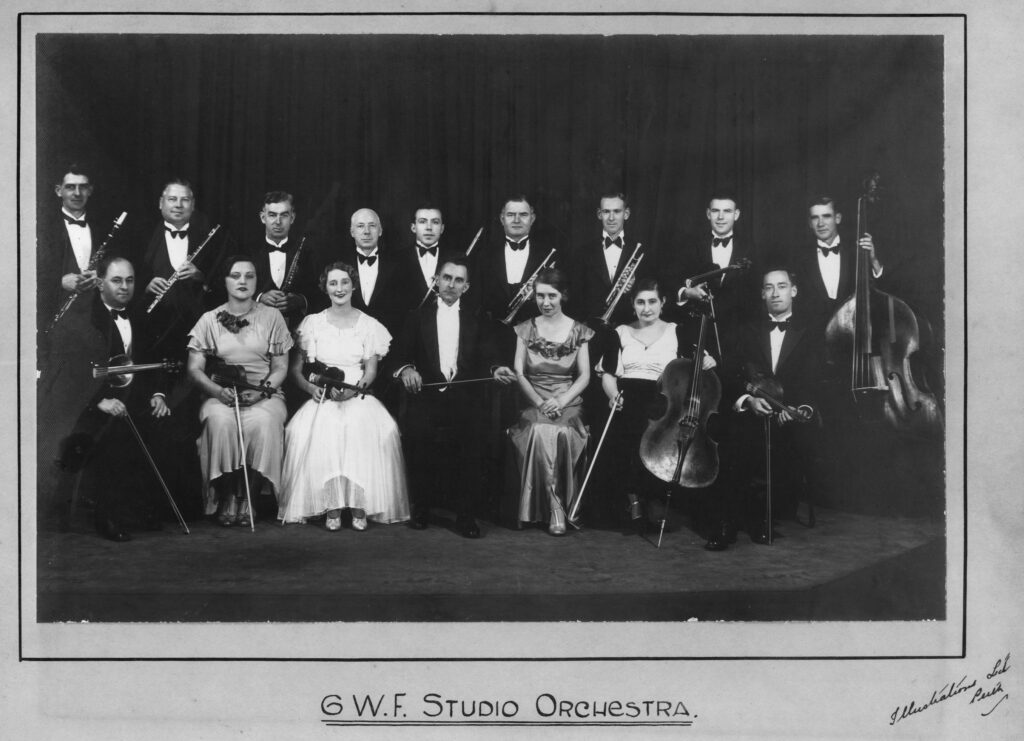
1890–1946
George Mellor was a highly respected Australian musician, teacher, and military bandleader who left a significant mark on the early community music scene in Perth, Western Australia.
Born in 1890, Mellor served his country during World War I as a member of the AIF (#1616). He enlisted and became a key figure in the 51st Battalion, where he served as a Lance Sergeant and Sergeant.
Apres La Guerre.
The 51st Battalion was well served with musical talent, and in its ranks were Sergeant George Mellor (bandmaster), Privates Lionel Hart (violinist), Alf Pateman and the late Bert Goff (pianists).
After the Armistice the 13th Brigade was quartered at Bouvignes, near Dinant, and George and his musicians ran a dance every night in a weaving factory. They were free at first, but the demand for encores and late nights caused a charge of half a franc to be made. There were plenty of ladies, and it was a common sight to see 1,000 couples on the floor, including many distinguished officers of high rank, with wives, or fiancées (I hope!). Colonel Bob Christie, D.S.O., of the 51st., and Colonel Harry Murray V.C. of the 4th Machine Gun Battalion, were frequent visitors.
A fancy-dress ball was the event of the year, and ingenious and appropriate costumes seemed to spring like magic from a district which had been in German hands for four years. Lieutenant Crocker, the 51st Signalling Officer, appeared in a life-like mask with a winking eye and a luminous nose. At the supper he was the great attraction, for, as he disposed of sundry glasses of vin-blanc, so he switched on the luminous nose and winked the eye. The outfit was improvised, and was a testimony to Aussie initiative.
Western Mail (Perth, WA : 1885 – 1954), Thursday 5 March 1931, page 2
The 51st Battalion Band.
Dear Non-Com.,
The very fine picture which appeared in the Diggers’ Diary of young George Mellor enjoying his “annual” brought to mind the first time I heard George perform on his cornet. The year was 1916, place Tel-el-Kebir, and the hour near midnight. The boys had packed up and were lying about waiting for the order to move off to entrain for Alexandria. It was a calm night, and we were getting a bit drowsy, but soon roused when George entertained with numerous melodies.
The 51st Battalion had returned to bi-lets; at Buire after its second trip in at Flers. We were greatly interested when the instruments arrived and the battalion band formed up each afternoon to practice near the railway line. The language used by George in getting, the instruments was an entertainment in itself.
Later we moved forward, leaving the band behind to undergo intense training. We were, naturally, very proud of our band, and were looking forward to much music on our return to billets. However, the circumstances of our next meeting were a little stiff for both sides, as we had been several days marching with bad feet on bad roads. The band was unlucky in having to play us into Buire over the last few miles. We tried to swing along, but found the step too quick, and were soon in trouble. The adjutant had his work cut out galloping his charger along calling on the platoon officers to keep their men in step. This broke the boys up, with the result that the band on its first regimental appearance was counted out!
Later, however, we enjoyed many pleasant hours listening to the band of the good old 51st. “Fifty-Fifty-First,” Subiaco.
Western Mail (Perth, WA : 1885 – 1954), Thursday 31 May 1934, page 2
Upon returning to civilian life in Western Australia, George Mellor embedded himself deeply into the local classical and brass band communities. In 1925, Mellor took on the role of Musical Director for the newly restructured R.S.L. Band (Returned Services League). He was at the helm when the band received a historic delivery of brand-new, premium Besson brass instruments, an event that elevated the ensemble’s prestige in the city. He spent 24 years as a core member and conductor for the prominent Perth RSL Memorial Band, leading high-profile performances at public locations like the Ascot racecourse.
He was a member of Bill Harrison’s Orchestra.
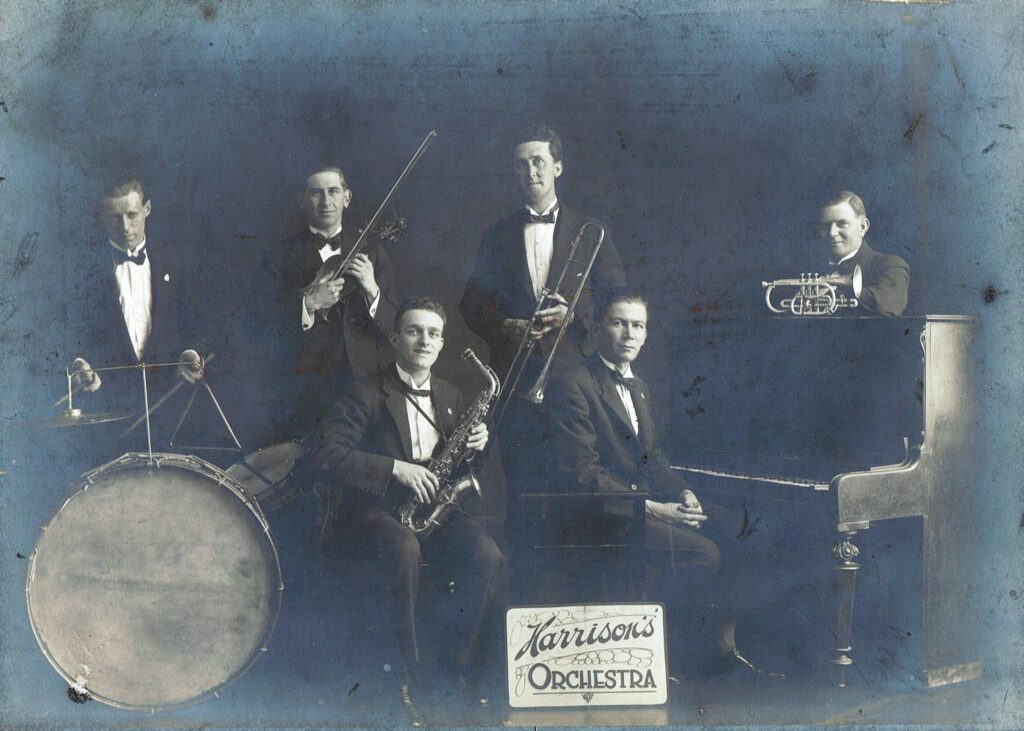
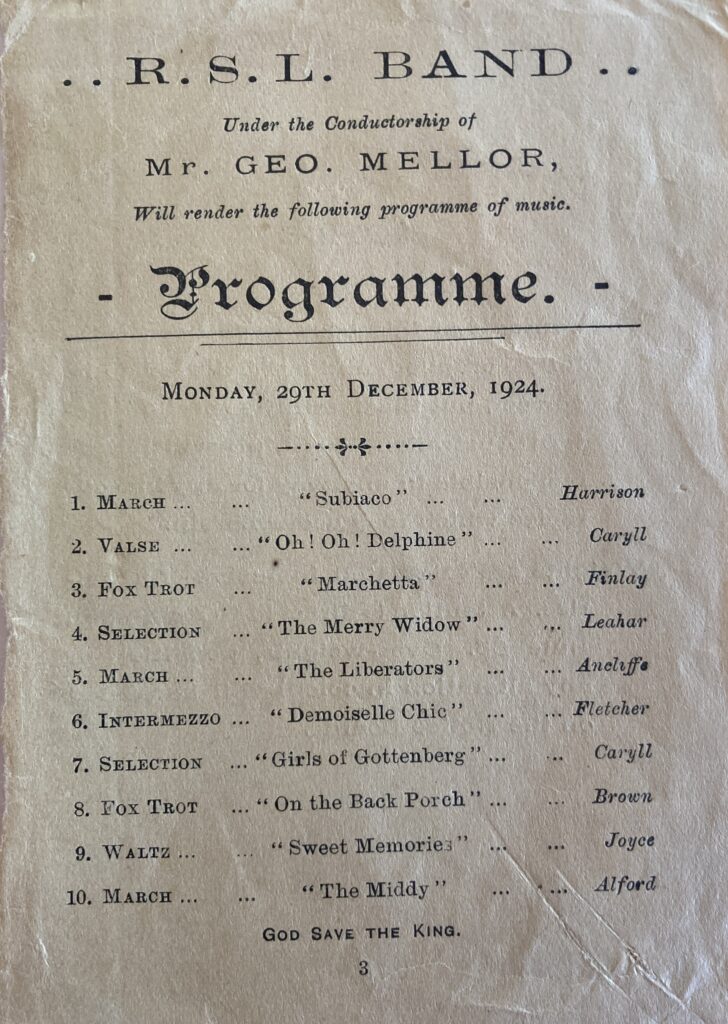
31 May 1931
Perth Symphony Orchestra
The cornet solo “Take A Pair of Sparkling eyes” from “The gondoliers”, played by G. Mellor, “was well set off by a soft accompaniment by the violins”.
1936
In 1936 auditions, overseen by Ernest J. Roberts, were held in order to establish a nucleus of Perth musicians to augment the 6.W.F. Studio Orchestra for public concerts given by the Perth Symphony Orchestra.
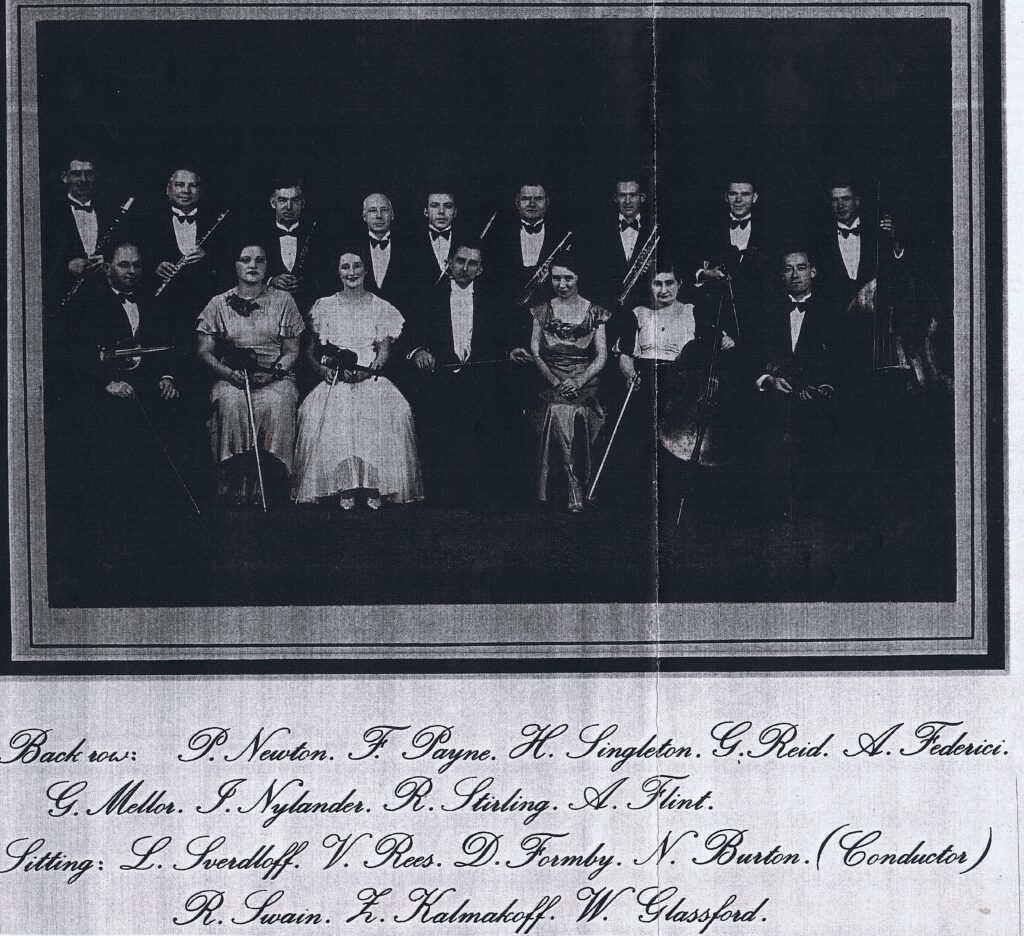
Those chosen for the coveted positions were: Vera Rees (Waterman) as the leader, Lazar Sverdloff and Dorothy Formby 1st violins, Bill Glassford 2nd violin, Bob Stirling viola, Zlata Kalmikoff cello, Freddy Flint bass, Harry Singleton oboe, Fred Payne flute, Percy Newton clarinet, George Mellor 1st trumpet, Ivan Nylander 2nd trumpet, Tony Federici trombone, George Reid drums and Rima Swain piano.
Harrison, Marcia, West Australian Symphony Orchestra Celebrating 75 Years, (WASO Holdings Pty Ltd, 2003). P.11
BACK L-R: Fred Flint, Tony Federici, Harry Singleton, Rima Swain, Lazar Sverdloff, Ivan Nylander, Alec Black, Vera Rees, Percy Newton, William Glassford, George Davies, Bob Trew, George Mellor.
FRONT: ?, Vaughan Hanly, Dave Kember, Harold Thornton, ?.
1929
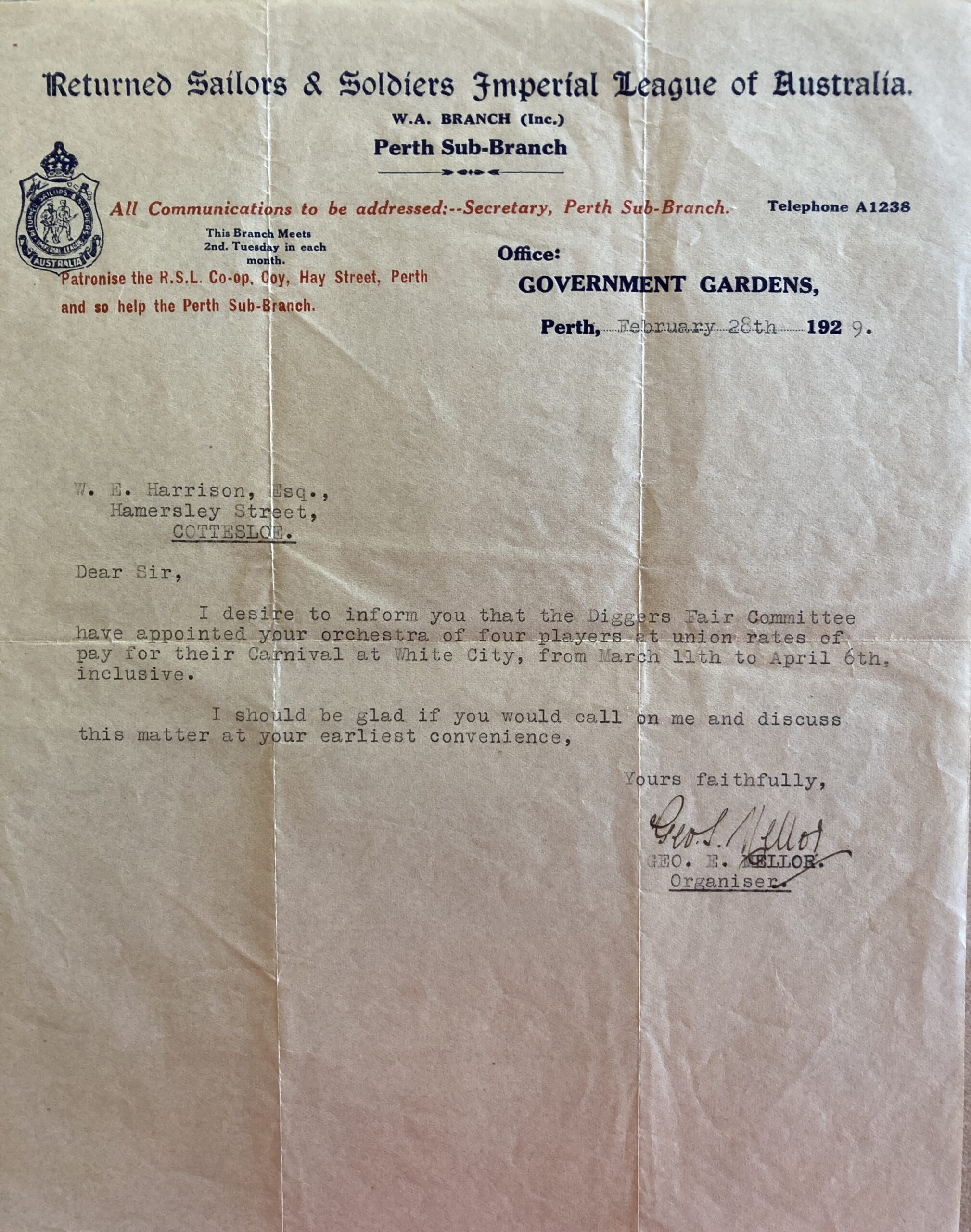
1946
MR. GEORGE MELLOR DEATH ON SATURDAY.
R.S.L and A.B.C. Bandsman.
Well known as a bandsman and as an enthusiast of the Returned Soldiers’ League since its inception, Mr George Mellor died yesterday. aged 56. His last illness was short but he had not enjoyed good health for several years. Although the late Mr Mellor played almost any brass instrument, he was perhaps best known as a cornetist. At the time of his death he was a member of the Australian Broadcasting Commission Orchestra. During many years’ association with the A.B.C. he played under the baton of most of the visiting conductors. Mr. Mellor was probably best known as the conductor of the RSL. Memorial Band, which he founded 24 years ago. One of his proudest achievements was to have been included as the only West Australian member in the, Commonwealth Band which visited America and Canada under the baton of Mr Bert Baile in 1926. Mr. Mellor was prominently associated with the administrative side of the RS.L. for many years. From 1924 to 1940 he was secretary of the Perth sub-branch of the R.S.L. and he was also a member of the State executive for a long period. Paying a tribute to the late Mr. Mellor last night the secretary of the RSL. (Mr. D. M. Benson) said: “The league has lost a very esteemed member and a great supporter, and hundreds of other diggers have lost a good cobber.” Mr. Benson said that as the secretary of the Perth sub-branch Mr. Mellor had successfully advocated the claims of many war widows with the Repatriation Department and the appeal tribunals. He had always made his services available, to sound the last post at diggers’ funerals and had been known to attend nine gravesides as bugler in one day. Although unseen, he was heard by many thousands when he sounded the bugle calls at the dawn services on Anzac Day. Mr. Benson said that Mr Mellor’s old comrade, Bugle-Major George Gilmore, who had been associated with Mr. Mellor as bugler at all Anzac Day parades with the exception of two when Mr-Mellor was again on active service, would sound the last post during a service at the Karrakatta crematorium today.
Mr. Mellor left a widow, two sons and a daughter.
West Australian (Perth, WA : 1879 – 1954), Monday 14 January 1946, page 6
Vale George Mellor
Although he had been ailing for several years, the death of the veteran R.S.L. band master, George Mellor, after a short illness on January 12, came as a surprise that shocked a wide circle of friends. He was a keen enthusiast in R.S.L. affairs and was equally well known in musical circles, both as a conductor and a performer in the Australian Broadcasting Commission’s Orchestra. He played almost any brass instrument, but he was best known as, a cornetist and trumpeter. The late George Mellor was the son of an Army bandmaster, the late Lieut. T. Mellor, who died in Sydney a few years ago. George was born in Sydney, but came to this State as a youth and did his war service with the 51st Bn. Towards the end of 1916, he formed the band of the 51st Bn., which soon became one of the outstanding bands of the A.I.F. He was probably best known as the conductor of the R.S.L. Memorial Band, which he formed 24 years ago, and of which he was bandmaster, with one break, ever since. One of his proudest achievements was to have been included, as the only West Australian member, in the Commonwealth Band, which visited the United States and Canada, under the baton of Mr. Bert Baile in 1926. For several years, he was full time secretary of the Perth sub branch, and he was a member of the State Executive for a long period. Paying a last tribute to an old friend and associate, the State Secretary (Mr. D. M. Benson) said: “The League has lost a very esteemed member and a great supporter, and hundreds of other. Diggers have lost a good cobber.” As secretary of the Perth sub branch, Mr. Mellor successfully advocated the claims of many war widows with the Repatriation Department and the appeal tribunals. He had always made his services available to sound the calls at Diggers’ funerals, and had been known to attend at nine gravesides in the one day. Although unseen, he was heard bv many thousands when he sounded the calls at Dawn and Esplanade services on ANZAC Day. Associated with George Mellor on these occasions was Bugler Major Gilmore, whose only absences were during the two years George Gilmore was again on active service in the Middle East. George Gilmore, with Drummer H. Tuckey, had the sad duty of sounding the calls over his old friend at the Karrakatta crematorium on January 14. Mr. Mellor left a widow, two sons and a daughter, to whom we tender deep condolence on a loss which is ours as well as theirs.
Listening Post (Perth, WA : 1921 – 1954), Tuesday 1 January 1946, page 3