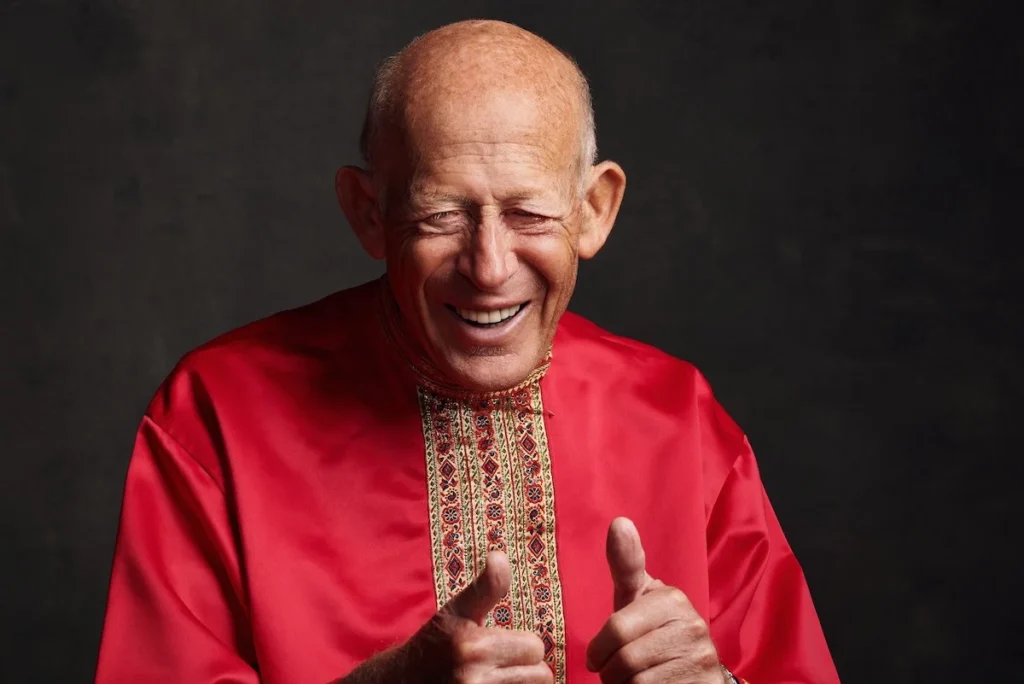
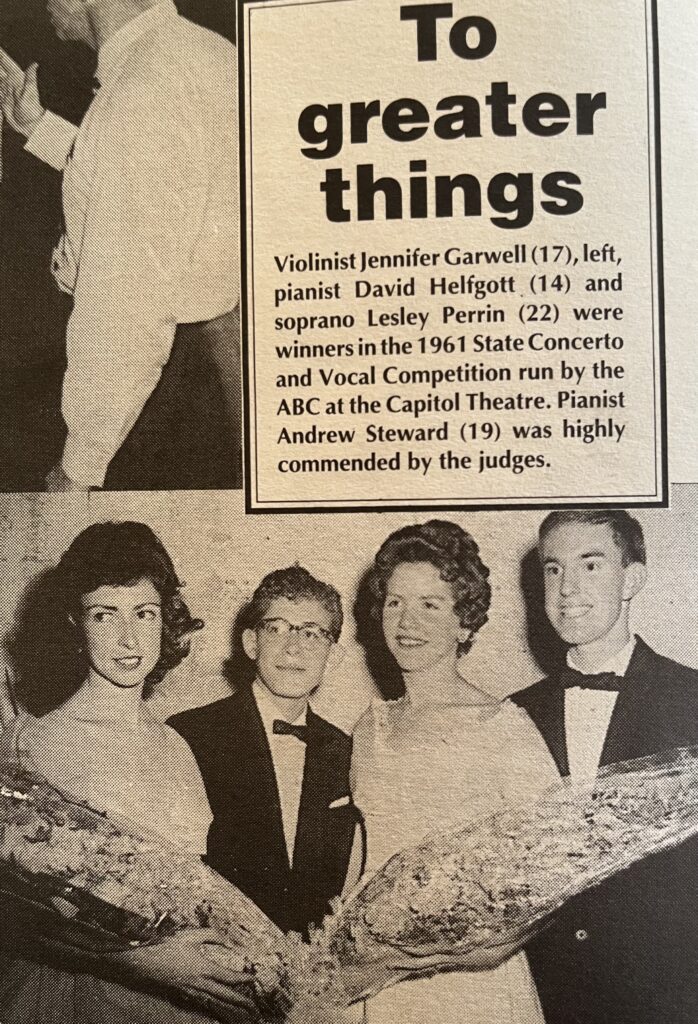
David Helfgott was born in Melbourne, Australia, in 1947. He showed extraordinary pianistic ability from an early age, winning the state finals of the ABC’s Instrumental & Vocal Competition six times.
At age 17, David began studying with Alice Carrard, a former student of Bartok and Istvan Thoman, himself a pupil of Liszt. Two years later, David went to London to study at the Royal College of Music with Cyril Smith, who described him as his most brilliant student in 25 years of teaching and likened him to Horowitz, both technically and temperamentally.
David won a number of awards at the College, including the Dannreuther Prize for Best Concerto Performance for his triumphant performance of Rachmaninov’s Third Piano Concerto. However, towards the end of his time in London, David faced increased emotional instability and mental excitability, compounded by the death in Perth of his mentor, writer Katherine Susannah Pritchard.
A period of frequent hospitalization followed during the 1970s, but by 1976 David had moved to a halfway house where he stayed for six years. The greatest crisis for David had been the loss of his inner music, but he remembers the day the music came back: “The fog lifted, I could hear again … I survived.”
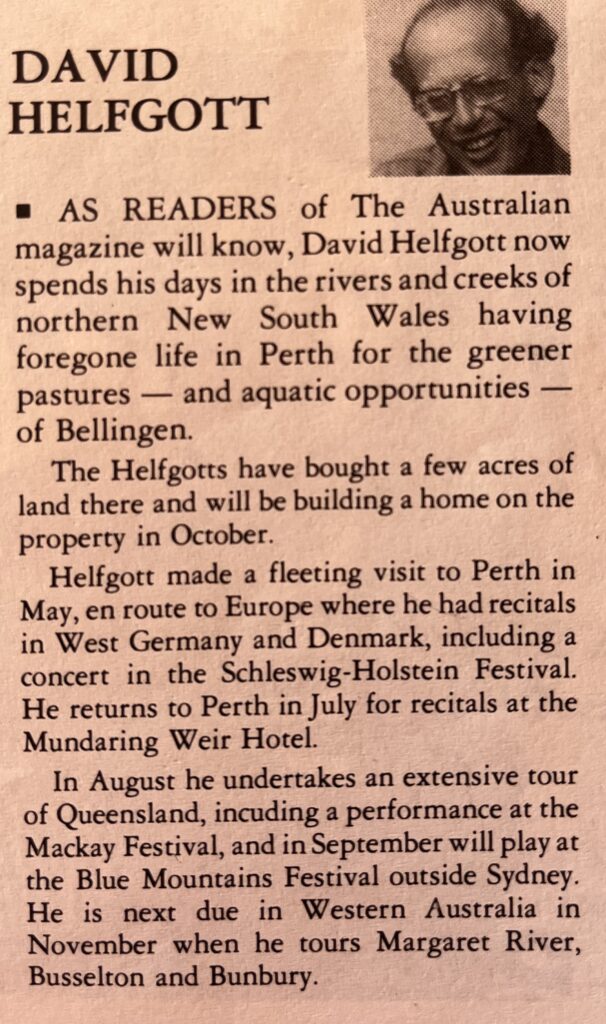
Dr Chris Reynolds, who owned Riccardo’s wine bar in Perth, where David performed on Saturday nights, brought David back to the public’s attention. It was there he meet his future wife, Gillian, who, with the support of promoter Mike Parry, helped David gradually resume his concert career with concert performances in Perth and a sell-out tour of Australia’s eastern states in 1986. This was followed by a trip to Europe, with recitals in Germany and Denmark.
David triumphantly returned to an active life of concert giving and performance, and made a series of CDs, including the soundtrack of the Oscar-winning film Shine, which celebrates his remarkable and inspiring life. David’s recording of the Rachmaninov Third was the number one selling CD in Australia, the United States and the United Kingdom for many months. Both attained gold status.
In October 1996, David played four sold-out concerts at the Sydney Opera House, an unprecedented occurrence. A challenging world tour followed the next year, with packed recitals and performances throughout the US and the UK, concluding with David’s return to the Royal Albert Hall in London, were he played the Rachmaninov Third Piano Concerto to a capacity crowd and received a thunderous standing ovation.
Over the next five years, David kept up his world touring, through Asia, Africa, Japan, New Zealand and Europe, while also maintaining a busy Australian schedule. David released four more CDs, including Brilliantissimo, Brave New World, and one featuring the Tchaikovsky Piano Concerto No.1 and Rachmaninov’s Variations on a Theme of Paganini, two of David’s favourite works. However, the highlight release for this year was In Viva, a disc containing two movements of the Mozart Piano Concerto No. 24 from David’s prize-winning performance in Perth when he was fourteen years of age.
In 2002, David was invited to represent Australia at the Beijing Music Festival and in Guangzhou, while 2003 saw a triumphant tour of Europe – particularly of Austria, where he completely won the hearts of the Viennese.
One of the major highlights of David’s career came in October 2004 when the Edith Cowan University in Western Australia awarded him an Honorary Doctorate of Music. His whole family was in attendance.
David conquered Europe yet again in 2005 and 2006. In Italy, he played the Rachmaninov Third in Montecatini Terme, where both Verdi and Puccini lived and where David and Gillian were awarded the Key of the City. Then it was on to sell-out performances of the concerto in Vienna and Zurich, plus many recitals in Spain, Norway and Denmark. On 26 November 2006, David was inducted into The Australian Walk of Fame.
In 2007 and 2008, David had extremely successful return tours of South Africa, New Zealand and Japan, and major European tours. But his recital in Sydney in November at the City Recital Hall gained the greatest accolades heard in the Hall in recent memory.
The year 2009 opened with David receiving a huge honour when a 2.7 metre sculpture by the internationally recognized sculpture, John Van Der Kolk, was dedicated to David and placed in the Bellingen Council Park in recognition of David’s courage, contribution to music and his work in the community.
In June, David performed in Israel for the first time in both Jerusalem and Tel Aviv as part of the Australian-Israel Cultural Exchange, and then toured Turkey and Europe, with a very successful recital in Vienna receiving one of the greatest ovations of David’s career.
2010 was David’s busiest year with tours of Germany, Cyprus and Turkey, some relaxation at home, then big tours of Australia before returning to South Africa and Zimbabwe. Denmark, Switzerland and Austria, followed by a performance at a conference in Kansas City, a trip to beautiful New Zealand and finally a return home in December.
2011 started in Budapest, followed by Denmark, extensive touring of Turkey and Italy, and more touring of Australia.
2012 was a very exciting year with performances of the Rachmaninov Third Piano Concerto in Europe, the highlight being the performance in the famous Musikverien Concert Hall in Vienna where David received a sixteen-minute standing ovation for a truly memorable performance.
Vienna was again the highlight in May when David performed to 40,000 people at the Life Ball, supporting AIDS. The next day, 19 May, he performed in the Hofburg Palace at President Clinton’s fund-raising dinner, which happened to be David’s 65th birthday. After the performance, David was embraced by President Clinton and the President of Austria, who then stood and sang with all the guests “Happy Birthday”. It was certainly a night to remember.
2013 saw further honours bestowed on David by the Commune of Montecatini Terme in Tuscany, which granted him Honorary Citizenship. This famous spa town is renowned for its association with Puccini and Verdi.
A return to Budapest in July that year was a special occasion to perform the Rachmaninov Third, as it was the birthplace of Madame Alice Carrard, one of David’s most influential and beloved teachers and a fitting end to his European tour.
In August, David undertook his largest Australian tour with 24 recitals. In September, gave his Farewell Tour of South Africa.
2014‘s touring started in Turkey, to our delight. Again there was a great reception and an invitation to return in 2015 for recitals in Istanbul, Izmir and Ankara. Austria, Denmark, Germany and Switzerland were also on the 2015 agenda, plus a return to Budapest to perform the Tchaikovsky Piano Concerto No.1, much to David’s delight.
However, the outstanding musical highlight of the year was David performing with Rhodri Clarke the Rachmaninov Third Piano Concerto on two pianos at the Sydney Opera House. This was followed by a truly memorable performance repeated in Melbourne in June 2015 to an ecstatic audience.
2015 also saw David returning to his old school, Mt.Lawley High School in Perth, where a piano practice room was to be named after him. This was a very nostalgic event for David and the current students were greatly inspired by him.
David also performed with the Royal Australian Navy Band. This was a huge crowd pleaser and a very happy event. David is always thrilled to perform with other musicians and hopes to do a repeat performance in the near future.
2016 was a particulary exciting year with the release of the German documentary Hello I Am David, which covers touring with David performing the Rachmaninov Third Piano Concerto. It is a very endearing film and is now available on Netflix.
Touring in 2016 was very extensive, covering Germany, Austria, Denmark and Turkey, plus Australia extending the number of countries where he has performed to over thirty five.
2017 will start with tours in Europe of the stunning performances of the Rachmaninov Third Piano Concerto for duo pianos, events not to be missed, and a return to the UK (after a long gap) for performances again of the “Rach 3” in Manchester and, to David’s great joy, London at The Barbican on 29 May.
Another highlight will be David’s 70th Birthday Celebration Recital in Copenhagen in the Konsevatoriets Koncertsal.
The truly extraordinary artist that is David Helfgott is continuing to receive the worldwide recognition that his remarkable technical and interpretative genius deserves. His continuing and unparalleled success comes as no surprise to David’s legion of devoted admirers everywhere. They have long regarded his recitals as transcending mere music making, and an affirmation of the tenacity of the human spirit and imagination.
http://www.davidhelfgott.com/piano
https://en.wikipedia.org/wiki/David_Helfgott
1983
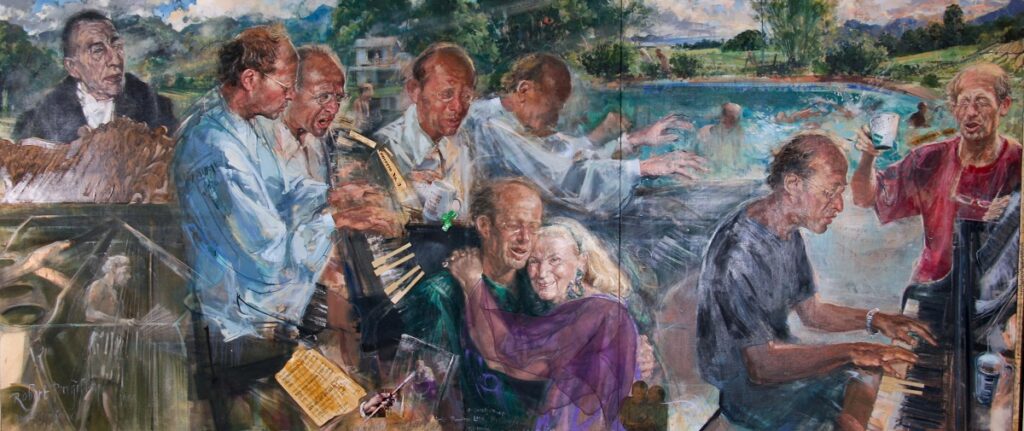
1985
Pianist David Helfgott performed at the inaugural Leeuwin Estate concert on February 23rd 1985 alongside the London Philharmonic Orchestra.
1986
Classical pianist David Helfgott is presenting a recital in the Great Hall or the National Gallery on Saturday, May 31, 8 p.m. He will perform Rachmaninov’s Preludes in B Flat, D, Major and G. Minor; Liszt’s Ballade in B. Minor, La Campanella and Mephisto Waltz, and Moussorgsky’s Pictures from an Exhibition. Helfgott formerly from Melbourne, is now a resident of Perth. His Melbourne recital is part of an Australia-wide tour. Helfgott, a child prodigy who enjoyed success in England, is now on the comeback trail. Tickets ($12) are available by phoning Brian Clark 861 7814 prior to recital, or on the night at the door for $15.
Australian Jewish News (Melbourne, Vic. : 1935 – 1999), Friday 16 May 1986, page 20
1989
On February 18th 1989, the annual Leeuwin Estate concert featured vocalist Dionne Warwick supported by pianist David Helfgott performing “Rhapsody in Blue” with the West Australian Symphony Orchestra.
1990
1996 – Shine
Shine (1996)
Synopsis
David Helfgott (played as a child by Alex Rafalowicz) is a piano prodigy, growing up in Perth in the 1950s. His father Peter (Armin Mueller-Stahl) is a loving authoritarian, determined to keep his family together at all costs, a legacy perhaps of having lost family members during the Nazi Holocaust. In his teens, David (now played by Noah Taylor) is offered a scholarship to study in the US but his father forbids him to go. A few years later, David walks out on the family, to take a scholarship to the Royal College of Music in London, where he has a complete breakdown. He returns to Perth and spends years in psychiatric care and half-way houses. He is still estranged from his father, but he rediscovers his love of performing by playing piano in a restaurant. The restaurant owner (Sonia Todd) introduces him to one of her friends, an astrologer called Gillian (Lynn Redgrave), and a romance blossoms. Eventually, David returns to the concert hall, where he triumphs.
Curator’s notes

Shine is a universal story of great talent triumphing over great trauma, but it was controversial at the time of release because of a debate about what caused the trauma. The film appears to suggest that the father Peter, traumatised by the Second World War, damaged the son. One of David Helfgott’s sisters (see below) later claimed that this was not an accurate portrayal of her father. A different interpretation might also be drawn from the film – that David Helfgott’s illness was just that – an illness that had no external causes, but could be affected by stress. In any case, the film is less about the causes than the depiction of how David Helfgott survived and came to terms with his illness. That is what audiences around the world loved about Shine.
There are at least three great performances in the film, not just that of Geoffrey Rush (as the adult David). Armin Mueller-Stahl is superb as the father, a man whose capacity for love is as obvious as his inability to compromise or forgive. The third great performance is Noah Taylor’s as the adolescent David. In some ways this is the hardest role, because he has to take David from shy 14-year-old to the young man who touches greatness at the Royal College of Music, even as his mind is cracking wide-open. It’s the kind of eccentric role that Taylor has made his specialty, but he gives one of the best performances of what is now already a long career (see The Year My Voice Broke, made in 1987). Geoffrey Rush won almost every award possible in 1997, including the Oscar for best actor in a leading role. The performance made him an international star, with good reason. He makes Helfgott’s mania credible, without becoming self-conscious. He makes the character loveable, without making him pathetic. David’s intelligence is always visible through the fog of his word-plays, and Rush brings a further layer of credibility by playing the piano himself (although the soundtrack mostly uses Helfgott’s own playing). This was also the film that catapulted director Scott Hicks to an international career. He was nominated for an Oscar as best director, one of seven Oscar nominations for Shine. The others were for best film (Jane Scott), best original screenplay (Jan Sardi) and story (Scott Hicks), best supporting actor (Armin Mueller-Stahl), best original score (David Hirschfelder), best editing (Pip Karmel), and best actor (Rush).
The controversy over accuracy stems largely from a book written by David’s sister Margaret (Out of Tune – David Helfgott and the Myth of Shine), after the film’s success. She claimed the film was wildly inaccurate and demeaned her father, who died in 1975. Rather than a tyrant, he was a loving father and husband who was, if anything, too lenient with his wayward son. Scott Hicks wrote a letter to The Wall Street Journal in rebuttal, in which he said that other members of the family supported his depiction of Peter Helfgott and that he withheld far more serious accusations of abuse against the father, out of consideration for the family and the audience. Hicks said he stands by the research that informed the film: ‘I maintain that all of the actions of the character Peter Helfgott have their origins in real events’.
https://aso.gov.au/titles/features/shine/notes/
Title: The Book of David Author: Beverley Eley Publisher: Harper/Collins, 285pp, $14.95 Reviewer: Shira Sebban
THIS book often made me cringe with embarrassment at the washing of one family’s dirty linen in public. For in attempting to tell the story of Australian Jewish pianist David Helfgott, his biographer Beverley Eley is forced to find her way through a maze of often conflicting memories and beliefs held by Helfgott himself and by those who have known him. One Helfgott family member is often pitted against another, such as when Helfgott and his older sister Margaret — who has been elected spokesperson by the family — disagree as to whether their father told the truth (pp 80-81).
Acknowledging such difficulties, Eley tries to present and accommodate all views, often limiting her own involvement to posing questions and raising hypotheses. For example, she provides the reader with several possible explanations for Helfgott’s behaviour, before concluding that “I believe the answer is a combination of all these perhapses” (pp 10-11).
However, she also sometimes takes sides, condoning and condemning, while trying to explain what is perhaps unexplainable. Helfgott’s father Peter tends to be treated particularly harshly, arid is unable to defend himself, having died in 1975.
Eley displays some generosity towards him early on, dismissing as a “myth” the view that Peter was an “unyielding fanatic’’ whose influence made his son ‘different’, and pointing out that “apart from David’s comments … there is no hard evidence to support these claims”. She also states the rest of the Helfgott family’s view, namely, that “Peter was a loving and much-loved father and … David was born ‘different’’’ (p 12).
Yet, later on she writes: “Peter’s entrenched and authoritarian stance … would ultimately lead to the disintegration of his relationship with his ‘Prince’ (David)” (p 88). Blame is clearly being laid at Peter’s feet.
We will never know conclusively why Peter acted the way he did. Little is known of his early life, Eley resorting to a potted version of Polish, Russian and Palestinian history, in which she hypothesises as to the part Peter might have played (chapter 2). All we really have are the often differing opinions of his children and in laws.
As for his wife Rachel, other than her statement that “Peter contributed to increasing her self-esteem and helped her to regain her health” (p 31), her views are rarely mentioned. No explanation is given for this, other than to practically dismiss Rachel as “a woman who had accepted her husband’s direction as to what kind of apples she should buy” (p 231).
Although not a psychologist herself, Eley constantly subjects the reader to pop psychology and truisms in an attempt to explain the behaviour of Helfgott and his family. We are told that in a child, “talking and bladder or bowel control are determined by maturation and learning” (p 47), and that “for some, maturity comes with the years as easily as breathing” (p 192).
But for this approach to work, the book would have had to be written by a trained psychologist or psychiatrist, and preferably by a doctor who had treated Helfgott himself. This, of course, is impossible as it would have destroyed the confidential nature of the doctorpatient relationship.
The book was written in a hurry — and it shows. Eley may have known Helfgott for some time, but Helfgott’s wife Gillian only approached her to write the biography in late 1994. Eley did not agree to do so until July 1995, which means that she had to complete all the research and writing in less than a year, not giving her much time to reflect on and attempt to make sense of such a complex character.
The book would have benefited from more stringent editing. The author constantly jumps back and forth, repeating points just in case we’ve forgotten them. For instance, Margaret’s belief as to why her father didn’t let David study in America is repeated several times (pp 82-83, p 181, p 216). There are also some typographical errors (such as p 213 where the sister of Helfgott’s father is mistakenly referred to as his aunt).
Nevertheless, the book does have its strengths. Eley makes extensive use of Helfgott’s letters, enabling readers to hear his voice as a young man for themselves. She also traces his life in considerable detail, including his first frustrated attempts as a child to learn the piano, early successes and failures, four years of study in London, his return to Australia, many years of repeated depression and mental illness, his gradual recovery, marriage and return to the stage.
Eley clearly shows what a struggle life has been for David Helfgott. But perhaps his very fallibility and courage are what make him so liked by so many.
Australian Jewish News (Sydney, NSW : 1990 – 2008), Friday 23 August 1996, page 29
Peter Helfgott
PLEASE allow me a comment on the film Shine.
The film is well produced and the acting is superb. The character of David Helfgott’s father, however, the late Peter Helfgott, has been horribly distorted and does him a great injustice.
After seeing the film, people seem to have the impression that David Helfgott’s breakdown was caused because his father placed too much pressure on David. Peter Helfgott was portrayed as having been too strict and overbearing. Those TV promotions for the film which I chanced to see, showed only the sequences which portrayed Peter Helfgott as a demon.
In a feature article printed in “The West Magazine” last year, Scott Hicks, the filmmaker, was quoted as saying — Shine is a dramatisation inspired by Helfgott’s life. It is not a documentary. It is a narrative, fictional, feature film.” If this were truly so, one would have to wonder why the filmmaker chose to use real names.
Please remember that it was Peter Helfgott who recognised his son’s talent and who made many sacrifices to enable David to develop his talent. Sadly history has shown that those blessed with great talent sometimes break down.
The filmmaker has offered an interpretation of David Helfgott’s life which lends dramatic appeal to the story, but the film portrayal has done untold damage to Peter Helfgott’s reputation. I just don’t know how such a great wrong can be redressed. Let us be mindful for the feel ings of Peter Helfgott’s widow, Rae Helfgott and her children and refrain from indulging in pop psychology. Let us not destroy Peter Helfgott’s Shern Tov, his good name.
Miriam London Menora, W A
Australian Jewish News (Melbourne, Vic. : 1935 – 1999), Friday 25 October 1996, page 18
1997
David Helfgott
A MAJOR concern with Ms Mar garet Helfgott’s campaign (AJN 22/11) against Shine is the way she talks about her brother David, as if he does not exist. David is indeed alive and well, and more than capable of making judgements about his own life and how it should be portrayed on film.
Shine, to a remarkably faithful degree, presents David’s perception of his childhood and his relationship with his father. Others might have different perceptions, but that in no way denies the reality of how David sees the events which played so important a part in his life.
Margaret is quoting medical sources about David’s mental history. And discussing very private and privileged matters without her brother’s permission. As well, Margaret’s reference to David’s “partial recovery” is not only ungracious but hardly the sort of supportive remark one would hope from a sister, who, like David, has had to endure many difficulties. Denial may be one way of coping, but it is not David’s and he should be supported in taking whatever healing path he chooses.
Gillian Helfgott
(David Helfgott’s wife) Bellingen, NSW
Australian Jewish News (Melbourne, Vic. : 1935 – 1999), Friday 29 November 1996, page 25
Helfgott family
I WOULD like to reply to a letter from Gillian Helfgott (AJN 29/11/96) in which she objected to my quoting medical information regarding my brother David’s health. This seems strange considering that Gillian herself arranged for David to be interviewed by his psychiatrist, Dr Susanne Win on the Witness programme of August 6, 1996, with Gillian present, when the diagnostic details were presented publicly nationwide on television.
Secondly, I have no “campaign against David”, as claimed by Gillian. The film stands on its own merits as an excellent cinematographic work and crowd puller. This does not mean, however, that it is sacrosant regarding legitimate criticism. It depicts my father in a cruel and offensive way. My criticism is totally focused on the biased and inaccurate character depiction of Peter Helfgott who was, incidentally, not exclusively related to David, but to all those who treasured and loved Peter, including other children and his widow. Are our thoughts, hurts and distress of no consequence?
The pity is that this film could have been made without “speaking ill of the dead”, a strict tradition in Judaism.
Lastly, Gillian objects to David’s current state being referred to as “partial recovery” from his illness. Please God that his health will strengthen and increase until his recovery will be indeed complete. It is a great comfort to know that David is once again able to participate as fully in his beloved world of music.
Margaret Helfgott Israel
I SAW the film Shine on the Gold Coast with friends. I walked out of the theatre. The acting was very good, but the way the film portrayed Peter Helfgott was unforgiveable. I was a bridesmaid at the wedding of Rae and Peter Helfgott in Melbourne in 1944. Peter was a clever and gentle man and knew what was good for his children. He had a difficult time and friends let him down so he shifted to Perth. Times were very hard then for the family.
I am very sad at what this film has done to Peter’s reputation as a fine and kind man.
Miriam, Lemish Doncaster
This correspondence is now closed. The Editor
Australian Jewish News (Melbourne, Vic. : 1935 – 1999), Friday 24 January 1997, page 16
1998
In February, advantage was taken of the immense popularity of the movie “Shine”. Western Australian pianist David Helfgott – whose life story was the subject of the film – was featured playing its musical centre-piece, the Piano Concerto No. 3 by Rachmaninov. Gerald Krug was the conductor for this special concert.
Harrison, Marcia, West Australian Symphony Orchestra Celebrating 75 Years, (WASO Holdings Pty Ltd, 2003), p. 115.
2010
https://thewest.com.au/news/wa/helfgotts-to-shine-in-perth-ng-ya-221437