This article was published:
- in the Australian Dictionary of Biography, Volume 15, 2000
- Online in 2006
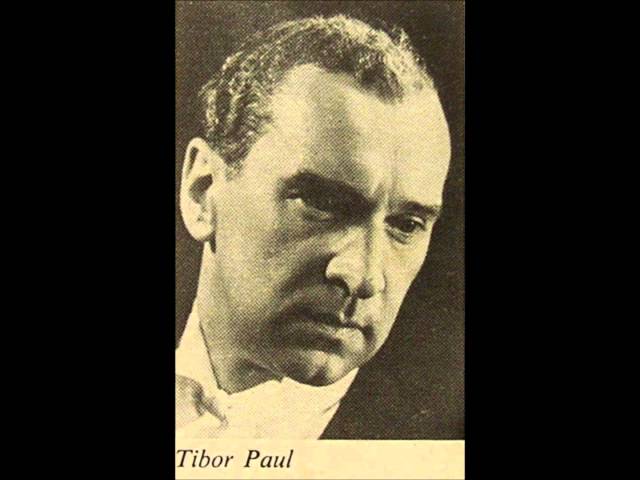
Tibor Paul (1909-1973), conductor, was born on 29 March 1909 in Budapest, son of Antal János Paul, vintner, and his wife Gizella, née Verényi. Tibor studied piano and woodwind instruments at the Liszt Ferenc Zenemüvészeti Föiskola under the composer Zoltán Kodály and the conductors Hermann Scherchen and Felix Weingartner. In 1930 he founded the Budapest Concert Orchestra which, through his leadership and that of guest conductors, ‘rapidly achieved a high standard’. On 9 November 1935 he married Maria Penninger in Budapest; they were to have two sons. In 1939 he began conducting his own orchestra. About this time he became an adviser to the recording firm Durium Products Corporation, recording supervisor of the fledgling Hungarian film institute and a conductor at the Budapest National Theatre. By 1945 he was principal conductor for the Hungarian Broadcasting Corporation.
In 1948, when communist rule was established in Hungary, Paul left for Switzerland. He conducted for the Swiss Broadcasting Corporation and at the opera house in Berne before emigrating to Australia with his family in 1950. Within a year he was a conductor with the New South Wales National Opera and a guest conductor with the Australian Broadcasting Commission. Appointed to teach orchestral and choral conducting at the New South Wales State Conservatorium of Music in 1954, he was also principal conductor for the Elizabethan Theatre Trust Opera Company in 1954-55. On 28 November 1955 he was naturalized.
Paul found that the A.B.C. was unable to offer him sufficient engagements. He regularly corresponded with (Sir) Charles Moses, the general manager, asking to be given more concerts. During his nine years with the commission he worked extremely hard, travelled widely throughout Australia and conducted in every capital city. Meanwhile, he made trips to Britain, Italy, Switzerland, the Netherlands, Denmark, France, Portugal and Austria. A vigorous promoter of Australian composers, he toured Europe and North America in 1958 and included the work of Australians in his concerts.
In 1959 Paul left for Europe with his wife and younger son. He eventually settled in Ireland, where he was principal conductor (1961-67) with the Radio Eireann Symphony Orchestra and director of music (1962-67) for Radio and Telefis Eireann, Dublin. Although he visited Australia from time to time, he was based in Ireland for almost seven years. A versatile and accomplished musician, he had a fiery temperament. At the behest of the Elizabethan Theatre Trust, he returned to Sydney in October 1968 to conduct its orchestra. Over the next six years he divided his time between Australia and Europe.
Appointed conductor of the Western Australian Symphony Orchestra in 1971, Paul led three seasons in Perth.
He knew by heart 47 symphonies, 11 operas and numerous other works, and seldom conducted from a score.
1972
Tibor Paul, resident conductor of the West Australian Symphony Orchestra, made a welcome return to the dais in last night’s youth concert at Winthrop Hall. With the W.A. Symphony Orchestra, he skilfully directed works by Stravinsky, Stanford and Beethoven amid enthusiastic applause from the audience. The guest artist was the clarinettist Jack Harrison. Stravinsky’s Ballet Suite “The fairy’s Kiss” offered a kaleidoscope of orchestral textures and was a systematic workshop of individual instrumental colour. The stillness of the string playing in the opening scene and their clipped clarity and momentum against burlesque brass effects in the second scene were highlights of the reading. Airy fairy floss dynamics were in character with the allegory and beautifully sustained the mood of each tableau. It was an impressive performance. So too was Jack Harrison’s solo performance in Stanford’s Clarinet Concerto Op. 80. Heavy, nostalgic harmonies, perhaps a trifle solid were given exceptional momentum under Mr Harrison’s deft direction. Orchestral and solo balance was ably sustained. Beethoven’s Fifth Symphony was the final number on the program. This could have been weightier and there were instances of rhythmic and instrumental blemish that were not entirely satisfactory.
The West Australian Wednesday May 10 1972
Congratulations – we’re lucky to have you, Mr Paul – By Robert Gude
If conductor Tibor Paul thought the rousing ovation he received at this week’s Youth Concert was simply urging him on for an encore, he misjudged his young audience. It is customary for audiences who want more for their money to stomp and holler hoping for a kind of bargain basement addition to the printed program. Such was not the case following the WASO’s fine performance of the titanic Fifth. Every section without exception excelled in alternating dynamics and delicacy, Mr Paul conducting without a score, was in complete command with his subtle sweeping cues and characteristically spare, precise beat. Jack Harrison was heard in a fine reading of Stanford’s Clarinet Concerto. Mr Harrison alone saved this plain, uninteresting work bearing shades of Elgar and a momentary sally in Wagner. For one brief moment, an elegant melody carried by the entire string section could have lent unusual character to this concerto – had Stanford continued variations on this theme for solo clarinet, developing and alternating this material into meaningful music. Mr Stanford chose however to leave this melody suspended in mid-air, a la Bruckner, never to be heard again. Mr. Harrison came upon this work during his recent Churchill Foundation study tour and brought it to us as an example of fine writing for clarinet. This it was beyond doubt propelled by Mr Harrison’s undoubted skill and this was reflected in the fine reception he received from a young audience which appreciates his enormous talents. The program opened with Stravinsky’s orchestral suite from the ballet “The Fairy’s Kiss” one of this great Russian, French, American’s gentler works. What could go unnoticed was the excellence of harpist, Michael Jefferies, the first chair solo quartet provided by leader Vaughn Hanly, Stanislav Kowarski (second violin) George Coleman (viola) and Raymond Fraser (cello) and, again risking reputation, the WASO’s splendid horn section led by Neil Pierson. Concert audiences in Liverpool, England still recall with awe and admiration Mr. Paul’s appearance on the podium of the Royal Liverpool Philharmonic last October. Here, beyond question, is a conductor of world standing. The A.B.C. the WASO and Perth concert audiences should appreciate the nature and global reputation of Mr. Paul while he is with us, they should count themselves fortunate.
Sunday Independent May 14 1972
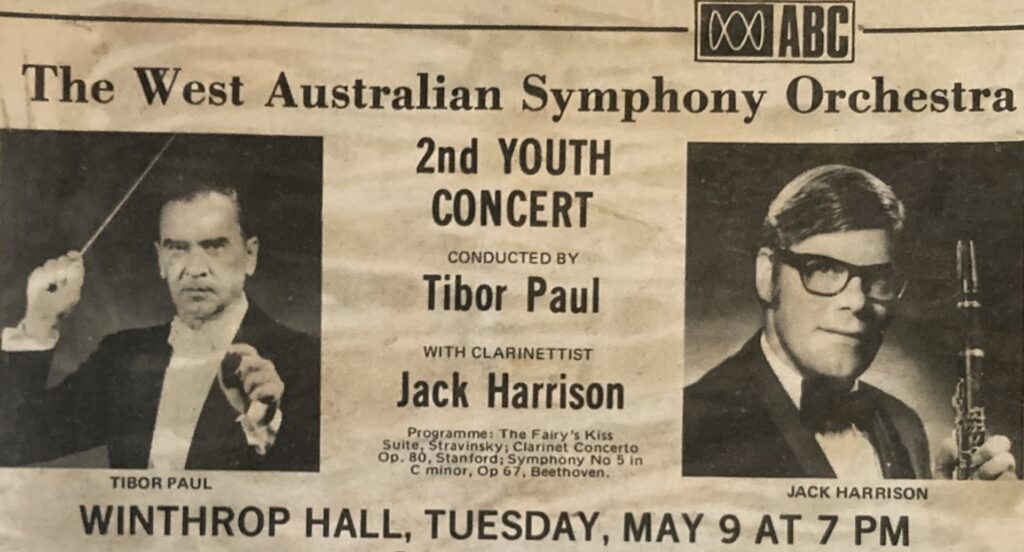
| 9.5.1972 | Charles Villiers Stanford
Clarinet Concerto, Op. 80. AUSTRALIAN PREMIERE |
Jack Harrison (clarinet)
Tibor Paul (conductor) West Australian Symphony Orchestra |
Youth Concert, Winthrop Hall, University of Western Australia |
Night of Russian Musical heritage
By John Meyer
Friday June 23 1972
In an evening of Russian music at the ABC orchestral subscription concert in Winthrop Hall last night three works illustrating different facets of that nations musical heritage were featured. The highlight was a controlled and well-defined performance of Tchaikovsky’s Fifth Symphony in E minor played by the West Australian Symphony Orchestra and conducted by Tibor Paul. Mr. Paul’s total view of this symphony seem to be an admirable one. He did not emphasise only it’s obvious emotional qualities but gradually built up the drama from the sombre opening for clarinets to the triumphant climax of the final. In this last movement he was well supported by the Orchestra. The performance throughout was distinguished by some fine solo playing especially by Neil Pierson, horn and Jack Harrison and Peter Clinch clarinets.
The West Australian Saturday June 24 1972
Spectacular Performance
With Robert Gude
This week’s 1972 Youth Concert at Winthrop Hall began with a rather lethargic reading of Rossini spirited overture to The Thieving Magpie. Both conductor, Tibor Paul and the Orchestra seemed weary following the massive work devoted to Mahler’s Fifth only a few days before. Perhaps to compensate for a lack of crispness, Mr. Paul increased the tempo during crescendi allegro passages which made it difficult for the heavier brass to produce definitive articulation. The same tendency occurred during the major work Rimsky Korsakov’s Scheherezade in which perfectly etched brass textures were rushed. However, it was the woodwinds Mr Jack Harrison on clarinet, Mr Owen Fisenden on flute and Mr Brian Pope on bassoon which saved the suite in its more expressive moments.
1973
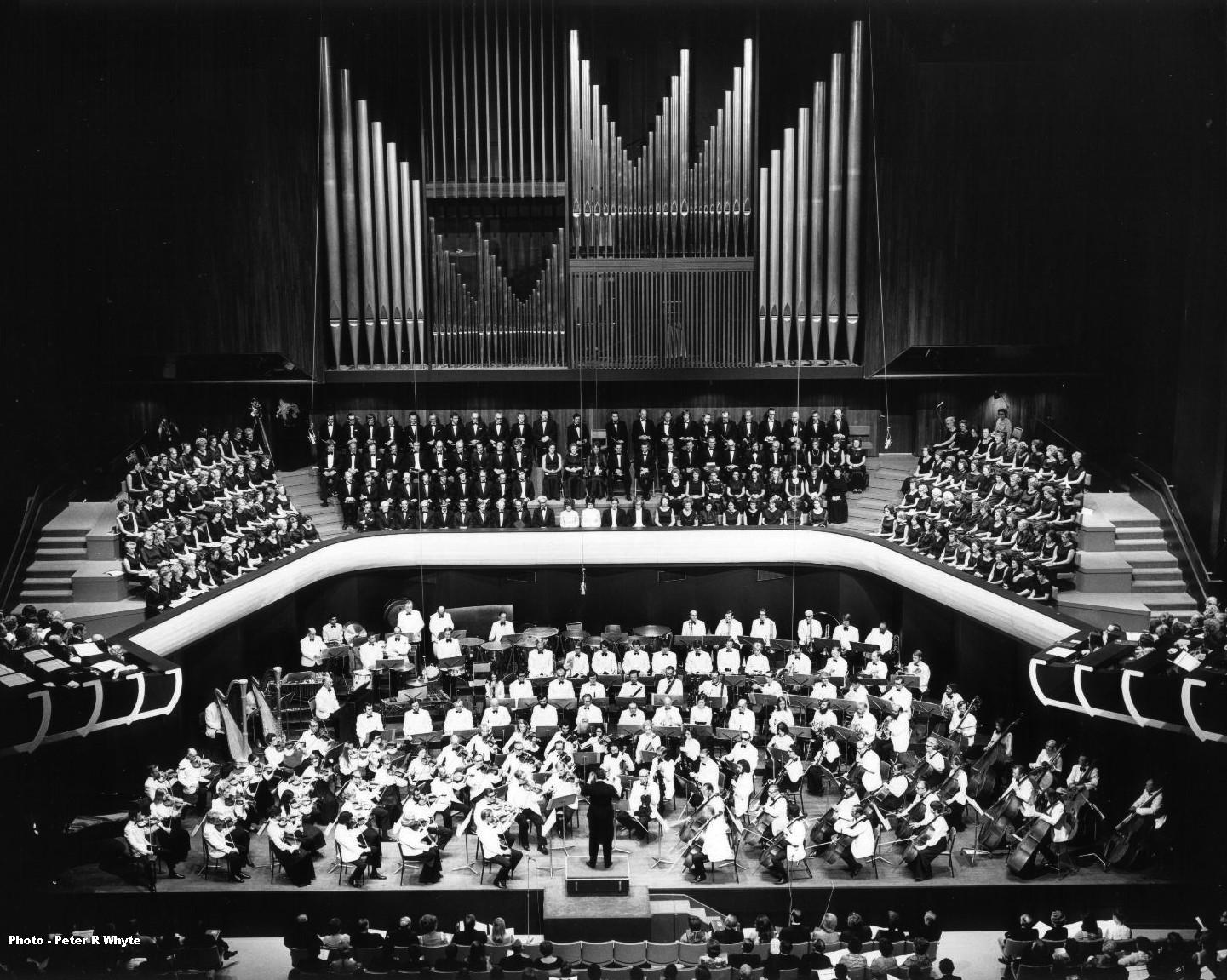
In January 1973 Tibor Paul conducted the combined West Australian and South Australian symphony orchestras in a performance to inaugurate the Concert Hall, Perth.
MUSIC PROGRAMMES
A six-part series of West Australia Australian Symphony orchestral programs under the baton of conductor Verdon Williams and Tibor Paul will begin on Channel 2 on Thursday. The series also brings before the public seven of Western Australia’s leading concert Hall soloists: Robert Armstrong (flute); Jack Harrison (clarinet); Leslie Perrin (soprano); Ashley Arbuckle (violin); the Perth Trumpet Trio and pianists Wendy Pomroy and David Bollard. Music for the series was selected for its broad appeal. Works range from the themes from “Love Story” and “Exodus” and the part from the ballet Spartacus (made popular as the theme from the television series The Onedin Line) to Rossini’s Barber of Seville overture the Capriccio Italien by Tchaikovsky and Mozart’s Eine Kleine Nachtmusik.
The Sunday Times April 29 1973
RACHMANINOFF AT HIS GREATEST – By Robert Gude – May 1973
Sergei Rachmaninoff, last of the great romantics, was well remembered at the Perth Concert Hall this week with the 100th anniversary performance of his second symphony. It was obvious that conductor Tibor Paul had taken great pains in preparation. From the first statement of the primary theme in the first movement on cellos and basses, members of the W.A. Symphony Orchestra were as absorbed and engrossed as their musical director. A long work rich and melodic invention, generously scored and meticulously constructed, it must be considered as a whole despite the desire to single out movements or pick sections to pieces. It is in this regard that strict though the classical romantic form may be, it is logical, precise and entirely clear in its intentions. Oddly enough it is in this respect- and for a creative use of melody – that the romantics such as Rachmaninoff are despised by music’s avant garde. On the other hand, beyond conventional romantic melodic and harmonic style in a work of such big dimensions as this symphony, there is much intellectual satisfaction in Rachmaninoff’s contrapuntal writing and his use of orchestral resources. There are several characteristics about the symphony which suggests that Rachmaninoff like most composers in their time, was seeking to create a new sound. His use of the middle voices in woodwinds (clarinet in the low register and the cor anglais) and in the strings (prominent viola and cello lines recurring throughout) gave his orchestra a tawny texture not heard before or since. Of individual musicians, mention must be made of Mr Jack Harrison’s perfect silvery melodic line on clarinet in the adagio. Rachmaninoff liked the smooth velvety tone of the clarinet used it often in solo passages, and Mr Harrison was obviously en rapport with the work from the beginning.
Sunday Independent May 13 1973
Survived by his wife and sons, he died of a coronary occlusion on 11 November 1973 in his home at Wahroonga, Sydney, and was cremated with Catholic rites.https://adb.anu.edu.au/biography/paul-tibor-11352
Happy Birthday WASO
By Derek Moore Morgan
ABC Documentary “FIFTY YEARS ON”
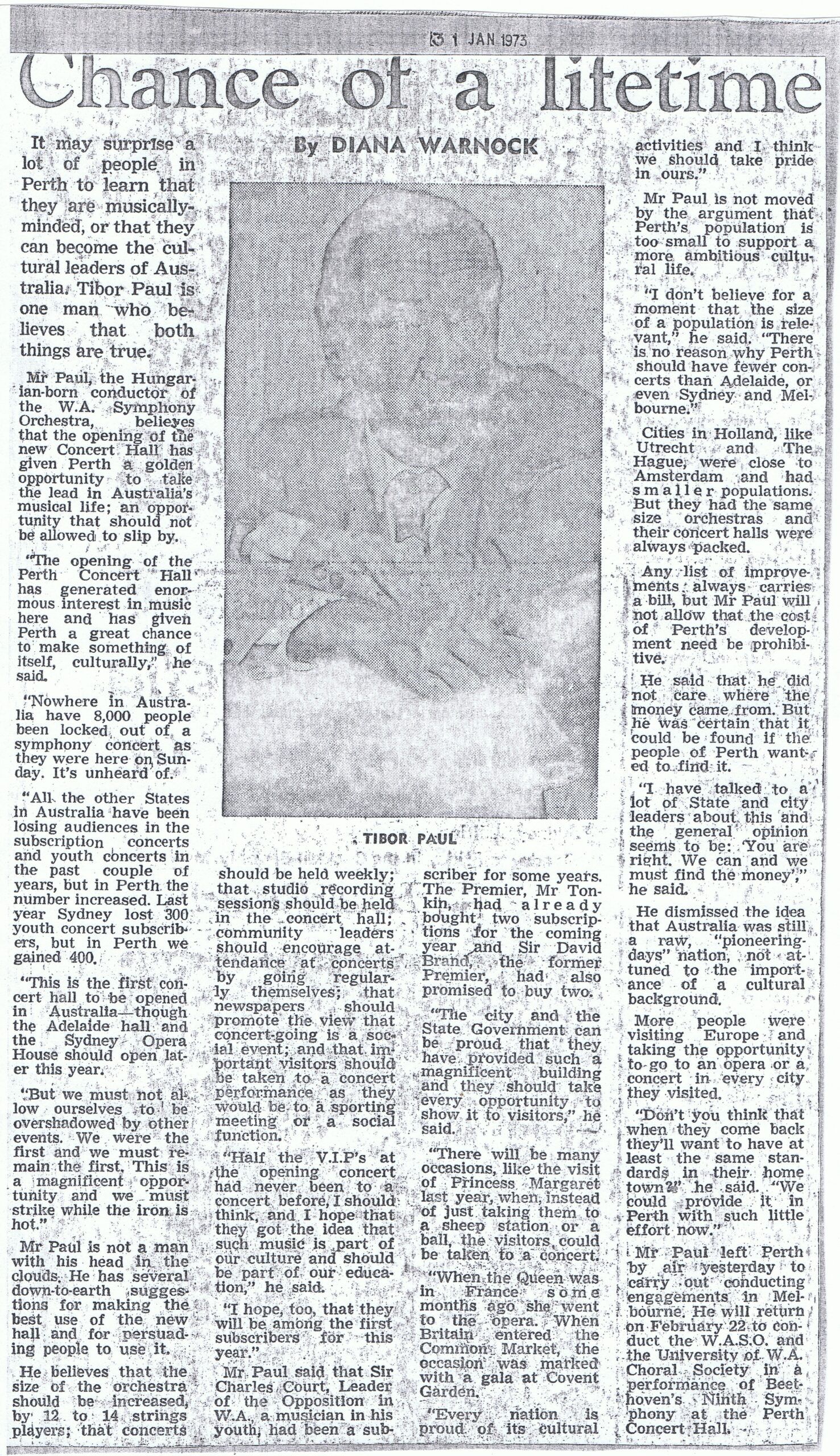
“Fifty Years On” is the title of an unusual hour long television documentary to be screened by the ABC on Sunday, December 23 at 9:30 pm. Commemorating the 50th anniversary of the West Australian Symphony Orchestra this program traces the Orchestra’s evolution in pictures and sound. Nostalgic shots of Perth’s palmy theatre orchestra days are swiftly followed by the traumatic depression period for the musicians, sparked by Al Jolson and the arrival of talkies in Australia in 1928 and Perth a year, later bringing unemployment in its wake. Rare pictures often had to be obtained from former players, now long retired, or from relatives. A can of early black and white film was accidentally discovered by an ABC employee among outdated material scheduled for the trashcan and was mercifully preserved. The Perth Symphony Orchestra is depicted on stage at his Majesty Theatre in 1931 with nearly 40 musicians headed by conductor Harold Duffy Newton. The Orchestra’s name changed to the W.A. Symphony Orchestra in 1950 with the State Government, the Perth City Council and other municipal authorities joining forces to subsidise it. Two of the Orchestra’s longest serving members – clarinettist Jack Harrison and flautist Owen Fisenden joined that same year. The role of conductors is long and sometimes distinguished, including names such as Nelson Burton, Ernest Roberts, Henry Krips, Rudolph Pekarek, John Farnsworth Hall, Thomas Mayer and Tibor Paul. Vaughan Hanly the violinist and WASO’s leader for almost 40 years, speaks with affection of the Orchestra’s past and expresses his confidence in the shape of things to come. Backed partly by rehearsal shots of today’s musicians at work with conductors David Measham and Peter Eros, the film highlights the Orchestra’s community role travelling with it on country tours and moving behind the scenes during rehearsal and recording sessions. Devised, directed and produced by David Witt, it is compulsory and compulsive pre-Christmas viewing for the State’s concert-goers.
The West Australian Tuesday December 18 1979