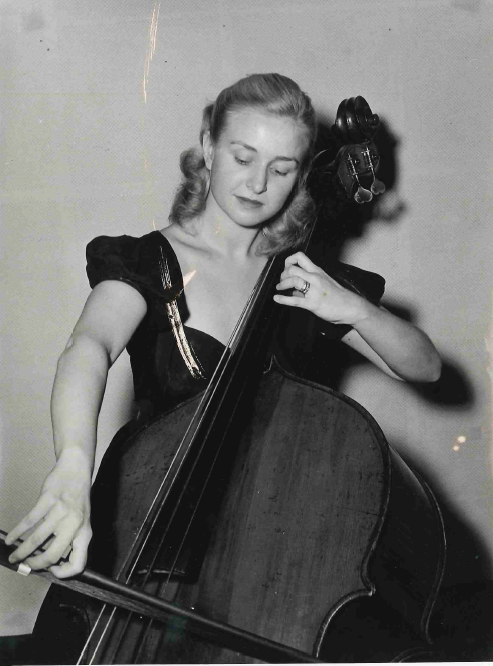
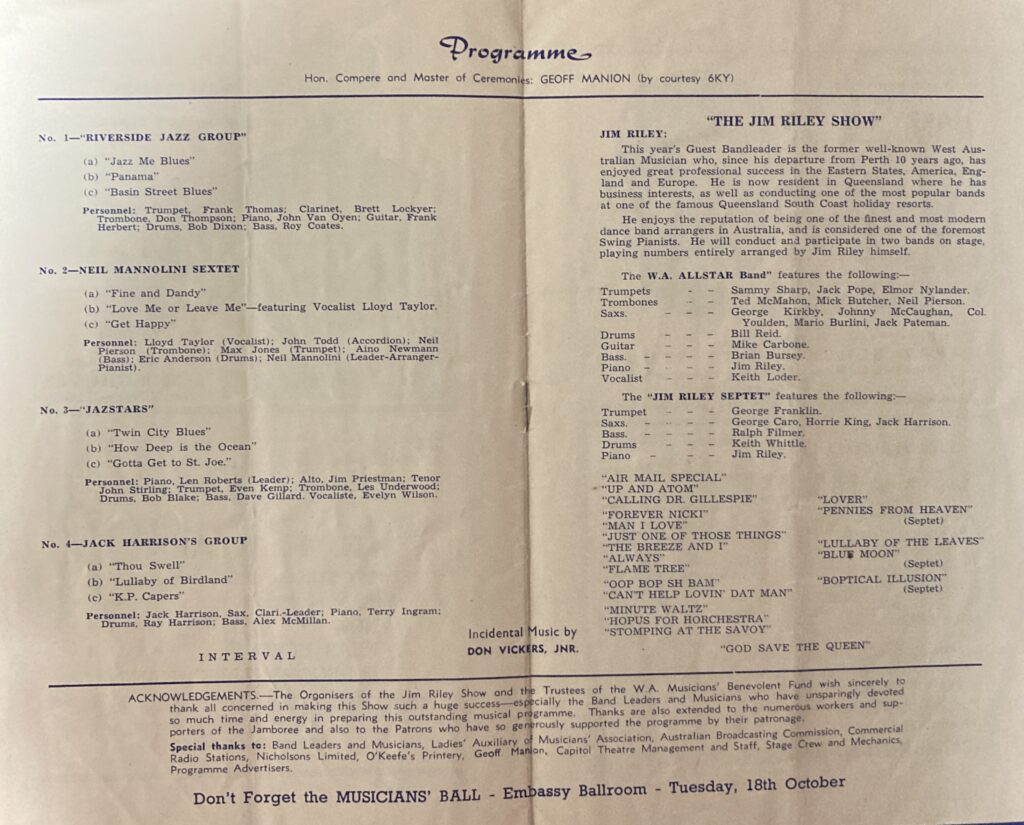
Husband and wife team Aino Neumann and Neil Pierson both studied at the Sydney Conservatorium. They married in 1952 and moved to Perth the following year, Aino to play bass with the West Australian Symphony Orchestra while Neil played trombone with a band at His Majesty’s Theatre. Later, on advice from Rudolf Pekarek, he studied french horn as a second instrument and joined the orchestra in 1956 playing that instrument.
Harrison, Marcia, West Australian Symphony Orchestra Celebrating 75 Years, (WASO Holdings Pty Ltd, 2003). p.57
1953
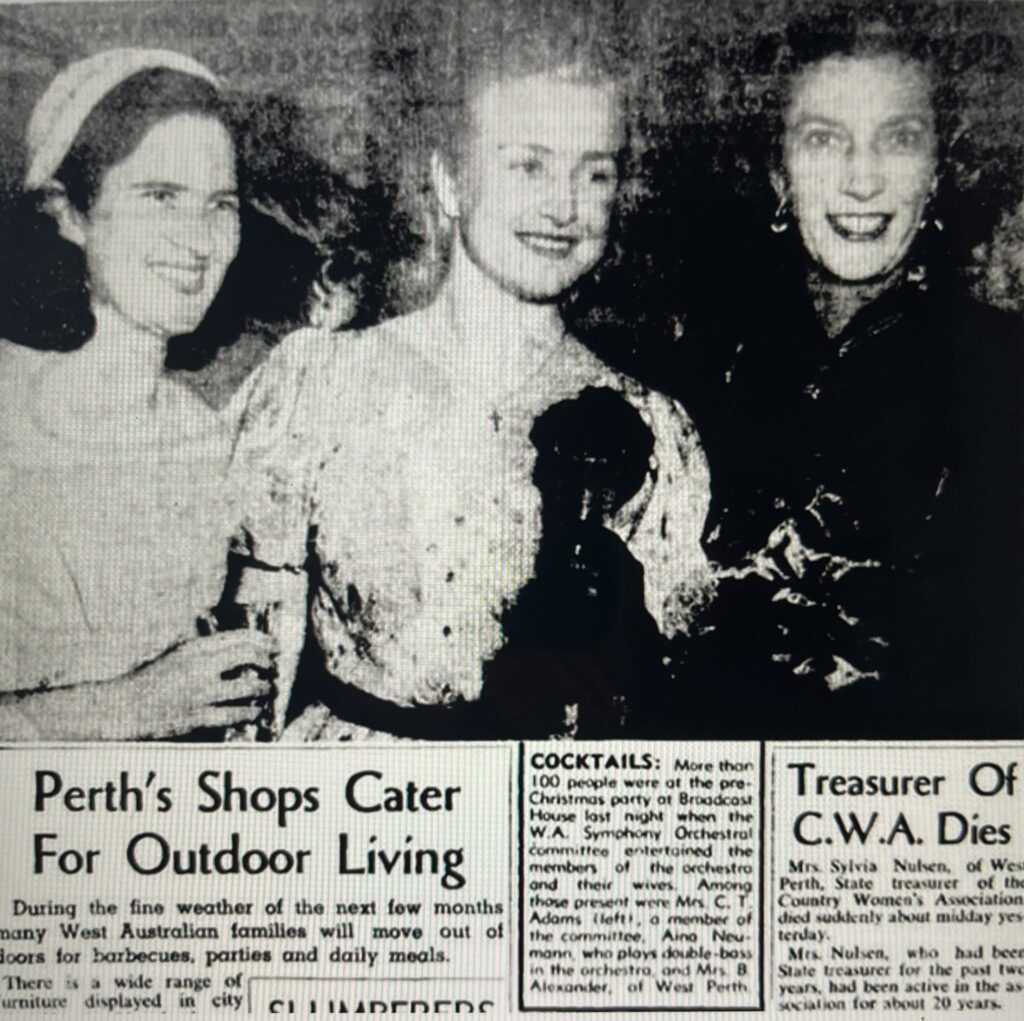
COCKTAILS: More than 100 people were at the pre-Christmas party at Broadcast House last night when the W.A. Symphony Orchestral Committee entertained the members of the orchestra and their wives. Among those present were Mrs. C. T. Adams (left), a member of the committee, Aino Neumann, who plays double-bass in the orchestra, and Mrs. B. Alexander, of West Perth.
West Australian (Perth, WA : 1879 – 1954), Friday 27 November 1953, page 26
1954
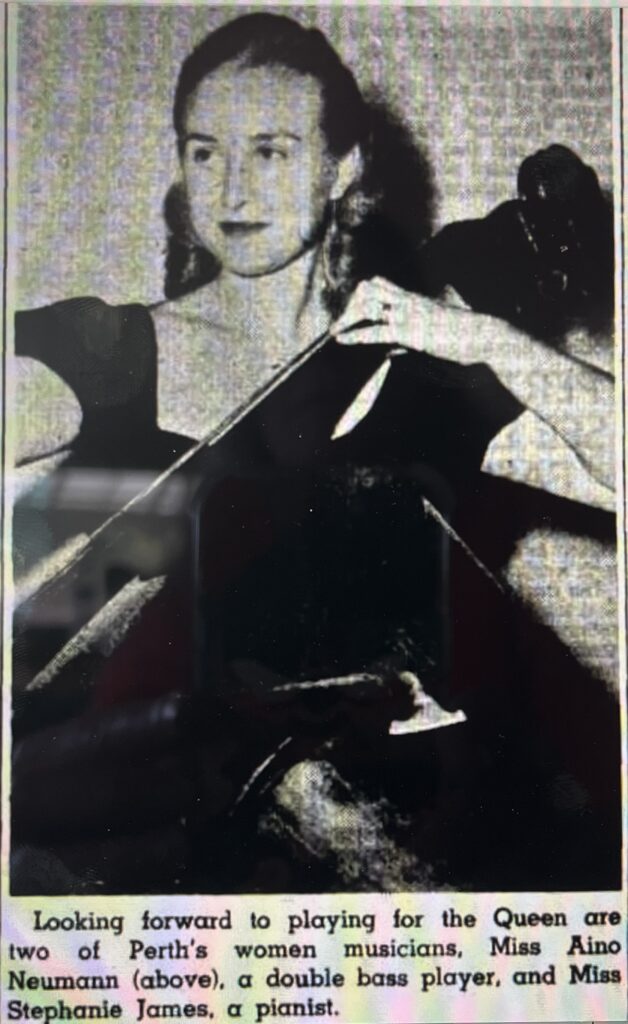
Two Women Musicians Will Play For Queen
Looking forward to playing for the Queen are two of Perth’s women musicians, Miss Aino Neumann, a double bass player, and Miss Stephanie James, a pianist. They will be members of a small group who will provide music at the parliamentary dinner and at the women’s reception at the University. Both are members of the West Australian Symphony Orchestra. Born in Sydney, where she studied at the Conservatorium, Miss Neumann joined the orchestra when she came to Perth last year. She started piano lessons when she was, 11, but later decided to learn the double bass, an instrument she had always admired. Dwarfed by her instrument, Miss Neumann is one of the very few women double bass players in Australia. She comes from a musical family. Her mother was a singer and ballet dancer, and her grandfather played the French horn and the organ. In private life Miss Neumann is the wife of Mr. Neil Pierson, a trombonist. Her only hobby beside music, is housekeeping at their City Beach home. As there is no harp in the orchestra, Miss James plays on the piano the parts scored for the harp. A West Australian, she studied at the Melbourne Conservatorium and in England before she joined the orchestra four years ago.
West Australian (Perth, WA : 1879 – 1954), Thursday 18 March 1954, page 22
Women Are Prominent In W.A. Orchestra
A Melbourne flautist, Miss June Lindsay, complained recently that in England there was a great prejudice against women in orchestras. But there seems to be no such feeling in the West Australian Symphony Orchestra.
A group of 15 musicians who will play when the: Queen attends the women’s reception at the University, includes six women. They are Misses Margaret Sharp and Denise Dingwell (violinists Barbara Smith (viola), Beatrice Pether (cellist), Stephanie James (pianist), and Aino Neumann (double For many years the deputy leader of the orchestra has been Mrs. Vera Rees, and she took over as first violinist during World War I. Born and trained in London, she has played in the. orchestra here for 20 years. She finds the life of a musician very interesting. “You have to be very meticulous with your work,” she says. ‘Cello, Horn The ‘cello section plays under Miss Wendy Tyler, of Nedlands, who has held the position for. three years. She studied under Laurie Ken nedy in Sydney and then returned to her home State. .’Another. – unusual.. instrument for a girl to play is .the French horn, .but Miss.Thelma Moire, of Claremont,. has gained the position of third horn in the orchestra. She studied at the Melbourne Conservatorium for four years: Miss Moore is a member of a musical family. “All of them have been” musicians at some stage.” she said. Her brother, Frank, is second flute in the orchestra. She sailed for England in the Orontes this week with her par-ents. ‘During her six months. overseas she hopes to be able to get some further musical experience. Miss Jill Harrison, of Cottesloe, has been the second bassoon player for two years. She is the only professional woman bassoonist in Australia and studied at the Elder Conservatorium, Adelaide. A veteran-musician is Miss W. Wright who studied the viola at the Royal Academy of Music in London under Sir Henry Wood. She returned to Australia for some years.and then decided to go back to England. Her intended stay of one year did not eventuate and it was 20 years before she returned to Perth and joined the orchestra here. Debutantes For ·Ball Plans are .already being made for the annual ball of the Order of the Eastern Stat which will be held at the Embassy on June 29. The secretary (Mrs. A. Mc Kirby), said yesterday that there were some vacancies in the list of girls who would make their debut at the ball. Any girls who were interested should get in touch with her at her home in Mosman Park.
West Australian (Perth, WA : 1879 – 1954), Wednesday 24 March 1954, page 26
SYMPHONY ORCHESTRA AT COLLIE
Tonight’s Concert Will Be Broadcast
Those people who appreciate good music should not fail to attend the concert to be given in (he Mineworkers’ Institute tonight by the West Australian Symphony Orchestra. If an audience of at least 300 people is obtained, not only at Collie but also the other three centres to be visited by the orchestra, then the concerts could become an annual event.
Tonight’s concert, or a portion of it, will be broadcast by the A.B.C. For this reason, all doors are closed during the playing of each orchestral item. Patrons are advised to be seated in good time for the first item as doors will be closed punctually at 8 p.m. The West Australian Orchestra boasts several unusual instruments to be played by women musicians. For example, there is double bass, Aino Neumann, probably one of the few instances of this instrument in a symphony orchestra to be played by a woman musician. Blond and of Latvian extraction, Aino Neumann only joined the orchestra a year ago. The orchestra will make its second tour of the country with these concerts, for at the ‘beginning of April, it appeared in the Great Southern district, giving concerts at Katanning and Albany, which attracted great local interest.
Collie Mail (WA : 1908 – 1966), Thursday 29 April 1954, page 12
1955
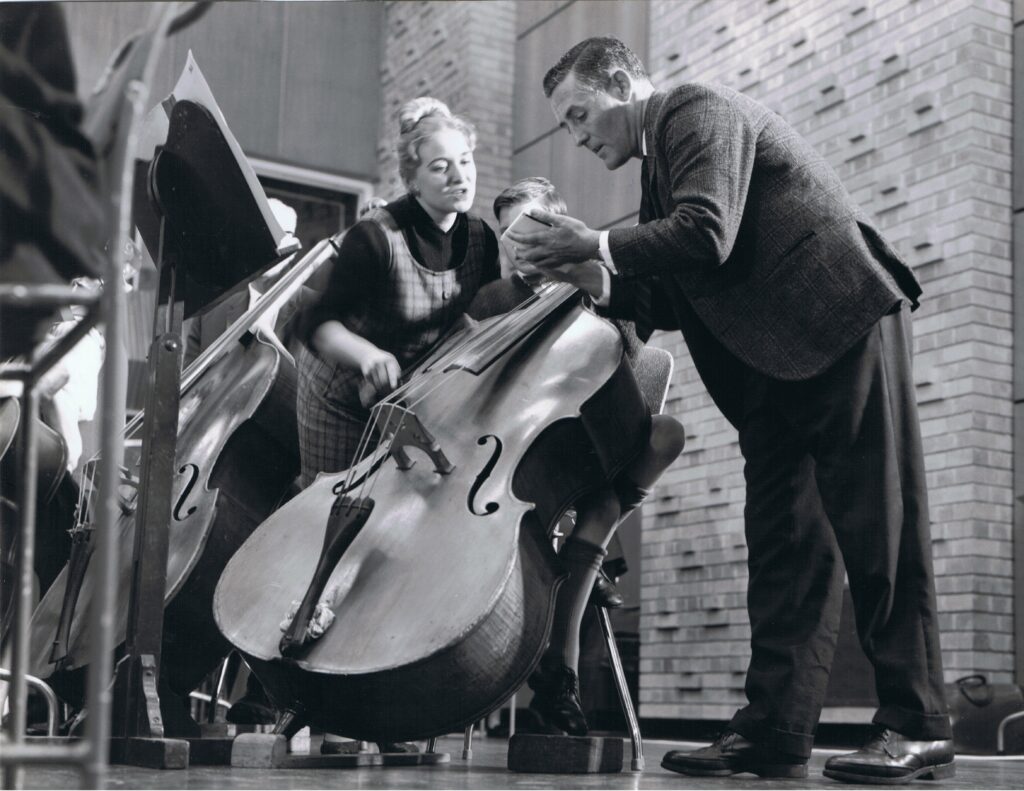
1966
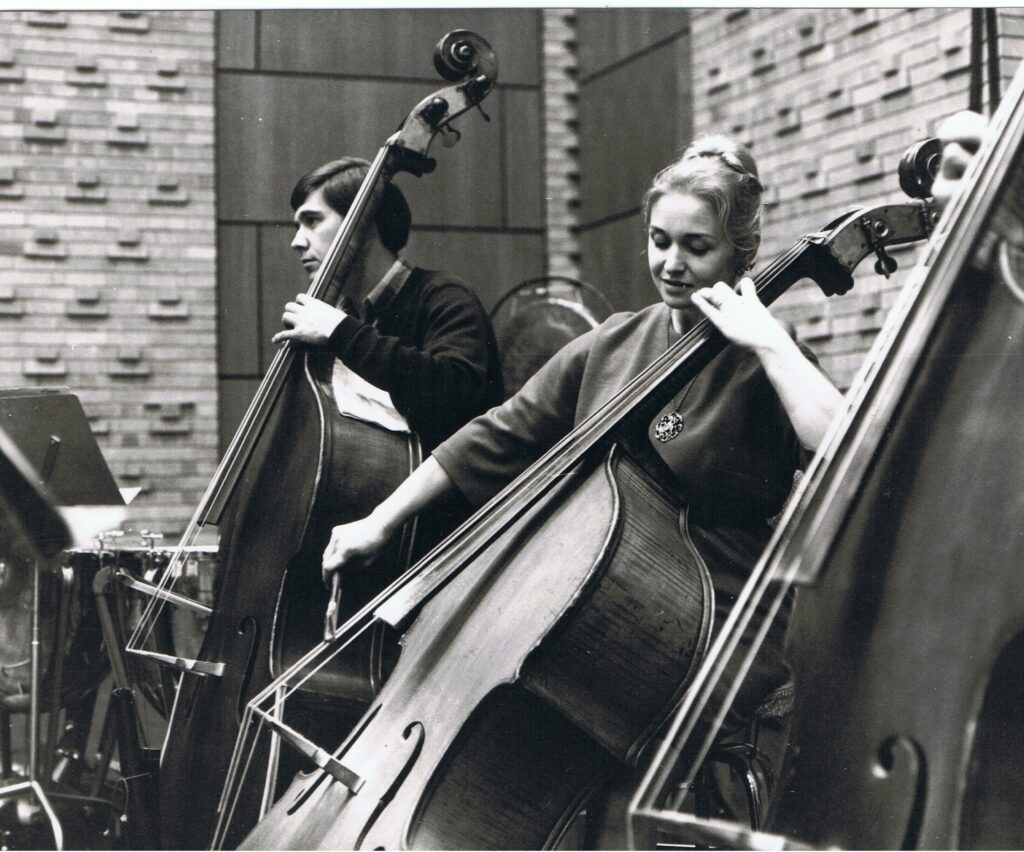
1967
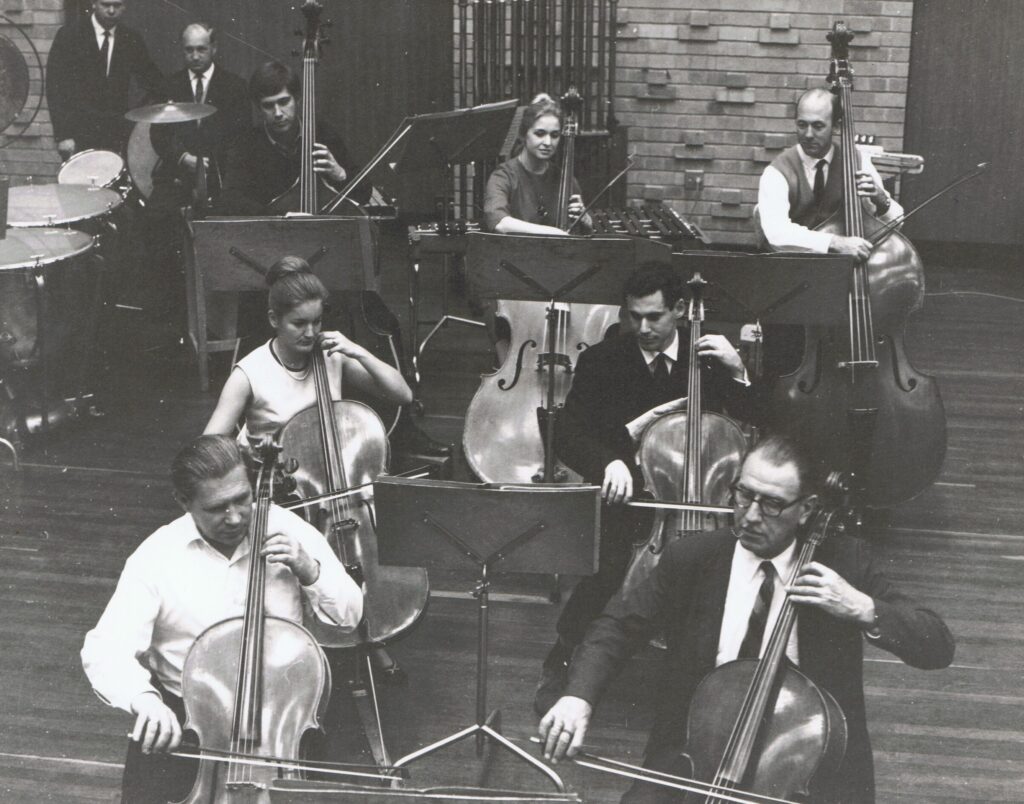
1970
Sunday May 26 1970
The second concert in Series I of this year’s A.B.C. recitals in the Basil Kirke Studio will be given tomorrow afternoon at 3 o’clock. A Rossini Quartet For Wind will be played by flautist Owen Fisenden, clarinettist Jack Harrison, horn player Neil Pierson and bassoonist Brian Pope. A Beethoven septet will be performed by clarinettist Jack Harrison, bassoonist Brian Pope, violinist Vaughan Hanly, violist John Gould, cellist Ray Fraser and double bass player Aino Neumann. One of the objects of the concert is to bring the best local artists playing chamber music before the public. Symphony concerts naturally attract more people because of the grandeur and perhaps a little because of the mere occasion. But we must not let the chamber music and solo recitals die. They are part of the backbone of music in Europe, the primary source of most music.
1973
Albert Herring Proves to be a Bad Catch
With Robert Gude
Ten minutes late getting underway to a two-fifths empty house at the Octagon, the opening night of the W.A. Opera Company’s production of Benjamin Britten’s “Albert Herring” was already too moribund to resuscitate. The plotting in Act One induced the muse of Morpheus simply because it was virtually impossible to decipher what anyone on stage was singing about. The company threw away the key to the plot which remained undiscovered right to the last bar of Act Three. Patricia Whitbread remained prominent both vocally and socially in her role as the imperious Lady Billows. Her larger than life characterisation lent itself to projecting both voice and diction into the lifeless acoustics of the Octagon. The rest of the cast had equal opportunity but for some inexplicable reason underplayed and undersang Britten’s brilliant operatic farce. An occasional word or two was intelligible. isolated by bar after bar of baffle. The less said about Martin Clare portraying the mumbling Mayor the better. Mr Clare’s pitch was pathetic, his onstage efforts inept. Between Miss Whitbread and Mr Clare this small cast was totally inadequate for the operatic task required.
What redeems Albert Herring is the splendid production by John Milson. Act Two Scene One had the magic Milson touch: Jeffrey Weaver as Harry enduring functional discomfort during choir practice; Cliff Arndt’s bedrock boredom of wearisome waffle from windbags; John Nicholson’s stunned mullet manner and accepting homage as though facing the gallows with a recommendation for preferential treatment. Kristan Fredrickson’s articulate set and consummate costumes were colourful. Allowance should have been made, however, for a costume change amongst characters who could afford more than one ensemble thus enhancing the illusion of a passage of stage time. Conductor Geore Tintner seemed determined that Britten’s 12 member orchestra should overwhelm his singers at every opportunity. Strings were insecure throughout, with the exception of Aino Neumann, contrabass; Neil Pierson’s horn; Jack Harrison’s clarinet; Peter Randall’s oboe; James Hopkinson’s flute and most commendable, Michael Jefferies impeccable harp held Mr Tintner’s orchestra together. This festival fare is indigestible, not worth a candle and most certainly not worth the price of admission. If Britten’s Herring performed at it was on opening night is the W.A. Opera Company’s first production for the Festival Of Perth it could well be the last.
Sunday Independent February 4 1973
1977
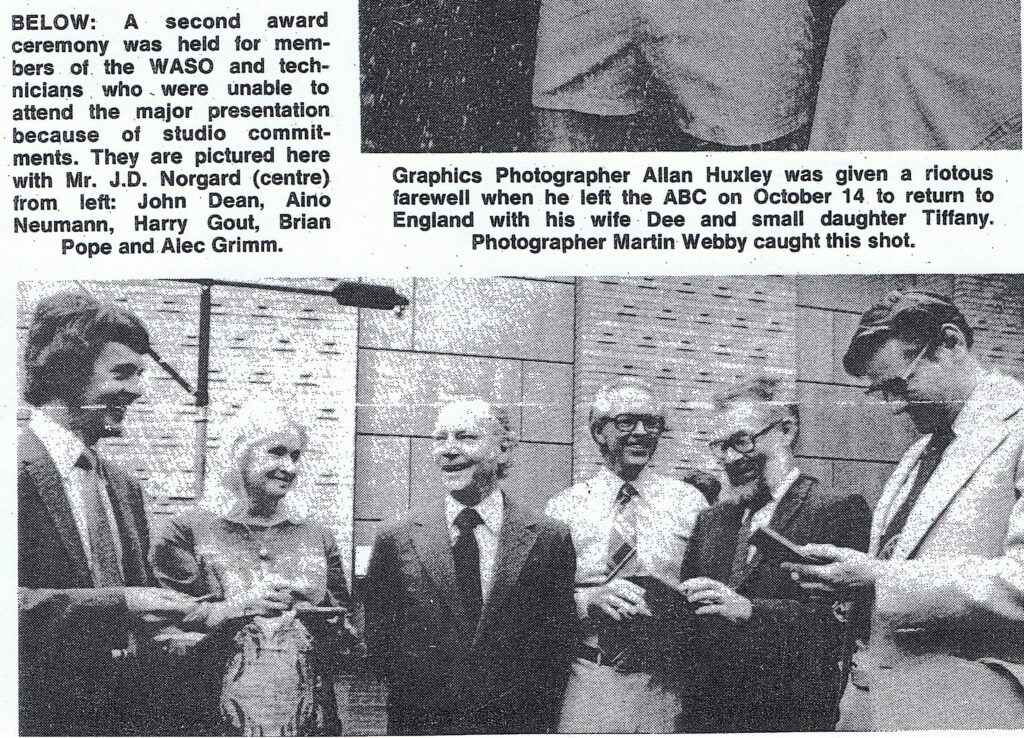 1977: 20 year A.B.C. service medals
1979
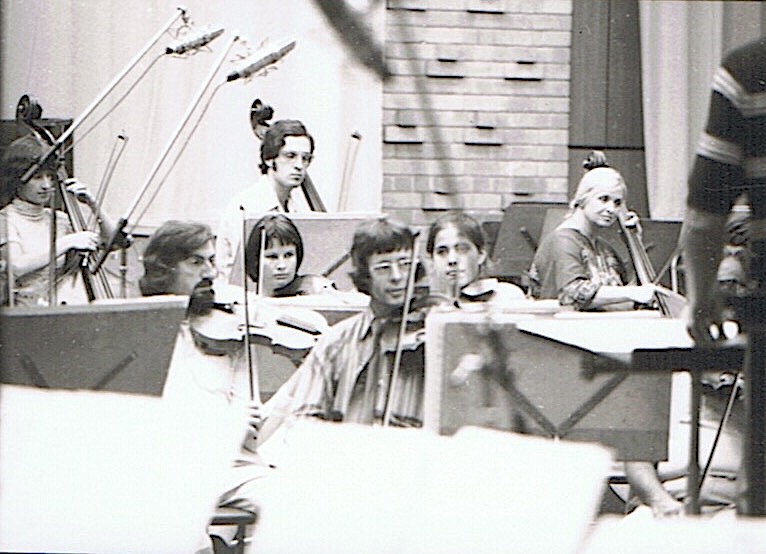
1989
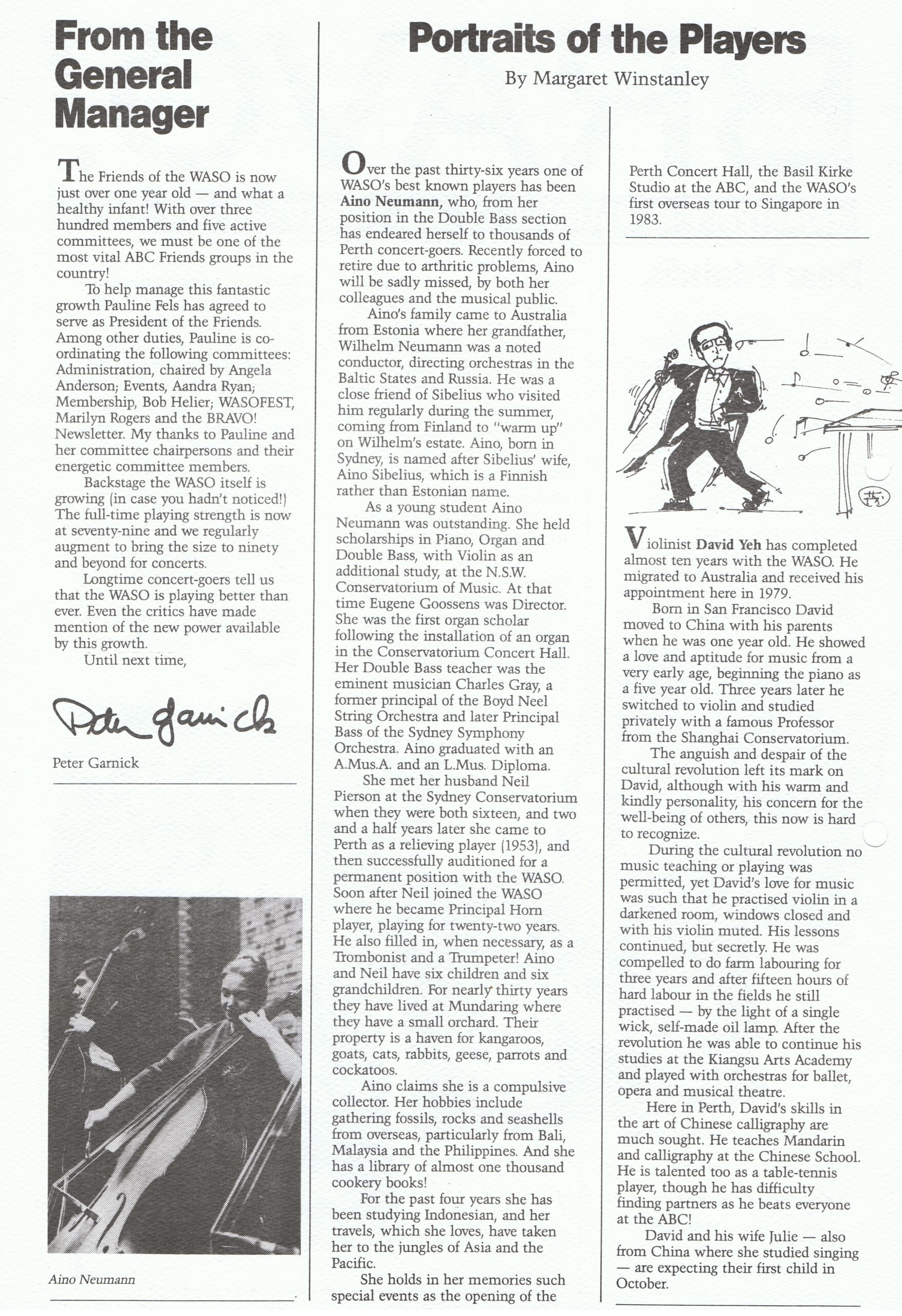
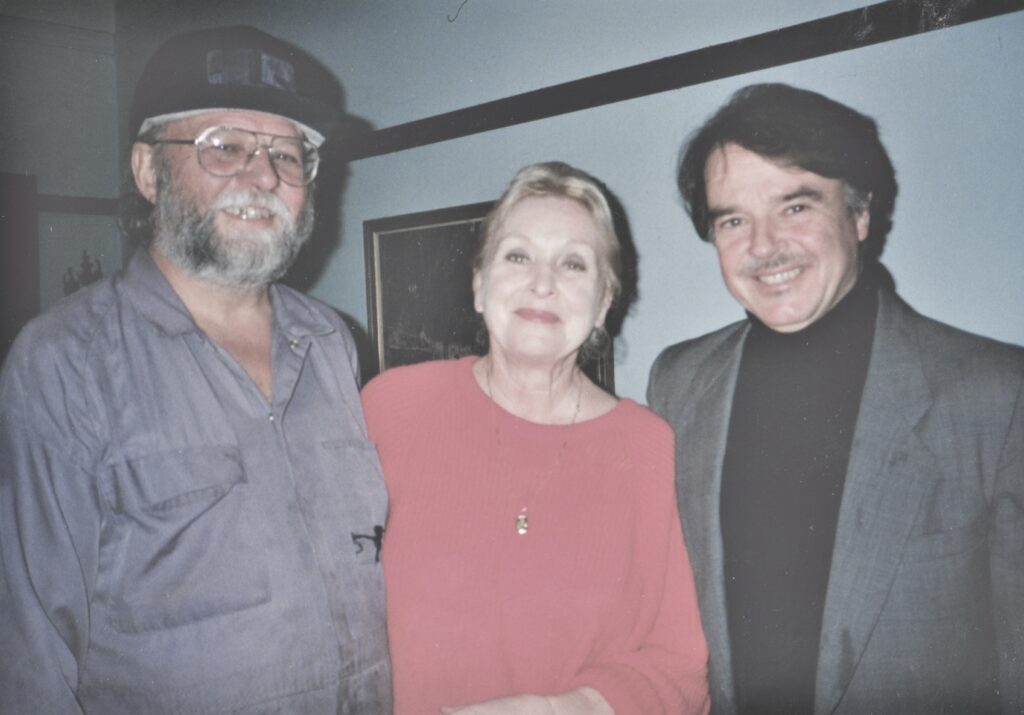
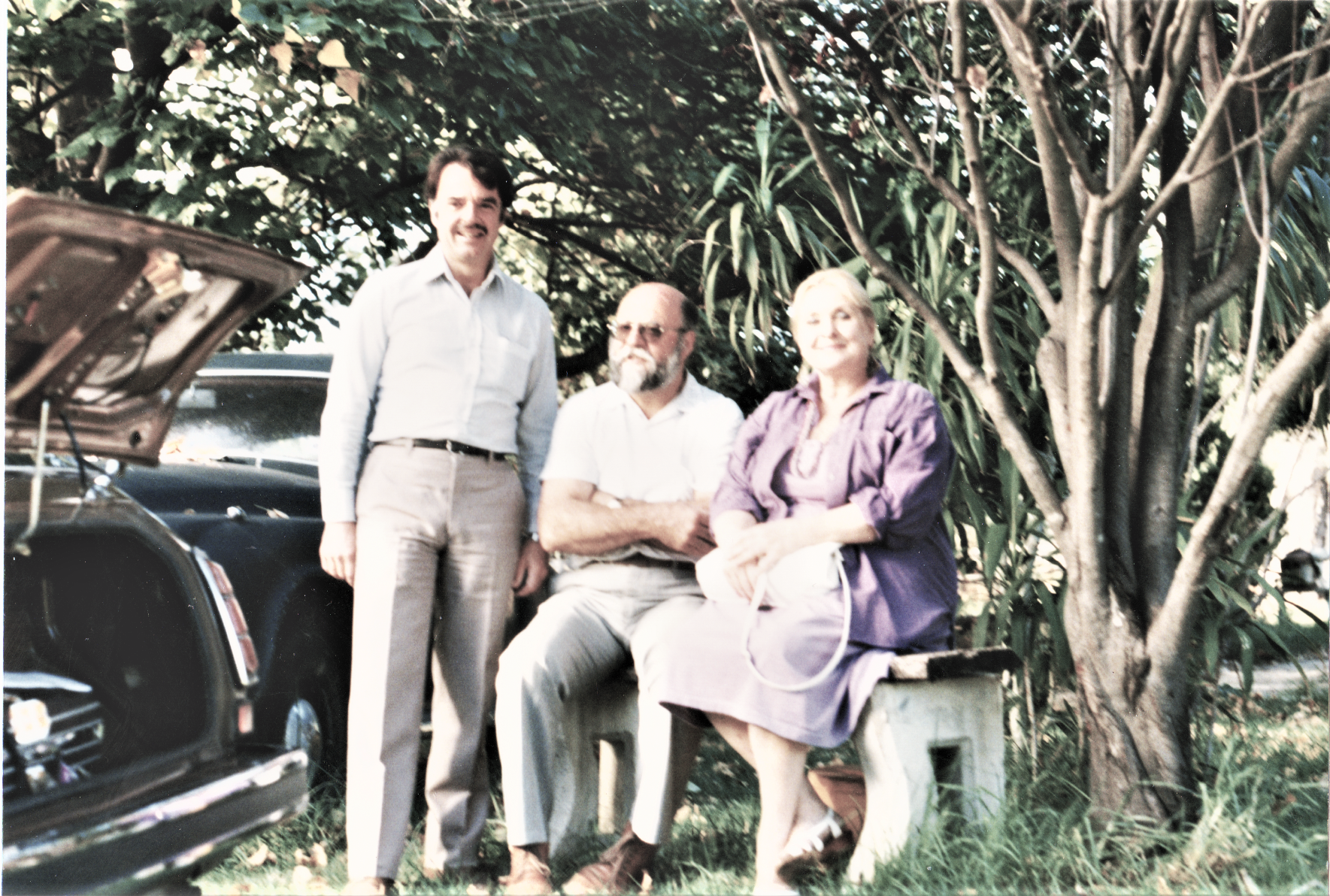
Aino died on the 2nd April 2016 aged 81.