Person

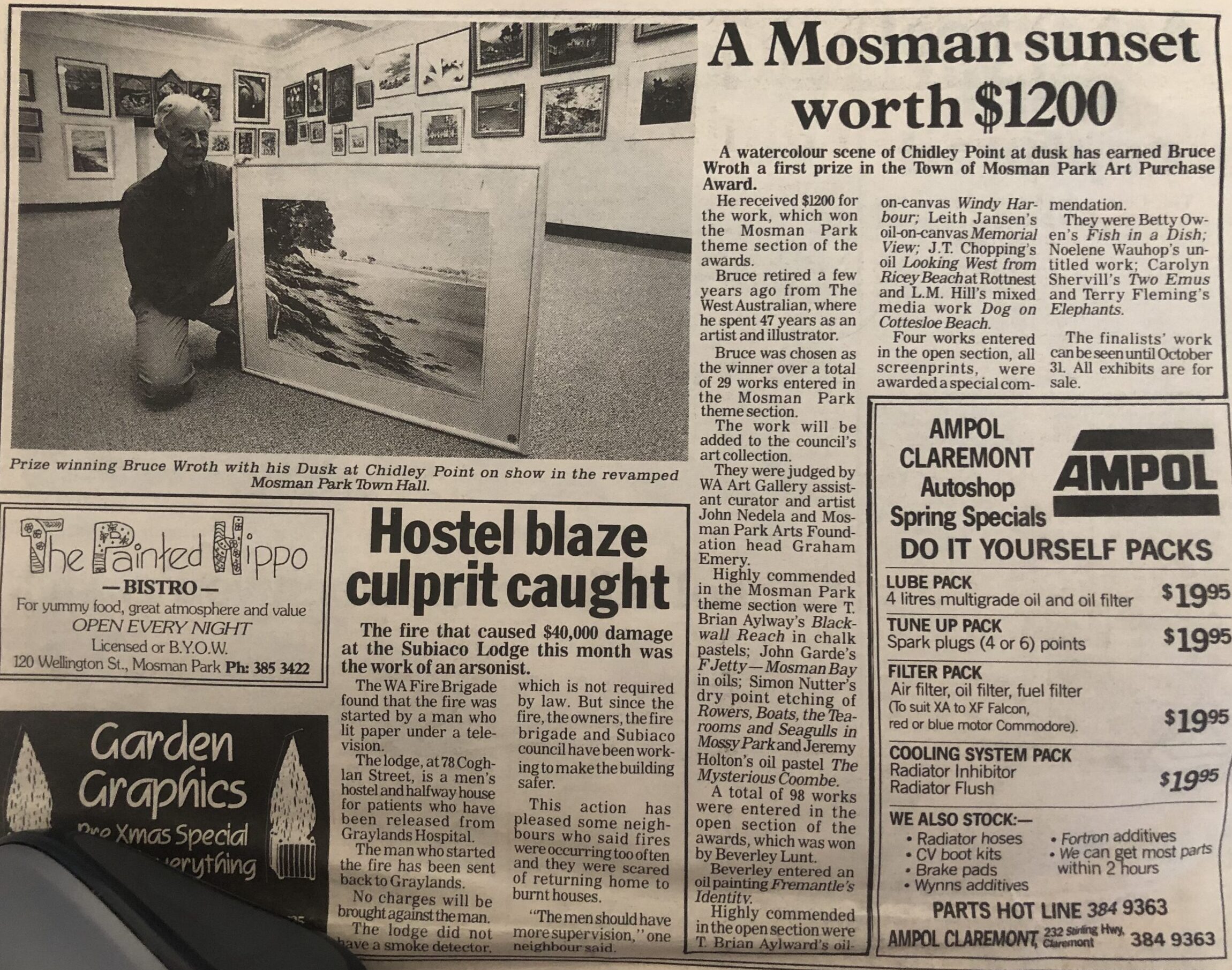
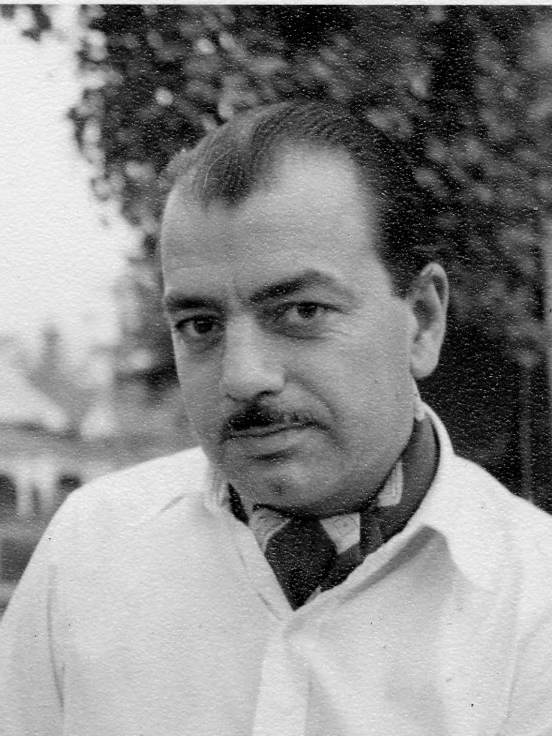
WROTH, Bruce

MYOLA CLUB TOASTS COLIN MOUNSEY’S 21st

The Myola Club, Claremont, was the scene of much gaiety one night during the week when Colin, eldest son of Mr. and Mrs. Fred Mounsey, of Nedlands, celebrated his 21st birthday. Mrs. Mounsey received the guests in charming gown of azure blue crepe, beaded in silver, and black accessories. During the evening the guests autographed a large wooden key. Only disappointment was that Colin ‘s only sister, Joy, was unable to be present. Some of those invited were: Mr. and Mrs. Cannemeyer, Mr. and Mrs. Ralph Siele, Mr. and Mrs. D. Lambert, Mr. and Mrs. Bob Lakides, .VJr. and Mrs. Morgan Herbert, Mrs. A. Moran, Mr. and Mrs. Eric Wilson, Mr. and Mrs. Jo Walton-; Misses Melva Jones, Betty Green, Bervl King. Billie Diamond, June McShane, Val Wroth, Edith Materson, Val Wansbrough, Mary Carlson. Joan Firby, Lea Parker, Beryl Sexton. J. Maloney, Norma Schofield, Margaret Atherdon., Margaret Le Lievre, P. Carter, Joan Carlson. Messrs. F. Mounsey, Des Thomas, Bruce Wroth, Arthur Downey, Keith Hownslow, Col. Goldsmith, Dick Hatton, John Miller, Frank Sagare, Peter Lyons, Mas Annear, Merv Howie, Phil Greenwood, Bert Hall, George Freeman, Ray West, Peter Hatton, Allan-Tyson, Roland Baker, Jo Watson, Bunt Hardy, D. Mounsey, and many others.

Mirror (Perth, WA : 1921 – 1956), Saturday 3 May 1947, page 13

Bruce and Joan Wroth

HULL-WROTH: Mr. and Mrs.

Ralph A. Hull, of 774 Beaufort street, Mt. Lawley, have pleasure in announcing the engagement of their only child, Joan, to David- Bruce, son of Mrs. H. Wroth, 31 Caporn-street, Nedlands.

HULL-WROTH: The marriage of Joan Hull, 774 Beaufort-street, to Bruce Wroth, will take place at St. Mary’s, Colin-street, West Perth, at 6.30 today.

West Australian (Perth, WA : 1879 – 1954), Monday 25 February 1952, page 6


ART GROUP’S RANGE WIDER THIS YEAR (By C.G.)

The Studio Group of Six can always be relied on for an Interesting and varied show of paintings.

This year their range is Wider, and the styles of painting more diverse than formerly. Interest is added, too, by the inclusion of four young newspaper artists who have joined The West Australian staff. The regulars continue to paint as a recreation-a kind of busman’s holiday, while the younger members are trying their wings and experimenting. The show is bright and colourful, strong in tonal quality, and varied in subject matter. Confident handling and strength in composition are also apparent, as would be expected from people accustomed to the precision and clarity demanded in newspaper work. Artistic quality is not lacking, and much of the work carries conviction of the painter’s sincerity and emotional expression. Good Study Both Clem Ambler and Henry F. Harffey continue in wellknown vein. The former’s watercolours are softer and broader than before. Harffey has a good study of geraniums, and a fine sketch in conte for a portrait. Paul Rigby and Cedric Baxter are alike in their bold approach and dashing execution. Rigby’s head of a girl with yellow background. and a fine study of an old house have strong appeal Cedric Baxter’s handling of pastel is sure and direct, sometimes theatrical, as in “Abandoned.” His portrait sketches and figure groups show progress in feeling and sense of atmosphere. Norman Aisbett’s more peaceful style keeps on improving. His landscape near Mandurah is a fine subject well handled, with doubtful framing. A girl’s portrait in crayon has much character in its simple treatment. Stewart Cownie has not been doing much work of late, but his landscapes have some of his old assurance. “Evening” is a picture marred by a white wave in the foreground. The younger members are doing well in their different styles. Michael Jones is a bold experimenter in oils and water-colours, who should go far with more tuition. Igor Katarski’s sensitive sketches form a contrast-an ink landscape sketch is really good. Bruce Wroth puts too much into his landscapes; his simpler sketches give promise of good things. Barry Lee is a little timid as yet, but his drawing and colouring are sound. Life studies, sketches; and small pictures are an interesting feature of a lively exhibition.

West Australian (Perth, WA : 1879 – 1954), Wednesday 5 August 1953, page 13


Recently Athol Thomas took you inside a beauty parlour for the man’s angle. This week – in company with artist Bruce Wroth-he invades the woman’s world again, this time at a fashion show.

PART CLUB HOLDS AN EXHIBITION (By C.G.)

At Boans fashion gallery is a mixed group of paintings and drawings by a loosely-constituted group of people working together as the Art Club. The better work suffers by comparison with that of inferior quality. Cyril Ross has two good oils in a yachting scene and a sun-lit glade of pine trees. His limited palette and sense of composition make for harmony. Portia Bennett’s little study of a boat is one of the high-lights: a quiet and competent effort which stresses the virtues of simple aims and sound means. Karafylakis follows his visual style in heavy impasto and brilliant colour. “The Bush” and “Kalamunda” are ‘broader than usual. G. F. Wilson keeps going with his impressions of city life. He is getting towards his goal in “Blue Night” and “Interval.” Satisfying In the water-colour and crayon section we notice at once John Lungh’s bright little sketch of Yallingup, in which variety of line and crayon stroke tell in a satisfying com-position. H. Harffey’s “Flooded Farm” and “Shack on Salting” are good, and Bruce Wroth’s broad and simple washes give quality. D. L. Cummings is broaden-ing his style with consequent improvement. H. E. Foote’s rather anaemic study of boats needs strength and emphasis to be effective, Cedric Baxter’s “Brahimini Lullaby” is strongly drawn in cravon. “The Charleston’ is a lively illustration in rather strident colour. Bill Angove has a bewilder-ing variety of drawings and paintings. Perhaps concentration would develop an individual style. His “Fremantle Building.” and “Blue Nude.” and “Figure Draped in Blue” are reason-ably successful. Leon Williams shows a couple of very melodramatic pictures which do not reveal his talent. L. Humby and J. E. Lindsay’s efforts are very amateurish and suggest the need of further study. The exhibition will close on November 10.

West Australian (Perth, WA : 1879 – 1954), Thursday 4 November 1954, page 6


Artists Show Work

THE work of well – known newspaper artists will be shown at an exhibition of paintings in Newspaper House Art Gallery during the next fortnight. The works will be from Clem Ambler, Cedric Baxter, Paul Rigby, Norman Aisbett, Bruce Wroth. Barry Lee. Henry F. Harffey. City businessman H. R. Howard is to open the exhibition late today.

Daily News (Perth, WA : 1882 – 1955), Monday 12 September 1955, page 6


PAINTINGS FOR FIELDS

3IX oil paintings of the WA oil search, by Perth newspaper artist Norman Aisbett, will go to Kalgoorlie tomorrow for- special exhibition. „ At present on exhibition in Newspaper House art gallery with a display of work done by other newspaper artists, they show the National 130 rig at Rough Range, the unloading of barges, preparing to spud in and the T32 jack-knife rig at Shothole Canyon. To cater for public demand artists Clem Ambler, Cedric Baxter, Henry F. Harffey, Paul Rigby, Norman Aisbett, Bruce Wroth and Barry Lee have decided to open the exhibition tonight from 7 until 9.30 and on Wednesday. Thursday and Friday nights next week.

Daily News (Perth, WA : 1882 – 1955), Thursday 15 September 1955, page 16
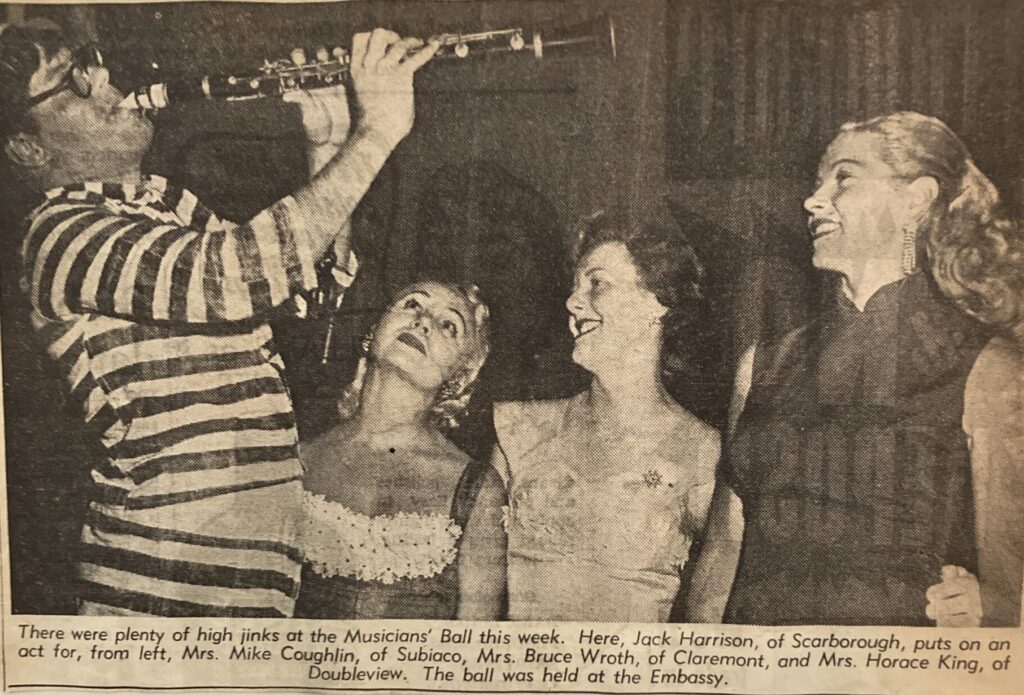

There were plenty of high jinks at the Musicians’ Ball this week.  Here, Jack Harrison of Scarborough, puts on an act for, from left Mrs Coughlin of Subiaco, Mrs Bruce Wroth of Claremont, and Mrs Horace King of Doubleview.  The ball was held at the Embassy.

The Sunday Times October 20 1957


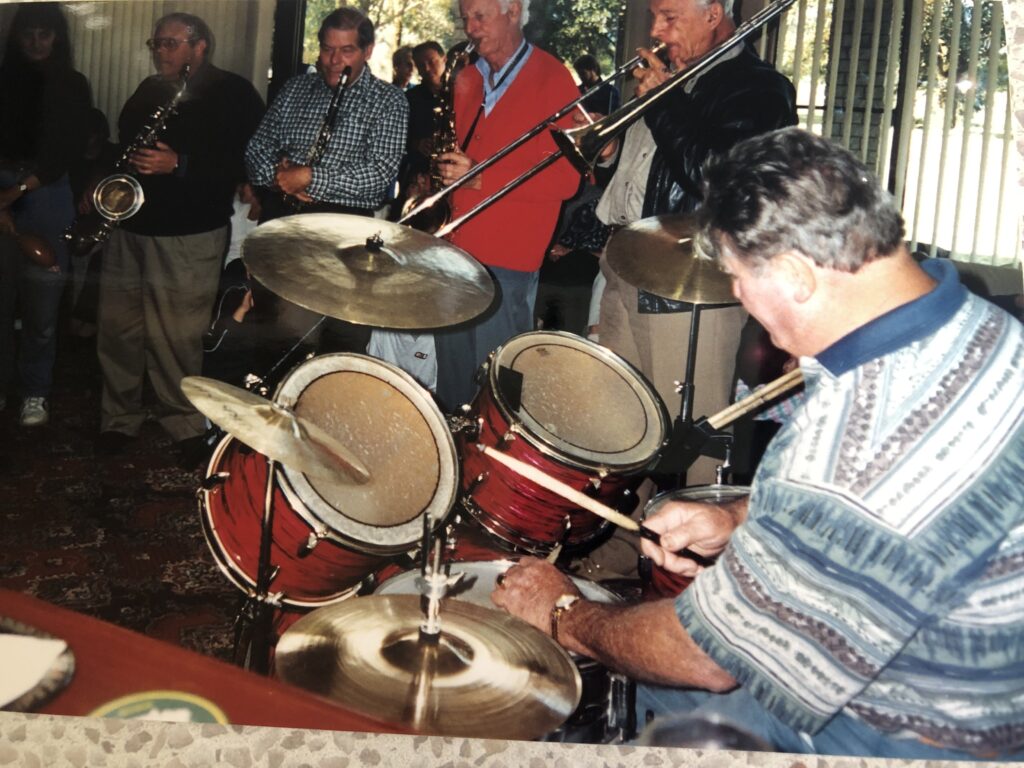
Bruce Wroth performed saxophone with pianist Jimmy Beeson and drummer Ray Harrison.
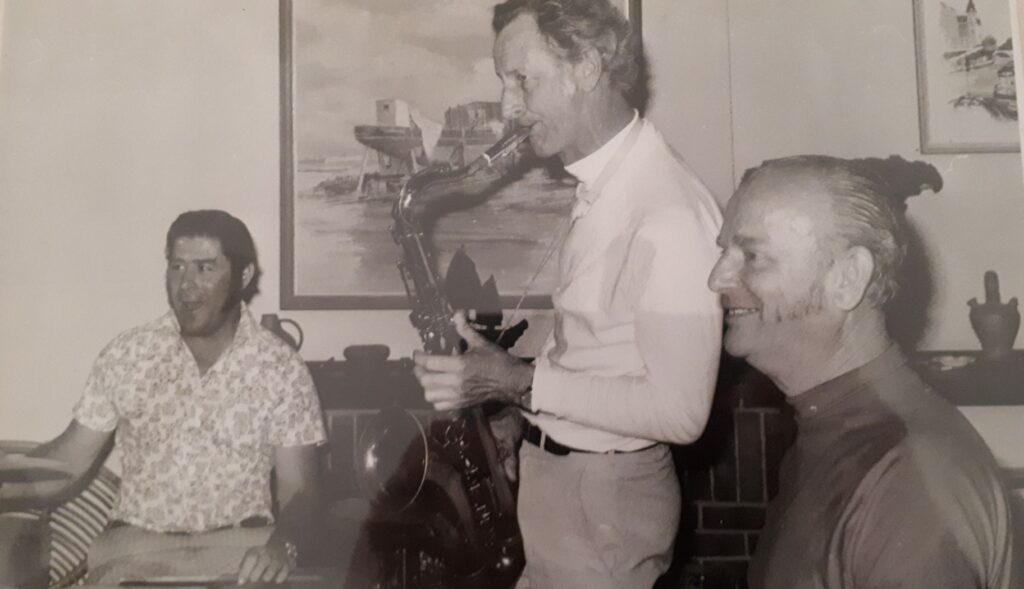
Ray Harrison, Bruce Wroth and Jimmy Beeson


“HOUSE OF THE YEAR” WINNERS HONOURED

The York Society which each year holds a ‘Restored House of the Year’ , award in conjunction with the York Fair recently hosted the 1975 winners Mr and Mrs Henry Penny, of Greenhills, to a luncheon at Sedgmoor Inn, Greenhills. The Penny’s was the first country home to win the award and, after the luncheon, they were presented with a painting of their house by Bruce Wroth. Two other entries, from Mr D. W. McLeod and Mrs A. Forrest, were also commended on the high quality of the restoration of their homes.

Beverley Times (WA : 1905 – 1977), Thursday 29 July 1976, page 7
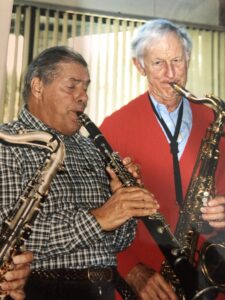

Jack Harrison and Bruce Wroth
Ray Harrison’s birthday: Jay Harrison (sax) Jack Harrison, Bruce Wroth, Dick Hatton (trombone) Ray Harrison (drums)

Portrait of Ray Harrison by Bruce Wroth
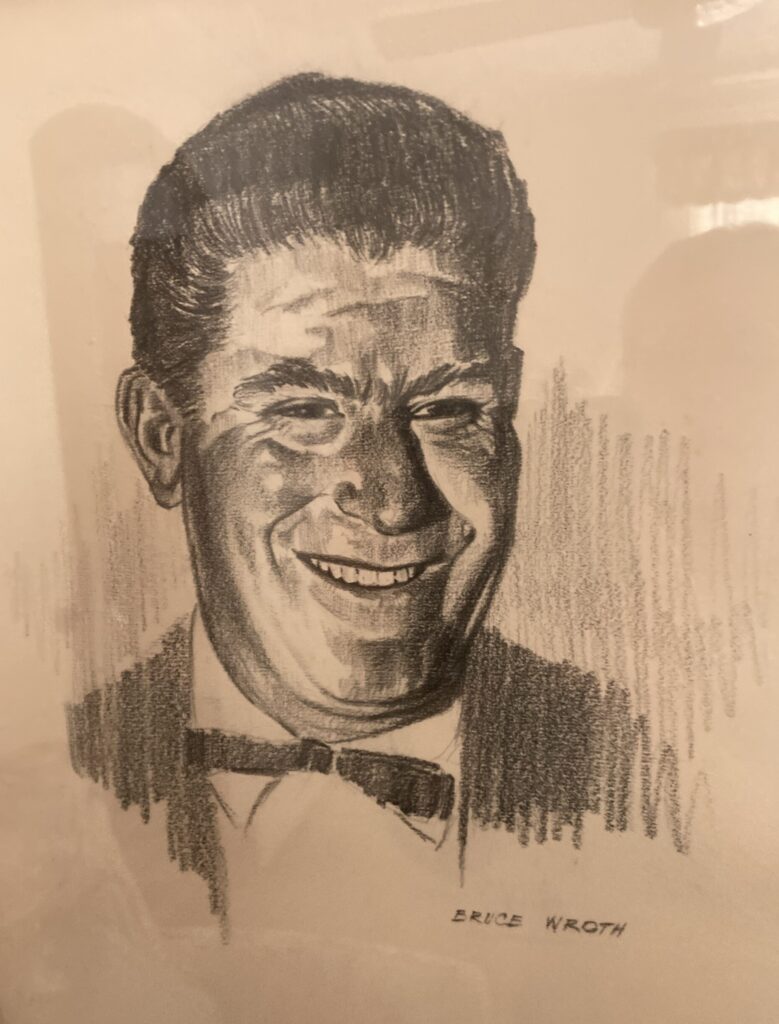
Ramon Harrison by Bruce Wroth

1993

POST October 26, 1993 page 19 
Years

Person

IWANOFF, Iwan

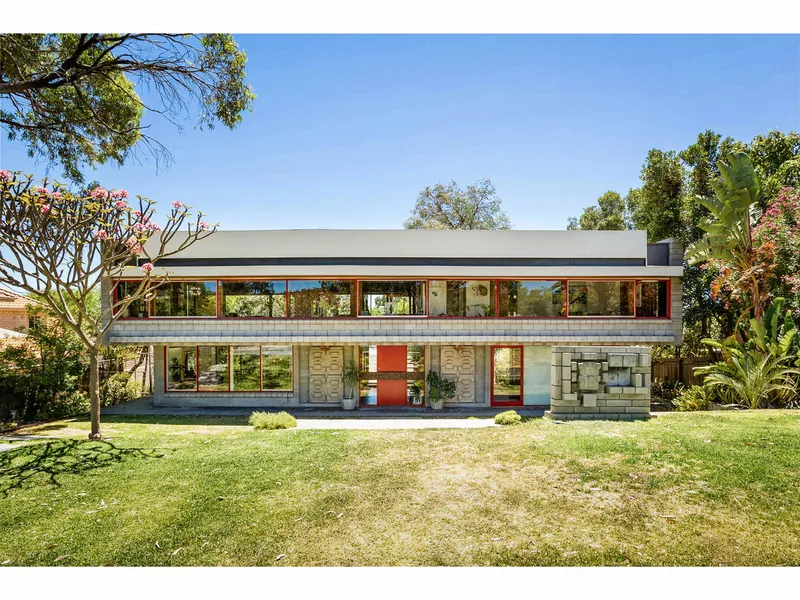
(architect of 11 Dodonia Gardens City Beach)

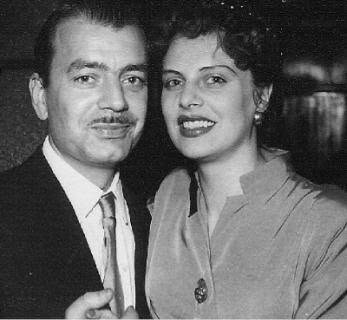
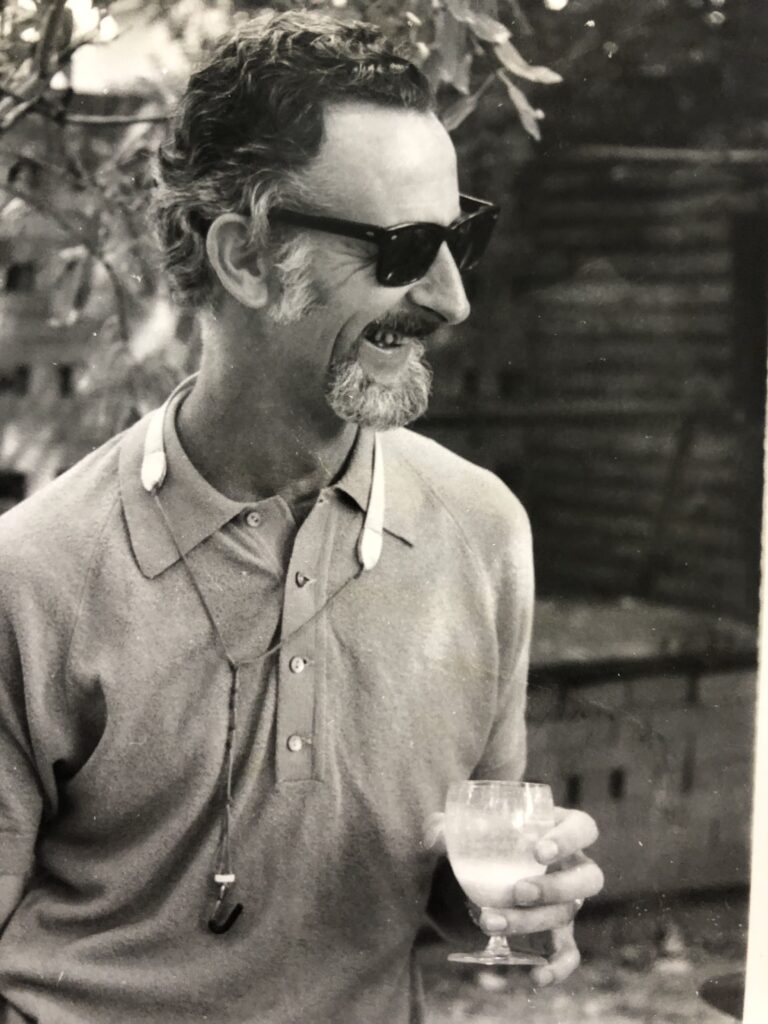
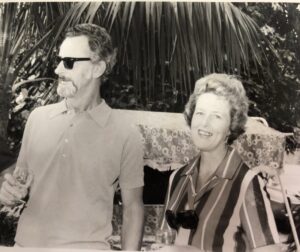
Iwan and Linda Iwanoff at Jack and Marcia Harrison’s wedding 1953

Born in Bulgaria in 1919, Iwan Iwanoff graduated with a degree in architecture and engineering from Munich University in 1946 and emigrated to Perth in 1950. Initially working in Perth for Krantz and Sheldon architects, and Yuncken Freeman Architects in Melbourne, he set up his own Perth practice in 1961. A fellowship from the Australian Institute of Architects was awarded in 1972, and he was the recipient of several international design awards for residential houses during the 1970s. Iwan passed away in 1986.

In terms of architectural approach, Iwanoff shares similarities with other modernist architects in his commitment to functionalism and efficiency. The idea of form following function is evident in his designs, as he prioritises the needs and comfort of the occupants. He pays attention to aspects such as natural light, ventilation, and spatial flow, creating spaces that are both aesthetically pleasing and practical.

This alignment with the functionalist principles of modernism can be seen in the works of other renowned architects like Walter Gropius or Alvar Aalto.

Iwan Iwanoff’s work, while primarily associated with Modernist architecture in Western Australia, does show some influences that can be traced back to certain design principles of the Austro-Hungarian and Viennese Modernist movements. These movements, which emerged in the early 20th century, were characterised by a departure from historical styles and an embrace of new materials, functionalism, and innovative design.

Northam Library and Office were awarded the Richard Roach Jewell Award for Enduring Architecture by the Australian Institute of Architects in 2021 and celebrated its 50th anniversary. These buildings were registered on 9 October 2009 by the Heritage Council of Western Australia as being of exceptional significance.

These comprise two double-storey concrete block buildings consisting of a Library (1971) and Town Council Offices (1974) being unique examples of monumental civic buildings in Australia, where other post war administrative structures are generally more of conventional internationalist style and smaller in scale.

Northam Council decided to build a new civic administration centre in July 1968. Councillor Alex Risco, who arrived in Perth in December 1950 as a Russian émigré was a musician, painter and photographer. At his own expense, he engaged architect Iwan Iwanoff to prepare a model and design brochure for the proposed buildings, which was presented to a Town Council meeting on 17 December 1968. The model was of a library building with curved side walls, located at the rear of a rectangular two-storey office building. The library (1971) was constructed as a first stage featuring curved side walls and roof, blockwork, vertical concrete framed columns with triangular recesses, and balcony on western side which is rarely seen by the public due to access restriction and proximity to adjoining buildings. The north-west wall incorporates vertical sculptural indentation and relief use of blockwork. The central interior stairway to the mezzanine has been replaced but in keeping with original aesthetics, with the interior retaining original light fittings and wall panelling.

The Office (1974) was subject to budgetary constraints due to politics and a loan restriction despite overwhelming public support for the project. The front facade was originally intended to feature Iwanoff’s distinctive relief blockwork in two panels, and length of overall building reduced by a third. The final external design is dominated by juxtaposition of classical elements comprising seamless integration of a roman stylobate, pilasters, columns and capitals, while also incorporating indented vertical window strips from the internationalist modernist genre. While the facade facing Fitzgerald Street has a vertically framed elevated faux entry and a balcony, the formal entry is from Beavis Place with portico and ribbed wall panel reminiscent of Carlo Scarpa and Italian sculptural concrete tradition.

The town Council Offices served the civic administrative needs of the growing Northam Township from May 1974 to July 2007, when the Town and Shire amalgamated, and a new administrative building was considered necessary and constructed further along Fitzgerald Street. The old council office is currently leased to Department of Sport and Recreation.

Between 1967 and 1976, Iwanoff designed a series of houses featuring distinctive relief Besser block pattern work. While this is what most observers recognise as a characteristic approach, three examples – Featherby (1970) Tombides (1971), and Kessell (1975) reflect classical elements of framing, columns, repetitive horizontal frieze motifs, and a restrained planar treatment whilst still celebrating inherent qualities and beauty of materials in their raw state, allowing texture and character of materials to shine. Featherby and Kessell houses also feature a formal stairway with tubular block balustrades, which is a major focal point of Marsala House (1975).

Notes

Register of Heritage Places – Assessment Documentation: Town Council Offices (fmr) & Library, Northam 9 October 2009 Heritage Council of Western Australia

Sharp, Dennis (Editor) The Rationalists – Theory and Design in the Modern Age, 1978 Architectural Book Company, New York.

Warren Andersen is the author of a soon to be released book – The Studio of Iwanoff, a comprehensive review of the art and architecture of architect Iwan Iwanoff in Western Australia, featuring works from 1950 to 1986.

https://www.architecture.com.au/archives/reading-architecture/modern-gothic-the-architecture-of-iwan-iwanoff

Iwan Iwanoff (1919-1986), architect, was born on 2 July 1919 at Küsstendil (Kyustendil), Bulgaria, elder son of Nickolai Iwanow, journalist and poet, and his wife Maria, née Schopowa. Raised in an artistic family, Iwan studied fine arts before undergoing military training. On his father’s advice, in 1941 he enrolled in architecture in Germany at the Technische Hochschule, Munich (Dip.Eng. And Arch., 1946). He graduated with high praise for an exceptional final project, a design for a chapel. Known as Iwan Nickolow Iwanow as a child, he changed his name to Iwan Nickoloff Iwanoff during his student years, and soon further simplified it to Iwan Iwanoff. In the difficult postwar years, he lived at Laufen, Bavaria, and supplemented his income by selling caricatures. On 25 October 1947 at the registrar office, Laufen, he married Dietlinde Hildegunde Zenns. In 1948-49 he worked with the modernist architect Emil Freymuth at Munich.

Migrating to Australia as part of the International Refugee Organization resettlement scheme, Iwanoff and his wife arrived at Fremantle, Western Australia, on 2 March 1950. He was offered employment as a draughtsman with Krantz & Sheldon, Perth, a large architectural firm specialising in the design of flats, and in time became senior draughtsman in charge of staff. He also took on private architectural projects. In 1956 he was naturalised. He worked with the Melbourne architectural firm of Yuncken, Freeman Bros, Griffiths & Simpson in 1960. After a visit to West Germany, where he was accepted as a member of the Bund Deutscher Architekten (Federation of German Architects), he returned in December 1961 to Krantz & Sheldon. In 1963 he obtained registration as an architect in Western Australia and Victoria, and immediately established the Studio of Iwanoff in Perth. He became an associate of the Royal Australian Institute of Architects in 1964 and a fellow in 1972.

A gifted architect, Iwanoff had exceptional drawing abilities, an innovative `expressionistic’ approach to design and detailing and, above all, a conviction that architecture was an art. In 1963-86 his small office produced work of high quality, including numerous houses. His creative use of concrete blocks drew richness out of every aspect of the utilitarian. The Iwanoff house, Lifford Road, Floreat Park (1965-67), a combination of architectural office and living accommodation, is a fine example. He also designed shop fronts and interiors in central Perth, and one larger project, the civic administration centre and public library at Northam (1969-74).

Although dapper and charming, Iwanoff displayed many contradictions. He could be cautious with strangers but was outgoing with friends and clients. Architectural students regarded him as a friend and mentor. Despite his commitment to Australia Iwanoff remained a European in spirit, valuing the artistic traditions and standards of excellence that Europe represented and hopeful that Australians would aspire to these values. Survived by his wife and their two sons, he died of pneumonia on 7 October 1986 in Perth and was buried in Karrakatta cemetery. In 1991 the Library and Information Service of Western Australia held an exhibition of his architectural drawings, most of which are held by the State Archives of Western Australia.

https://adb.anu.edu.au/biography/iwanoff-iwan-12685

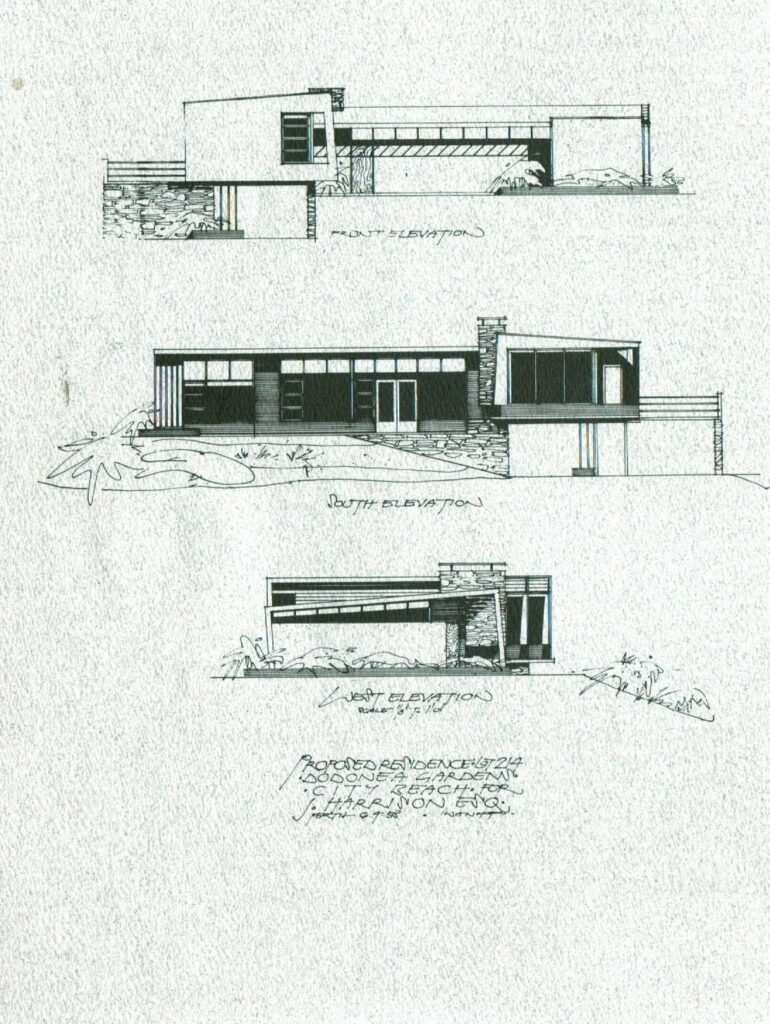
Sometime in early 1953, Jack had sold his prized car (Vauxhall) to purchase a block of land in Berkeley Street, Floreat, but when his chosen architect, Iwan Iwanoff viewed it, he talked him into selling it for a block with ocean views at 11 Dodonia Gardens, City Beach – Lot 214 – which cost 325 pounds.

11 Dodonia Iwanoff design

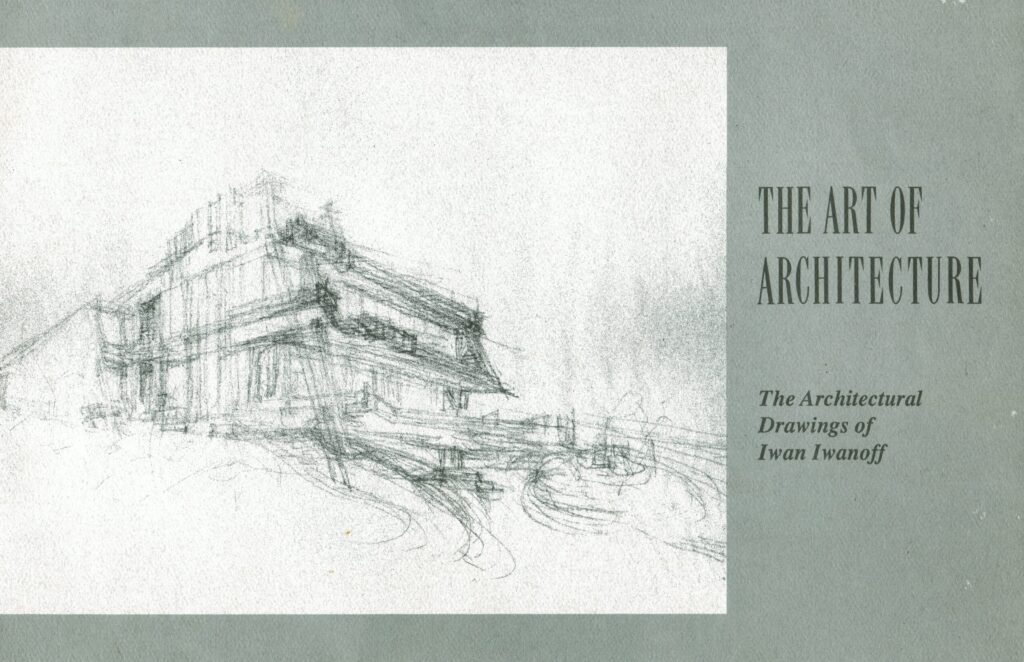
Nichols, Duncan, Richards, Duncan, The Art of Architecture: The Architectural Drawings of Iwan Iwanoff (1919 – 1986) (The State Archives of Western Australia, 1991)

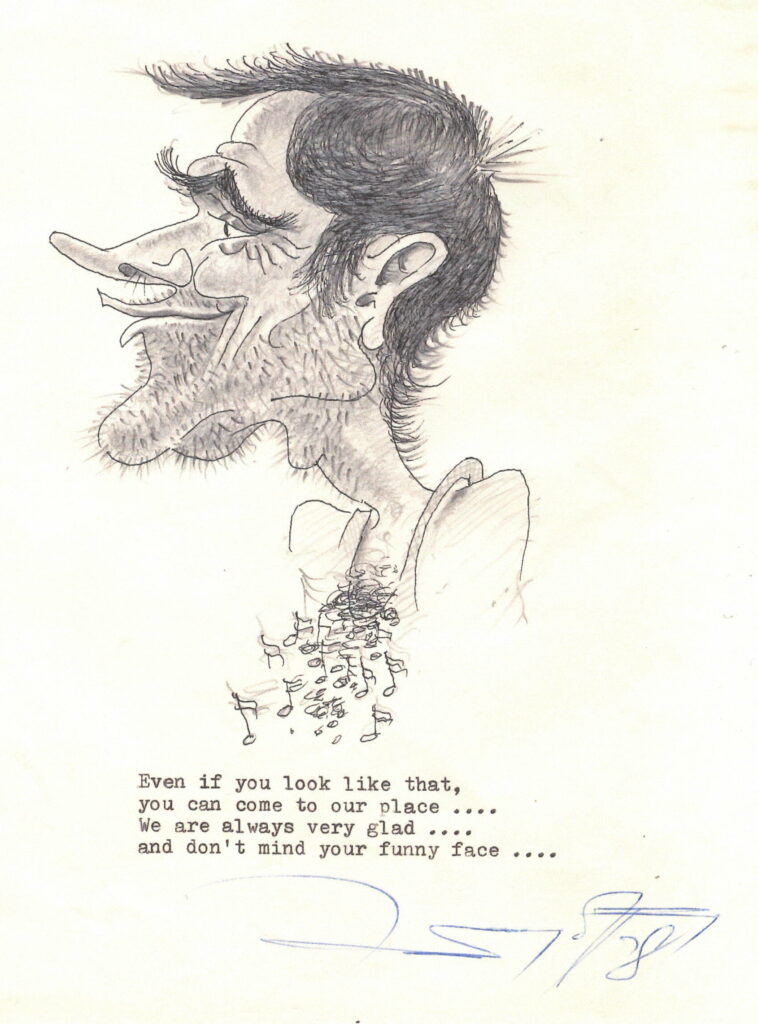
Iwan was also a caricature artist and often sketched the owners of his houses.

Iwanoff Jack Harrison caricature


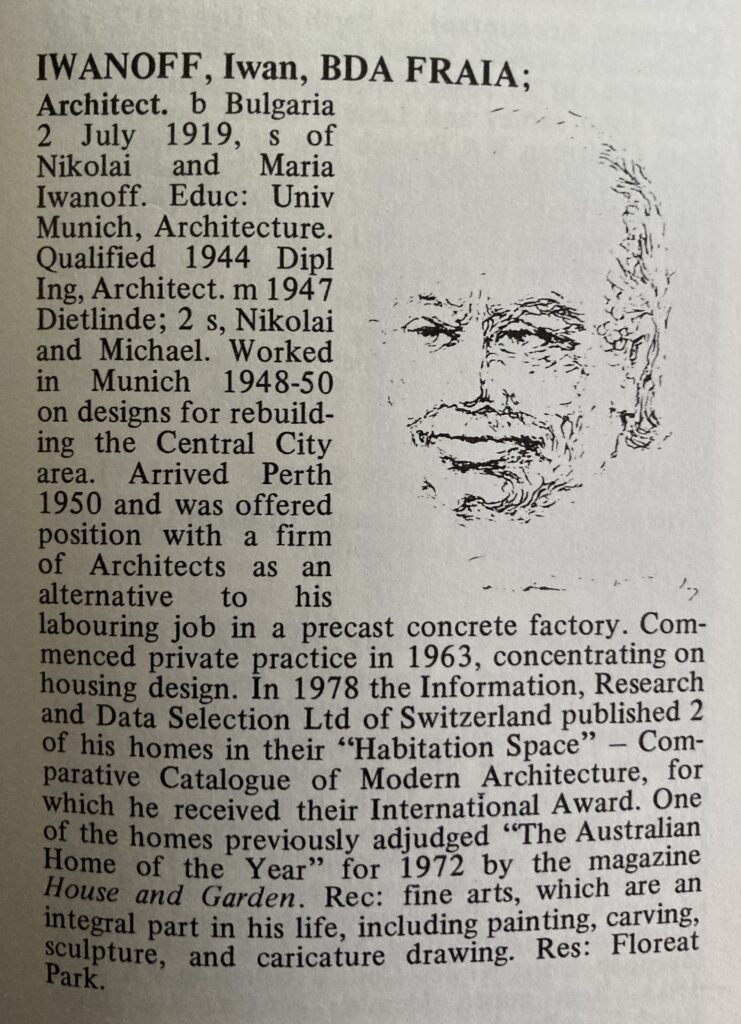
Iwanoff “The Way 79 – Who is Who”

Sacks, Margaret, The Way 79 Who is Who, (Crawley Publishers Pty Ltd, 1979). p. 195


PUBLICATIONS

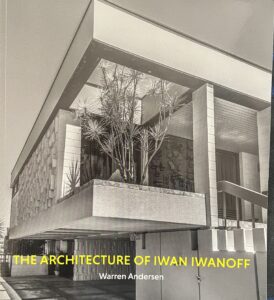
The Architecture of Iwan Iwanoff by Warren Anderson


Nichols, Duncan, Richards, Duncan, The Art of Architecture: The Architectural Drawings of Iwan Iwanoff (1919 – 1986) (The State Archives of Western Australia, 1991)


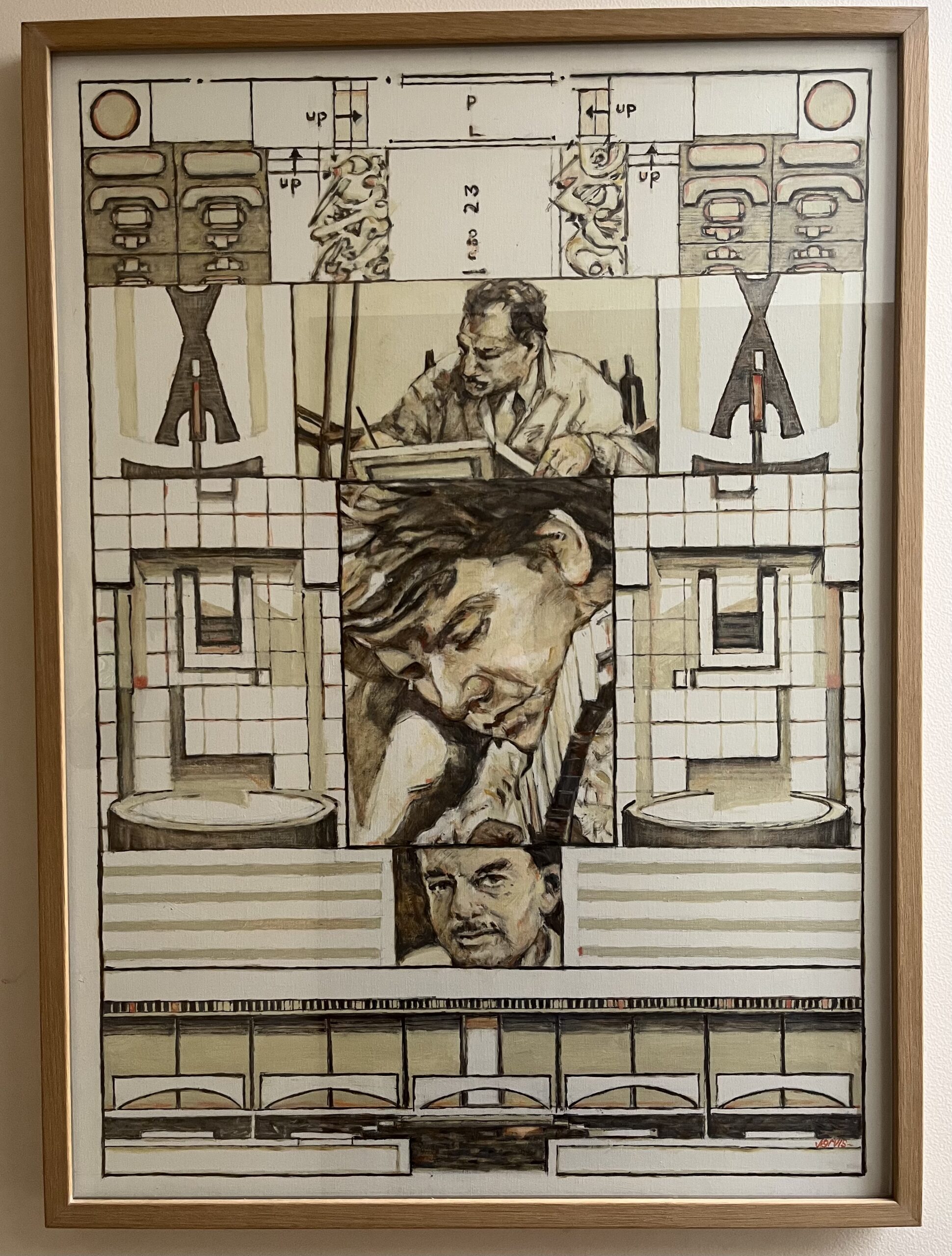
Homage to Iwan Iwanoff by Sue Jarvis

Iwan Iwanoff designed and built his own nome at 16 Lifford Road Floreat and moved there in 1967.