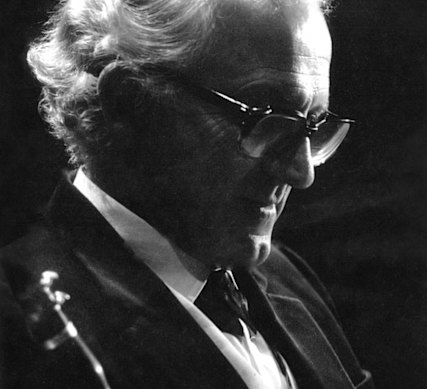
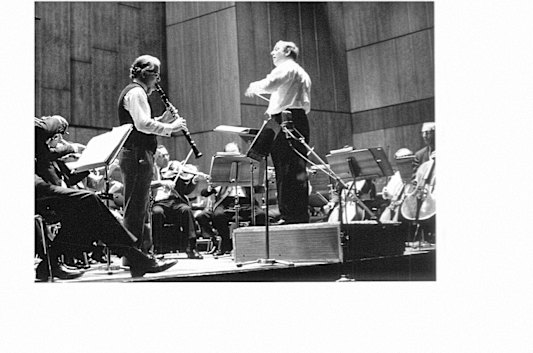
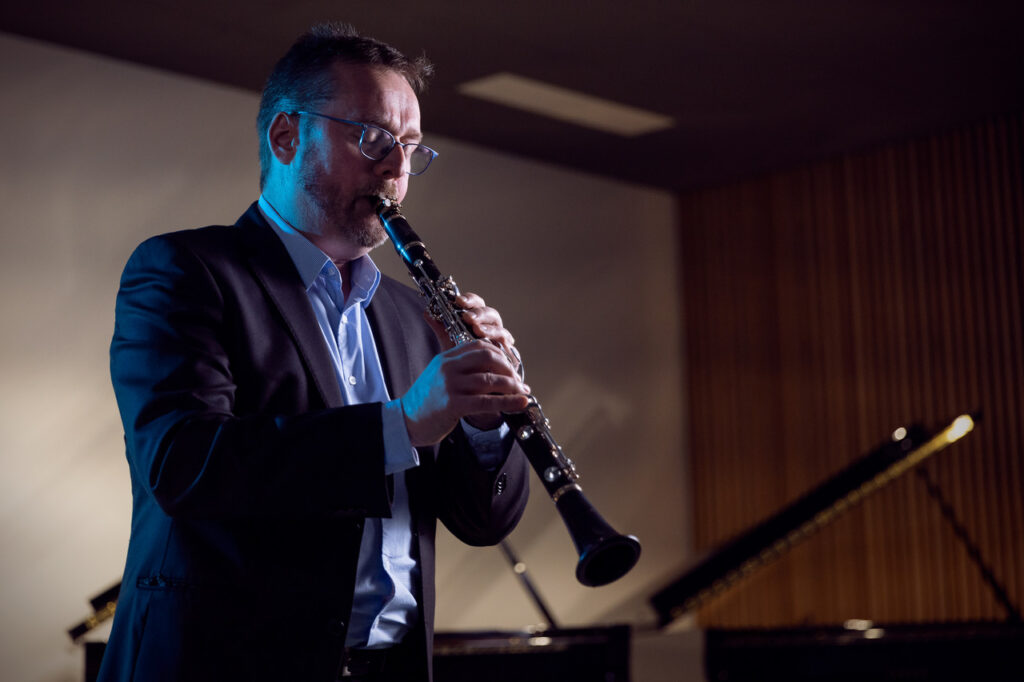
Chris Dragon learnt the clarinet from Allan Meyer.
Australian conductor Christopher Dragon is the Music Director of Greensboro Symphony Orchestra, Music Director of the Philly Pops, former Music Director of the Wyoming Symphony Orchestra and is the Resident Conductor of the Colorado Symphony. He joined the Colorado Symphony in the 2015/2016 Season as Associate Conductor – a position he held for four years. For three years prior, Dragon held the inaugural position of Assistant Conductor with the West Australian Symphony Orchestra, which gave him the opportunity to work closely with Principal Conductor Asher Fisch.
Dragon has a versatile portfolio ranging from live-to-picture performances including Nightmare Before Christmas, Toy Story and Star Wars: Return of the Jedi, a wide variety of collaborations with artists such as the Wu-Tang Clan, Cynthia Erivo and Joshua Bell, to standard and contemporary orchestral repertoire such as Danny Elfman’s Percussion Concerto; all areas of which he has become highly sought after. Christopher has become known for his charisma, high energy and affinity for a good costume, consistently delivering unforgettable performances that has made him an audience favourite.
Recent highlights include his sold-out symphony tour with Gregory Alan Isakov including two performances at New York’s iconic Radio City, with another symphony tour planned in 2026 culminating at the Hollywood Bowl. Other upcoming highlights include collaborations with Jon Batiste, Idina Menzel and his debut with the Boston Pops at Tanglewood.
Christopher is highly sought after as a guest conductor and has worked with the Los Angeles Philharmonic, San Francisco Symphony, National Symphony Orchestra, Cincinnati Pops Orchestra, San Diego Symphony, WDR Funkhausorchester, Singapore Symphony Orchestra, Orquestra Sinfônica de Porto Alegre and the New Zealand Symphony Orchestra to name a few. In Australia, he has guest conducted the Sydney, Melbourne, Adelaide and West Australian Symphony Orchestras. His 2015 debut performance at the Sydney Opera House with John Pyke and the Sydney Symphony Orchestra was released on album by ABC Music and won an ARIA the following year
He has also conducted at numerous festivals including the Breckenridge and Bangalow Music Festivals, with both resulting in immediate re-invitations. At the beginning of 2016 Dragon conducted Wynton Marsalis’ Swing Symphony as part of the Perth International Art Festival alongside Wynton Marsalis and the Jazz at Lincoln Center Orchestra.
Christopher began his conducting studies in 2011 and was a member of the prestigious Symphony Services International Conductor Development Program in Australia under the guidance of course director Christopher Seaman. He has also studied with numerous distinguished conductors including Leonid Grin, Paavo and Neeme Jarvi at the Jarvi Summer Festival, Fabio Luisi at the Pacific Music Festival and conducting pedagogue Jorma Panula.
Neil Boon was born in England in 1936 and came to Australia in 1949.
1953
LISTENERS WILL HEAR GIBSON
An agreement reached between the W.A. Musicians’ Association and the ABC resulted in last Sunday’s Jazz Jamboree (featuring The Bob Gibson Show) being recorded for broadcasting from 6WF. When the ABC heard that ace band leader Gibson would be the guest artist for the second part of Jazz Jamboree, it came to an agreement with organisers Sam Sharp and Harry Bluck for Gibson’s show to be recorded, and also agreed to pay the W.A. Musicians’ Association a fee for the right to record the show. The date of the broadcast will be published shortly. Gibson is now musical director for 2UW. Recently Gibson signed an agreement with the Columbia Recording Company. The first of his releases to be heard in Perth will probably be “Wild Horses” and “My One and Only Heart”. Gibson, who went to England in 1948 and returned in 1950, now favours big band. He records with a 28-piece band, and for concert and radio work he uses anything from 16 to 20 musicians. Two of his most popular programmes, heard from 2UW and Sportsman’s Parade and Musically Yours. Gibson said that any young musicians who hoped to go abroad needed plenty of capital and lucky breaks. He said that there were too many instances of a bandleader casually approaching a popular tune without having any idea of presentation.
Of the orchestra he conducted at the Jazz Jamboree on Sunday night, Gibson commented “They are a first class bunch of musicians. Considering they had such short notice to get together they gave a truly remarkable performance.” The band leader also praised individual performances. He believes that 17 year old Neil Boon could develop into a top line artist. Jack Harrison displayed plenty of versatility and gave a smooth performance, he said. Gibson also praised the responsiveness of the audience. “In modern music there is no greater encouragement” he said.
The Broadcaster Saturday November 7 1953 Vol .20 No. 1023
Young Musician Receives Loud Applause
A saxophone solo by 17-year old Neil Boon was loudly applauded in the Capitol Theatre last night at the final session of the Jazz Jubilee. The young musician, who arrived in Australia from England four years ago with no knowledge of music appeared in an orchestra with the veteran trumpeter Harry Phillips. He played an arrangement by the late Freddy Gardiner of “I’m In the Mood for Love.” Another artist on the same programme was Jack Harrison, who played six instruments in a ten-minute “jam session.” He played the alto and bass saxophone, clarinet, vibraphone, trombone and the piano accompaniment to his sister Jill when she moved from the piano to play the oboe (bassoon!) in “bebop” tempo.
The West Australian Monday 2 November 1953 page 4
1954
Sunday 7 November 1954 – Jazz Concert – George Watson Show
The Capitol Theatre was packed last night when six local bands and a combined band led by George Watson, a former West Australian, gave a jazz concert. Mr. Watson is regarded in Melbourne as one of Australia’s foremost drummers and bandleaders.
The young audience heard jazz classics played by Neil Boon’s Quartet; Cliff Adam’s Show Band; Harry Phillips’ Quartet; Ossie Sanderson’s Trio; Jack Harrison’s Quartet; and the Dixieland Group.
The West Australian Monday 8 November 1954 page 15
1956
BOON WILL BOOM WITH HIS BOOP-BOOP-A-DOO
One night last week I had the pleasure of working with a young musician who has just arrived here from Perth, and I have no hesitation in naming him as one of the most promising clarinettists in town today. He is 19 year old Neil Boon and his very easy style (which shows a distinct Goodman influence) and excellent tone, had the boys in the Joe Marchesani trio very enthusiastic indeed concerning his future prospects in the music game.
The boy’s playing was full of ideas and his technique is a tribute to the thorough teaching of Alan Rule in Perth. Rule was well known to Melbourne theatre audiences as a member of the Regent orchestra for years and built an excellent reputation here as a teacher, before returning to home in the West. He is a big husky fellow and a fine player himself. Another of his prize pupils who is frequently mentioned when swing musicians are discussing the country’s top clarinet men is Jack Harrison of Perth, whose sister Jill was recently appointed to the Melbourne Symphony Orchestra in the bassoon chair.
The Argus Melbourne Saturday March 31 1956
1971
Neil Boon joined the clarinet section of the West Australian Symphony Orchestra while Jack Harrison was away on a Churchill Fellowship.
Clive Lyoff Amadio (1904-1983), saxophonist and clarinettist, was born on 28 February 1904 at Darlington, Sydney, second son of New Zealand-born Harry Henville Taylor, furniture manufacturer and instrumentalist, and his wife Florence Ada, née Beer, who was from New South Wales. Harry had taken the surname of his stepfather, Henry Antonio Amadio. The flautist John Amadio, who was to marry Florence Austral, was Harry’s brother. One of Sydney’s leading musicians, Harry played flute, oboe and clarinet for `The Firm’ (J. C. Williamson Ltd), and also for the New South Wales State Conservatorium of Music orchestra. He gave Clive all his early training, first on the flute and oboe and then on the clarinet, and encouraged him to take the saxophone seriously. Having left school by the age of 13, Clive often practised for eight hours without a break. Eager to become an engineer, he began an apprenticeship but was, he claimed, `forced into the musical world’ by his father.
In his mid-teens, as well as playing in ensembles for silent pictures and musical comedies, Clive was solo clarinettist in both the New South Wales State Military Band and the Manly Municipal Band. At 19 he was touring as solo saxophonist on the Tivoli circuit, in, by his own account, one of the highest paid musical positions in Australia at that time, earning £15 a week. When `the talkies’ arrived, Amadio’s popularity as solo saxophonist in the accompanying show bands blossomed. With slicked-back black hair and dark eyes, he was described in 1929 as `that handsome sheik with the sax’. He had married Gwendolen Marjorie Morgan on 25 August 1928 at St Michael’s Church of England, Rose Bay, but they were divorced after about a year. On 2 October 1935 he married Laurie Mary Walley at the registrar’s office, Annandale.
Amadio played with groups such as the Royal Squadron Syncopators, Nigger Minstrels and Spanish Syncopators, and recorded with Quintrell’s Tivolians. His show-band performances continued until the demise of the bands themselves after World War II, a frenetic period that included two years (1932-34) as principal clarinettist to the Australian Broadcasting Commission’s studio orchestra; membership of an early light music broadcast ensemble, the New Note Octet; the formation of his own quintet, a group that was to survive the end of the war by thirteen years; and solo engagements that proliferated with his burgeoning popularity. He had performed on 1 July 1932, when the ABC assumed control of the national broadcasting service, as saxophone soloist on 2BL.
Late in 1939 the quintet that was to render him a household name across Australia and the South Pacific went to air for the first time. Usually billed in the early years as the Mode Moderne Quintet, its name was changed to the Clive Amadio Quintet after the war and the group was given prime Sunday night listening time with recorded mid-week repeats. Reviews at the time reflected its popularity: `the best light musical combination ever presented on the air in this country’ and `the finest small-ensemble music on the air’. It broadcast on the ABC for almost twenty years, sometimes featuring Australian compositions and guest artists.
Meanwhile Amadio was establishing a reputation as one of Australia’s most accomplished clarinettists and its finest saxophonist. His public performances often included saxophone pieces that have since become standard repertoire: Rapsodie (Claude Debussy); Concertino da Camera (Jacques Ibert); Saxo-Rhapsody (Eric Coates); and works written especially for him by his three arrangers, Dulcie Holland, Henry Krips and Bruce Finlay. Employed by the State Conservatorium of Music (1942-45), he taught the saxophone.
In January 1954 Amadio played for Queen Elizabeth II at a royal banquet and was cited by the Sun-Herald as Australia’s best-known serious musician after (Sir) Eugene Goossens. He took part in the first of a series of chamber music concerts sponsored by the ABC in February 1954. Accompanied by his pianist Olga Krasnik, he left for an overseas tour of some months (1954-55). In Paris they recorded Holland’s Sonata for E♭ Alto Saxophone and Piano and her Musette and Gigue for the United Nations Educational, Scientific and Cultural Organization. They gave recitals for the British Broadcasting Corporation and he performed Coates’s Saxo-Rhapsody with the BBC Concert Orchestra conducted by (Sir) Charles Mackerras. Amadio and Krasnik also broadcast for the French, Austrian, Spanish and South African broadcasting services.
In August 1958 Amadio’s contract was not renewed by the ABC. For a time he continued freelancing but by May 1959 he had bought the newsagency in Oxford Street, Woollahra, that, with Olga Krasnik, he would run for the next thirteen years. Divorcing Laurie, Clive married Olga, also a divorcee, on 28 July 1967 at the registrar-general’s office, Sydney. In August 1972 they retired to Nelson Bay. They joined the part-time staff of the State Conservatorium of Music, Newcastle branch, where they taught and performed from 1973 until 1980. In that year he was appointed AM and awarded honorary life membership of the Clarinet Society of New South Wales, the first time this award had been made to an Australian. He collected rare guns, which interested him more for the workmanship displayed than for their performance. He died on 21 October 1983 at Randwick and was cremated. His wife, and the son and two daughters of his second marriage survived him.
Select Bibliography
D. Westlake, From Me to You (1999)
ABC Weekly, 8 June 1946, p 5, 22 June 1957, p 9
Sun-Herald (Sydney), 31 Jan 1954, p 46
Canon, Oct 1956, p 93
SP613/1, series item 7/4/10, parts 1 and 2 (National Archives of Australia)
private information.
Citation details
Donald Westlake, ‘Amadio, Clive Lyoff (1904–1983)’, Australian Dictionary of Biography, National Centre of Biography, Australian National University, https://adb.anu.edu.au/biography/amadio-clive-lyoff-12131/text21733, published first in hardcopy 2007, accessed online 22 September 2026.
This article was published in hardcopy in Australian Dictionary of Biography, Volume 17, (Melbourne University Press), 2007
In 1950 during his stay in Sydney Jack Harrison performed with Frank Coughlan’s band in a series of swing concerts at the Trocadero and received an offer to stay with the band as a permanent member. He also received lessons from Clive Amadio.
In Donald Westlake’s book “From Me to You The Life and Times of Clive Amadio” he quotes a letter from Jack written in December 1998:
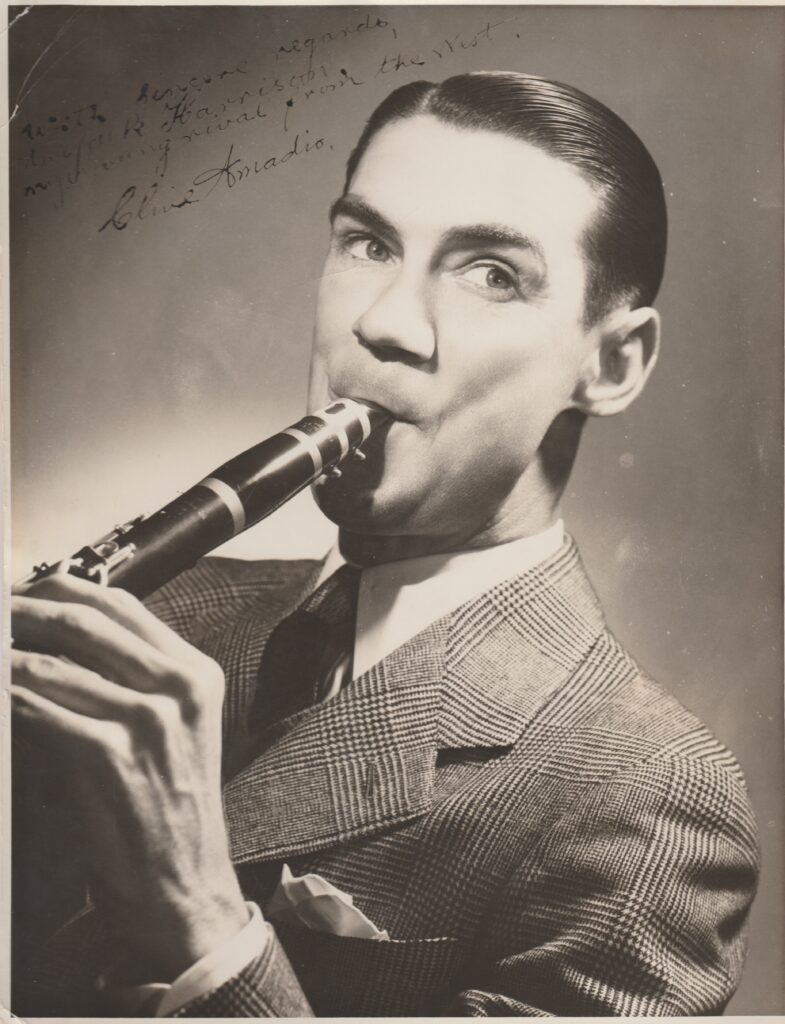
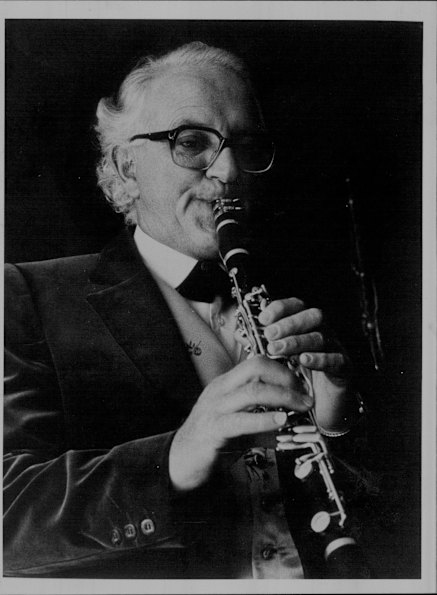
Sometime in the early 50s, I went East with Dad and met Clive Amadio. I had a little ensemble in Perth similar to his that’s why I was interested. We went to a couple of his recording sessions in an old studio somewhere in the middle of Sydney and then out to his house in Vaucluse for a couple of lessons, lovely chap very friendly. The main thing he talked about was the double embouchure. He was a great one for that. I tried it for a couple of months but couldn’t see any advantage so gave it away. I’ve still got the autographed photograph. He gave me very nice head and shoulder studio photograph. When I got back, I had it framed and hung it over my bed – it was there for years. It says “with sincere regards to Jack Harrison, my young rival from the West. Clive Amadio.”
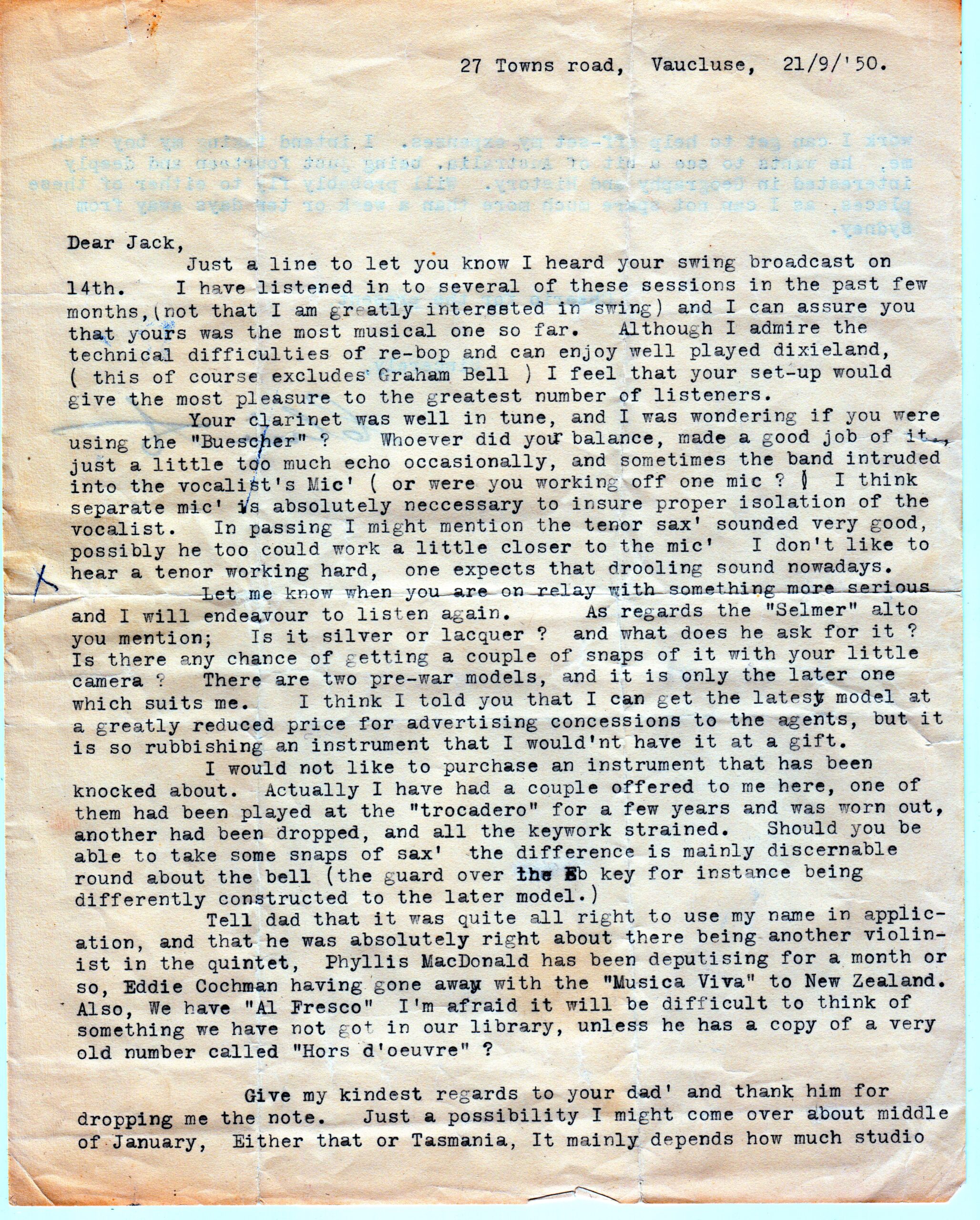
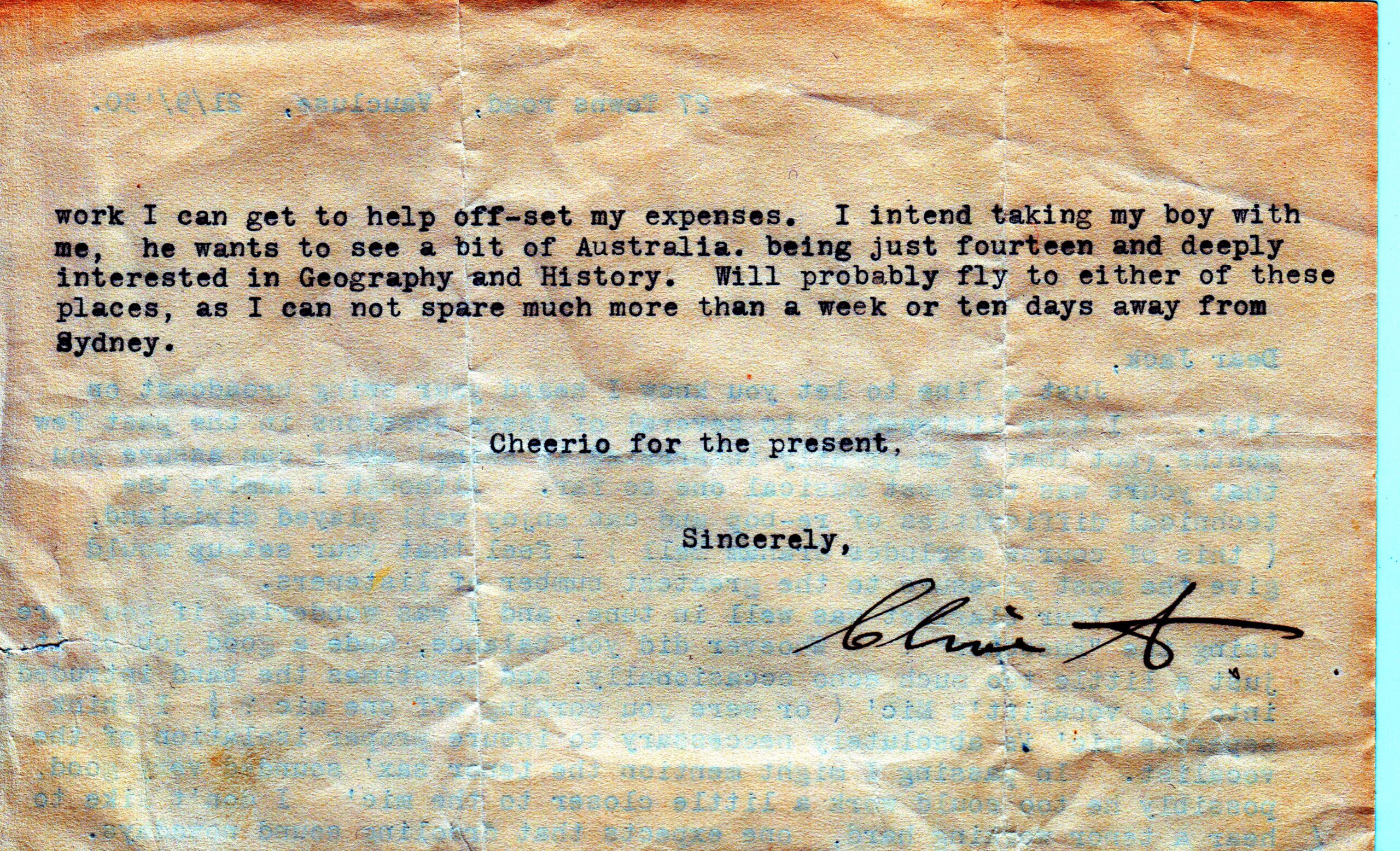
On Monday 21st August 1950 Jack Harrison received a letter from Clive Amadio:
27 Towns Road, Vaucluse, 21/09/50.
Dear Jack,
Just a line to let you know I heard your swing broadcast on 14th (September). I have listened in to several of these sessions in the past few months, (not that I am greatly interested in swing) and I can assure you that yours was the most musical one so far. Although I admire the technical difficulties of be-bop and can enjoy well played Dixieland (this of course excludes Graham Bell) I feel that your set up would give the most pleasure to the greatest number of listeners.
Your clarinet was well in tune and I was wondering if you were using the Buescher? Whoever did your balance made a good job of it, just a little too much echo occasionally and sometimes the band intruded into the vocalist’s microphone (or were you working off one mic?). I think separate mic is absolutely necessary to ensure proper isolation of the vocalist. In passing. I might mention the tenor sax sounded very good. Possibly he, too, could work a little closer to the mic. I don’t like to hear a tenor working hard. One expects that drooling sound nowadays.
Let me know when you are on relay with something more serious and I will endeavour to listen again. As regards the Selmer alto you mentioned, is it silver or lacquer? And what does he ask for it? Is there any chance of getting a couple of snaps of it with your little camera? There are two pre-war models and it is only the later one which suits me. I think I told you that I can get the latest model at a greatly reduced price for advertising concessions to the agents, but it is so rubbishing an instrument that I wouldn’t have it as a gift.
I would not like to purchase an instrument that has been knocked about. Actually, I have had a couple offered to me here, one of them had been played at the Trocadero for a few years and was worn out. Another had been dropped and all the key work strained. Should you be able to take some snaps of the sax, the difference is mainly discernible round about the bell (the guard over the E flat key for instance being differently constructed to the later model).
Tell Dad that it was quite alright to use my name in application and that he was absolutely right about there being another violinist in the quintet, Phyllis MacDonald has been deputising for a month or so, Eddie Cochman having gone away with the Music Viva to New Zealand. Also we have “Al Fresco” (music). I’m afraid it will be difficult to think of something we have not got in our library unless he has a copy of a very old number called “Hors d’oeuvre”?
Give my kindest regards to your dad and thank him for dropping me the note. Just a possibility I might come over about middle of January, either that or Tasmania. It mainly depends how much studio work I can get to help off-set my expenses. I intend taking my boy with me. He wants to see a bit of Australia being just 14 and deeply interested in geography and history. Will probably fly to either of these places as I cannot spare much more than a week or 10 days away from Sydney. Cheerio for the present,
Despite his father’s fierce disapproval, Donald Westlake was undeterred in his desire to pursue a career in music from an early age. His mother – a gifted pianist – actively encouraged the young Donald by regularly taking him to concerts by the Perth Symphony Orchestra.
Donald Westlake, principal clarinettist with the Sydney Symphony Orchestra.
At age 13, he began clarinet lessons in Perth with Percy Newton and dabbled with dance-band music and jazz until moving east to attend the Melbourne Conservatorium studying under Isobel Carter.
His rise to professional status was meteoric: by the age of 22, in 1953, he had won 1st prize in the ABC’s Concerto Competition; was awarded a commonwealth tour as a featured soloist with the ABC; was appointed principal clarinet with the Queensland Symphony Orchestra; and was then subsequently invited by Sir Eugene Goossens to take up the principal clarinet position with the Sydney Symphony Orchestra (SSO).
In August of the same year, he married SSO violinist Heather Sumner and they travelled to London where Donald accepted a scholarship at the Royal College of Music in London, studying under Bernard Walton and graduating in 1956. After returning to Australia, he was re-appointed principal clarinet with the SSO, a position he held from 1960 until 1978.
Clarinettist Donald Westlake on the Sydney Symphony Orchestra European Tour in 1974.
As a soloist, he commanded a formidable stage presence and his interpretations of the great concertos by Mozart, Weber, Copland, and Nielsen left music critics grasping for superlatives and frequently garnered standing ovations.
He shared the stage of the Sydney Opera House and Town Hall with numerous musical luminaries of the era, including Igor Stravinsky, Leonard Bernstein, Aaron Copland, Sir Charles Mackerras, Willem van Otterloo and performed the Mozart clarinet concerto under the baton of the legendary Daniel Barenboim on the occasion of the maestro’s very first conducting engagement in 1962.
He was the featured soloist on the SSO’s 1974 European tour, performing the Mozart clarinet concerto in Montreux, Basel, Stuttgart, Braunschweig and Lisbon. His performance in Stuttgart earned no less than seven curtain calls.
From our partners
“He can make the clarinet recite poetry with rare eloquence, but then he can launch a sequence of breath-taking pyrotechnics that few other clarinet players can match in speed, clarity, accuracy and range of timbre,” wrote music critic Fred Blanks of Donald’s 1980 performance of Webers second concerto. “No wonder he unleashed an ovation.”
Donald Westlake, clarinettist, guest artist with the Sydney String Quartet when they perform in the forthcoming Mostly Mozart season at the Sydney Opera House on December 23, 1983.Fairfax
As a teacher he was highly revered, with a reputation for delivering brutal honesty and nigh impossible expectations; despite his old school “make it or break it” teaching philosophy, many fine players flourished and went on to pursue professional careers.
When not rehearsing or touring with the SSO, he could be found sailing the Great Barrier Reef, bushwalking in the Blue Mountains, or performing chamber music with his colleagues.
He was a committed environmentalist and actively supported Friends of the Earth by organising a number of benefit concerts during the 1970s.
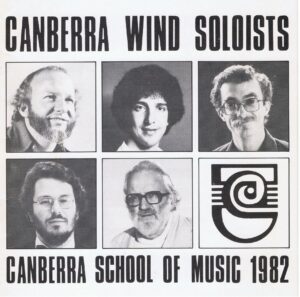
Canberra Wind Soloists 1982
From 1979 to 1984, he took up the position of Head of Woodwind at the Canberra School of Music at ANU, where he focused on teaching and performing with the Canberra Wind Soloists.
In 1985, following a long battle with tenosynovitis, he was no longer able to play the clarinet and retired to a hobby farm in northern NSW where he wrote several music biographies, most notably From me to you: the life and times of Clive Amadio.
He separated from Heather and married his partner of over 40 years, Laura Danckwerts in 2018.
His recording of the Mozart Concerto with the SSO conducted by Robert Pikler for RCA in 1976 remains perhaps one of his most enduring legacies and still receives regular airplay on classical radio.
“Westlake’s technique is impeccable, his control of phrasing and contrasts of attack quite beyond all carping. I’ve come to love the school of clarinet playing to which Westlake belongs: even, steady in tone, coloured by occasional washes of moonlit lustre,” stated music critic Roger Covell upon the album’s release.
Donald, who died in August, was father to Nigel, Kathryn (deceased), Kristin, a grandfather of six and great-grandfather of four.
Nigel Westlake is a composer, musician and conductor.
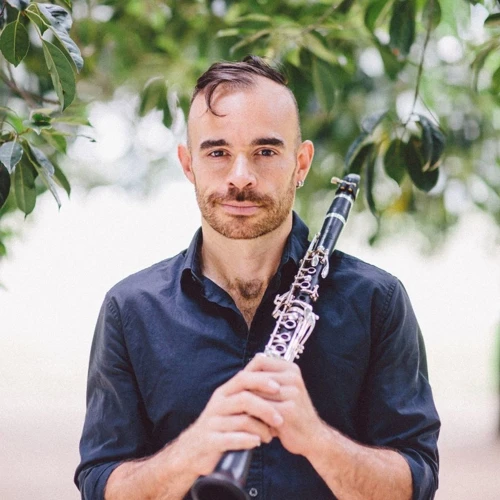
David Thomas is one of Australia’s leading orchestral clarinettists and clarinet teachers. He grew up in the Dandenong Ranges near Melbourne and studied clarinet with Phillip Miechel (ex-MSO principal clarinet) at the University of Melbourne and Roger Salander at the Vienna Conservatorium of Music.
His first permanent orchestral position was Associate Principal Clarinet with WASO, joining the orchestra in 1998 with Allan Meyer as his Section Principal Clarinet. Since 2000 he has been Principal Clarinet of the Melbourne Symphony Orchestra, and since 2005 he has taught at the Australian National Academy of Music, helping a whole generation of young Australian clarinettists find their feet professionally.
“Unfortunately I am a little too young to have heard some of the really important pioneering Australian clarinettists in the flesh — Don Westlake in Sydney, Isabel Carter in Melbourne, and Jack Harrison in Perth. But I did get to chat with Jack after WASO concerts he attended, and I’ve heard plenty of anecdotes from musicians who worked with him. For a performance of Mahler’s 1st Symphony towards the end of his playing career, I’m told the WASO clarinet section delighted in loading Jack up with all the possible doublings on his 3rd clarinet part: bass clarinet as well as clarinets in Bb, A, C and Eb. It must have taken him half an hour to pack up after those concerts. My favourite attributed quote is one of reassurance to a young clarinettist colleague addressing perhaps our biggest fear in concert: “If you don’t bust a note occasionally, you’re not trying hard enough”. I am quite sure this doesn’t reflect any sort of lackadaisical attitude from Jack, but rather a wonderfully Australian attitude to work: quality really does matter, but let’s not get worked up if something goes wrong, and let’s make sure to encourage our colleagues to give it their all. In this sense, I am proud to (try to) follow in Jack’s footsteps, and the experience of working in the section he had led so effectively for so many years helped me develop the skills I needed as a section leader in the orchestra of my own home town.”
Described as ‘Incandescent… a masterly display of skill and insight… as an apologist for contemporary music-making, you would search hard to find this clarinettist’s equal’ (The Age), Ashley William Smith performs as a clarinet soloist, recitalist, and chamber musician across Australia, the USA and Asia.
A laureate of major Australian awards, he has received the Music Council of Australia Freedman Fellowship, an ABC Symphony International Young Performer Award, a Churchill Fellowship, and the APRA Performance of the Year. He is recognised by leading instrument makers as a Backun and D’Addario Artist.
Committed to the creation and performance of new music, more than 30 major solo works have been written for him, including concertos by Lachlan Skipworth and James Ledger.
As a chamber musician, Ashley has appeared worldwide with ensembles including the Calder Quartet, Dover Quartet, the Australian String Quartet and the Southern Cross Soloists, and with organisations including Bang on a Can, the Chamber Music Society of Lincoln Centre, Chamber Music Northwest, the Kennedy Centre, and the Beijing Modern Music Festival.
Ashley is an Associate Professor at the University of Western Australia, where he is Chair of Woodwind and Deputy Head of School. A graduate of Yale University and the University of Western Australia, and a Fellow of the Australian National Academy of Music, he received prizes as the most outstanding performance graduate of each institution. In 2020, he completed a doctorate in music analysis.
Alongside performance, he works in artistic leadership as an artistic director and is a sought-after public speaker and music educator. He contributes to the Australian music sector through mentorship, programming, advisory work and board leadership.
In 1995, he won the Western Australian Citizen Of The Year (community services) award. He won the Premier’s Book Award in 1994 for an anthology of Western Australian writing.
In 2003, in the midst of National Nine News’ national dominance in the ratings, Holland left his role with local television station STW and took up a full-time teaching post with Edith Cowan University, having been a part-time member of staff since 2001.
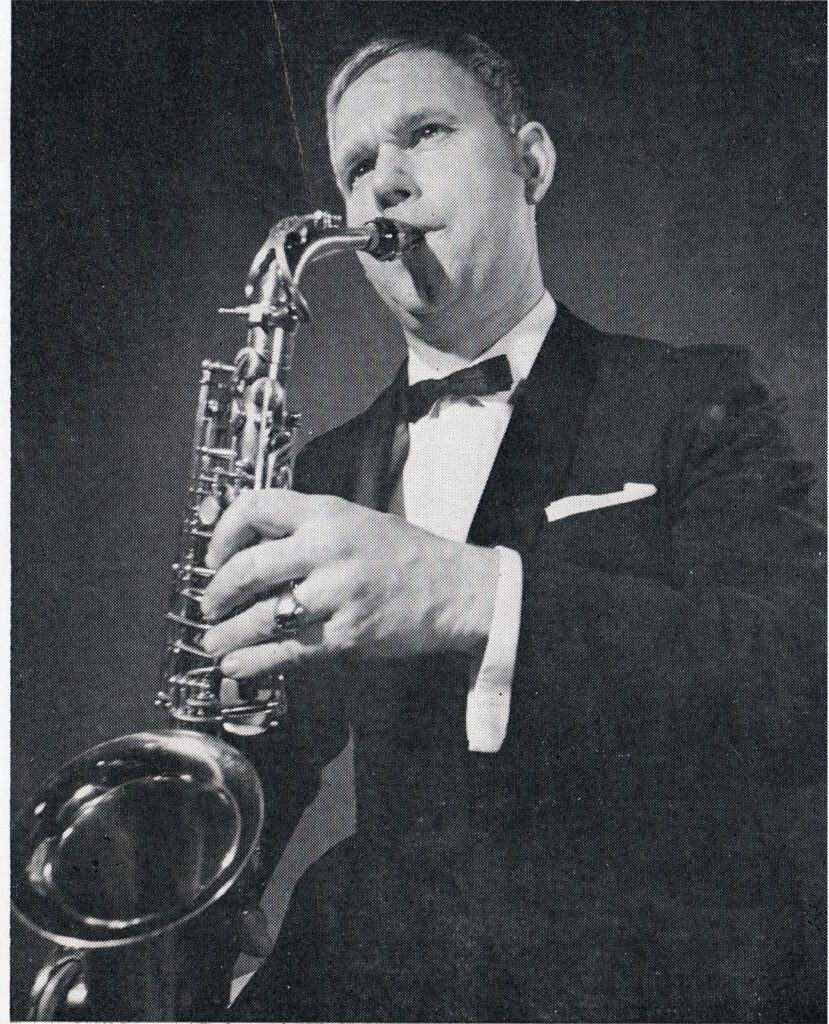
Peter Clinch was an Australian saxophonist, clarinettist, composer and educator.
Dr. Peter Clinch was born in Geraldton, Western Australia in 1930. He began his early career augmenting in the clarinet section of the Perth Symphony Orchestra in 1947 , the West Australian Symphony Orchestra and then joined the RAAF Central Band as Principal Solo Clarinet and Senior NCO in 1953. Subsequent to this he played clarinet and saxophone with every ABC Symphony Orchestra in Australia either as a member of the orchestra or as a soloist. Peter was the Head of the Music Department at the Melbourne College of Advanced Education and later the Reader, then Associate Dean (Music Education) at the Faculty of Music, University of Melbourne.
As well as producing a number of recordings, Peter toured extensively in Europe, Asia and the USA as a soloist, recitalist, a chamber music performer, and a conductor as well as giving lectures and masterclasses. The Peter Clinch Saxophone Quartet was the most exciting ensemble of the Australian music scene, certainly its most pertinent in contemporary significance. He won several awards for composition. He was widely respected as a conductor and his jazz performance. He was the founder and President of the Clarinet and Saxophone Society of Victoria, Vice President of the Comité International de Saxophone and has a citation in several “Who’s Who” guides including “Who’s Who in the Commonwealth” and “Who’s Who in the World”. He was the Head of the Department and Reader and Associate Dean of Music Education at the Melbourne CAE (University of Melbourne).
Peter’s international conference contributions included papers for several of the World Saxophone Congresses, the Australian National Clarinet Seminar in Sydney, several of the International Clarinet Congresses and the Australian National Saxophone Seminar in Melbourne (which he organised). He also presented papers at conferences in Western Australia, Sydney, London, Canberra and Yugoslavia. He died in 1995.
Peter’s published works included a Clarinet Tutor for Allan’s Music, the Tausch Concerto for Clarinet and Orchestra and several other clarinet and jazz studies tutors. His journal articles included articles for the international publication Studies in Music, music and book reviews for the Journal of Music Education, the Journal of Australian Music and Musicians, the National Association of Teachers of Singing, the International Journal of Music Education and The Clarinet.
Original compositions include Instruments of the Orchestra, Introduction and Fugue for 4 Percussion, Music for a Grand Tour, Variations for Clarinet and Electric Tape, Introspections for Saxophone and Tape, Saxophony for Voice, Flute, Clarinet and Percussion, Inventions for 7 Players, Clarion Call for Small Ensemble, Music for Clarinet and Small Ensemble, and Quartet for Clarinet, Viola, Piano and Percussion. Many of these works were performed overseas in London, West Berlin, Salzburg, Munich, Hamburg and Brussels.
Up-and-coming exponent of the tenor sax is 18-y-o Peter Clinch, who is heard a lot— and appreciated — in city dance combinations.
Biography
18 – year – old tenor exponent Peter Clinch, of Wembley commenced taking sax lessons at the age of 13 with noted Perth reed man, George Caro. His studies on this instrument commenced along the normal classical lines and later he moved about in amateur orchestral circles until early in 1947, when he joined a group of young musicians who were training under Ken Murdoch, the back-bone of, and step-ping stone to, the majority of the city’s prospective dance band men.
During Peter’s stay with Ken’s group, he filled a casual role and played with a number of small outfits around the city until he received his first break, playing 2nd. tenor with Jackie Sue’s Seven Piece outfit at the Fremantle Town Hall in the 1947 season. He remained with this combination for one season, playing at the port and a number of city spots, before moving his stand across to the Chris Gosper combination, which was featured at Anzac House.
During the middle of 1948, Peter sat in with the Sammy Sharp outfit as 4th tenor and later accepted 2nd tenor when well known Johnny McCaughan vacated the position to go South in October, ’48. Since then he has remained with the Sharp outfit and has been heard in the Jazz Jamboree with this outfit, the Battle of the Bands with Jackie Sue and was prominent in Thursday’s Round-up over 6WF, once again with Sammy’s boys. He is a full-time dance musician , and is assured of a rosy path ahead.
Mirror (Perth, WA : 1921 – 1956), Saturday 25 June 1949, page 15
Peter Clinch died in 1995
1949
Only 18 But Has Future!
Up-and-coming exponent of the tenor sax is 18-y-o Peter Clinch, who is heard a lot— and appreciated — in city dance combinations.
Biography
18 – year – old tenor exponent Peter Clinch, of Wembley commenced taking sax lessons at the age of 13 with noted Perth reed man, George Caro. His studies on this instrument commenced along the normal classical lines and later he moved about in amateur orchestral circles until early in 1947, when he joined a group of young musicians who were training under Ken Murdoch, the back-bone of, and step-ping stone to, the majority of the city’s prospective dance band men. During Peter’s stay with Ken’s group, he filled a casual role and played with a number of small outfits around the city until he received his first break, playing 2nd. tenor with Jackie Sue’s Seven Piece outfit at the Fremantle Town Hall in the 1947 season. He remained with this com-bination for one season, playing at the port and a number of city spots, before moving his stand across to the Chris Gosper combination, which was featured at Anzac House. During the middle of 1948, Peter sat in with the Sammy Sharp outfit as 4th tenor and later accepted 2nd tenor when well known Johnny McCaughan vacated the position to go South in October, ’48. Since then he has remain-ed with the Sharp outfit and has been heard in the Jazz Jamboree with this outfit, the Battle of the Bands with Jackie Sue and was prominent In Thursday’s Round-up over 6WF, once again with Sammy’s boys. He Is a full-time dance musician , and is assured of a rosy path ahead.
Mirror (Perth, WA : 1921 – 1956), Saturday 25 June 1949, page 15
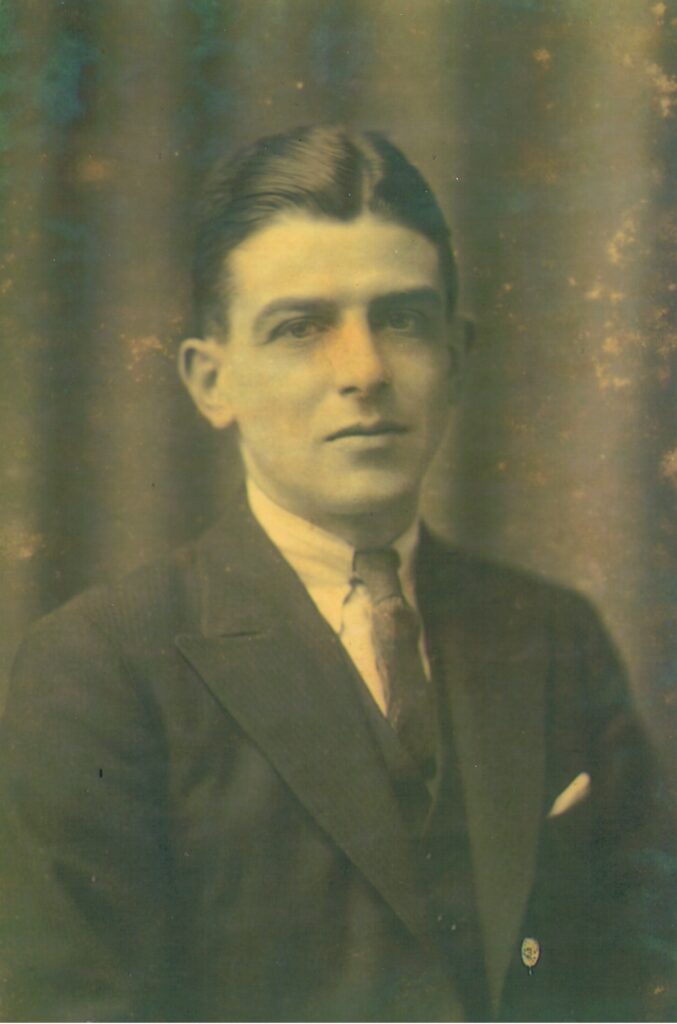
Walter Percival Newton was born in 1897 and died 26.1.1947 aged 50.
Percy Newton arrived with his brother Harold and family from England in 1927. The Newton brothers were very involved in consolidating the new Perth Symphony Orchestra in the late 1920s.
Nicholson’s Limited was a music store situated in the heart of Perth and many of the players used to meet in its music hall to discuss a possible solution to their problems of finding work. Among this group were the Newton Brothers, Percy and Harold, who had immigrated from the United Kingdom in 1927. They played for the most part with the Prince of Wales Theatre Orchestra then, following its demise, moved to the Capitol Theatre Orchestra. Percy Newton was a fine clarinet player whose services had been sought by prestigious orchestral conductors in England and who later became a leader teacher of this instrument giving a good grounding to later clarinet stars like Donald Westlake and Jack Harrison.
Harrison, Marcia WEST AUSTRALIAN SYMPHONY ORCHESTRA Celebrating 75 Years 2003 page 3
Percy was an appointed member of the professional Perth Symphony Orchestra formed in 1936 playing clarinet and was appointed deputy conductor in 1937. He remained Principal Clarinet until 1946.
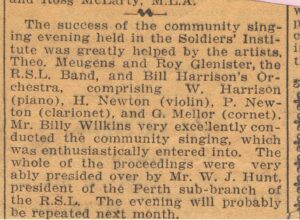
1928 William Harrison performed with the Newton brothers
Joy Boys – A Talented Company
The Joy Boys gave a bright and varied entertainment in the Town Hal Dalwallinu on Wednesday night. The programme included singing, step-dancing, and musical items. Mr Sydney Clarke, on the violin, was much appreciated. Mr Clark rendered an imitation of the bagpipes on the violin, which was very good indeed, as were his old-time melodies and step dancing. Mr Cass Mahomet’s singing was greatly enjoyed. Mr Irwin Lawrances’s cornet solo and Mr Percy Newton‘s saxophone number brought forth great applause. Mr Les Dixon delighted his hearers by his playing the piano, and Mr Townley was splendid on the sousaphone and trombone. The company was worthy of a larger audience.
North-Eastern Courier (Perth, WA), Saturday 6 September 1930, page 3
Saturday, January 9th 1932 – 6WF, PERTH.
8.0: The first revue of 1932 by the Radioptomists, produced by Harry Graham. Artists: Dorothy Manning, Billy Edwards, David Lyle, Harold Newton, Malcolm Dick, Paul Daly, Eileen Hart, Lulu Potter, Edna Waterman and Percy Newton; accompanist, Phyllis Blott. The 6WF Revue Orchestra and the A.B.C. Mixed Quartet will assist.
Western Mail (Perth, WA : 1885 – 1954), Thursday 24 December 1931, page 3
SYMPHONY ORCHESTRA – Last Sunday’s Concert
Before a moderately large audience, the Perth Symphony Orchestra offered another first class concert at His Majesty’s Theatre last Sunday evening. The music was of a lighter type than usual and, though it may not have suited sonic of the high-brow critics, appealed to the major section of the crowd.
Two dance numbers, Ponchielli’s popular ‘Dance of the Hours’ and Puccini’s ‘Witches’ Dance’ from ‘Le Villi,’ were both well rendered, except that the cold weather mitigated against the tone of the strings and affected the wood wind, where one or two weak links sometimes TEND TO SPOIL the excellent playing of the principal clarinet (Mr. Percy Newton). A suite of ballet music, ‘Hiawatha,’ by Coleridge-Taylor was a delight, and selections from ‘Rigoletto’ — one of Verdi’s best -known operas — proved popular with the audience. Mr. George Mellor (cornet) was, as usual, responsible for some fine solo work in the ‘Paraphrase’ which preceded the famous quartette that closed the number, and incidentally Mr. Reid had to respond with an encore to this item. Two overtures, ‘The Barber of Seville’ (Rossini) and ‘Zampa’ (Herold) completed the orchestral section of the programme. Signor Ugo Mina (tenor) offered pleasing selections from Italian operas.
Mirror (Perth, WA : 1921 – 1956), Saturday 22 July 1933, page 12
‘JOHN O’LONDON’S’ CIRCLE – An Evening of Music
The concluding session of the year of the ‘John O’ London’s’ Literary Circle was held last night at Lyric House, Murray street. A programme of music was contributed to by Perth musicians. A quintet conducted by Mr. Harold Newton, and consisting of Messrs. Ron Brearley (cello), Fred Murphy (clarionet), Percy Newton (clarionet), Norbert Coulehan (oboe), and Mrs. Wilson (pianoforte) provided several of the items. Solos were given by Mr. Brearley and Mrs. Wilson, and songs by Mr. Austin Coulehan and Miss June Fiore. In addition, a musical monologue and elocutionary items were contributed by Miss May Downes and Miss Mary Ward. The musical part of the entertainment was organised by Mr. Norbert Coulehan. The circle will resume its meetings in March.
West Australian (Perth, WA : 1879 – 1954), Friday 15 December 1933, page 12
SUNDAY BROADCASTS – New 6IX Feature.
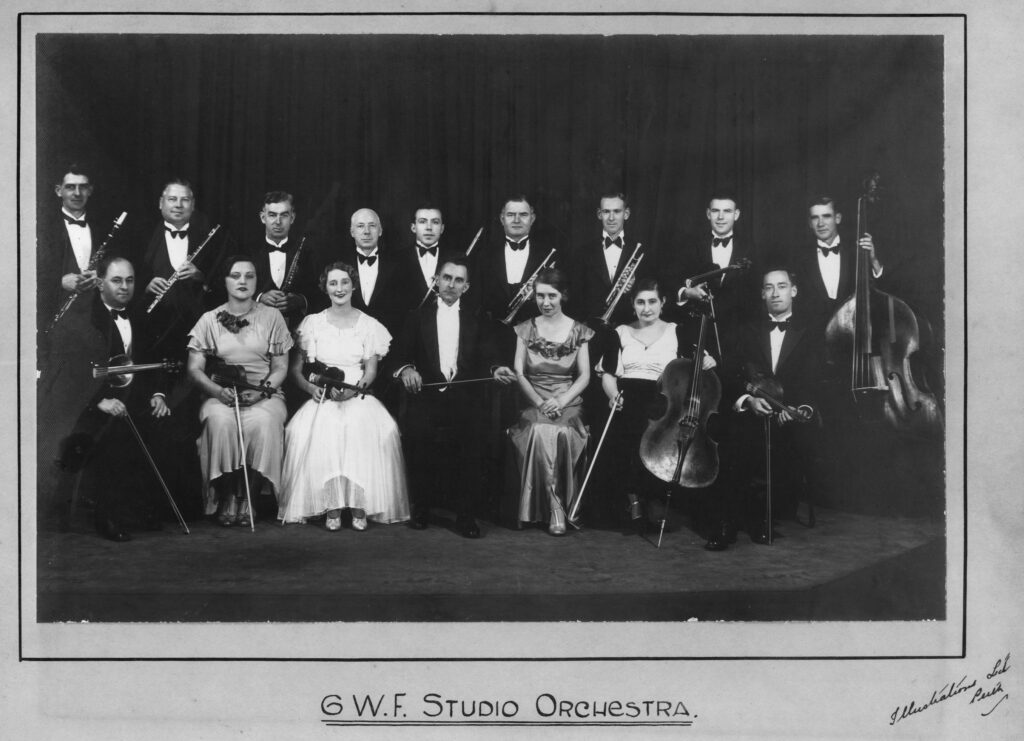
NEXT Sunday evening at 6.15 o’clock the first of a new series of broadcast will take place from the Ambassadors Theatre over station 6IX. Ron Brearley and his Merrymakers and a novelty orchestra will present a session of popular and classical vocal and instrumental numbers, which is being sponsored by General Theatres Corporation, Ltd., as a regular weekly feature. Among the artists who are to be heard are Harold Newton, Rita Hawse, Will Talbot Anthony Northe, Teddy Phillips, Percy Newton, and a feature of the first programme will be the novel way of introducing the items. Among the items to be played on the first night will be the ever-popular “Mikado” selection, rendered by the Merrymakers Orchestra. Rita Hawse will be heard in three numbers, “Bird Songs at Eventide,” “Ballad Memories” and “Everything I Have Is Yours,” accompanied by the orchestra and organ. Will Talbot, monologuist, will present “Sitting on a Log” and there will be an unusual organ and piano duet by Messrs. Northe and Phillips.
Western Mail (Perth, WA : 1885 – 1954), Thursday 23 August 1934, page 39
State Symphony Orchestra.
The West Australian State Symphony Orchestra will give another concert at the Prince of Wales Theatre, Perth, on Sunday night. An Algerian march by Mr. de Laeter (a member of the orchestra) will be the opening number and will be followed by “Capriccio Espagnol” (Rimsky-Korsakov), “Komarinskaja” (Glinka) and a repetition by request of Rimsky Korskov’s “The Flight of the Bumble Bee,” played at the last concert. Assisting artists include Paul Daly, May Webster and her eight mascots, Percy Newton and Ruth Cranfield.
West Australian (Perth, WA : 1879 – 1954), Friday 24 August 1934, page 8
FAMOUS CONDUCTOR – Coaxes Great Music From Perth Orchestra
Thursday night was a momentous one in Perth musical circles, when the fruits of Professor Schneevoigt’s (the eminent Finnish conductor) work with the Perth Symphony Orchestra of 65 players were revealed to the public at His Majesty’s Theatre. A Tchaikowsky Symphony occupied the whole of the first half, and right
from the first bar of the supremely delicate, wistful pianissimo opening it was apparent that a genius was wielding the baton. Indeed, never before had local music-lovers been regaled with such appetising fare, and while the four movements were being played, one might have heard the proverbial pin drop during the soft passages or the brief pause between each section. Even at the conclusion of the Symphony there was an impressive silence before a STORM OF APPLAUSE which lasted for several minutes, swept through the theatre. Professor Schneevoigt was recalled several times and eventually he also joined in the applause as a gesture to the magnificent work of the orchestra. Indeed, unstinted praise must be given the musicians, especially to the leader of the clarionets, Mr. Percy Newton, on whose capable shoulders rested the initial responsibility for introducing the symphonic theme. Later in the evening the conductor shook hands with Mr. W. Glassford, whose interpretation of a pleading melody in one of the other numbers was to his liking. A delicate suite for strings, Sibelius’ ‘Rakastava.’ was the first item of the second half. This, as was the case with rest of the offerings, suffered a few blemishes by minor false entries and, at times, a decided uncertainty on the part of some of the key players, but were overshadowed by the grand concerted climax that were obtained throughout the evening. Of special merit was the performance, with lovely orchestral accompaniment, of Perth’s gifted soprano, Miss Lorna Sydney Smith, whose DELIGHTFUL RENDERINGS of Wagner’s ‘Schmergen’ and ‘Traume’ were well received.
Mirror (Perth, WA : 1921 – 1956), Saturday 12 June 1937, page 17
DUAL BIRTHDAY PARTY – WEST PERTH FUNCTION
With a flesh-and-blood orchestra playing the opening overture, scenes from ‘Romeo and Juliet,’ musical travesties and acting ad lib, quite a gay party took place at the home of Mrs. Craze, Havelock-street, West Perth, on Tuesday night. The occasion was the anniversary of the birthdays of Misses Roma
Craze and Edna Waterman, and was marked by the attendance of many musicians and their friends. Some of the culminating scenes were real rollicking gems, when instead of cellos and double basses, Alf Shute sang a declamatory ditty and danced a fandango amid the wreckage of a travelling gipsy’s caboose. Harold Newton as guest conductor and brother Percy as temperamental pianist saw these maestros in lighter vein and provided much entertainment to their friends, who developed sore throats cheering them on or shrieking at their carefree antics. In addition to Mrs. Craze and her three daughters, those present were Mr. and Mrs. Harold Newton, Mr. and Mrs. Percy Newton, Mr. and Mrs. Dan Chaloner, Mr. and Mrs. Alf Shute, Mrs. Jones (Tasmania), Mrs. Waterman, Mrs. R. Rees, Miss Frankie Woodhouse, Miss Nina Gobi, T. Bennett and Cyril Huntley. During the partaking of supper Mr. Harold Newton, supported by many other speakers, proposed the toast of the celebrants, referring eulogistically to Miss Roma Craze, who is leaving for England shortly to continue her studies as a linguist and other professional attainments.
Mirror (Perth, WA : 1921 – 1956), Saturday 10 September 1938, page 23
HER REWARD FOR PLUCKY RESCUE
THIS IS THE SIDE OF LAST WEEK’S HEROIC RESCUE STORY THAT WASN’T TOLD
When little 14-year-old Nylsalie Newton, daughter of well-known clarinettist and A.B.C. deputy conductor Percy Newton, dragged two drowning women to safety in the Claremont Baths, she subsequently received unstinted admiration of praise from her schoolmates and the many others who heard about her noble deed. Scores of people stood watching the two women drown, were even laughing at their antics, not dreaming they were in difficulties. Nylsalie Newton did. Her young brain did a piece of quick thinking and she jumped into split-second action of which any veteran would have been proud. So much everyone knows, although at the time she unobtrusively slipped away from the Baths soon as she had informed the attendant of the two ladies’ plight. But what the public doesn’t know is how the brave youngster was rewarded for her plucky effort. She put down her bathing cap while she changed into her street clothes and returned to find it missing. It had been stolen.
Mirror (Perth, WA : 1921 – 1956), Saturday 22 April 1939, page 10
MINIATURE RECITAL – Mozart Trio and Songs
A Mozart trio in E flat major for piano, viola and clarinet was played by Phyllis Blott, William Glassford and Percy Newton at the thirteenth of this seasons series of miniature recitals at the Karrakatta Club Hall yesterday afternoon. It was a pleasing experience, having for a Perth audience not only the attraction of a masterly composition well presented but also the element of novelty for the work has had but few public performances in this city.
West Australian (Perth, WA : 1879 – 1954), Friday 5 November 1943, page 3
EVERYMAN’S MUSIC – Recital Tonight
An unusually varied programme is offered by the Adult Education Board in the third of the current Everyman’s Music series to be given in Winthrop Hall this evening at 815 o’clock. Chamber music will include the Divertimento in B Flat for two clarinets and bassoon (Mozart) with Percy Newton, Robert Trew and Jock Good and the Mozart Trio in E Flat for piano, clarinet and viola with Edward Black, Percy Newton and William Glassford.
West Australian (Perth, WA : 1879 – 1954), Thursday 25 April 1946, page 6
Benny Goodman (born May 30, 1909, Chicago, Illinois; died June 13, 1986)
Benny Goodman’s reign as “King of Swing,” “Patriarch of the Clarinet,” and “Swing’s Senior Statesman” began when he helped many Americans see the silver lining around that cloud known as the Depression. The optimism and grace of swing music brought the nation through some of its darkest days.
Goodman was the ninth of 12 children born to Russian-Jewish immigrants. Although many boys at that time followed in their father’s footsteps in terms of profession, Goodman followed his heart and pursued a career in music. His first clarinet was borrowed from Chicago’s Kehelah Jacob Synagogue in order to play in the boys’ band there. The synagogue provided instruments and lessons to young boys who wished to play in the band. As jazz spread like wildfire through the Chicago music scene in the 1920s, the teenage Goodman became inspired by such jazz pioneers as King Oliver and Louis Armstrong.
At the age of 14, Goodman was already making money playing the clarinet in Chicago’s South Side speakeasies and dance halls. Goodman later met drummer Ben Pollack and headed off to New York with his orchestra. Not long afterwards, Goodman formed his own band to work for singer Russ Columbo. The band included Gene Krupa on drums, Joe Sullivan on piano, and Babe Russin on tenor sax. Goodman and his band worked for Columbo for a summer, then they got a job on a national New York-based radio show, “Let’s Dance” in a 10:30 PM to 1:30 AM time slot. The band was able to make its first extended tour because of the popularity of the radio show. However, Goodman’s segment was on too late for most New Yorkers so he was not well known in New York. Consequently, the turn-out for the band’s opening night was very disappointing. On opening night at Elitch’s Garden, in Denver, nightclubbers demanded a refund unless the band played waltzes. When the band got to California, though, crowds of people were lining up waiting to hear Goodman and his band. Being in a time zone three hours earlier than New York, the Californians had been listening to th on the radio show.
At this point, everything began to change. The band’s luck changed in a major way when they performed at Hollywood’s Palomar Ballroom. The crowd even stopped dancing to stand around the bandstand when Goodman played “King Porter Stomp” and “When Buddha Smiles.” By the time the band reached Chicago for what turned into an eight-month engagement at the Urban Room of the Congress Hotel, Goodman was being called “The King of Swing.” The band also started a new radio series and began a series of Sunday afternoon concerts at the Congress Hotel while they were in Chicago.
It was at the Congress that Goodman made an important breakthrough in race relations when he hired two black musicians, Teddy Wilson and Lionel Hampton. Goodman refused to appear without them, even in the deep south.
Goodman became the first jazzman to also achieve prominence in the genre of classical music, but it was swing music that brought the crowds out at dawn to line up at the entrances of dance halls such as the Manhattan Room of the Pennsylvania Hotel and even had people dancing in the aisles of New York’s Paramount Theater. Goodman received numerous awards during his 60 year-long career including an honorary doctorate from Yale University and the Peabody Medal from the Peabody Conservatory. He died in 1986 at the age of 77.
On October 5, a concert entitled “Symphony in Swing” will be presented in the Capitol Theatre. Produced by Harry Bluck, whose concert orchestra and dance band will give a number of items, the programme will include varied numbers by local artists, many of whom are under 20 years of age. The 12-year-old pianist, Wendy Nash, will give a classical group, Jack Harrison, the young clarinettist will give the first West Australian performance of a number entitled “Clarinet a la King,” and the 16-year-old pianist Ossie Sanderson, will present “London Fantasia.” Other artists will be Ronald Pollastrini, tenor, and a new vocal group, the Tritoffs, who will be making their first public appearance. They will be associated with Phyllis Frost, the blind vocalist. There will be many other singers and instrumentalists. [2]
5.10.1950
Benny Goodman Clarinet a la King W.A. PREMIERE AUSTRALIAN PREMIERE?
Jack Harrison (clarinet) Harry Bluck and his Concert Orchestra and Dance band
Capitol Theatre Perth, Western Australia Bruce Carroll presents “Symphony in Swing”
[1] The Daily News Monday 25 September 1950 page 12
[2] Western Mail Thursday 28 September 1950 page 23