Search names, events, places, organisations, and sources across the archive.
Person
HOWIE, Som
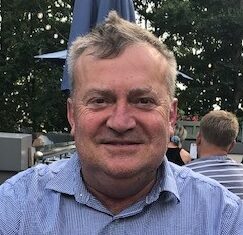
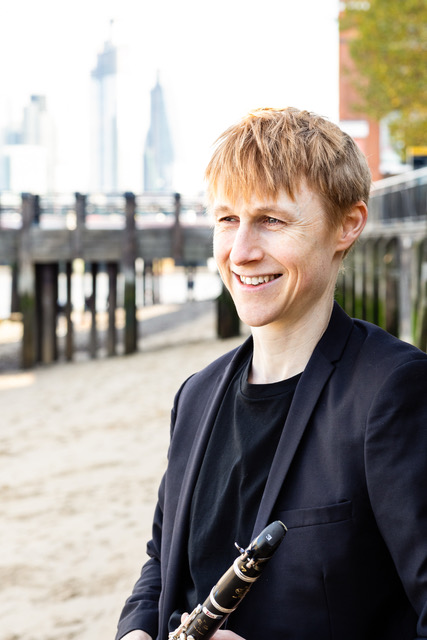
Som Howie joined WASO in 2024 and is the Associate Principal clarinet sitting next to Allan Meyer.
Before joining WASO, Som held the position of solo Clarinettist at the Danish Chamber Players. Originally from Sydney, Som began playing clarinet at the age of 11 with Mark Walton until he started his bachelor’s degree at the Sydney Conservatorium of Music. During his time in Sydney, Som studied with Cathy McCorkill, and Sue Newsome and completed his final years with Frank Celata. After moving to Europe in 2014, Som completed a Masters Degree with Hermann Stefánsson and Andreas Sundén at the Royal College of Music in Stockholm.
As an orchestral musician, Som has performed with major orchestras around the world including; Copenhagen Philharmonic, The Swedish Radio Symphony, Royal Stockholm Philharmonic, Swedish Chamber Orchestra, Royal Swedish Opera, Royal Liverpool Philharmonic, Royal Philharmonic Orchestra, Malaysian Philharmonic, Sydney Symphony, Australian Opera and Ballet, and the New Zealand Symphony Orchestra. Som has toured to Edinburgh with the Swedish Radio Symphony Orchestra and to India with the Australian World Orchestra.
In 2016, Som was selected for the Royal Stockholm Philharmonic Orchestra Academy. Previous to this, Som has held academy positions with the Sydney Symphony, and London Philharmonic Orchestra’s Future Firsts Scheme. Som has attended masterclasses with; Sabine Meyer, Andrew Marriner, Martin Fröst, and Yehuda Gilad.
As a soloist, Som has performed concertos with the Adelaide Symphony Orchestra, West Australian Symphony Orchestra, Willoughby Symphony Orchestra, the Southbank Sinfonia in the UK, and, in 2016, he recorded English composer Geoffrey Hanson’s Clarinet Concerto with the London Mozart Players.
In 2015, Som was a prize winner for the Royal Overseas League (ROSL) Annual Competition, and as a result toured with his trio, the Dolmen Ensemble on behalf of ROSL to; Malta, Scotland, and New Zealand. In the same year, Som recorded his first solo album with his Father, David Howie. The album is titled ‘Premiere Rhapsody’ and was produced by UK based record label, Cala Records. Som is a Buffet Crampon Artist and a scholar of the Australian Elizabethan Theatre Trust.
In his spare time Som loves spending time at the beach, playing cricket and soccer, and looking for all the best coffee spots.
Philip Everall is Lecturer in Classical Music at WAAPA, where he is Head of Woodwind, Musical Director of the Symphonic Wind Ensemble, and lecturer in performance, ensembles, and music history. An internationally recognised bass clarinettist, he has performed with ensembles including the Ebony Band of the Concertgebouw, The Schoenberg Ensemble, ASKO, Bang on a Can All-Stars, and Sequitur, among many others. As an orchestral clarinettist and bass clarinettist, Philip performs regularly with the West Australian Symphony Orchestra, and has been a guest with the Adelaide, Tasmanian, and Melbourne Symphony Orchestras, Orchestra Victoria, and the Malaysian Philharmonic Orchestra.
Philip completed his PhD at ECU, developing a digital resource for contemporary bass clarinet performance techniques. His research continues to focus on extended techniques, performer-centred approaches to new repertoire, and the relationship between notation, acoustics, and performance practice. Alongside this work, he also undertakes research in music history pedagogy, exploring ways to reconnect historical study with artistic practice so that music history becomes an active component of performance, interpretation, and musicianship for tertiary students.
Awards and recognition
University and National Teaching Awards
2016 – ECU WAAPA Research Medal
Research areas and interests
Bass Clarinet extended techniques
Contemporary performance practices
Music History pedagogy
Qualifications
Doctor of Philosophy, Edith Cowan University, 2016.
Masters programme of Music, Netherlands, 2005.
Bachelor of Music, The University of Western Australia, 2003.
George “Butch” Kirkby Jnr was born 1st October 1912 in Perth.
1934
In aid of the Baby Week Appeal, the Regal Entertainers will give a concert tonight in the Perth Town Hall. Assisting artists will include Misses Ronie Opie, Bubbles Cooper, Edna Winter, Hazel Charles, Doris Mose, Ally Campbell, Valmai Winter and Messrs. Terry Scanlon, Bert Tomlie and Ernest Waltman. The music will be provided by Miss Carma Nagfel, and Albert Thompson, George Kirkby and Arthur Taylor.
West Australian (Perth, WA : 1879 – 1954), Wednesday 2 May 1934, page 5
1936
MAJORITY PARTY Amid Pink Decorations
To celebrate the coming of age of their eldest daughter, Kaye, Mr. and Mrs. E. Hodges, of Ellesmere street, Mt. Hawthorn, entertained about 120 guests in the R.S.L. Hall, Oxford-street, last Monday evening. The hall was beautifully decorated with streamers and balloons, etc., the tables being well supplied and tastefully decorated by Mrs. Bowen. Dancing was enjoyed to the music supplied by Lena Mills, George Kirkby, Stan Charles and Alby Thompson. A large number of presents were received by the guest of honor, who was dressed in a beautiful gown of pink and wore a pink flower in her hair. The beautiful three-tier cake was presented to her by Mrs. Davies and Miss J. Davies. It was also pink and beautifully decorated. During supper a large key was presented to the guest of honor by her father. Items were rendered by Lena Mills (pianoforte solos), Mr. D. Thompson (comic songs), George Kirkby (saxophone solos) and Alby Thompson (violin solos). The guest of honor also gave a toe solo. The duties of chairman were ably carried out by Mr. Henry, while the usual toasts were proposed by Mr. D. Thompson, Mr. W. Weaver and Mr. T. Steadman. The programme was skilfully arranged by Albert Thompson, who also acted as master of ceremonies.
Sunday Times (Perth, WA : 1902 – 1955), Sunday 17 May 1936, page 1
1939
Deanna Durbin Quest Awaits Vote
The highly successful quest for a local Deanna Durbin was brought to a conclusion apart from final voting at the S.T.C. concert at the Piccadilly Theatre last night. So great was public interest in the concert that every seat was occupied or sold within 10 minutes of the opening of the doors. The principal feature of the enjoyable programme was the grand final of the Deanna Durbin quest. Seven grand finalists faced the microphone and the packed theatre. Five independent judges chose three of that number. Listeners’ votes will decide the question as to which of the selected three deserves main honours. Each of the grand finalists gave a creditable performance. In one case the contestant was extremely nervous and although she had a particularly sweet voice her nervousness spoiled her effort. In this contest there was pleasing variety of fare. Each of the grand finalists deserves commendation for her efforts. There was plenty of variety in the S.T.C. search for talent. A pianist, male and female vocalists, and instrumentalists presented good fare. One of the competitors — a vocalist — got the gong, but the length or the song rather than any reflection on his performance was responsible. There was only time for one community song.
Then came seven year old Jack Harrison, who was described beforehand as a wonder with the mouth-organ. His performance indicated that the description really applied to him. He gave encores with pleasing matter-of-factness. George Kirkby, saxophonist and Baden Fixter, violinist, gave enjoyable numbers. With the Lucas Novelty Band led by Niddy Roberts they also rendered other pleasing items. The Misses N. Sheridan and A. Hyens gave a particularly pleasing two-piano duet. The two pianists in the Lucas Novelty Band also performed excellently in a duet. Popularity of the band was well evidenced. Paul Daly was in charge of the programme and presided over the happiest concert of the series. Proceeds of the concert (as with the others held at the Piccadilly Theatre) will go to the Baby Week Appeal. Winners of the Deanna Durbin grand final and the S.T.C. search session will be announced in The Daily News on Thursday. Votes must reach station 6PR or W.J. Lucas Ltd., Hay-street, Perth, by Wednesday at the latest. Last night’s concert was organised by the sponsors of the S.T.C. search for talent — Messrs. W. J. Lucas Ltd., Hay-street,- Perth; M. J. Bateman Ltd., Milligan-street, Perth; and Messrs. Randell and Long, Fremantle, in association with the management of the Piccadilly Theatre and Universal Pictures. The Daily News Monday 5 June 1939 page 9
1940
SAX PLAYER WEDS COTTESLOE GIRL
Married last week at St. Hilda’s Church of England in View-street, North Perth, Miss Sylvia Page, a pretty brunette of Cottesloe, and Mr. George (‘Butch’) Kirkby of Leederville. Bridegroom has been well known to those in musical spheres for about eight years, he having played the saxophone and clarionette with such combinations as Ron Moyle’s band, the Radiola Rhythm band, and the 6WF dance orchestra. However, he is giving up his musical interests, as he finds hie work with the Crown Law Department keeping him particularly busy. Both bride and bridegroom are much esteemed and highly popular amongst those acquainted with them.
Mirror (Perth, WA : 1921 – 1956), Saturday 2 March 1940, page 2
1943
A GRAND CONCERT
Thursday night, 27th May last was a unique occasion for Moora. A popular military concert party visited the town and gave a concert to a house that was literally full to the doors. Special interest centred in this concert because it was at Moora that the Concert Party made its debut last year. W.O. S. H. Ellwood, O.C. Party and Producer, turned out a polished show with each member of the party doing his bit in a big way. The producer, himself, is an efficient and talented entertainer. He appeared during the evening in parts from Mephistopheles, the double-eyed villain, to an eastern houriairily dancing the exotic dances of the East (Middle). Under the name of Lolita he was “lofed” by Ren. Nolan, the silvery-voiced tenor, who also sang “The Holy City” and other popular songs. Ren has a cultivated voice which should take him high up in the sclae of musical achievement. For the hand of Lolita he had for a rival Billy Kerr, comedian and raconteur, who looked superb with a drooping black moustache. Billy was the life and soul of the party so to speak. His jokes, acting and sardonic explosive laughter kept the audience constantly a-twitter. Geo. (“Glory Road”) Nicholls and Ted Barton were two members of the party who appeared in numerous guises, but particularly as tenor and baritone respectively. They sang the lively duet, with lively movements, ” We Run ‘Em In.” Earl Nowotney, a fine violinist, was well received with his solos, one of which was the popular “Voices of Spring” waltz. Robert (“Dusty Road”) Symonds excelled himself as Canio, basely used by “Mepbo,” among other things in his singing of the aria from “I Pagliacci,” “On with the Motley.” A difficult song to sing but he made it and was roundly applauded for it. Les Dixon was the accomplished leader of the tuneful swingful band. The band played some excellent numbers in a manner which aroused the enthusiasm of the audience to a high pitch. Harold Taylor made his drums talk, while George Kirkby showed great talent on his clarionet and saxophone. Barnie Conlon the dulcet-toned trombone player betrayed championship style in various types, old and new, of trombone playing. Jack Diamond, illusionist and magician, gave a performance which has never been excelled on the Moora stage, and would be quite worthy on any stage. The unique part of this item was that most of his tricks were undetectable. We are still wondering how he managed to get the glass of water up his sleeve. Moora people gave the concert party a special welcome in view of its early and close association with the town. A local C.O. thanked the party at the conclusion which resulted in three hearty Australian cheers from the audience. The producer replied briefly and the assembled party on the stage smiled in sympathy.
Midlands Advocate (Perth, WA : 1930 – 1954), Friday 4 June 1943, page 1
1949
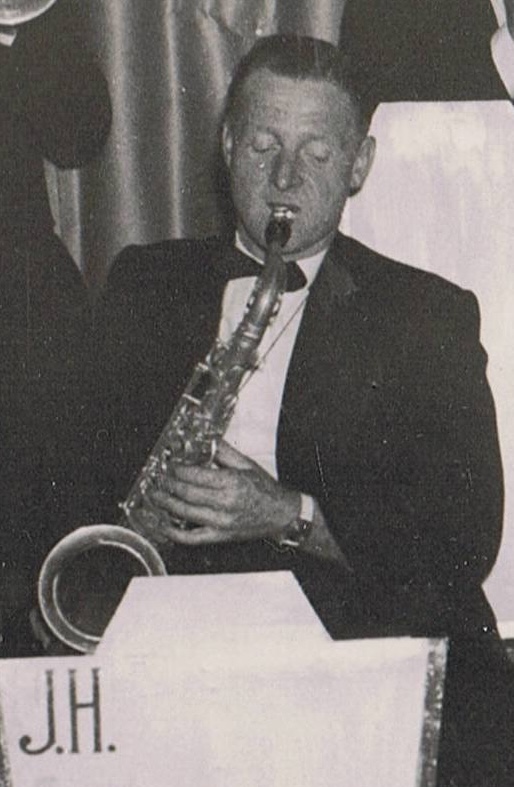
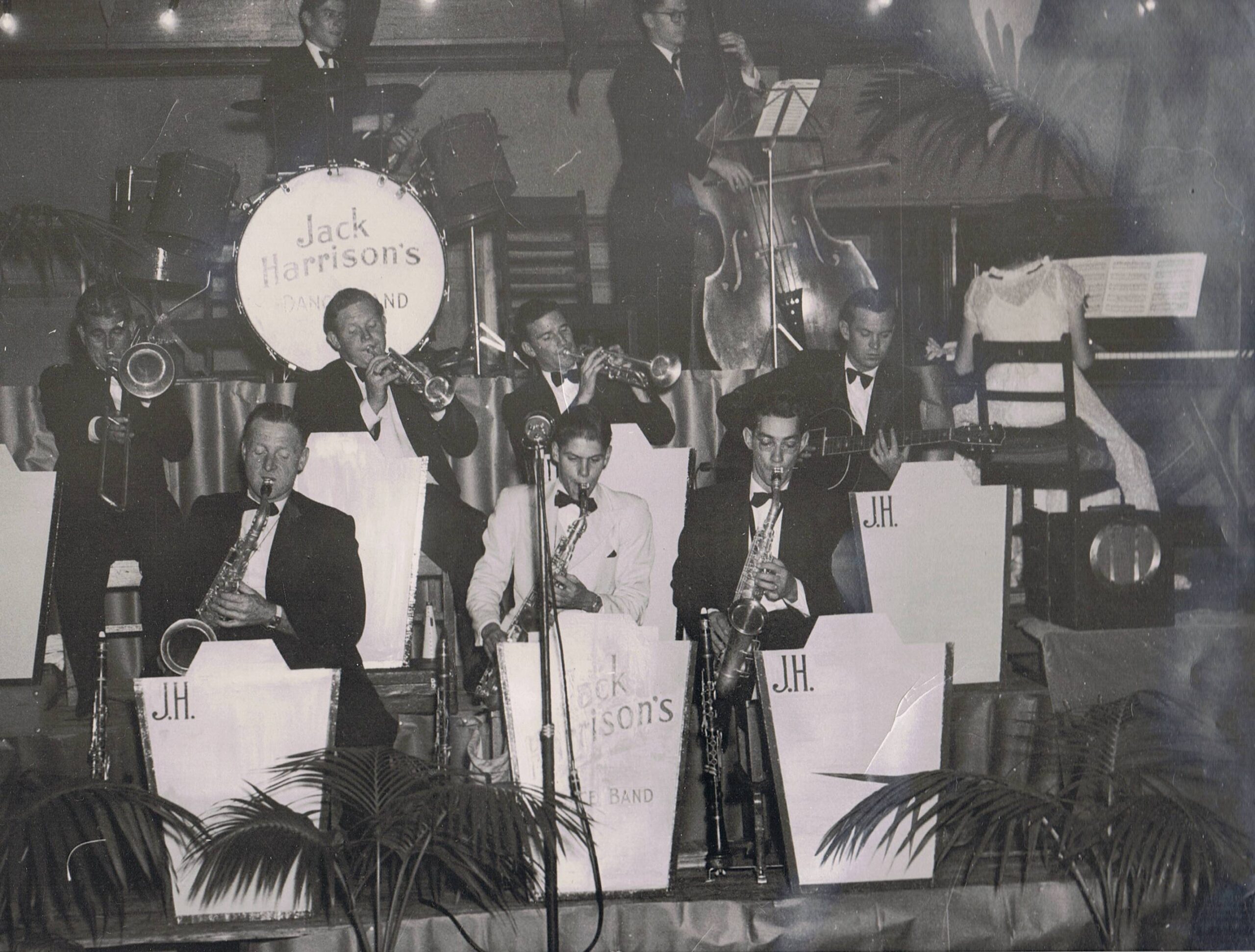
Jack Harrison augmented his swing band according to the requirements of functions, sometimes up to ten players, such as the April 22nd 1949 University of Western Australia Graduation Ball at Winthrop Hall. Players were issued with a cheque on 5th May 1949 and were paid 3 pound 2 and 6 for the gig. Players paid were: Norm Wrightson (saxophone), George Kirkby (saxophone), Jack Pope (trumpet), George Franklin (trumpet), Charles Thompson, Bill Hendrie (guitar), Roy Coates, Ray Harrison (drums), Jill Harrison (piano) and Jack was the tenth band member.
Jack Harrison Dance Band Winthrop Hall
GRADUATION BALL
8.30pm – 2am
April 22 1949 Winthrop Hall, University
In Aid of World Student relief
ADMISSION Double Ticket 24/7 (inc tax.)
Jack Harrison’s Ten Piece Orchestra – bookings at Nicholsons
AROUND PERTH – WITH HARRY BLUCK
Ball Season Starts Rolling in Perth – Heavy Bookings as Biz Booms
The annual outcrop of balls generally makes its presence felt about this time of the year and already some of the earliest have taken place. This season promises to be a busier one than previously and some large-sized bands should be seen on the various stands. Already, youthful Jack Harrison has made a good start by fronting a 10 piece outfit at the University Graduation Ball, and from all accounts the ultimate sound of the band justified the Harrison judgement in selecting good players as his support.
It’s in The Family!
Jack Harrison’s Trio, winners of Perth’s “Popular Dance Band Contest” for 1948. This talented threesome have remarkable polish, considering their extreme youthfulness, and have certainly made their presence felt in the comparatively short time for which they have been associated with the dance band business. From L to R: Jack Harrison (saxes), Ray Harrison (drums), Jill Harrison (piano). Jack and Jill are both aged 16 and Ray is 18. Since this photo was taken, Jack Harrison has blossomed out with a 10 piece band, with which he played at the Perth University Graduation Ball. (Photo by Arthur Fielding Ruskin).
Music Maker and Dance Band News May 1949
JACK HARRISON CHEQUE BOOK:
5 MAY 1949
JACK Cheque to:
Norm Wrightson Grad Ball £3/2/6
Kirkby Grad Ball £3/2/6
Pope Grad Ball £3/2/6
Franklin Grad Ball £3/2/6
Thompson Grad Ball £3/2/6
Hendrie Grad Ball £3/2/6
Coates Grad Ball £3/2/6
Ray Harrison Grad Ball £3/2/6
Jill Harrison Grad Ball £3/2/6
1950
All Together With A Tra-la-la
EVERY musicker of note turned up at the Jack and Dudie Pateman’s Nedlands home for the serious business of wetting baby Graeme William’s head. They packed the women off to Sylvia Caporn’s home and the ”boys’ had a right royal time. During the arvo Harry Bluck cheffed up spag. savories and what have you. Pete Sullivan (not the curly headed one) brought a can of Indian curry. A spokeshavian playlet ‘Cinderella’ was produced by Maestro Beeson, featured Alan Gough, Cliff Adam, Pete Harrison, Merv Rowston and ‘Lily of the Valley’ Roberts. It was a real classic. Kev Logan even stopped hibernating and made an attempt to hydrate himself. They nearly sold him a sax. Bam Sharp put on a happy time and the beer flowed like wine. Ray Le Cornu did a job with the kegs. Chick helped the food along. Wally Hadley, Maurice Maurice, Keith Whittle, ‘Mule Train,’ George Caro, ‘Cigarettes’ Cooke, Baden Fixter, Butch Kirkby, Bill Kirkham, Henry Cochran were ell in it. At nine o’clock sharp they drank a special toast to George Franklin— wherever he might have been between here and Curfew rang at 2 a.m and everyone departed for their homes. They tell me the Patemans have since bought a block and 3 tents in case of repercussions from neighbours who may dislike jazz, Dixieland — and just plain noise.
Mirror (Perth, WA : 1921 – 1956), Saturday 20 May 1950, page 12
1951
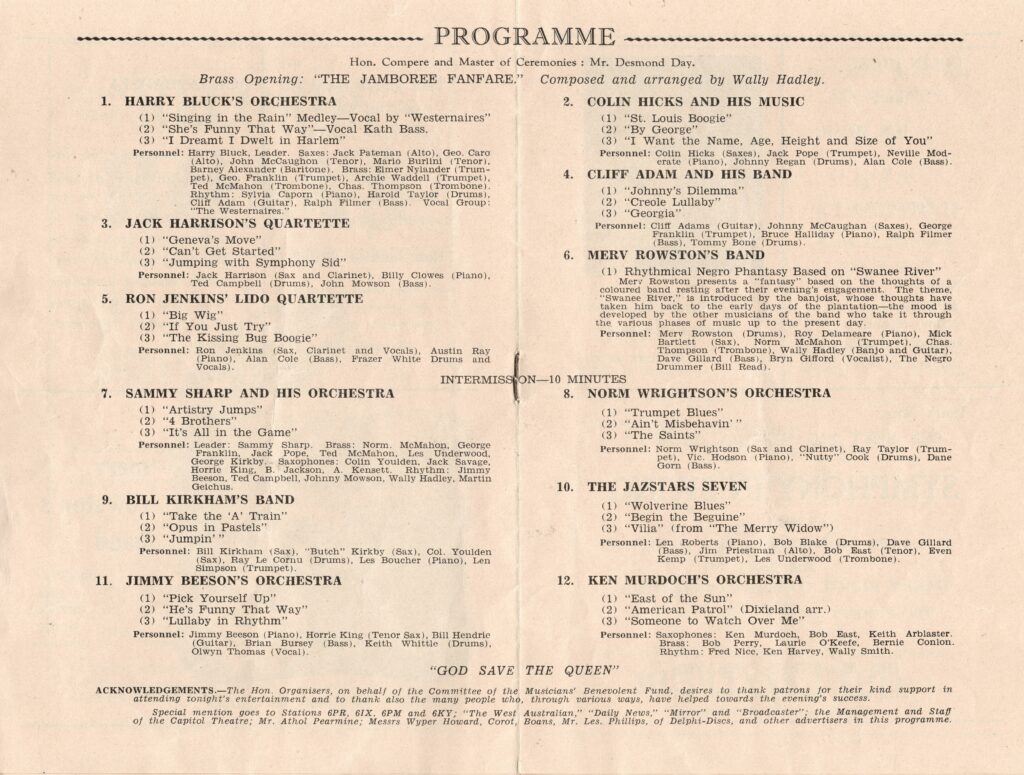
1951 Jazz Jamboree
1951 Jazz Jamboree program cover
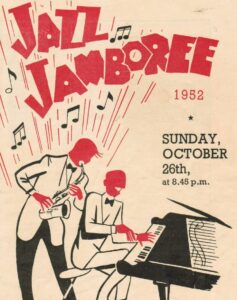
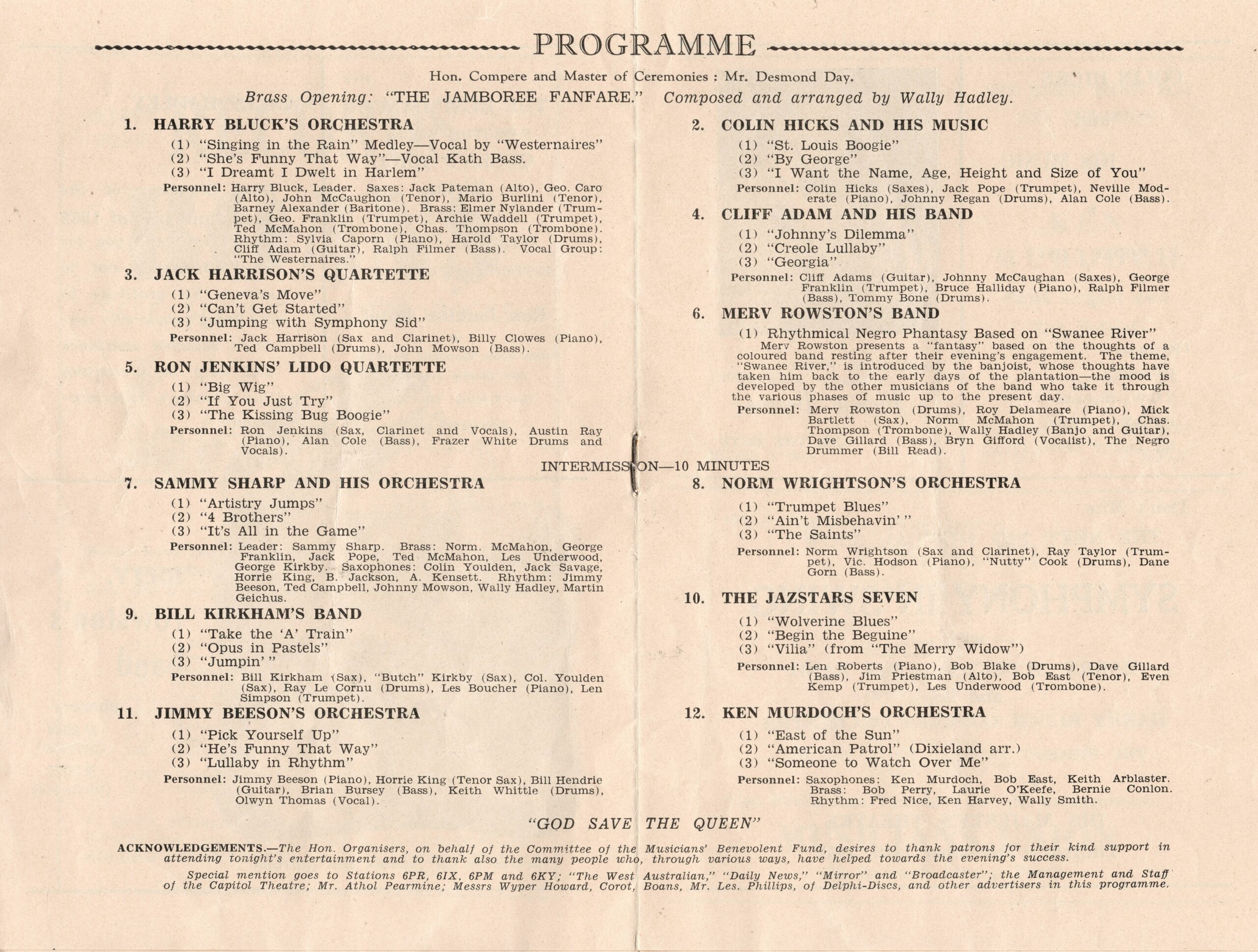
1952 Jazz Jamboree
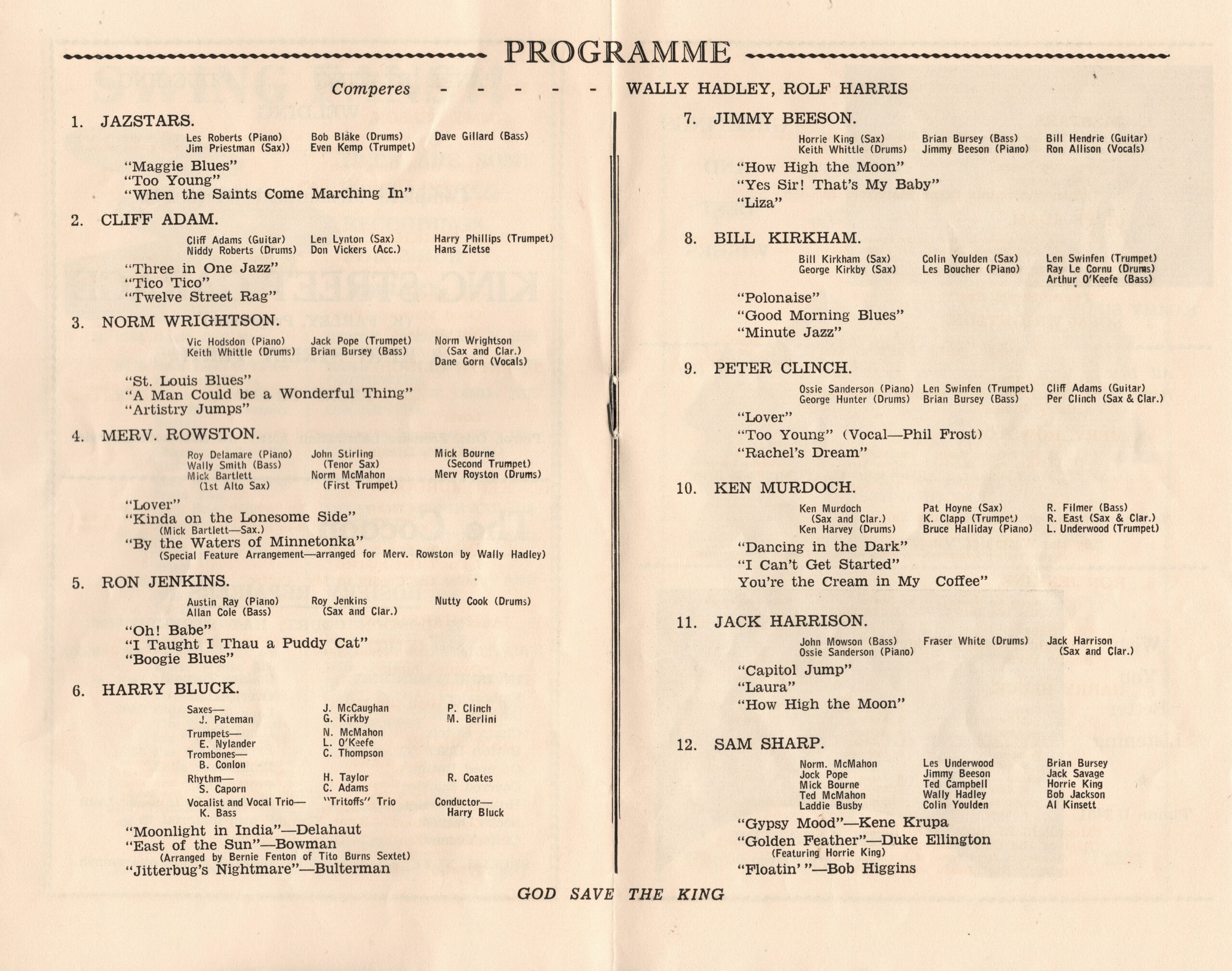
1951 Jazz Jamboree – programme
1952
Jazz Jamboree 1952
1953
RANDOM NOTES
ENJOYABLE party-cum-jam-session was held at Colin Youlden’s the other night when a number of local Jazz men and women celebrated the 8th anniversary of Wayne Handrick’s band’s engagement at the now defunct Rainbow Room. Among the participants were Greta Young, who gave out with some nice vocals as well as piano work), Mike Carbone and Hank Collins (guitars), Wayne Handricks, Colin Youlden and George Kirkby (saxes), Ralph Filmer (bass) and Roley Nash (drums). Bryn Gifford pleased with vocals a la Frankie Laine.
Mirror (Perth, WA : 1921 – 1956), Saturday 27 June 1953, page 11
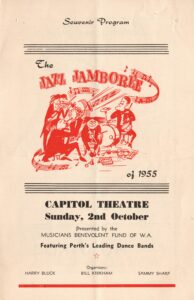
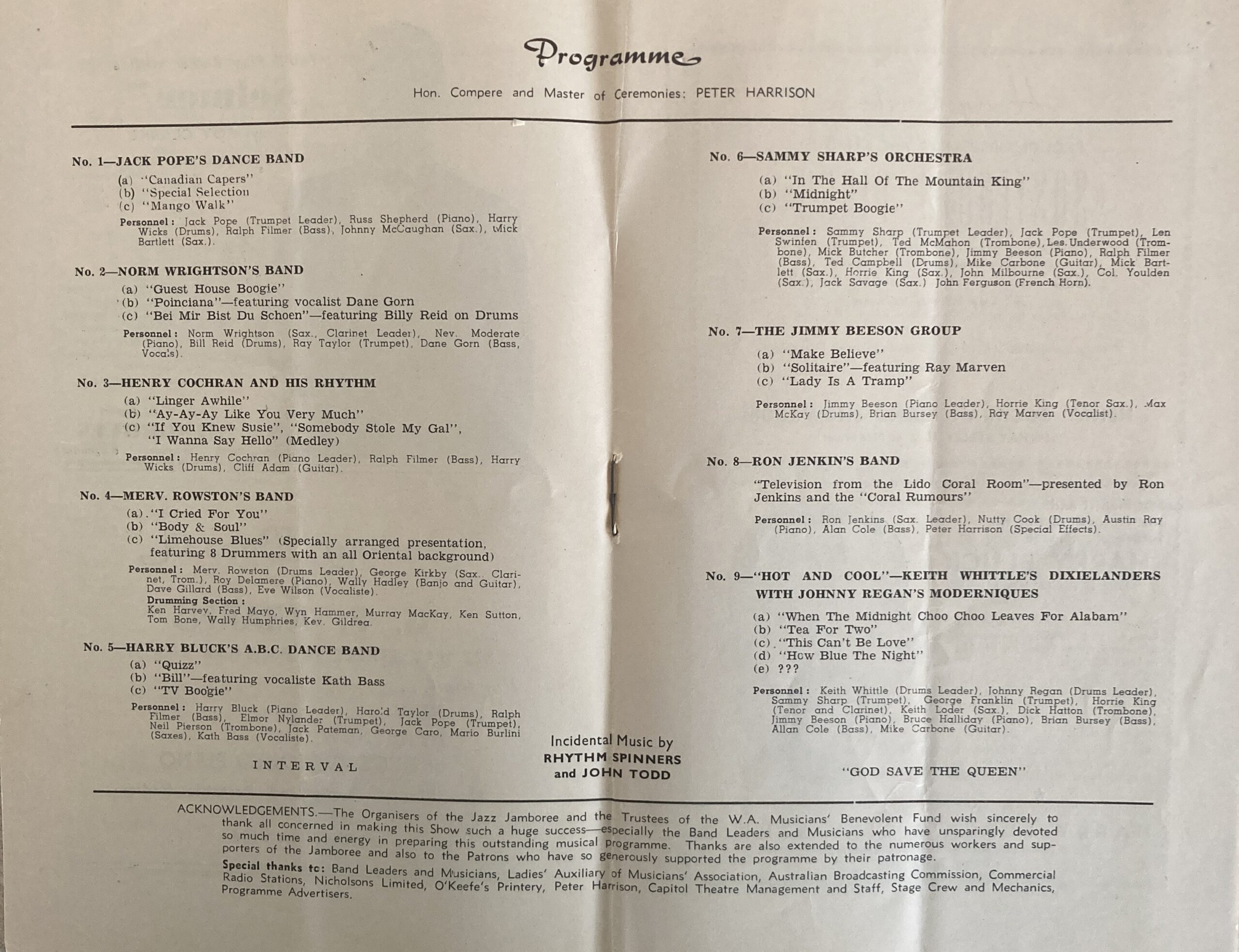
1955
1955 Jazz Jamboree – program cover1955 Jazz Jamboree Program
1994
George Kirkby died on 23rd September 1994 aged 87.
Rosalind Appleby is a Perth-based arts journalist, author and speaker. She uses words to champion, document and critique the arts and its practitioners. She also learnt the clarinet from Allan Meyer.
Rosalind’s book Women of Note (Fremantle Press, 2012) reveals startling discoveries about Australian women composers, completing the missing jigsaw pieces in Australia’s music history.
Rosalind was Managing Editor and founding board member of Western Australia’s leading arts magazine Seesaw (2018 – 2023). She was music critic at The West Australian newspaper for 16 years and has contributed to numerous publications including Opera Magazine (London), Limelight Magazine, The Australian newspaper, The Financial Times (London) and The Sunday Times.
Rosalind advocates for the arts through her lectures, author talks, artist interviews, pre-concert talks, program notes, awards judging and school seminars. She has presented at the Perth Writer’s Festival (2013, 2018, 2019) and at the national Women in the Creative Arts Conference (2017) in Canberra. For several years she produced and broadcast the experimental program Difficult Listening for RTRFM. She has been interviewed by Andrew Ford on The Music Show and for programs on 3MBS, 2MBS, Radio Fremantle and RTRFM.
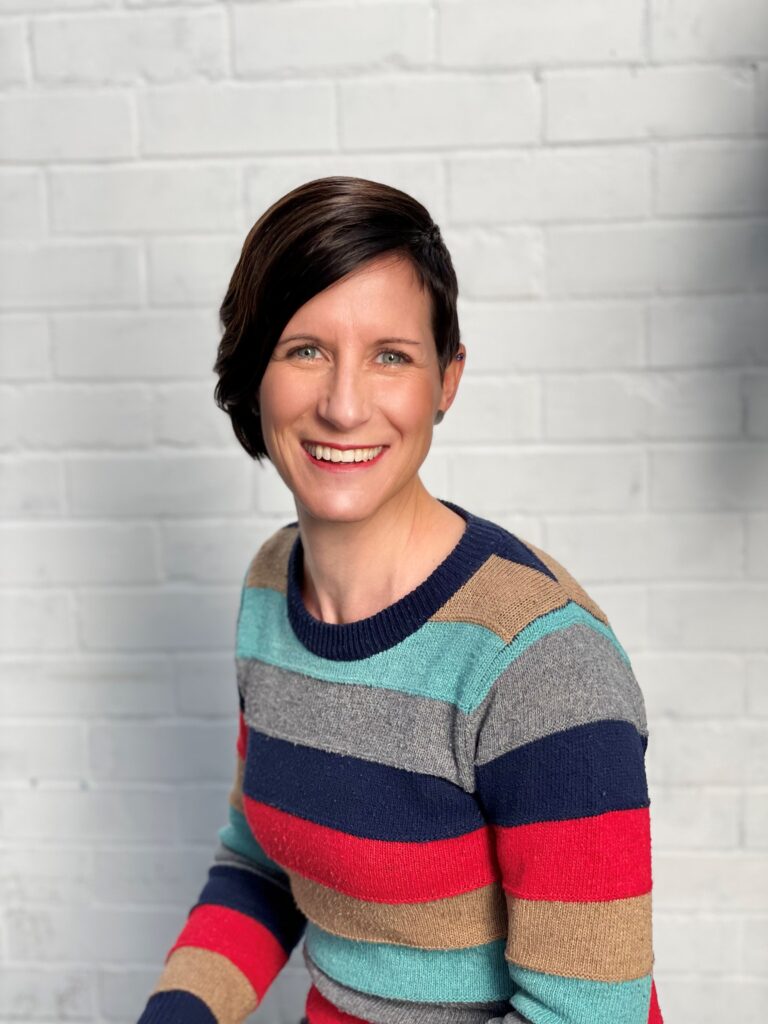
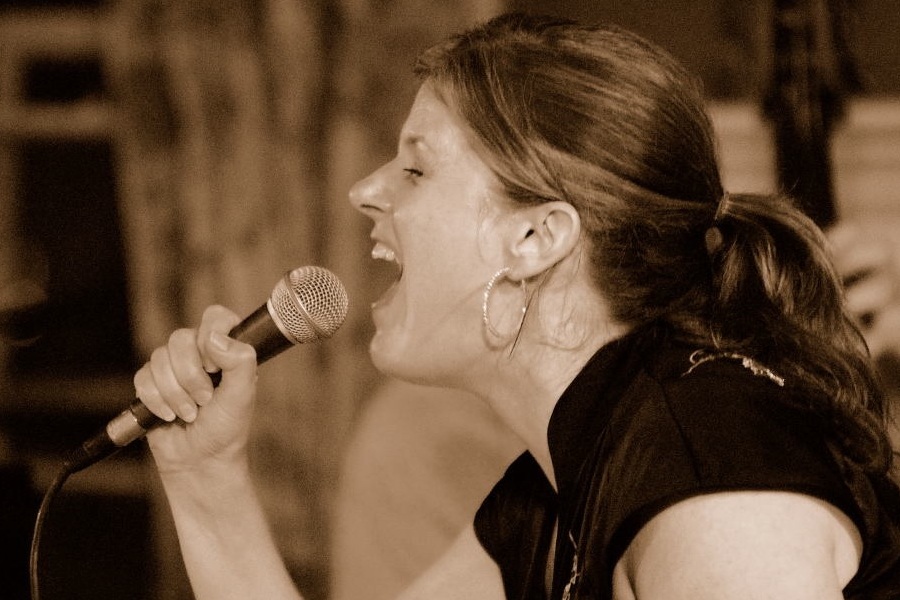
Australian jazz vocalist Victoria Newton has delighted audiences worldwide with her unique combination of energy, spontaneity and musicianship. Her heartwarming vocal delivery and engaging stage presence are summed up by Steve Rubie (owner of London’s 606 Club) when he describes her as having “a fabulous strong clear voice with a great sense of time and an even greater sense of fun!”
Victoria began her musical career in Perth, and whilst studying towards a Bachelor of Music degree majoring in clarinet at the University of Western Australia, she discovered an enormous passion for jazz. She then went on to study jazz voice at the Western Australian Academy of Performing Arts, where she had the most amazing opportunity to support international artists such as Ray Charles, Dionne Warwick, Ray Brown and James Moody whilst singing with the Western Australian Youth Jazz Orchestra.
Victoria relocated to the UK in the early 1990s, and became recognised as one of the most exciting and dynamic jazz vocalists on the London jazz scene, initially collaborating with Acid-Jazz recording artist Ronny Jordan and supporting Terence Blanchard at the Jazz Cafe in London with her own quartet.
She has appeared at many venues and festivals in many countries including the famous Ronnie Scott’s Jazz Club in London, the London International Jazz Festival, Oxford Literary Festival, Ealing Jazz Festival, Ingolstadt Jazz Festival in Germany, and Alexis Jazz Club in Kuala Lumpur for their International Jazz Series. One of Victoria’s favourite gigs to date has been performing Brazilian songs whilst cruising up the Amazon!
Victoria also experienced international success during the mid 1990s with UK dance/pop group Strike and their massive hit ‘U Sure Do’. The success of this single followed by 4 UK top 40 hits and the critically acclaimed album ‘I Saw the Future’ lead to a whirlwind of TV appearances including MTV and BBC’s Top of the Pops, touring to many countries around the world, and sharing the stage with the likes of Jocelyn Brown, and The Spice Girls Victoria’s vocal performance on ‘I Saw the Future’ has been described as “outstanding throughout”
(Dream Magazine) and her live performances “simply stunning”, with “staggering vocals” (M8 magazine).
Victoria released her first jazz album ‘The Song is You’ in 2004 which received regular air play in the UK and featured some of the finest British musicians including the internationally acclaimed Gwilym Simcock.
Since relocating to Perth, Western Australia, Victoria performs in a variety of musical settings which include her ‘Watercolours of Brazil’ and ‘Funky Brasilia’ projects, regular appearances at the Ellington Jazz Club, the Perth International Jazz Festival, York Jazz Festival, Fairbridge, and Jazz by the Bay. She is also one of the vocalists for Manteca and the Straight Ahead Big Band.
Victoria is also head of the jazz vocal program at the Western Australian Academy of Performing Arts.
‘Deeply into the music, a real jazz singer’ ~ Brian Blain, Jazz UK
‘A jazz singer a cut above the crowd’ ~ John Fordham, The Guardian, UK
‘Beautiful phrasing, faultless pitching and great swing throughout’ ~ Peter Quinn, Jazzwise, UK
Current as of 2026
Born in Australia, Newton developed her academic focus on jazz and classical traditions while based in Perth, completing studies in clarinet with teacher Jack Harrison at the University of Western Australia. She simultaneously enrolled in a jazz vocals program at the Conservatorium and performed regularly as a member of the Western Australia Youth Jazz Orchestra.
After entering the Australian Singing Competition she advanced to finalist status. Relocating to the UK in 1990, she rapidly gained recognition across London’s jazz, pop and Latin circuits. Early collaborators included acid-jazz guitarist Ronny Jordan and the Latin jazz fusion band Cayenne, where she took the role of lead singer; she was also the first vocalist engaged by Steve Rubie’s Latin ensemble Samara.
In late 1994 Newton joined dance-pop group Strike as lead singer, an affiliation that generated extensive touring and select studio work. The act’s debut single “U Sure Do” climbed to number 4 on the UK charts and achieved solid sales across continental Europe and Australia. Strike subsequently performed in Spain, Italy, Norway, the Netherlands, Germany and Japan, securing additional UK Top 40 singles while their album I Saw The Future earned both critical praise and strong public response.
Newton’s broad repertoire has made her a frequent choice for engagements at prominent London hotels and clubs. She performs repertoire in Spanish, Italian, French and Portuguese.
In 2002 she appeared with the London funk outfit 3 Bean Salad. Beyond those affiliations she fronts the all-female ensemble Katmandhu and participates in Oxala, a Brazilian-music collective.
Her debut jazz album under her own name appeared in 2004 and met with favorable notices from both reviewers and listeners.
Jazz artists she has accompanied include pianists Jonathan Gee, David Newton, Gwilym Simcock and Gareth Williams. In addition to her stage work, Newton instructs on the Jazz Studies course at Trinity College of Music and maintains an established practice as a vocal coach.
Victoria Newton relocated to Perth in 2008 after many years in the UK, where she was recognised as one of the most exciting and dynamic jazz vocalists on the scene. In recent times she performed at the famous Ronnie Scott’s in London, Alexis in Kuala Lumpur, for their International Jazz Series, and a dream gig performing Brazilian songs cruising up the Amazon!
She has appeared at many festivals and venues throughout the UK and Europe including Queille in France, The Ingolstadt Jazz Festival in Germany, The Oxford Literary Festival, Pizza Express, the 606 Club and the Jazz Cafe in London where she supported Terence Blanchard and performed with Ronny Jordan.
Victoria also experienced international success during the mid 1990s with UK dance / pop group Strike and their hit ‘U Sure Do’. This led to her appearing on MTV and the BBC’s Top of the Pops, touring throughout the world and recording the critically acclaimed album ‘I Saw the Future’.
She released her first jazz album ‘The Song is You’ in 2004 which received a great response from the press and regular air play in the UK.
In March 2009 she was the featured singer during the opening week of the Ellington Jazz Club, where she continues to perform regularly.
Her rich, sensual voice and powerful stage presence are summed up by Steve Rubie (owner of London’s 606 Club) when he describes her as having “a fabulous strong, clear voice with a great sense of time and an ever greater sense of fun!”.
“I grew up hearing stories of the legendary Jack Harrison from my family—his dance band, radio broadcasts, magnificent clarinet and harmonica playing, and his superb performances with the West Australian Symphony Orchestra.
As a child, it was the enchanting clarinet duo towards the end of Mendelssohn’s ‘Hebrides’ Overture, played by Jack Harrison and Duncan Abercromby at a WASO concert, that made me fall in love with the sound-world of the clarinet. To my imagination, it had the quality of moonlight on silvery water.
I was fortunate that both these wonderful musicians subsequently became my teachers.”
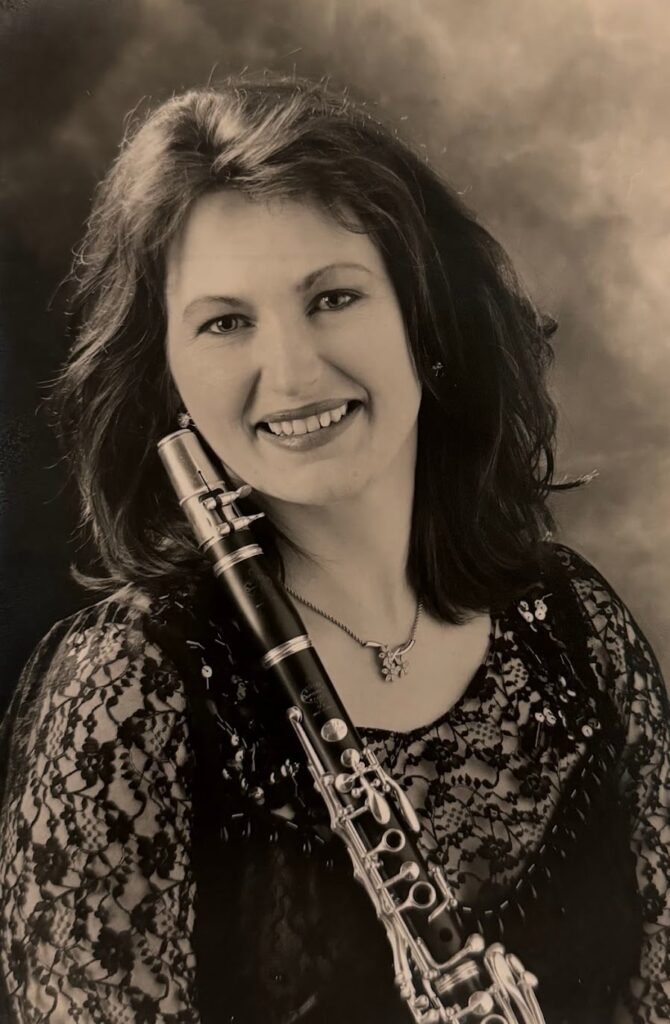
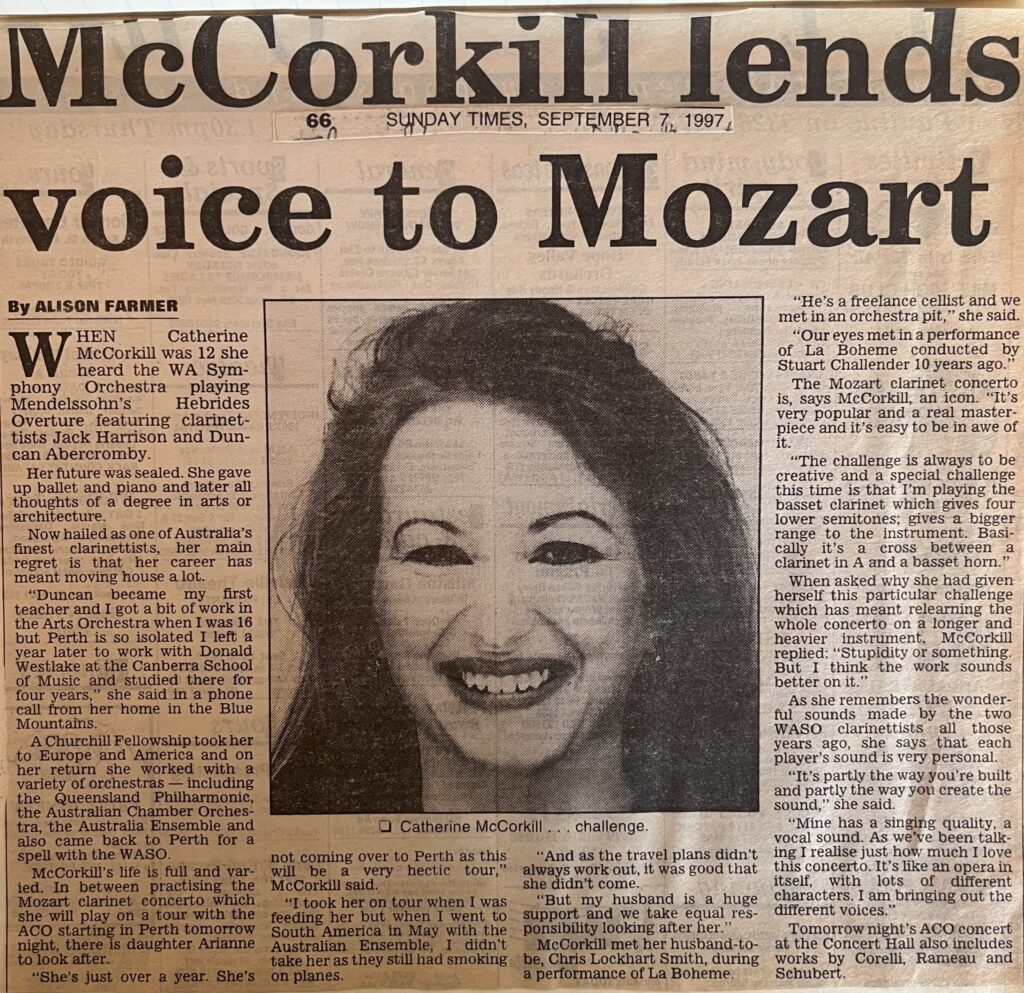
Catherine McCorkill was born in Perth in 1962 and began studying the clarinet at the age of twelve, principally with Duncan Abercromby and, for a shorter period, with Jack Harrison. Her first professional engagements were with the WA Arts Orchestra during her final two years of school.
At seventeen, Catherine left Perth to study with Donald Westlake at the Canberra School of Music, having been offered direct entry into the second year of a performance degree. While still a student, she also taught in the CSM music education programmes and reached the Sydney finals of the ABC Concerto and Vocal Competition. She graduated with the Bernhard Neumann Prize and subsequently undertook postgraduate studies.
During a period performing with the Tasmanian Symphony Orchestra, Catherine won the Tasmanian state finals of the ABC competition. In 1984, she toured Europe as principal clarinet of the Australian Youth Orchestra on its landmark six-week tour.
Awarded a Churchill Fellowship in 1984, Catherine undertook fifteen months of advanced study in Europe and the United States. This included seven months with the distinguished German clarinettist Hans Deinzer, as well as lessons with leading London clarinettists John McCaw, Anthony Pay, Michael Collins and Jack Brymer; Guy Deplus in Paris; Elsa Ludewig-Verdehr in Michigan; and Gervase de Peyer in New York. She also pursued chamber music studies with Yvonne Loriod and Jacques Delannoy at summer schools in France.
On returning to Australia, Catherine was appointed Principal Clarinet of the Queensland Philharmonic Orchestra in Brisbane. After four years, her growing interest in pedagogy led her to accept a lectureship in clarinet at the WA Conservatorium of Music in 1990, during Richard Gill’s tenure as Dean. She also performed with the Conservatorium’s resident wind quintet, Ensemble Vasse.
In 1993, Catherine moved to Melbourne to take up the position of Lecturer in Woodwind at the Victorian College of the Arts, where she enjoyed a rich musical collaboration with her colleagues. A particularly memorable performance, with Kirsten Williams, Michael Kieran Harvey and Nathan Waks, was Messiaen’s Quartet for the End of Time in the Great Hall of the National Gallery of Victoria. The composer’s celebrated fascination with “stained glass chords” found a striking visual counterpart in Leonard French’s magnificent stained-glass ceiling.
From 1995, Catherine was a core member of the Australia Ensemble, resident at the University of New South Wales, for two decades. She also enjoyed a long association with the Australian Chamber Orchestra, performing regularly as Principal Clarinet from 1994. These engagements took her throughout Australia and on numerous international tours.
Among her most treasured chamber music performances were Mozart’s Clarinet Quintet at London’s Wigmore Hall and at Sayles Hall, Brown University, in Providence, Rhode Island, with the Australia Ensemble. Memorable performances with the Australian Chamber Orchestra included concerts at Seiji Ozawa Hall, Tanglewood, Massachusetts; Cadogan Hall, London; and Dresden’s Frauenkirche. Catherine also fondly recalls many performances with the ACO, Australia Ensemble and Australian String Quartet in her home city of Perth, particularly in the beautiful acoustics of Perth Concert Hall and Winthrop Hall.
As a soloist, Catherine has appeared with most of Australia’s major orchestras. A particular highlight was her 1997 national tour with the Australian Chamber Orchestra, performing Mozart’s Clarinet Concerto on the modern basset clarinet. The performances were recognised by Limelight magazine as among the highlights of Australia’s classical music year.
Catherine appeared extensively for Musica Viva as both soloist and chamber musician, and was a featured artist at many of Australia’s leading music festivals, including the Huntington Estate Music Festival, Australian Festival of Chamber Music, Barossa Festival, Music in the Hunter, Bowral Festival, Four Winds, Canberra Festival and Moët & Chandon Festival. Many of these performances were collaborations with colleagues from the Australia Ensemble and Australian Chamber Orchestra.
She also toured nationally with the Australian String Quartet and Kathryn Selby’s ensemble, Selby & Friends.
Alongside her performing career, Catherine maintained a strong commitment to music education. She taught for many years at the Sydney Conservatorium of Music, including as Lecturer in Clarinet, and was frequently invited to teach at the Australian National Academy of Music. At ANAM, she performed the Australian premiere of British composer, Thomas Adès’s The Origin of the Harp, for solo clarinet and chamber ensemble, conducted by Brett Dean.
As an advocate for contemporary Australian music, Catherine premiered numerous works with the Australia Ensemble, including compositions by Ross Edwards, Elena Kats-Chernin, Peter Sculthorpe, Martin Wesley-Smith, Andrew Ford and Elliott Gyger, as well as the Australian premiere of Thomas Adès’s Catch.
Her performance of Nigel Westlake’s Rare Sugar, a concertino for clarinet and chamber ensemble, received the 2008 APRA / AMC Classical Music Award for Best Performance of an Australian Composition.
In the latter years of her performing career, Catherine also held the position of Associate Principal Clarinet with the Australian Opera and Ballet Orchestra.
In 2014, progressive difficulties with her hands brought Catherine’s professional performing career to a close, after thirty-five years devoted to music. Among its most enduring rewards has been the success of her former students, many of whom have established distinguished careers as educators and performers, including the brilliant clarinettist, Benjamin Mellefont, Principal Clarinet of the London Philharmonic Orchestra and Professor at the Royal College of Music
Following her performing career, Catherine continued teaching music pedagogy at the Sydney Conservatorium and also worked in EAL/D English education with migrants, international students and refugees.
During the COVID-19 pandemic, she increasingly directed her creative energies towards the visual arts, developing her practice in printmaking and oil portraiture.
In 2023, her large-scale portrait of Ivor Houston, the youngest person to walk solo and unaided from Fremantle to Bondi to raise funds and awareness for refugees, won the People’s Choice Prize at Blue Mountains Portraits. Catherine has also twice been a finalist in the Kennedy Prize and a semifinalist in the Darling Portrait Prize.
She completed a Master of Arts (Studio Art) at the Florence Academy of Art in 2023 and has held several solo exhibitions in Sydney and the Blue Mountains.
Catherine lives in the Blue Mountains with her husband, cellist Christopher Lockhart Smith, formerly of the Queensland Philharmonic and West Australian Symphony Orchestra, and who, for many years, played with the Australian Opera and Ballet Orchestra in Sydney. They have two children and recently welcomed their first grandchild.
George Leslie Caro was born in Perth in 1911, the son of German immigrant Emil Caro, and was a member of the “old school” jazz musicians in Perth and played clarinet and saxophone.
1933
A Charity Concert
A second charity concert, presented by Mr. Lee McAlinden and his stage orchestra, took place at His Majesty’s Theatre last night and was well received by a small but very appreciative audience. The orchestra, under the direction of Mr. McAlinden, did pleasing work, its opening number being a vigorous march entitled ‘Call to Arms.’ This was followed by ‘The’ ‘Yea’ Man,’ a foxtrot, after which a symphonic arrangement of Gounod’s ‘Faust’ was rendered by special request. Other numbers played included ‘Lullaby of the Leaves,’ with a vocal refrain by Mr. W. Quarrell, ‘June,’ selections from ‘II Trovatore,’ ‘Marcheta’ (by request) and a medley of English’ songs. The assisting artists included Miss Edith. Simmons (soprano), Mr. W. Quarrell (baritone), the Linton Boys (patter songs and step dances), Messrs. Walter Hadley (banjoist), Ray Reason (trumpeter), Ray Le Cornu (xylophonist), George Caro (saxophonist), Edward Birnie (clarionettist) and Baby Shirley King (juvenile entertainer).
West Australian (Perth, WA : 1879 – 1954), Monday 29 May 1933, page 8
RON MOYLE’S TOURING WESTRALIANS
The nine members of Ron Moyle’s “Westralians” — Ron Moyle, Niddy Roberts, Bob Gibson, Wally Hadley, Viv. Nylander, Geo. Caro, Allan Gough, Ken Fimmell, Chas. Thompson, Cliff Adam and Tom Bennett will be making their farewell appearance in this State on Friday next, December 15, when they will ap- pear at the Ambassadors and present a musical pot pourri of rhythm and novelty numbers. Perth, which is recognised for its capable musicians, will wish Ron and his boys a successful and happy trip.
Mirror (Perth, WA : 1921 – 1956), Saturday 9 December 1933, page 15
1935
Success of Perth Orchestra in Ceylon and India
Local musicians will be interested to know that Miss Leoni (Dot) Salter and her orchestra of Western Australian professional musicians have made a sensational hit throughout their engagements in India. Leaving Perth late last year, they went to Colombo under engagement to the Hotel Mount Lavinia, and after a most successful season of several months they were then booked for the Grand Hotel, Calcutta, by appointment to His Excellency the Earl of Willingdon, Viceroy of India, where a further outstanding success was achieved. They were the highest-paid artists in any Calcutta hotel. Their performances attracted a great deal of interest, and local residents gained the impression that it was an All-American band, and great was their surprise to know that it consisted entirely of Australians.
Finishing their engagement at the Grand Hotel, they are now doing a return season at the Hotel Mount Lavinia. Accompanying Miss Salter are the Misses Edna and Leah Waterman, and Messrs. Niddy Roberts, Wally Hadley, Sam Sharp and George Caro.
Sunday Times (Perth, WA : 1902 – 1955), Sunday 8 September 1935, page 25
1936
GEO. CARO RETURNS FROM PENANG
Saxophonist George Caro returned to the West by the Centaur this week. For the past eight months he has been playing in the band of the E. and 0. I Hotel at Penang (Malaya), but when the leader of the band won a big lottery prize, that was the end of the band. Another Westerner in the band was the drummer, Harold Reid.
Mirror (Perth, WA : 1921 – 1956), Saturday 5 December 1936, page 4
1947
In 1947, George Caro married Christine Maggie Bradley and they had a son, Barry.
George Caro (saxophone), Peter Boyd (trumpet) and Sylvia Caporn (pianist)
THREE MEMBERS of a Perth band gave a noisy farewell to people who watch them leave for Collie for the first of a series of one-night performances which will take in nearly all principal country centres. Northam and Bunbury are next on the list. Left to right above are George Caro (saxophone), Peter Boyd (trumpet) and Sylvia Caporn (pianist).
Daily News (Perth, WA : 1882 – 1955), Tuesday 9 December 1947, page 12
1949
Outstanding alto and clarinet man with the Sharp combination, George Caro, has had a colourful career in the game. At 15 he commenced the sax, and as George maintains, was completely self-taught. He first came to the public notice in 1930 when he was one of 18 who competed in the saxophone competition conducted by the Brass Band Association of WA. Winner was Cas Mitchell, now of the ABC Melbourne, second George Caro, Bob Gibson (now in England) was third, and fourth position was filled by Bob Trew (Perth ABC). In 1934, when the exodus was on, George made the Eastern States tour with the Ron Movie outfit, and when this orch. returned to WA, George decided to hit out for the overseas spots. His first working port o’ call was Colombo, where he played at the Mount Lavinia Hotel. From here he went to the Grand Hotel at Calcutta, before making the Malayan Peninsula in 1936, where he played in Singapore cabarets and the Eastern and Oriental Hotel in Penang. On his return to Australia, George linked up with pit work, played for the American Marcus ‘Show, North China Troupe, Dante, and various other visiting shows. During the war he played second cornet with the 28th Battalion Band, and at a later stage, while serving in Darwin conducted a Sunday night Swing Show featuring a 5piece outfit. Returning to civvy street, he joined Chris Gosper‘s eight playing at St. Mary’s, Mt. Hawthorn. When Sammy Sharp returned from England, George moved in with Sammy and remained with him ever since. —’QUAIL.’
Mirror (Perth, WA : 1921 – 1956), Saturday 23 April 1949, page 14
Rhythm Round up
The newly-formed teenagers’ club in Perth has got everything but a name; so anyone with a brainwave might collect a guinea prize-money for suggesting an appropriate name to club president Beverley Beckwith.
The teenagers gathered on Tuesday night at the Y.A.L. and were entertained by a number of musicians including Jimmy Beeson, George Caro, Bill Hendrie, Ralph Filmer, Val Fremantle, Robin Harwood and Geoff Manion. Over 100 teenagers discussed further proposals concerning the club, which was recently formed by Beverley Beckwith. Club which caters for sport, dancing, music and other pas times, meets every Tuesday night at the Y.A.L. and all young people and interested parents are invited to attend.
Mirror (Perth, WA : 1921 – 1956), Saturday 18 June 1949, page 13
Only 18 But Has Future!
Up-and-coming exponent of the tenor sax is 18-y-o Peter Clinch, who is heard a lot— and appreciated — in city dance combinations.
Biography
18 – year – old tenor exponent Peter Clinch, of Wembley commenced taking sax lessons at the age of 13 with noted Perth reed man, George Caro. His studies on this instrument commenced along the normal classical lines and later he moved about in amateur orchestral circles until early in 1947, when he joined a group of young musicians who were training under Ken Murdoch, the back-bone of, and step-ping stone to, the majority of the city’s prospective dance band men. During Peter’s stay with Ken’s group, he filled a casual role and played with a number of small outfits around the city until he received his first break, playing 2nd. tenor with Jackie Sue’s Seven Piece outfit at the Fremantle Town Hall in the 1947 season. He remained with this com-bination for one season, playing at the port and a number of city spots, before moving his stand across to the Chris Gosper combination, which was featured at Anzac House. During the middle of 1948, Peter sat in with the Sammy Sharp outfit as 4th tenor and later accepted 2nd tenor when well known Johnny McCaughan vacated the position to go South in October, ’48. Since then he has remain-ed with the Sharp outfit and has been heard in the Jazz Jamboree with this outfit, the Battle of the Bands with Jackie Sue and was prominent In Thursday’s Round-up over 6WF, once again with Sammy’s boys. He Is a full-time dance musician , and is assured of a rosy path ahead.
Mirror (Perth, WA : 1921 – 1956), Saturday 25 June 1949, page 15
1950
MODERN DANCING TONIGHT. Easter Saturday AT Y.A.L. BALLROOM. Music by Embassy’s Modern Band led by George Caro. This is acclaimed as the most popular Modern Dance in Perth on Saturday night. Cooling fans operating during the warm nights. Supper and cool drinks available in the Lower Supper Room. Meet you Tonight at the Y.A.L. Ballroom.
West Australian (Perth, WA : 1879 – 1954), Saturday 8 April 1950, page 32
All Together With A Tra-la-la
EVERY musicker of note turned up at the Jack and Dudie Pateman’s Nedlands home for the serious business of wetting baby Graeme William’s head. They packed the women off to Sylvia Caporn’s home and the ”boys’ had a right royal time. During the arvo Harry Bluck cheffed up spag. savories and what have you. Pete Sullivan (not the curly headed one) brought a can of Indian curry. A spokeshavian playlet ‘Cinderella’ was produced by Maestro Beeson, featured Alan Gough, Cliff Adam, Pete Harrison, Merv Rowston and ‘Lily of the Valley’ Roberts. It was a real classic. Kev Logan even stopped hibernating and made an attempt to hydrate himself. They nearly sold him a sax. Bam Sharp put on a happy time and the beer flowed like wine. Ray Le Cornu did a job with the kegs. Chick helped the food along. Wally Hadley, Maurice Maurice, Keith Whittle, ‘Mule Train,’ George Caro, ‘Cigarettes’ Cooke, Baden Fixter, Butch Kirkby, Bill Kirkham, Henry Cochran were ell in it. At nine o’clock sharp they drank a special toast to George Franklin— wherever he might have been between here and Curfew rang at 2 a.m and everyone departed for their homes. They tell me the Patemans have since bought a block and 3 tents in case of repercussions from neighbours who may dislike jazz, Dixieland — and just plain noise.
Mirror (Perth, WA : 1921 – 1956), Saturday 20 May 1950, page 12
1951
Square Dancing Draws Record Attendance At Pinjarra Hall
The introduction of Square Dancing to country districts proved an outstanding success at Pinjarra when representatives of the ABC, Messrs. Dave Howard, Bob Scudder, Harry Bluck, George Caro and Sylvia Caporn entertained a capacity house on Monday night. From Harvey to Armadale, Mandurah to the Hills Districts, the record crowd came. So many attended that the entrance to the street and side windows crowded as they endeavoured to see the new craze which is sweeping the country. As an introduction to country towns the success of the venture is assured. That a record crowd would be in attendance was obvious by the number who attended to receive tuition given between 6 and 8 p.m.
Popular Caller
Caller Bob Scudder carried the evening with a swing and kept the large crowd entertained with his variety and versions of old and popular songs. From toddlers to ancients who came along just for the heck of seeing the dance, from the gentleman in the dinner suit to the teenager with the gaily coloured swinging skirt it was entertainment plus. The echo of those enjoying themselves awakened residents who until the end of the evening would find sleep impossible.
Captivating
It is rarely that one dance can captivate an audience for a whole evening, normally one dance repeated throughout would become monotonous but the square dance with variety has set a precedent. Not since the Charleston swept the country has anything been seen like this. So much were the crowd enjoying themselves with laughter and song that two small children having a free for all near the entrance were passed unnoticed. As the crowd swelled into the hall endeavouring to enjoy the fun they pressed onto the stage among the musicians who didn’t seem to mind and were obviously enjoying themselves as much as anyone. When it became obvious that no more could be admitted Dave Howard forsook the ticket office for his main attraction, the saxophone, and joined the band.
South Western Advertiser (Perth, WA), Thursday 15 March 1951, page 1
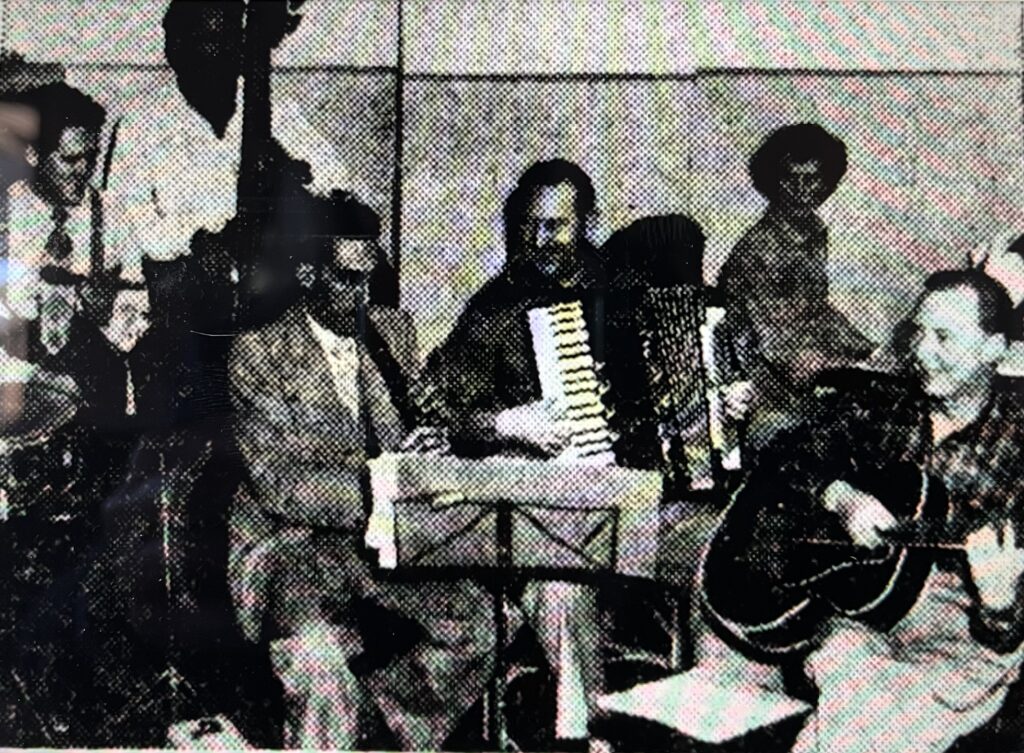
“ON THE BEAM”: Keith Whittle, Ralph Filmer, George Caro, Harry Black, Sylvia Caporn and Cliff Adam seem to enjoy rehearsal for Repertory Club’s current season, “On the Beam.”
Western Mail (Perth, WA : 1885 – 1954), Thursday 8 November 1951, page 40
1952
Jazz Jamboree 1952
1953
Ladies’ Night Was One To Be Remembered
Secretary Mrs. Le Cornu (Sylvia Caporn) and an energetic committee really pulled one out of the bag for Musicians’ Union Ladies’ Auxiliary’s first night at Anzac House lower hall on Tuesday. Musical items were contributed by Phyllis Frost and Bryn Gifford, drummers Merv Rowston, Keith Whittle, Murray McKay and Max McKay, sax players George Caro, Sonny Henderson, Johnny McCaughan, trumpeter Jack Pope, pianists Nell Sheridan, Roy de la Mere and Henry Cochran, guitarist Hank Collins and Dane Gorn on bass. It was a jam session extraordinary, and it was enjoyed by all. Auxiliary’s next function is to be an afternoon tea on Aug. 29 at 2.30 in the Musicians’ Union offices, 102 Beaufort-st.
Mirror (Perth, WA : 1921 – 1956), Saturday 15 August 1953, page 13
An effort is being made to have a reunion of players of Ron Moyle’s old band. – These include: Ron Moyle (pianist and leader), Cliff Adam (guitar, vocals and tapdancing), Niddy Roberts (drums), Wally Hadley (banjo), Tommy Bennett (bass), Ken Pimmell and Viv Nylander (trumpets), Charles Thompson (trombone), Alan Gough, George Caro, Bob Gibson (saxes).
Mirror (Perth, WA : 1921 – 1956), Saturday 24 October 1953, page 12
1954
NATION HEARS ‘BARRACK STREET’ BLUES
You’ve probably heard ‘Boogie Blues’ and ‘Memphis Blues.’ You’ve certainly heard ‘St. Louis Blues.’ But have you heard ‘Barrack-st. Blues?’ This is the name of Harry Bluck’s composition heard throughout Australia on the ABC Swing Club this week. Graeme Bell’s ‘Square Dance Rag’ was one of the few standard jazz numbers play ed in the session. Another Bell number, ‘Rockinghorse Rag,’ gave Harry Bluck a chance to feature some impressive key board work as he played the piano solos. Group comprised Harry Bluck (leader and piano), El Nylander (trumpet), Charlie Thompson (trombone), Jack Pateman (tenor sax), George Caro (licorice stick). In the rhythm section were Harold Taylor (tubs), Cliff Adam (guitar and banjo), Ralph Filmer (bass). Program showed just what can be done with skilful arranging. If you wonder why Harold should have picked Barrack-st. for his blues, the answer is simple. His studio overlooks Barrack-st. Harry Bluck WA Jazz Group served up 30 minutes of Australian numbers in the Dixieland style. Some of these compositions were standard jazz compositions. Majority, however, were Australian folk songs, given a new treatment by the local group. All arrangements were by Harry himself. It must have been one of the first times that numbers such as Jack O’Hagen’s ‘Along the Road to Gundagai’ and ‘I’m Gonna Hump My Bluey’ have been heard played in the ‘real razz’ style. But the arrangements were particularly tasteful and these old numbers retained all the appeal which made them a hit for so many years. Even the old bullockies’ classic, ‘Gee Back, Woo Back, Ema,’ was given a new coat of paint by the local boys. They added a little vocal to this number. Even the old ‘When the Dog Sits on the Tuckerbox’ got a jazzing up.
Mirror (Perth, WA : 1921 – 1956), Saturday 22 May 1954, page 13
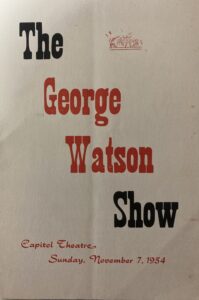
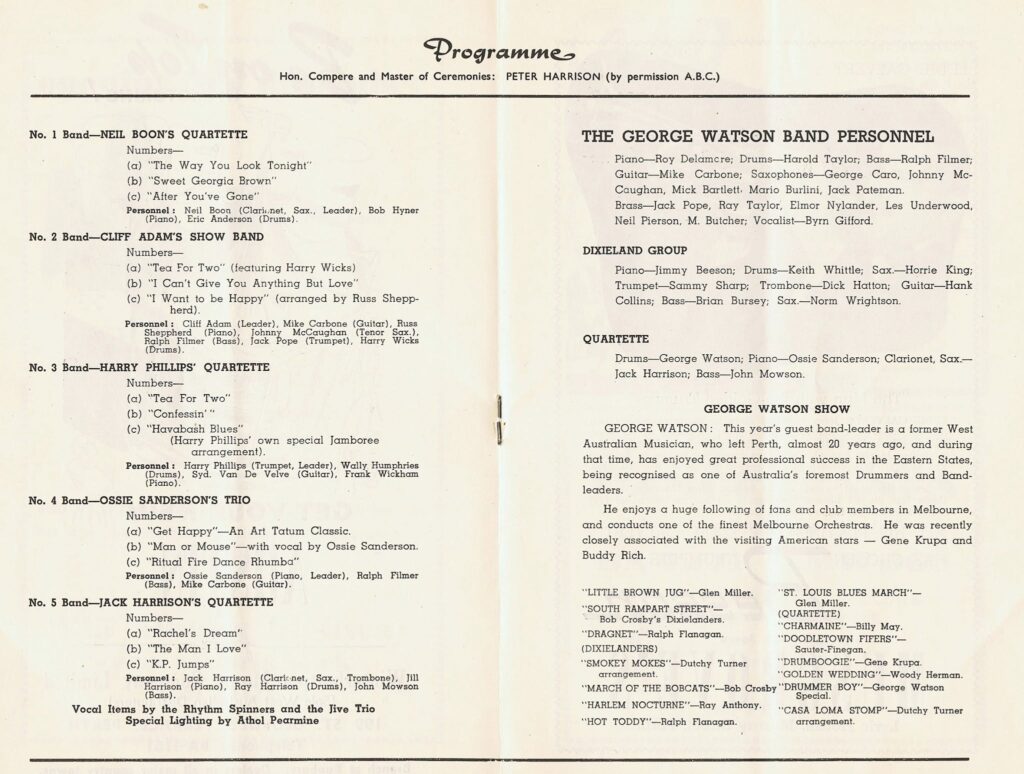
The George Watson Show
1954 George Watson Show1954 Watson George program
George Caro died in 2002 aged 91.
National Film and Sound Archive – PHOTO – Summary
L-R: Peter Boyd (vocalist), Sam Sharp (trumpet, leader), Peter Clinch (tenor saxophone, clarinet), George Caro (alto saxophone, clarinet), Ralph Filmer (bass), Les Mackay (alto saxophone), Keith Whittle (drums), Cliff Adam (guitar), Jim Beeson (piano), Charles Thompson (trombone), Norm McMahon (trumpet), Jack Pope (trumpet), Phyllis Frost (blind English vocalist).
Born in Perth in 1961, Bruce Gillam grew up in a family where music was a central part of everyday life.
He began learning piano from his mother before discovering a passion for the clarinet. During his teenage years, he studied with renowned clarinet teacher Ted Lewis and was awarded his AMusA diploma in 1979.
The 1980s marked an exciting and formative period in Bruce’s musical journey. While completing a Bachelor of Science degree majoring in Physics, he studied with legendary clarinettist Allan Rule and served for three years as Principal Clarinet with the WA Youth Orchestra. He then successfully auditioned for the WA Arts Orchestra, performing professionally with this ensemble for six years.
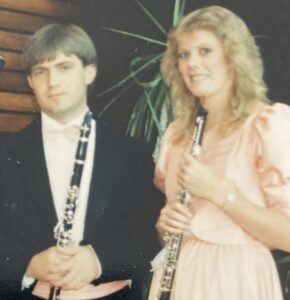
1984 Bruce Gillam and Jody Harrison
In 1984, Bruce was named a State Winner of the ABC Instrumental and Vocal Competition, performing Nielsen’s Clarinet Concerto with the West Australian Symphony Orchestra. Since then, he has enjoyed a long and varied freelance career, performing with orchestras and ensembles in concerts, musicals, and major choral works.
Bruce joined the West Australian Clarinet Quartet in 2010. The ensemble enjoyed considerable success, including an invitation to perform at the International Clarinet Association Conference in Assisi, Italy, in 2013. The quartet also recorded a recital for ABC Classic FM in the Perth Town Hall.
Alongside his performing career, teaching has been one of Bruce’s greatest passions. Since 1984, he has taught clarinet in government schools across the Perth metropolitan area, inspiring generations of young musicians.
Many of his former students have gone on to become music teachers and professional performers:
NOTABLE STUDENTS TAUGHT BY BRUCE GILLAM:
Catherine Cahill – Clarinet Teacher at Churchlands Senior High School
Jacqui Edwick – Coordinator of Woodwind Teaching, Instrumental Music School Services
Ashley Smith – Chair of Woodwind and Contemporary Performance UWA
Alex Roberts – Clarinettist with Welsh National Opera Orchestra
Scott Collinson – Clarinettist with Australian Army Band, Canberra
Nicole Niewendijk – Clarinet Teacher, Instrumental Music School Services
Samantha Lillis – Clarinet Teacher, Instrumental Music School Services
Michael Hodgkins – Clarinettist with Fremantle Symphony Orchestra
Ashleigh Hill – Secretary WA Symphonic Wind Ensemble
Kristy Hopkins – Clarinet Teacher St Marks Anglican Community School
Bronwyn Rogers – Clarinet Teacher Corpus Christi College
Vicki Powell – Clarinet Teacher Instrumental Music School Services
Amanda Noordzy – Clarinet teacher Instrumental Music School Services
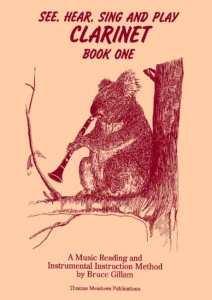
Bruce is also a respected author and educator. He has written and published several successful music education resources, including the popular See, Hear, Sing and Play series, written as a project for a Master of Music Education degree, the Roundabout series, which sold more than 20,000 copies, and Trendy Trios, a collection of accessible and enjoyable pieces for beginner clarinet students.
Today, Bruce continues to share his love of music through performing, teaching, and writing, helping musicians of all ages develop their skills and appreciation of the clarinet.
Alex is an Australian clarinettist based in the UK.
He is currently Sub-Principal Clarinet with the Welsh National Opera Orchestra, and has worked with the most of the major London orchestras.
He is a long-time member of Explore Ensemble, a boundary pushing new music group, working with some of the most exciting living composers, performers and improvisers in the UK and abroad.
Alex has also worked as a pianist and musical director with several large community choirs and was until recently Director of Music Programmes for Liberty Choir, a charity which creates and runs choirs in prisons, creating pathways to rehabilitation.
Alex studied with Allan Meyer and Paul Dean in Australia, before working with Nicholas Cox, Barnaby Robson and Linda Merrick at the Royal Northern College of Music.
After graduating he continued to take lessons and masterclasses with Andrew Marriner, Chi-Yu Mo, Francois Benda and Yehuda Gilad.
In 1929 aged 21, was working at Perth Hospital and fell 30 foot from a ladder and fractured bones in his left foot.
He performed in “Bert Howell’s Stage Band”.
1934
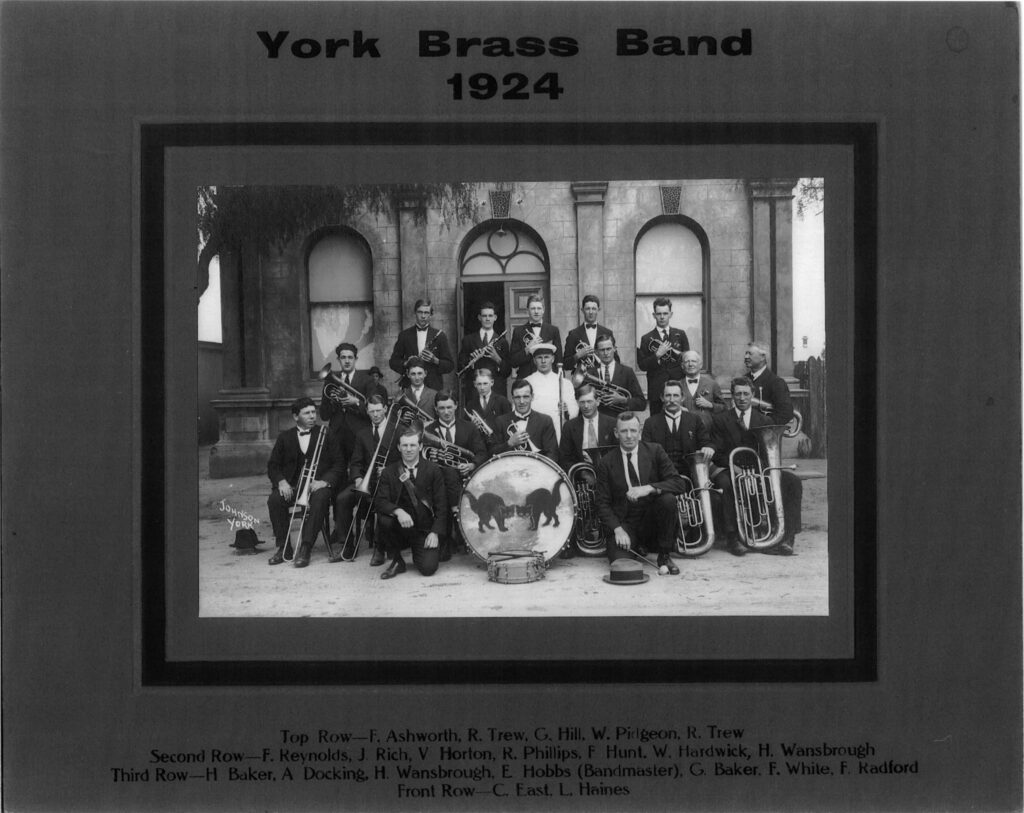
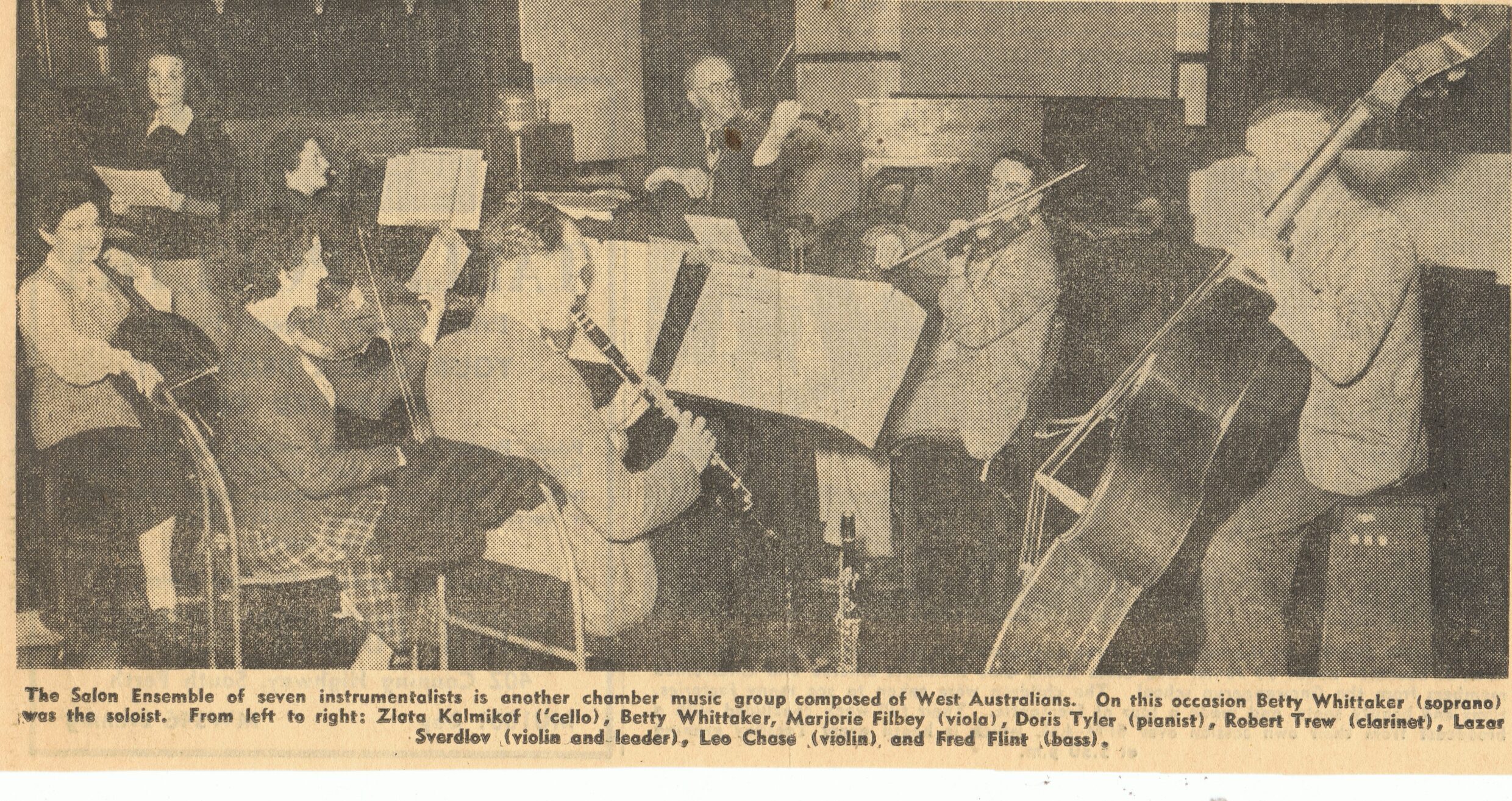
The musical career of second clarinet player Bob Trew, who joined the Perth Symphony Orchestra in 1934, began in 1920 in York, which at that time enjoyed both an orchestra and a brass band. Trew was also a qualified plumber.
1930s Perth Studio Orchestra in front of old ABC building.
BACK L-R: Fred Flint, Tony Federici, Harry Singleton, Rima Swain, Lazar Sverdloff, Ivan Nylander, Alec Black, Vera Rees, Percy Newton, William Glassford, George Davies, Bob Trew, George Mellor.
FRONT: ?, Vaughan Hanly, Dave Kember, Harold Thornton, ?.
1938
TREAT FOR THE KIDDIES – Symphony Orchestra Pleases The children’s concert held in His Majesty’s Theatre last week was a most successful one. Sponsored by the National Broadcasting Commission, a highly educational programme was performed by the A.B.C.(Perth) Symphony Orchestra conducted by E. G. Roberts. This musical body is now delivering the goods and is comprised of the usual studio orchestra, containing as it some of the finest musicians in Australia, and all of whom are capable of giving a most exacting performance of their instrument. This was manifested when, reinforced by other players not on the permanent staff, the various leaders were called upon to show the children their instruments and play a few classical bars or lilting little ditty. …Other woodwind soloists were Mr. Singleton (oboe) and the clarinet pair Mr. Percy Newton and Bob Trew, the latter delivering a delightful duet in a workman like fashion. Mirror (Perth, WA : 1921 – 1956), Saturday 4 June 1938, page 2
1942
SYMPHONY MEN PLAY DANCE MUSIC. An occasion unique in the history of South Australian rural entertainment, writes ”Jazzman,” was the playing of three symphony men in the dance band at the recent carnival at the Berri Co-op. Packing House. Being in a shed, the acoustics were naturally poor, but your scribe managed to get near the stand and was impressed with the sax work of Bob Trew, a clarinet player from the Perth Symphony and the A.B.C. network. He plays with a round, smooth tone, reminiscent of the American Negro, Benny Carter. Unfortunately no traditional jazz was played and this prevented his swinging improvisations. Another interesting musician was S/Sgt. V. Lombardi who played violin for part of the evening. Formerly a first violin of the Adelaide Symphony he handled the dance orchestrations deftly. The third symphonic figure was the Conservatorium pianist Frank Lellmann. His bass slapping is extremely powerful and his tremendous rhythmic drive literally kicked the melodic instruments along. A word to promoters of future “shed shows”: have the band centre of the floor. This idea has been tried in Adelaide with great success. Murray Pioneer (Renmark, SA), Thursday 10 December 1942, page 4
Entertaining the troops WWII
1944
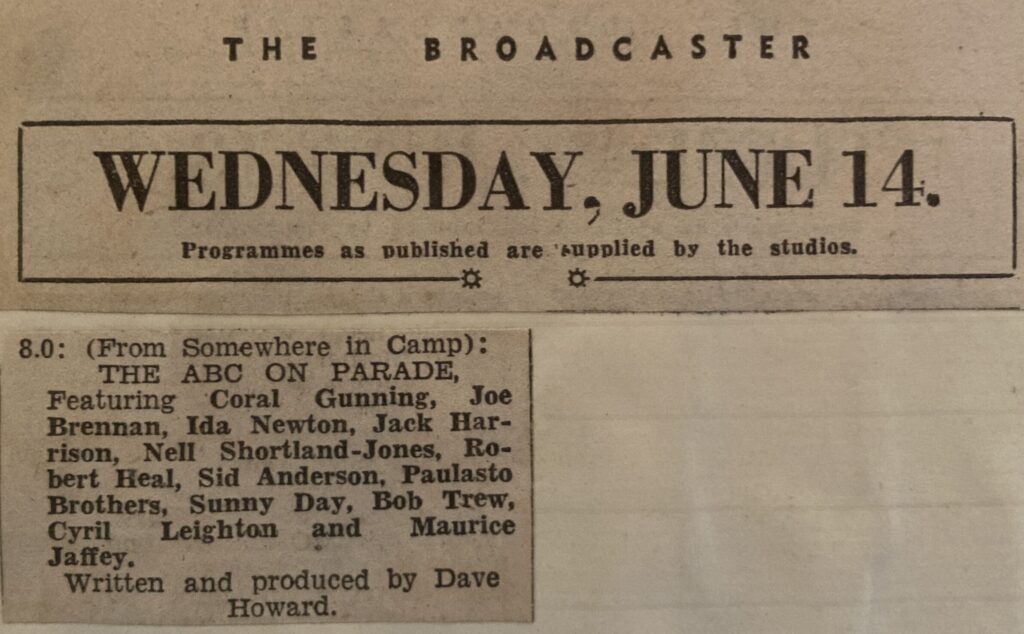
From somewhere in camp: ABC ON PARADE.
Devised, arranged and produced by Dave Howard, with the ABC Theatre Orchestra, conducted by Ernest J. Roberts and including the following artists: Joe Brennan and Ida Newton, Sunny Day (Elsie Connoly), Olive Dunton, Jack Harrison, Eileen Moran, Vernon Sellars, Maurice Jaffey, Neil Shortland-Jones, The Paulasto Brothers. (Bob Trew 14th June) Compered by Cyril Leighton. The Broadcaster Thursday February 24, Thursday April 20, June 14 1944
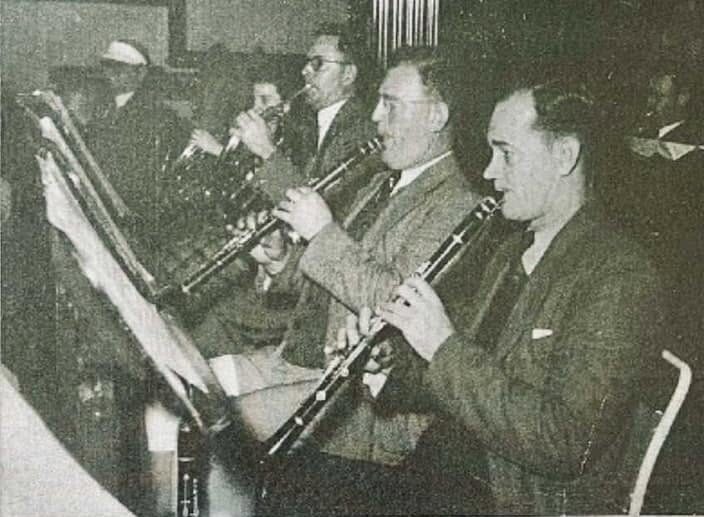
Robert Trew in 1949 Perth Symphony Orchestra clarinet section
1946
EVERYMAN’S MUSIC – Recital TonightAn unusually varied programme is offered by the Adult Education Board in the third of the current Everyman’s Music series to be given in Winthrop Hall this evening at 8.15 o’clock. Chamber music will include the Divertimento in B Flat for two clarinets and bassoon (Mozart) with Percy Newton, Robert Trew and Jock Good and the Mozart Trio in E Flat for piano, clarinet and viola with Edward Black, Percy Newton and William Glassford.
West Australian (Perth, WA : 1879 – 1954), Thursday 25 April 1946, page 6
1949
Outstanding alto and clarinet man with the Sharp combination, George Caro, has had a colourful career in the game. At 15 he commenced the sax, and as George maintains, was completely self-taught. He first came to the public notice in 1930 when he was one of 18 who competed in the saxophone competition conducted by the Brass Band Association of WA. Winner was Cas Mitchell, now of the ABC Melbourne, second George Caro, Bob Gibson (now in England) was third, and fourth position was filled by Bob Trew (Perth ABC). In 1934, when the exodus was on, George made the Eastern States tour with the Ron Movie outfit, and when this orch. returned to WA, George decided to hit out for the overseas spots. His first working port o’ call was Colombo, where he played at the Mount Lavinia Hotel. From here he went to the Grand Hotel at Calcutta, before making the Malayan Peninsula in 1936, where he played in Singapore cabarets and the Eastern and Oriental Hotel in Penang. On his return to Australia, George linked up with pit work, played for the American Marcus ‘Show, North China Troupe, Dante, and various other visiting shows. During the war he played second cornet with the 28th Battalion Band, and at a later stage, while serving in Darwin conducted a Sunday night Swing Show featuring a 5piece outfit. Returning to civvy street, he joined Chris Gosper’s eight playing at St. Mary’s, Mt. Hawthorn. When Sammy Sharp returned from England, George moved in with Sammy Sharp and remained with him ever since. —’QUAIL.’ Mirror (Perth, WA : 1921 – 1956), Saturday 23 April 1949, page 14
1950 Broadcaster article Perth Musicians
1951 Only three months in the South Australian Symphony Orchestra, Jack Harrison returned to Perth on 8th February 1951 to fill the second clarinet position with the West Australian Symphony Orchestra after the sudden death on January 18 1951 of second clarinettist Bob Trew aged 43.
TREW (Robert Walker); A sincere tribute to the memory of Bob deepest sympathy to Mrs. Trew and family. Inserted by the staff of the Australian Broadcasting Commission.
TREW (Robert W.): In memory of a great friend and associate. The Moore family.
 Born in Australia, Newton developed her academic focus on jazz and classical traditions while based in Perth, completing studies in clarinet with teacher