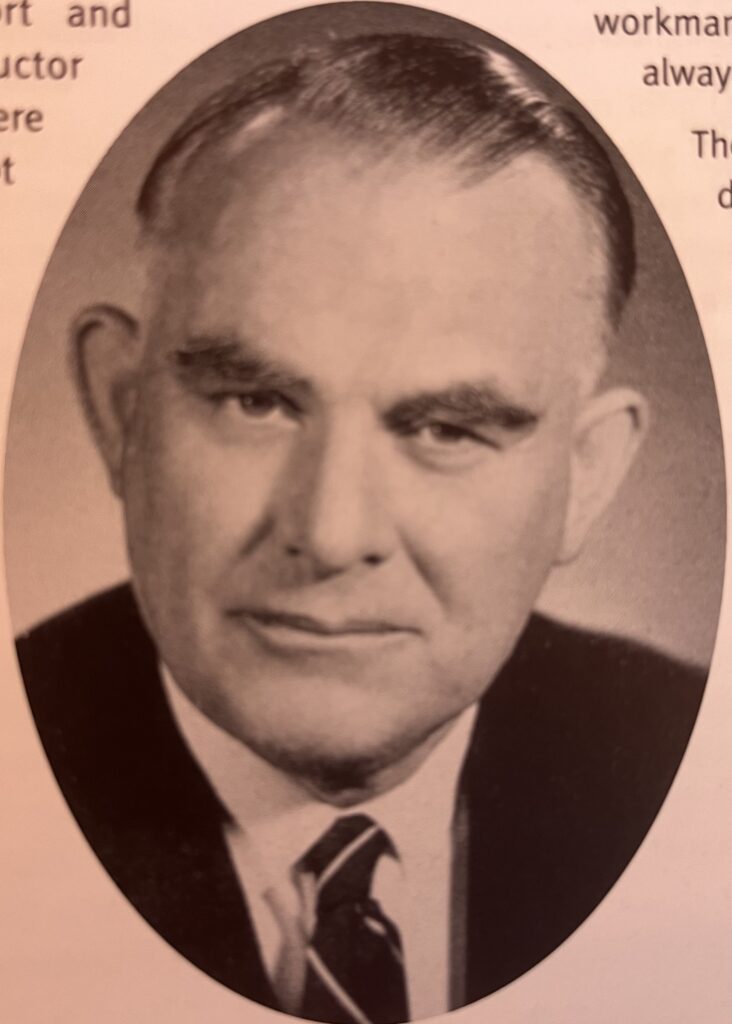
Stephen Lloyd George Dornan was born in Perth in 1916. He died on 25th April 2012 aged 95.
1933
The Resident Secretary of the Associated Board of the Royal Schools of Music (Mr. W. E. Southwood) has been notified of a record success for Western Australia, in, that two exhibitions tenable in London have been awarded to West Australian musicians. The successful candidates are Miss Joy Huggett, pupil of St. Hilda’s Church of England Girls’ School, Cottesloe (tenable at the Royal Academy of Music, London) and Mr. Stephen Dornan, pupil of Mr. A: J. Leckie, Mus.Bac. (tenable at the, Royal College of ‘Music, London).
West Australian (Perth, WA : 1879 – 1954), Saturday 8 April 1933, page 5
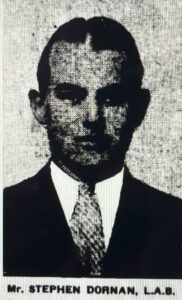 Stephen L. G. Dornan, – L.A.B., A.Mus.A., a pupil of Mr. A. J. Leckie, Mus.Bac, left for, London this week to study at the Royal College of Music, having gained an Associated Board exhibition. This exceptionally clever young pianist, who is now only- 17 years old, has had a remarkable series of examination successes. He gained exhibitions in Grade III and Grade II. of the A.M.E.B. examinations, the gold medal and prize in both advanced and final trades of this Associated Board, and this year shared the prize for L.A.B. with 192 marks out of a possible 200. It was mainly through his active enthusiasm that the Young Musicians’ Club was formed in Perth. He has acted as president of. the club since its inception. The exhibition given by the Associated Board is one of three awarded annually in Australia. It provides free tuition at either the Royal College or Royal Academy of Music for a period of two years or more.
West Australian (Perth, WA : 1879 – 1954), Saturday 16 December 1933, page 5
1940
A PIANIST’S SUCCESS. Mr. Stephen Dorman Returns.
Mr. Stephen Dorman, a young West Australian pianist who has acquitted himself creditably in musical circles in London, has returned to this state, where he plans to make his home. In 1933 Mr. Dorman, then 16 years of age, won a two years’ scholarship of the Associated Board of Music and in the following year he went to the Royal College of Music, London, where he studied pianoforte as a soloist and, from the teacher’s aspect, the organ, choral and orchestral conducting, orchestration and ensemble. He studied pianoforte under Herbert Fryer, Kendall-Taylor and Edwin Mitchell. After he had two years’ study the scholarship was extended for three years and in 1938 he won the Leverhulme Scholarship and the Challen Gold Medal. The medal is awarded to an advanced student giving the best half-hour recital of work selected by himself. It was presented to him by the Duke of Kent at St. James’s Palace. Mr. Dorman gave several recitals at the Royal College of Music, and included some big modern works in his programmes. He took part in several concertos at the college, including the Glazounov Concerto in F minor under Constant Lambert and the Delius Concerto under Dr. Malcolm Sargent. He has given several Empire broadcasts for the British Broadcasting Corporation and was to have given a recital in the Wigmore Hall in January last, having won a competition for the honour. However, the war Intervened and the recital bad to be postponed. Since the beginning of the war, Mr. Dorman said, he had been pianist for a successful ballet company named the Arts Theatre Ballet. In a few months this small but very talented company, which included some former members of the Russian Ballet, had risen to a position of amazing solidarity and importance in the ballet world. Mr. Dorman was accompanied on his homeward journey by his sister, Miss Pearl Dorman, a chemist, who has for the past 12 months been studying singing in London.
West Australian (Perth, WA : 1879 – 1954), Tuesday 6 August 1940, page 11
Reception at the University. The president (Mr. C. L. Jenkins) and committee of the University Music Society held a reception at the refectory at the University on Saturday evening, at which the guests of honour were the music examiners at present visiting Western Australia, Messrs. Frank Hutchins and H. Elvins. The president, and secretary (Mrs. A. D. Hunter) received the guests, Mrs. Hunter wearing a self-patterned apple green satin frock with matching rucked velvet bolero jacket. A profusion of golden broom and Geraldton wax flower decorated the refectory, and there were between 150 and 200 people present. A programme of music was presented, the following artists contributing items, Misses Angus and Bunning (Tschaikowsky Concerto on two pianos), Vaughan Hanley (violin solo. Bach Unaccompanied Sonata), Miss Alice Mallon (three songs by Brahms), and Mr. Stephen Dornan (who has recently returned from abroad, pianoforte solos). Specially interesting notes were lent to the programme by talks by the guests of honour. Mr. Elvins took as his subject, “Adventures in Norway,” relating charming and humorous incidents of his travels. Mr. Hutchins’s remarks were followed by illustrations played by himself, of some of his own compositions for the piano. Professor A. D. Ross, patron of the society, proposed a vote of thanks to the artists, and at the conclusion of the programme an adjournment was made to another part of the refectory. where supper was served. Other special guests of the society included Dr. Lyon (Trinity College), Mrs. Conrad Charlton, Mr. and Mrs. A. J. Leckie. Mr. and Mrs. R. Wood, Mr. F. Robertson, and Mr. E. Black. Mrs. Partridge and Miss Harrie Partridge of White Rocks. Brunswick Junction, motored up to Perth on Friday and spent the week-end with Mrs. Horace Sholl at her home at Peppermint Grove.
West Australian (Perth, WA : 1879 – 1954), Monday 7 October 1940, page 10
1941
Young Australian pianist, who returned to Perth last year from London after building a successful career. He is now touring the National stations ; under contract to the A.B.C. He won the Challen medal, which is the highest distinction awarded by the Royal College of Music in London for a soloist, and he was presented with the medal by the Duke of Kent at St. James Palace.
Narracoorte Herald (SA : 1875 – 1965), Tuesday 29 July 1941, page 3
1942
You all know Steven Dornan, A.B.C. pianist. He’s given up twiddling his fingers on the ivory keys and donned khaki.
Mirror (Perth, WA : 1921 – 1956), Saturday 3 January 1942, page 20
1944
STEPHEN DORNAN’S RECITALS.
Warrant-Officer Stephen Dornan, who visited Cairns during the week-end and gave recitals, sponsored by Army Education Service, for service-men and women, may give a public recital in Cairns some time next month. The selections tor his recital at the Council Chambers on Friday night, which was attended by members of all types of services and units in the district, included Bachs “Jesu, Joy of Man’s Desiring” ; Chopin’s “Waltz in A Flat,” “Waltz in C Sharp Minor,.” “Berceuse,” and “Study in E”; Beethoven’s “Moonlight Sonata” and Brahms’ “Rhapsody in G Minor.” for the first half; then “The Viennese Dance,” by Gartner ; “Valse Oubliee,” by Liszt ; “The Cathedral Under the Sky,” by Debussy ; “Ritual Fire Dance,” by Falla ; “Harpsichord Dance,” by Delius ; “Carillon,” by Casella ; “Perpetual Motion,” by Poulenc ; “Jeux d’Eauz,” by Ravel, and “Chromatic Waltz,” by Godard.
Cairns Post (Qld. : 1909 – 1965), Tuesday 12 September 1944, page 4
1946
MUSIC AND THEATRE. (By “Fidelio”) The detailed programme of the fifth series of “Everyman’s Music” recitals under the auspices of the Adult Education Board, which will: commence shortly, discloses some new features. In two of the four recitals chamber music is represented -in one case a string quartet, in the other a woodwind group to the: fore. For the first time seats can be’ reserved in advance, and printed; programmes will be available. Thei artists, besides a number already; well known in this connection, and: some youthful newcomers, will in-i elude also a notable visitor from the [Eastern States, the soprano Thea Philips. Miss Philips will appear on Thursday evening, May 2-all these recitals take place on Thursdays with, as associate artist, Stephen Dornan, the West Australian pianist, returning from Army Education Service duties.
West Australian (Perth, WA : 1879 – 1954), Saturday 9 March 1946, page 6
1947
Recital at Geraldton – Dornan-Everett Concert DELIGHTFUL MUSIC (By ‘Music-Lover’)
On Saturday evening last the Adult Education Board, in association with the Geraldton Music-Lovers’ Club, offered to a Geraldton Town Hall audience (of less than expected numbers, let it be stated) an evening of fine music. The artists were the brilliant young pianist, soon to leave for overseas, Stephen Dornan and Phyllis Everett, contralto. Introducing the programme in a friendly and informal style Mr. Dornan explained that it was designed to present to listeners a brief survey of music over three centuries — the eighteenth, nineteenth and the present. The audience would easily discern the differences in style of composers whose lives fell within the span of the periods covered. The earlier composers were restricted in their mode of writing, not only by established practices, but also by the limitations of the instruments tneu known. The piano as they knew it to-day, belonged rather to the nineteenth century and earlier instruments, notably the harpsichord, had nothing of the pianoforte’s robustness of tone nor its compass. Among the composers included in the earlier groups were Bach, Handel and Scarlatti. Mr. Dornan’s playing was sure and pleasing to a degree, while Miss Everett’s fine contralto voice was heard to advantage in several groups of songs. Singing with deceptive ease, the contralto’s efforts brought forth the very best in the audience — perfect stillness and rapt attention during items and sustained and genuine applause after each song. Throughout the entire evening Stephen Dornan’s annotations were in every way most helpful, combining authoritative musical knowledge with a friendly attitude towards his audience, the whole enlivened by occasional flashes of humour. His playing of both solo items and acompaniments for Miss Everett’s songs was a joy. His command of the tonal resources of the instrument, his ability to express the mood and the period of the various composers selected, and his skill at making the most of a not-too-co-operative hall piano were in full measure appreciated by the audience. If one could pick any items as outstanding in a really first-class programme one might be tempted to mention the pianist’s ‘Etude in E’ (Chopin) and the Debussy ‘Cathedrale Engloutie’ and the contralto’s ‘Do i Not Go My Love’ and the enchanting ‘Foxgloves.’ One feels that in a town and district of such size there should be better support for these recitals of good music by leading artists, especially in view of the very moderate charge made for admission. Members of the Geraldton Music-Lovers’ Club, upon whose shoulders falls the responsibility of organising these recitals at the Geraldton end, feel that many people do not fully realise what they are missing by not attending these recitals. Children, particularly those studying music, should be especially encouraged to attend these functions as the benefit to be derived is enormous. The next Everyman’s Music recital to be held in Geraldton should attract considerable attention as three artists of very high standing have been engaged to visit the town. On October 9th, Father Albert Lynch (violinist), Irene Stancliffe (soprano) and Frances Moran (pianist) will give a combined recital at the Geraldton Town Hall under the auspices of the Adult Education Board. The attention of readers is drawn to press advertisements, shortly to begin, in which full particulars of this musical treat will be given.
Geraldton Guardian and Express (WA : 1929 – 1947), Saturday 27 September 1947, page 5
1951
Pianist On Way Home
A REALLY warm reception will be given Australian pianist Stephen Dornan when he arrives in Fremantle from England on February 15, on the Maloja. Since he left the army over three years ago, he has been under the tuition of Reizenstein and Rosa Kosloff in England. During the war, he was well known to Australian troops for his recitals in the Pacific islands. He will also be remembered by Australian audiences for his broadcasts with the A.B.C.. particularly during his 1940 tour of Australian cities.
Daily Mirror (Sydney, NSW : 1941 – 1955), Monday 29 January 1951, page 10
PARTNERS IN SUCCESS Sonatas For Violin And Piano (By “Fidelio.”)
The large audience drawn to the Winthrop Hall on Saturday night to hear Vaughan Hanly and Stephen Dornan in four sonatas for violin and piano was richly rewarded. In the past the association of these artists proved a happy one. Their reunion on Saturday showed that while both have matured in the intervening years, their approach to the chosen works retains conspicuous freshness and vitality. Backed by high technical competence and fine standards of tone, their interpretations must have kindled an answering glow in every attentive, sensitive listener. The springing full-blooded, incisive impetuosity, for instance, with which the bold opening passages of Elgar in E Minor were flung forth! But the high point of this sonata is the slow movement, in which the composer. preceding and following a central passage of intense lyrical feeling with broken phrases half playful, half wistful, has created a very original piece of music, distinctive m character and of great poetic appeal. UNANIMITY. Of the four sonatas played, only the Cesar Franck can be described as thoroughly familiar. The programme began with a performance of Beethoven’s Op. 12 No. 1, in D, which most happily captured the buoyant impulse and lyrical charm of one of the most gracious and masterly works of the composer in his teenager state. At once the fine finish of the partnership, its unanimity, ardour and sensitiveness, were manifest. After the interval came an excursion into modernity. Hindemith’s Sonata in E, dated 1935, is not in the atonal category to which this German composer has contributed much. Its dissonances are not of the aggressively excruciating kind; and, unlike many modern composers, Hindemith does not outrage the nature of the violin by condemning it to scrappy percussiveness. He allows it flowing, singing passages in plenty but, being anything but a Romantic, it is-a cool, impersonal kind of song, which seems to communicate nothing but its own equable patterning. More immediately accessible is a. section which exploits a tarantella rhythm with stimulating vigour. Many recalls at the end signified the audience’s appreciation of an outstanding recital.
West Australian (Perth, WA : 1879 – 1954), Monday 23 April 1951, page 7
This Tuesday, June 12, a recital was given in the Town Hall to the children of Pingelly by Australian , soprano, Lorna McKean, and brilliant pianist, Stephen Dornan. The programme was one chosen especially for the children, the opening: song being “The Road to the Isles,” rendered delightfully by Miss McKean. A description of the song was given by Mr. Dornan to an appreciative audience. This was followed by a Maori song, “Waaata.Poi,” by the Australian composer, Alfred Hill. We were then entertained with the Military Prelude by Rachmaninoff with Stephen Dornan at the piano. Further vocal and pianoforte items were fully appreciated by the children present and it is hoped that we will receive many more entertainments of such a high calibre.
At the beginning of this month the new typewriter arrived at the school, in time for the preparation of examination papers.
Pingelly-Brookton Leader (WA : 1925 – 1954), Thursday 14 June 1951, page 4
Jubilee Recital
Soprano, Lorna McKean and associate artist, pianist, Stephen Dornan presented a Jubilee recital in the Albany Town Hall last Friday, under the direction of the Adult Education Board. A programme of varied works was received by an enthusiastic, if rather sparse audience. Although bookings were filled for the dress circle, a number of seats in the hall remained vacant. One can easily imagine why Lorna McKean is popular with fellow artists and audiences. She sings with grace and charm. Miss McKean commenced the programme with two well known songs “My Mother Bids Me Bind My Hair” by Haydyn and “My Heart Ever Faithful” by Bach, sung with sympathy and sensitive expression. One of the most popular of Max Reger’s compositions, “The Virgin Slumber Song,” “A Dream,” by Grieg and a highly dramatic song “The Trout” by Schubert were executed with fin-The only operatic works included in the programme were “They Call Me Mimi” from La Boheme by Puccini, and “The Laughing Song” from der Fledermaus by Strauss. Miss McKean completely captivated her audience with her effervescent charm and her excellent interpretation of both. “The Laughing Song” was received with more than ordinary enthusiasm. In her five years’ absence from the musical scene of Albany, Miss McKean’s voice has developed from a lyric soprano, to a soprano with greater depth of tone, dramatic content and flexibility. Her interpretations of “They Call Me Mimi” and “The Laughing Song” were beautifully done, the first being most poignant and the second sung with joyous abandonment. . Finally, Miss McKean sang three delightful folk songs, “The Road to the Isles,” “The Last Rose of Summer” and Peter Warlock’s arrangement of “One More River to Cross,” which had a very fine piano accompaniment. Stephen Dornan gave explanatory notes oji all the music performed, and to the listener, they were too long and definitely overdone. To an audience of school children this is most desirable, but for adults the explanations and story of musical architecture want to be drastically pruned. Mr. Dornan’s contribution to the recital was three fold. He did the talking, accompaniments and solo playing. His playing was noted for its fine technique, clarity of tone and rhythm content, but one feels that the aesthetic side was lost through the explanatory interruptions. Debussy’s soothing composition, “Clair de Lune” was presented in direct contrast with its companion, “Prelude in G Minor,” by Rachmaninoff: Dornan played this gripping military piece with vitality and understanding and a great deal of rhythmic quality. This Prelude is seldom heard at recitals and it possesses great rhythm and dramatic feeling. “Viennese Dances,” by Gaitner-Friedmann were delightful and entertaining, but his final presentation was easily the most popular on the programme. “The Ritual Fire Dance” by de Falla was played stirringly and with admirable understanding for the barbaric quality of the composition. Stephen Dornan’s rendering was his best on the programme. This young pianist wants to be careful that he does not let mannerism and habit at the keyboard detract from his musicianship.
Albany Advertiser (WA : 1897 – 1965), Monday 18 June 1951, page 8
FINE MUSIC BY ‘CELLO AND PIANO (By “Fidelio.”)
A recital rich in musical satisfaction was given by Alice Carrard (piano) and Zoltan Barna (‘cello) at the Winthrop Hall on Saturday night. Each was heard as soloist, and jointly they interpreted sonatas by Debussy and Kodaly, a modern Hungarian master. The work last named, a novelty here but composed over 40 years ago, impressed most in the haunting, brooding music of its slow opening, re-captured at the end. Debussy’s sonata, which we have heard from these artists before, again charmed with its piquant effects in original sonorities, and characteristic finesse. In both sonatas the players’ partnership was conspicuously successful. UNACCOMPANIED. Mr. Barna had undertaken the formidable task of opening the recital with a performance of one of Bach’s suites for un-accompanied cello. Here, one felt, he was a little dry and at times inadequate in firm outlining of the music. His fine skill and sensitive musicianship (a striking feature of which is a flair for capturing the beauty of “re-mote,” dreamy moods) were displayed more effectively later. He played also that 19th Century favourite of the cello virtuoso, Boellmann’s “Varia-ions Symphoniques.” Masterfully able as was Mme. Carrard’s performance of Schumann’s “Carnaval,” we valued more the opportunity of hearing her in one of the late Beethoven sonatas—great music seldom played here. Her affinity for the works of this composer and her “masculine” grasp were evidenced anew in a deeply satisfying performance of Op. 109. The last of this series of Adult Education Board recitals will be given next Saturday, with the Perth String Quartet, Stephen Dornan and Lorna McKean.
West Australian (Perth, WA : 1879 – 1954), Monday 8 October 1951, page 5
1954
The Repertory Club will present the operetta “The New Moon” (music by Sigmund Romberg) at the end of June. Nita Pannell is producing, with Stephen Dornan as musical director. Auditions will be held at the club tomorrow evening. Romberg, a prolific composer of musical plays, is best known, probably, by his scores for “Desert Song” and “The Student Prince.”
West Australian (Perth, WA : 1879 – 1954), Saturday 3 April 1954, page 27
Melodious Vocalists – English Duo’s Artistry TOWN HALL CONCERT
Presented under the auspices of the Adult Education Board, with whom the Geraldton Music Lovers’ Club co-operated, the celebrated English, Duo—soprano Viola Morris and contralto Victoria Anderson—with a Western Australian in Stephen Dornan at the piano — delighted a small but most enthusiastic audience in the Geraldton Town Hall last Thursday night. The singers teamed admirably in their duets, drew from a repertoire so extensive that they might have truthfully . been billed as “The Cosmopolitans” and in their expressive renderings revealed sweetness of tone, clarity and a capacity, to reproduce with fidelity the mood of every composer. Nor was their artistry in solo numbers any less satisfying, and the end of the programme came all too quickly for a house which revelled in their many items. In some contributions they were unaccompanied, and in those which Stephen Dornan accompanied them the pianist revealed ability of a high order, despite the fact that he found the instrument he was playing was not up to expectations. In his own brackets Mr. Dornan demonstrated he could reproduce every shade of musical beauty and, whether in lively or sedate passages, was equally at home. The programme opened brightly with Viola Morris and Victoria Anderson singing the lilting “Now is the Month of Maying,” which they followed with. “My Dearest, My Fairest,” “Angler’s Song,” “It Was a Lover and His Lass” {a particularly popular offering), “Adieu. Sweet Amaryllis” and “Sound the Trumpet” (in which there was all the requisite vigor). Stephen Dornan’s first group comprised the Concert Study (Poldini), Debussy’s Clair de Lune, played with all the delicacy which has made this number a favorite with concertgoers, and Mozart’s lively Turkish March. The English Duo submitted “When Spring With It’s Joy,” “Schon Blumelein,” “Die Schwestem,” “Le Coeur de Ma Mie,” “I, Would That My Love,” “I Know a Bank” and the sprightly “Where the Bee Sucks.’ With her delightful soprano voice Viola Morris began the second half with “Have You Seen but a Whyte Lillie Grow,” which preceded, the spirited rendering of “I’ll Sail Upon the Dog Star,” the other two numbers in this group comprising “L’Invitation au Voyage” and “The Maiden.” All the anticipated animation was apparent in Stephen Dornan’s playing of Seguidillas and the Ritual Fire Dance, and then came further vocal camoes with the melodious contralto offerings of Victoria Anderson in “Awake Saturnia” (calling for considerable power in volume and expression), “The Queen’s Maries” and the vivacious number entitled “The Bold Unbiddable Child.” Amongst the duets which concluded. a splendid programme were “Early One Morning,” ‘.’Five Eyes,” “Afton Water” and the “Keel Row,” with “O Dear What Can the Matter Be?” as an encore. ‘ On Thursday afternoon about 250 pupils from the Geraldton High School and Geraldton Primary School made a very appreciative audience at a special concert given in the town hall.
John Kay (27), of Taringa (Queensland) had forty-seven stitches inserted in his head and right arm after being attacked with a reaping hook in a southern suburb (Holland Park) to-day. The police have charged a fifty-one-year-old man with unlawful wounding.
Geraldton Guardian (WA : 1948 – 1966), Saturday 7 August 1954, page 5
Adult Education Recital – ASSOCIATE ARTIST
Stephen Dornan the associate artist in the Adult Education recital by Viola Morris and Victoria Anderson at the Kalgoorlie Town Hall tomorrow night, needs no introduction to goldfields audiences. He is a firm favourite with metropolitan music lovers, and ranks high in the list of outstanding Western Australian artists. Some years ago he won the associated board scholarship and carried out further studies at the Royal College of Music. London, where he came under the supervision of well known tutors in Herbert Fryer and Kendall Taylor (piano), Sir Walter Alcock (organ) and Dr. William Reed (conducting). He has also given numerous recitals for the Australian Broadcasting Commission.
Kalgoorlie Miner (WA : 1895 – 1954), Monday 30 August 1954, page 9
1956
The Youth concert on 31st May 1956 presented enthusiastic patrons with an interesting item – Concerto in E flat for two pianos by Mozart. Stephen Dornan joined Stephanie James, who had already played many times with the orchestra. Stephen, who studied at the Royal College of Music in London and later under Roza Kozloff, was also well known to the Perth musical public as a soloist and chamber music player, and also later as a teacher. Hi sympathetic accompanying technique was admired by all musicians who had the privilege of playing with him.
1963
WIND QUINTET IS REFRESHING – By Sally Trethowan – Thursday June 27 1963
A concert by a rare composition of instruments – a wind quintet – makes a refreshing excursion from the string works that monopolise the field of chamber music. Though few composers have been attracted to the wind group as a medium for musical expression, they have not in general been cavalier in their treatment of it. Beethoven’s early Quintet Op. 16 played at yesterday’s free lunch-hour concert in Winthrop Hall, is as felicitous an example of fusion of form and content as any that can be found in the repertoire. The artists, Jack Harrison (clarinet), Peter Randall (oboe), Brian Pope (bassoon) and Harold Thornton (horn) with Stephen Dornan (pianist) , wove the interlaced counterpoint of their respective strands with a professional skill to give a nearly flawless reading. The other work on the programme, Mozart’s Quintet K 452, was given a less inspired though pleasant performance. Stephen Dornan is playing at his best and yesterday fulfilled his pivotal role in setting the tempo and maintaining the balance of the ensemble and gave coherence to the whole.
The West Australian Friday June 28 1963
1965
MUSIC – By Peter Hellstrom – U.W.A. Thursday Lunchtime Recital
September 1965
The free lunch-time concert at 1.10pm at the University next Thursday will be given in the undercroft of Winthrop Hall. The performers will be clarinettist Jack Harrison, cellist Louis Mojzer and pianist Stephen Dornan. The programme will be Sonata in E flat major Op. 120 No. 2 for Clarinet by Brahms, Sonata (1934) for Cello and Piano by Shostakovich, and the
Sonata for Clarinet and Piano by Leonard Bernstein.
By Peter Hellstrom – Festival Of Perth 1966
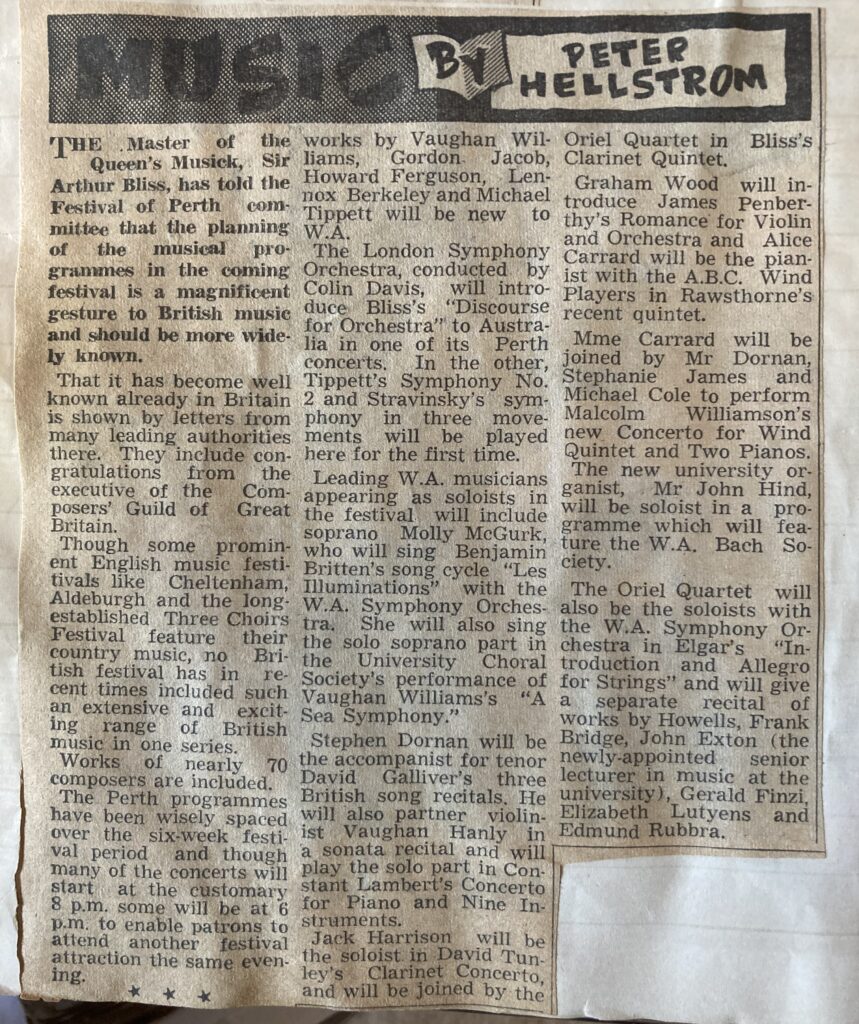
The Master of Queens Musick, Sir Arthur Bliss, has told the Festival Of Perth committee that the planning of the musical programs in the coming festival is a magnificent gesture to British music and should be more widely known. That it has become well known already in Britain is showing by letters from many leading authorities there they include congratulations from the executive of the Composers Guild of Great Britain. Though some prominent English music festivals like Cheltenham Aldeburgh and the longest established Three Choirs Festival feature their country music, no British festival has in recent times included such an extensive and exciting range of British music in one series. Works of nearly 70 composers are included. The Perth programs have been wisely spaced over the six week festival period and though many of the concerts will start at the customary 8 pm some will be at 6 pm to enable patrons to attend another festival attraction the same evening.
Works by Vaughan Williams Gordon Jacob, Howard Ferguson, Lennox Berkeley and Michael Tippett will be new to W.A. The London Symphony Orchestra conducted by Colin Davis will introduce Bliss’s “Discourse for Orchestra” to Australia in one of its Perth concerts. In the other, Tippitt’s Symphony No. 2 and Stravinsksy’s Symphony in Three movements will be played here for the first time. Leading W.A. musicians appearing as soloists in the festival will include soprano Molly McGurk who will sing Benjamin Britain’s song cycle Les Illuminations with the W.A. Symphony Orchestra. She will also sing the solo soprano part in the University Choral Society’s performance of Vaughan Williams A Sea Symphony. Stephen Dorman will be the accompanist for tenor David Galliver’s three British song recitals. He will also partner violinist Vaughan Hanley in a Sonata recital and will play the solo part in constant Lambert’s Concerto for Orchestra and Nine Instruments. Jack Harrison will be the soloist in David Tunley’s Clarinet Concerto and will be joined by the Oriole Quartet in Bliss Clarinet Quintet. Graham Wood will introduce James Penberthy’s Romance for Violin and Orchestra and Alice Carrard will be the pianist with the A.B.C. Wind Players in Rawsthorne’s recent quintet. Madame Carrard will be joined by Mr Dornan, Stephanie James and Michael Cole to perform Malcolm Williamson’s new Concerto for Wind Quintet and two pianos. The new university organist, Mr John Hind, will be soloist in a program which will feature the W.A. Bach Society. The Oriel Quartet will also be the soloists with the W.A. Symphony Orchestra in Elgar’s Introduction and Allegro for strings and will give a separate recital of works by Howells, Frank Bridge, John Exton (the newly appointed senior lecturer in music at the university) Gerald Finzi, Elizabeth Lutyens and Edmund Rubbra.
The West Australian September 1965
EXPRESSION IN BRAHMS TRIO – By Sally Trethowan
Much of Brahms later music is valedictory in sentiment, and the trio for Piano Clarinet and Cello Op. 114 is typical of his last works. The major item in yesterday’s free lunchtime concert in Winthrop Hall, this work was performed expressively by Stephen Dornan (piano) Jack Harrison (clarinet) and Louis Mojzer (cello). Mr Dornan’s realisation of the full textured piano part which lies mainly in the middle and lower registers of the instrument demonstrated his deep understanding of and affinity for Brahms’s chamber music. Mr Harrison played the clarinet line with a poignancy and sweetness that echoed in sentiment the autumnal sadness of the cello part effectively realised by Mr Mozer. To open the program Mr Dornan and Mr Harrison play the Sonata for Clarinet and Piano by American Leonard Bernstein, a man famed as composer, conductor, concert pianist, scholar and expert on Bach and jazz. The first of the two movements was a romantic outpouring of song which, however, adroitly sidestepped both the banal and the sentimental. The second was a delightful capricious movement strongly flavoured with jazz rhythms. Here the clarinet chatted loquaciously, emphasising its arguments with strongly accented syncopations till it finally deemed to defeat the piano with sheer ebullience. After this Mr. Dornan in an expert display on the piano played three highly coloured pieces from Mihaud’s “Saudades do Brazil”, music that alternatively swayed and exploded with the ferocity of a tropical storm.
The West Australian Friday September 10 1965
 1966
HARSH-TONED MUSIC ENTERTAINS – By Sally Trethowan
The last of the festival “Music of Britain” chamber concerts given in the Basil Kirk memorial studio last night offered some of the most complex and insistently dissonant music of the whole series. Yet each of the three works was so excellently performed that some measure of the composers musical thought in each case intense and highly individual must surely have impressed the general music lover no matter how unsympathetic he might have been to the harsh contemporary harmonic language. The first work “Quintet for wind and piano” by Alan Rawsthorne, was perhaps the most earnest in intention, and also the most abstruse and uncompromising. Much of it was concerned with working out, in terms of spasmodic tempi, unremitting dissonance and often exciting and original blends of wind colour, two moods, one apparently serene but masking disquieting emotional currents; the other desperately merry. This difficult music was persuasively presented by Alice Carrard (piano), Peter Randall (oboe), Jack Harrison (clarinet), Brian Pope (bassoon) and Neil Pierson (French horn). After this, Trevor Jones’s happy blend of whimsy lyricism and drama in his “Cantata Zoologica” was immensely entertaining. It was given a premiere late last year by the W.A. Bach Society choir and quintet and it was performed last night by the same artists except that the conductor on this occasion was Laughton Harris and the narrator was Neville Teede. Mr Harris’s cogent grasp, poetically and musically of the work was incisively conveyed through the unerring accuracy of his beat to which the choir and instrumentalists responded with brilliant execution. Mr Harris also conducted the final concerto for wind Quintet and two pianos (eight hands) by Malcolm Williamson. The wind players were joined by flautist Owen Fisenden and pianist Madame Carrard by fellow soloist Allyne Tilsed, Stephen Dornan and Michael Cole. This work exhibited complex interplay of tone colour. The finale, where the piano parts exploded in figuration of a Bartokian ferocity and aliveness was, I think, unrivalled in the festival music for sheer excitement of performance.
The West Australian Wednesday March 9 1966 page 17
1966 MUSIC LOVER’S DIARY
The fourth programme in the A.B.C.’s free recitals in the Basil Kirke Studio this year will be held at 3pm tomorrow. Jack Harrison, Graham Wood, John Dean, Brian Meddemmen and Stephen Dornan will perform trios by Mozart and Shostakovich. The Kylie Club will hold its annual general meeting in the Skinner Galleries at 8.15pm next Saturday. There will be a musical programme in which the artists will be Frances Moncrieff, Allyne Tilsed and Brian Meddemmen.
1967
MUSIC – A CONCERT – By Peter Hellstrom
Saturday August 5th 1967 8pm
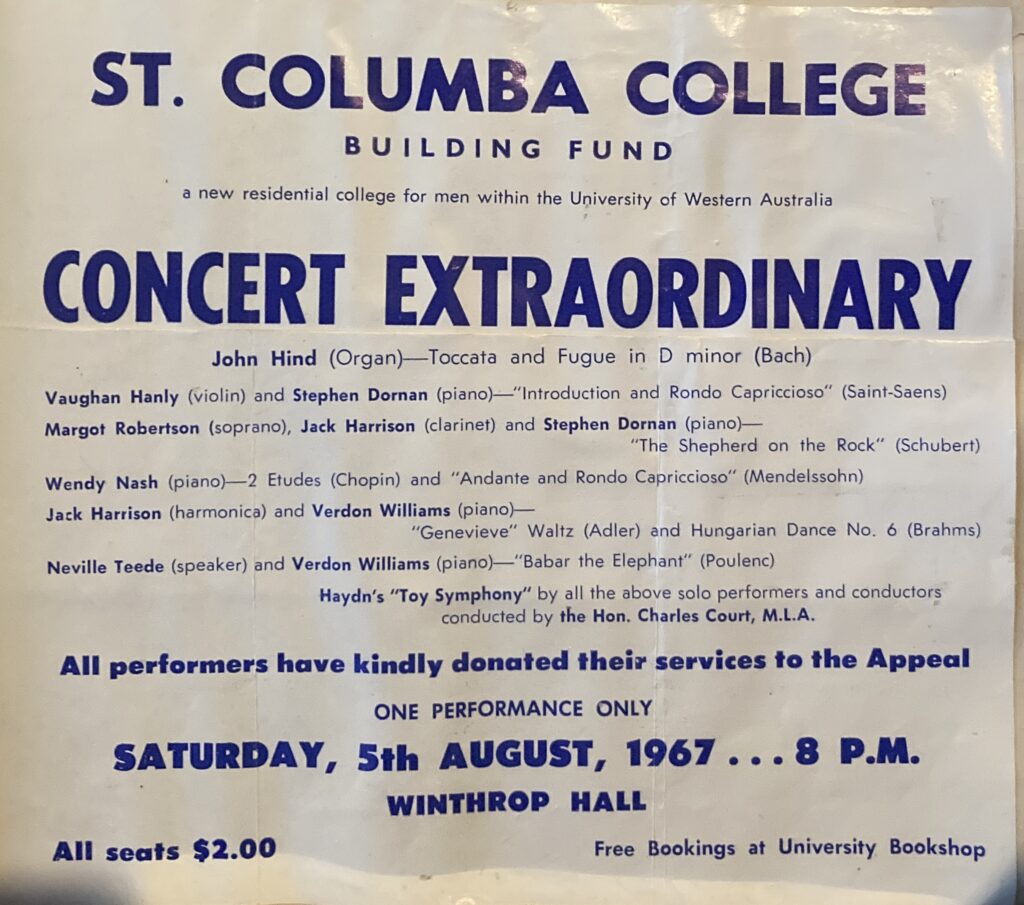
An unusual and exciting concert will be given in Winthrop Hall on August 5 in aid of the building fund of St Columba the new university men’s residential college. Called “Concert Extraordinary”, the varied program will involve more than 300 performers including several leading W.A. musicians, all of whom will donate their services to the appeal. Directed by John Hind, the Bach Society Choir will sing Benjamin Britain’s “Hymn to St Cecilia” and the Perth Madrigal Singers will sing ”The Daniel Jazz” by Herbert Chappell. The University’s A Cappella Choir conducted by David Tunley, will sing English madrigals. The University Choral Society will join combined choirs in performances of works by Mozart and Handel which will be conducted by Professor Frank Callaway. The program will open with university organist, John Hind, playing Bach’s great “Toccata and Fugue in D minor”. Violinist Vaughan Hanly will play Saint-Saen’s “Introduction and Rondo Capriccioso” with pianist Stephen Dornan who will also be heard with soprano Margot Robertson and clarinettist Jack Harrison in Schubert’s “The Shepherd on The Rock”.
1967 CONCERT IS A PERTH MUSIC “HAPPENING” – By Sally Trethowan
The “straight” items included popular classics such as… Schubert’s “The Shepherd on The Rock” with pianist Stephen Dornan, soprano Margot Robertson and clarinettist Jack Harrison.
1968
Free A.B.C. Concert – Sunday September 29th 1968
The free concert in the A.B.C.s Basil Kirke Studio tomorrow beginning at 3 o’clock is one of a series of six in which distinguished artists are performing a wide variety of works. The program will be Bartok’s outstanding and complicated “Sonata for two pianos and percussion” played by Wendy Nash and Stephen Dornan and percussionists John Reece and Brian Sadique directed by Verdon Williams and Stravinsky’s “Soldiers Tale” concert suite conducted by Verdon Williams. The performers will be Graham Wood (violin), John Mowson (bass), Jack Harrison (clarinet), Jill Harrison (bassoon), Donald Johnson (trumpet), Alan Mewitt (trombone) and Brian Sadique (percussion).
The West Australian Saturday September 28 1968
1971
On Feb 23 1971, Jack Harrison performed the Perth premiere of Margaret Sutherland’s “Sonata for Clarinet and Piano” (1949) with Stephen Dornan (piano) in a Festival of Perth’s Australian Composers’ Workshop held at the Basil Kirke Memorial Studio at the A.B.C. in Western Australia. He performed on the first commercial recording in 1972 – LP compilation titled Australian Festival of Music, Volume 8.
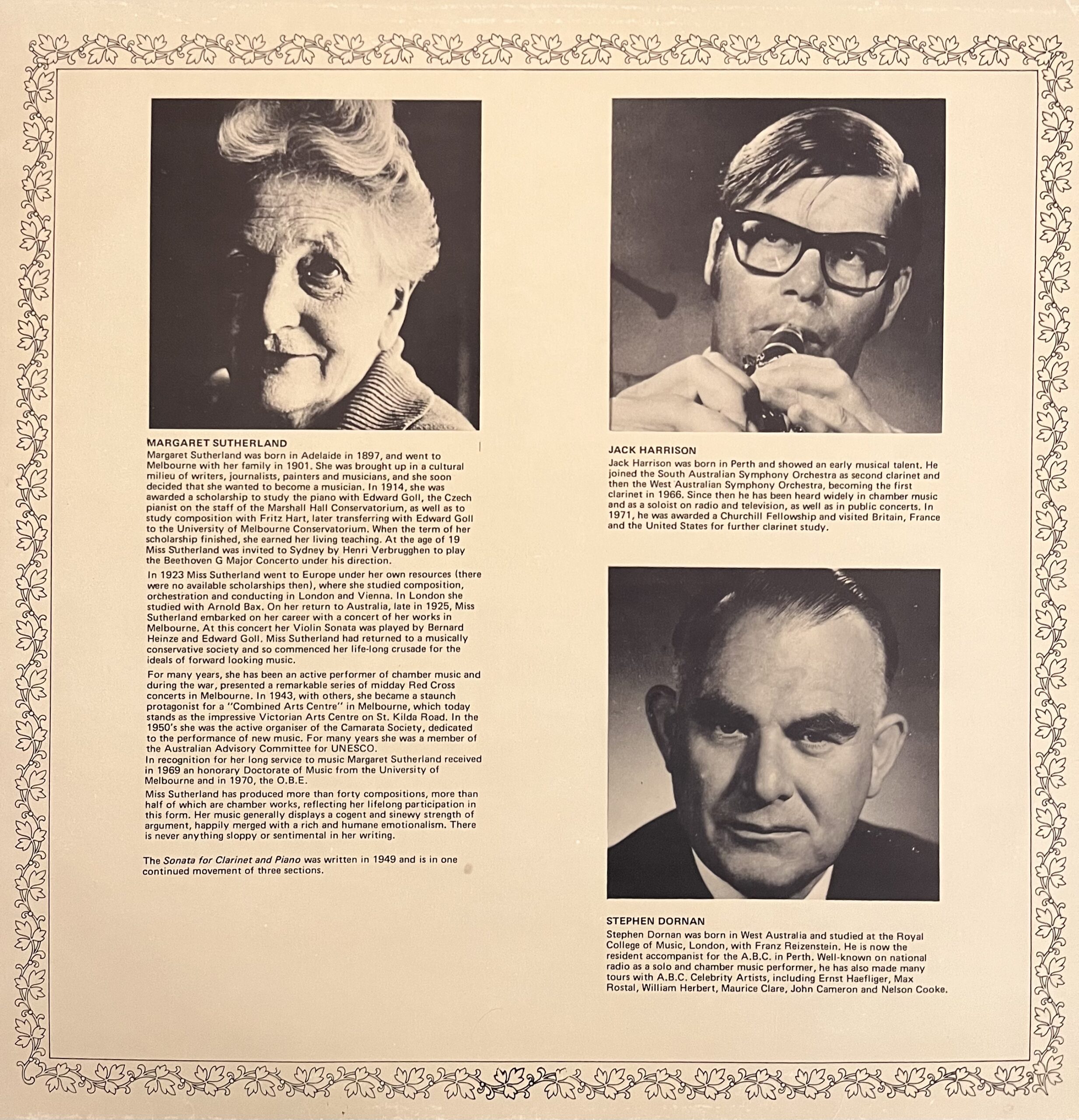
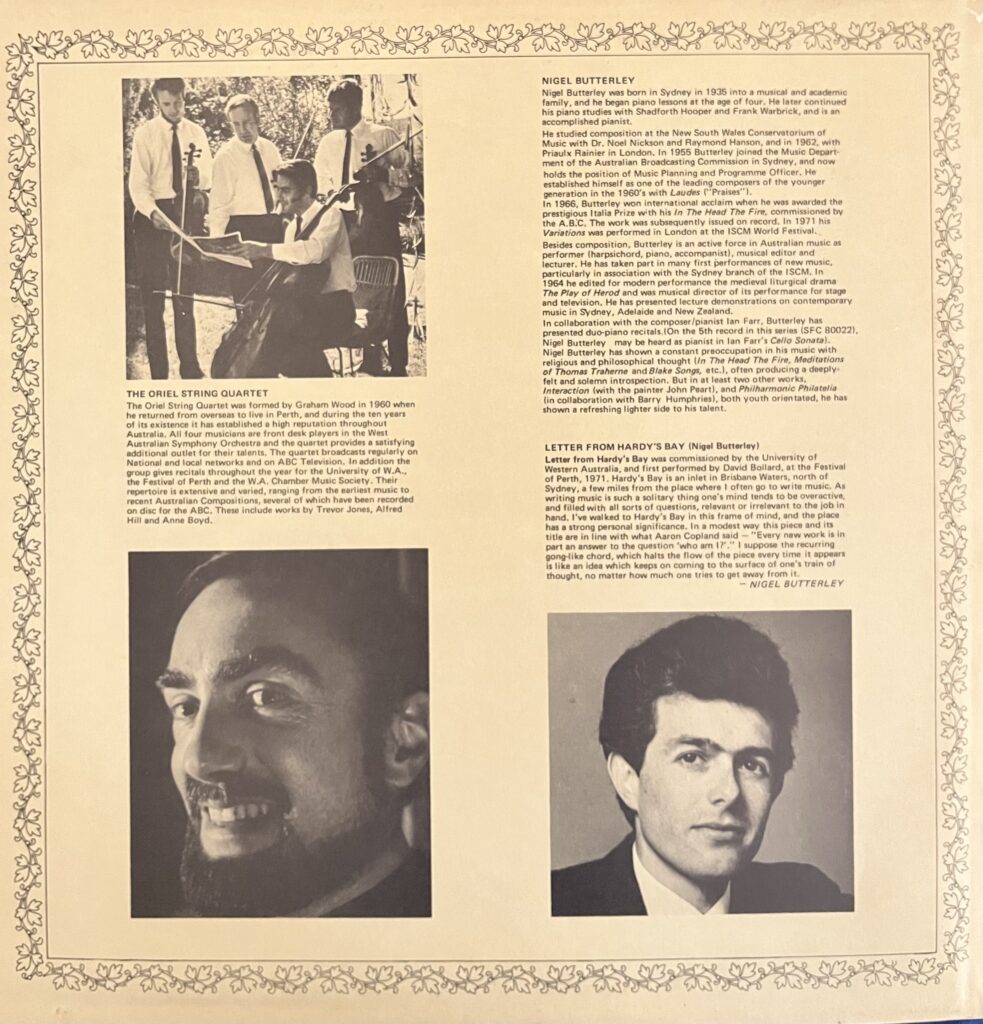
Peter Jenkins: I suspect Jack’s was probably the first recording. (Festival SFC 80025)
Workshop at its most attractive – By MARY TANNOCK – Thursday February 18 1971
Last night’s Australian composers workshop program at the Basil Kirke Studio was distinguished by the presence of Dr Andre Jurres, president of the International Society of Contemporary Music and the Australian composer Peter Sculthorpe. They were members of the panel chaired by Professor Frank Callaway. It was also the most attractive of the workshop series in the festival so far. Works by Margaret Sutherland, Colin Brumby, John Exton, Peter Sculthorpe and Trevor Jones were performed by Molly McGurk (soprano), Jack Harrison (clarinet), Stephen Dornan (piano) and the Oriel Quartet. Peter Sculthorpe’s “The stars turn” opened with wistful echoes from Gregorian Chant and a sea shanty and dissipated quickly into the character of the song. With limpid tones Miss McGurk sensitively delineated the shifting patterns of a lyrical line. Again, with Colin Brumby’s “Three Italian Songs for High Voice and String Quartet”, she infused chiselled and graceful declamation into the string line, throwing into relief its undulating fluidity. Trevor Jones’s “Essay for String Quartet” was alive with dense pulsating rhythms and sometimes fugal growth. Its textural complexity was skilfully highlighted by the Oriel Quartet.
In Margaret Sutherland’s “Sonata for Clarinet and Piano” traditional texture and techniques were cleverly reconciled to the clarinet line and the accompanist Stephen Dornan’s deft chordal Textures in the piano provided neat and subtle undertones.
The West Australian February 19 1971
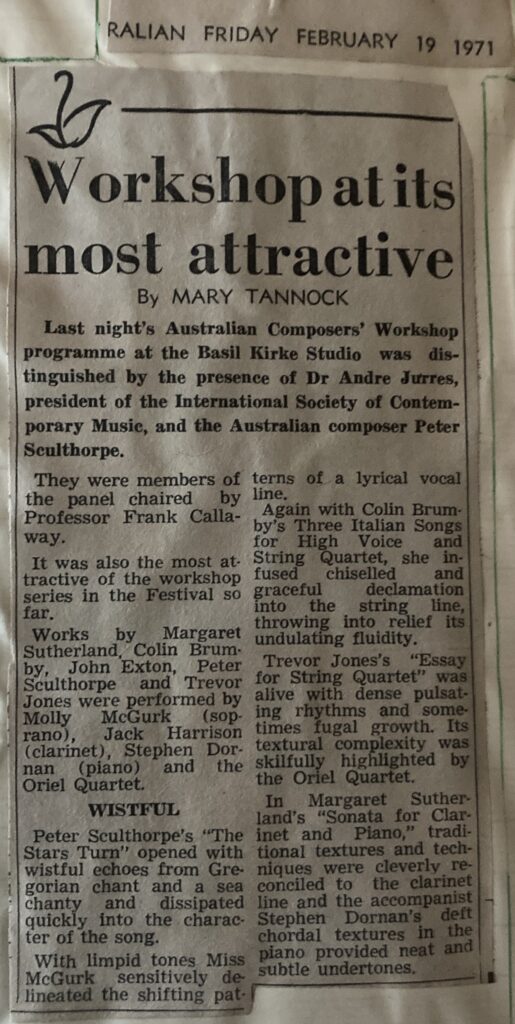
Composers’ Workshop an Evening of Contrasts – By ALAN BONDS – Thursday February 18 1971
The workshop program presented in the Basil Kirke Studio last night was an evening of contrasts. The programme began with a polished rendition by Jack Harrison and Stephen Dornan of a “polished” Sonata for Clarinet and Piano by Dr. Margaret Sutherland. The work’s appeal was immediate, its form was basically straightforward and concealed few intricacies for cerebral digestion. The cycle of three songs by Colin Brumby further enhanced this composer’s reputation for skilful handling of texts. The work was witty and sensitive, but I feel that the texture of the accompanying string quartet was frequently too thick and overpowered the refined singing of Molly McGurk. For those interested, last Thursday’s performance of John Exton’s String Quartet (1969) was their fourth opportunity to hear the work in as many months and the work could easily stand a fourth hearing. It is completely absorbing, combining the all-embracing logic of serialism with a wonderful sense of contrast and colour. The performance by the Oriel Quartet was both accurate and persuasive, skilfully handling textures, which demand fine precision and control. “The Stars Turn” (1970) by Peter Sculthorpe was I feel more notable for the performance than the music which was performed. The piece itself was expressive and moving in the skull for tradition of Irkanda and the Quartets but I couldn’t help it feel that I had heard it all before. Molly McGurk did a splendid job moulding and phrasing as she might to Schubert or Brahms. The Oriel Quartet concluded the performance with a performance of Trevor Jones’s “Essay for string Quartet”. It would be fair to say that much of the work is reminiscent of Bartok’s quartet writing. The Essay was easily sectionalised thematically with frequent excursions through poly modality to atonalism.
The Sunday Times February 21 1971
1972
The A.B.C. presents Studio Recital – 3pm Sunday May 21 1972 – Basil Kirke Studio
Molly McGurk (soprano) Jack Harrison (clarinet) Stephen Dornan (piano)
Programme
Women’s Love and Life – Song Cycle Op. 42 SCHUMANN
Three Fantasy Pieces for Clarinet and Piano Op. 73 SCHUMANN
The Shepherd on the Rock SCHUBERT
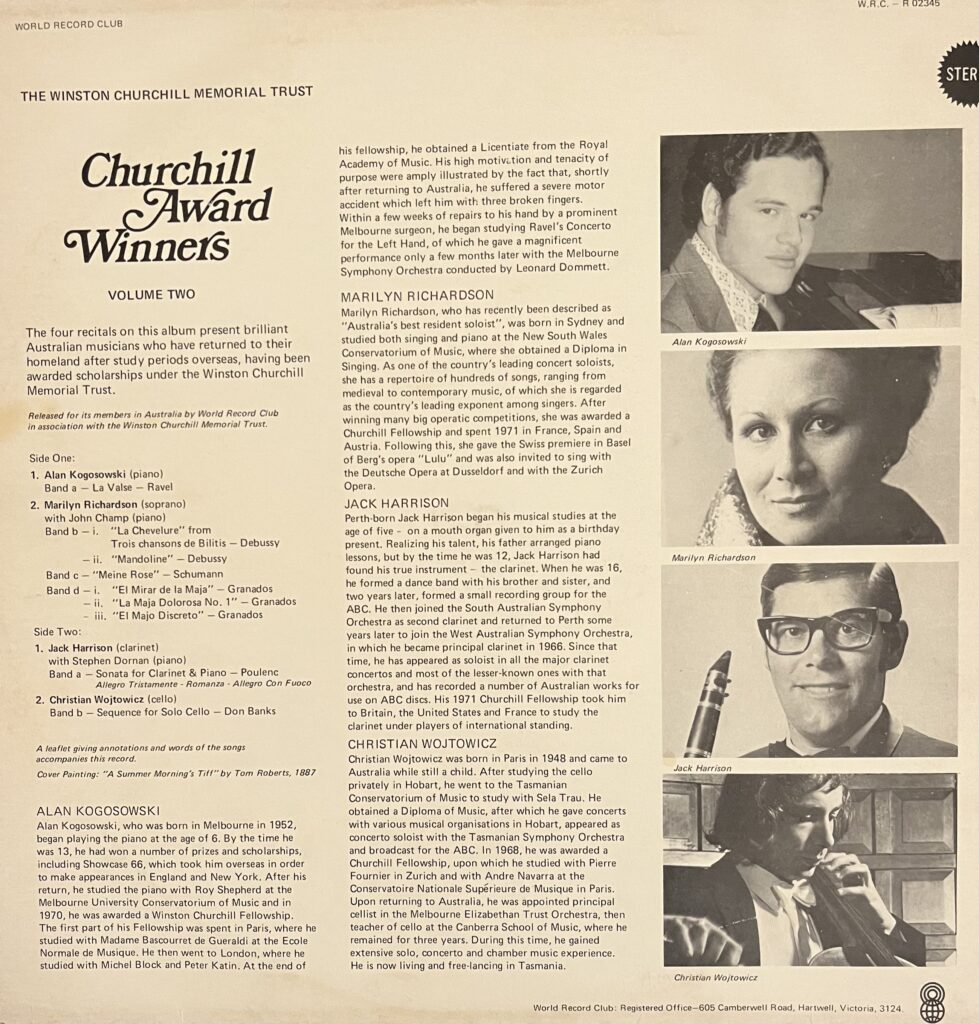
In September 1973 Jack Harrison was invited by Ivor Meddleton to be an artist on the second Churchill Fellows’ L.P. recording. The artist was asked to donate their time, to be recorded at the closest A.B.C. studio and the cost of the accompanist covered by The Winston Churchill Memorial Trust.
Jack replied that he would be happy to contribute. “Listed below are three pieces, any one of which would be suitable and I will leave the final choice in your hands:-
“Concerto for Clarinet and String Orchestra” by Malcolm Arnold – my reasons for including this work is that I am performing this piece of music with the W.A. Symphony Orchestra during the month of November and the A.B.C. has agreed to allow a recording to be made for the Churchill Trust. Another reason is that there is, to my knowledge, no commercial recording of this concerto. As I will be concentrating on this piece for the next six weeks, I would naturally favour it as my choice.
“Sonatina” for Clarinet and Piano” by Malcolm Arnold
“Sonata for Clarinet and Piano” by Poulenc
He recorded the Poulenc with Stephen Dornan (piano) and was the first Australian recording of the work.
1989
Medal of the Order of Australia
- Name
- Stephen Lloyd George Dornan
- Award Date
- 26 Jan 1989
- Award Place
- Floreat Park, Western Australia, Australia
- Announcement Event
- Australia Day 1989 Honours List
- Citation
- In Recognition of Service to Music