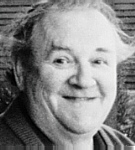
Trevor Jones arrived at UWA as a Senior Lecturer in the late 1950s alongside Tunley. A bassoonist, ethnomusicologist, and composer, Jones was deeply invested in Renaissance, Baroque, and Indigenous Australian music before leaving to become the Foundation Professor of Music at Monash University.
1961 – MUSIC by Peter Hellstrom As a contribution to the W.A. Music Council’s bursary scheme, the University Music Society will hold a public concert in Winthrop Hall at 8 o’clock on Monday night. The programme will be presented by the University Orchestral Society, clarinettist Jack Harrison and the University’s A Cappella Choir. They will perform works by composers of the 16th Century to the present, including compositions by Perth musicians Jennifer Fowler, David Tunley and Trevor Jones. The West Australian Saturday (cut off) 1961
FESTIVAL CONCERT TONIGHT World Premiere of David Farquhar’s prize winning Concertino for Piano and Orchestra First Performance in Australia – Chamber Concerto No. 3 for Bassoon, Strings and Percussion by Elisabeth Lutyens. David Tunley’s Introduction and Scherzo for Clarinet and Strings Plus works by Dvorak, Grieg, Delius, Elgar, Walton and others. UNIVERSITY ORCHESTRA conducted by Trevor Jones. Soloists: Michael Cole, Jack Harrison, Brian Pope. Assisting Artists: John Mowson, John Dean, Verdon Williams. WINTHROP HALL 8pm Sat 5th August 1961 Unreserved seats at door 10/ Students 7/6
CANTATA ZOOLOGICA A classical musical composition created in 1963 by the Australian composer, ethnomusicologist, and academic Trevor Alan Jones (1932–2012).
- Instrumentation: The piece is written for a mixed choir (SATB) and a wind quintet consisting of a flute, oboe, clarinet, bassoon, and horn.
- Commission: It was commissioned by the Choir of the Sydney University Musical Society.
- Text & Movements: The composition sets animal-themed literary texts to music. For example, the fourth movement, titled “Tiger,” is a musical setting of William Blake’s famous 1794 poem, “The Tyger”.
1966 HARSH-TONED MUSIC ENTERTAINS By Sally Trethowan The last of the festival “Music of Britain” chamber concerts given in the Basil Kirke memorial studio last night offered some of the most complex and insistently dissonant music of the whole series. Yet each of the three works was so excellently performed that some measure of the composers musical thought in each case intense and highly individual must surely have impressed the general music lover no matter how unsympathetic he might have been to the harsh contemporary harmonic language. The first work “Quintet for wind and piano” by Alan Rawsthorne, was perhaps the most earnest in intention, and also the most abstruse and uncompromising. Much of it was concerned with working out, in terms of spasmodic tempi, unremitting dissonance and often exciting and original blends of wind colour, two moods, one apparently serene but masking disquieting emotional currents; the other desperately merry. This difficult music was persuasively presented by Alice Carrard (piano), Peter Randall (oboe), Jack Harrison (clarinet), Brian Pope (bassoon) and Neil Pearson (French horn). After this, Trevor Jones’s happy blend of whimsy lyricism and drama in his “Cantata Zoologica” was immensely entertaining. It was given a premiere late last year by the W.A. Bach Society choir and quintet and it was performed last night by the same artists except that the conductor on this occasion was Laughton Harris and the narrator was Neville Teede. Mr Harris’s cogent grasp, poetically and musically of the work was incisively conveyed through the unerring accuracy of his beat to which the choir and instrumentalists responded with brilliant execution. Mr Harris also conducted the final concerto for wind Quintet and two pianos (eight hands) by Malcolm Williamson. The wind players were joined by flautist Owen Fisenden and pianist Madame Carrard by fellow soloist Allyne Tilsed, Stephen Dornan and Michael Cole. This work exhibited complex interplay of tone colour. The finale, where the piano parts exploded in figuration of a Bartokian ferocity and aliveness was, I think, unrivalled in the festival music for sheer excitement of performance. The West Australian Wednesday March 9 1966 page 17
| 8.3.1966 | Trevor Jones Cantata Zoologica (1963) Mixed choir (chorus) and wind quintet / quartet PERTH PREMIERE | Jack Harrison (clarinet) Peter Randall (oboe), Brian Pope (bassoon) Neil Pierson (French horn) Neville Teede (narrator) Laughton Harris (conductor) W.A.Bach Society Choir | Festival of Perth: “Music of Britain” series Basil Kirke Studio A.B.C. Adelaide Terrace, Perth, Western Australia |
Workshop at its most attractive – By MARY TANNOCK – Thursday February 18 1971 Last night’s Australian composers workshop program at the Basil Kirke Studio was distinguished by the presence of Dr Andre Jurres, president of the International Society of Contemporary Music and the Australian composer Peter Sculthorpe. They were members of the panel chaired by Professor Frank Callaway. It was also the most attractive of the workshop series in the festival so far. Works by Margaret Sutherland, Colin Brumby, John Exton, Peter Sculthorpe and Trevor Jones were performed by Molly McGurk (soprano), Jack Harrison (clarinet), Stephen Dornan (piano) and the Oriel Quartet. Peter Sculthorpe’s “The stars turn” opened with wistful echoes from Gregorian Chant and a sea shanty and dissipated quickly into the character of the song. With limpid tones Miss McGurk sensitively delineated the shifting patterns of a lyrical line. Again, with Colin Brumby’s “Three Italian Songs for High Voice and String Quartet”, she infused chiselled and graceful declamation into the string line, throwing into relief its undulating fluidity. Trevor Jones’s “Essay for String Quartet” was alive with dense pulsating rhythms and sometimes fugal growth. Its textural complexity was skilfully highlighted by the Oriel Quartet. In Margaret Sutherland’s “Sonata for Clarinet and Piano” traditional texture and techniques were cleverly reconciled to the clarinet line and the accompanist Stephen Dornan’s deft chordal Textures in the piano provided neat and subtle undertones. The West Australian February 19 1971
Composers’ Workshop an Evening of Contrasts – By ALAN BONDS – Thursday February 18 1971 The workshop program presented in the Basil Kirke Studio last night was an evening of contrasts. The programme began with a polished rendition by Jack Harrison and Stephen Dornan of a “polished” Sonata for Clarinet and Piano by Dr. Margaret Sutherland. The work’s appeal was immediate, its form was basically straightforward and concealed few intricacies for cerebral digestion. The cycle of three songs by Colin Brumby further enhanced this composer’s reputation for skilful handling of texts. The work was witty and sensitive, but I feel that the texture of the accompanying string quartet was frequently too thick and overpowered the refined singing of Molly McGurk. For those interested, last Thursday’s performance of John Exton’s String Quartet (1969) was their fourth opportunity to hear the work in as many months and the work could easily stand a fourth hearing. It is completely absorbing, combining the all-embracing logic of serialism with a wonderful sense of contrast and colour. The performance by the Oriel Quartet was both accurate and persuasive, skilfully handling textures, which demand fine precision and control. “The Stars Turn” (1970) by Peter Sculthorpe was I feel more notable for the performance than the music which was performed. The piece itself was expressive and moving in the skull for tradition of Irkanda and the Quartets but I couldn’t help it feel that I had heard it all before. Molly McGurk did a splendid job moulding and phrasing as she might to Schubert or Brahms. The Oriel Quartet concluded the performance with a performance of Trevor Jones’s “Essay for string Quartet”. It would be fair to say that much of the work is reminiscent of Bartok’s quartet writing. The Essay was easily sectionalised thematically with frequent excursions through poly modality to atonalism. The Sunday Times February 21 1971