Search names, events, places, organisations, and sources across the archive.
Person
BRUMBY, Colin
Colin Brumby was born in Melbourne, Australia, in 1933 and educated at the Glen Iris State School, Spring Road Central School, and Melbourne Boys’ High School.
While enrolled in the Bachelor of Music Course at the Conservatorium of Music, he began to develop an interest in composition
A suggestion from the conductor Verdon Williams, that he should write something for solo instrument and orchestra, resulted in his first work to receive a professional performance: Romance for Oboe and Strings was performed on radio by the Jiri Tancibudek with the Melbourne Symphony Orchestra in 1954.
On graduating from the Melbourne University Conservatorium of Music, Colin Brumby was appointed Music Master at Sunshine High School. After teaching for three years, however, in 1959 he decided to head north to Queensland where he was promptly appointed a Junior Lecturer in Music on the staff of the (then) Kelvin Grove Teachers’ College
In 1962 he left to take up a scholarship awarded by the Spanish Government to study advanced musical composition under Philipp Jarnach at an international music course in Santiago de Compostela, Spain. It was there that he met with fellow-Australian, guitarist John Williams, who suggested that Colin should continue on to London at the conclusion of the course in Spain.
Taking up John Williams’s advice, he was appointed Head of Music at Greenford Grammar School, and studied composition privately with Alexander Goehr, resulting in his major orchestral work, Fibonacci Variations.
He returned to Australia in 1964 to take up a lectureship in the Department of Music at the University of Queensland. In the late ’60s, at the invitation of the Queensland Division of the Arts Council of Australia, he composed several twenty-minute operettas for children, which were toured around the state where they were enjoyed by more than 70,000 children annually.
In 1972, he was awarded a Doctorate in Music by the Melbourne University, prior to returning to Europe for twelve months’ further study in advanced music composition with Franco Evangelisti in Rome, Italy.
Because, however, of his increasing dissatisfaction with the prevailing atonal style of composition, he returned composing tonal music in The Phoenix and the Turtle, a work written in response to a commission from Musica Viva for the 1974 Australian tour of the Academy of St Martin in the Fields under Neville Marriner.
This work marked a lasting change of compositional style for Brumby, who said at the time, ‘I became convinced that the atonal style of composition attempted to elevate gibberish to an art-form, and that I wanted no further part in it.’
The immediate appeal that his extremely large musical output makes to performer and listener alike means that he is one of Australia’s most frequently broadcast and performed composers.
His list of works, many of them commissions, includes symphonies, concertos, operas, ballets, film scores, musicals, chamber music, songs and choral works…in fact, music in almost every genre.
Colin Brumby passed away in Brisbane on 3 January 2018.
https://www.australianmusiccentre.com.au/artist/brumby-colin1966PARTITE FOR CLARINET AND STRING ORCHESTRA
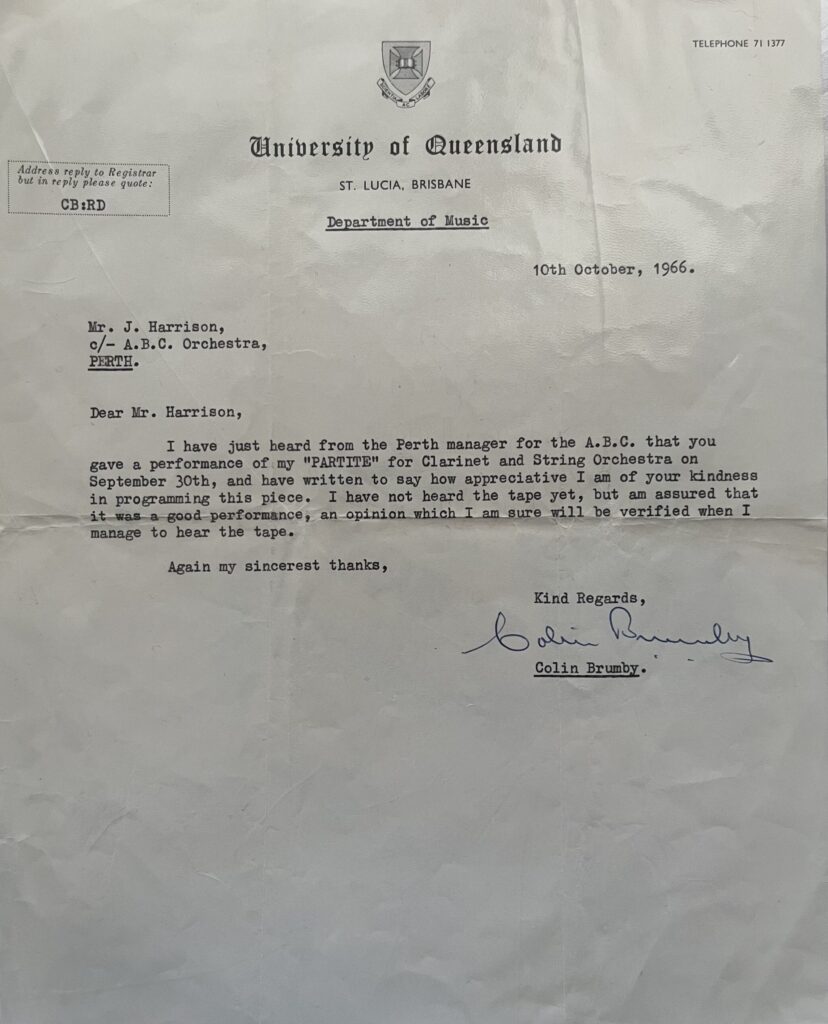
On 30th September 1966 Jack Harrison performed the Perth Premiere of the Colin Brumby Partite for Clarinet and String Orchestra with the West Australian Symphony Orchestra in Basil Kirke Studio, A.B.C. as part of the Festival of Perth. I can’t find who did the Premiere, but probably someone in Queensland, where Colin Brumby was based at the time.
Letter from Colin Brumby1967
On Sunday, January 29, 1967, Jack Harrison performed in the Australian premiere of “Strophe” (written in 1964 for violin, clarinet, and piano) by Australian composer Colin Brumby as part of the Recital of Australian Contemporary Composers during the 1967 Festival of Perth. The performance took place live in the Basil Kirke Studio (ABC Studio 620 on Adelaide Terrace) with John Exton (violin) and Alice Carrard (piano).
TRIO FOR CLARINET VIOLIN AND PIANO1967MUSICBy Peter HellstromThe opening musical performance of the Festival Of Perth at 3 pm tomorrow week will be a free recital of contemporary Australian chamber music in the A.B.C. Basil Kirke Studio. The festival committee is to be congratulated on the emphasis it has given this year to Australian music. As a result of its cooperation with the Fellowship of Australian composers, 14 of the 55 composers represented in the Festival are Australian. The opening recital is by the Oriel Quartet with which will appear pianist Alice Carrard, violinist John Exton and clarinettist Jack Harrison. Many of the works will be given their first W.A. performances. They include Sydney composer Peter Sculthorpe’s Sixth String Quartet, Colin Brumby’s Trio for clarinet violin and piano and Peter Tahourdin ’s Clarinet and Piano Sonata. West Australian compositions will include Jennifer Fowler’s String Trio and Ashley Arbuckle’s Movements for String Trio. The West Australian January 21 1967 page 35
30.09.1966
Colin BrumbyPartite for Clarinet and String OrchestraPERTH PREMIERE
Jack Harrison (clarinet) West Australian Symphony Orchestra
Festival of Perth Basil Kirke Studio ABC Letter from Colin Brumby
29.1.1967
Colin BrumbyStrophe for Clarinet, Violin and Piano (1964)AUSTRALIAN PREMIEREPeter TahourdinClarinet SonataPERTH PREMIERE
Jack Harrison (clarinet) Alice Carrard (piano) John Exton (violin)
Festival of Perth Free Studio Recital Basil Kirke Studio A.B.C. Adelaide Terrace, Perth, Western Australia
1968MUSICFESTIVAL OF PERTH 1968By Peter HellstromAn aspect of the Festival of Perth already creating interest throughout Australia is a workshop series of four Australian composers to be presented by the A.B.C. in conjunction with the festival committee. The workshops will consist of programs of works mainly for Orchestra. Several will be first performances they will be given in the Basil Kirke Studio at 6 pm on February 15, 22 and 29 and March 7. Each program will have a different conductor. The conductors will be Henry Kripps, Patrick Thomas, John Hopkins and Thomas Mayer. A further special feature of each program will be the presence of at least one interstate composer who will come to Perth for the occasion. The composers are Nigel Butterley, Larry Sitsky, Felix Werder and Richard Meale. Other interstate composers whose works will be performed are Colin Brumby, George Dreyfus Helen Gifford, Peter Sculthorpe and David Ahern. The four W.A. composers contributing to the programs are James Penberthy, Dr John Exton, David Tunley and Jennifer Fowler. As a contrast to the formality of the normal concert presentation, the workshops will include discussion between conductors, composers and members of the audiences. In several of the concerts, provision has been made for some works to be played twice to give listeners a further opportunity of coming to grips with the new music. The chairman of the Festival Of Perth music committee, Professor Frank Callaway, said yesterday that W.A. compositions would include Mr Tunley’s Concerto for Clarinet and Strings (with soloist Jack Harrison), Dr Exton’s Movements for Orchestra, a recently completed string Quartet by Jennifer Fowler to be played by the Oriel Quartet and James Penberthy’s Cantata for Chorus and Orchestra “The Swan of Bibbulman”. This will be performed by the Lyrics Singers and the W.A. Symphony Orchestra. The work is set to a poem by Mary Durack. The West Australian Saturday December 23 1967
Trevor Alan Jones was born in Sydney in 1932. He studied at the NSW State Conservatorium of Music (1949-1955), and at the University of Sydney (1954-1955), completing a BA and an MA, both with first class honours. Upon graduation he received the University of Sydney’s University Medal.
In 1955 he went as a Saltonstall Fellow to Harvard University, USA, to study musicology and composition, before continuing his studies in musicology at King’s College, Cambridge, in 1956. In 1957 he attended the Royal College of Music, London, where he studied composition, conducting and the harpsichord continuo. He also studied conducting privately with Sir Eugene Goossens.
Jones was the recipient of numerous awards, including the Busby and Sydney Moss Scholarships (University of Sydney), a Fulbright Travel Award (USA) and, several times, the Frank Albert Prize (University of Sydney).
Formerly a professional bassoonist, harpsichordist and recorder player in Sydney and Perth, Trevor Jones held a number of teaching posts in Australian tertiary institutions. In 1954 he took up a position as teaching fellow while a research student in the Department of Music at the University of Sydney, becoming a temporary lecturer there in 1958 and 1959, after his return from the USA and Europe. He was Senior Lecturer in Music at the University of Western Australia from 1960 to 1965, and in 1965 became the Foundation Professor of Music and Chairman of the Department of Music at Monash University in Melbourne, a position which he retained until his retirement in 1988.
Jones’s compositions include works for choir, for example his Four Goliard Songs and Elegy; instrumental chamber works, songs and incidental music for documentary films. His Fugue in Jazz Rhythms won first prize in the Recorder Society of NSW’s 1963 Composers’ Competition.
His major area of research and publication was ethnomusicology, with a particular emphasis on Australian Aboriginal music. Jones contributed the article on the didjeridu in the New Grove Dictionary of Music and Musicians. He was also interested in music education, and carried out research into English wind music of the Jacobean period.
Trevor Jones served on several committees, such as the UNESCO National Advisory Committee for Music, the Australian Institute of Aboriginal Studies’ Ethnomusicology Committee (1964-1976), and the ABC Music Advisory Committee (1966-1969).
https://www.australianmusiccentre.com.au/artist/jones-trevorTrevor Jones arrived at UWA as a Senior Lecturer in the late 1950s alongside Tunley. A bassoonist, ethnomusicologist, and composer, Jones was deeply invested in Renaissance, Baroque, and Indigenous Australian music before leaving to become the Foundation Professor of Music at Monash University.
1961 – MUSIC by Peter HellstromAs a contribution to the W.A. Music Council’s bursary scheme, the University Music Society will hold a public concert in Winthrop Hall at 8 o’clock on Monday night. The programme will be presented by the University Orchestral Society, clarinettist Jack Harrison and the University’s A Cappella Choir. They will perform works by composers of the 16th Century to the present, including compositions by Perth musicians Jennifer Fowler, David Tunley and Trevor Jones. The West Australian Saturday (cut off) 1961FESTIVAL CONCERT TONIGHTWorld Premiere of David Farquhar’s prize winningConcertino for Piano and OrchestraFirst Performance in Australia – Chamber Concerto No. 3 for Bassoon, Strings and Percussion by Elisabeth Lutyens.David Tunley’s Introduction and Scherzo for Clarinet and StringsPlus works by Dvorak, Grieg, Delius, Elgar, Walton and others.UNIVERSITY ORCHESTRA conducted by Trevor Jones.Soloists: Michael Cole, Jack Harrison, Brian Pope.Assisting Artists: John Mowson, John Dean, Verdon Williams.WINTHROP HALL8pm Sat 5th August 1961Unreserved seats at door 10/ Students 7/6CANTATA ZOOLOGICA
A classical musical composition created in 1963 by the Australian composer, ethnomusicologist, and academic Trevor Alan Jones (1932–2012).
Instrumentation: The piece is written for a mixed choir (SATB) and a wind quintet consisting of a flute, oboe, clarinet, bassoon, and horn.
Commission: It was commissioned by the Choir of the Sydney University Musical Society.
Text & Movements: The composition sets animal-themed literary texts to music. For example, the fourth movement, titled “Tiger,” is a musical setting of William Blake’s famous 1794 poem, “The Tyger”.
1966HARSH-TONED MUSIC ENTERTAINSBy Sally TrethowanThe last of the festival “Music of Britain” chamber concerts given in the Basil Kirke memorial studio last night offered some of the most complex and insistently dissonant music of the whole series. Yet each of the three works was so excellently performed that some measure of the composers musical thought in each case intense and highly individual must surely have impressed the general music lover no matter how unsympathetic he might have been to the harsh contemporary harmonic language. The first work “Quintet for wind and piano” by Alan Rawsthorne, was perhaps the most earnest in intention, and also the most abstruse and uncompromising. Much of it was concerned with working out, in terms of spasmodic tempi, unremitting dissonance and often exciting and original blends of wind colour, two moods, one apparently serene but masking disquieting emotional currents; the other desperately merry. This difficult music was persuasively presented by Alice Carrard (piano), Peter Randall (oboe), Jack Harrison (clarinet), Brian Pope (bassoon) and Neil Pearson (French horn). After this, Trevor Jones’s happy blend of whimsy lyricism and drama in his “Cantata Zoologica” was immensely entertaining. It was given a premiere late last year by the W.A. Bach Society choir and quintet and it was performed last night by the same artists except that the conductor on this occasion was Laughton Harris and the narrator was Neville Teede. Mr Harris’s cogent grasp, poetically and musically of the work was incisively conveyed through the unerring accuracy of his beat to which the choir and instrumentalists responded with brilliant execution. Mr Harris also conducted the final concerto for wind Quintet and two pianos (eight hands) by Malcolm Williamson. The wind players were joined by flautist Owen Fisenden and pianist Madame Carrard by fellow soloist Allyne Tilsed, Stephen Dornan and Michael Cole. This work exhibited complex interplay of tone colour. The finale, where the piano parts exploded in figuration of a Bartokian ferocity and aliveness was, I think, unrivalled in the festival music for sheer excitement of performance. The West Australian Wednesday March 9 1966 page 17
Festival of Perth: “Music of Britain” series Basil Kirke Studio A.B.C. Adelaide Terrace, Perth, Western Australia
Workshop at its most attractive – By MARY TANNOCK – Thursday February 18 1971Last night’s Australian composers workshop program at the Basil Kirke Studio was distinguished by the presence of Dr Andre Jurres, president of the International Society of Contemporary Music and the Australian composer Peter Sculthorpe. They were members of the panel chaired by Professor Frank Callaway. It was also the most attractive of the workshop series in the festival so far. Works by Margaret Sutherland, Colin Brumby, John Exton, Peter Sculthorpe and Trevor Jones were performed by Molly McGurk (soprano), Jack Harrison (clarinet), Stephen Dornan (piano) and the Oriel Quartet. Peter Sculthorpe’s “The stars turn” opened with wistful echoes from Gregorian Chant and a sea shanty and dissipated quickly into the character of the song. With limpid tones Miss McGurk sensitively delineated the shifting patterns of a lyrical line. Again, with Colin Brumby’s “Three Italian Songs for High Voice and String Quartet”, she infused chiselled and graceful declamation into the string line, throwing into relief its undulating fluidity. Trevor Jones’s “Essay for String Quartet” was alive with dense pulsating rhythms and sometimes fugal growth. Its textural complexity was skilfully highlighted by the Oriel Quartet. In Margaret Sutherland’s “Sonata for Clarinet and Piano” traditional texture and techniques were cleverly reconciled to the clarinet line and the accompanist Stephen Dornan’s deft chordal Textures in the piano provided neat and subtle undertones.The West Australian February 19 1971Composers’ Workshop an Evening of Contrasts – By ALAN BONDS – Thursday February 18 1971The workshop program presented in the Basil Kirke Studio last night was an evening of contrasts. The programme began with a polished rendition by Jack Harrison and Stephen Dornan of a “polished” Sonata for Clarinet and Piano by Dr. Margaret Sutherland. The work’s appeal was immediate, its form was basically straightforward and concealed few intricacies for cerebral digestion. The cycle of three songs by Colin Brumby further enhanced this composer’s reputation for skilful handling of texts. The work was witty and sensitive, but I feel that the texture of the accompanying string quartet was frequently too thick and overpowered the refined singing of Molly McGurk. For those interested, last Thursday’s performance of John Exton’s String Quartet (1969) was their fourth opportunity to hear the work in as many months and the work could easily stand a fourth hearing. It is completely absorbing, combining the all-embracing logic of serialism with a wonderful sense of contrast and colour. The performance by the Oriel Quartet was both accurate and persuasive, skilfully handling textures, which demand fine precision and control. “The Stars Turn” (1970) by Peter Sculthorpe was I feel more notable for the performance than the music which was performed. The piece itself was expressive and moving in the skull for tradition of Irkanda and the Quartets but I couldn’t help it feel that I had heard it all before. Molly McGurk did a splendid job moulding and phrasing as she might to Schubert or Brahms. The Oriel Quartet concluded the performance with a performance of Trevor Jones’s “Essay for string Quartet”. It would be fair to say that much of the work is reminiscent of Bartok’s quartet writing. The Essay was easily sectionalised thematically with frequent excursions through poly modality to atonalism. The Sunday Times February 21 1971
Alan Rawsthorne was born on 2 May 1905 in Haslingden, Lancashire. He spent a period of training as a dentist, and not until his early twenties did he take up music seriously. He then entered the Royal Manchester College of Music, studying piano, composition, and cello. In 1930 he went abroad and continued his studies, including piano under Egon Petri. On his return to England he taught from 1932 to 1934 at Dartington Hall, there writing music for the School of Dance-Mime. He settled in London in 1935 and three years later gained international recognition through a performance of his Theme and Variations for two violins at the London Festival of the International Society for Contemporary Music. The same Society, just at the outbreak of war, produced his Symphonic Studies at the Warsaw Festival, a work which subsequently won a firm place in the orchestral repertoire.
After the war – during which Rawsthorne served in the Army – he devoted the bulk of his time to composition, and although he was not a prolific composer, his output was substantial. Notable among his post-war compositions are the two violin concertos; the Cello Concerto, commissioned by the Royal Philharmonic Society; the Second Piano Concerto – probably the most popular of his major works – three symphonies; the second and third string quartets; the sonatas for violin & piano, and cello & piano; the Quintet for Piano and Wind; the Quintet for Piano and Strings; and the Ballade for piano written for John Ogden. He also composed a good deal of incidental music for stage and film as well as a ballet for Covent Garden, Madame Chrysanthème.
Rawsthorne was awarded the CBE in 1961, and was made an Honorary Doctor of Music by Liverpool, Essex, and Belfast Universities. He died in Cambridge on 24 July 1971, but his elegant and beautifully crafted music continues to be enjoyed by both performers and listeners. There is an active Rawsthorne Society which disseminates information about the composer, and encourages recordings.
In 2007 the Rawsthorne Trust commissioned Edward Harper to re-orchestrate Rawsthorne’s setting of Coleridge’s Kubla Khan. The score and parts of the choral work, originally commissioned by the BBC, were destroyed when Rawsthorne’s flat was bombed in 1940. The première of the newly reconstructed work took place in Manchester’s Bridgewater Hall in March 2008.
https://global.oup.com/academic/category/arts-and-humanities/sheet-music/composers/rawsthornea/?cc=au&lang=en&
https://alanrawsthorne.com/biography/
QUINTET FOR PIANO, OBOE, CLARINET, HORN, AND BASSOON (1963)
The first performance of Alan Rawsthorne’s Quintet for Wind and Piano took place in the spring of 1963.
The piece was commissioned by the BBC specifically for its prestigious Thursday Invitation Concerts series. While specific individual ensemble configurations varied for the live broadcast broadcast, the primary musicians associated with the debut and subsequent definitive early recordings of the piece included prominent British instrumentalists of the era:
Sidney Sutcliffe (Oboe)
Bernard Walton (Clarinet)
Alan Civil (Horn)
Roger Birnstingl (Bassoon)
David Parkhouse (Piano
1966 – HARSH-TONED MUSIC ENTERTAINS – By Sally TrethowanThe last of the festival “Music of Britain” chamber concerts given in the Basil Kirk memorial studio last night offered some of the most complex and insistently dissonant music of the whole series. Yet each of the three works was so excellently performed that some measure of the composers musical thought in each case intense and highly individual must surely have impressed the general music lover no matter how unsympathetic he might have been to the harsh contemporary harmonic language. The first work “Quintet for wind and piano” by Alan Rawsthorne, was perhaps the most earnest in intention, and also the most abstruse and uncompromising. Much of it was concerned with working out, in terms of spasmodic tempi, unremitting dissonance and often exciting and original blends of wind colour, two moods, one apparently serene but masking disquieting emotional currents; the other desperately merry. This difficult music was persuasively presented by Alice Carrard (piano), Peter Randall (oboe), Jack Harrison (clarinet), Brian Pope (bassoon) and Neil Pearson (French horn). After this, Trevor Jones’s happy blend of whimsy lyricism and drama in his “Cantata Zoologica” was immensely entertaining. It was given a premiere late last year by the W.A. Bach Society choir and quintet and it was performed last night by the same artists except that the conductor on this occasion was Laughton Harris and the narrator was Neville Teede. Mr Harris’s cogent grasp, poetically and musically of the work was incisively conveyed through the unerring accuracy of his beat to which the choir and instrumentalists responded with brilliant execution. Mr Harris also conducted the final concerto for wind Quintet and two pianos (eight hands) by Malcolm Williamson. The wind players were joined by flautist Owen Fisenden and pianist Madame Carrard by fellow soloist Allyne Tilsed, Stephen Dornan and Michael Cole. This work exhibited complex interplay of tone colour. The finale, where the piano parts exploded in figuration of a Bartokian ferocity and aliveness was, I think, unrivalled in the festival music for sheer excitement of performance. The West Australian Wednesday March 9 1966 page 17
8.3.1966
Alan Rawsthorne Quintet for Piano, Oboe, Clarinet, Horn, and Bassoon (1963)AUSTRALIAN PREMIERE
QUARTET FOR CLARINET AND STRINGS
The Quartet for Clarinet and Strings (composed in 1948) by Alan Rawsthorne was written for and dedicated to the celebrated British clarinettist Frederick Thurston.
The piece received its first performance in London in November 1948 by the following musicians:
Frederick Thurston (Clarinet)
Harry Blech (Violin)
Keith Cummings (Viola)
Douglas Cameron (Cello)
Chamber Group off to a Good Start – By Derek Moore Morgan – 23rd April 1979The recently formed Wigmore Ensemble made its first public appearance last night with a delightfully varied program at the Octagon Theatre. A flexible group with no fixed numbers, it has the practical advantage of being able to present music of widely different genres some of which inevitably gets left on the shelf because it doesn’t quite fit a specific mould such as the string quartet or Trio. This was a University of W.A. music Society recital. The performers were Graham Wood and Ashley Arbuckle (violins), John Dean (viola), Jill Cole (cello), Neil Fisenden (flute), Jack Harrison (clarinet) and Anthony Maydwell (harp). The final item, Ravel’s atmospheric and beautifully crafted “Introduction and Allegro” brought all the players together to produce a nice degree of sonority and delicacy capturing much of the subtlety of the masterpiece. Starting with the Mozart Quartet for Flute and Strings in D major a mellifluous example of the composer’s earliest style, the players gave us a bright indication of the bubbling and effervescent Gatty of the Rondo finale. The British composer Frank Bridge, himself a viola player, wrote a whole body of telling string music. His little known Trio (Rhapsody) from 1928 proved to be a forward looking piece for the difficult unless usual combination of two violins and viola, with mysterious opening and closing sections surrounding an energetic central portion. The Italian composer Malpiero’s “Sonata a cinque” (1936) is an appealing piece of writing which hangs on the air like a haunting elergy. Anthony Maydwell’s expressive harp playing came to the fore here. The Quartet for clarinet and strings by Rawsthorne is another piece of chamber music which is deftly written and manipulates varying moods. Jack Harrison’s neatly inflected clarinet tone was well handled.
Sir Arthur Bliss is generally remembered as an English composer, a pillar of the British musical establishment, but he was in fact half-American (on his father’s side), and America was to play an important part in his life and career.
Bliss was born in London on 2 August 1891 and was educated at Rugby School and Pembroke College, Cambridge. In the spring of 1914 he attended the Royal College of Music – only for a term, but long enough to receive valuable instruction and advice from Vaughan Willliams and Holst. His studies were interrupted by the outbreak of the First World War. Bliss obtained a commission, to servein France, first with the Royal Fusiliers, and then with the Grenadier Guards. He was wounded on the Somme in 1916 and, two years later, gassed at Cambrai, and his bravery was commended in despatches, but he survived – unlike his brother Kennard, whose loss he felt keenly.
Bliss began to make an impact as a composer shortly after the War, with works like Madam Noy (1918) and Rout (1920), and he also began to be noticed as a conductor. The modernity of these early works had gained him a reputation as an enfant terrible but a more mature tone entered his voice with the Mêlée Fantasque of 1921 and, in particular, the Colour Symphony, first performed at the Three Choirs Festival in 1922; it was commissioned at the behest of Elgar, whom Bliss had first met in 1912.
In 1923 Bliss went with his father to the United States, composing little during this period but becoming highly active as a conductor, pianist, lecturer and writer; he also heard his music played by the Boston Symphony Orchestra under Pierre Monteux and the Philadelphia Orchestra under Leopold Stokowski. During this period he met Trudy Hoffmann, whom he married in 1925; early the following year they returned to England and the stream of compositions began to flow again: Introduction and Allegro for orchestra (1926), a quintet for oboe and strings (1927), Pastoral (“Lie strewn the white rocks”) for soprano, chorus, flute, timpani and strings (1928) and a Serenade for baritone and orchestra (1929). In the late 1920s Bliss began work on the score that may well be his masterpiece, Morning Heroes, a symphony for orator, chorus and orchestra dedicated to the memory of his brother Kennard and “all other comrades killed in battle”. With it, Bliss said, he exorcised his own horrific memories of action in the First World War.
One of Bliss’ most influential scores was his film music for Alexander Korda’s version of H. G. Wells’ Things to Come (1934–35), which set a benchmark for future composers. This was followed by three equally influential ballets: Checkmate (1937), Miracle in the Gorbals (1944) and Adam Zero (1946). Bliss always responded to the stimulus of writing for individual musicians, and his Piano Concerto (1939) was composed for Solomon, the Violin Concerto (1955) for Alfredo Campoli and the Cello Concerto (1970) for Mstislav Rostropovich. He also continued to produce a number of impressive orchestral scores, not least the Meditations on a Theme of John Blow (1955) and the late Metamorphic Variations (1972).
Bliss’s only attempt at a stage opera, The Olympians (1949), to a libretto by J. B. Priestley, was only moderately successful, and he attempted the genre only once again, in the TV opera Tobias and the Angel (1960), to a text by Christopher Hassall. He continued to enjoy writing for voice: The Enchantress (1952), a scena for contralto and orchestra, was composed for Kathleen Ferrier, and The Beatitudes (1962) is an extensive cantata for soprano, tenor, chorus and orchestra. His last major work was another cantata, Shield of Faith (1975).
Bliss was always at the centre of British musical life: he worked in the Overseas Music Service of the BBC in 1941, and was the BBC’s Director of Music from 1942 to 1944. He was knighted in 1950, and was appointed Master of the Queen’s Musick in 1953, in succession to Sir Arnold Bax. He died on 27 March 1975.
Arthur Bliss is published by Boosey & Hawkes.
This biography can be reproduced free of charge in concert programmes with the following credit: Reprinted by kind permission of Boosey & Hawkes.
Bliss wrote his Clarinet Quintet (1932) for the prominent British clarinettist Frederick Thurston, who gave the first performance at the composer’s home alongside the Kutcher Quartet. While Thurston was the intended performer, Bliss dedicated the published score to his friend, the composer Bernard van Dieren.
The quintet is also widely regarded as a private, musical tribute to Bliss’s younger brother, Kennard (a talented amateur clarinettist who was killed in World War I)
English composer and conductor Sir Arthur Bliss visited Perth in September 1964.
As the serving Master of the Queen’s Musick, his tour of Australia generated significant national media coverage. Newspaper archives from 28 September 1964 capture his time in Western Australia, including interviews where he publicly praised Australia’s growing classical music potential.
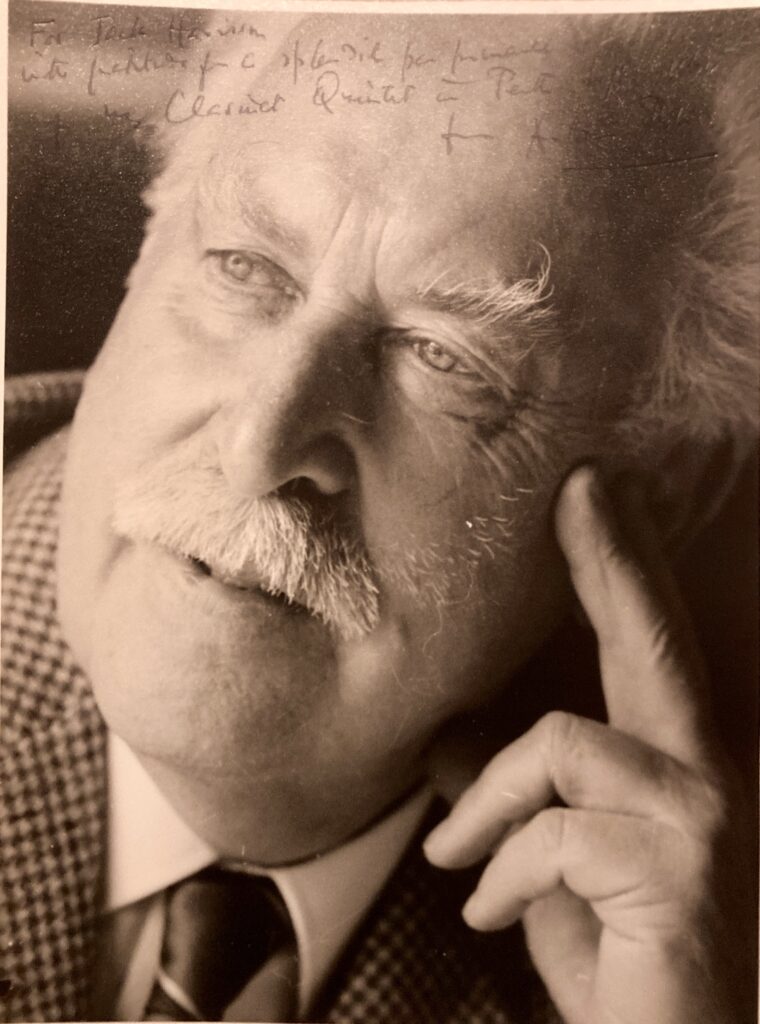
Clarinettist Jack Harrison performed the Australian premiere of the Arthur Bliss Clarinet Quintet with the Oriel Quartet in September 1964 in the presence of the composer. Jack got Arthur Bliss to sign a photograph that is inscribed
“For Jack Harrison with gratitude for a splendid performance of my clarinet Quintet in Perth 1964 from Arthur Bliss”.
U.W.A. Thursday Lunchtime Recital
September 1964
Clarinettist Jack Harrison with the Oriel String Quartet will interpret the Bliss Quintet at next Thursday’s free lunch-hour recital at 1.15pm in the Winthrop Hall undercroft, and oboist Peter Randall, with members of the quartet, will play the Mozart Oboe Quartet.
MUSIC
By Sally Trethowan
September 1964
Also a fine performance was the reading of the Bliss Clarinet Quintet by Jack Harrison and the Oriel Quartet who emphasized the romantic, lyrical nature of this music which is expressed through a dissonant idiom. The clarinet beginning as only one bright strand in a contrapuntal musical skein, emerges as soloist in the adagio where it wanders, looping itself in long braids and arabesques of melody in clarinet writing that recalls the Brahms Quintet. The studio was about two thirds full for the performance.
17.4.1964 18.9.1964
Arthur Bliss Clarinet Quintet (1932)AUSTRALIAN PREMIERE (performed in front of Bliss)
Jack Harrison (clarinet) Oriel String Quartet, Sir Arthur Bliss
Studio performance ABC Free lunchtime concert Winthrop Hall Undercroft University of Western Australia
The Master of Queens Musick, Sir Arthur Bliss, has told the Festival Of Perth committee that the planning of the musical programs in the coming festival is a magnificent gesture to British music and should be more widely known. That it has become well known already in Britain is showing by letters from many leading authorities there they include congratulations from the executive of the Composers Guild of Great Britain. Though some prominent English music festivals like Cheltenham Aldeburgh and the longest established Three Choirs Festival feature their country music, no British festival has in recent times included such an extensive and exciting range of British music in one series. Works of nearly 70 composers are included. The Perth programs have been wisely spaced over the six week festival period and though many of the concerts will start at the customary 8 pm some will be at 6 pm to enable patrons to attend another festival attraction the same evening.
Works by Vaughan Williams Gordon Jacob, Howard Ferguson, Lennox Berkeley and Michael Tippett will be new to W.A. The London Symphony Orchestra conducted by Colin Davis will introduce Bliss’s “Discourse for Orchestra” to Australia in one of its Perth concerts. In the other, Tippitt’s Symphony No. 2 and Stravinsksy’s Symphony in Three movements will be played here for the first time. Leading W.A. musicians appearing as soloists in the festival will include soprano Molly McGurk who will sing Benjamin Britain’s song cycle Les Illuminations with the W.A. Symphony Orchestra. She will also sing the solo soprano part in the University Choral Society’s performance of Vaughan Williams A Sea Symphony. Stephen Dorman will be the accompanist for tenor David Galliver’s three British song recitals. He will also partner violinist Vaughan Hanley in a Sonata recital and will play the solo part in constant Lambert’s Concerto for Orchestra and Nine Instruments. Jack Harrison will be the soloist in David Tunley’s Clarinet Concerto and will be joined by the Oriole Quartet in Bliss Clarinet Quintet. Graham Wood will introduce James Penberthy’s Romance for Violin and Orchestra and Alice Carrard will be the pianist with the A.B.C. Wind Players in Rawsthorne’s recent quintet. Madame Carrard will be joined by Mr Dornan, Stephanie James and Michael Cole to perform Malcolm Williamson’s new Concerto for Wind Quintet and two pianos. The new university organist, Mr John Hind, will be soloist in a program which will feature the W.A. Bach Society. The Oriel Quartet will also be the soloists with the W.A. Symphony Orchestra in Elgar’s Introduction and Allegro for strings and will give a separate recital of works by Howells, Frank Bridge, John Exton (the newly appointed senior lecturer in music at the university) Gerald Finzi, Elizabeth Lutyens and Edmund Rubbra.
The West Australian September 1965Heat Affects Performance – By Sally Trethowan
The auditorium may have been stifling but the choice of program was coolly classical at the Chamber Music Society’s first meeting for 1970 held last night in the Secondary Teachers College Hall Nedlands. The Oriel String Quartet with Jack Harrison (clarinet) presented works by Beethoven, Mozart and Sir Arthur Bliss. The Oriel Members have a new stage image. Two are now bearded and all four are stylishly sporting sideburns. Last night’s heat though must have been too enervating, for they seem to have neither the heart nor the energy to give us anything more than technically acceptable professional playing. However, Jack Harrison’s two performances in the great Mozart Clarinet Quintet and in Bliss’s astringent Quintet were jewels. While the Oriel provided the harmonic and contrapuntal décor, Harrison’s cool, pure intonation and intrinsic musicality made glorious sound and sense of his every phrase. His playing of the finely wrought clarinet line in the Mozart was especially lovely and here, too, there was some beautiful responsive phrases from Graham Wood’s violin. In the performance of Beethoven’s String Quartet Op. 18. No. 6. the heat seemed ponderable enough to weigh the Oriel’s bows judging from the absence of enthusiasm in the player’s movements. The resulting reading of what is in fact one of Beethoven’s gayest inspirations paced wearily where it should’ve nimbly stepped the light fantastic. Indeed, the phrases of the slow movement drooped so desperately that my sympathies went out to players and composer alike. Had the room being 20° cooler, the performance would predictively have been very different.
Perth Chamber Soloists – Sunday July 21 1985 – UWA Music Auditorium
Robert Cooper, Neil Barclay, John Dean and Jill Cole
The Irish pianist, musicologist, and composer, Howard Ferguson, was heard at the age of 13 performing in a music competition by the pianist Harold Samuel, who persuaded Ferguson’s understanding parents to let him come to London to study with him. Two years later Ferguson entered the Royal College of Music, studying composition first with the legendary pedagogue R.O. Morris and then with Ralph Vaughan Williams, and conducting with Malcolm Sargent; he also continued to study privately with Harold Samuel. It was through Morris that he met another composition student, Gerald Finzi, and they remained close friends, discussing each other’s music in depth; their correspondence is currently being edited for publication.
Howard Ferguson was always a distinguished chamber musician and he first came to widespread attention through the publication of his First Violin Sonata (1931) and his Octet (1933), generally regarded as his most masterly work. The Octet was initially drafted as a quintet for clarinet and strings, but the canny Morris, observing that there was no companion piece to share the scoring of the Schubert Octet, suggested that Ferguson recast it accordingly.
Through Harold Samuel, Ferguson had met Myra Hess, and at the outbreak of World War II he was enlisted by her to help run the series of concerts at the National Gallery which did so much to maintain wartime morale in London. The importance of the concerts was officially recognised when Ferguson was released from service with the RAF Central Band to continue his work with the Lunchtime Concerts. With the War over, Ferguson took up his concertising career again, maintaining two long-lived duos with musicians he had met through those National Gallery concerts, the violinist Yfrah Neaman and the pianist Denis Matthews. From 1948 until 1963 he also taught at the Royal Academy of Music, where Susan Bradshaw, Richard Rodney Bennett and Cornelius Cardew were among his students.
In the meantime he was still composing, including a Second Violin Sonata in 1946, a Piano Concerto in 1950-1951 and a song-cycle, Discovery, that was later recorded by Kathleen Ferrier. Howard Ferguson closed his career in composition with two large-scale choral works, both written for the Three Choirs Festival: Amore langeo for tenor, chorus and orchestra (1955-1956) and The Dream of the Rood for soprano or tenor, chorus and orchestra (1958-1959).
Howard Ferguson was unusual among composers in that he voluntarily called a halt to his composing career when barely past his 50th birthday; his musical energies thereafter were deployed in a number of parallel enthusiasms, not least musicology. His activities as a musicologist now filled the gap left by composition, and he produced a number of authoritative editions of early keyboard music; his musicological efforts were crowned in 1978-1979 with a complete edition of the Schubert piano sonatas. Howard Ferguson is published by Boosey & Hawkes. https://www.bach-cantatas.com/Lib/Ferguson-Howard.htmhttps://www.boosey.com/composer/Howard+Ferguson
MUSIC – By Peter Hellstrom – Festival of Perth 1966The Master of Queens Musick, Sir Arthur Bliss, has told the Festival Of Perth committee that the planning of the musical programs in the coming festival is a magnificent gesture to British music and should be more widely known. That it has become well known already in Britain is showing by letters from many leading authorities there they include congratulations from the executive of the Composers Guild of Great Britain. Though some prominent English music festivals like Cheltenham Aldeburgh and the longest established Three Choirs Festival feature their country music, no British festival has in recent times included such an extensive and exciting range of British music in one series. Works of nearly 70 composers are included. The Perth programs have been wisely spaced over the six week festival period and though many of the concerts will start at the customary 8 pm some will be at 6 pm to enable patrons to attend another festival attraction the same evening.Works by Vaughan Williams Gordon Jacob, Howard Ferguson, Lennox Berkeley and Michael Tippett will be new to W.A. The London Symphony Orchestra conducted by Colin Davis will introduce Bliss’s “Discourse for Orchestra” to Australia in one of its Perth concerts. In the other, Tippitt’s Symphony No. 2 and Stravinsksy’s Symphony in Three movements will be played here for the first time. Leading W.A. musicians appearing as soloists in the festival will include soprano Molly McGurk who will sing Benjamin Britain’s song cycle Les Illuminations with the W.A. Symphony Orchestra. She will also sing the solo soprano part in the University Choral Society’s performance of Vaughan Williams A Sea Symphony. Stephen Dorman will be the accompanist for tenor David Galliver’s three British song recitals. He will also partner violinist Vaughan Hanley in a Sonata recital and will play the solo part in constant Lambert’s Concerto for Orchestra and Nine Instruments. Jack Harrison will be the soloist in David Tunley’s Clarinet Concerto and will be joined by the Oriole Quartet in Bliss Clarinet Quintet. Graham Wood will introduce James Penberthy’s Romance for Violin and Orchestra and Alice Carrard will be the pianist with the A.B.C. Wind Players in Rawsthorne’s recent quintet. Madame Carrard will be joined by Mr Dornan, Stephanie James and Michael Cole to perform Malcolm Williamson’s new Concerto for Wind Quintet and two pianos. The new university organist, Mr John Hind, will be soloist in a program which will feature the W.A. Bach Society. The Oriel Quartet will also be the soloists with the W.A. Symphony Orchestra in Elgar’s Introduction and Allegro for strings and will give a separate recital of works by Howells, Frank Bridge, John Exton (the newly appointed senior lecturer in music at the university) Gerald Finzi, Elizabeth Lutyens and Edmund Rubbra. The West Australian September 1965FOURTEENTH ANNUAL FESTIVAL OF PERTH 1966THE ABC PRESENTS (in association with Festival of Perth Committee) Opening Concerts ofMUSIC OF BRITAIN SERIESA 15-concert feast of music from the great heritage of British compositions and including many new works.Tuesday Feb 8 1966A.B.C. Festival OrchestraConductor: Vaughan HanlySoloist: Jack Harrison (clarinet)Programme:Symphony No. 4 (Boyce)Little Symphony (Jacob)Concerto for Clarinet and Strings – first performance (Tunley)Serenade (Ferguson)B Flat Divertimento (Berkeley)WINTHROP HALLReserve Prices 11/-, 8/6, Unreserved from 5/ at hall after 7pm
27.7.1968
Howard Ferguson Octet Op. 4for clarinet, bassoon, horn, string quartet and double-bass (1933)
AUSTRALIAN PREMIERE
ABC Broadcast
Basil Kirke Studio A.B.C.
Adelaide Terrace, Perth, Western Australia
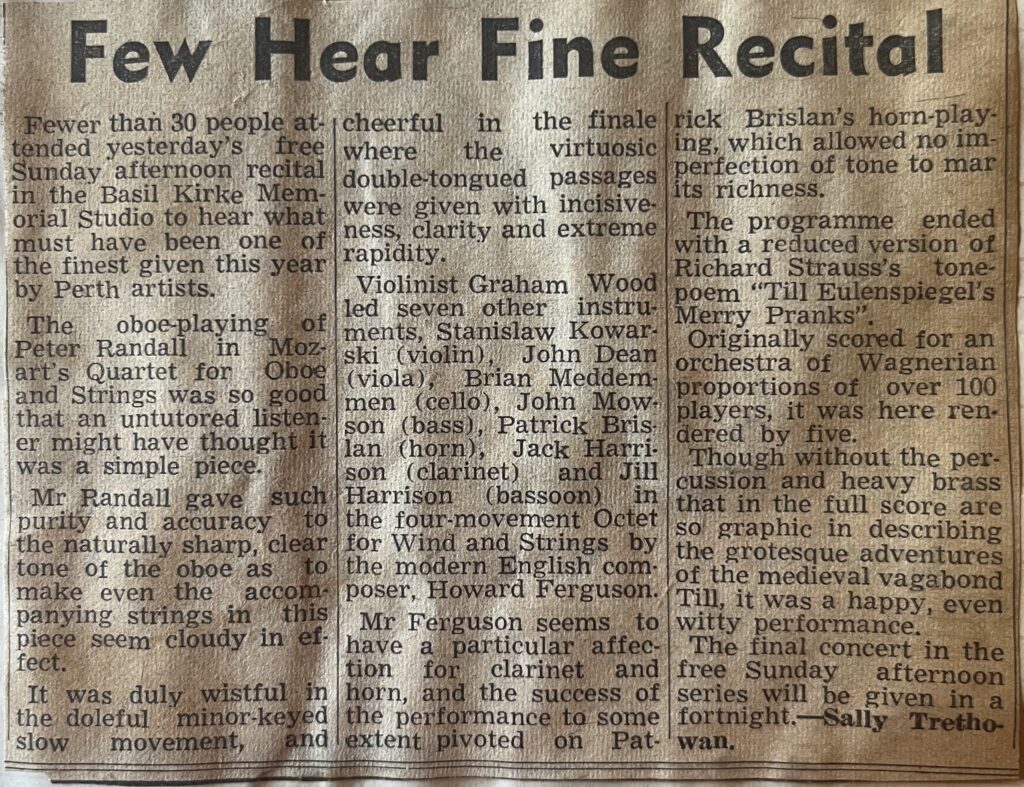
FergusonFEW HEAR FINE RECITALBy Sally TrethowanSunday February 29 1968Fewer than 30 people attended yesterday’s free Sunday afternoon recital in the Basil Kirke Memorial Studio to hear what must have been one of the finest given this year by Perth artists. The oboe playing of Peter Randall in Mozart’s Quartet for oboe and strings was so good that an unchartered listener might’ve thought it was a simple piece. Mr. Randall gave such purity and accuracy to the naturally sharp clear tone of the oboe as to make even the accompanying strings in this piece seem cloudy in effect. It was duly wistful in the doleful minor keyed slow movement and cheerful in the finale where the virtuosic double-tongued passages were given within incisiveness, clarity and extreme rapidity. Violinist Graham Wood led seven other instrumentalists Stanislaw Kowarski (violin) John Dean (Viola) Brian Meddemmen (cello) John Mowson (bass) Patrick Brislan (Horn) Jack Harrison (clarinet) and Jill Harrison(bassoon) in the four movement Octet for Wind and Strings by the modern English composer Howard Ferguson. Mr. Ferguson seems to have a particular affection for clarinet and horn, and the success of the performance to some extent pivoted on Patrick Brislan’s horn playing which allowed no imperfection of tone to mar its richness. The program ended with a reduced version of Richard Strauss’s tone poem “Till Eulenspiegel’s Merry Pranks”. Originally scored for an orchestra of Wagnerian proportions of over 100 players, it was here rendered by five. Though without the percussion and heavy brass that in the full score are so graphic in describing the grotesque adventures of the mediaeval vagabond Till, it was a happy even witty performance. The final concert in the free Sunday afternoon series will be given in a fortnight.