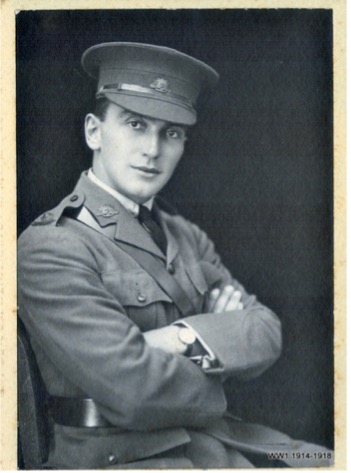
John “Jack” Crosby-Browne was the band master and conductor of the ANZAC Mounted Division Band in Palestine formed in 1917.
He was born on 5th July 1886 at St George Hanover Square, London, England and was schooled at the Duke of York’s Royal Military College, London.
On 4.10.1915, aged 29 Lieutenant John Crobsy-Browne enlisted in the A.I.F. 5th Light Horse Regiment at North Quay, Qld, citing his profession as Musician.
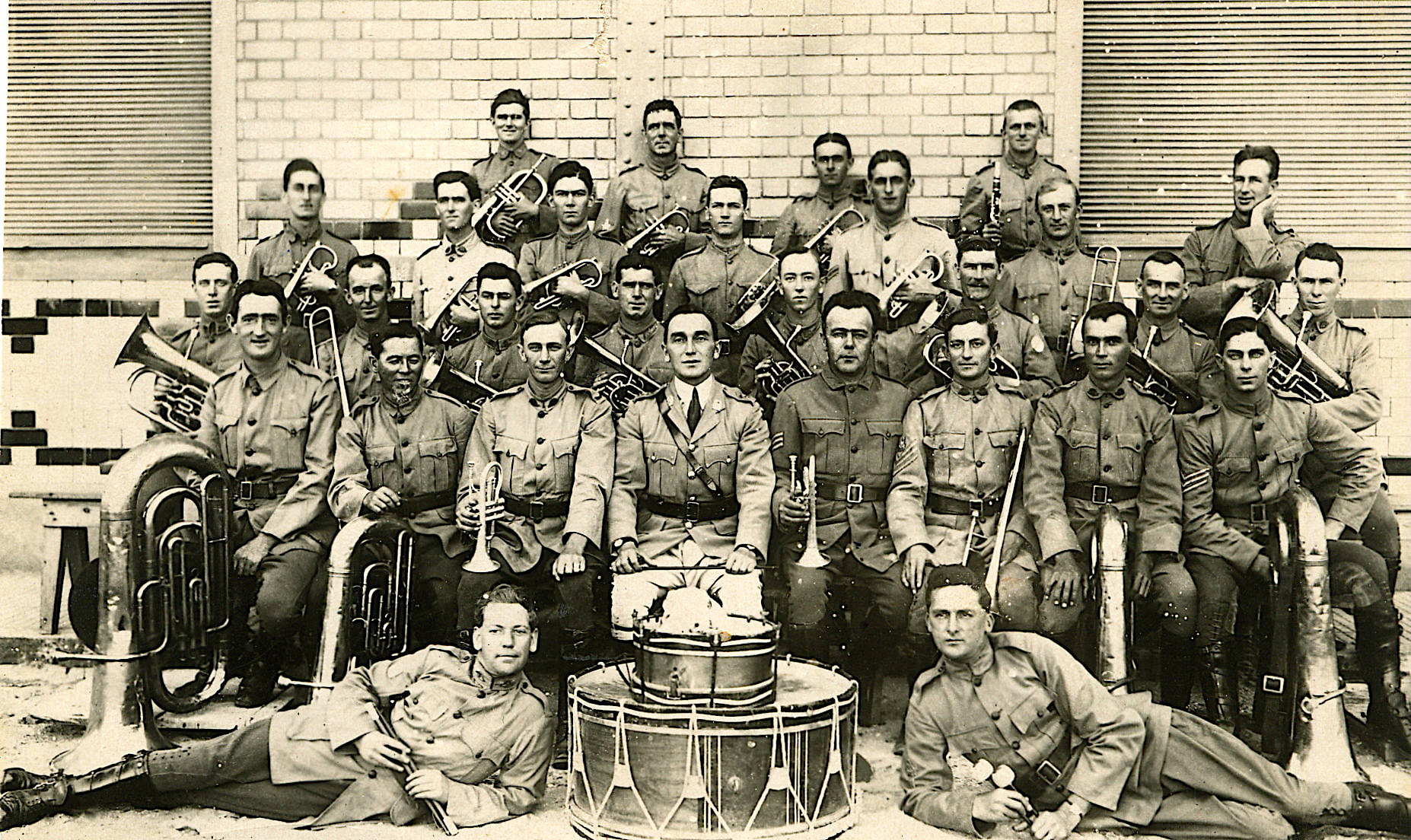
In August 1917, the Anzac Mounted Division was resting at Marakeb, a camp on the Mediterranean coast about three miles north of Khan Yunis. After months of campaigning, the men were given a rare opportunity to rest, swim in the Mediterranean, train and prepare their horses for the coming offensive.
Lieutenant John Crosby-Browne of the 5th Light Horse had previously served as a military band conductor in the British Army. Recovering from malaria, he was approached by Lieutenant Colonel John Arnott, commanding officer of the 7th Light Horse Regiment, and asked to form a band to entertain and raise the morale of the troops.
The response was rapid and the band grew steadily in numbers for the next month.
When Lieutenant General Harry Chauvel inspected the 20 member band at Desert Column on 22 September 1917 he was impressed. The band was seconded to Anzac Mounted Divisional Headquarters and ordered to accompany the Division into the field. Additional instruments and music were obtained from London by Crosby-Browne in late September.
One of the band’s earliest major assignments was a sports afternoon on 6 October 1917 organised by the 2nd Light Horse Brigade, commanded by Brigadier General Ryrie with Generals Allenby and Chaytor present.
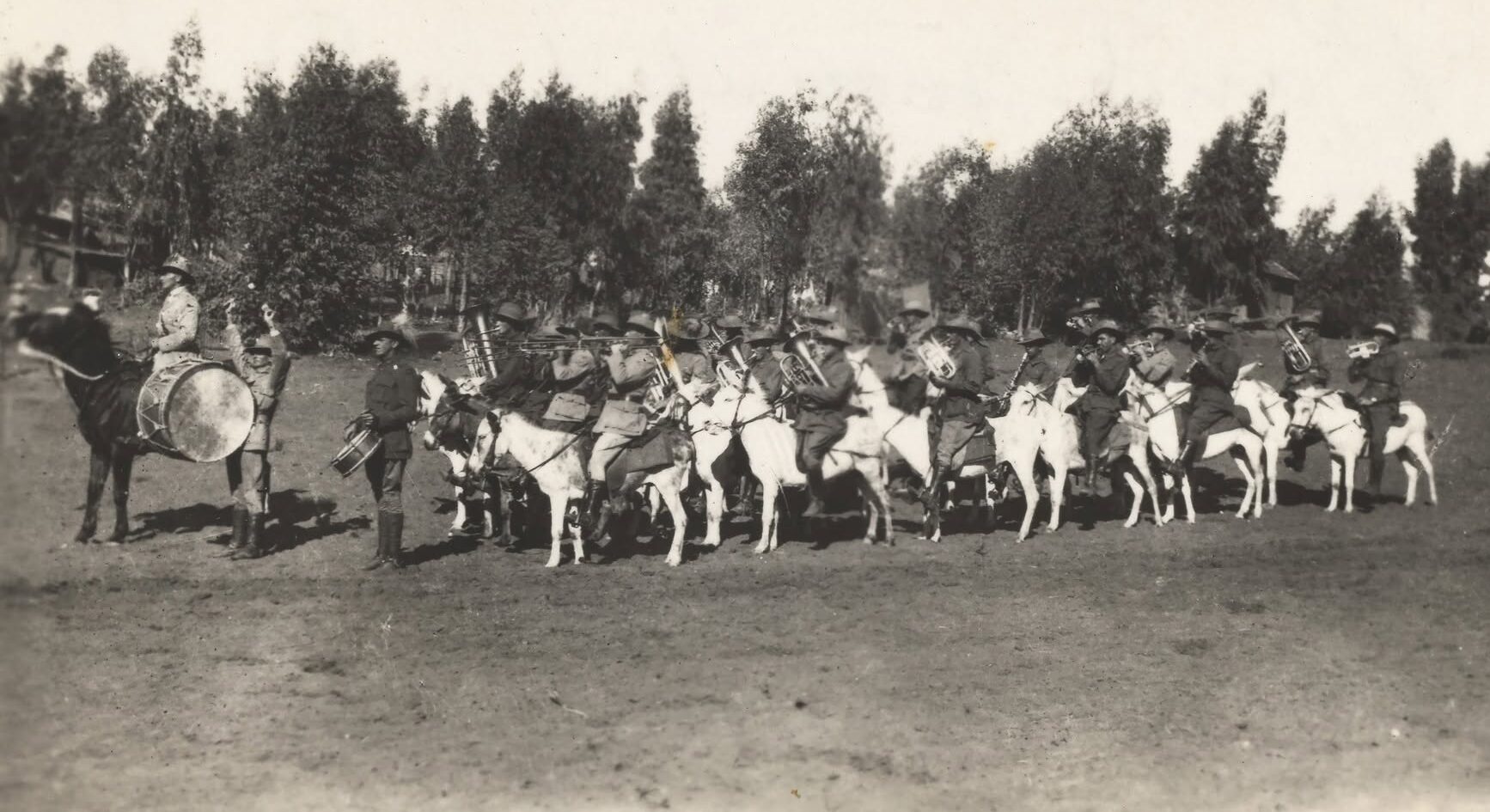
The band was famous for riding on white sudanese donkeys played over 140 performances.
At the conclusion of the war Crosby-Browne returned to Australia on 27 June 1919.
In his non service life he was a Musical Director and Conductor of the NSW Police Band. He was the Band Director at the 1938 Sydney Empire Games. He also worked as a teacher of the clarinet at the Sydney Conservatorium of Music.
His last rank was Captain in WWII – Service Numbers N60178, N278378.
1940
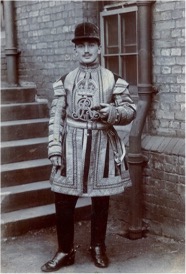 Crosby-Browne Is Man Of Many Parts
Light-Horseman; Police Inspector ; and Professor
RECENTLY Sydney Police Band – 40 men strong — set out from headquarters to give a mid-day performance in a city park. When band arrived at the park, there were only 39 men present.
MYSTERY of missing bandsman was left unsolved during performance. On return to headquarters puzzled bandmaster was relieved to learn that the absentee had been found. Unnoticed by his companions, he had slipped from band ranks, had made a quick and silent arrest on the footpath, and had taken the culprit away to lay a charge. Which only shows that a police-bandsman is a policeman first of all. Not so, however, the director of the police band — Captain J. Crosby-Browne, known as “Bing” when at home.
Versatile Officer
He is three things in one — a captain in the army, an inspector in the police force, and a professor at Sydney’s Conservatorium of Music. He holds his rank of captain as senior bandmaster of Commonwealth armed forces. At present he is also officer-in-charge of bands of the Eastern Command. As director of police band, he Is “honorary” first-class inspector, entitled to wear three “pips.”
And for last 20 years he has been professor of clarionet playing at Conservatorium. But the director is the one exception In the band. All other members must be
fully graduated policemen. Sometimes this makes captain — he prefers this title — Crosby-Browne’s task difficult: “It is not always easy to find musicians who have required height and weight for policemen,” he told “Smith’s.” “So most recruits for the band must come from inside the force.” Only rarely does he choose a musician from outside. Even if musician has outstanding ability, he must first be eligible to join the force, prove himself as a policeman, before he is admitted. Fortunately for standard of band, musical and police temperaments seem to have something in common. With exception of that of Australian Broadcasting Commission, Sydney Police Band is only full military band in Australia. It Is modern. In conformity with present trend, full- set of low-pitch instruments was obtained in 1936. And it has perhaps a more thorough training than any other band of its kind in Australia. On an average 60 performances are given every year, apart from the regular mid-day performances each week-day,” and the two rehearsals each week.
In Palestine
Captain Crosby-Browne has been with band now for more than 14 years. Born in England, he received his early band training in the British Army, with the crack 21st Lancers and First Life Guards. He then studied at the London Academy of Music. Crosby-Browne migrated to Australia in 1912, and, when war broke out two years later, joined the 5th Light Horse, A.I.F., as an officer. He saw service In Palestine, and later became bandmaster of Anzac Mounted Division Band there. At the moment he divides his time between police headquarters and Ingleburn barracks. He has trained all the bands that have so far gone away with the new A.I.F. Though he has been for a long time with the Police Band, he is by no means the oldest member. Sergeant J. Anderson, clarionet player, and Sergeant Mclntyre, French horn, have both been with the band for 30 years; and Sergeant B. L. Caesar for 25 years. Distinguished bandsman Is Sergeant R. Prowse, who for three years in succession won the N.S.W. “B” flat Bass championship, which in 1938 included the All-Australia championship.
Opposition To Band
Band was established in 1894, and at first met with opposition from many quarters, even from inside Police Department, where view was widely held that a good policeman would never be a musician. But as band showed it could produce good policemen — two Commissioners, Mitchell and Childs, came from its ranks – it won favor in official eyes. Today N.S.W. Police Commissioner (W. McKay) is a keen supporter, gives every assistance in permitting members to attend rehearsals and performances. Band members receive no extra pay for their services, and band itself does not accept fees. Performances are only given at functions of purely charitable or patriotic character. It Is not yet decided whether band will take an active part in new recruiting campaign, but, since the war, midday park performances have been given at request of civic authorities.
PHOTO CROSBY-BROWNE …. likes trying anything.
Smith’s Weekly (Sydney, NSW : 1919 – 1950), Saturday 8 June 1940, page 6
MUSICIAN’S MISCONDUCT
In the Divorce Court to-day, Mrs. Inez Lois Crosby-Browne was granted a decree nisi for divorce from John Crosby-Browne, former police band-master, on the ground of his misconduct with Lillian Grimsley.
The suit was undefended. Mrs Crosby-Browne said she saw her husband and Grimsley on the back seat of his car in Fairlight-crescent, Manly. She recognised the woman as a student at the Conservatorium of Music, where her husband had appeared in a concert. “I told Crosby-Browne that he should be ashamed of himself, taking girls out from the Conservatorium.” Joseph Barker, Inquiry agent, told the Court he admonished Crosby-Browne at Manly.
Sun (Sydney, NSW : 1910 – 1954), Wednesday 23 April 1941, page 3
Musician’s Wife Seeks Alimony;
Reference To Caesar Divorce
Mention of the Caesar divorce case, which resulted in the dismissal from the police force of Detective-Sergeant McRae of the C.I.B., was made today before the Deputy-Registrar in Divorce (Mr. Doughan). CAPTAIN JOHN CROSBY BROWNE, military band leader and former leader of the N.S.W. Police Band, and who was a professional, musician employed prior to his divorce by the Conservatorium, defended an application brought by his wife, Mrs. Inez Crosby Browne, for alimony. Crosby Browne admitted that he had been married four times, but denied that he was now engaged to be married again. Mrs. Crosby Browne, of Northbridge, divorced her husband last year on the ground of his adultery with Miss Lillian Grimsley. She also named three other girls, but did not proceed with the cases against them. Two of the girls, it was stated today, had been pupils at
the Conservatorium under Crosby Browne. Herself a professional violinist, Mrs. Crosby Browne told the court that she estimated her husband’s income from all sources at £1500 a year. Heavy Tax Payment’s Crosby Browne denied this, and said it was only £813, of which £473 was military pay, the balance being private income. Out of this he had to pay £230 in taxes, while the 4 per cent, limitation on profits if enacted would also hit him hard. He said his wife was one of the best professional musicians in Sydney and could find employment anywhere as a violinist. Browne said that following the Caesar divorce case, and also his own divorce, the Police Commissioner had a conversation with him, and as a result he resigned from his position of police band leader. The hearing is not finished.
Mr. Howard Beale (by W. Boland) for the wife; Mr. J. Smyth for the husband.
Daily Mirror (Sydney, NSW : 1941 – 1955), Thursday 30 July 1942, page 2
Decree Against Police Bandsman
The New. South Wales Police Bandmaster, John Crosby Browne, 54, was found guilty in the Divorce Court yesterday of misconduct with a student
of the Conservatorium of Music. The petitioner was1 Mrs. Inez Lois Crosby Browne (formerly Lang), 33, of Bay Street, Mosman. She charged her husband, who did not defend the suit, with having committed adultery with Lilian Grimsley, Conservatorium student, at Manly on December 13, 1940. The names of three other women were Included as Interveners in the petition, but Mr. G. Barwick (for the wife) said he did not propose to offer any evidence against them. Mr. Justice Edwards dismissed them from the suit.
Mrs. Crosby Browne said she was married in Sydney in April, 1932, and she and her husband lived together at Battle Boulevarde. Seaforth, until the time of the misconduct. Her husband was formerly a “professor at the Conservatorium on the clarinet.” On the night of December 13 she attended a concert at the Conservatorium, where her husband was playing, and later she and a private detective, and others, followed him and a girl to Bollngbroke Parade, Manly, In a car. She walked up to his cat and found misconduct taking place between him and Lilian Grimsley. ‘ Joseph Barter; inquiry agent, .said that Crosby Browne “went berserk” when discovered, and tried to punch him. The judge granted Mrs. Crosby Browne a decree nisi.
Daily Telegraph (Sydney, NSW : 1931 – 1954), Thursday 24 April 1941, page 8
BAND LEADER’S AMOURS
Married four times, Captain John Crosby Browne told the Deputy-Registrar in Divorce today that he was divorced last August when his fourth wife charged him with adultery with three women.
Now a band leader, with the AMF, Captain Crosby Browne denied that he had become engaged again. One of his former wives had died, he said. Crosby Browne’s fourth wife, Inez Lois Crosby Browne, to day sought an order for permanent alimony and maintenance for their son. Crosby Browne said he was formerly leader of the Police Band. Following the Caesar divorce case and Detective-Sergeant McRae’s dismissal from the police force, the Commissioner said something to him, in consequence of which he resigned. At Conservatorium, Crosby Browne said he was a professional musician and had been dismissed from the Conservatorium after his wife divorced him in August. Two of the three women named by his wife were pupils at the Conservatorium. Income £813 , Crosby Browne told the Deputy-Registrar (Mr. Doughan) that his gross annual income was £813, including £473 military pay and allowances. Out of this he had to pay £230 State and Federal tax and mortgage payments of £352 a year. The 4 per cent, profit limitation would reduce his income further. He also had to pay £100 to support his mother, who was a widow aged 83 he added. His former wife was 34 and in good health, he said. She was one of the best professional musicians in Sydney, and could at any time find employment as a violinist with theatre or orchestras, the ABC or the Conservatorium, In a theatre she could earn £6 a week. Mr. H. O. Beale (by Mr. W. Boland) for the wife: Mr. J. Smyth for the husband.
Sun (Sydney, NSW : 1910 – 1954), Thursday 30 July 1942, page 2
Musician To Find Notes For Wife’s Alimony
WELL-KNOWN musician John Crosby Browne, now a bandmaster and captain in the A.I.F., and formerly of Seaforth, has been associated with the production of millions of the kind of notes that blend into melody, but from now on the maestro will be required to produce some notes of a more material kind. They are to be produced in accordance with an order made last week by the Deputy-Registrar
in Divorce (Mr. J. Doughan), and in the shape of permanent alimony for his wife, Inez Lois Crosby Browne, and maintenance of their 10 year old child, now in the custody of Mrs. Browne. Mr Doughan. in a reserved judgment, directed that Crosby Browne pay his wife alimony at the rate of £4 5s a week and that he also cough up £1 I5s a week for the support of the child. For many years Crosby Browne has loomed large in the musical world. For some time he was prominently associated with the Conservatorium of Music, and at one time he was leader of the Police Band. Since 1941 he has been in the Army as a District Bandmaster with the rank of Captain. It was indicated, during the hearing recently of the wife’s alimony application, that Crosby Browne, whom she divorced in May, 1941, on the ground of his adultery, was pretty well ‘ribbed’ in the matter of cash. ft was revealed that he has assets amounting at least to £9500. comprising shares £7500, a house at Seaforth valued at £1550, a car valued at £300 and £300 in cash. His income was assessed at £1010 s year. Mr. Doughan was apparently of the opinion that Crosby Browne was actually somewhat better off than the above figures would indicate. “I think, on the evidence, there is a strong suspicion that the respondent might have other assets. During the last four or five years he has sold various shares and a motor cruiser, about which he was cross-examined. His answers were vague and unsatisfactory and he has made no real attempt to present a clear statement of his transactions during recent years.” the Deputy-Registrar said.
Mr Beale for Mrs Crosby Browne: Mr Smyth for the husband.
PHOTOS CAPTAIN CROSBY BROWNE, whose alimony payments to his former wife (top right) were fixed last week.
Truth (Sydney, NSW : 1894 – 1954), Sunday 27 June 1943, page 19
Ex-Police Band Chief Fined Over Revolver
FROM TRUTH’S BULLI REPRESENTATIVE.
JOHN CROSBY-BROWN (61), former bandmaster of the N.S.W. Police Band, was fined £10 at Bulli Court on Friday on a charge of having had an unlicensed revolver in his possession.
Police alleged that the revolver was found in his car at Woonona on September 10. When the revolver was found he told police that someone must have planted it in his car, it was stated. Crosby-Brown, of 41 Seaforth Crescent, Seaforth, pleaded not guilty, and told the court that he did not know the pistol was in his car. He said he had been married five times. During the past 12 months he had been worried by anonymous telephone calls and threatening letters, he said. Detective R. H. Marsh said that after receiving an anonymous telephone call on September 10, 1947. he went to the house where Crosby-Brown was staying. When he told Crosby-Brown that he had been informed that he had an unlicensed pistol in his possession, Crosby-Brown replied: ‘That’s ridiculous. I haven’t any firearms,’ he said. ‘I searched the car and found a 22 calibre revolver, loaded in four chambers,’ said Marsh. ‘Crosby-Brown said, ‘It’s not mine. I’ve never seen it before,” he said.
Crosby-Brown told him, he said, that no one else had been driving the car, but someone must have planted the revolver in it. Det. V. Marriot said that when the revolver had been found the hammer was jammed and the trigger could not be pulled. Crosby-Brown said he was of independent means. Outlining his life from the time he joined the Life Guards in England at the age of 17 years, and from which he was discharged in 1911, he said he was a lieutenant in the Anzac Mounted Division in World War I., and was Professor of the Clarinet at the Sydney Conservatorium from 1920-40. He was appointed Musical Director of the N.S.W. Police Force in 1925 with the honorary rank of Inspector First Class and organised the police bands throughout the State, he said. Prom 1940 to 1946, he said, he served in World War with the rank of captain, and the appointment of senior Army Bandmaster. He retired in 1946 with the rank of major and was awarded the Efficiency Decoration. He said that a day or two after his discharge from the Army he was walking in Martin Place when he saw a woman. He passed her as it was his impression that she did not wish to speak. After that, he said, he received an anonymous telephone call and later two police officers called at his home and found two revolvers. One was a service revolver and the other he had not seen before. He was charged at Manly Court with having had unlicensed revolvers in his possession and was convicted, he said. The day after his conviction, he received another anonymous phone call from a man who said: ‘What you got yesterday is nothing to what you will get in the future.’ ‘From then on I was worried with telephone calls every other day and in the middle of the night. I complained to the Manly Police and the Postal Investigation Department, but they could not locate the callers,’ Crosby-Brown said. He said he also received anonymous letters. Two witnesses gave evidence that Crosby-Brown bore an excellent character. Crosby-Brown was allowed 21 days to pay the fine.
Truth (Sydney, NSW : 1894 – 1954), Sunday 2 November 1947, page 43
1980
John Crosby-Browne died of natural causes on 21.2.1980 in Drummoyne, New South Wales, Australia aged 93.