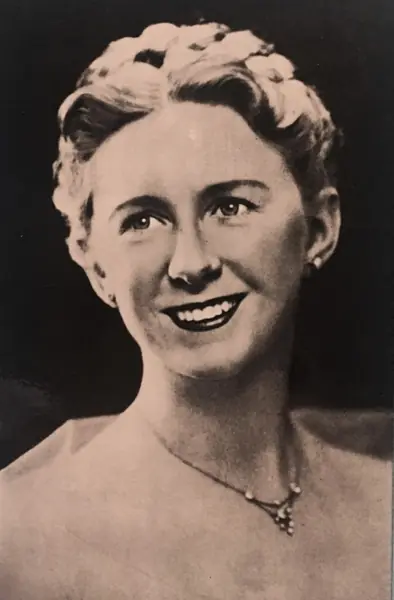
Lorna Crawford McKean (1914-1963), soprano, was born on 13 August 1914 at Arncliffe, Sydney, youngest of three daughters of native-born parents Robert Crawford McKean, schoolteacher, and his wife Jane, née McManus. Lorna received early piano tuition from her mother and formal education at Bexley Public, Cleveland Street Intermediate High and St George Girls’ High schools. She left school to concentrate on full-time piano studies with Elizabeth Coleman and singing lessons with Ruth Ladd.
A talented actress who performed at (Dame) Doris Fitton‘s Independent Theatre, McKean loved music. She studied singing at the New South Wales State Conservatorium of Music, giving lieder recitals and performing operatic roles such as Pamina in Mozart’s The Magic Flute and Eurydice in Gluck’s Orpheus and Eurydice. McKean was awarded a Layman Martin Harrison scholarship, and in 1936 gained teacher’s and performer’s diplomas in singing. Shortly afterwards she accepted an invitation to join the Australian Broadcasting Commission’s wireless chorus, conducted by Joseph Post.
On 9 August 1938 at the district registrar’s office, Rockdale, Lorna married Leo Denis Vaughan Hanly, a 21-year-old violinist and a fellow student at the conservatorium; they were to have three children. Hanly had been assisting-artist during Richard Tauber’s Australian tour and the Taubers attended the wedding. The newlyweds completed a national broadcasting tour for the A.B.C. before settling in Perth, where Hanly was appointed (1939) leader of the A.B.C.’s local orchestra. His wife soon became active in music circles in the city. When World War II broke out she undertook extensive touring and concert work throughout the State to assist the war effort.
In 1948 Lorna McKean (as she continued to be known professionally) travelled to London with an introduction to the soprano Elisabeth Schumann. She auditioned successfully for the British Broadcasting Corporation and fulfilled a number of engagements, including radio recitals and public performances. In 1949 she returned to Western Australia. Her work in London had impressed (Sir) John Barbirolli, conductor of the Hallé Orchestra. In accepting an invitation to tour Australia for the A.B.C. in the summer of 1950-51, he stipulated two conditions: that the tour take place when the English cricket team was in Australia, and that she should appear as soloist in some of his concerts. Barbirolli’s tour established McKean in the front rank of Australian musicians.
She continued her singing career, tackling new compositions, adding to her repertoire, and introducing works by composers such as Claude Debussy, Paul Hindemith and Edgar Bainton to Perth audiences. During the 1950s and early 1960s McKean occupied a prominent position in Perth’s music world. Survived by her husband, daughter and one of her two sons, (violinist Brian Hanly) she died of a cerebral tumour on 26 October 1963 at Royal Perth Hospital and was cremated with Congregational forms. John Farnsworth Hall, the conductor of the West Australian Symphony Orchestra, described her as ‘a superb artist who was deeply appreciated’.
Select Bibliography
- Broadcaster, 24 Sept-1 Oct 1938, 29 July 1939, 27 Feb 1946.
- West Australian, 19 Apr 1939, 2, 28 Oct 1963.
- Sydney Morning Herald, 15 Jan 1951; family records (privately held).
Citation Details
Brian Pope, ‘McKean, Lorna Crawford (1914–1963)’, Australian Dictionary of Biography, National Centre of Biography, Australian National University, https://adb.anu.edu.au/biography/mckean-lorna-crawford-10982, published online 1 January 2006, accessed online 28 October 2026.
Sydney Morning Herald (NSW : 1842 – 1954), Saturday 1 August 1936, page 12
1936
LORNA MCKEAN.
Miss Lorna McKean, pupil of Miss Ruth Ladd, will give a Leder recital at the Conservatorium Hall on Thursday August 13. The programme will include works by Schubert, Brahms. Schumann and Strauss, also groups of songs by French and English composers. The assisting artists will be Vaughan Hanly violinist, and Miss Muriel Edsall, accompanist.
Sydney Morning Herald (NSW : 1842 – 1954), Saturday 1 August 1936, page 12
1941
Evening of Music.
MEMBERS of the W.A. Music Teachers’ Association and many friends met last Saturday night at the Burt Memorial Hall and listened to a programme of music by local composers. The programme was arranged by Mr. Edward Black. The president, Mr. F. L. Robertson, with Mrs. Robertson, and the hon. secretary, Miss J. L. Young, received the guests. Mr. Edward Black gave an introductory paper on “The Guild of Australian Composers.” This was followed by songs by Mrs. Carroll, Paul Buddee, Edward Black, and Otto Kaye, sung by Miss Lorna McKean; four sketches for violin and cello, composed by Lazar Sverdloff were played by Madame Zlata Kalmikoff and the composer; song by Miss Lorna Ford. sung by Miss Boesser; songs by Roy Wood, sung by Mr. Frank Robertson: piano solos by Alec and Edward Black played by Edward Black; and songs by Miss Florence Hedd sung by Miss Gertrude Hutton. At the conclusion of the music supper was served on tables gay with yellow and orange tinted flowers.
West Australian (Perth, WA : 1879 – 1954), Wednesday 2 July 1941, page 8
Monster Concert TONIGHT – 8.45 – CAPITOL
Stanley Clarkson, Perth Symphony Orchestra, Ante Soljanic, Perth Highland Pipe Band, Sammy Sharp‘s Band, C.T.A. Choir, Betty Wright, Vaughan Hanly, Subiaco Brass Band, Henry Cochran, Radio Players, Lorna McKean, and “MISS RADIO”.
Sunday Times (Perth, WA : 1902 – 1955), Sunday 17 August 1947, page 13
1951
Jack Harrison was second clarinet in the South Australian Symphony Orchestra for the following concerts:
THE AUSTRALIAN BROADCASTING COMMISSION
THANKS ALL Symphony Orchestral and Celebrity Concert SUBSCRIBERS and PATRONS for their interest and support during the past year and in extending to them the Compliments of the Season also announces the
NEW YEAR’S CONCERT ATTRACTIONS
A NEW YEAR SYMPHONY EVENING
Thursday 18th January, 1951
SOUTH AUSTRALIAN SYMPHONY ORCHESTRA
Conductor: HENRY KRIPS
Soloist: LORNA McKEAN (delightful Westralian soprano)
FIRST 1951 OPEN AIR CONCERT
Free Sunday Matinee
BOTANIC GARDEN, ADELAIDE
Sunday, January 28, 1951, 2.45 p.m.
Free to all — No charges — Everybody is invited.
Commonwealth Jubilee Celebrations
STATE CONCERT
organised and presented for the SOUTH AUSTRALIAN GOVERNMENT
CENTENNIAL HALL, WAYVILLE
Thursday, February 1, 1951, 8 p.m.
introducing
SIR JOHN BARBIROLLI
Eminent British Conductor of Halle Orchestra directing the
SOUTH AUSTRALIAN SYMPHONY ORCHESTRA
Soloist: EVELYN ROTHWELL
Distinguished British Oboist
Under the distinguished patronage of HIS EXCELLENCY THE GOVERNOR OF SA, SIR WILLOUGHBY NORRIE, LADY NORRIE and SUITE
A memorable musical event of interest to all South Australians.
FAREWELL APPEARANCE
SIR JOHN RARBIROLLI
CENTENNIAL HALL, WAYVILLE
WEDNESDAY, FEBRUARY 7, 1951, 8 p.m.
South Australian Symphony Orchestra
Soloist: RAYMOND O’CONNELL Brilliant Australian Pianist
Preferential plans from Thursday January 11. Ordinary plans from Thursday, January 18.
Price 10/-, 7/6, 5/-, and 3/- (No tax).
The Mail Adelaide Saturday 23 December 1950 page 28
MUSIC . . . . ART . . . THEATRE – Moderm Works For Symphony Concert
FIRST CONCERT Thursday 18 January 1951
By Harold Tideman
Modern orchestral works will be a feature oi the SA Symphony Orchestra’s first concert for the year in the Adelaide Town Hall on Thursday night. Of particular interest to South Australians will be the first public performance here of Alex Burnard’s overture ‘L’Allegro.’ Conductor Henry Krips gave this work a successful airing in a recent broadcast. Based on Milton’s poem it is definitely in the modern idiom, cleverly orchestrated. Formerly of Adelaide, and now senior lecturer in Harmony and Composition at the NSW State Conservatorium of Music, Sydney, Dr. Burnard gained his Music degree at the Elder Conservatorium in 1927 and his Mus. Doc. in 1932. He studied with Dr. Ralph Vaughan Williams during a visit to England, and in 1935 gained five major awards in the ABC composers’ competition. Besides instrumental works, he has written a number of unusual songs, including settings of William Blake’s ‘Songs of Innocence’ for soprano and flute which were performed here in the Australian Music Festival last year.
First Time
Richard Strauss’s ‘Rosenkavalier’ Suite will also be played for the first time here by the orchestra. Those familiar with the opera (‘The Rose Cavalier’) know the peculiarities of Strauss’s orchestration and recognise that his work demands a pinnacle of orchestral playing. That the SA Orchestra is now able to cope with this field of music is a tribute in itself to the conductor and the personnel, and augers well for the future. Smetana’s symphonic poem ‘Ma Vlast’ (My Fatherland) will be one of the major works on Thursday’s programme. In this brilliantly orchestrated piece, the famous Czech composer traces the course of the River Moldau from its mountain source, through the noble city of Prague, to the sea. In more reflective vein will be Liszt’s symphonic poem, ‘Les Preludes,’ based on Lamartine’s ‘Meditations Poetiques,’ and lighted texture will be provided in the ‘Dance of the Tumblers’ from ‘The Snow Maiden’ by Rimsky-Korsakov which will conclude the evening and Henry Krip’s own transcriptions of ‘Clair de Lune’ and ‘Passepied’ from Debussy’s ‘Suite Bergamasque.’ Assisting artists will be Western Australian soprano, Lorna McKean, who will sing two famous operatic arias— ‘Si, michiamano Mimi,’ from ‘La Boheme’ (Puccini), and ‘Ah, fors e lui’ from ‘La Traviata’ (Verdi).
Barbirolli’s Visit
FEBRUARY 1 1951
Listeners to the broadcasts of the Barbirolli concerts from Sydney have been greatly impressed, and the famous conductor’s visit to Adelaide is being eagerly awaited. The two programmes arranged for here contain mostly solid and well tried fare which will make the task of both conductor and orchestra all the harder. For the State concert in the Centennial Hall on February 1, the orchestra will open with Berlioz’s ‘Carnaval Romaine’ Overture and the concerto for oboe and strings by Corelli (arranged by Barbirolli) will follow, Evelyn Rothwell being the soloist. Then comes Mozart’s ‘Jupiter’ symphony, and after the interval, the Brahms Symphony No. 1 in C minor.
FEBRUARY 7 1951
For the second concert on Feb. 7 in the same hall, the programme will be — -‘Egmont’ overture (Beethoven), Serenade for Strings (Elgar), Concerto in A minor for piano and orchestra (Schumann) with Raymond O’Connell soloist, and the Symphony No. 7 to C major (‘The Great’) by Schubert.
The Advertiser Adelaide Saturday 13 January 1951 page 7
This Tuesday, June 12, a recital was given in the Town Hall to the children of Pingelly by Australian , soprano, Lorna McKean, and brilliant pianist, Stephen Dornan. The programme was one chosen especially for the children, the opening: song being “The Road to the Isles,” rendered delightfully by Miss McKean. A description of the song was given by Mr. Dornan to an appreciative audience. This was followed by a Maori song, “Waaata.Poi,” by the Australian composer, Alfred Hill. We were then entertained with the Military Prelude by Rachmaninoff with Stephen Dornan at the piano. Further vocal and pianoforte items were fully appreciated by the children present and it is hoped that we will receive many more entertainments of such a high calibre. At the beginning of this month the new typewriter arrived at the school, in time for the preparation of examination papers.
Pingelly-Brookton Leader (WA : 1925 – 1954), Thursday 14 June 1951, page 4
Jubilee Recital
Soprano, Lorna McKean and associate artist, pianist, Stephen Dornan presented a Jubilee recital in the Albany Town Hall last Friday, under the direction of the Adult Education Board. A programme of varied works was received by an enthusiastic, if rather sparse audience. Although bookings were filled for the dress circle, a number of seats in the hall remained vacant. One can easily imagine why Lorna McKean is popular with fellow artists and audiences. She sings with grace and charm. Miss McKean commenced the programme with two well known songs “My Mother Bids Me Bind My Hair” by Haydyn and “My Heart Ever Faithful” by Bach, sung with sympathy and sensitive expression. One of the most popular of Max Reger’s compositions, “The Virgin Slumber Song,” “A Dream,” by Grieg and a highly dramatic song “The Trout” by Schubert were executed with fin-The only operatic works included in the programme were “They Call Me Mimi” from La Boheme by Puccini, and “The Laughing Song” from der Fledermaus by Strauss. Miss McKean completely captivated her audience with her effervescent charm and her excellent interpretation of both. “The Laughing Song” was received with more than ordinary enthusiasm. In her five years’ absence from the musical scene of Albany, Miss McKean’s voice has developed from a lyric soprano, to a soprano with greater depth of tone, dramatic content and flexibility. Her interpretations of “They Call Me Mimi” and “The Laughing Song” were beautifully done, the first being most poignant and the second sung with joyous abandonment. . Finally, Miss McKean sang three delightful folk songs,
“The Road to the Isles,” “The Last Rose of Summer” and Peter Warlock’s arrangement of “One More River to Cross,” which had a very fine piano accompaniment. Stephen Dornan gave explanatory notes oji all the music performed, and to the listener, they were too long and definitely overdone. Tp an audience of school children this is most desirable, but for adults the explanations and story of musical architecture want to be drastically pruned. Mr. Dornan’s contribution to the recital was three fold. He did the talking, accompaniments and solo playing. His playing was noted for its fine technique, clarity of tone and rhythm content, but one feels that the aesthetic side was lost through the explanatory interruptions. Debussy’s soothing composition, “Clair de Lune” was presented in direct contrast with its companion, “Prelude in G Minor,” by Rachmaninoff: Dornan played this gripping military piece with vitality and understanding and a great deal of rhythmic quality. This Prelude is seldom heard at recitals and it possesses great rhythm and dramatic feeling. “Viennese Dances,” by Gaitner-Friedmann were delightful and entertaining, but his final presentation was easily the most popular on the programme. “The Ritual Fire Dance” by de Falla was played stirringly and with admirable understanding for the barbaric quality of the composition. Stephen Dornan’s rendering was his best on the programme. This young pianist wants to be careful that he does not let mannerism and habit at the keyboard detract from his musicianship.
Albany Advertiser (WA : 1897 – 1965), Monday 18 June 1951, page 8